

SIST EN 13232-4:2023
(Main)Railway applications - Track - Switches and crossings for Vignole rails - Part 4: Actuation, locking and detection
General Information
- Abstract
This document determines the interface between moveable parts and the actuation, locking and detection equipment, and defines the basic criteria for switches and crossing with moveable parts in respect of the interface.
It concerns:
— rules, parameters and tolerances for alternative positions of the moveable parts;
— criteria and limits for the forces which move and restrain the moveable parts.
- Status
- Published
- Public Enquiry End Date
- 31-Mar-2020
- Publication Date
- 23-Oct-2023
- Technical Committee
- IŽNP - Reilway applications
- Current Stage
- 6060 - National Implementation/Publication (Adopted Project)
- Start Date
- 19-Oct-2023
- Due Date
- 24-Dec-2023
- Completion Date
- 24-Oct-2023


Overview
EN 13232-4:2023 (CEN) - "Railway applications - Track - Switches and crossings for Vignole rails - Part 4: Actuation, locking and detection" defines the interface and basic acceptance criteria between moveable switch/crossing parts and their actuation, locking and detection equipment. The standard addresses rules, parameters and tolerances for alternative positions of moveable parts and sets criteria and limits for the forces that move and restrain those parts. It is part of the EN 13232 series covering switches and crossings for flat‑bottom (Vignole) rails.
Key topics and technical requirements
- Scope of interface requirements: Defines how actuators, rods, locking devices and detection devices must interface with switch rails, wing rails and moveable crossing parts to guarantee safe operation and signalling reliability.
- Actuation forces and capacities: Introduces key force terms such as actuation force (F), actuator capacity (Fcap), negative force (Fneg) and retaining force (FR) and requires verification of actuator capability against design loads.
- Geometrical parameters and tolerances: Covers stud gap, maximum gap of closed switch rail (dgap1/dgap2), longitudinal/differential displacements (thermal, braking/acceleration effects) and other dimensional tolerances influencing actuation and detection.
- Movement, retention and trailability: Specifies device classifications - trailable as standard, trailable as non‑standard, and non‑trailable - and defines acceptance criteria for trailing operations (permitting train passage with or without expected damage).
- Detection and locking: Requires reliable position detection (for signalling interlocking) and locking devices that ensure moveable parts remain in the correct position under operational loads.
- Test and verification methods: Includes test methods and acceptance criteria for obstacle detection, minimum flangeway, correct closing, actuation force measurement, neutral position, negative force checks, trailability tests, prototype and factory acceptance testing.
- Safety and conformity: Relates to essential requirements of EU legislation (informative Annex ZA), and supersedes the 2005/2011 edition.
Applications and users
EN 13232-4:2023 is intended for:
- Railway infrastructure designers and track engineers specifying switches and crossings for mainline and depot applications.
- Manufacturers of switch actuation, locking and detection systems.
- Signalling engineers who integrate position detection into interlocking systems.
- Maintenance teams and testing laboratories performing factory acceptance and in‑track verification.
- Certification and procurement bodies assessing compliance with European track standards.
Keywords: EN 13232-4:2023, switches and crossings, Vignole rails, actuation, locking, detection, rail switch standards, trailability, actuation force, CEN.
Related standards
Part of the EN 13232 series - see:
- EN 13232-1 (Definitions)
- EN 13232-2 (Geometric design)
- EN 13232-3 (Wheel/rail interaction)
- EN 13232-5 to -7 (Switches; fixed and moveable crossings) Refer to Annex ZA for the relationship with EU Directive (EU) 2016/797.
Relations
- Effective Date
- 28-Jan-2026
- Effective Date
- 28-Jan-2026
- Effective Date
- 28-Jan-2026
- Effective Date
- 28-Jan-2026
- Effective Date
- 28-Jan-2026
- Effective Date
- 28-Jan-2026
- Effective Date
- 28-Jan-2026
- Effective Date
- 28-Jan-2026
- Effective Date
- 28-Jan-2026
- Effective Date
- 19-Jan-2023
Get Certified
Connect with accredited certification bodies for this standard

IRIS Certification (UNIFE)
International Railway Industry Standard certification.

TÜV SÜD Rail GmbH
TÜV SÜD railway certification services.

Bureau Veritas Railway Certification
Railway and transportation certification.
Sponsored listings
Frequently Asked Questions
SIST EN 13232-4:2023 is a standard published by the Slovenian Institute for Standardization (SIST). Its full title is "Railway applications - Track - Switches and crossings for Vignole rails - Part 4: Actuation, locking and detection". This standard covers: This document determines the interface between moveable parts and the actuation, locking and detection equipment, and defines the basic criteria for switches and crossing with moveable parts in respect of the interface. It concerns: — rules, parameters and tolerances for alternative positions of the moveable parts; — criteria and limits for the forces which move and restrain the moveable parts.
This document determines the interface between moveable parts and the actuation, locking and detection equipment, and defines the basic criteria for switches and crossing with moveable parts in respect of the interface. It concerns: — rules, parameters and tolerances for alternative positions of the moveable parts; — criteria and limits for the forces which move and restrain the moveable parts.
SIST EN 13232-4:2023 is classified under the following ICS (International Classification for Standards) categories: 45.080 - Rails and railway components. The ICS classification helps identify the subject area and facilitates finding related standards.
SIST EN 13232-4:2023 has the following relationships with other standards: It is inter standard links to SIST EN 13232-3:2023, SIST EN 13232-6:2023, SIST EN 13232-7:2006+A1:2012, SIST EN 13232-9:2006+A1:2012, SIST EN ISO 20557-1:2018, SIST EN 13232-2:2023, SIST EN 13231-1:2024, SIST EN 13232-5:2023, SIST EN 13232-7:2023, SIST EN 13232-4:2005+A1:2012. Understanding these relationships helps ensure you are using the most current and applicable version of the standard.
SIST EN 13232-4:2023 is associated with the following European legislation: EU Directives/Regulations: 2008/57/EC, 2010-01-4867, 2016/797/EU; Standardization Mandates: M/483, M/591. When a standard is cited in the Official Journal of the European Union, products manufactured in conformity with it benefit from a presumption of conformity with the essential requirements of the corresponding EU directive or regulation.
SIST EN 13232-4:2023 is available in PDF format for immediate download after purchase. The document can be added to your cart and obtained through the secure checkout process. Digital delivery ensures instant access to the complete standard document.
Standards Content (Sample)
SLOVENSKI STANDARD
01-december-2023
Železniške naprave - Zgornji ustroj proge - Kretnice in križišča za Vignolove tirnice
- 4. del: Postavljalna naprava in kontrola lege ostrice
Railway applications - Track - Switches and crossings for Vignole rails - Part 4:
Actuation, locking and detection
Bahnanwendungen - Oberbau - Weichen und Kreuzungen für Vignolschienen - Teil 4:
Umstellung, Verriegelung und Lageprüfung
Applications ferroviaires - Infrastructure - Appareils de voie - Partie 4: Manuvre, blocage
et contrôle
Ta slovenski standard je istoveten z: EN 13232-4:2023
ICS:
45.080 Tračnice in železniški deli Rails and railway
components
2003-01.Slovenski inštitut za standardizacijo. Razmnoževanje celote ali delov tega standarda ni dovoljeno.
EN 13232-4
EUROPEAN STANDARD
NORME EUROPÉENNE
October 2023
EUROPÄISCHE NORM
ICS 93.100 Supersedes EN 13232-4:2005+A1:2011
English Version
Railway applications - Track - Switches and crossings for
Vignole rails - Part 4: Actuation, locking and detection
Applications ferroviaires - Voie - Appareils de voie Bahnanwendungen - Oberbau - Weichen und
pour rails Vignole - Partie 4 : Manœuvre, blocage et Kreuzungen für Vignolschienen - Teil 4: Umstellung,
contrôle Verriegelung und Lageprüfung
This European Standard was approved by CEN on 23 October 2022.
CEN members are bound to comply with the CEN/CENELEC Internal Regulations which stipulate the conditions for giving this
European Standard the status of a national standard without any alteration. Up-to-date lists and bibliographical references
concerning such national standards may be obtained on application to the CEN-CENELEC Management Centre or to any CEN
member.
This European Standard exists in three official versions (English, French, German). A version in any other language made by
translation under the responsibility of a CEN member into its own language and notified to the CEN-CENELEC Management
Centre has the same status as the official versions.
CEN members are the national standards bodies of Austria, Belgium, Bulgaria, Croatia, Cyprus, Czech Republic, Denmark, Estonia,
Finland, France, Germany, Greece, Hungary, Iceland, Ireland, Italy, Latvia, Lithuania, Luxembourg, Malta, Netherlands, Norway,
Poland, Portugal, Republic of North Macedonia, Romania, Serbia, Slovakia, Slovenia, Spain, Sweden, Switzerland, Türkiye and
United Kingdom.
EUROPEAN COMMITTEE FOR STANDARDIZATION
COMITÉ EUROPÉEN DE NORMALISATION
EUROPÄISCHES KOMITEE FÜR NORMUNG
CEN-CENELEC Management Centre: Rue de la Science 23, B-1040 Brussels
© 2023 CEN All rights of exploitation in any form and by any means reserved Ref. No. EN 13232-4:2023 E
worldwide for CEN national Members.
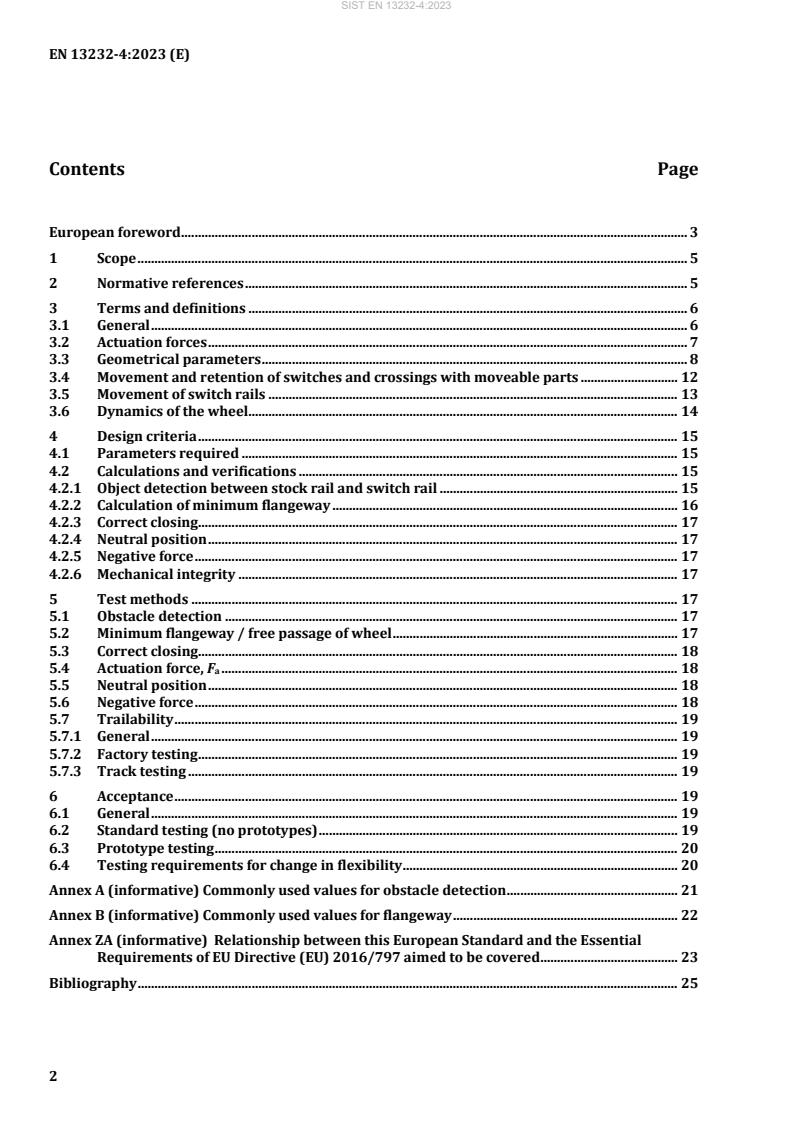
Contents Page
European foreword . 3
1 Scope . 5
2 Normative references . 5
3 Terms and definitions . 6
3.1 General . 6
3.2 Actuation forces . 7
3.3 Geometrical parameters . 8
3.4 Movement and retention of switches and crossings with moveable parts . 12
3.5 Movement of switch rails . 13
3.6 Dynamics of the wheel . 14
4 Design criteria . 15
4.1 Parameters required . 15
4.2 Calculations and verifications . 15
4.2.1 Object detection between stock rail and switch rail . 15
4.2.2 Calculation of minimum flangeway . 16
4.2.3 Correct closing. 17
4.2.4 Neutral position . 17
4.2.5 Negative force . 17
4.2.6 Mechanical integrity . 17
5 Test methods . 17
5.1 Obstacle detection . 17
5.2 Minimum flangeway / free passage of wheel . 17
5.3 Correct closing. 18
5.4 Actuation force, F . 18
a
5.5 Neutral position . 18
5.6 Negative force . 18
5.7 Trailability . 19
5.7.1 General . 19
5.7.2 Factory testing . 19
5.7.3 Track testing . 19
6 Acceptance . 19
6.1 General . 19
6.2 Standard testing (no prototypes) . 19
6.3 Prototype testing . 20
6.4 Testing requirements for change in flexibility . 20
Annex A (informative) Commonly used values for obstacle detection . 21
Annex B (informative) Commonly used values for flangeway . 22
Annex ZA (informative) Relationship between this European Standard and the Essential
Requirements of EU Directive (EU) 2016/797 aimed to be covered . 23
Bibliography . 25
European foreword
This document (EN 13232-4:2023) has been prepared by Technical Committee CEN/TC 256 “Railway
applications”, the secretariat of which is held by DIN.
This European Standard shall be given the status of a national standard, either by publication of an
identical text or by endorsement, at the latest by April 2024, and conflicting national standards shall be
withdrawn at the latest by April 2024.
Attention is drawn to the possibility that some of the elements of this document may be the subject of
patent rights. CEN shall not be held responsible for identifying any or all such patent rights.
This document supersedes EN 13232-4:2005+A1:2011.
This series of standards “Railway applications – Track – Switches and crossings for Vignole rails” covers
the design and quality of switches and crossings in flat bottomed rail. The list of Parts is as follows:
— Part 1: Definitions
— Part 2: Requirements for geometric design
— Part 3: Requirements for wheel/rail interaction
— Part 4: Actuation, locking and detection
— Part 5: Switches
— Part 6: Fixed common and obtuse crossings
— Part 7: Crossings with moveable parts
— Part 8: Expansion devices
— Part 9: Layouts
Part 1 contains terminology used throughout all parts of this series. Parts 2 to 4 contain basic design
guides and are applicable to all switch and crossing assemblies. Parts 5 to 8 deal with particular types of
equipment including their tolerances. These use Parts 1 to 4 as a basis. Part 9 defines the geometric and
non-geometrical acceptance criteria for inspection of layouts.
The changes in this document bring some improved clarity to the wording of the requirements and an
update to several of the figures. The structure of the document remains similar to the previous revision.
This document has been prepared under a standardisation request addressed to [the relevant ESO] by
the European Commission. The Standing Committee of the EFTA States subsequently approves these
requests for its Member States.
For the relationship with EU Legislation, see informative Annex ZA, which is an integral part of this
document.
Any feedback and questions on this document should be directed to the users’ national standards body.
A complete listing of these bodies can be found on the CEN website.
According to the CEN-CENELEC Internal Regulations, the national standards organisations of the
following countries are bound to implement this European Standard: Austria, Belgium, Bulgaria,
Croatia, Cyprus, Czech Republic, Denmark, Estonia, Finland, France, Germany, Greece, Hungary, Iceland,
Ireland, Italy, Latvia, Lithuania, Luxembourg, Malta, Netherlands, Norway, Poland, Portugal, Republic of
North Macedonia, Romania, Serbia, Slovakia, Slovenia, Spain, Sweden, Switzerland, Türkiye and the
United Kingdom.
1 Scope
This document determines the interface between moveable parts and the actuation, locking and
detection equipment, and defines the basic criteria for switches and crossing with moveable parts in
respect of the interface.
It concerns:
— rules, parameters and tolerances for alternative positions of the moveable parts;
— criteria and limits for the forces which move and restrain the moveable parts.
2 Normative references
The following documents are referred to in the text in such a way that some or all of their content
constitutes requirements of this document. For dated references, only the edition cited applies. For
undated references, the latest edition of the referenced document (including any amendments) applies.
EN 13232-3:2023, Railway applications – Track – Switches and crossings for Vignole rails – Part 3:
Requirements for wheel/rail interaction
EN 13232-5:2023, Railway applications – Track – Switches and crossings for Vignole rails – Part 5:
Switches
EN 13232-6:2023, Railway applications – Track – Switches and crossings for Vignole rails – Part 6: Fixed
common and obtuse crossings
EN 13232-7:2023, Railway applications – Track – Switches and crossings for Vignole rails – Part 7:
Crossings with moveable parts
3 Terms and definitions
For the purposes of this document, the following terms and definitions apply.
ISO and IEC maintain terminological databases for use in standardization at the following addresses:
— ISO Online browsing platform: available at https://www.iso.org/obp
— IEC Electropedia: available at http://www.electropedia.org/
3.1 General
NOTE The guidance of a wheelset through switches and crossings concerns mainly the lateral or horizontal
dimensions of wheel, axle, and track. In Figures 6, 7, 8 and 9, the wheels are shown in a simplified form as ellipses
at the gauge reference plane.
3.1.1
actuation system
system that ensures the correct movement of the moveable parts of the switch and crossing
Note 1 to entry: The actuation system includes the rods, links and actuators needed to ensure the operation.
3.1.2
locking device
device that ensures the moveable part of the switches and crossings stays in the desired position
Note 1 to entry: It guarantees the correct position of the moveable part.
3.1.3
detection device
device that enables the verification of the correct positioning of the moveable part of the switch and
crossing
Note 1 to entry: It enables the signalling to decide whether safe train passage can be guaranteed.
3.1.4
trailability
ability of actuator and locking systems to permit the trailing of the switches and crossings by a vehicle
3.1.5
trailable device as non-standard operation
device which permits trailing as a non-standard operation
Note 1 to entry: Parts of the switch may be slightly damaged.
Note 2 to entry: The switches and crossings will only be released for further operation after full inspection of
switch and actuator.
3.1.6
trailable device as standard operation
device which permits trailing at a defined maximum speed as a standard operation
Note 1 to entry: The actuator and locking system permits the trailing of the switches and crossings by a vehicle,
without damaging any part of it.
3.1.7
non-trailable device
device which does not permit the trailing of the switches and crossings by a vehicle
3.1.8
single drive
drive operated at one position, i.e. the switch toe
3.1.9
multiple drives
drives operated at more than one position with either single or multiple locking
3.1.10
non-lubricated slide baseplates
no lubrication on the slide baseplates is required to ensure the correct actuation of the switch and
crossing
Note 1 to entry: This can be ensured by special baseplates, roller systems or other devices.
3.1.11
lubrication free actuator and locking system
no lubrication is required to ensure the correct actuation and locking of the switch and crossing
3.1.12
switches and switch diamond crossings – closed position
switch rail is applied to its corresponding stock rail
3.1.13
switches and switch diamond crossings – open position
switch rail stands away from its corresponding stock rail by a defined distance (switch toe opening)
3.1.14
common crossings with moveable parts – closed position
running edge (of main line or branch line) is not interrupted
3.2 Actuation forces
3.2.1
actuation force
F
a
instant value of the force, applied by the actuator in order to operate the moveable parts of the switches
and crossings
Note 1 to entry: see Figure 1.
Note 2 to entry: This force is measured at the interface between actuator and the throwing or locking device.
Key
1 Actuation force
2 Displacement
Figure 1 — Actuation forces
3.2.2
actuator capacity
F
cap
maximum force the actuator can provide
Note 1 to entry: see Figure 1
3.2.3
negative force
F
neg
force needed to keep the moveable part at its closed position
3.2.4
retaining force
F
R
force externally applied to the actuator necessary to move the actuator out of its retention position
3.3 Geometrical parameters
3.3.1
stud gap
dstud
gap between the stud (distance block) supporting surface and the corresponding surface of the
moveable part (i.e. switch rail, point rail, wing rail)
3.3.2
longitudinal displacement
displacements which occur in the switch and crossing area due to thermal, acceleration and braking
forces
Note 1 to entry: These forces can create differential displacement between the various components of the
switch or crossing. Differential displacement between switch and stock rail is the most important with regard to
the switch actuation, locking and detection system.
3.3.2.1
differential switch tip displacement
longitudinal displacement between the switch rail and the corresponding stock rail. It may be indicated
by a reference point placed on the stock rail
3.3.2.2
differential switch displacement at the heel block
longitudinal displacement between the switch rail and the corresponding stock rail, at the switch heel
3.3.2.3
differential displacement of crossings with moveable parts
longitudinal displacement between point or switch rail and the corresponding housing (wing rail)
Note 1 to entry: This displacement is defined at the nose point. In order to be able to measure the swing nose or
switch toe displacement, a reference point may be placed on the wing rail
3.3.3
maximum gap of closed switch rail
d
gap
maximum permissible horizontal distance between the two machined contact faces of the switch and
stock rail to give detection
Note 1 to entry: A different value applies in front of the first detection position (dgap1) than in the rest of the
machined area (dgap2). See Figures 2 and 3.
Note 2 to entry: The same definition applies in principle to crossings with moveable parts.
Key
1 dgap (either dgap1 or dgap2)
2 dtoe
Figure 2 — Gap of closed switch rail
Key
1 dgap or dtoe
Figure 3 — Maximum gap of closed switch rail
3.3.4
maximum gap at closed switch toe
d
toe
maximum permissible horizontal distance between the two machined contact faces of the switch and
stock rail to give safe operation
Note 1 to entry: The dimension is defined at the switch toe. This basic dimension is taken into account during
switch point design to avoid derailment.
3.3.5
foot clearance
d
foot
distance between the foot of the switch rail and the nearest part of the stock rail or any other
component (bolt, heaters etc.) fixed to it, ensuring clearance between both is maintained
Note 1 to entry: see Figure 4
Note 2 to entry: The clearance can be required to accommodate additional equipment (e.g. heaters, cable
connections).
Key
1 d
foot
Figure 4 — Foot clearance
3.3.6
toe movement
f
p
movement distance of the toe between open and closed positions, when moved by the actuator
Note 1 to entry see Figure 5
Key
1 Actuation position
f toe movement
p
fd opening at the drive position
f minimum flangeway
f
Figure 5 — Opening and flangeway
3.3.7
opening at the drive position
f
d
movement of the switch rail at the drive position
Note 1 to entry: This movement is less than the toe movement (see also Figure 5)
3.3.8
neutral switch rail position
f
N
position of the s
...