

SIST EN 302 372-2 V1.2.1:2011
(Main)Electromagnetic compatibility and Radio spectrum Matters (ERM) - Short Range Devices (SRD) - Equipment for Detection and Movement; Tanks Level Probing Radar (TLPR) operating in the frequency bands 5,8 GHz, 10 GHz, 25 GHz, 61 GHz and 77 GHz - Part 2: Harmonized EN covering the essential requirements of article 3.2 of the R&TTE Directive
- Abstract
The present document specifies the requirements for Tank Level Probing Radar (TLPR) applications based on pulse RF,
FMCW, or similar wideband techniques, operating in the following frequency bands or part hereof as specified in table 1.
Table 1: Frequency bands designated to Tank Level Probing Radars (TLPR)
Table 1 shows a list of the frequency bands as designated to Tank Level Probing Radars in the EC-Decision 2009/381 [i.4] and CEPT/ERC/Recommendation 70-03 [i.3] as known at the date of publication of the present document.
TLPRs are used for tank level measurement applications.
The scope is limited to TLPRs operating as Short Range Devices, in which the devices are installed in closed metallic tanks or reinforced concrete tanks, or similar enclosure structures made of comparable attenuating material, holding a substance, liquid or powder.
The radar applications in the present document are not intended for communications purposes. Their intended usage excludes any intended radiation into free space.
The present document applies to TLPRs radiating RF signals directly from the tank top downwards to the surface of a substance contained in a closed tank. Any radiation outside of the tank is caused by leakage and is considered as unintentional emission. It applies only to TLPRs fitted with dedicated antennas. The present document does not necessarily include all the characteristics, which may be required by a user, nor does it necessarily represent the optimum performance achievable.
- Status
- Published
- Public Enquiry End Date
- 31-Oct-2010
- Publication Date
- 11-Apr-2011
- Technical Committee
- MOC - Mobile Communications
- Current Stage
- 6060 - National Implementation/Publication (Adopted Project)
- Start Date
- 10-Mar-2011
- Due Date
- 15-May-2011
- Completion Date
- 12-Apr-2011
- Mandate
- M/284
Buy Documents


en_30237202v010201p - Electromagnetic compatibility and Radio spectrum Matters (ERM); Short Range Devices (SRD); Equipment for Detection and Movement; Tanks Level Probing Radar (TLPR) operating in the frequency bands 5,8 GHz, 10 GHz, 25 GHz, 61 GHz and 77 GHz; Part 2: Harmonized EN covering the essential requirements of article 3.2 of the R&TTE Directive


en_30237202v010201v - Electromagnetic compatibility and Radio spectrum Matters (ERM); Short Range Devices (SRD); Equipment for Detection and Movement; Tanks Level Probing Radar (TLPR) operating in the frequency bands 5,8 GHz, 10 GHz, 25 GHz, 61 GHz and 77 GHz; Part 2: Harmonized EN covering the essential requirements of article 3.2 of the R&TTE Directive


ETSI EN 302 372-2 V1.2.1 (2010-08) - Electromagnetic compatibility and Radio spectrum Matters (ERM); Short Range Devices (SRD); Equipment for Detection and Movement; Tanks Level Probing Radar (TLPR) operating in the frequency bands 5,8 GHz, 10 GHz, 25 GHz, 61 GHz and 77 GHz; Part 2: Harmonized EN covering the essential requirements of article 3.2 of the R&TTE Directive



SIST EN 302 372-2 V1.2.1:2011 is the Slovenian adoption of ETSI EN 302 372-2 V1.2.1, a Harmonized European Standard for Tank Level Probing Radar (TLPR). It specifies the radio and electromagnetic compatibility requirements, and the related compliance tests, for TLPR short range devices used for level measurement in closed tanks, in support of article 3.2 of the R&TTE Directive.
What does SIST EN 302 372-2 V1.2.1:2011 specify?
SIST EN 302 372-2 V1.2.1:2011 covers TLPR applications based on pulse RF, FMCW, or similar wideband techniques. The standard is limited to equipment installed in closed metallic tanks, reinforced concrete tanks, or similar attenuating enclosures holding a substance such as liquid or powder.
The standard applies to TLPRs that radiate downward from the tank top to the product surface, with any energy outside the tank treated as leakage and unintentional emission. It is not intended for communications use.
The document is organized into five clauses, plus two annexes:
| Annex | What it covers |
|---|---|
| Annex A | HS Requirements and conformance Test specifications Table (HS-RTT) for article 3.2 conformity |
| Annex B | The EN title in the official languages |
What are the key requirements of SIST EN 302 372-2 V1.2.1:2011?
The core of SIST EN 302 372-2 V1.2.1:2011 is a set of transmitter limits and a matching compliance test structure. In practice, it tells a supplier what to declare, what to control in the design, and what to prove in testing.
Clause 4.1, environmental profile - The supplier declares the operational environmental profile, and the equipment must meet the technical requirements throughout the declared limits. This means compliance is tied to real operating conditions, not just ideal bench conditions.
Clause 4.2.1.1, frequency band of operation - The operating band must stay within the limits taken from EN 302 372-1. This matters because the device must remain inside the spectrum assigned to TLPR use.
Clause 4.2.1.2, duty cycle - The provider declares the transmit duty cycle DU, and both DU and DX must stay within the limits taken from EN 302 372-1. In practice, the radar's transmission pattern must be controlled and documented because it affects spectrum use.
Clause 4.2.1.3, equivalent isotropically radiated power - The radiated power must not exceed the stated limit. This means compliance is judged at the antenna output in radiated terms, not only by transmitter output on its own.
Clause 4.2.1.4, emissions - Emissions must stay within the limits taken from EN 302 372-1. For users, this is the key control on unwanted radiation, including leakage outside the tank.
Clause 4.2.1.5 and 4.2.1.6 - The installation requirements in normative annex B of EN 302 372-1 apply, and the range of modulation parameters in normative annex G applies. This links compliance to both installation practice and the modulation scheme chosen.
Clause 5, testing for compliance - Tests are performed at representative points within the declared environmental profile, using manufacturer-declared normal and extreme conditions. Clause 5 also ties the compliance checks to EN 302 372-1 for measurement interpretation, power source, sample selection, and the transmitter test suites for band, radiated power, emissions, and duty cycle.
Annex A is especially important because it maps each requirement to its test specification and indicates which tests are part of the Essential Radio Test Suite used for presumption of conformity.
What terms does SIST EN 302 372-2 V1.2.1:2011 define?
- TLPR - Tank Level Probing Radar, the radar equipment used to measure the level of a substance in a tank.
- SRD - Short Range Device, the radio equipment category used for this application.
- FMCW - Frequency Modulated Continuous Wave, one of the wideband radar techniques covered by the standard.
- EIRP - Equivalent isotropically Radiated Power, the radiated power measure used in the transmitter limit.
- DU - The declared transmit duty cycle, used to control how long the device transmits.
- DX - A duty cycle measure used in the conformance requirement and test suite.
- R&TTE Directive - Directive 1999/5/EC, the legal framework referenced by the harmonized standard.
Who uses SIST EN 302 372-2 V1.2.1:2011?
SIST EN 302 372-2 V1.2.1:2011 is used by TLPR manufacturers, radio compliance engineers, and test laboratories that need to check spectrum and emission limits. It is also used by quality managers, regulatory teams, and buyers selecting tank level radar equipment for process, storage, or materials-handling tanks. Installers and integrators use it to verify that the sensor is mounted and operated in the intended tank environment.
What changed in SIST EN 302 372-2 V1.2.1:2011 from the previous edition?
This document is version 1.2.1. The history shows a previous publication, V1.1.1, from April 2006.
Which standards are used with SIST EN 302 372-2 V1.2.1:2011?
The key normative companion is ETSI EN 302 372-1, which provides the technical characteristics, test methods, definitions, symbols, abbreviations, and the detailed limits and procedures that Part 2 refers to throughout. The document also sits in the ETSI harmonized-standards framework described by ETSI EG 201 399.
For spectrum and regulatory context, the document names CEPT/ERC/Recommendation 70-03 and Commission Decision 2006/771/EC as amended by 2009/381/EC.
What does the SIST EN 302 372-2 V1.2.1:2011 document contain?
The document contains the scope, the reference structure, the technical requirements, and the compliance test structure for TLPR equipment. It includes a band table in the scope, transmitter requirements in Clause 4, and test instructions in Clause 5 for environmental conditions, measurement interpretation, sample selection, and the essential radio test suites.
Annex A provides the HS-RTT cross-reference used for conformity assessment under article 3.2 of the R&TTE Directive. Annex B gives the official-language title information.
Buy Documents
en_30237202v010201p - Electromagnetic compatibility and Radio spectrum Matters (ERM); Short Range Devices (SRD); Equipment for Detection and Movement; Tanks Level Probing Radar (TLPR) operating in the frequency bands 5,8 GHz, 10 GHz, 25 GHz, 61 GHz and 77 GHz; Part 2: Harmonized EN covering the essential requirements of article 3.2 of the R&TTE Directive
en_30237202v010201v - Electromagnetic compatibility and Radio spectrum Matters (ERM); Short Range Devices (SRD); Equipment for Detection and Movement; Tanks Level Probing Radar (TLPR) operating in the frequency bands 5,8 GHz, 10 GHz, 25 GHz, 61 GHz and 77 GHz; Part 2: Harmonized EN covering the essential requirements of article 3.2 of the R&TTE Directive
ETSI EN 302 372-2 V1.2.1 (2010-08) - Electromagnetic compatibility and Radio spectrum Matters (ERM); Short Range Devices (SRD); Equipment for Detection and Movement; Tanks Level Probing Radar (TLPR) operating in the frequency bands 5,8 GHz, 10 GHz, 25 GHz, 61 GHz and 77 GHz; Part 2: Harmonized EN covering the essential requirements of article 3.2 of the R&TTE Directive
Get Certified
Connect with accredited certification bodies for this standard

ANCE
Mexican certification and testing association.

Intertek Slovenia
Intertek testing, inspection, and certification services in Slovenia.

LNE (Laboratoire National de Métrologie et d'Essais)
French national laboratory for metrology and testing.
Sponsored listings
Frequently Asked Questions
SIST EN 302 372-2 V1.2.1:2011 is a standard published by the Slovenian Institute for Standardization (SIST). Its full title is "Electromagnetic compatibility and Radio spectrum Matters (ERM) - Short Range Devices (SRD) - Equipment for Detection and Movement; Tanks Level Probing Radar (TLPR) operating in the frequency bands 5,8 GHz, 10 GHz, 25 GHz, 61 GHz and 77 GHz - Part 2: Harmonized EN covering the essential requirements of article 3.2 of the R&TTE Directive". This standard covers: The present document specifies the requirements for Tank Level Probing Radar (TLPR) applications based on pulse RF, FMCW, or similar wideband techniques, operating in the following frequency bands or part hereof as specified in table 1. Table 1: Frequency bands designated to Tank Level Probing Radars (TLPR) Table 1 shows a list of the frequency bands as designated to Tank Level Probing Radars in the EC-Decision 2009/381 [i.4] and CEPT/ERC/Recommendation 70-03 [i.3] as known at the date of publication of the present document. TLPRs are used for tank level measurement applications. The scope is limited to TLPRs operating as Short Range Devices, in which the devices are installed in closed metallic tanks or reinforced concrete tanks, or similar enclosure structures made of comparable attenuating material, holding a substance, liquid or powder. The radar applications in the present document are not intended for communications purposes. Their intended usage excludes any intended radiation into free space. The present document applies to TLPRs radiating RF signals directly from the tank top downwards to the surface of a substance contained in a closed tank. Any radiation outside of the tank is caused by leakage and is considered as unintentional emission. It applies only to TLPRs fitted with dedicated antennas. The present document does not necessarily include all the characteristics, which may be required by a user, nor does it necessarily represent the optimum performance achievable.
The present document specifies the requirements for Tank Level Probing Radar (TLPR) applications based on pulse RF, FMCW, or similar wideband techniques, operating in the following frequency bands or part hereof as specified in table 1. Table 1: Frequency bands designated to Tank Level Probing Radars (TLPR) Table 1 shows a list of the frequency bands as designated to Tank Level Probing Radars in the EC-Decision 2009/381 [i.4] and CEPT/ERC/Recommendation 70-03 [i.3] as known at the date of publication of the present document. TLPRs are used for tank level measurement applications. The scope is limited to TLPRs operating as Short Range Devices, in which the devices are installed in closed metallic tanks or reinforced concrete tanks, or similar enclosure structures made of comparable attenuating material, holding a substance, liquid or powder. The radar applications in the present document are not intended for communications purposes. Their intended usage excludes any intended radiation into free space. The present document applies to TLPRs radiating RF signals directly from the tank top downwards to the surface of a substance contained in a closed tank. Any radiation outside of the tank is caused by leakage and is considered as unintentional emission. It applies only to TLPRs fitted with dedicated antennas. The present document does not necessarily include all the characteristics, which may be required by a user, nor does it necessarily represent the optimum performance achievable.
SIST EN 302 372-2 V1.2.1:2011 is classified under the following ICS (International Classification for Standards) categories: 33.060.20 - Receiving and transmitting equipment; 33.100.01 - Electromagnetic compatibility in general. The ICS classification helps identify the subject area and facilitates finding related standards.
SIST EN 302 372-2 V1.2.1:2011 is associated with the following European legislation: EU Directives/Regulations: 1999/5/EC, TRRTP124; Standardization Mandates: M/284. When a standard is cited in the Official Journal of the European Union, products manufactured in conformity with it benefit from a presumption of conformity with the essential requirements of the corresponding EU directive or regulation.
SIST EN 302 372-2 V1.2.1:2011 is available in PDF format for immediate download after purchase. The document can be added to your cart and obtained through the secure checkout process. Digital delivery ensures instant access to the complete standard document.
Standards Content (Sample)
Harmonized European Standard
Electromagnetic compatibility
and Radio spectrum Matters (ERM);
Short Range Devices (SRD);
Equipment for Detection and Movement;
Tanks Level Probing Radar (TLPR) operating in the
frequency bands 5,8 GHz, 10 GHz, 25 GHz, 61 GHz and 77 GHz;
Part 2: Harmonized EN covering the essential requirements
of article 3.2 of the R&TTE Directive
2 ETSI EN 302 372-2 V1.2.1 (2011-02)
Reference
REN/ERM-TGTLPR-0117-2
Keywords
EHF, radar, regulation, SHF, short range, SRD,
testing, UWB
ETSI
650 Route des Lucioles
F-06921 Sophia Antipolis Cedex - FRANCE
Tel.: +33 4 92 94 42 00 Fax: +33 4 93 65 47 16
Siret N° 348 623 562 00017 - NAF 742 C
Association à but non lucratif enregistrée à la
Sous-Préfecture de Grasse (06) N° 7803/88
Important notice
Individual copies of the present document can be downloaded from:
http://www.etsi.org
The present document may be made available in more than one electronic version or in print. In any case of existing or
perceived difference in contents between such versions, the reference version is the Portable Document Format (PDF).
In case of dispute, the reference shall be the printing on ETSI printers of the PDF version kept on a specific network drive
within ETSI Secretariat.
Users of the present document should be aware that the document may be subject to revision or change of status.
Information on the current status of this and other ETSI documents is available at
http://portal.etsi.org/tb/status/status.asp
If you find errors in the present document, please send your comment to one of the following services:
http://portal.etsi.org/chaircor/ETSI_support.asp
Copyright Notification
No part may be reproduced except as authorized by written permission.
The copyright and the foregoing restriction extend to reproduction in all media.
© European Telecommunications Standards Institute 2011.
All rights reserved.
TM TM TM TM
DECT , PLUGTESTS , UMTS , TIPHON , the TIPHON logo and the ETSI logo are Trade Marks of ETSI registered
for the benefit of its Members.
TM
3GPP is a Trade Mark of ETSI registered for the benefit of its Members and of the 3GPP Organizational Partners.
LTE™ is a Trade Mark of ETSI currently being registered
for the benefit of its Members and of the 3GPP Organizational Partners.
GSM® and the GSM logo are Trade Marks registered and owned by the GSM Association.
ETSI
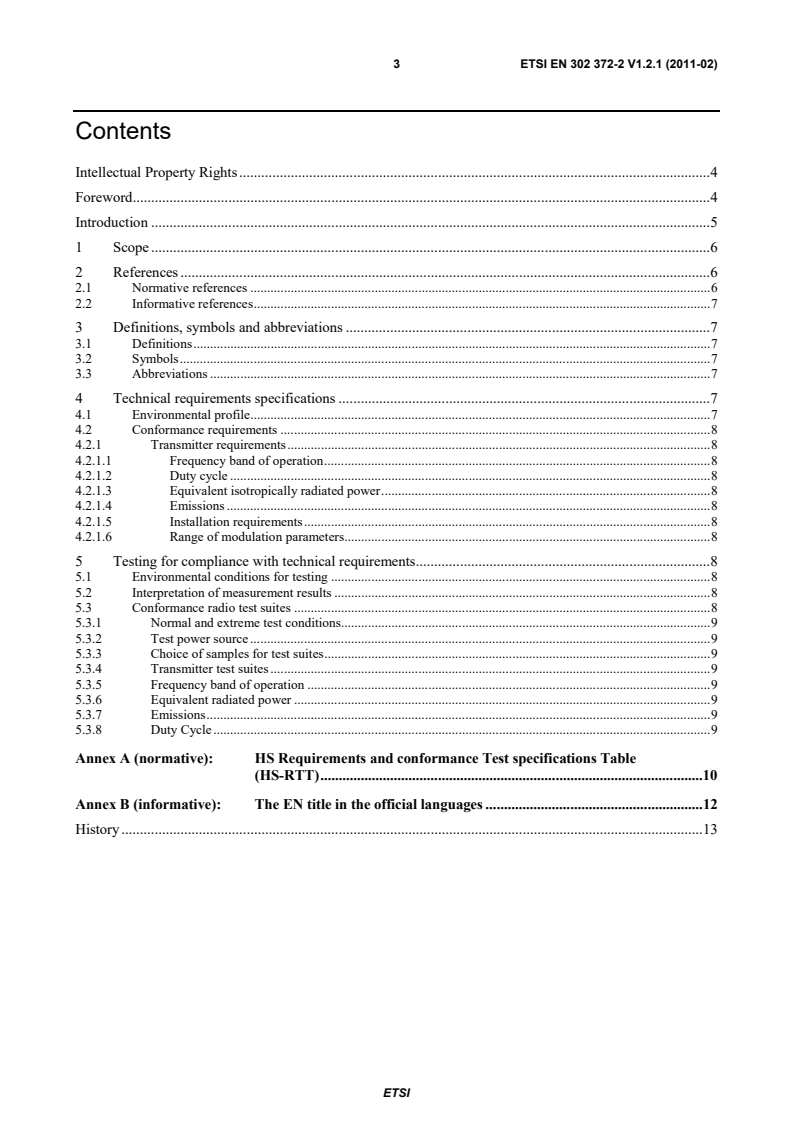
3 ETSI EN 302 372-2 V1.2.1 (2011-02)
Contents
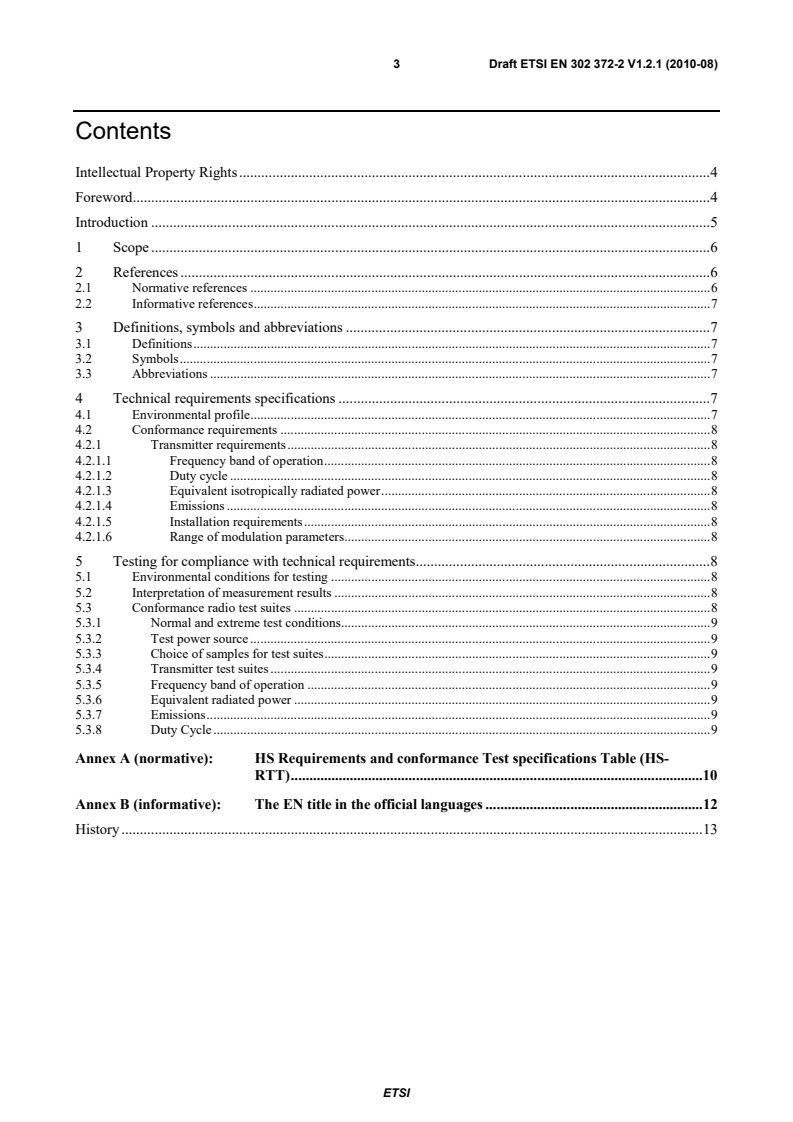
Intellectual Property Rights . 4
Foreword . 4
Introduction . 5
1 Scope . 6
2 References . 6
2.1 Normative references . 6
2.2 Informative references . 7
3 Definitions, symbols and abbreviations . 7
3.1 Definitions . 7
3.2 Symbols . 7
3.3 Abbreviations . 7
4 Technical requirements specifications . 7
4.1 Environmental profile . 7
4.2 Conformance requirements . 8
4.2.1 Transmitter requirements . 8
4.2.1.1 Frequency band of operation . 8
4.2.1.2 Duty cycle . 8
4.2.1.3 Equivalent isotropically radiated power . 8
4.2.1.4 Emissions . 8
4.2.1.5 Installation requirements . 8
4.2.1.6 Range of modulation parameters . 8
5 Testing for compliance with technical requirements . 8
5.1 Environmental conditions for testing . 8
5.2 Interpretation of measurement results . 8
5.3 Conformance radio test suites . 8
5.3.1 Normal and extreme test conditions. 9
5.3.2 Test power source . 9
5.3.3 Choice of samples for test suites . 9
5.3.4 Transmitter test suites . 9
5.3.5 Frequency band of operation . 9
5.3.6 Equivalent radiated power . 9
5.3.7 Emissions . 9
5.3.8 Duty Cycle . 9
Annex A (normative): HS Requirements and conformance Test specifications Table
(HS-RTT) . 10
Annex B (informative): The EN title in the official languages . 12
History . 13
ETSI
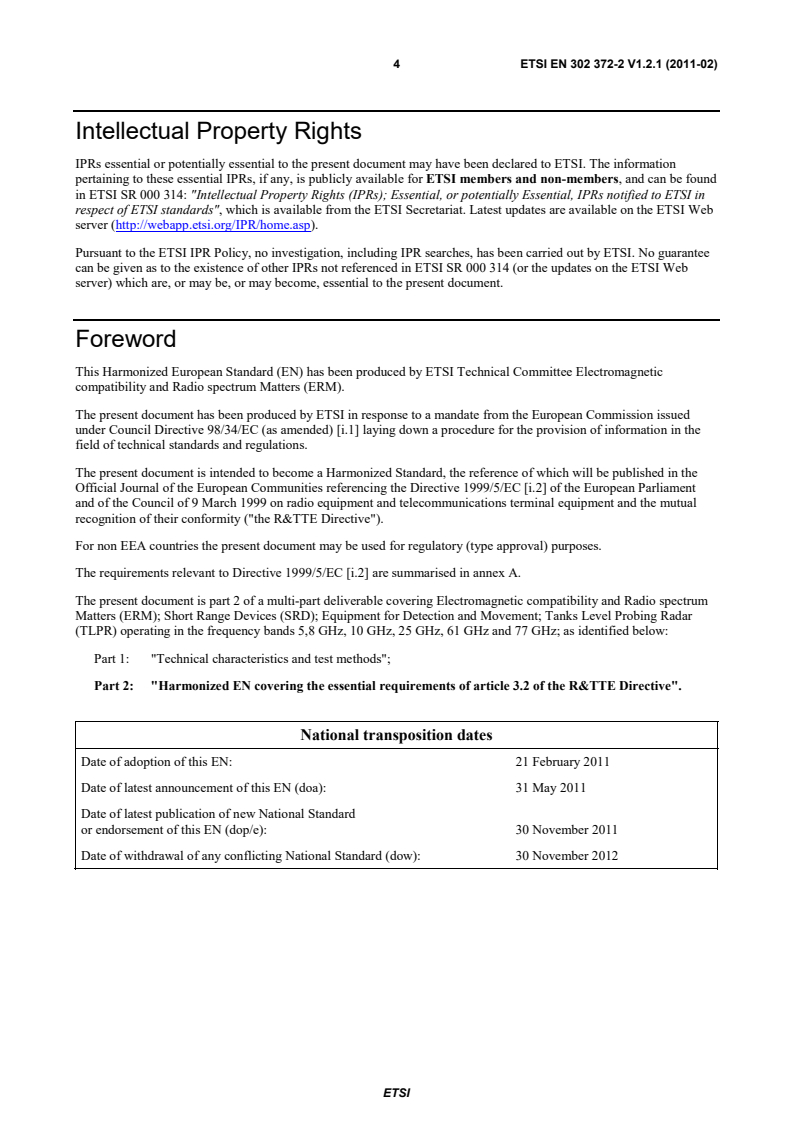
4 ETSI EN 302 372-2 V1.2.1 (2011-02)
Intellectual Property Rights
IPRs essential or potentially essential to the present document may have been declared to ETSI. The information
pertaining to these essential IPRs, if any, is publicly available for ETSI members and non-members, and can be found
in ETSI SR 000 314: "Intellectual Property Rights (IPRs); Essential, or potentially Essential, IPRs notified to ETSI in
respect of ETSI standards", which is available from the ETSI Secretariat. Latest updates are available on the ETSI Web
server (http://webapp.etsi.org/IPR/home.asp).
Pursuant to the ETSI IPR Policy, no investigation, including IPR searches, has been carried out by ETSI. No guarantee
can be given as to the existence of other IPRs not referenced in ETSI SR 000 314 (or the updates on the ETSI Web
server) which are, or may be, or may become, essential to the present document.
Foreword
This Harmonized European Standard (EN) has been produced by ETSI Technical Committee Electromagnetic
compatibility and Radio spectrum Matters (ERM).
The present document has been produced by ETSI in response to a mandate from the European Commission issued
under Council Directive 98/34/EC (as amended) [i.1] laying down a procedure for the provision of information in the
field of technical standards and regulations.
The present document is intended to become a Harmonized Standard, the reference of which will be published in the
Official Journal of the European Communities referencing the Directive 1999/5/EC [i.2] of the European Parliament
and of the Council of 9 March 1999 on radio equipment and telecommunications terminal equipment and the mutual
recognition of their conformity ("the R&TTE Directive").
For non EEA countries the present document may be used for regulatory (type approval) purposes.
The requirements relevant to Directive 1999/5/EC [i.2] are summarised in annex A.
The present document is part 2 of a multi-part deliverable covering Electromagnetic compatibility and Radio spectrum
Matters (ERM); Short Range Devices (SRD); Equipment for Detection and Movement; Tanks Level Probing Radar
(TLPR) operating in the frequency bands 5,8 GHz, 10 GHz, 25 GHz, 61 GHz and 77 GHz; as identified below:
Part 1: "Technical characteristics and test methods";
Part 2: "Harmonized EN covering the essential requirements of article 3.2 of the R&TTE Directive".
National transposition dates
Date of adoption of this EN: 21 February 2011
Date of latest announcement of this EN (doa): 31 May 2011
Date of latest publication of new National Standard
or endorsement of this EN (dop/e): 30 November 2011
Date of withdrawal of any conflicting National Standard (dow): 30 November 2012
ETSI
5 ETSI EN 302 372-2 V1.2.1 (2011-02)
Introduction
The present document is part of a set of standards developed by ETSI and is designed to fit in a modular structure to
cover all radio and telecommunications terminal equipment within the scope of the R&TTE Directive [i.2]. The
modular structure is shown in EG 201 399 [i.5].
ETSI
6 ETSI EN 302 372-2 V1.2.1 (2011-02)
1 Scope
The present document specifies the requirements for Tank Level Probing Radar (TLPR) applications based on pulse RF,
FMCW, or similar wideband techniques, operating in the following frequency bands or part hereof as specified
in table 1.
Table 1: Frequency bands designated to Tank Level Probing Radars (TLPR)
Frequency Bands/frequencies
(GHz)
Transmit and Receive 4,5 to 7
Transmit and Receive 8,5 to 10,6
Transmit and Receive 24,05 to 26,5
Transmit and Receive 57 to 64
Transmit and Receive 75 to 85
Table 1 shows a list of the frequency bands as designated to Tank Level Probing Radars in the EC-Decision
2009/381 [i.4] and CEPT/ERC/Recommendation 70-03 [i.3] as known at the date of pub
...
Final draft ETSI EN 302 372-2 V1.2.1 (2010-12)
Harmonized European Standard (Telecommunications series)
Electromagnetic compatibility
and Radio spectrum Matters (ERM);
Short Range Devices (SRD);
Equipment for Detection and Movement;
Tanks Level Probing Radar (TLPR) operating in the
frequency bands 5,8 GHz, 10 GHz, 25 GHz, 61 GHz and 77 GHz;
Part 2: Harmonized EN covering the essential requirements
of article 3.2 of the R&TTE Directive
2 Final draft ETSI EN 302 372-2 V1.2.1 (2010-12)
Reference
REN/ERM-TGTLPR-0117-2
Keywords
EHF, radar, regulation, SHF, short range, SRD,
testing, UWB
ETSI
650 Route des Lucioles
F-06921 Sophia Antipolis Cedex - FRANCE
Tel.: +33 4 92 94 42 00 Fax: +33 4 93 65 47 16
Siret N° 348 623 562 00017 - NAF 742 C
Association à but non lucratif enregistrée à la
Sous-Préfecture de Grasse (06) N° 7803/88
Important notice
Individual copies of the present document can be downloaded from:
http://www.etsi.org
The present document may be made available in more than one electronic version or in print. In any case of existing or
perceived difference in contents between such versions, the reference version is the Portable Document Format (PDF).
In case of dispute, the reference shall be the printing on ETSI printers of the PDF version kept on a specific network drive
within ETSI Secretariat.
Users of the present document should be aware that the document may be subject to revision or change of status.
Information on the current status of this and other ETSI documents is available at
http://portal.etsi.org/tb/status/status.asp
If you find errors in the present document, please send your comment to one of the following services:
http://portal.etsi.org/chaircor/ETSI_support.asp
Copyright Notification
No part may be reproduced except as authorized by written permission.
The copyright and the foregoing restriction extend to reproduction in all media.
© European Telecommunications Standards Institute 2010.
All rights reserved.
TM TM TM TM
DECT , PLUGTESTS , UMTS , TIPHON , the TIPHON logo and the ETSI logo are Trade Marks of ETSI registered
for the benefit of its Members.
TM
3GPP is a Trade Mark of ETSI registered for the benefit of its Members and of the 3GPP Organizational Partners.
LTE™ is a Trade Mark of ETSI currently being registered
for the benefit of its Members and of the 3GPP Organizational Partners.
GSM® and the GSM logo are Trade Marks registered and owned by the GSM Association.
ETSI
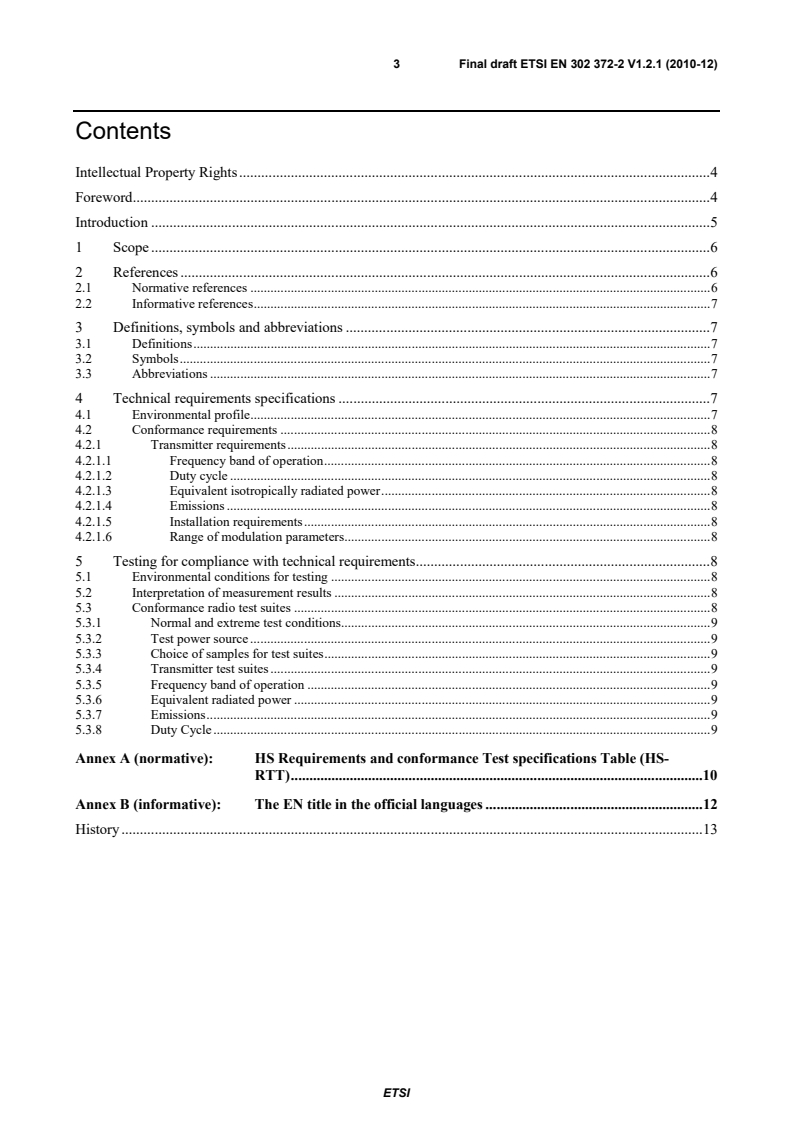
3 Final draft ETSI EN 302 372-2 V1.2.1 (2010-12)
Contents
Intellectual Property Rights . 4
Foreword . 4
Introduction . 5
1 Scope . 6
2 References . 6
2.1 Normative references . 6
2.2 Informative references . 7
3 Definitions, symbols and abbreviations . 7
3.1 Definitions . 7
3.2 Symbols . 7
3.3 Abbreviations . 7
4 Technical requirements specifications . 7
4.1 Environmental profile . 7
4.2 Conformance requirements . 8
4.2.1 Transmitter requirements . 8
4.2.1.1 Frequency band of operation . 8
4.2.1.2 Duty cycle . 8
4.2.1.3 Equivalent isotropically radiated power . 8
4.2.1.4 Emissions . 8
4.2.1.5 Installation requirements . 8
4.2.1.6 Range of modulation parameters . 8
5 Testing for compliance with technical requirements . 8
5.1 Environmental conditions for testing . 8
5.2 Interpretation of measurement results . 8
5.3 Conformance radio test suites . 8
5.3.1 Normal and extreme test conditions. 9
5.3.2 Test power source . 9
5.3.3 Choice of samples for test suites . 9
5.3.4 Transmitter test suites . 9
5.3.5 Frequency band of operation . 9
5.3.6 Equivalent radiated power . 9
5.3.7 Emissions . 9
5.3.8 Duty Cycle . 9
Annex A (normative): HS Requirements and conformance Test specifications Table (HS-
RTT) . 10
Annex B (informative): The EN title in the official languages . 12
History . 13
ETSI
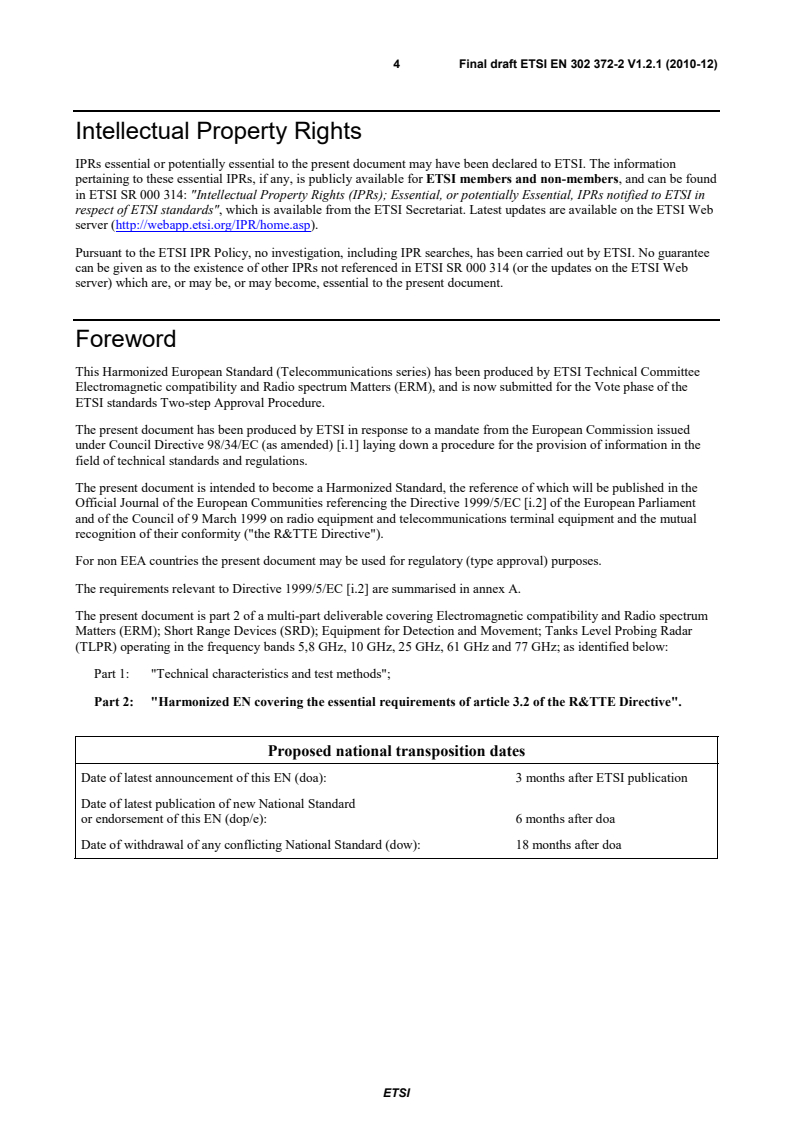
4 Final draft ETSI EN 302 372-2 V1.2.1 (2010-12)
Intellectual Property Rights
IPRs essential or potentially essential to the present document may have been declared to ETSI. The information
pertaining to these essential IPRs, if any, is publicly available for ETSI members and non-members, and can be found
in ETSI SR 000 314: "Intellectual Property Rights (IPRs); Essential, or potentially Essential, IPRs notified to ETSI in
respect of ETSI standards", which is available from the ETSI Secretariat. Latest updates are available on the ETSI Web
server (http://webapp.etsi.org/IPR/home.asp).
Pursuant to the ETSI IPR Policy, no investigation, including IPR searches, has been carried out by ETSI. No guarantee
can be given as to the existence of other IPRs not referenced in ETSI SR 000 314 (or the updates on the ETSI Web
server) which are, or may be, or may become, essential to the present document.
Foreword
This Harmonized European Standard (Telecommunications series) has been produced by ETSI Technical Committee
Electromagnetic compatibility and Radio spectrum Matters (ERM), and is now submitted for the Vote phase of the
ETSI standards Two-step Approval Procedure.
The present document has been produced by ETSI in response to a mandate from the European Commission issued
under Council Directive 98/34/EC (as amended) [i.1] laying down a procedure for the provision of information in the
field of technical standards and regulations.
The present document is intended to become a Harmonized Standard, the reference of which will be published in the
Official Journal of the European Communities referencing the Directive 1999/5/EC [i.2] of the European Parliament
and of the Council of 9 March 1999 on radio equipment and telecommunications terminal equipment and the mutual
recognition of their conformity ("the R&TTE Directive").
For non EEA countries the present document may be used for regulatory (type approval) purposes.
The requirements relevant to Directive 1999/5/EC [i.2] are summarised in annex A.
The present document is part 2 of a multi-part deliverable covering Electromagnetic compatibility and Radio spectrum
Matters (ERM); Short Range Devices (SRD); Equipment for Detection and Movement; Tanks Level Probing Radar
(TLPR) operating in the frequency bands 5,8 GHz, 10 GHz, 25 GHz, 61 GHz and 77 GHz; as identified below:
Part 1: "Technical characteristics and test methods";
Part 2: "Harmonized EN covering the essential requirements of article 3.2 of the R&TTE Directive".
Proposed national transposition dates
Date of latest announcement of this EN (doa): 3 months after ETSI publication
Date of latest publication of new National Standard
or endorsement of this EN (dop/e): 6 months after doa
Date of withdrawal of any conflicting National Standard (dow): 18 months after doa
ETSI
5 Final draft ETSI EN 302 372-2 V1.2.1 (2010-12)
Introduction
The present document is part of a set of standards developed by ETSI and is designed to fit in a modular structure to
cover all radio and telecommunications terminal equipment within the scope of the R&TTE Directive [i.2]. The
modular structure is shown in EG 201 399 [i.5].
ETSI
6 Final draft ETSI EN 302 372-2 V1.2.1 (2010-12)
1 Scope
The present document specifies the requirements for Tank Level Probing Radar (TLPR) applications based on pulse RF,
FMCW, or similar wideband techniques, operating in the following frequency bands or part hereof as specified
in table 1.
Table 1: Frequency bands designated to Tank Level Probing Radars (TLPR)
Frequency Bands/frequencies
(GHz)
Transmit and Receive 4,5 to 7
Transmit and Receive 8,5 to 10,6
Transmit and Receive 24,05 to 26,5
Transmit and Receive 57 to 64
Transmit and Receive 75 to 85
Table 1 shows a list of the frequency bands as designated to Tank Level Probing Radars in the
EC-Decision 2009/
...
Draft ETSI EN 302 372-2 V1.2.1 (2010-08)
Harmonized European Standard (Telecommunications series)
Electromagnetic compatibility
and Radio spectrum Matters (ERM);
Short Range Devices (SRD);
Equipment for Detection and Movement;
Tanks Level Probing Radar (TLPR) operating in the
frequency bands 5,8 GHz, 10 GHz, 25 GHz, 61 GHz and 77 GHz;
Part 2: Harmonized EN covering the essential requirements
of article 3.2 of the R&TTE Directive
2 Draft ETSI EN 302 372-2 V1.2.1 (2010-08)
Reference
REN/ERM-TGTLPR-0117-2
Keywords
EHF, radar, regulation, SHF, short range,
SRD, testing, UWB
ETSI
650 Route des Lucioles
F-06921 Sophia Antipolis Cedex - FRANCE
Tel.: +33 4 92 94 42 00 Fax: +33 4 93 65 47 16
Siret N° 348 623 562 00017 - NAF 742 C
Association à but non lucratif enregistrée à la
Sous-Préfecture de Grasse (06) N° 7803/88
Important notice
Individual copies of the present document can be downloaded from:
http://www.etsi.org
The present document may be made available in more than one electronic version or in print. In any case of existing or
perceived difference in contents between such versions, the reference version is the Portable Document Format (PDF).
In case of dispute, the reference shall be the printing on ETSI printers of the PDF version kept on a specific network drive
within ETSI Secretariat.
Users of the present document should be aware that the document may be subject to revision or change of status.
Information on the current status of this and other ETSI documents is available at
http://portal.etsi.org/tb/status/status.asp
If you find errors in the present document, please send your comment to one of the following services:
http://portal.etsi.org/chaircor/ETSI_support.asp
Copyright Notification
No part may be reproduced except as authorized by written permission.
The copyright and the foregoing restriction extend to reproduction in all media.
© European Telecommunications Standards Institute 2010.
All rights reserved.
TM TM TM TM
DECT , PLUGTESTS , UMTS , TIPHON , the TIPHON logo and the ETSI logo are Trade Marks of ETSI registered
for the benefit of its Members.
TM
3GPP is a Trade Mark of ETSI registered for the benefit of its Members and of the 3GPP Organizational Partners.
LTE™ is a Trade Mark of ETSI currently being registered
for the benefit of its Members and of the 3GPP Organizational Partners.
GSM® and the GSM logo are Trade Marks registered and owned by the GSM Association.
ETSI
3 Draft ETSI EN 302 372-2 V1.2.1 (2010-08)
Contents
Intellectual Property Rights . 4
Foreword . 4
Introduction . 5
1 Scope . 6
2 References . 6
2.1 Normative references . 6
2.2 Informative references . 7
3 Definitions, symbols and abbreviations . 7
3.1 Definitions . 7
3.2 Symbols . 7
3.3 Abbreviations . 7
4 Technical requirements specifications . 7
4.1 Environmental profile . 7
4.2 Conformance requirements . 8
4.2.1 Transmitter requirements . 8
4.2.1.1 Frequency band of operation . 8
4.2.1.2 Duty cycle . 8
4.2.1.3 Equivalent isotropically radiated power . 8
4.2.1.4 Emissions . 8
4.2.1.5 Installation requirements . 8
4.2.1.6 Range of modulation parameters . 8
5 Testing for compliance with technical requirements . 8
5.1 Environmental conditions for testing . 8
5.2 Interpretation of measurement results . 8
5.3 Conformance radio test suites . 8
5.3.1 Normal and extreme test conditions. 9
5.3.2 Test power source . 9
5.3.3 Choice of samples for test suites . 9
5.3.4 Transmitter test suites . 9
5.3.5 Frequency band of operation . 9
5.3.6 Equivalent radiated power . 9
5.3.7 Emissions . 9
5.3.8 Duty Cycle . 9
Annex A (normative): HS Requirements and conformance Test specifications Table (HS-
RTT) . 10
Annex B (informative): The EN title in the official languages . 12
History . 13
ETSI
4 Draft ETSI EN 302 372-2 V1.2.1 (2010-08)
Intellectual Property Rights
IPRs essential or potentially essential to the present document may have been declared to ETSI. The information
pertaining to these essential IPRs, if any, is publicly available for ETSI members and non-members, and can be found
in ETSI SR 000 314: "Intellectual Property Rights (IPRs); Essential, or potentially Essential, IPRs notified to ETSI in
respect of ETSI standards", which is available from the ETSI Secretariat. Latest updates are available on the ETSI Web
server (http://webapp.etsi.org/IPR/home.asp).
Pursuant to the ETSI IPR Policy, no investigation, including IPR searches, has been carried out by ETSI. No guarantee
can be given as to the existence of other IPRs not referenced in ETSI SR 000 314 (or the updates on the ETSI Web
server) which are, or may be, or may become, essential to the present document.
Foreword
This Harmonized European Standard (Telecommunications series) has been produced by ETSI Technical Committee
Electromagnetic compatibility and Radio spectrum Matters (ERM), and is now submitted for the Public Enquiry phase
of the ETSI standards Two-step Approval Procedure.
The present document has been produced by ETSI in response to a mandate from the European Commission issued
under Council Directive 98/34/EC (as amended) [i.1] laying down a procedure for the provision of information in the
field of technical standards and regulations.
The present document is intended to become a Harmonized Standard, the reference of which will be published in the
Official Journal of the European Communities referencing the Directive 1999/5/EC [i.2] of the European Parliament
and of the Council of 9 March 1999 on radio equipment and telecommunications terminal equipment and the mutual
recognition of their conformity ("the R&TTE Directive").
For non EEA countries the present document may be used for regulatory (type approval) purposes.
The requirements relevant to Directive 1999/5/EC [i.2] are summarised in annex A.
The present document is part 2 of a multi-part deliverable covering Electromagnetic compatibility and Radio spectrum
Matters (ERM); Short Range Devices (SRD); Equipment for Detection and Movement; Tanks Level Probing Radar
(TLPR) operating in the frequency bands 5,8 GHz, 10 GHz, 25 GHz, 61 GHz and 77 GHz; as identified below:
Part 1: "Technical characteristics and test methods";
Part 2: "Harmonized EN covering the essential requirements of article 3.2 of the R&TTE Directive".
Proposed national transposition dates
Date of latest announcement of this EN (doa): 3 months after ETSI publication
Date of latest publication of new National Standard
or endorsement of this EN (dop/e): 6 months after doa
Date of withdrawal of any conflicting National Standard (dow): 18 months after doa
ETSI
5 Draft ETSI EN 302 372-2 V1.2.1 (2010-08)
Introduction
The present document is part of a set of standards developed by ETSI and is designed to fit in a modular structure to
cover all radio and telecommunications terminal equipment within the scope of the R&TTE Directive [i.2]. The
modular structure is shown in EG 201 399 [i.5].
ETSI
6 Draft ETSI EN 302 372-2 V1.2.1 (2010-08)
1 Scope
The present document specifies the requirements for Tank Level Probing Radar (TLPR) applications based on pulse RF,
FMCW, or similar wideband techniques, operating in the following frequency bands or part hereof as specified
in table 1.
Table 1: Frequency bands designated to Tank Level Probing Radars (TLPR)
Frequency Bands/frequencies
(GHz)
Transmit and Receive 4,5 to 7
Transmit and Receive 8,5 to 10,6
Transmit and Receive 24,05 to 26,5
Transmit and Receive 57 to 64
Transmit and Receive 75 to 85
Table 1 shows a list of the frequency bands as designated to Tank Level
...
2003-01.Slovenski inštitut za standardizacijo. Razmnoževanje celote ali delov tega standarda ni dovoljeno.Electromagnetic compatibility and Radio spectrum Matters (ERM) - Short Range Devices (SRD) - Equipment for Detection and Movement; Tanks Level Probing Radar (TLPR) operating in the frequency bands 5,8 GHz, 10 GHz, 25 GHz, 61 GHz and 77 GHz - Part 2: Harmonized EN covering the essential requirements of article 3.2 of the R&TTE Directive33.100.01Elektromagnetna združljivost na splošnoElectromagnetic compatibility in general33.060.20Sprejemna in oddajna opremaReceiving and transmitting equipmentICS:Ta slovenski standard je istoveten z:EN 302 372-2 Version 1.2.1SIST EN 302 372-2 V1.2.1:2011en01-maj-2011SIST EN 302 372-2 V1.2.1:2011SLOVENSKI
STANDARD
ETSI ETSI EN 302 372-2 V1.2.1 (2011-02) 2
Reference REN/ERM-TGTLPR-0117-2 Keywords EHF, radar, regulation, SHF, short range, SRD, testing, UWB ETSI 650 Route des Lucioles F-06921 Sophia Antipolis Cedex - FRANCE
Tel.: +33 4 92 94 42 00
Fax: +33 4 93 65 47 16
Siret N° 348 623 562 00017 - NAF 742 C Association à but non lucratif enregistrée à la Sous-Préfecture de Grasse (06) N° 7803/88
Important notice Individual copies of the present document can be downloaded from: http://www.etsi.org The present document may be made available in more than one electronic version or in print. In any case of existing or perceived difference in contents between such versions, the reference version is the Portable Document Format (PDF). In case of dispute, the reference shall be the printing on ETSI printers of the PDF version kept on a specific network drive within ETSI Secretariat. Users of the present document should be aware that the document may be subject to revision or change of status. Information on the current status of this and other ETSI documents is available at http://portal.etsi.org/tb/status/status.asp If you find errors in the present document, please send your comment to one of the following services: http://portal.etsi.org/chaircor/ETSI_support.asp Copyright Notification No part may be reproduced except as authorized by written permission. The copyright and the foregoing restriction extend to reproduction in all media.
© European Telecommunications Standards Institute 2011. All rights reserved.
DECTTM, PLUGTESTSTM, UMTSTM, TIPHONTM, the TIPHON logo and the ETSI logo are Trade Marks of ETSI registered for the benefit of its Members. 3GPPTM is a Trade Mark of ETSI registered for the benefit of its Members and of the 3GPP Organizational Partners. LTE™ is a Trade Mark of ETSI currently being registered for the benefit of its Members and of the 3GPP Organizational Partners. GSM® and the GSM logo are Trade Marks registered and owned by the GSM Association. SIST EN 302 372-2 V1.2.1:2011
ETSI ETSI EN 302 372-2 V1.2.1 (2011-02) 3 Contents Intellectual Property Rights . 4 Foreword . 4 Introduction . 5 1 Scope . 6 2 References . 6 2.1 Normative references . 6 2.2 Informative references . 7 3 Definitions, symbols and abbreviations . 7 3.1 Definitions . 7 3.2 Symbols . 7 3.3 Abbreviations . 7 4 Technical requirements specifications . 7 4.1 Environmental profile . 7 4.2 Conformance requirements . 8 4.2.1 Transmitter requirements . 8 4.2.1.1 Frequency band of operation . 8 4.2.1.2 Duty cycle . 8 4.2.1.3 Equivalent isotropically radiated power . 8 4.2.1.4 Emissions . 8 4.2.1.5 Installation requirements . 8 4.2.1.6 Range of modulation parameters . 8 5 Testing for compliance with technical requirements . 8 5.1 Environmental conditions for testing . 8 5.2 Interpretation of measurement results . 8 5.3 Conformance radio test suites . 8 5.3.1 Normal and extreme test conditions. 9 5.3.2 Test power source . 9 5.3.3 Choice of samples for test suites . 9 5.3.4 Transmitter test suites . 9 5.3.5 Frequency band of operation . 9 5.3.6 Equivalent radiated power . 9 5.3.7 Emissions . 9 5.3.8 Duty Cycle . 9 Annex A (normative): HS Requirements and conformance Test specifications Table (HS-RTT) . 10 Annex B (informative): The EN title in the official languages . 12 History . 13
ETSI ETSI EN 302 372-2 V1.2.1 (2011-02) 4 Intellectual Property Rights IPRs essential or potentially essential to the present document may have been declared to ETSI. The information pertaining to these essential IPRs, if any, is publicly available for ETSI members and non-members, and can be found in ETSI SR 000 314: "Intellectual Property Rights (IPRs); Essential, or potentially Essential, IPRs notified to ETSI in respect of ETSI standards", which is available from the ETSI Secretariat. Latest updates are available on the ETSI Web server (http://webapp.etsi.org/IPR/home.asp). Pursuant to the ETSI IPR Policy, no investigation, including IPR searches, has been carried out by ETSI. No guarantee can be given as to the existence of other IPRs not referenced in ETSI SR 000 314 (or the updates on the ETSI Web server) which are, or may be, or may become, essential to the present document. Foreword This Harmonized European Standard (EN) has been produced by ETSI Technical Committee Electromagnetic compatibility and Radio spectrum Matters (ERM). The present document has been produced by ETSI in response to a mandate from the European Commission issued under Council Directive 98/34/EC (as amended) [i.1] laying down a procedure for the provision of information in the field of technical standards and regulations. The present document is intended to become a Harmonized Standard, the reference of which will be published in the Official Journal of the European Communities referencing the Directive 1999/5/EC [i.2] of the European Parliament and of the Council of 9 March 1999 on radio equipment and telecommunications terminal equipment and the mutual recognition of their conformity ("the R&TTE Directive"). For non EEA countries the present document may be used for regulatory (type approval) purposes. The requirements relevant to Directive 1999/5/EC [i.2] are summarised in annex A. The present document is part 2 of a multi-part deliverable covering Electromagnetic compatibility and Radio spectrum Matters (ERM); Short Range Devices (SRD); Equipment for Detection and Movement; Tanks Level Probing Radar (TLPR) operating in the frequency bands 5,8 GHz, 10 GHz, 25 GHz, 61 GHz and 77 GHz; as identified below: Part 1: "Technical characteristics and test methods"; Part 2: "Harmonized EN covering the essential requirements of article 3.2 of the R&TTE Directive".
National transposition dates Date of adoption of this EN: 21 February 2011 Date of latest announcement of this EN (doa): 31 May 2011 Date of latest publication of new National Standard or endorsement of this EN (dop/e):
30 November 2011 Date of withdrawal of any conflicting National Standard (dow): 30 November 2012
ETSI ETSI EN 302 372-2 V1.2.1 (2011-02) 5 Introduction The present document is part of a set of standards developed by ETSI and is designed to fit in a modular structure to cover all radio and telecommunications terminal equipment within the scope of the R&TTE Directive [i.2]. The modular structure is shown in EG 201 399 [i.5]. SIST EN 302 372-2 V1.2.1:2011
ETSI ETSI EN 302 372-2 V1.2.1 (2011-02) 6 1 Scope The present document specifies the requirements for Tank Level Probing Radar (TLPR) applications based on pulse RF, FMCW, or similar wideband techniques, operating in the following frequency bands or part hereof as specified in t
...