


SIST-TP CEN/TR 15350:2020
(Main)Mechanical vibration - Guideline for the assessment of exposure to hand-transmitted vibration using available information including that provided by manufacturers of machinery
Mechanical vibration - Guideline for the assessment of exposure to hand-transmitted vibration using available information including that provided by manufacturers of machinery
This document gives guidelines for estimating and documenting the daily vibration exposure due to the use of hand-held power tools and hand-guided machines, in relation to the requirements of the European Physical Agents Directive (vibration) 2002/44/EC. This document is addressed to competent services for the assessment of vibration exposure at the workplace and to national authorities and industrial organizations.
The methods in this document are based on the requirements and guidance given in EN ISO 5349 1 and EN ISO 5349 2 but instead of measuring the vibration magnitudes at the specific workplaces, the methods in this document use existing vibration values from other sources of information including those provided by the manufacturers of the machinery in relation to the requirements of the Machinery Directive 2006/42/EC.
This document gives guidance on how to estimate the exposure time and the daily vibration exposure A(8) as defined in EN ISO 5349 1. It also offers a simple method for estimating the daily vibration exposure by means of a table which indicates the vibration exposure as a function of the equivalent vibration total value and the associated exposure time. Both methods can be used even in cases of multiple exposures on the same day.
Mechanische Schwingungen - Anleitung zur Beurteilung der Belastung durch Hand-Arm-Schwingungen aus Angaben zu den benutzten Maschinen einschließlich Angaben von den Maschinenherstellern
Dieses Dokument gibt eine Anleitung zur Abschätzung und Dokumentation der durch die Benutzung von handgehaltenen und handgeführten Maschinen verursachten Tages-Schwingungsbelastung entsprechend den Anforderungen der Europäischen Richtlinie über physikalische Einwirkungen (Vibrationen) 2002/44/EG. Dieses Dokument richtet sich an diejenigen fachlichen Stellen, die die Schwingungsbelastung am Arbeitsplatz beurteilen, sowie an Behörden und Organisationen der Arbeitswelt.
Die in diesem Dokument angegebenen Vorgehensweisen entsprechen den in EN ISO 5349 1 und EN ISO 5349 2 enthaltenen Anforderungen und Leitlinien. Doch anstatt die Stärke der Schwingungen an den jeweiligen Arbeitsplätzen zu messen, verwenden die Verfahren in diesem Dokument Schwingungswerte aus anderen Informationsquellen, zu denen auch die Angaben des Maschinenherstellers entsprechend der Maschinenrichtlinie 2006/42/EG zählen.
Dieses Dokument enthält eine Anleitung, wie sich die Einwirkungsdauer und die Tages-Schwingungs-belastung A(8), wie in EN ISO 5349 1 definiert, abschätzen lassen. Es enthält darüber hinaus ein vereinfachtes Verfahren zur Abschätzung der Tages-Schwingungsbelastung mit Hilfe einer Tabelle, die die Schwingungsbelastung in Abhängigkeit vom äquivalenten Schwingungsgesamtwert und von der zugehörigen Einwirkungsdauer angibt. Beide Verfahren können auch in solchen Fällen angewandt werden, in denen mehrere Belastungen an einem Tag auftreten.
Vibrations mécaniques - Guide pour l’évaluation de l’exposition aux vibrations transmises à la main à partir de l’information disponible, y compris l’information fournie par les fabricants de machines
Le présent document fournit un cadre directeur pour estimer et documenter l’exposition quotidienne aux vibrations liée à l’utilisation de machines tenues ou guidées à la main, conformément aux exigences de la directive européenne relative aux agents physiques 2002/44/CE et en particulier aux vibrations. Le présent document est destiné aux services compétents chargés d’évaluer l’exposition aux vibrations sur le lieu de travail, aux autorités nationales et aux organisations industrielles nationales.
Les méthodes présentées dans le présent document s’appuient sur les exigences et les recommandations de l’EN ISO 5349 1 et l’EN ISO 5349 2 mais, au lieu de mesurer les amplitudes de vibration à des postes de travail spécifiques, les méthodes décrites dans le présent document utilisent les valeurs de vibration existantes provenant d’autres sources d’information et en particulier celles fournies par les fabricants de machines, conformément aux exigences de la Directive 2006/42/CE relative aux machines.
Le présent document fournit des recommandations relatives à la méthode à utiliser pour évaluer le temps d’exposition et l’exposition quotidienne aux vibrations A(8) conformément à l’EN ISO 5349 1. Il propose également une méthode simplifiée pour déterminer l’exposition quotidienne aux vibrations au moyen d’un tableau indiquant une valeur d’exposition en fonction de la valeur totale de vibration équivalente et du temps d’exposition associé. L’une ou l’autre de ces méthodes peut être utilisée, même dans le cas d’expositions multiples au cours d’une même journée.
Mehanske vibracije - Smernice za ocenjevanje izpostavljenosti vibracijam preko rok z uporabo podatkov o stroju, vključno s podatki proizvajalca
General Information
- Status
- Published
- Public Enquiry End Date
- 27-May-2020
- Publication Date
- 26-Jul-2020
- Technical Committee
- I13 - Imaginarni 13
- Current Stage
- 6060 - National Implementation/Publication (Adopted Project)
- Start Date
- 20-Jul-2020
- Due Date
- 24-Sep-2020
- Completion Date
- 27-Jul-2020
Relations
- Effective Date
- 15-Jul-2020
- Effective Date
- 25-Oct-2017
Overview
CEN/TR 15350:2020 - "Mechanical vibration - Guideline for the assessment of exposure to hand‑transmitted vibration using available information including that provided by manufacturers of machinery" - is a CEN technical report that gives practical guidance for estimating and documenting daily exposure to hand‑transmitted vibration from hand‑held power tools and hand‑guided machines. It aligns assessment methods with the requirements of the European Physical Agents Directive (vibration) 2002/44/EC and references EN ISO 5349‑1 and EN ISO 5349‑2. The report focuses on using existing vibration information (for example manufacturers’ declared emission values under the Machinery Directive 2006/42/EC) as an alternative to full workplace measurement where appropriate.
Key topics and technical requirements
- Estimation of daily vibration exposure A(8): Procedures for calculating the daily vibration exposure A(8) from an equivalent vibration total value (ahv,eq) and exposure time, and for combining multiple partial exposures.
- Exposure time vs. user time: Clear definitions and guidance on estimating the actual exposure time (duration the hand is in contact with vibration) rather than the broader user time.
- Use of existing vibration data: Guidance on acceptable sources (manufacturer declarations, trade associations, published data) and how to evaluate data quality and representativeness.
- Vibration exposure points (P): A simpler scoring method (partial and total exposure points) to estimate risk quickly; 100 points ≈ A(8) = 2.5 m/s² (exposure action value), 400 points ≈ A(8) = 5 m/s² (exposure limit value).
- Variability and uncertainty: Advice on accounting for variability in tools, tasks and operator technique; recommendation to err on the side of caution when estimates are close to action or limit values.
- Documentation and control programmes: Recommended record‑keeping and a procedure (Annex B) for integrating exposure estimation into a vibration control programme.
- Informative annexes: Practical material, including information manufacturers should supply (Annex A), limits on the use of declarations (Annex C), estimating exposure durations (Annex D), determining exposure points (Annex E) and worked examples (Annex F).
Practical applications and users
This guidance is intended for:
- Competent services performing workplace vibration assessments
- Occupational health & safety professionals and safety managers
- National authorities and regulators implementing the Physical Agents Directive
- Industrial organizations and employers using hand‑held tools and hand‑guided machines
Use cases:
- Rapid screening to decide whether detailed workplace vibration measurements are needed
- Estimating daily A(8) exposure when manufacturer vibration declarations are available
- Prioritizing vibration control measures and health surveillance for exposed workers
Related standards
- EN ISO 5349‑1 (measurement and evaluation of hand‑transmitted vibration)
- EN ISO 5349‑2 (practical guidance for workplace measurement)
- Machinery Directive 2006/42/EC (manufacturer declaration requirements)
- Physical Agents Directive 2002/44/EC (exposure action and limit values)
CEN/TR 15350:2020 is a practical complement to EN ISO 5349 standards, helping organizations use available vibration information effectively while respecting regulatory exposure limits.


Frequently Asked Questions
SIST-TP CEN/TR 15350:2020 is a technical report published by the Slovenian Institute for Standardization (SIST). Its full title is "Mechanical vibration - Guideline for the assessment of exposure to hand-transmitted vibration using available information including that provided by manufacturers of machinery". This standard covers: This document gives guidelines for estimating and documenting the daily vibration exposure due to the use of hand-held power tools and hand-guided machines, in relation to the requirements of the European Physical Agents Directive (vibration) 2002/44/EC. This document is addressed to competent services for the assessment of vibration exposure at the workplace and to national authorities and industrial organizations. The methods in this document are based on the requirements and guidance given in EN ISO 5349 1 and EN ISO 5349 2 but instead of measuring the vibration magnitudes at the specific workplaces, the methods in this document use existing vibration values from other sources of information including those provided by the manufacturers of the machinery in relation to the requirements of the Machinery Directive 2006/42/EC. This document gives guidance on how to estimate the exposure time and the daily vibration exposure A(8) as defined in EN ISO 5349 1. It also offers a simple method for estimating the daily vibration exposure by means of a table which indicates the vibration exposure as a function of the equivalent vibration total value and the associated exposure time. Both methods can be used even in cases of multiple exposures on the same day.
This document gives guidelines for estimating and documenting the daily vibration exposure due to the use of hand-held power tools and hand-guided machines, in relation to the requirements of the European Physical Agents Directive (vibration) 2002/44/EC. This document is addressed to competent services for the assessment of vibration exposure at the workplace and to national authorities and industrial organizations. The methods in this document are based on the requirements and guidance given in EN ISO 5349 1 and EN ISO 5349 2 but instead of measuring the vibration magnitudes at the specific workplaces, the methods in this document use existing vibration values from other sources of information including those provided by the manufacturers of the machinery in relation to the requirements of the Machinery Directive 2006/42/EC. This document gives guidance on how to estimate the exposure time and the daily vibration exposure A(8) as defined in EN ISO 5349 1. It also offers a simple method for estimating the daily vibration exposure by means of a table which indicates the vibration exposure as a function of the equivalent vibration total value and the associated exposure time. Both methods can be used even in cases of multiple exposures on the same day.
SIST-TP CEN/TR 15350:2020 is classified under the following ICS (International Classification for Standards) categories: 13.160 - Vibration and shock with respect to human beings. The ICS classification helps identify the subject area and facilitates finding related standards.
SIST-TP CEN/TR 15350:2020 has the following relationships with other standards: It is inter standard links to SIST-TP CEN/TR 15350:2014, SIST-TP CEN/TR 15350:2014. Understanding these relationships helps ensure you are using the most current and applicable version of the standard.
SIST-TP CEN/TR 15350:2020 is associated with the following European legislation: EU Directives/Regulations: 2006/42/EC. When a standard is cited in the Official Journal of the European Union, products manufactured in conformity with it benefit from a presumption of conformity with the essential requirements of the corresponding EU directive or regulation.
SIST-TP CEN/TR 15350:2020 is available in PDF format for immediate download after purchase. The document can be added to your cart and obtained through the secure checkout process. Digital delivery ensures instant access to the complete standard document.
Standards Content (Sample)
SLOVENSKI STANDARD
01-oktober-2020
Nadomešča:
SIST-TP CEN/TR 15350:2014
Mehanske vibracije - Smernice za ocenjevanje izpostavljenosti vibracijam preko
rok z uporabo podatkov o stroju, vključno s podatki proizvajalca
Mechanical vibration - Guideline for the assessment of exposure to hand-transmitted
vibration using available information including that provided by manufacturers of
machinery
Mechanische Schwingungen - Anleitung zur Beurteilung der Belastung durch Hand-Arm-
Schwingungen aus Angaben zu den benutzten Maschinen einschließlich Angaben von
den Maschinenherstellern
Vibrations mécaniques - Guide pour l’évaluation de l’exposition aux vibrations transmises
à la main à partir de l’information disponible, y compris l’information fournie par les
fabricants de machines
Ta slovenski standard je istoveten z: CEN/TR 15350:2020
ICS:
13.160 Vpliv vibracij in udarcev na Vibration and shock with
ljudi respect to human beings
2003-01.Slovenski inštitut za standardizacijo. Razmnoževanje celote ali delov tega standarda ni dovoljeno.
CEN/TR 15350
TECHNICAL REPORT
RAPPORT TECHNIQUE
July 2020
TECHNISCHER BERICHT
ICS 13.160 Supersedes CEN/TR 15350:2013
English Version
Mechanical vibration - Guideline for the assessment of
exposure to hand-transmitted vibration using available
information including that provided by manufacturers of
machinery
Vibrations mécaniques - Guide pour l'évaluation de Mechanische Schwingungen - Anleitung zur
l'exposition aux vibrations transmises à la main à Beurteilung der Belastung durch Hand-Arm-
partir de l'information disponible, y compris Schwingungen aus Angaben zu den benutzten
l'information fournie par les fabricants de machines Maschinen einschließlich Angaben von den
Maschinenherstellern
This Technical Report was approved by CEN on 29 June 2020. It has been drawn up by the Technical Committee CEN/TC 231.
CEN members are the national standards bodies of Austria, Belgium, Bulgaria, Croatia, Cyprus, Czech Republic, Denmark, Estonia,
Finland, France, Germany, Greece, Hungary, Iceland, Ireland, Italy, Latvia, Lithuania, Luxembourg, Malta, Netherlands, Norway,
Poland, Portugal, Republic of North Macedonia, Romania, Serbia, Slovakia, Slovenia, Spain, Sweden, Switzerland, Turkey and
United Kingdom.
EUROPEAN COMMITTEE FOR STANDARDIZATION
COMITÉ EUROPÉEN DE NORMALISATION
EUROPÄISCHES KOMITEE FÜR NORMUNG
CEN-CENELEC Management Centre: Rue de la Science 23, B-1040 Brussels
© 2020 CEN All rights of exploitation in any form and by any means reserved Ref. No. CEN/TR 15350:2020 E
worldwide for CEN national Members.
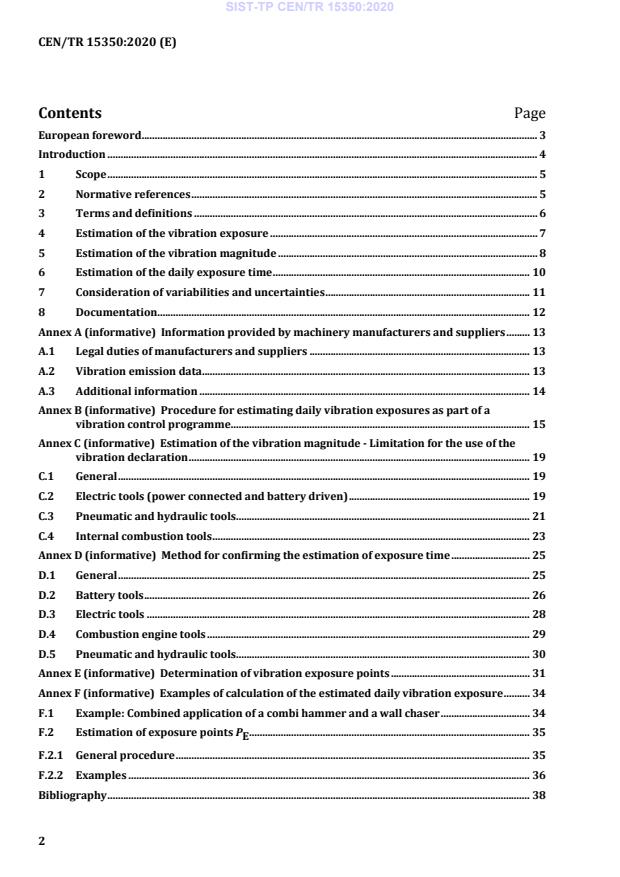
Contents Page
European foreword . 3
Introduction . 4
1 Scope . 5
2 Normative references . 5
3 Terms and definitions . 6
4 Estimation of the vibration exposure . 7
5 Estimation of the vibration magnitude . 8
6 Estimation of the daily exposure time . 10
7 Consideration of variabilities and uncertainties . 11
8 Documentation . 12
Annex A (informative) Information provided by machinery manufacturers and suppliers . 13
A.1 Legal duties of manufacturers and suppliers . 13
A.2 Vibration emission data . 13
A.3 Additional information . 14
Annex B (informative) Procedure for estimating daily vibration exposures as part of a
vibration control programme . 15
Annex C (informative) Estimation of the vibration magnitude - Limitation for the use of the
vibration declaration . 19
C.1 General . 19
C.2 Electric tools (power connected and battery driven) . 19
C.3 Pneumatic and hydraulic tools. 21
C.4 Internal combustion tools . 23
Annex D (informative) Method for confirming the estimation of exposure time . 25
D.1 General . 25
D.2 Battery tools . 26
D.3 Electric tools . 28
D.4 Combustion engine tools . 29
D.5 Pneumatic and hydraulic tools. 30
Annex E (informative) Determination of vibration exposure points . 31
Annex F (informative) Examples of calculation of the estimated daily vibration exposure . 34
F.1 Example: Combined application of a combi hammer and a wall chaser . 34
F.2 Estimation of exposure points P . 35
E
F.2.1 General procedure . 35
F.2.2 Examples . 36
Bibliography . 38
European foreword
This document (CEN/TR 15350:2020) has been prepared by Technical Committee CEN/TC 231
“Mechanical vibration and shock”, the secretariat of which is held by DIN.
Attention is drawn to the possibility that some of the elements of this document may be the subject of
patent rights. CEN shall not be held responsible for identifying any or all such patent rights.
This document supersedes CEN/TR 15350:2013.
The main changes are as follows:
— Document brought in line with CEN/TR 1030-2:2016 by removing content already covered there;
— Annex B updated by explaining the procedure for identifying vibration risks that need to be
controlled;
— Annex C now based on harmonized standards published after 2007 (e.g. EN 60745, EN 62841,
EN ISO 28927, EN ISO 22867), providing more realistic results, without the need of multiplying
factors, formely used for correcting the risk of underevaluating vibration exposure;
— new Annex D included, providing the estimation of exposure duration with examples of indicative
exposure durations according to the quality of operators.
Introduction
This document provides information on how to estimate the exposure time (exposure duration) and
how to assess the vibration exposure from hand-held power tools and hand-guided machines. The
methods described use existing vibration emission values declared for the machine of interest or
information coming from other sources.
Daily vibration exposure depends on both the average vibration magnitude at the vibrating surface in
contact with the hand and the total user time for which an employee is in contact with that vibration.
EN ISO 5349-1 notes that vibration is affected by many factors, such as force, posture, inserted tools etc.
It is therefore important to recognize that vibration exposure values are estimates of true exposures
and therefore estimates of true risk from hand-arm vibration. To make good exposure assessments it is
important to have an appreciation of the limitations of different vibration information sources (sources
such as collated information on types of machine, manufacturer’s declared emission values, or
workplace). However, it is also important to recognize when your estimate of exposure is sufficiently
precise for your application.
It is important that the vibration values used in the exposure assessment are representative of those in
the specific use of the machinery. Workplace measurements, however, are required if suitable data are
not available to represent the vibration under the specific working conditions or if the calculation
results do not help to decide whether or not the vibration exposure limit value or exposure action value
is likely to be exceeded or if appropriate information from health surveillance shows needs of
precaution.
1 Scope
This document gives guidelines for estimating and documenting the daily vibration exposure due to the
use of hand-held power tools and hand-guided machines, in relation to the requirements of the
European Physical Agents Directive (vibration) 2002/44/EC. This document is addressed to competent
services for the assessment of vibration exposure at the workplace and to national authorities and
industrial organizations.
The methods in this document are based on the requirements and guidance given in EN ISO 5349-1 and
EN ISO 5349-2 but instead of measuring the vibration magnitudes at the specific workplaces, the
methods in this document use existing vibration values from other sources of information including
those provided by the manufacturers of the machinery in relation to the requirements of the Machinery
Directive 2006/42/EC.
This document gives guidance on how to estimate the exposure time and the daily vibration exposure
A(8) as defined in EN ISO 5349-1. It also offers a simple method for estimating the daily vibration
exposure by means of a table which indicates the vibration exposure as a function of the equivalent
vibration total value and the associated exposure time. Both methods can be used even in cases of
multiple exposures on the same day.
2 Normative references
The following documents are referred to in the text in such a way that some or all of their content
constitutes requirements of this document. For dated references, only the edition cited applies. For
undated references, the latest edition of the referenced document (including any amendments) applies.
EN ISO 5349-1, Mechanical vibration - Measurement and evaluation of human exposure to hand-
transmitted vibration - Part 1: General requirements (ISO 5349-1)
EN ISO 5349-2:2001, Mechanical vibration - Measurement and evaluation of human exposure to hand-
transmitted vibration - Part 2: Practical guidance for measurement at the workplace (ISO 5349-2)
3 Terms and definitions
For the purposes of this document, the terms and definitions given in EN ISO 5349-2 and the following
apply.
ISO and IEC maintain terminological databases for use in standardization at the following addresses:
— ISO Online browsing platform: available at https://www.iso.org/obp
— IEC Electropedia: available at http://www.electropedia.org/
3.1
user time
user time of the work involving the use of the machinery, i.e. including the interruptions required by the
work and the break periods directly related to the use
Note 1 to entry: This is more likely to be reported by the operator than the exposure time (see 3.2).
3.2
exposure time
T
total duration the hand is in direct contact with the vibrating surface (handle, work piece, etc.)
EXAMPLE The user time for mounting wheels on five automobiles is estimated by the operator at 1 h per
day; but the exposure time is just 5 cars x 4 lug nuts x 4 wheels x 2 loosening/tightening actions x 4 s which yields
T = 0,18 h. The exposure proportion is only 18 %.
Note 1 to entry: The exposure time is often confused with the user time when estimating the daily exposure
time T.
3.3
equivalent vibration total value
a
hv,eq
time-averaged sum of the vibration total values of the various machinery operating modes, a , during
hvi
their associated exposure times T
i
m
a = a T (1)
hv,eq hv ii
∑
T
i=1
Note 1 to entry: For the vibration total value a , see EN ISO 5349-1. The total exposure time T for a machine is
hv
the sum of all m individual exposure times T within the entire work cycle considered (an example is given in
i
Annex F). If there is one operating mode only, then a = a .
hv,eq hv
3.4
partial vibration exposure points
P
E
index describing the vibration exposure from a single machine or work task during the associated
exposure time
a
hv,eq T
(2)
P × 100
E
8h
2,5 m/s
with the equivalent vibration total value a and the associated exposure time T
hv,eq
Note 1 to entry: Vibration exposure points are a simple alternative to the A(8) value for describing a person's
partial or total daily vibration exposure. The relationship is:
2,5 m/s
AP8 = (3)
( )
E
3.5
total vibration exposure points
P
E tot
sum of the partial vibration exposure points P within one day
E
n
PP= (4)
E tot ∑ E i
i=1
with n being the number of partial vibration exposures considered
Note 1 to entry: A score of 100 points for the total vibration exposure in a day is equal to the exposure action
2 2
value of A(8) = 2,5 m/s and a score of 400 points is equal to the exposure limit value of A(8) = 5 m/s (see
Annex E).
4 Estimation of the vibration exposure
4.1 General
The daily vibration exposure depends on two key elements:
a) average magnitude of vibration at the surface in contact with the hand and
b) total daily time for which an employee is in contact with that vibration.
The daily vibration exposure is determined from vibration magnitude and exposure time values
obtained using the procedures in Clauses 4 and 5. The principle of the procedure for the estimation of
the daily vibration exposure based on existing vibration values is outlined in Annex B. Estimation and
assessment can be performed either using A(8) values or more easily using vibration exposure points
P , see Annex E.
E
=
4.2 Using the daily vibration exposure A(8)
The daily vibration exposure A(8) can be calculated by using the equivalent vibration total value a
hv,eq
and the daily exposure time T for the specific machine and work task as follows:
T
A 8 = a (5)
( )
hv,eq
T
where T = 8 h.
If the work of the day consists of usage of n machines with the individual equivalent vibration total
value a and exposure time T for the i-th machine, calculate the partial vibration exposure for
hv,eq i i
each machine, A (8), according to Formula (5) and combine the A (8) values as follows:
i i
n
(6)
AA8 = 8
( ) ( )
∑ i
i= 1
This procedure is described in EN ISO 5349-1 and further guidance is given in EN ISO 5349-2. Examples
of the use of this procedure are shown in Annex F.
NOTE When a machine is used under several different working conditions with known vibration values, it
can be regarded as several machines each with its own vibration magnitude and exposure time.
The daily vibration exposure is assessed by comparison with the exposure action value of
2 2
A(8) = 2,5 m/s and the exposure limit value of A(8) = 5 m/s in order to establish the necessary action
by the employer (see the Physical Agents Directive 2002/44/EC and Table E.1). The daily exposure
values have a high level of uncertainty. If the estimated value is close to the exposure action value or the
exposure limit value it is better to assume that the value is likely to be exceeded and employers should
take necessary actions.
5 Estimation of the vibration magnitude
5.1 Sources of information
Vibration magnitudes may be measured at the workplace by the employer, or on his behalf. However,
this can be expensive and difficult and it is not always necessary. There are other sources of information
on vibration magnitudes, which are often sufficient to roughly estimate the daily vibration exposure of
workers and help to decide whether the exposure action value or the exposure limit value is likely to be
exceeded.
Declared vibration emission values may be available (and shall be available for hand-held power tools)
from manufacturers or suppliers of machinery. Some employers are making vibration measurement
data available to others in the same industry (often through trade associations); sharing information in
this way can be cost effective for companies using similar machinery for similar work. Other sources of
vibration data include specialist vibration consultants, employers' organizations (trade associations)
and government bodies. Data can also be found in various technical or scientific publications and on the
internet. If data from one of these sources are used, the quality and accuracy of the data should be
checked, e.g. by comparing data from two or more sources; comparing data from several sources is
generally recommended. It should be tried to find a value (or range of values) which represents the
likely vibration magnitude for the particular machine and operating conditions.
If sufficient magnitude data are not available from other sources, then workplace measurements might
become necessary.
5.2 Manufacturer’s declared vibration emission values
5.2.1 General
An important source of information is the manufacturer or supplier of the machinery. Annex A lists the
information employers can expect from manufacturers and suppliers to help them identify and manage
vibration risks.
An estimation of the vibration total value can be obtained in the manufacturer’s information. This
estimated value should be used only where the information in Annex C shows it is likely to be
representative of the specific use of the machinery. Where this is not possible, measurement of the
vibration, in accordance with EN ISO 5349-1, will be required for the specific use of the machine.
The principle of the procedure for the estimation of the daily vibration exposure based on existing
vibration values is outlined in Annex B. This method can be used only if all of the following conditions
are met:
a) declared vibration emission values(s) for the machine, and the test code used, are given, e.g. by the
manufacturer;
b) machine and equipment, like inserted tools, are in good condition and are maintained in
accordance with manufacturer’s recommendations;
c) machine and equipment, like inserted tools, are used according to manufacturer‘s
recommendations.
5.2.2 Vibration test codes
The vibration values given by manufacturers in their instruction handbooks or other publications
(declared vibration emission values) are determined under standardized measuring and operating
conditions which are defined in the appropriate vibration test code for the family of machines.
Following EN ISO 20643, the vibration test codes developed should use three axes and give values
representative of the upper quartile of vibration total values produced by the machines in their
intended use.
If the declared vibration emission value is not representative of the vibration likely in the intended use
of the machine, machine manufacturers and suppliers should provide additional information which may
include more appropriate information on likely vibration magnitudes in practical use (see Annex A).
5.2.3 Interpreting manufacturers' declared vibration emission values
If the machine manufacturer or supplier is unable to confirm that the declared vibration emission value
(and uncertainty K) represents the vibration in the intended use, and does not provide additional
information, then the employer may need to seek information from other sources or make
measurements at the workplace in order to assess the exposure of his employees (see 5.1 and 5.3).
Manufacturers will usually not publish vibration emission values if they are below 2,5 m/s but in this
2 2
case they shall state that it is less than 2,5 m/s . In this case the value of 2,5 m/s shall be used for
estimating exposures. In this case the value of 2,5 m/s shall be used for estimating exposures, see C.1.
If the declared emission vibration value is not determined by using a harmonized test code the
employer shall ensure that the way he is using the machine is in accordance with the operating
conditions described by the manufacturer. More information about the influence of machine operating
and measurement conditions can be found in EN ISO 20643.
NOTE Information about possibly influencing factors, like the influence of anti-vibration systems and
resilient grips inserted tools can be found in CEN/TR 1030-2.
5.3 When vibration measurements are appropriate
There may be situations in which the vibration exposures cannot adequately be estimated. It may then
be necessary to make measurements at the workplace.
EXAMPLE 1 A vibrating machine is used for an unusual purpose, of which the manufacturer has limited
previous experience and so cannot provide vibration information.
EXAMPLE 2 It may not be clear, from the limited information available, whether the exposure action value or
the exposure limit value is likely to be exceeded.
EXAMPLE 3 Employer may wish to check the effectiveness of actions taken to control vibration exposure.
Further information and practical guidance on exposure evaluation and vibration measurement at the
workplace is given in EN ISO 5349-2.
6 Estimation of the daily exposure time
The daily exposure time for each relevant machine or process should be determined. This should
generally be done directly by observing the work (see EN ISO 5349-2:2001, 5.5). Alternatively, this can
be done with reduced accuracy by multiplying the user time (e.g. that estimated by the operator) by an
appropriate exposure proportion.
It should be recognized that for most machines the vibration exposure time is shorter than the user
time.
In some special cases it may be possible to estimate the daily exposure time using generic exposure
times obtained from time studies.
Exposure time is often estimated subjectively. Table 1 lists the various methods for determining the
exposure time according to their quality.
Estimation of the exposure time should be accompanied by a plausibility check, for example by means
of the following procedure:
1) Division of the entire working time per day into periods with and without use of the tool.
2) Estimation of the duration of use of the tool in the case concerned.
3) Plausibility check with reference to the material or energy consumption.
4) Plausibility check with guideline values for the typical application case (see Annex D).
Table 1 — Methods for determining the exposure time according to their quality
Method Remarks
Time studies (video recordings, stopwatch) This method is resource-intensive, and consideration
may have to be given to the inaccuracy if short random
samples are used.
Measurement of the tool usage time with a This method and the measurement equipment are
sensor system fitted to the machine or described in CEN ISO/TR 19664 and in
equipment or worn by the operator EN ISO 5349-2:2001, Annex E.
Estimation of the duration of tool use and In almost all cases, the duration of use of a tool is
plausibility check against empirically higher than the actual duration of exposure.
observed exposure times Consequently, subjective estimation frequently leads
to the duration of exposure being overestimated, and
must therefore be accompanied by a plausibility check.
Estimation of the duration of exposure and Daily exposure times determined by manufacturers
performance of a plausibility check with are stated in Annex D according to the type of tool and
typical mean durations of exposure drive. Personal exposure times may however deviate
strongly from these values in specific cases.
7 Consideration of variabilities and uncertainties
There are many reasons to make a poor estimation of the vibration exposure because of the variabilities
of the conditions of the use of machines and uncertainties of measurements.
The vibration magnitude for a particular machine can be highly variable. For example, operators,
different operating conditions and different inserted tools all influence the actual magnitude. The
magnitude also often varies over time. It is usually difficult or impossible to obtain a precise value or
narrow value range, so an indication of the average value is all that can be expected. For exposure
estimation, it is usually necessary to take into account the fact that values are obtained within a range of
uncertainty (see CEN/TR 1030-2:2016, Annex H). In case of doubt the employer will have to check the
plausibility of his estimation by other means such as databases or the “Non-binding guide to good
practice for implementing Directive 2002/44/EC (Vibrations at work)”, Part I “Guide to good practice
on hand-arm vibration”, which is addressed to the European Member States.
NOTE 1 The uncertainty of the declared vibration emission value from the manufacturer is given as a K value
estimated in accordance with EN 12096. The uncertainty of the vibration value in real use is normally much
greater.
NOTE 2 The manufacturer's declared vibration emission values are determined using new or almost new
machines. Irregular or poor maintenance of machines can lead to substantial changes in the vibration emissions,
depending on the type of machine in question.
8 Documentation
EN ISO 5349-2 contains a list of information to be reported when evaluating vibration exposure. Where
vibration is not measured at the workplace, the following information should also be documented:
a) sources of vibration data used and observations on their quality;
b) description of vibration data, e.g. vibration total value or single-axis value, operating conditions;
c) description of exposure time and how it was estimated;
d) periods of observation;
e) any corrections (correction factor) to the vibration magnitude and the reasons for that;
f) consideration of uncertainty for vibration magnitude and exposure time;
g) documentation of the working task.
Annex A
(informative)
Information provided by machinery manufacturers and suppliers
A.1 Legal duties of manufacturers and suppliers
The European Machinery Directive 2006/42/EC requires machinery manufacturers to make their
products as safe as possible and to provide information on residual risks so that the machinery can be
used safely. This annex explains the duties of manufacturers and suppliers of machinery to provide
information that warns of risks from human exposure to vibration.
The instructions provided with a machine shall contain warnings about residual risks which have not
been eliminated in the design and manufacture of the machine, and which shall be managed.
For hand-held and hand-guided machinery, information on vibration emission shall be given in the
instruction handbook and in any sales literature or official publication in so far there is also information
on performance characteristics (e.g. power, input power, blowing performance). This is known as the
manufacturer's declared vibration emission: the weighted r.m.s. acceleration value to which the hands
and arms are subjected where this exceeds 2,5 m/s when determined by the appropriate vibration test
code (or a declaration that it does not exceed 2,5 m/s ).
A.2 Vibration emission data
The vibration emission data provided by machine manufacturers and suppliers should help employers
to:
a) compare different manufacturers' models of the same class of machinery to identify (and avoid)
any machines that have unusually high vibration emissions;
b) identify any significant differences between the vibration emissions of different machines which
are, in other respects, suitable for the particular task;
c) identify a likely range of vibration values in normal use of the machine.
Useful vibration information may also be available from the manufacturer for the assessment of the risk
from human exposure to vibration and a decision on the need to control the exposure and risk.
Suppliers should usually report vibration emission data which have been measured according to
harmonized European Standards. Examples of vibration test codes are EN ISO 28927 series and for
electric machines EN 60745 series and EN 62841 series.
Where no test code exists for a specific type of machinery, the general standard method given in
EN ISO 20643 is available to manufacturers to determine the vibration emission. They should select
realistic machine operating conditions for vibration tests with care to give values typical of the upper
range produced by the machine in its intended use. Manufacturers should report the test procedures
they have adopted, including the machine configuration, operating and loading conditions during the
test; and the locations and directions in which the vibration was measured.
In accordance with EN 12096, two values should be reported by machine manufacturers when
declaring the vibration emission of their product (see 5.2):
1) a (the average measured acceleration value) and
2) K (the uncertainty of a).
By declaring the a and K values, the supplier states that the value obtained from a reproduction of the
vibration emission test is likely to produce the a value of less than a + K. In some cases K can be more
than 40 % of a. The difference between the a values for two machines should not be considered
significant if it is smaller than one of the quoted K values.
A.3 Additional information
If the values produced by the vibration test code (a and K values) do not adequately reflect the vibration
during the intended use of the machine, the declared vibration emission may not be sufficient to warn
of the residual risk to be managed and more information should be provided. Supplementary
information on the likely magnitude (or range of magnitudes) for the machine in real use is one method
of compliance with the manufacturer's duty to warn of residual risks, see CEN/TR 1030-2.
Annex B
(informative)
Procedure for estimating daily vibration exposures as part of a vibration
control programme
Table B.1 shows the essential steps of the procedure for achieving and evaluating hand-arm vibration
risk that is suitable for the purpose of controlling workplace risks. Figure B.1 shows the phases of
procedure of Table B.1
The objective of the procedure in this Annex is to obtain sufficient information on vibration exposures
to identify those at risk and the tasks producing the highest vibration exposures; it is not designed to
obtain precise vibration exposures in every case. Using this procedure, should help employers to
quickly assess who is at risk and identify control priorities.
Table B.1 provides information on possible data sources and the information that needs to be
documented.
Directive 2002/44/EC states that the data obtained from the assessment and/or measurement of the
level of exposure to mechanical vibration shall be preserved in a suitable form so as to permit
consultation at a later stage.
Figure B.1 — Overview of exposure estimation procedures
Table B.1 — Procedure for identifying vibration risks that need to be controlled
Phase Para- Comments / sources / references Information to
meter be documented
PHASE 1: Initial estimation of hand-arm vibration
exposures
Phase 1 is the initial process of identifying
those workers who may be at risk.
1.A Identify workers (or A worker group consists of a set of workers Workers, or
worker groups) that who are essentially doing the same work, such worker groups
are exposed to that they are likely to receive similar vibration identified
hand-arm vibration exposures
1.B For each worker / T Exposure time is the time that the worker’s Daily vibration
i
worker group hand or hands are in contact with a vibrating exposure times
identify the sources surface. For hand-held power tools, this is
of hand-arm sometimes called: “trigger time”.
vibration and
You should assess separately the different
estimate the time
machines (and in some cases different machine
exposed to those
operating modes) that each worker or worker
sources.
group uses. For further information, see
EN ISO 5349-2.
1.C Obtain indicative a + k Use manufacturer’s vibration emission data or Indicative values
values for vibration other sources, such as vibration databases, or used for
magnitudes from generic information for machine types. vibration
each task, using magnitudes.
The value of a + k should be used, unless there
readily available
is evidence to show that the a value alone is
information, such as
more appropriate.
manufacturer
declared emission
data.
1.D Estimate partial A (8) The partial vibration exposure is the Partial vibration
i
vibration exposures contribution that a single machine makes to a exposures
for each task or workers daily vibration exposure (Formula 5)
operating mode.
1.E Estimate the total A(8) The total daily vibration exposure is a Total daily
daily vibration combination of the individual partial vibration vibration
exposure for each exposures (Formula 6) exposure
worker or worker
group.
1.F Identify those at The exposure action and limit values provide Comparison with
risk. Compare one indication of likely vibration risk. the exposure
estimated daily Comparison of likely exposures with these action and limit
vibration exposures values identifies those workers at greatest risk values
with the exposure and determines some of the actions employers
action and limit are required to take.
values
Phase Para- Comments / sources / references Information to
meter be documented
PHASE 2: Refinement of exposure estimates
The initial exposure estimates may need
improving, if control of exposure is not simple
and if the total daily exposure for a worker or
worker group is near to, or above, the exposure
action value or exposure limit value.
2.A Identify those A (8) Identify the activities with the higher partial
i
activities that vibration exposures. These are the activities
contribute most to where greatest benefit will be obtained from
the total daily either vibration reduction or refining the
vibration exposure. exposure estimate.
2.B Consider the need T Confirm exposure times for the identified Updated daily
i
to refine the activities. vibration
exposure time data exposure times
for the identified
activities
2.C Consider the need a Look for reliable alternative data sources for Updated
i
to refine the vibration magnitudes; particularly look for data vibration
vibration magnitude that relate closely to the real work activity in magnitudes
data for the your workplace. values
identified activities
If suitable alternative data are not available,
consider measurement.
2.D Re-calculate partial A (8) Re-calculate the partial daily vibration Updated partial
i
and daily vibration exposures and then the total daily vibration vibration
and
exposure estimates exposure. exposures
A(8)
Repeat Phase 2 if necessary &
Total daily
vibration
exposure
PHASE 3: Control of vibration exposures
At any vibration exposure, you should look for
opportunities to minimize that exposure. If
worker’s vibration exposure is likely to be at or
above the exposure action value, you should
look for ways to reduce exposure from those
activities that contribute most to that daily
vibration exposure.
3.A Reduce vibration a Review the work processes, machines used and New vibration
i
magnitude inserted tools used. Look for opportunities to magnitudes
eliminate exposure, or reduce vibration values
magnitudes by using alternative (e.g. low-
vibration) machines or more appropriate
inserted tools (e.g. abrasives, drill-bits, saw
blades). Consider worker training, machinery
maintenance and purchasing policies.
Phase Para- Comments / sources / references Information to
meter be documented
3.B Reduce vibration T Review how long individuals are operating New daily
i
exposure times machinery. Should the exposure times should vibration
be restricted? Can activities with high-exposure exposure times
be shared between workers?
3.C Re-assess vibration A (8) Re-calculate the partial daily vibration Updated partial
i
exposures exposures and then the total daily vibration vibration
and
exposure. exposures
A(8)
&
Total daily
vibration
exposure
3.D Consider other Vibration risks can be mitigated by:
ways to reduce risk
Keeping warm and dry
Using the correct grip and push forced (letting
the machine do the work)
Maintaining a good hand and body posture (e.g.
bring the work up to you rather than bending
down to do the work)
etc. (see CEN/TR 1030-2)
3.E Health surveillance Monitor workers for signs of hand-arm
vibration injury. Regular health surveillance
can highlight when vibration exposures are
actually greater than the estimated values.
Annex C
(informative)
Estimation of the vibration magnitude - Limitation for the use of the
vibration declaration
C.1 General
Vibration emission values declared according to harmonized standards published after 2007, such as
standards series EN 60745, EN 62841, EN ISO 28927 and EN ISO 22867, may be used for estimating the
daily vibration exposure. Nevertheless there is a risk of under evaluating the exposure for the following
cases, described in C.2 to C.4. The test codes were developed to simulate the most common usage of the
tools. In practice tools may be used for various applications which are not covered by the emission test
codes, examples, including further information, are given in C.2 to C.4.
In case of doubt it is recommended to add the uncertainty (k factor) to the corresponding declared
value. When the declared value is below 2,5 m/s , an estimation of the uncertainty can be up to
1,25 m/s .
NOTE 1 Where there is no possibility to measure vibration emission, because the tool is no longer available, an
alternative is to refer to CEN/TR 15350:2013.
Prior to 2005, the declared emission values for tools were based on single-axis values according to the
both meanwhile replaced standards series EN ISO 8662 and EN 50144 or the first edition of standards
series EN 60745. These values should not be used for estimating the daily vibration exposure.
Improper maintenance of the machine or cutting attachment can lead to higher vibration emissions.
Damaged or hardened rubber elements of the anti-vibration system can reduce the vibration isolation
of the machine. Furthermore, improper sharpening, dull or unbalanced cutting attachments are likely to
increase vibration emissions. These may result in higher vibration values compared to the
corresponding declared vibration emission value.
C.2 Electric tools (power connected and battery driven)
Table C.1 gives examples of results of verification tests.
Table C.1 — Examples of results of verification tests
Machine Vibration test code Real work task Further information
considered
(limited to standards in
place 2007 and after)
Drills EN 62841-2-1:2018 Drilling (without impact)
Impact drills EN 62841-2-1:2018 Impact drilling
Diamond drills EN 62841-2-1:2018 Wet diamond drilling
Dry diamond drilling
Screw drivers EN 62841-2-2:2014 Fastening screws
Impact EN 62841-2-2:2014 Impact fastening of
wrenches screws
Machine Vibration test code Real work task Further information
considered
(limited to standards in
place 2007 and after)
Grinders EN 60745-2-3:2011 Grinding and cutting a
different materials
Sanding different
materials and coatings
Polishing different
materials and coatings
Sanders, EN 62841-2-4:2014 Sanding different
polishers materials and coatings
Circular saws EN 62841-2-5:2014 Cutting wood and soft
materials
Hammer drills EN 60745-2-6:2010 Hammer drilling b
(combi drill)
Chiselling, breaking brick c
or concrete
Other applications with c
percussion to the wall
Breakers EN 60745-2-6:2010 Breaking concrete
(combi drill in
b
Breaking masonry
breaking
mode)
Sheet metal EN 62841-2-8:2016 Cutting sheet metal d
sheers and
nibblers
Tappers, EN 62841-2-9:2015 Tapping holes
threaders
Sabre saws EN 62841-2-11:2016 Cutting boards
Cutting beams and pipes
and demolition work
Jig saws EN 62841-2-11:2016 Cutting boards
Cutting sheet metal
Planers EN 62841-2-14:2015 Planning soft wood
Routers, EN 62841-2-17:2017 Cutting groves into MDF-
laminate board, cutting groves and
trimmers edges
Oscillating EN ISO 28927-8/A2 Cutting rubber e
knives
Transportable EN 62841-3-1:2014 Cutting woods
table saws
...
Questions, Comments and Discussion
Ask us and Technical Secretary will try to provide an answer. You can facilitate discussion about the standard in here.
Loading comments...