

SIST EN 12697-37:2022
(Main)Bituminous mixtures - Test methods - Part 37: Hot sand test for the adhesivity of binder on pre-coated chippings for Hot-Rolled-Asphalt (HRA)
General Information
- Abstract
This document describes a hot sand test method for determining the condition of the binder on coated chippings for use with hot rolled asphalt (HRA) surface course.
- Status
- Published
- Public Enquiry End Date
- 24-Feb-2021
- Publication Date
- 15-Jun-2022
- Technical Committee
- CES - Roads
- Current Stage
- 6060 - National Implementation/Publication (Adopted Project)
- Start Date
- 19-May-2022
- Due Date
- 24-Jul-2022
- Completion Date
- 16-Jun-2022



Overview
SIST EN 12697-37:2022 is a European standard developed by CEN that defines a hot sand test method to evaluate the adhesivity of bituminous binder on pre-coated chippings intended for use in Hot-Rolled Asphalt (HRA) surface courses. This standard method ensures that the binder coating on chippings has not been compromised by overheating, which could negatively affect the adhesion between the binder and chippings, critical for asphalt durability and performance.
The test assesses the condition of the binder by immersing coated chippings in hot sand under controlled conditions, with results expressed both by weighing retained sand and visual inspection. This test is crucial for quality control in road construction materials, particularly for ensuring the reliability and longevity of HRA surfaces.
Key Topics
Scope and Purpose: SIST EN 12697-37:2022 focuses on the binder condition on coated chippings, a vital parameter affecting the adhesivity and overall quality of Hot-Rolled Asphalt surface courses.
Test Principle:
- Coated chippings are immersed in hot silica sand at temperatures between 125 °C and 130 °C.
- Sand retention on chippings is measured by weight and visually inspected to determine binder adhesion.
Materials:
- Clean, dry silica sand and silica grit meeting specific grading and flow coefficient requirements (minimum Flow Coefficient (FCF) 27 s).
- The sand is refreshed regularly to maintain test accuracy.
Sampling and Preparation:
- Representative samples of minimum 25 kg are obtained from stockpiles, avoiding surplus or residual materials.
- Test portions are prepared with careful sample reduction procedures ensuring masses from 2,000 to 3,000 grams.
Equipment:
- Thermostatically controlled ovens, balances with ±1g accuracy, metal trays for hot sand, sieves meeting EN 933-2 specifications, and cylindrical tins for agitation.
Test Procedure Highlights:
- Heating sand to 125–130 °C.
- Sieving chippings to remove fines and ensure uniform size.
- Immersing chippings in hot sand for a minimum of 10 minutes maintaining sand temperature above 100 °C.
- Sieving and washing chippings post-test, drying them thoroughly before weighing and visual inspection.
Result Calculation:
- Proportion of retained sand relative to chippings mass, expressed in percentage.
- Proportion of chippings failing adhesion by visual criteria (less than half sand coverage), also given as a percentage.
Reporting and Precision:
- Detailed test reports include sample identification, test conditions, results, deviations, and observations.
- Precision data are not currently available for this test method.
Applications
SIST EN 12697-37:2022 is essential for professionals in road construction and maintenance, bituminous mixture manufacturing, and quality control laboratories involved with Hot-Rolled Asphalt (HRA) surfacing. Practical applications include:
Ensuring the adhesion quality of binder-coated chippings prior to asphalt production or laying to prevent premature surface failures.
Verifying that the coating process for chippings has not degraded the binder due to overheating, which could impact the longevity and safety of asphalt pavements.
Supporting material acceptance procedures for coated chippings used in surfacing applications, aligning with regulatory or project specifications.
Facilitating quality assurance programs by allowing reliable testing consistent with European standards, aiding in compliance and certification.
Related Standards
SIST EN 12697-37:2022 references several related standards supporting its methodology and context, including:
EN 12697-27 - Bituminous mixtures - Sampling methods, ensuring representative sample collection.
EN 12697-28 - Bituminous mixtures - Preparation of samples for determining binder content and grading.
EN 933-2 - Tests for geometrical properties of aggregates - Determination of particle size distribution using test sieves.
EN 933-6 - Tests for geometrical properties of aggregates - Assessment of flow coefficient, influencing sand and grit suitability.
These related parts of the EN 12697 series provide foundational procedures necessary for correct sample handling, preparation, and testing in bituminous mixture analysis.
By adhering to SIST EN 12697-37:2022, road material specialists ensure that hot-rolled asphalt surfaces achieve optimal binder-to-aggregate adhesion, leading to improved performance, durability, and safety of paved roads. This testing standard promotes best practices in materials testing and quality control in modern road construction.
Relations
- Effective Date
- 01-Jul-2022
- Effective Date
- 28-Jan-2026
- Effective Date
- 28-Jan-2026
- Effective Date
- 28-Jan-2026
- Effective Date
- 28-Jan-2026
- Referred By
SIST EN 13108-4:2016 - Bituminous mixtures - Material specifications - Part 4: Hot Rolled Asphalt - Effective Date
- 28-Jan-2026
- Referred By
SIST EN 13108-4:2006 - Bituminous mixtures - Material specifications - Part 4: Hot Rolled Asphalt - Effective Date
- 28-Jan-2026
- Referred By
SIST EN 13108-7:2016 - Bituminous mixtures - Material specifications - Part 7: Porous Asphalt - Effective Date
- 28-Jan-2026
- Effective Date
- 28-Jan-2026
Get Certified
Connect with accredited certification bodies for this standard

Zavod za gradbeništvo Slovenije (ZAG) - Inšpekcija
ZAG inspection body for construction products, structures, and materials.
Sponsored listings
Frequently Asked Questions
SIST EN 12697-37:2022 is a standard published by the Slovenian Institute for Standardization (SIST). Its full title is "Bituminous mixtures - Test methods - Part 37: Hot sand test for the adhesivity of binder on pre-coated chippings for Hot-Rolled-Asphalt (HRA)". This standard covers: This document describes a hot sand test method for determining the condition of the binder on coated chippings for use with hot rolled asphalt (HRA) surface course.
This document describes a hot sand test method for determining the condition of the binder on coated chippings for use with hot rolled asphalt (HRA) surface course.
SIST EN 12697-37:2022 is classified under the following ICS (International Classification for Standards) categories: 93.080.20 - Road construction materials. The ICS classification helps identify the subject area and facilitates finding related standards.
SIST EN 12697-37:2022 has the following relationships with other standards: It is inter standard links to SIST EN 12697-37:2004, SIST EN 12697-27:2017, SIST EN 933-2:2020, SIST EN 933-6:2023, SIST EN 12697-28:2020, SIST EN 13108-4:2016, SIST EN 13108-4:2006, SIST EN 13108-7:2016, SIST EN 13108-9:2016. Understanding these relationships helps ensure you are using the most current and applicable version of the standard.
SIST EN 12697-37:2022 is available in PDF format for immediate download after purchase. The document can be added to your cart and obtained through the secure checkout process. Digital delivery ensures instant access to the complete standard document.
Standards Content (Sample)
SLOVENSKI STANDARD
01-julij-2022
Nadomešča:
SIST EN 12697-37:2004
Bitumenske zmesi - Preskusne metode - 37. del: Preskus sprijemanja veziva s
posipom iz drobirja za asfaltiranje z vročim peskom (HRA)
Bituminous mixtures - Test methods - Part 37: Hot sand test for the adhesivity of binder
on pre-coated chippings for Hot-Rolled-Asphalt (HRA)
Asphalt - Prüfverfahren - Teil 37: Prüfung des Haftvermögens eines Bindemittels auf
vorumhülltem Splitt für Hot-Rolled-Asphalt (HRA) mittels heißem Sand
Mélanges bitumineux - Méthodes d’essai - Partie 37 : Essai au sable chaud pour
l’adhérence du liant sur des gravillons pré-enrobés pour Hot-Rolled Asphalt (HRA)
Ta slovenski standard je istoveten z: EN 12697-37:2022
ICS:
93.080.20 Materiali za gradnjo cest Road construction materials
2003-01.Slovenski inštitut za standardizacijo. Razmnoževanje celote ali delov tega standarda ni dovoljeno.
EN 12697-37
EUROPEAN STANDARD
NORME EUROPÉENNE
April 2022
EUROPÄISCHE NORM
ICS 93.080.20 Supersedes EN 12697-37:2003
English Version
Bituminous mixtures - Test methods - Part 37: Hot sand
test for the adhesivity of binder on pre-coated chippings
for Hot-Rolled-Asphalt (HRA)
Mélanges bitumineux - Méthodes d'essai - Partie 37 : Asphalt - Prüfverfahren - Teil 37: Prüfung des
Essai au sable chaud pour l'adhérence du liant sur des Haftvermögens eines Bindemittels auf vorumhülltem
gravillons pré-enrobés pour Hot-Rolled Asphalt (HRA) Splitt für Hot-Rolled-Asphalt (HRA) mittels heißem
Sand
This European Standard was approved by CEN on 21 February 2022.
CEN members are bound to comply with the CEN/CENELEC Internal Regulations which stipulate the conditions for giving this
European Standard the status of a national standard without any alteration. Up-to-date lists and bibliographical references
concerning such national standards may be obtained on application to the CEN-CENELEC Management Centre or to any CEN
member.
This European Standard exists in three official versions (English, French, German). A version in any other language made by
translation under the responsibility of a CEN member into its own language and notified to the CEN-CENELEC Management
Centre has the same status as the official versions.
CEN members are the national standards bodies of Austria, Belgium, Bulgaria, Croatia, Cyprus, Czech Republic, Denmark, Estonia,
Finland, France, Germany, Greece, Hungary, Iceland, Ireland, Italy, Latvia, Lithuania, Luxembourg, Malta, Netherlands, Norway,
Poland, Portugal, Republic of North Macedonia, Romania, Serbia, Slovakia, Slovenia, Spain, Sweden, Switzerland, Turkey and
United Kingdom.
EUROPEAN COMMITTEE FOR STANDARDIZATION
COMITÉ EUROPÉEN DE NORMALISATION
EUROPÄISCHES KOMITEE FÜR NORMUNG
CEN-CENELEC Management Centre: Rue de la Science 23, B-1040 Brussels
© 2022 CEN All rights of exploitation in any form and by any means reserved Ref. No. EN 12697-37:2022 E
worldwide for CEN national Members.
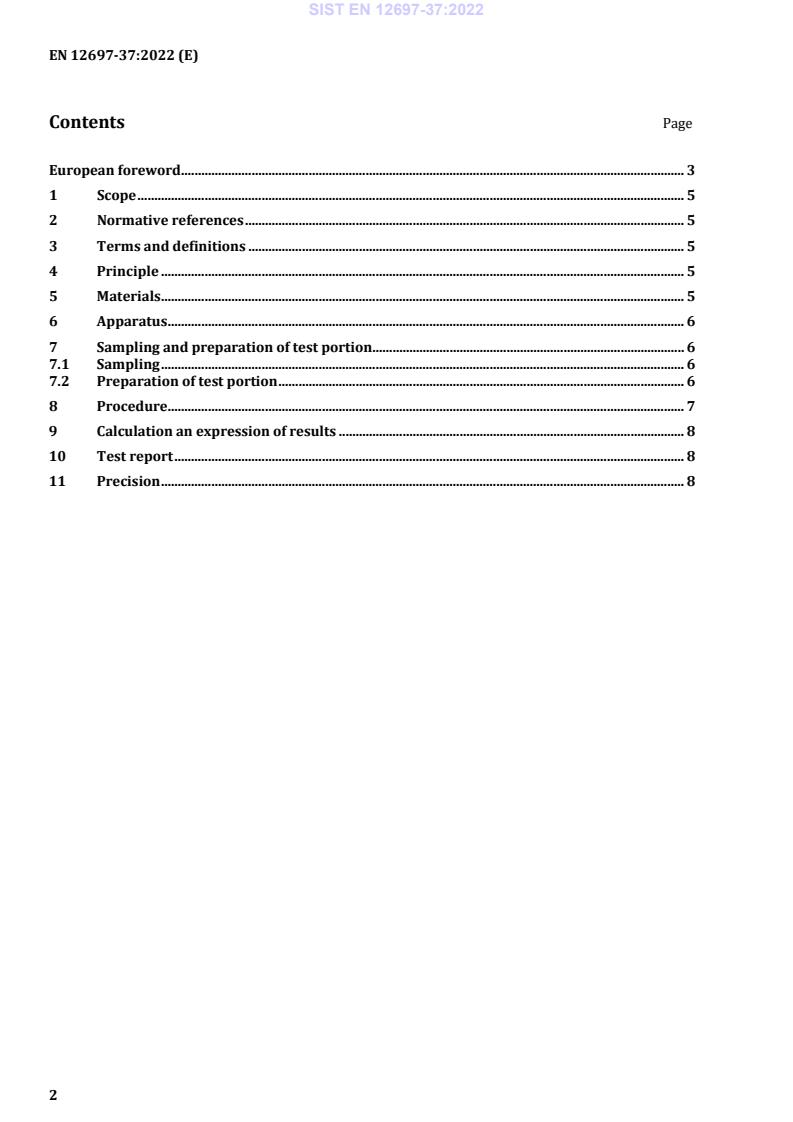
Contents Page
European foreword . 3
1 Scope . 5
2 Normative references . 5
3 Terms and definitions . 5
4 Principle . 5
5 Materials . 5
6 Apparatus . 6
7 Sampling and preparation of test portion . 6
7.1 Sampling . 6
7.2 Preparation of test portion . 6
8 Procedure. 7
9 Calculation an expression of results . 8
10 Test report . 8
11 Precision . 8
European foreword
This document (EN 12697-37:2022) has been prepared by Technical Committee CEN/TC 227 “Road
materials”, the secretariat of which is held by BSI.
This European Standard shall be given the status of a national standard, either by publication of an identical
text or by endorsement, at the latest by October 2022, and conflicting national standards shall be withdrawn
at the latest by October 2022.
Attention is drawn to the possibility that some of the elements of this document may be the subject of patent
rights. CEN shall not be held responsible for identifying any or all such patent rights.
This document supersedes EN 12697-37:2003.
The main changes compared to the previous edition are listed below:
— the title no longer refers to hot mix asphalt;
— the title completed with “Hot-Rolled Asphalt”. The abbreviation “HRA” placed within brackets;
— general editorial update according to current standard template;
— European Foreword, deletion of paragraph “The applicability of this European Standard is described in
prEN 13108-4”;
— deletion of reference to EN 13043. Correction of titles for EN 12697-27 and EN 12697-28;
— Clause 3, deletion of terms and definitions 3.1 to 3.9. Terms and definitions given in EN 12697-27 and
EN 12697-28 are applied in relevant paragraphs;
— Clause 4, revision of NOTE to normal text;
— Clause 5, completion of left column heading in Table 1 to read “Test sieve aperture size”;
— 6.2, replacement of “accuracy” with “maximum permissible error”;
— 6.4, replacement of “accuracy” with “maximum permissible error”;
— 6.5, replacement of sieve “350 mm” with sieve “300 mm”;
— Clause 7, alteration of title to read “Sampling and preparation of test portions”.
— 7.1, alteration of title to read “Sampling”. Clarification of paragraph;
— 7.2, alteration of title to read “Preparation of test portion”. Clarification of paragraph;
— 7.2, reference to EN 12697-28:2000, 4.5 deleted;
— 7.3 to 7.12, renumbered to 8.1 to 8.10;
— 7.13, deletion of paragraph. NOTE 1 and NOTE 2 amended to normal text and placed under 8.10;
— Clause 8, alteration of title to read “Procedure”. Former Clause 8 renumbered to Clause 9;
— 8.1 (7.3 in previous version), correction of description of sieve sizes. Unit changed to “mm”;
— 8.6 (7.8 in previous version), deletion of superfluous text “ensuring that the sand temperature is not less
than 100 °C;
— 8.7 (7.9 in previous version), correction of description of sieve sizes. Unit changed to “mm”;
— 8.10 (7.13 in previous version), NOTE 1 and NOTE 2 amended to normal text”;
— Clause 9 (Clause 8 in previous version), alteration of title to read “Calculation and expression of results”;
— 9.1 (8.1 in previous version), equations adjusted and completed with keys and numbered;
— 9.2, (8.2 in previous version), equations adjusted and completed with keys and numbered;
— Clause 10 (Clause 9 in previous version), revision of the order and data to be reported;
— Clause 11, renumbered from “Clause 10” to “Clause 11”;
— Bibliograhy, deletion of references to prEN 13108-4 and prEN 12697-38.
A list of all parts in the EN 12697 series can be found on the CEN website.
Any feedback and questions on this document should be directed to the users’ national standards body. A
complete listing of these bodies can be found
...