

oSIST prEN 17756:2026
(Main)Fertilizers, liming materials and inhibitors - Determination of the chloride content
- Abstract
This document specifies references to methods for the determination of the chloride content in organic fertilizers, organo-mineral fertilizers, inorganic fertilizers, liming materials and inhibitors.
This document is applicable to fertilizing product blends where the blend is a mix of at least two of the following components: fertilizers, liming materials, soil improvers, growing media, inhibitors, plant biostimulants, and where the following category: fertilizers is the highest % in the blend by mass or volume, or in the case of liquid form by dry mass. If fertilizer is not the highest % in the blend, the European Standard for the highest % of the blend applies. In case a fertilizing product blend is composed only of inorganic products, the European Standard for inorganic fertilizers applies.
NOTE Variations in analytical methods for fertilizing product blends can lead to differing results as some components or matrix interactions can affect the outcome. Validation procedures have shown that developed standard methods are robust and reliable across diverse product compositions, but possible interferences and unexpected results when analysing fertilizing product blends are possible.
- Status
- Not Published
- Public Enquiry End Date
- 01-Oct-2026
- Technical Committee
- KAT - Soil quality
- Current Stage
- 4020 - Public enquire (PE) (Adopted Project)
- Start Date
- 22-Jul-2026
- Due Date
- 09-Dec-2026

oSIST prEN 17756:2026 is the Slovenian draft of prEN 17756:2026, published by SIST and prepared in CEN. It specifies references to methods for determining chloride content in organic fertilizers, organo-mineral fertilizers, inorganic fertilizers, liming materials and inhibitors. In practice, it tells laboratories and compliance teams which sampling, preparation and measurement standards to use for chloride control in EU fertilising products.
What does oSIST prEN 17756:2026 specify?
oSIST prEN 17756:2026 sets out the method references for chloride content testing and the product groups they apply to. It also organizes the work into scope, normative references, terms and definitions, sampling and sample preparation, chloride determination, and an informative annex on EU legal alignment.
The scope is broader than single-ingredient products. It also covers fertilizing product blends when fertilizers are the largest component by mass or volume, or by dry mass for liquid forms. If another component category is dominant, the standard for that category applies instead; if the blend is made only of inorganic products, the inorganic-fertilizer standard applies.
| Annex | What it covers |
|---|---|
| Annex ZA | Relationship between this European Standard and Regulation (EU) 2019/1009, including the link to conformity with essential requirements |
What are the key requirements of oSIST prEN 17756:2026?
Scope control, Clause 1. oSIST prEN 17756:2026 applies to organic fertilizers, organo-mineral fertilizers, inorganic fertilizers, liming materials and inhibitors, plus qualifying fertilizing product blends. For a buyer or laboratory, this means the first task is to classify the product correctly before choosing a method.
Sampling is external to the method, Clause 4.1. Sampling itself is not part of this standard; EN 1482-1 and EN 1482-3 are given as recommended sampling methods. The laboratory sample should be representative and should not be altered during transport or storage, because a poor sample can invalidate the chloride result.
Sample preparation follows EN 1482-2:2024, Clause 4.2. This keeps preparation consistent before analysis. In practice, the lab should not improvise its own preparation route if it wants comparable results.
Method selection depends on product type, Clause 5. For fertilizers and liming materials, prEN 17758:2026 is the referenced method. For inhibitors, prEN 18388:2026 is used. For inorganic fertilizers and liming materials in the absence of organic material, EN 16195 may be used. This is the core decision point for routine testing.
Result expression is fixed, Clause 5. The mass fraction of chlorides, Cl, is reported in g/kg. That gives a common reporting basis for specifications, conformity checks and certificates.
EU legal alignment is mapped in Annex ZA. Annex ZA links Clause 4 and Clause 5 to Annex III, Part I, point 9 of Regulation (EU) 2019/1009. For users placing products on the EU market, this is the route by which the standard supports conformity assessment once cited in the Official Journal of the European Union.
What terms does oSIST prEN 17756:2026 define?
- Organic fertilizers - A product category within the scope of this chloride-determination standard.
- Organo-mineral fertilizers - A product category treated separately from purely organic and purely inorganic fertilizers.
- Inorganic fertilizers - A product category for which the standard gives a specific chloride-testing route, including blends made only of inorganic products.
- Liming materials - Materials within scope that can be tested for chloride content under this document.
- Inhibitors - Products within scope for which prEN 18388:2026 is the referenced chloride method.
- Fertilizing product blends - Mixtures of at least two listed component types, classified by the dominant category for method selection.
- mass fraction of chlorides (Cl), w - The reported chloride result, expressed in g/kg.
Who uses oSIST prEN 17756:2026?
This standard is used by testing laboratories, fertilizer and liming-material manufacturers, inhibitor producers, and conformity assessment teams. It is also relevant to quality managers, buyers and regulatory staff who need to check chloride content against product specifications or EU fertilising product requirements. In practice, they use it for sampling control, method selection, reporting and compliance documentation.
What changed in oSIST prEN 17756:2026 from the previous edition?
oSIST prEN 17756:2026 supersedes CEN/TS 17756:2022. The stated changes are:
- adoption of the CEN Technical Specification as a European Standard, including Annex ZA;
- addition of chloride determination for inhibitors in Clause 5;
- updated scope;
- updated normative references;
- updated bibliography.
Which standards are used with oSIST prEN 17756:2026?
| Standard | What it contributes |
|---|---|
| EN 1482-2:2024 | General sample preparation provisions |
| EN 12944-1:1999 | General vocabulary |
| EN 12944-2:1999 | Vocabulary for fertilizers |
| EN 12944-3:2025 | Vocabulary for liming materials |
| prEN 17758:2026 | Chloride determination by potentiometric titration for fertilizers and liming materials |
| prEN 18388:2026 | Chloride determination by ion chromatography and conductivity detection for inhibitors |
| EN 1482-1 | Recommended general sampling provisions |
| EN 1482-3 | Recommended sampling of static heaps |
| EN 16195 | Alternative chloride determination for inorganic fertilizers and liming materials in the absence of organic material |
What does the oSIST prEN 17756:2026 document contain?
The document contains a short framework centered on method choice rather than a full standalone laboratory procedure. It covers scope, terminology, sampling, sample preparation, chloride determination and a legal-relationship annex. Annex ZA includes a correspondence table between the standard and Regulation (EU) 2019/1009, and the bibliography lists the linked legal and technical references.
Relations
- Effective Date
- 01-Sep-2026
Get Certified
Connect with accredited certification bodies for this standard

Control Union Certifications
Global certification for agriculture and sustainability.
ECOCERT
Organic and sustainability certification.

FSC International
Forest Stewardship Council certification.
Sponsored listings
Frequently Asked Questions
oSIST prEN 17756:2026 is a draft published by the Slovenian Institute for Standardization (SIST). Its full title is "Fertilizers, liming materials and inhibitors - Determination of the chloride content". This standard covers: This document specifies references to methods for the determination of the chloride content in organic fertilizers, organo-mineral fertilizers, inorganic fertilizers, liming materials and inhibitors. This document is applicable to fertilizing product blends where the blend is a mix of at least two of the following components: fertilizers, liming materials, soil improvers, growing media, inhibitors, plant biostimulants, and where the following category: fertilizers is the highest % in the blend by mass or volume, or in the case of liquid form by dry mass. If fertilizer is not the highest % in the blend, the European Standard for the highest % of the blend applies. In case a fertilizing product blend is composed only of inorganic products, the European Standard for inorganic fertilizers applies. NOTE Variations in analytical methods for fertilizing product blends can lead to differing results as some components or matrix interactions can affect the outcome. Validation procedures have shown that developed standard methods are robust and reliable across diverse product compositions, but possible interferences and unexpected results when analysing fertilizing product blends are possible.
This document specifies references to methods for the determination of the chloride content in organic fertilizers, organo-mineral fertilizers, inorganic fertilizers, liming materials and inhibitors. This document is applicable to fertilizing product blends where the blend is a mix of at least two of the following components: fertilizers, liming materials, soil improvers, growing media, inhibitors, plant biostimulants, and where the following category: fertilizers is the highest % in the blend by mass or volume, or in the case of liquid form by dry mass. If fertilizer is not the highest % in the blend, the European Standard for the highest % of the blend applies. In case a fertilizing product blend is composed only of inorganic products, the European Standard for inorganic fertilizers applies. NOTE Variations in analytical methods for fertilizing product blends can lead to differing results as some components or matrix interactions can affect the outcome. Validation procedures have shown that developed standard methods are robust and reliable across diverse product compositions, but possible interferences and unexpected results when analysing fertilizing product blends are possible.
oSIST prEN 17756:2026 is classified under the following ICS (International Classification for Standards) categories: 65.080 - Fertilizers. The ICS classification helps identify the subject area and facilitates finding related standards.
oSIST prEN 17756:2026 has the following relationships with other standards: It is inter standard links to SIST-TS CEN/TS 17756:2023. Understanding these relationships helps ensure you are using the most current and applicable version of the standard.
oSIST prEN 17756:2026 is associated with the following European legislation: EU Directives/Regulations: 2019/1009; Standardization Mandates: M/564, M/564 AMD 1, M/564 AMD 2. When a standard is cited in the Official Journal of the European Union, products manufactured in conformity with it benefit from a presumption of conformity with the essential requirements of the corresponding EU directive or regulation.
oSIST prEN 17756:2026 is available in PDF format for immediate download after purchase. The document can be added to your cart and obtained through the secure checkout process. Digital delivery ensures instant access to the complete standard document.
Standards Content (Sample)
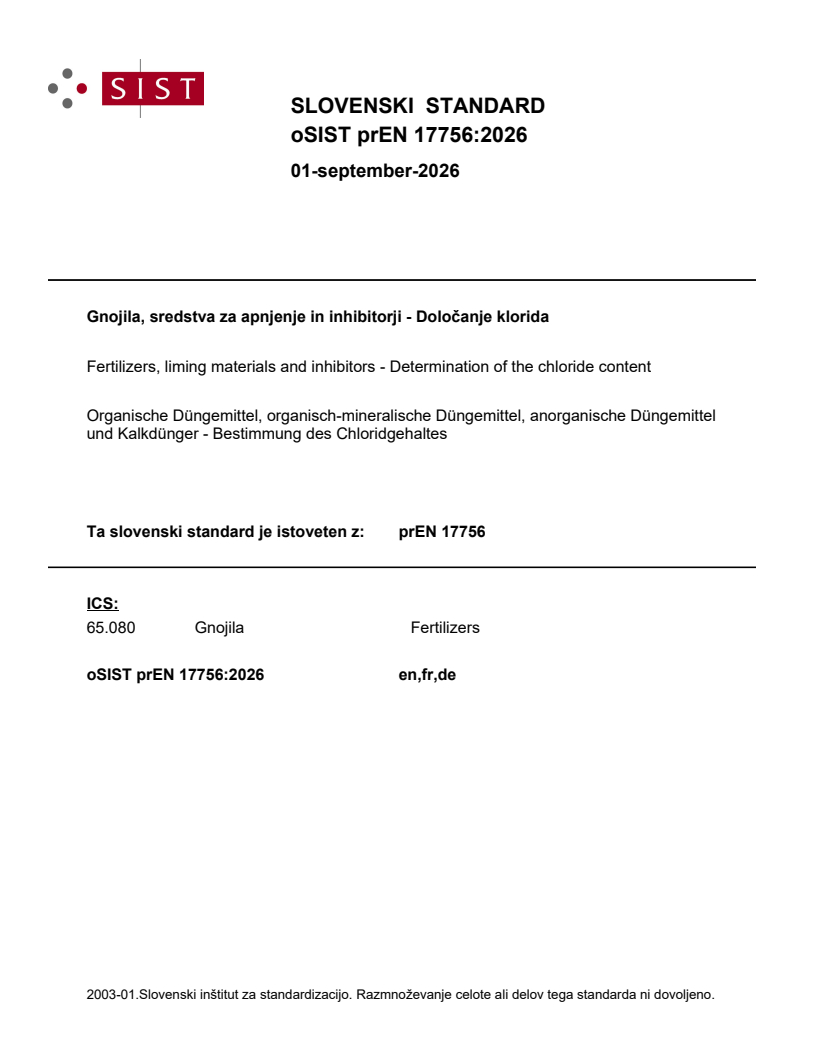
SLOVENSKI STANDARD
01-september-2026
Gnojila, sredstva za apnjenje in inhibitorji - Določanje klorida
Fertilizers, liming materials and inhibitors - Determination of the chloride content
Organische Düngemittel, organisch-mineralische Düngemittel, anorganische Düngemittel
und Kalkdünger - Bestimmung des Chloridgehaltes
Ta slovenski standard je istoveten z: prEN 17756
ICS:
65.080 Gnojila Fertilizers
2003-01.Slovenski inštitut za standardizacijo. Razmnoževanje celote ali delov tega standarda ni dovoljeno.
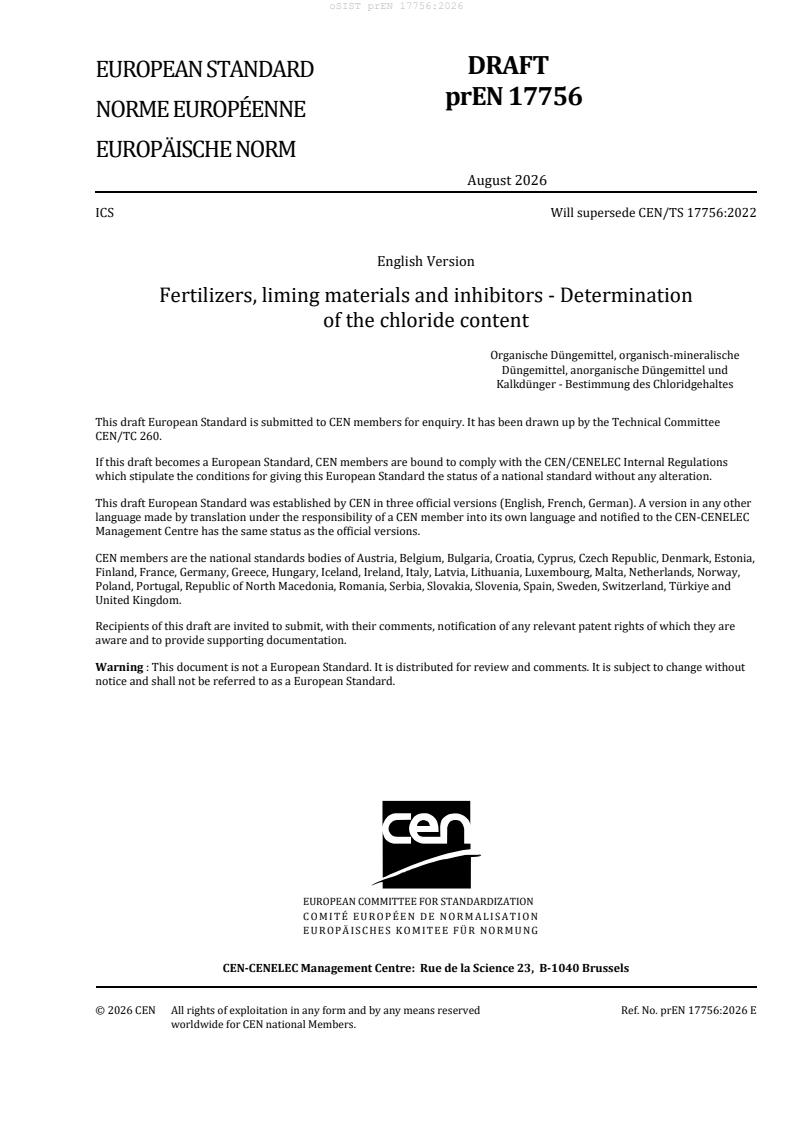
DRAFT
EUROPEAN STANDARD
NORME EUROPÉENNE
EUROPÄISCHE NORM
August 2026
ICS Will supersede CEN/TS 17756:2022
English Version
Fertilizers, liming materials and inhibitors - Determination
of the chloride content
Organische Düngemittel, organisch-mineralische
Düngemittel, anorganische Düngemittel und
Kalkdünger - Bestimmung des Chloridgehaltes
This draft European Standard is submitted to CEN members for enquiry. It has been drawn up by the Technical Committee
CEN/TC 260.
If this draft becomes a European Standard, CEN members are bound to comply with the CEN/CENELEC Internal Regulations
which stipulate the conditions for giving this European Standard the status of a national standard without any alteration.
This draft European Standard was established by CEN in three official versions (English, French, German). A version in any other
language made by translation under the responsibility of a CEN member into its own language and notified to the CEN-CENELEC
Management Centre has the same status as the official versions.
CEN members are the national standards bodies of Austria, Belgium, Bulgaria, Croatia, Cyprus, Czech Republic, Denmark, Estonia,
Finland, France, Germany, Greece, Hungary, Iceland, Ireland, Italy, Latvia, Lithuania, Luxembourg, Malta, Netherlands, Norway,
Poland, Portugal, Republic of North Macedonia, Romania, Serbia, Slovakia, Slovenia, Spain, Sweden, Switzerland, Türkiye and
United Kingdom.
Recipients of this draft are invited to submit, with their comments, notification of any relevant patent rights of which they are
aware and to provide supporting documentation.
Warning : This document is not a European Standard. It is distributed for review and comments. It is subject to change without
notice and shall not be referred to as a European Standard.
EUROPEAN COMMITTEE FOR STANDARDIZATION
COMITÉ EUROPÉEN DE NORMALISATION
EUROPÄISCHES KOMITEE FÜR NORMUNG
CEN-CENELEC Management Centre: Rue de la Science 23, B-1040 Brussels
© 2026 CEN All rights of exploitation in any form and by any means reserved Ref. No. prEN 17756:2026 E
worldwide for CEN national Members.
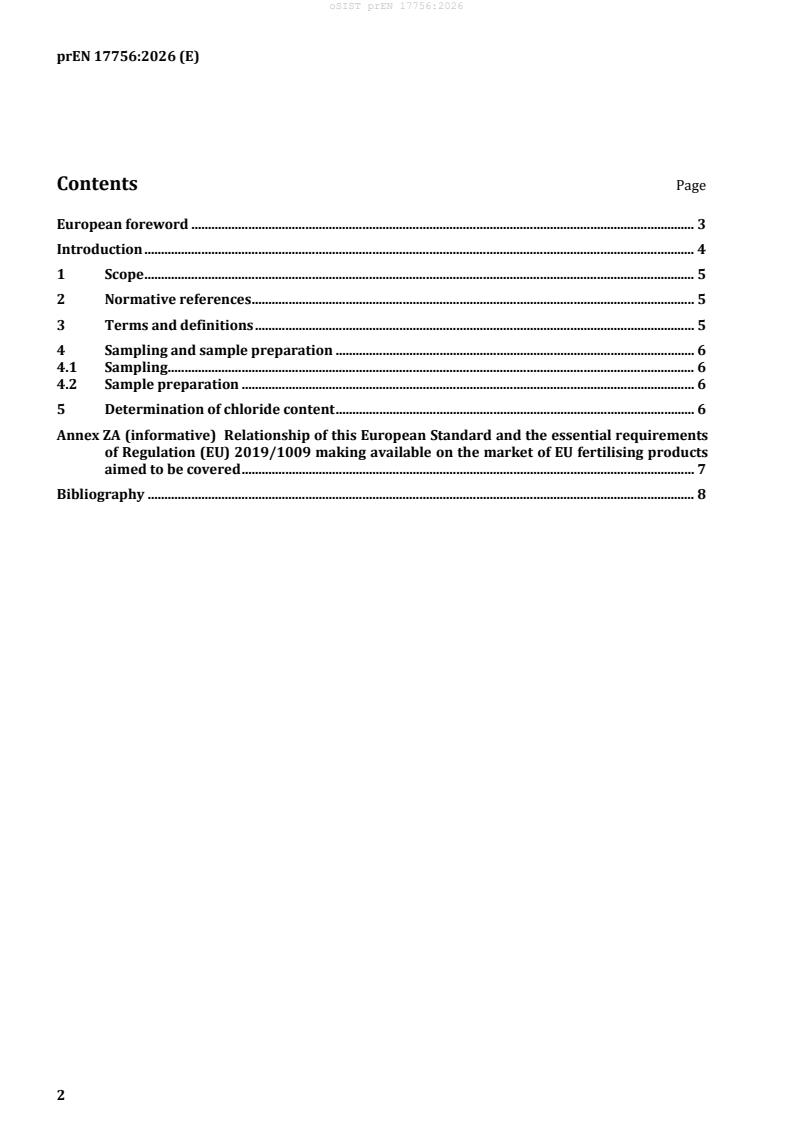
Contents Page
European foreword . 3
Introduction . 4
1 Scope . 5
2 Normative references . 5
3 Terms and definitions . 5
4 Sampling and sample preparation . 6
4.1 Sampling . 6
4.2 Sample preparation . 6
5 Determination of chloride content . 6
Annex ZA (informative) Relationship of this European Standard and the essential requirements
of Regulation (EU) 2019/1009 making available on the market of EU fertilising products
aimed to be covered . 7
Bibliography . 8
European foreword
This document (prEN 17756:2026) has been prepared by Technical Committee CEN/TC 260 “Fertilizers
and liming materials”, the secretariat of which is held by DIN.
This document is currently submitted to the CEN Enquiry.
This document will supersede CEN/TS 17756:2022.
CEN/TS 17756:2022:
a) The CEN Technical Specification has been adopted as a European Standard including the addition of
Annex ZA;
b) Determination of the chloride content in inhibitors added to Clause 5;
c) Scope (Clause 1) updated;
d) Normative references (Clause 2) updated;
e) Bibliography updated.
This document has been prepared under a standardization request addressed to CEN by the European
Commission. The Standing Committee of the EFTA States subsequently approves these requests for its
Member States.
For the relationship with EU Legislation, see informative Annex ZA, which is an integral part of this
document.
Introduction
Regulation (EU) 2019/1009 [1] lays down the rules on the making available on the market of EU
fertilizing products and the specific safety and quality requirements for the defined product function
categories (PFCs).
The specific safety and quality requirements in relation to the determination of chloride content in
organic fertilizers, organo-mineral fertilizers, inorganic fertilizers and liming materials are defined in this
document as well as normative references of the test methods to be used in order to measure the
compliance w
...