

SIST EN ISO 3262-1:2020
(Main)Extenders - Specifications and methods of test - Part 1: Introduction and general test methods (ISO 3262-1:2020)
General Information
- Abstract
This document gives the definition for the term extender and specifies test methods that are required for most of the subsequent parts of ISO 3262.
NOTE The subsequent parts of ISO 3262 specify requirements and the corresponding methods of test for extenders for use in paints, related coating materials and other applications.
- Status
- Published
- Public Enquiry End Date
- 30-Sep-2019
- Publication Date
- 04-May-2020
- Technical Committee
- PIP - Pigments and extenders
- Current Stage
- 6060 - National Implementation/Publication (Adopted Project)
- Start Date
- 22-Apr-2020
- Due Date
- 27-Jun-2020
- Completion Date
- 05-May-2020


Overview
EN ISO 3262-1:2020 - "Extenders - Specifications and methods of test - Part 1: Introduction and general test methods" (ISO 3262-1:2020) is the introductory part of the ISO 3262 series. Published by CEN/ISO in 2020, it defines the term extender and specifies the general sampling and test methods used as the basis for the subsequent parts of the ISO 3262 series. This part supersedes earlier editions and focuses on extenders for paints, related coating materials and other applications where extenders modify physical properties.
Key topics and technical requirements
- Definition of extender: Extenders are granular or powdered materials, practically insoluble or only slightly soluble in the application medium, used to modify physical properties.
- Sampling: Requires representative sampling according to ISO 15528 to ensure test results reflect the product batch.
- General test methods included as referee procedures:
- Comparison of colour - a visual referee method (with allowance for agreed instrumental methods such as CIE Lab* per ISO 11664-4; ISO 18314-1 for near-white hue assessment is noted).
- Determination of loss on ignition (LOI) - ignition at 1 000 ± 25 °C to constant mass, with calculation of mass loss expressed as percent.
- Determination of calcium and magnesium contents - chemical titration procedures including required reagents (e.g., HCl, EDTA solution), indicators (Calcon, Eriochrome black T), and apparatus; reagents are specified with CAS numbers.
- Normative references: Laboratory glassware and analytical methods referenced include ISO 385, ISO 648, ISO 787-2, ISO 1042, ISO 3696, ISO 3819 and ISO 15528.
Practical applications
- Ensures consistent quality control for raw extenders used in paints, coatings and related materials.
- Provides standardized test methods for vendors, manufacturers and QC laboratories to verify physical and chemical properties (colour, volatile content, LOI, Ca/Mg).
- Forms the foundation for product specifications in supply contracts and regulatory compliance for pigment and extender materials.
Who should use this standard
- Paint and coatings manufacturers and formulators
- Raw material and extender suppliers
- Quality control and analytical laboratories
- Standards committees and procurement specialists specifying extender performance
Related standards
- Other parts of the ISO 3262 series (specific extenders and their test limits)
- ISO 787-2 (volatile matter at 105 °C)
- ISO 11664-4 (colour coordinates, CIE Lab*)
- ISO 15528 (sampling)
- ISO 3696 (water for analytical use)
This standard is essential for anyone involved in specifying, testing or supplying extenders for paints and coatings, providing harmonized test methods and definitions to support reliable product performance and supply chain consistency.
Relations
- Effective Date
- 01-Jun-2020
- Effective Date
- 25-Aug-2026
- Effective Date
- 09-Feb-2026
- Effective Date
- 28-Jan-2026
Frequently Asked Questions
SIST EN ISO 3262-1:2020 is a standard published by the Slovenian Institute for Standardization (SIST). Its full title is "Extenders - Specifications and methods of test - Part 1: Introduction and general test methods (ISO 3262-1:2020)". This standard covers: This document gives the definition for the term extender and specifies test methods that are required for most of the subsequent parts of ISO 3262. NOTE The subsequent parts of ISO 3262 specify requirements and the corresponding methods of test for extenders for use in paints, related coating materials and other applications.
This document gives the definition for the term extender and specifies test methods that are required for most of the subsequent parts of ISO 3262. NOTE The subsequent parts of ISO 3262 specify requirements and the corresponding methods of test for extenders for use in paints, related coating materials and other applications.
SIST EN ISO 3262-1:2020 is classified under the following ICS (International Classification for Standards) categories: 87.060.10 - Pigments and extenders. The ICS classification helps identify the subject area and facilitates finding related standards.
SIST EN ISO 3262-1:2020 has the following relationships with other standards: It is inter standard links to SIST EN ISO 3262-1:1998, SIST ISO 1042:1998, SIST ISO 3696:1995, SIST EN 15649-3:2010. Understanding these relationships helps ensure you are using the most current and applicable version of the standard.
SIST EN ISO 3262-1:2020 is available in PDF format for immediate download after purchase. The document can be added to your cart and obtained through the secure checkout process. Digital delivery ensures instant access to the complete standard document.
Standards Content (Sample)
SLOVENSKI STANDARD
01-junij-2020
Nadomešča:
SIST EN ISO 3262-1:1998
Polnila - Specifikacije in preskusne metode - 1. del: Uvod in splošne preskusne
metode (ISO 3262-1:2020)
Extenders - Specifications and methods of test - Part 1: Introduction and general test
methods (ISO 3262-1:2020)
Füllstoffe - Anforderungen und Prüfverfahren - Teil 1: Einleitung und allgemeine
Prüfverfahren (ISO 3262-1:2020)
Matières de charge - Spécifications et méthodes d'essai - Partie 1: Introduction et
méthodes d'essai générales (ISO 3262-1:2020)
Ta slovenski standard je istoveten z: EN ISO 3262-1:2020
ICS:
87.060.10 Pigmenti in polnila Pigments and extenders
2003-01.Slovenski inštitut za standardizacijo. Razmnoževanje celote ali delov tega standarda ni dovoljeno.
EN ISO 3262-1
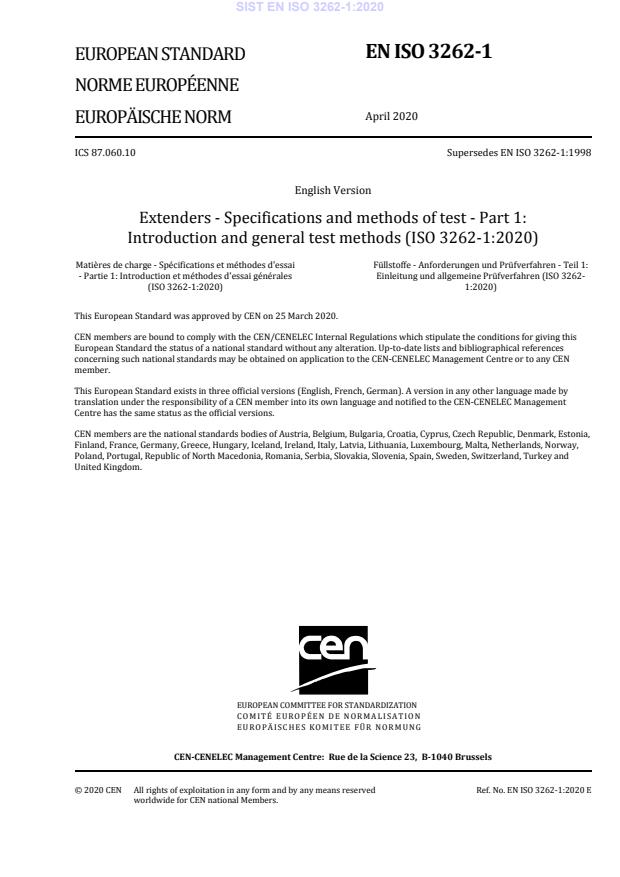
EUROPEAN STANDARD
NORME EUROPÉENNE
April 2020
EUROPÄISCHE NORM
ICS 87.060.10 Supersedes EN ISO 3262-1:1998
English Version
Extenders - Specifications and methods of test - Part 1:
Introduction and general test methods (ISO 3262-1:2020)
Matières de charge - Spécifications et méthodes d'essai Füllstoffe - Anforderungen und Prüfverfahren - Teil 1:
- Partie 1: Introduction et méthodes d'essai générales Einleitung und allgemeine Prüfverfahren (ISO 3262-
(ISO 3262-1:2020) 1:2020)
This European Standard was approved by CEN on 25 March 2020.
CEN members are bound to comply with the CEN/CENELEC Internal Regulations which stipulate the conditions for giving this
European Standard the status of a national standard without any alteration. Up-to-date lists and bibliographical references
concerning such national standards may be obtained on application to the CEN-CENELEC Management Centre or to any CEN
member.
This European Standard exists in three official versions (English, French, German). A version in any other language made by
translation under the responsibility of a CEN member into its own language and notified to the CEN-CENELEC Management
Centre has the same status as the official versions.
CEN members are the national standards bodies of Austria, Belgium, Bulgaria, Croatia, Cyprus, Czech Republic, Denmark, Estonia,
Finland, France, Germany, Greece, Hungary, Iceland, Ireland, Italy, Latvia, Lithuania, Luxembourg, Malta, Netherlands, Norway,
Poland, Portugal, Republic of North Macedonia, Romania, Serbia, Slovakia, Slovenia, Spain, Sweden, Switzerland, Turkey and
United Kingdom.
EUROPEAN COMMITTEE FOR STANDARDIZATION
COMITÉ EUROPÉEN DE NORMALISATION
EUROPÄISCHES KOMITEE FÜR NORMUNG
CEN-CENELEC Management Centre: Rue de la Science 23, B-1040 Brussels
© 2020 CEN All rights of exploitation in any form and by any means reserved Ref. No. EN ISO 3262-1:2020 E
worldwide for CEN national Members.
Contents Page
European foreword . 3
European foreword
This document (EN ISO 3262-1:2020) has been prepared by Technical Committee ISO/TC 256
"Pigments, dyestuffs and extenders" in collaboration with Technical Committee CEN/TC 298 “Pigments
and extenders” the secretariat of which is held by DIN.
This European Standard shall be given the status of a national standard, either by publication of an
identical text or by endorsement, at the latest by October 2020, and conflicting national standards shall
be withdrawn at the latest by October 2020.
Attention is drawn to the possibility that some of the elements of this document may be the subject of
patent rights. CEN shall not be held responsible for identifying any or all such patent rights.
This document supersedes EN ISO 3262-1:1998.
According to the CEN-CENELEC Internal Regulations, the national standards organizations of the
following countries are bound to implement this European Standard: Austria, Belgium, Bulgaria,
Croatia, Cyprus, Czech Republic, Denmark, Estonia, Finland, France, Germany, Greece, Hungary, Iceland,
Ireland, Italy, Latvia, Lithuania, Luxembourg, Malta, Netherlands, Norway, Poland, Portugal, Republic of
North Macedonia, Romania, Serbia, Slovakia, Slovenia, Spain, Sweden, Switzerland, Turkey and the
United Kingdom.
Endorsement notice
The text of ISO 3262-1:2020 has been approved by CEN as EN ISO 3262-1:2020 without any
modification.
INTERNATIONAL ISO
STANDARD 3262-1
Second edition
2020-03
Extenders — Specifications and
methods of test —
Part 1:
Introduction and general test methods
Matières de charge — Spécifications et méthodes d'essai —
Partie 1: Introduction et méthodes d'essai générales
Reference number
ISO 3262-1:2020(E)
©
ISO 2020
ISO 3262-1:2020(E)
© ISO 2020
All rights reserved. Unless otherwise specified, or required in the context of its implementation, no part of this publication may
be reproduced or utilized otherwise in any form or by any means, electronic or mechanical, including photocopying, or posting
on the internet or an intranet, without prior written permission. Permission can be requested from either ISO at the address
below or ISO’s member body in the country of the requester.
ISO copyright office
CP 401 • Ch. de Blandonnet 8
CH-1214 Vernier, Geneva
Phone: +41 22 749 01 11
Fax: +41 22 749 09 47
Email: copyright@iso.org
Website: www.iso.org
Published in Switzerland
ii © ISO 2020 – All rights reserved
ISO 3262-1:2020(E)
Contents Page
Foreword .iv
1 Scope . 1
2 Normative references . 1
3 Terms and definitions . 1
4 Sampling . 2
5 Test methods . 2
5.1 Comparison of colour . 2
5.2 Determination of loss on ignition . 2
5.2.1 Apparatus . 2
5.2.2 Procedure . 2
5.2.3 Expression of results . 3
5.3 Determination of calcium and magnesium contents . 3
5.3.1 Reagents . 3
5.3.2 Apparatus . 4
5.3.3 Procedure . 4
Bibliography . 6
ISO 3262-1:2020(E)
Foreword
ISO (the International Organization for Standardization) is a worldwide federation of national standards
bodies (ISO member bodies). The work of preparing International Standards is normally carried out
through ISO technical committees. Each member body interested in a subject for which a technical
committee has been established has the right to be represented on that committee. International
organizations, governmental and non-governmental, in liaison with ISO, also take part in the work.
ISO collaborates closely with the International Electrotechnical Commission (IEC) on all matters of
electrotechnical standardization.
The procedures used to develop this document and those intended for its further maintenance are
described in the ISO/IEC Directives, Part 1. In particular, the different approval criteria needed for the
different types of ISO documents should be noted. This document was drafted in accordance with the
editorial rules of the ISO/IEC Directives, Part 2 (see www .iso .org/ directives).
Attention is drawn to the possibility that some of the elements of this document may be the subject of
patent rights. ISO shall not be held responsible for identifying any or all such patent rights. Details of
any patent rights identified during the development of the document will be in the Introduction and/or
on the ISO list of patent declarations received (see www .iso .org/ patents).
Any trade name used in this document is information given for the convenience of users and does not
constitute an endorsement.
For an explanation of the voluntary nature of standards, the meaning of ISO specific terms and
expressions related to conformity assessment, as well as information about ISO's adherence to the
World Trade Organization (WTO) principles in the Technical Barriers to Trade (TBT), see www .iso .org/
iso/ foreword .html.
This document was prepared by Technical Committee ISO/TC 256, Pigments, dyestuffs and extenders,
in collaboration with the European Committee for Standardization (CEN) Technical Committee CEN/
TC 298, Pigments and extenders, in accordance with the Agreement on technical cooperation between
ISO and CEN (Vienna Agreement).
This second edition cancels and replaces the first edition (ISO 3262-1:1997), which has been technically
revised.
The main changes compared to the previous edition are as follows:
— the main title has been changed from “Extenders for paints” to “Extenders”;
— clarification and focus on extender
...