

SIST EN 16101:2013
(Main)Water quality - Guidance standard on the design and analysis of interlaboratory comparison studies for ecological assessment
General Information
- Abstract
This European Standard provides guidance on interlaboratory comparison with a special focus on biological methods. Guidance on the methods and procedures given in this standard should ensure that field survey results and laboratory analyses are comparable within specified limits. This guidance enables participants in interlaboratory comparison to demonstrate their level of performance. In addition it provides a mechanism for quality improvement. This standard describes a process structure. Detailed elements can be found in EN 14996, EN ISO/IEC 17000, EN ISO/IEC 17025, and EN ISO/IEC 17043.
- Status
- Published
- Public Enquiry End Date
- 19-Aug-2010
- Publication Date
- 26-Dec-2012
- Technical Committee
- KAV - Water quality
- Current Stage
- 6060 - National Implementation/Publication (Adopted Project)
- Start Date
- 07-Dec-2012
- Due Date
- 11-Feb-2013
- Completion Date
- 27-Dec-2012



Overview
EN 16101:2012 - Water quality: Guidance standard on interlaboratory comparison studies for ecological assessment (CEN) - provides pan‑European guidance for designing, running and analysing interlaboratory comparison (ILC) and proficiency testing schemes with a special focus on biological methods. Its purpose is to ensure that field survey results and laboratory analyses for ecological assessment are comparable within specified limits, enable participants to demonstrate performance, and support continuous quality improvement. The standard sets out a general process structure and points to detailed requirements in related standards.
Key topics and requirements
- Scope & principle
- Guidance targets ecological assessments involving both field surveys and laboratory analyses (taxa counts, abundance, organism measurements, categorical estimators).
- Emphasises comparability, traceability and documented quality assurance.
- Terms & definitions
- Concepts such as assigned value, interlaboratory comparison, participant, proficiency testing, z‑score and standard deviation for proficiency assessment are defined for clarity and consistency.
- Procedures
- Guidance on sampling strategies, sample handling (fixing, transport, storage), replicate sampling and sample size selection.
- Focus on identifying sources of variability through sampling, processing and analytical stages.
- Recommendations for training, operator competence records and minimum participant numbers depending on method/statistics.
- Field survey & laboratory aspects
- Method-specific instructions for survey timing, sampling frequency, randomisation and QA (repeat surveys, expert panels).
- Intra‑laboratory checks and conformity with laboratory quality management (EN ISO/IEC 17025).
- Annexes
- Annex A: Approaches in interlaboratory comparison.
- Annex B: Statistical analysis (evaluation techniques for proficiency).
- Annex C: Characteristics associated with biological measurement procedures.
- Safety & regulatory context
- Highlights safety precautions for working in/near water and references the Water Framework Directive requirement for confidence and precision in monitoring.
Applications - who uses EN 16101
- Environmental laboratories performing biological/ecological analyses that need to demonstrate proficiency and comparability.
- Proficiency testing providers designing ILC schemes for biotic elements.
- Regulatory agencies and river basin managers implementing Water Framework Directive (WFD) monitoring plans.
- Consultants, researchers and universities conducting intercomparisons or validating ecological assessment methods.
- Contractors delivering field surveys and data for cross‑border or multi‑site programmes.
Related standards and references
- EN 14996 (ecological assessment specifics)
- EN ISO/IEC 17025 (laboratory competence and quality)
- EN ISO/IEC 17043 (requirements for proficiency testing providers)
- EN ISO/IEC 17000 (conformity assessment)
- ISO 13528 (statistical methods for proficiency testing)
- Water Framework Directive (WFD 2000/60/EC) - monitoring and confidence requirements
EN 16101 is practical guidance for ensuring reliable, comparable ecological data through well‑designed interlaboratory comparisons, supporting compliance with regulatory monitoring and improving data quality across organisations.
Get Certified
Connect with accredited certification bodies for this standard

CIS Institut d.o.o.
Personal Protective Equipment (PPE) certification body. Notified Body NB-2890 for EU Regulation 2016/425 PPE.

Kiwa BDA Testing
Building and construction product certification.
Kmetijski inštitut Slovenije
Agricultural Institute of Slovenia. Soil testing, plant health, agricultural product analysis.
Sponsored listings
Frequently Asked Questions
SIST EN 16101:2013 is a standard published by the Slovenian Institute for Standardization (SIST). Its full title is "Water quality - Guidance standard on the design and analysis of interlaboratory comparison studies for ecological assessment". This standard covers: This European Standard provides guidance on interlaboratory comparison with a special focus on biological methods. Guidance on the methods and procedures given in this standard should ensure that field survey results and laboratory analyses are comparable within specified limits. This guidance enables participants in interlaboratory comparison to demonstrate their level of performance. In addition it provides a mechanism for quality improvement. This standard describes a process structure. Detailed elements can be found in EN 14996, EN ISO/IEC 17000, EN ISO/IEC 17025, and EN ISO/IEC 17043.
This European Standard provides guidance on interlaboratory comparison with a special focus on biological methods. Guidance on the methods and procedures given in this standard should ensure that field survey results and laboratory analyses are comparable within specified limits. This guidance enables participants in interlaboratory comparison to demonstrate their level of performance. In addition it provides a mechanism for quality improvement. This standard describes a process structure. Detailed elements can be found in EN 14996, EN ISO/IEC 17000, EN ISO/IEC 17025, and EN ISO/IEC 17043.
SIST EN 16101:2013 is classified under the following ICS (International Classification for Standards) categories: 13.060.45 - Examination of water in general. The ICS classification helps identify the subject area and facilitates finding related standards.
SIST EN 16101:2013 is associated with the following European legislation: EU Directives/Regulations: 2000/60/EC. When a standard is cited in the Official Journal of the European Union, products manufactured in conformity with it benefit from a presumption of conformity with the essential requirements of the corresponding EU directive or regulation.
SIST EN 16101:2013 is available in PDF format for immediate download after purchase. The document can be added to your cart and obtained through the secure checkout process. Digital delivery ensures instant access to the complete standard document.
Standards Content (Sample)
2003-01.Slovenski inštitut za standardizacijo. Razmnoževanje celote ali delov tega standarda ni dovoljeno.VNLKWasserbeschaffenheit - Anleitung zur Planung und Auswertung von Laborvergleichuntersuchungen für ökologische UntersuchungenQualité de l'eau - Guide pour la conception et l'analyse des études comparatives interlaboratoires ayant pour objet l'évaluation écologiqueWater quality - Guidance standard on the design and analysis of interlaboratory comparison studies for ecological assessment13.060.45Preiskava vode na splošnoExamination of water in generalICS:Ta slovenski standard je istoveten z:EN 16101:2012SIST EN 16101:2013en,fr,de01-januar-2013SIST EN 16101:2013SLOVENSKI
STANDARD
EUROPEAN STANDARD NORME EUROPÉENNE EUROPÄISCHE NORM
EN 16101
October 2012 ICS 13.060.45 English Version
Water quality - Guidance standard on interlaboratory comparison studies for ecological assessment
Qualité de l'eau - Guide pour les études comparatives interlaboratoires ayant pour objet l'évaluation écologique
Wasserbeschaffenheit - Anleitung für Vergleichsprüfungen zwischen Laboratorien für ökologische Untersuchungen This European Standard was approved by CEN on 25 August 2012.
CEN members are bound to comply with the CEN/CENELEC Internal Regulations which stipulate the conditions for giving this European Standard the status of a national standard without any alteration. Up-to-date lists and bibliographical references concerning such national standards may be obtained on application to the CEN-CENELEC Management Centre or to any CEN member.
This European Standard exists in three official versions (English, French, German). A version in any other language made by translation under the responsibility of a CEN member into its own language and notified to the CEN-CENELEC Management Centre has the same status as the official versions.
CEN members are the national standards bodies of Austria, Belgium, Bulgaria, Croatia, Cyprus, Czech Republic, Denmark, Estonia, Finland, Former Yugoslav Republic of Macedonia, France, Germany, Greece, Hungary, Iceland, Ireland, Italy, Latvia, Lithuania, Luxembourg, Malta, Netherlands, Norway, Poland, Portugal, Romania, Slovakia, Slovenia, Spain, Sweden, Switzerland, Turkey and United Kingdom.
EUROPEAN COMMITTEE FOR STANDARDIZATION
COMITÉ EUROPÉEN DE NORMALISATION EUROPÄISCHES KOMITEE FÜR NORMUNG
Management Centre:
Avenue Marnix 17,
B-1000 Brussels © 2012 CEN All rights of exploitation in any form and by any means reserved worldwide for CEN national Members. Ref. No. EN 16101:2012: ESIST EN 16101:2013
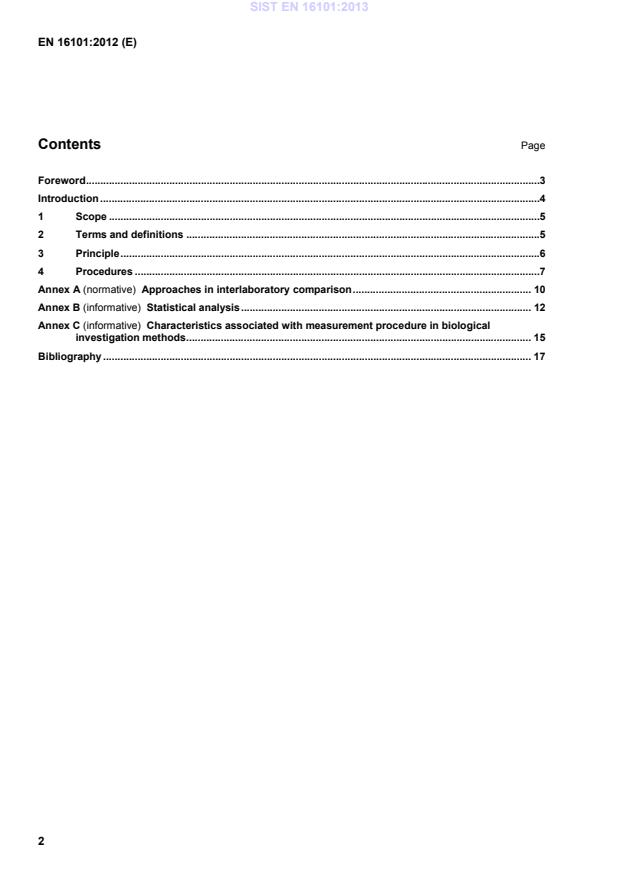
Approaches in interlaboratory comparison . 10Annex B (informative)
Statistical analysis . 12Annex C (informative)
Characteristics associated with measurement procedure in biological investigation methods . 15Bibliography . 17 SIST EN 16101:2013
Existing systems of interlaboratory comparison are generally not well developed for ecological assessments. By their nature the techniques used should be specific to the organism group and may not be readily transferable to other applications. This standard provides general guidance on the design of such systems.
[SOURCE: EN ISO/IEC 17043:2010, 3.1, modified – Note 1 to entry has been added] 2.2 interlaboratory comparison organisation, performance and evaluation of measurements or tests on the same or similar items by two or more laboratories in accordance with predetermined conditions Note 1 to entry: ISO 13528:2005, 3.1, refers to this term as ‘organisation, performance and evaluation of tests on the same or similar test items by two or more laboratories in accordance with predetermined conditions’.
Note 2 to entry: The data under test may be qualitative, quantitative, continuous or discrete, and derived from laboratory analysis or field survey. [SOURCE: EN ISO/IEC 17043:2010, 3.4, modified – Note 1 and 2 to entry have been added] 2.3
participant laboratory, organisation or individual that receives proficiency test items and submits results for review by the proficiency testing provider Note 1 to entry: In case of testing field survey methods, e.g. assessing hydro-morphological characteristics of water bodies, test items can by river stretches or lake shore length selected for survey by the participant. [SOURCE: EN ISO/IEC 17043:2010, 3.6, modified – Note 1 to entry has been added] 2.4 proficiency testing evaluation of participant performance against pre-established criteria by means of interlaboratory comparisons
Note 1 to entry: For the purposes of this International Standard, the term “proficiency testing” is taken in its widest sense and includes, but is not limited to:
a) quantitative scheme — where the objective is to quantify one or more measurands of the proficiency test item;
b) qualitative scheme — where the objective is to identify or describe one or more characteristics of the proficiency test item;
d) simultaneous scheme — where proficiency test items are distributed for concurrent testing or measurement within a defined time period;
e) single occasion exercise — where proficiency test items are provided on a single occasion;
f) continuous scheme — where proficiency test items are provided at regular intervals;
g) sampling — where samples are taken for subsequent analysis; and
h) data transformation and interpretation — where sets of data or other information are furnished and the information is processed to provide an interpretation (or other outcome).
Note 2 to entry: Some providers of proficiency testing in the medical area use the term “External Quality Assessment (EQA)” for their proficiency testing schemes, or for their broader programs, or both (see Annex A). The requirements of this International Standard cover only those EQA activities that meet the definition of proficiency testing. Note 3 to entry: ISO 13528:2005, 3.2, refers to this term as ‘determination of laboratory testing performance by means of interlaboratory comparisons’. [SOURCE: EN ISO/IEC 17043:2010, 3.7, modified – Note 3 to entry has been added] 2.5 single occasion exercise proficiency test items provided on a single occasion 2.6 standard deviation for proficiency assessment measure of dispersion used in the evaluation of results of proficiency testing, based on the available information
Note 1 to entry: The standard deviation applies only to ratio and differential scale results. Note 2 to entry: Not all proficiency testing schemes evaluate proficiency based on the dispersion of results. Note 3 to entry: ISO 13528:2005, 3.2, refers to this term as ‘standard deviation used in the assessment of proficiency which may be related to the reproducibility standard deviation or to a statement of the fitness for purpose of the measurement method’. [SOURCE: EN ISO/IEC 17043:2010, 3.13, modified – Note 3 to entry has been added] 2.7 z-score one of the standardised measures of laboratory bias, calculated using the assigned value and the standard deviation for proficiency assessment (applicable to continuous data only) [SOURCE: ISO 13528:2005, 3.5] 3 Principle Results of biological and ecological assessments from laboratories across the European Union are increasingly used to inform decision making and investment programmes. There is a clear need to ensure that these assessments are based upon sound science and validated data, comparable between laboratories within member states and between member states. Effective interlaboratory comparisons are based on the adoption of procedures to quantify and control process errors (Clause 4) within specified limits, and to enable participants to demonstrate that their analyses fulfil requirements for quality, and to maintain their SIST EN 16101:2013
In general the comparison of each stage of the sampling and investigation process should occur within the limits of applicability. This starts with sampling strategies, followed by sampling procedures (especially field analyses, see 4.2), sample processing, sample analysis (including lab methods, see 4.2), etc. Knowledge is needed therefore on sources of variability. The fundamental concept of survey design should be defined by the quality of the output and the purpose for what it is to be used such as absolute value or Ecological Quality Ratio (EQR, an output for the European Water Framework Directive) or a classification. European Standards shall be used where they exist.
Several approaches exist for the comparison of ecological data (see [1]) on which interlaboratory comparison methods for field survey data can be based. The selection of an appropriate design of an interlaboratory comparison shall first relate to the exact methods used and on the level of taxonomic resolution, and the method of investigation of other than taxonomic data. In a next step guidance shall be given on the statistical methods to be applied, and on the skills of the analysts involved. To ensure good results all individuals involved in field surveys as well as in lab procedures should have training programs on the methods and the taxonomy of the type of organisms assessed. The comparison of identification skills is the first step, which should be followed by testing the proper use of the sampling equipment. In the event of perceived quality defects traceability throughout sampling, analysis, data handling and production of final reports is an essential element for identifying sources of error in the process. For interlaboratory comparison the minimum number of participants shall be defined according to the method SIST EN 16101:2013
...