

SIST EN 300 019-2-4 V2.3.1:2013
(Main)Environmental Engineering (EE) - Environmental conditions and environmental tests for telecommunications equipment - Part 2-4: Specification of environmental tests - Stationary use at non-weatherprotected locations
- Abstract
The present document specifies test methods and severities for verification of the required resistibility of equipment according to the relevant environmental class. The tests defined in the present document apply to stationary use of equipment at non-weatherprotected locations covering the environmental conditions stated in EN 300 019-1-4 [1].
- Status
- Published
- Public Enquiry End Date
- 28-Feb-2013
- Publication Date
- 23-Sep-2013
- Technical Committee
- SPN - Services and Protocols for Networks
- Current Stage
- 6060 - National Implementation/Publication (Adopted Project)
- Start Date
- 02-Sep-2013
- Due Date
- 07-Nov-2013
- Completion Date
- 24-Sep-2013
Buy Documents
ETSI EN 300 019-2-4 V2.3.1 (2012-12) - Environmental Engineering (EE); Environmental conditions and environmental tests for telecommunications equipment; Part 2-4: Specification of environmental tests; Stationary use at non-weatherprotected locations
ETSI EN 300 019-2-4 V2.3.1 (2013-06) - Environmental Engineering (EE); Environmental conditions and environmental tests for telecommunications equipment; Part 2-4: Specification of environmental tests; Stationary use at non-weatherprotected locations
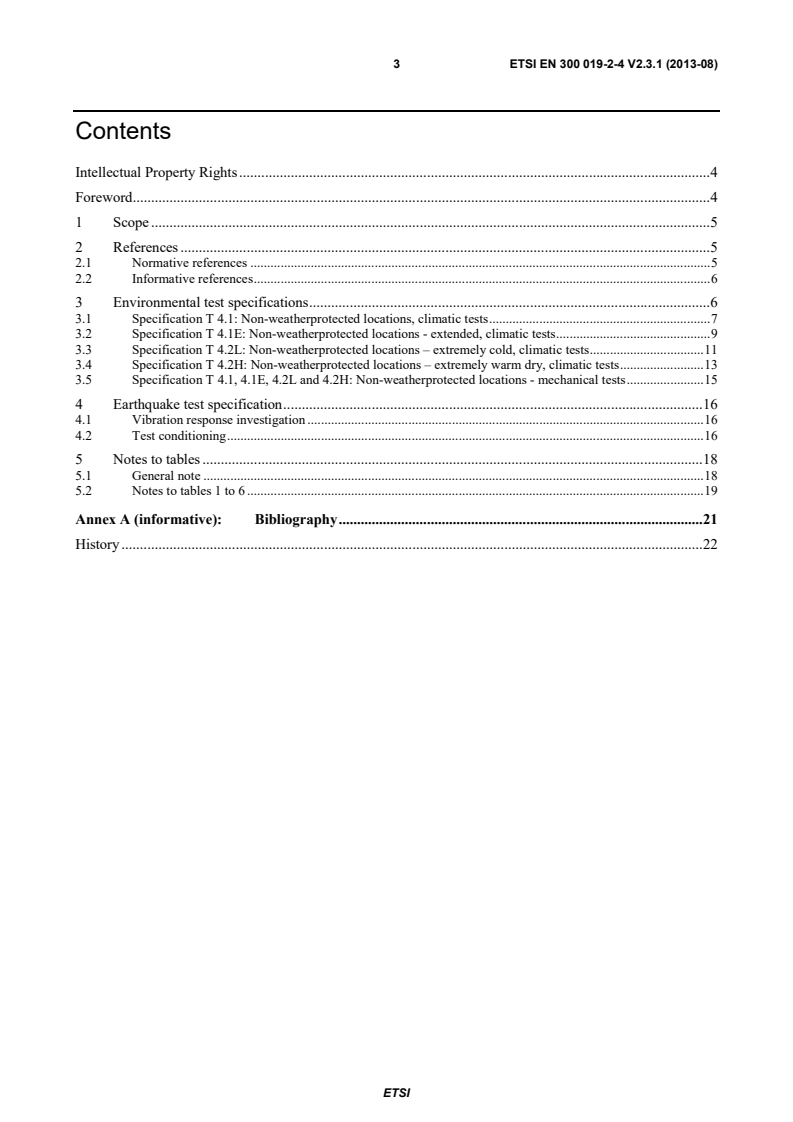
ETSI EN 300 019-2-4 V2.3.1 (2013-08) - Environmental Engineering (EE); Environmental conditions and environmental tests for telecommunications equipment; Part 2-4: Specification of environmental tests; Stationary use at non-weatherprotected locations

SIST EN 300 019-2-4 V2.3.1:2013 is the Slovenian adoption of ETSI EN 300 019-2-4, published by SIST. It specifies environmental test methods and severities for telecommunications equipment intended for stationary use at non-weatherprotected locations. In practice, it is the document engineers, test labs, quality managers, and buyers use to check whether equipment can resist the climate and mechanical conditions assigned to its environmental class.
What does SIST EN 300 019-2-4 V2.3.1:2013 specify?
SIST EN 300 019-2-4 V2.3.1:2013 specifies the environmental tests used to verify the required resistibility of equipment against the relevant environmental class. It is tied to the stationary-use conditions in EN 300 019-1-4 and organizes the tests by climatic class and by mechanical and earthquake conditions.
| Clause / part | What it covers |
|---|---|
| Clause 3 | Environmental test specifications for classes 4.1, 4.1E, 4.2L and 4.2H |
| Clause 3.5 | Mechanical tests for the same classes |
| Clause 4 | Earthquake test specification, when customer requirements call for it |
| Clause 5 | Notes that explain test choices and special cases |
| Annex A | Informative bibliography |
What are the key requirements of SIST EN 300 019-2-4 V2.3.1:2013?
SIST EN 300 019-2-4 V2.3.1:2013 assumes the equipment under test is operating throughout the stated conditions unless the product specification says otherwise. The product specification also has to define what performance is measured before, during, and after testing, and what counts as failure. That matters because the standard gives the test environment, but the product specification has to say how the product is judged.
Clause 3 and Tables 1 to 4 define the climatic test specifications for the four environmental classes. They cover cold, dry heat, temperature change, damp heat in steady and cyclic forms, rain, icing and frosting, solar radiation, chemically active substances, dust, sand, microorganisms, and rodents or insects. For a reader, this means the standard is a qualification map: you select the class and then apply the associated test set.
The air temperature notes are important for real installations. The lower or higher test temperature can change depending on solar protection, ventilation, and whether the equipment includes heating from its own enclosure. The cold and high-temperature values can also serve as start-up temperatures, but the product specification may modify them. That is useful when defining outdoor cabinets, shelters, or ventilated units.
The water and humidity notes explain why some tests are chosen and others are not. Rain uses IEC 60068-2-18 Test Rb, method 1, and the longer of the two stated durations is chosen. Some effects, such as low air pressure or the heating effect of solar radiation, are handled by the classification or by other tests instead of separate dedicated tests. This helps avoid duplicate qualification work.
Clause 3.5 defines the mechanical tests. For the main stationary-use classes, the standard uses IEC 60721-3-4 classes 4M5 and, in some cases, 4M3, together with sinusoidal vibration, random vibration, and shock. The equipment must be mounted in its in-use position and its function monitored during the test. That means the mounting and monitoring setup are part of the qualification result, not just the test machine settings.
Clause 4 adds earthquake testing when the customer specifies earthquake conditions. It begins with a vibration response investigation to find the lowest resonant frequency, then uses a time-history method with required response spectrum and Zero Period Acceleration values. The standard also allows some simplifications if the equipment shows no low-frequency resonance and already passes the relevant vibration test. In practice, this section is used when the installation site or customer contract includes seismic requirements.
What terms does SIST EN 300 019-2-4 V2.3.1:2013 define?
- Environmental class - The class used to match equipment to a defined set of environmental conditions and test severities.
- Characteristic severity - The environmental level that represents the class condition being addressed.
- Test severity - The actual level used during the laboratory test.
- Acceleration Spectral Density (ASD) - A way to describe random vibration over frequency.
- Required Response Spectrum (RRS) - The target response spectrum used for earthquake testing.
- Zero Period Acceleration (ZPA) - The reference acceleration level at the short-period end of the earthquake spectrum.
- IEC class 4M5 - The mechanical severity class used for the vibration and shock tests in this document.
Who uses SIST EN 300 019-2-4 V2.3.1:2013?
This standard is used by telecommunications equipment manufacturers, environmental test laboratories, and qualification engineers who need to verify stationary equipment for non-weatherprotected locations. Quality managers use it to define acceptance criteria, and buyers or specifiers use it when writing procurement requirements for outdoor telecom equipment, cabinets, and installed systems. It is especially relevant when the product has to be tested against climate, mechanical stress, or earthquake conditions before deployment.
Which standards are used with SIST EN 300 019-2-4 V2.3.1:2013?
| Standard | What it contributes |
|---|---|
| EN 300 019-1-4 | The environmental conditions and classes for stationary use at non-weatherprotected locations |
| EN 300 019-2-0 | The general overview of part 2 of the series |
| IEC 60068-2-1 | Cold test method |
| IEC 60068-2-2 | Dry heat test method |
| IEC 60068-2-14 | Change of temperature test |
| IEC 60068-2-30 | Damp heat, cyclic |
| IEC 60068-2-64 | Random vibration |
| IEC 60068-2-27 | Shock |
| IEC 60068-2-6 | Sinusoidal vibration |
| IEC 60068-2-57 | Earthquake time-history method |
| IEC 60068-2-18 | Water test used for rain |
| IEC 60068-2-78 | Damp heat, steady state |
| IEC 60721-3-4 | Mechanical class references used for vibration and shock |
| ANSI T1.0600329 | Earthquake time-history reference named for the seismic test |
What does the SIST EN 300 019-2-4 V2.3.1:2013 document contain?
SIST EN 300 019-2-4 V2.3.1:2013 contains tables that pair environmental parameters with characteristic severities, test severities, durations, and test methods for each class. It also includes notes that explain why some conditions are tested and others are considered in design rather than in a separate test.
For earthquake qualification, the document includes a vibration response investigation, a conditioning procedure, a time-history test, and a required response spectrum figure with coordinate points in a table. Those items are the practical core of the seismic section, because they tell the test lab how to excite the specimen and what response shape to use.
Buy Documents
ETSI EN 300 019-2-4 V2.3.1 (2012-12) - Environmental Engineering (EE); Environmental conditions and environmental tests for telecommunications equipment; Part 2-4: Specification of environmental tests; Stationary use at non-weatherprotected locations
ETSI EN 300 019-2-4 V2.3.1 (2013-06) - Environmental Engineering (EE); Environmental conditions and environmental tests for telecommunications equipment; Part 2-4: Specification of environmental tests; Stationary use at non-weatherprotected locations
ETSI EN 300 019-2-4 V2.3.1 (2013-08) - Environmental Engineering (EE); Environmental conditions and environmental tests for telecommunications equipment; Part 2-4: Specification of environmental tests; Stationary use at non-weatherprotected locations
Get Certified
Connect with accredited certification bodies for this standard

ANCE
Mexican certification and testing association.

IMP NDT d.o.o.
Non-destructive testing services. Radiography, ultrasonic, magnetic particle, penetrant, visual inspection.
Inštitut za kovinske materiale in tehnologije
Institute of Metals and Technology. Materials testing, metallurgical analysis, NDT.
Sponsored listings
Frequently Asked Questions
SIST EN 300 019-2-4 V2.3.1:2013 is a standard published by the Slovenian Institute for Standardization (SIST). Its full title is "Environmental Engineering (EE) - Environmental conditions and environmental tests for telecommunications equipment - Part 2-4: Specification of environmental tests - Stationary use at non-weatherprotected locations". This standard covers: The present document specifies test methods and severities for verification of the required resistibility of equipment according to the relevant environmental class. The tests defined in the present document apply to stationary use of equipment at non-weatherprotected locations covering the environmental conditions stated in EN 300 019-1-4 [1].
The present document specifies test methods and severities for verification of the required resistibility of equipment according to the relevant environmental class. The tests defined in the present document apply to stationary use of equipment at non-weatherprotected locations covering the environmental conditions stated in EN 300 019-1-4 [1].
SIST EN 300 019-2-4 V2.3.1:2013 is classified under the following ICS (International Classification for Standards) categories: 19.040 - Environmental testing; 33.050.01 - Telecommunication terminal equipment in general. The ICS classification helps identify the subject area and facilitates finding related standards.
SIST EN 300 019-2-4 V2.3.1:2013 is available in PDF format for immediate download after purchase. The document can be added to your cart and obtained through the secure checkout process. Digital delivery ensures instant access to the complete standard document.
Standards Content (Sample)
Draft ETSI EN 300 019-2-4 V2.3.1 (2012-12)
European Standard
Environmental Engineering (EE);
Environmental conditions and environmental tests
for telecommunications equipment;
Part 2-4: Specification of environmental tests;
Stationary use at non-weatherprotected locations
2 Draft ETSI EN 300 019-2-4 V2.3.1 (2012-12)
Reference
REN/EE-01049
Keywords
environment, testing
ETSI
650 Route des Lucioles
F-06921 Sophia Antipolis Cedex - FRANCE
Tel.: +33 4 92 94 42 00 Fax: +33 4 93 65 47 16
Siret N° 348 623 562 00017 - NAF 742 C
Association à but non lucratif enregistrée à la
Sous-Préfecture de Grasse (06) N° 7803/88
Important notice
Individual copies of the present document can be downloaded from:
http://www.etsi.org
The present document may be made available in more than one electronic version or in print. In any case of existing or
perceived difference in contents between such versions, the reference version is the Portable Document Format (PDF).
In case of dispute, the reference shall be the printing on ETSI printers of the PDF version kept on a specific network drive
within ETSI Secretariat.
Users of the present document should be aware that the document may be subject to revision or change of status.
Information on the current status of this and other ETSI documents is available at
http://portal.etsi.org/tb/status/status.asp
If you find errors in the present document, please send your comment to one of the following services:
http://portal.etsi.org/chaircor/ETSI_support.asp
Copyright Notification
No part may be reproduced except as authorized by written permission.
The copyright and the foregoing restriction extend to reproduction in all media.
© European Telecommunications Standards Institute 2012.
All rights reserved.
TM TM TM
DECT , PLUGTESTS , UMTS and the ETSI logo are Trade Marks of ETSI registered for the benefit of its Members.
TM
3GPP and LTE™ are Trade Marks of ETSI registered for the benefit of its Members and
of the 3GPP Organizational Partners.
GSM® and the GSM logo are Trade Marks registered and owned by the GSM Association.
ETSI
3 Draft ETSI EN 300 019-2-4 V2.3.1 (2012-12)
Contents
Intellectual Property Rights . 4
Foreword . 4
1 Scope . 5
2 References . 5
2.1 Normative references . 5
2.2 Informative references . 6
3 Environmental test specifications . 6
3.1 Specification T 4.1: Non-weatherprotected locations, climatic tests . 7
3.2 Specification T 4.1E: Non-weatherprotected locations - extended, climatic tests . 9
3.3 Specification T 4.2L: Non-weatherprotected locations – extremely cold, climatic tests . 11
3.4 Specification T 4.2H: Non-weatherprotected locations – extremely warm dry, climatic tests . 13
3.5 Specification T 4.1, 4.1E, 4.2L and 4.2H: Non-weatherprotected locations - mechanical tests . 15
4 Earthquake test specification . 16
4.1 Vibration response investigation . 16
4.2 Test conditioning . 16
5 Notes to tables . 18
5.1 General note . 18
5.2 Notes to tables 1 to 6 . 19
Annex A (informative): Bibliography . 21
History . 22
ETSI
4 Draft ETSI EN 300 019-2-4 V2.3.1 (2012-12)
Intellectual Property Rights
IPRs essential or potentially essential to the present document may have been declared to ETSI. The information
pertaining to these essential IPRs, if any, is publicly available for ETSI members and non-members, and can be found
in ETSI SR 000 314: "Intellectual Property Rights (IPRs); Essential, or potentially Essential, IPRs notified to ETSI in
respect of ETSI standards", which is available from the ETSI Secretariat. Latest updates are available on the ETSI Web
server (http://ipr.etsi.org).
Pursuant to the ETSI IPR Policy, no investigation, including IPR searches, has been carried out by ETSI. No guarantee
can be given as to the existence of other IPRs not referenced in SR 000 314 (or the updates on the ETSI Web server)
which are, or may be, or may become, essential to the present document.
Foreword
This draft European Standard (EN) has been produced by ETSI Technical Committee Environmental Engineering (EE),
and is now submitted for the combined Public Enquiry and Vote phase of the ETSI standards EN Approval Procedure.
The present document is part 2, sub-part 4 of a multi-part deliverable. Full details of the entire series can be found in
part 2, sub-part 0 [3].
Proposed national transposition dates
Date of latest announcement of this EN (doa): 3 months after ETSI publication
Date of latest publication of new National Standard
or endorsement of this EN (dop/e): 6 months after doa
Date of withdrawal of any conflicting National Standard (dow): 6 months after doa
ETSI
5 Draft ETSI EN 300 019-2-4 V2.3.1 (2012-12)
1 Scope
The present document specifies test methods and severities for verification of the required resistibility of equipment
according to the relevant environmental class.
The tests defined in the present document apply to stationary use of equipment at non-weatherprotected locations
covering the environmental conditions stated in EN 300 019-1-4 [1].
2 References
References are either specific (identified by date of publication and/or edition number or version number) or
non-specific. For specific references, only the cited version applies. For non-specific references, the latest version of the
reference document (including any amendments) applies.
Referenced documents which are not found to be publicly available in the expected location might be found at
http://docbox.etsi.org/Reference.
NOTE: While any hyperlinks included in this clause were valid at the time of publication, ETSI cannot guarantee
their long term validity.
2.1 Normative references
The following referenced documents are necessary for the application of the present document.
[1] ETSI EN 300 019-1-4: "Environmental Engineering (EE); Environmental conditions and
environmental tests for telecommunications equipment; Part 1-4: Classification of environmental
conditions; Stationary use at non-weatherprotected locations".
[2] IEC 60068-2-1 (03/2007): "Environmental testing, Part 2-1: Tests - Test A: Cold".
[3] ETSI EN 300 019-2-0: "Environmental Engineering (EE); Environmental conditions and
environmental tests for telecommunications equipment; Part 2-0: Specification of environmental
tests; Introduction".
[4] IEC 60721-3-4: "Classification of environmental conditions - Part 3: Classification of groups of
environmental parameters and their severities - Section 4: Stationary use at non-weatherprotected
locations".
[5] ANSI T1.0600329 (2008): "Network Equipment - Earthquake Resistance Standard".
[6] Void.
[7] IEC 60068-2-2 (07/2007): "Environmental testing, Part 2-2: Tests - Test B: Dry heat".
[8] IEC 60068-2-14 (01/2009): "Environmental testing - Part 2-14: Tests - Test N: Change of
temperature".
[9] IEC 60068-2-30 (08/2005): "Environmental testing - Part 2-30: Tests - Test Db: Damp heat, cyclic
(12 h + 12 h cycle)".
[10] IEC 60068-2-64 (04/2008): "Environmental testing - Part 2-64: Tests - Test Fh: Vibration,
broadband random and guidance".
[11] IEC 60068-2-27 (02/2008): "Environmental testing - Part 2-27: Tests - Test Ea and guidance:
Shock".
[12] IEC 60068-2-6 (12/2007): "Environmental testing - Part 2-6: Tests - Test Fc: Vibration
(sinusoidal)".
ETSI
6 Draft ETSI EN 300 019-2-4 V2.3.1 (2012-12)
[13] IEC 60068-2-57 (11/1999): "Environmental testing - Part 2-57: Tests - Test Ff: Vibration - Time-
history method".
[14] IEC 60068-2-68 (8/1994): "Environmental testing - Part 2: Tests - Test L: Dust and sand".
[15] IEC 60068-2-18 (10/2000): "Environmental testing - Part 2-18: Tests - Test R and guidance:
Water".
[16] IEC 60068-2-78 (08/2001): "Environmental testing - Part 2-78: Tests - Test Cab: Damp heat,
steady state".
2.2 Informative references
The following referenced documents are not necessary for the application of the present document but they assist the
user with regard to a particular subject area.
Not applicable.
3 Environmental test specifications
The detailed descriptions of the environmental conditions are given in clauses 4 and 5 of EN 300 019-1-4 [1].
EN 300 019-2-0 [3] forms a general overview of Part 2 of the present document.
The equipment under test is assumed to be in its operational state throughout the test conditions described in the present
document unless otherwise stated. The required performance before, during and after the test need to be specified in the
product specification. Input and load conditions of the equipment shall be chosen to obtain full utilization of the
equipment under test. The heat dissipation shall be maximized, except for the steady state, low temperature test, where
it shall be minimized.
ETSI
7 Draft ETSI EN 300 019-2-4 V2.3.1 (2012-12)
3.1 Specification T 4.1: Non-weatherprotected locations, climatic tests
This specification applies to most of Europe as described in EN 300 019-1-4 [1] (see table 1).
Table 1: Test specification T 4.1: Stationary use at non-weatherprotected locations - climatic tests
Environmental parameter Environmental Environmental test specification T 4.1: Stationary use,
Class 4.1 Non-weatherprotected locations
Type Parameter Detail parameter Characteristic Test severity Duration Reference Method Notes
severity
(°C) -33 -33 or -45 16 h IEC 60068-2-1 [2] Ab/Ad: Cold 1
Low
Air
High (°C) +40 +40 or +55 16 h IEC 60068-2-2 [7] Bb/Bd: Dry heat 2
temperature
(°C) -10/+40 2 cycles IEC 60068-2-14 [8] Nb: Change of 3
Change
(°C/min) 0,5 0,5 t = 3 h temperature
Low (%) 15 none 8
high (%) 100 93 10 d IEC 60068-2-78 [16] Cab: Damp heat 4
Relative (°C) +30 steady state
condensation yes 5
Humidity
(%) 90-100 2 cycles IEC 60068-2-30 [9] Db: Damp heat, cyclic
(°C) +30 Variant 1
0,26 none
Low (g/m )
Absolute
25 6
high (g/m )
Low (kPa) 70 none 7
Pressure
high (kPa) 106 none 7
Air
Speed (m/s) 50 none 8
3 2
Intensity 6 mm/min IEC 60068-2-18 [15] Rb: Impacting water 9
0,01 m /min 3 min/m or
Method 2
Rain
90 kPa 15 min
low temperature (°C) +5 none
Water
Other splashing water 10
sources
Icing & yes none 8
frosting
1 120 11
Solar
(W/m )
Radiation
negligible
Heat
(W/m )
ETSI
8 Draft ETSI EN 300 019-2-4 V2.3.1 (2012-12)
Environmental parameter Environmental Environmental test specification T 4.1: Stationary use,
Class 4.1 Non-weatherprotected locations
Type Parameter Detail parameter Characteristic Test severity Duration Reference Method Notes
severity
0,3/1,0 none 12
SO (mg/m )
Sulphur
0,1/0,5 none 12
HS (mg/m )
salt mist sea and road salt none 12
0,1/0,3 none 12
Chlorine Cl (mg/m )
Chemically
0,1/0,5 none 12
HCI (mg/m )
active
substances
0,5/1,0 none 12
NO (mg/m )
x
Nitrogen
1,0/3,0 none 12
NH (mg/m )
3 0,01/0,03 none 12
Hydrogen fluoride HF
(mg/m )
Ozone O 3
0,05/0,1 none 12
3 (mg/m )
sedimentation 20 13
Mechanically
Dust (mg/(m h))
active
5 13
suspension (mg/m )
substances
300 13
Sand
(mg/m )
Micro organisms mould, fungus, etc. none 14
Flora and
fauna Rodents, insects rodents, etc. none 14
NOTE 1: none = verification is required only in special cases.
NOTE 2: n = number of note, see clause 5.
ETSI
9 Draft ETSI EN 300 019-2-4 V2.3.1 (2012-12)
3.2 Specification T 4.1E: Non-weatherprotected locations - extended, climatic tests
This specification covers most of Europe as described in EN 300 019-1-4 [1] (see table 2).
Table 2: Test specification T 4.1E: Stationary use at non-weatherprotected locations, extended - climatic tests
Environmental parameter Environmental Environmental test specification T 4.1E: Stationary use
Class 4.1E Non-weatherprotected locations - extended
Type Parameter Detail parameter Characteristic Test severity Duration Reference Method Notes
severity
Low (°C) -45 -45 or -55 16 h IEC 60068-2-1 [2] Ab/Ad: Cold 1
Air High (°C) +45 +45 or +60 16 h IEC 60068-2-2 [7] Bb/Bd: Dry heat 2
temperature
(°C) -10/+45 2 cycles IEC 60068-2-14 [8] Nb: Change of temperature 3
Change
(°C/min) 0,5 0,5 t1 = 3 h
low (%) 8 none 8
high (%) 100 93 10 d IEC 60068-2-78 [16] Cab: Damp heat steady state 4
(°C) +30
Relative
condensation yes 2 cycles IEC 60068-2-30 [9] Db: Damp heat cyclic Variant 1 5
(%) 90–100
Humidity
(°C) +30
0,03 none 6
low (g/m )
Absolute
high (g/m )
low (kPa) 70 none 7
Pressure
high (kPa) 106 none 7
Air
(m/s) 50 none 8
Speed
3 2
intensity 15 mm/min IEC 60068-2-18 [15] Rb: Impacting water, method 1 9
0,01 m /min 90 kPa 6 min/m or 30 min
Rain
low temperature (°C) +5 none
Water
Other sources splashing water 10
Icing & frosting yes none 8
1 120 11
Solar
(W/m )
Radiation
negligible
Heat
(W/m )
ETSI
10 Draft ETSI EN 300 019-2-4 V2.3.1 (2012-12)
Environmental parameter Environmental Environmental test specification T 4.1E: Stationary use
Class 4.1E Non-weatherprotected locations – extended
Type Parameter Detail parameter Characteristic Test severity Duration Reference Method Notes
severity
Chemically Sulphur 0,3/1,0 none 12
SO (mg/m )
active
0,1/0,5 none 12
HS (mg/m )
substances 2
Chlorine salt mist sea and road salt none 12
0,1/0,3 none 12
Cl (mg/m )
0,1/0,5 none 12
HCl (mg/m )
Nitrogen 0,5/1,0 none 12
NO (mg/m )
x
1,0/3,0 none 12
NH (mg/m )
Hydrogen fluoride HF 3 0,01/0,03 none 12
(mg/m )
Ozone O 3
0,05/0,1 none 12
3 (mg/m )
Mechanically Dust sedimentation 20 13
active
(mg/(m h))
substances
suspension 5 13
(mg/m )
Sand 300 13
(mg/m )
Flora and Micro organisms mould, fungus, etc. none 14
fauna
Rodents, insects rodents, etc. none 14
NOTE 1: none = verification is required only in special cases.
NOTE 2: n = number of note, see clause 5.
ETSI
11 Draft ETSI EN 300 019-2-4 V2.3.1 (2012-12)
3.3 Specification T 4.2L: Non-weatherprotected locations – extremely cold, climatic tests
This specification covers world-wide conditions as described in EN 300 019-1-4 [1] (see table 3).
Table 3: Test specification T 4.2L: Stationary use at non-weatherprotected locations, extremely cold - climatic tests
Environmental parameter Environmental Environmental test specification T 4.2L: Stationary use
Class 4.2L Non-weatherprotected locations – extremely cold
Type Parameter Detail parameter Characteristic Test severity Duration Reference Method Notes
severity
Low (°C) -65 -65 or -75 16 h IEC 60068-2-1 [2] Ab/Ad: Cold 1
Air High (°C) +35 +35 or +50 16 h IEC 60068-2-2 [7] Bb/Bd: Dry heat 2
temperature
(°C) -10/+45 2 cycles IEC 60068-2-14 [8] Nb: Change of temperature 3
Change
(°C/min) 0,5 0,5 t1 = 3 h
low (%) 20 none 8
high (%) 100 93 10 d IEC 60068-2-78 [16] Cab: Damp heat steady state 4
(°C) +30
Relative
condensation yes 2 cycles IEC 60068-2-30 [9] Db: Damp heat cyclic Variant 1 5
(%) 90 –100
Humidity
(°C) +30
...
Final draft ETSI EN 300 019-2-4 V2.3.1 (2013-06)
European Standard
Environmental Engineering (EE);
Environmental conditions and environmental tests
for telecommunications equipment;
Part 2-4: Specification of environmental tests;
Stationary use at non-weatherprotected locations
2 Final draft ETSI EN 300 019-2-4 V2.3.1 (2013-06)
Reference
REN/EE-01049
Keywords
environment, testing
ETSI
650 Route des Lucioles
F-06921 Sophia Antipolis Cedex - FRANCE
Tel.: +33 4 92 94 42 00 Fax: +33 4 93 65 47 16
Siret N° 348 623 562 00017 - NAF 742 C
Association à but non lucratif enregistrée à la
Sous-Préfecture de Grasse (06) N° 7803/88
Important notice
Individual copies of the present document can be downloaded from:
http://www.etsi.org
The present document may be made available in more than one electronic version or in print. In any case of existing or
perceived difference in contents between such versions, the reference version is the Portable Document Format (PDF).
In case of dispute, the reference shall be the printing on ETSI printers of the PDF version kept on a specific network drive
within ETSI Secretariat.
Users of the present document should be aware that the document may be subject to revision or change of status.
Information on the current status of this and other ETSI documents is available at
http://portal.etsi.org/tb/status/status.asp
If you find errors in the present document, please send your comment to one of the following services:
http://portal.etsi.org/chaircor/ETSI_support.asp
Copyright Notification
No part may be reproduced except as authorized by written permission.
The copyright and the foregoing restriction extend to reproduction in all media.
© European Telecommunications Standards Institute 2013.
All rights reserved.
TM TM TM
DECT , PLUGTESTS , UMTS and the ETSI logo are Trade Marks of ETSI registered for the benefit of its Members.
TM
3GPP and LTE™ are Trade Marks of ETSI registered for the benefit of its Members and
of the 3GPP Organizational Partners.
GSM® and the GSM logo are Trade Marks registered and owned by the GSM Association.
ETSI
3 Final draft ETSI EN 300 019-2-4 V2.3.1 (2013-06)
Contents
Intellectual Property Rights . 4
Foreword . 4
1 Scope . 5
2 References . 5
2.1 Normative references . 5
2.2 Informative references . 6
3 Environmental test specifications . 6
3.1 Specification T 4.1: Non-weatherprotected locations, climatic tests . 7
3.2 Specification T 4.1E: Non-weatherprotected locations - extended, climatic tests . 9
3.3 Specification T 4.2L: Non-weatherprotected locations – extremely cold, climatic tests . 11
3.4 Specification T 4.2H: Non-weatherprotected locations – extremely warm dry, climatic tests . 13
3.5 Specification T 4.1, 4.1E, 4.2L and 4.2H: Non-weatherprotected locations - mechanical tests . 15
4 Earthquake test specification . 16
4.1 Vibration response investigation . 16
4.2 Test conditioning . 16
5 Notes to tables . 18
5.1 General note . 18
5.2 Notes to tables 1 to 6 . 19
Annex A (informative): Bibliography . 21
History . 22
ETSI
4 Final draft ETSI EN 300 019-2-4 V2.3.1 (2013-06)
Intellectual Property Rights
IPRs essential or potentially essential to the present document may have been declared to ETSI. The information
pertaining to these essential IPRs, if any, is publicly available for ETSI members and non-members, and can be found
in ETSI SR 000 314: "Intellectual Property Rights (IPRs); Essential, or potentially Essential, IPRs notified to ETSI in
respect of ETSI standards", which is available from the ETSI Secretariat. Latest updates are available on the ETSI Web
server (http://ipr.etsi.org).
Pursuant to the ETSI IPR Policy, no investigation, including IPR searches, has been carried out by ETSI. No guarantee
can be given as to the existence of other IPRs not referenced in SR 000 314 (or the updates on the ETSI Web server)
which are, or may be, or may become, essential to the present document.
Foreword
This final draft European Standard (EN) has been produced by ETSI Technical Committee Environmental Engineering
(EE), and is now submitted for the Vote phase of the ETSI standards EN Approval Procedure.
The present document is part 2, sub-part 4 of a multi-part deliverable. Full details of the entire series can be found in
part 2, sub-part 0 [i.1].
Proposed national transposition dates
Date of latest announcement of this EN (doa): 3 months after ETSI publication
Date of latest publication of new National Standard
or endorsement of this EN (dop/e): 6 months after doa
Date of withdrawal of any conflicting National Standard (dow): 6 months after doa
ETSI
5 Final draft ETSI EN 300 019-2-4 V2.3.1 (2013-06)
1 Scope
The present document specifies test methods and severities for verification of the required resistibility of equipment
according to the relevant environmental class.
The tests defined in the present document apply to stationary use of equipment at non-weatherprotected locations
covering the environmental conditions stated in EN 300 019-1-4 [1].
2 References
References are either specific (identified by date of publication and/or edition number or version number) or
non-specific. For specific references, only the cited version applies. For non-specific references, the latest version of the
reference document (including any amendments) applies.
Referenced documents which are not found to be publicly available in the expected location might be found at
http://docbox.etsi.org/Reference.
NOTE: While any hyperlinks included in this clause were valid at the time of publication, ETSI cannot guarantee
their long term validity.
2.1 Normative references
The following referenced documents are necessary for the application of the present document.
[1] ETSI EN 300 019-1-4: "Environmental Engineering (EE); Environmental conditions and
environmental tests for telecommunications equipment; Part 1-4: Classification of environmental
conditions; Stationary use at non-weatherprotected locations".
[2] IEC 60068-2-1 (03-2007): "Environmental testing, Part 2-1: Tests - Test A: Cold".
[3] Void.
[4] IEC 60721-3-4: "Classification of environmental conditions - Part 3: Classification of groups of
environmental parameters and their severities - Section 4: Stationary use at non-weatherprotected
locations".
[5] ANSI T1.0600329 (2008): "Network Equipment - Earthquake Resistance Standard".
[6] Void.
[7] IEC 60068-2-2 (07-2007): "Environmental testing, Part 2-2: Tests - Test B: Dry heat".
[8] IEC 60068-2-14 (01-2009): "Environmental testing - Part 2-14: Tests - Test N: Change of
temperature".
[9] IEC 60068-2-30 (08-2005): "Environmental testing - Part 2-30: Tests - Test Db: Damp heat, cyclic
(12 h + 12 h cycle)".
[10] IEC 60068-2-64 (04-2008): "Environmental testing - Part 2-64: Tests - Test Fh: Vibration,
broadband random and guidance".
[11] IEC 60068-2-27 (02-2008): "Environmental testing - Part 2-27: Tests - Test Ea and guidance:
Shock".
[12] IEC 60068-2-6 (12-2007): "Environmental testing - Part 2-6: Tests - Test Fc: Vibration
(sinusoidal)".
[13] IEC 60068-2-57 (11-1999): "Environmental testing - Part 2-57: Tests - Test Ff: Vibration - Time-
history method".
[14] Void.
ETSI
6 Final draft ETSI EN 300 019-2-4 V2.3.1 (2013-06)
[15] IEC 60068-2-18 (10-2000): "Environmental testing - Part 2-18: Tests - Test R and guidance:
Water".
[16] IEC 60068-2-78 (08-2001): "Environmental testing - Part 2-78: Tests - Test Cab: Damp heat,
steady state".
2.2 Informative references
The following referenced documents are not necessary for the application of the present document but they assist the
user with regard to a particular subject area.
[i.1] ETSI EN 300 019-2-0: "Environmental Engineering (EE); Environmental conditions and
environmental tests for telecommunications equipment; Part 2-0: Specification of environmental
tests; Introduction".
[i.2] IEC 60068-2-68 (8-1994): "Environmental testing - Part 2: Tests - Test L: Dust and sand".
3 Environmental test specifications
The detailed descriptions of the environmental conditions are given in clauses 4 and 5 of EN 300 019-1-4 [1].
EN 300 019-2-0 [i.1] forms a general overview of part 2 of this multipart deliverable.
The equipment under test is assumed to be in its operational state throughout the test conditions described in the present
document unless otherwise stated. The required performance before, during and after the test need to be specified in the
product specification. Input and load conditions of the equipment shall be chosen to obtain full utilization of the
equipment under test. The heat dissipation shall be maximized, except for the steady state, low temperature test, where
it shall be minimized.
ETSI
7 Final draft ETSI EN 300 019-2-4 V2.3.1 (2013-06)
3.1 Specification T 4.1: Non-weatherprotected locations, climatic tests
This specification applies to most of Europe as described in EN 300 019-1-4 [1] (see table 1).
Table 1: Test specification T 4.1: Stationary use at non-weatherprotected locations - climatic tests
Environmental parameter Environmental Environmental test specification T 4.1: Stationary use,
Class 4.1 Non-weatherprotected locations
Type Parameter Detail parameter Characteristic Test severity Duration Reference Method Notes
severity
(°C) -33 -33 or -45 16 h IEC 60068-2-1 [2] Ab/Ad: Cold 1
Low
Air
High (°C) +40 +40 or +55 16 h IEC 60068-2-2 [7] Bb/Bd: Dry heat 2
temperature
(°C) -10/+40 2 cycles IEC 60068-2-14 [8] Nb: Change of 3
Change
(°C/min) 0,5 0,5 t = 3 h temperature
Low (%) 15 none 8
high (%) 100 93 10 d IEC 60068-2-78 [16] Cab: Damp heat 4
Relative (°C) +30 steady state
condensation yes 5
Humidity
(%) 90-100 2 cycles IEC 60068-2-30 [9] Db: Damp heat, cyclic
(°C) +30 Variant 1
0,26 none
Low (g/m )
Absolute
25 6
high (g/m )
Low (kPa) 70 none 7
Pressure
high (kPa) 106 none 7
Air
Speed (m/s) 50 none 8
3 2
Intensity 6 mm/min IEC 60068-2-18 [15] Rb: Impacting water 9
0,01 m /min 3 min/m or
Method 1
Rain
90 kPa 15 min
low temperature (°C) +5 none
Water
Other splashing water 10
sources
Icing & yes none 8
frosting
1 120 11
Solar
(W/m )
Radiation
negligible
Heat
(W/m )
ETSI
8 Final draft ETSI EN 300 019-2-4 V2.3.1 (2013-06)
Environmental parameter Environmental Environmental test specification T 4.1: Stationary use,
Class 4.1 Non-weatherprotected locations
Type Parameter Detail parameter Characteristic Test severity Duration Reference Method Notes
severity
0,3/1,0 none 12
SO (mg/m )
Sulphur
0,1/0,5 none 12
HS (mg/m )
salt mist sea and road salt none 12
0,1/0,3 none 12
Chlorine Cl (mg/m )
Chemically
0,1/0,5 none 12
HCI (mg/m )
active
substances
0,5/1,0 none 12
NO (mg/m )
x
Nitrogen
1,0/3,0 none 12
NH (mg/m )
3 0,01/0,03 none 12
Hydrogen fluoride HF
(mg/m )
Ozone O 3
0,05/0,1 none 12
3 (mg/m )
sedimentation 20 13
Mechanically
Dust (mg/(m h))
active
5 13
suspension (mg/m )
substances
300 13
Sand
(mg/m )
Micro organisms mould, fungus, etc. none 14
Flora and
fauna Rodents, insects rodents, etc. none 14
NOTE 1: none = verification is required only in special cases.
NOTE 2: n = number of note, see clause 5.
ETSI
9 Final draft ETSI EN 300 019-2-4 V2.3.1 (2013-06)
3.2 Specification T 4.1E: Non-weatherprotected locations - extended, climatic tests
This specification covers most of Europe as described in EN 300 019-1-4 [1] (see table 2).
Table 2: Test specification T 4.1E: Stationary use at non-weatherprotected locations, extended - climatic tests
Environmental parameter Environmental Environmental test specification T 4.1E: Stationary use
Class 4.1E Non-weatherprotected locations - extended
Type Parameter Detail parameter Characteristic Test severity Duration Reference Method Notes
severity
Low (°C) -45 -45 or -55 16 h IEC 60068-2-1 [2] Ab/Ad: Cold 1
Air High (°C) +45 +45 or +60 16 h IEC 60068-2-2 [7] Bb/Bd: Dry heat 2
temperature
(°C) -10/+45 2 cycles IEC 60068-2-14 [8] Nb: Change of temperature 3
Change
(°C/min) 0,5 0,5 t1 = 3 h
low (%) 8 none 8
high (%) 100 93 10 d IEC 60068-2-78 [16] Cab: Damp heat steady state 4
(°C) +30
Relative
condensation yes 2 cycles IEC 60068-2-30 [9] Db: Damp heat cyclic Variant 1 5
(%) 90–100
Humidity
(°C) +30
0,03 none 6
low (g/m )
Absolute
high (g/m )
low (kPa) 70 none 7
Pressure
high (kPa) 106 none 7
Air
(m/s) 50 none 8
Speed
3 2
intensity 15 mm/min IEC 60068-2-18 [15] Rb: Impacting water, method 1 9
0,01 m /min 90 kPa 6 min/m or 30 min
Rain
low temperature (°C) +5 none
Water
Other sources splashing water 10
Icing & frosting yes none 8
1 120 11
Solar
(W/m )
Radiation
negligible
Heat
(W/m )
ETSI
10 Final draft ETSI EN 300 019-2-4 V2.3.1 (2013-06)
Environmental parameter Environmental Environmental test specification T 4.1E: Stationary use
Class 4.1E Non-weatherprotected locations – extended
Type Parameter Detail parameter Characteristic Test severity Duration Reference Method Notes
severity
Chemically Sulphur 0,3/1,0 none 12
SO (mg/m )
active
0,1/0,5 none 12
HS (mg/m )
substances 2
Chlorine salt mist sea and road salt none 12
0,1/0,3 none 12
Cl (mg/m )
0,1/0,5 none 12
HCl (mg/m )
Nitrogen 0,5/1,0 none 12
NO (mg/m )
x
1,0/3,0 none 12
NH (mg/m )
Hydrogen fluoride HF 3 0,01/0,03 none 12
(mg/m )
Ozone O 3
0,05/0,1 none 12
3 (mg/m )
Mechanically Dust sedimentation 20 13
active
(mg/(m h))
substances
suspension 5 13
(mg/m )
Sand 300 13
(mg/m )
Flora and Micro organisms mould, fungus, etc. none 14
fauna
Rodents, insects rodents, etc. none 14
NOTE 1: none = verification is required only in special cases.
NOTE 2: n = number of note, see clause 5.
ETSI
11 Final draft ETSI EN 300 019-2-4 V2.3.1 (2013-06)
3.3 Specification T 4.2L: Non-weatherprotected locations – extremely cold, climatic tests
This specification covers world-wide conditions as described in EN 300 019-1-4 [1] (see table 3).
Table 3: Test specification T 4.2L: Stationary use at non-weatherprotected locations, extremely cold - climatic tests
Environmental parameter Environmental Environmental test specification T 4.2L: Stationary use
Class 4.2L Non-weatherprotected locations – extremely cold
Type Parameter Detail parameter Characteristic Test severity Duration Reference Method Notes
severity
Low (°C) -65 -65 or -75 16 h IEC 60068-2-1 [2] Ab/Ad: Cold 1
Air High (°C) +35 +35 or +50 16 h IEC 60068-2-2 [7] Bb/Bd: Dry heat 2
temperature
(°C) -10/+45 2 cycles IEC 60068-2-14 [8] Nb: Change of temperature 3
Change
(°C/min) 0,5 0,5 t1 = 3 h
low (%) 20 none 8
high (%) 100 93 10 d IEC 60068-2-78 [16] Cab: Damp heat steady state 4
(°C) +30
Relative
condensation yes 2 cycles IEC 60068-2-30 [9] Db: Damp heat cyclic Variant 1 5
(%) 90 –100
Humidity
(°C) +30
0,003 none 6
low (g/m )
Abso
...
European Standard
Environmental Engineering (EE);
Environmental conditions and environmental tests
for telecommunications equipment;
Part 2-4: Specification of environmental tests;
Stationary use at non-weatherprotected locations
2 ETSI EN 300 019-2-4 V2.3.1 (2013-08)
Reference
REN/EE-01049
Keywords
environment, testing
ETSI
650 Route des Lucioles
F-06921 Sophia Antipolis Cedex - FRANCE
Tel.: +33 4 92 94 42 00 Fax: +33 4 93 65 47 16
Siret N° 348 623 562 00017 - NAF 742 C
Association à but non lucratif enregistrée à la
Sous-Préfecture de Grasse (06) N° 7803/88
Important notice
Individual copies of the present document can be downloaded from:
http://www.etsi.org
The present document may be made available in more than one electronic version or in print. In any case of existing or
perceived difference in contents between such versions, the reference version is the Portable Document Format (PDF).
In case of dispute, the reference shall be the printing on ETSI printers of the PDF version kept on a specific network drive
within ETSI Secretariat.
Users of the present document should be aware that the document may be subject to revision or change of status.
Information on the current status of this and other ETSI documents is available at
http://portal.etsi.org/tb/status/status.asp
If you find errors in the present document, please send your comment to one of the following services:
http://portal.etsi.org/chaircor/ETSI_support.asp
Copyright Notification
No part may be reproduced except as authorized by written permission.
The copyright and the foregoing restriction extend to reproduction in all media.
© European Telecommunications Standards Institute 2013.
All rights reserved.
TM TM TM
DECT , PLUGTESTS , UMTS and the ETSI logo are Trade Marks of ETSI registered for the benefit of its Members.
TM
3GPP and LTE™ are Trade Marks of ETSI registered for the benefit of its Members and
of the 3GPP Organizational Partners.
GSM® and the GSM logo are Trade Marks registered and owned by the GSM Association.
ETSI
3 ETSI EN 300 019-2-4 V2.3.1 (2013-08)
Contents
Intellectual Property Rights . 4
Foreword . 4
1 Scope . 5
2 References . 5
2.1 Normative references . 5
2.2 Informative references . 6
3 Environmental test specifications . 6
3.1 Specification T 4.1: Non-weatherprotected locations, climatic tests . 7
3.2 Specification T 4.1E: Non-weatherprotected locations - extended, climatic tests . 9
3.3 Specification T 4.2L: Non-weatherprotected locations – extremely cold, climatic tests . 11
3.4 Specification T 4.2H: Non-weatherprotected locations – extremely warm dry, climatic tests . 13
3.5 Specification T 4.1, 4.1E, 4.2L and 4.2H: Non-weatherprotected locations - mechanical tests . 15
4 Earthquake test specification . 16
4.1 Vibration response investigation . 16
4.2 Test conditioning . 16
5 Notes to tables . 18
5.1 General note . 18
5.2 Notes to tables 1 to 6 . 19
Annex A (informative): Bibliography . 21
History . 22
ETSI
4 ETSI EN 300 019-2-4 V2.3.1 (2013-08)
Intellectual Property Rights
IPRs essential or potentially essential to the present document may have been declared to ETSI. The information
pertaining to these essential IPRs, if any, is publicly available for ETSI members and non-members, and can be found
in ETSI SR 000 314: "Intellectual Property Rights (IPRs); Essential, or potentially Essential, IPRs notified to ETSI in
respect of ETSI standards", which is available from the ETSI Secretariat. Latest updates are available on the ETSI Web
server (http://ipr.etsi.org).
Pursuant to the ETSI IPR Policy, no investigation, including IPR searches, has been carried out by ETSI. No guarantee
can be given as to the existence of other IPRs not referenced in SR 000 314 (or the updates on the ETSI Web server)
which are, or may be, or may become, essential to the present document.
Foreword
This European Standard (EN) has been produced by ETSI Technical Committee Environmental Engineering (EE).
The present document is part 2, sub-part 4 of a multi-part deliverable. Full details of the entire series can be found in
part 2, sub-part 0 [i.1].
National transposition dates
Date of adoption of this EN: 23 August 2013
Date of latest announcement of this EN (doa): 30 November 2013
Date of latest publication of new National Standard
or endorsement of this EN (dop/e): 31 May 2014
Date of withdrawal of any conflicting National Standard (dow): 31 May 2014
ETSI
5 ETSI EN 300 019-2-4 V2.3.1 (2013-08)
1 Scope
The present document specifies test methods and severities for verification of the required resistibility of equipment
according to the relevant environmental class.
The tests defined in the present document apply to stationary use of equipment at non-weatherprotected locations
covering the environmental conditions stated in EN 300 019-1-4 [1].
2 References
References are either specific (identified by date of publication and/or edition number or version number) or
non-specific. For specific references, only the cited version applies. For non-specific references, the latest version of the
reference document (including any amendments) applies.
Referenced documents which are not found to be publicly available in the expected location might be found at
http://docbox.etsi.org/Reference.
NOTE: While any hyperlinks included in this clause were valid at the time of publication, ETSI cannot guarantee
their long term validity.
2.1 Normative references
The following referenced documents are necessary for the application of the present document.
[1] ETSI EN 300 019-1-4: "Environmental Engineering (EE); Environmental conditions and
environmental tests for telecommunications equipment; Part 1-4: Classification of environmental
conditions; Stationary use at non-weatherprotected locations".
[2] IEC 60068-2-1 (03-2007): "Environmental testing, Part 2-1: Tests - Test A: Cold".
[3] Void.
[4] IEC 60721-3-4: "Classification of environmental conditions - Part 3: Classification of groups of
environmental parameters and their severities - Section 4: Stationary use at non-weatherprotected
locations".
[5] ANSI T1.0600329 (2008): "Network Equipment - Earthquake Resistance Standard".
[6] Void.
[7] IEC 60068-2-2 (07-2007): "Environmental testing, Part 2-2: Tests - Test B: Dry heat".
[8] IEC 60068-2-14 (01-2009): "Environmental testing - Part 2-14: Tests - Test N: Change of
temperature".
[9] IEC 60068-2-30 (08-2005): "Environmental testing - Part 2-30: Tests - Test Db: Damp heat, cyclic
(12 h + 12 h cycle)".
[10] IEC 60068-2-64 (04-2008): "Environmental testing - Part 2-64: Tests - Test Fh: Vibration,
broadband random and guidance".
[11] IEC 60068-2-27 (02-2008): "Environmental testing - Part 2-27: Tests - Test Ea and guidance:
Shock".
[12] IEC 60068-2-6 (12-2007): "Environmental testing - Part 2-6: Tests - Test Fc: Vibration
(sinusoidal)".
[13] IEC 60068-2-57 (11-1999): "Environmental testing - Part 2-57: Tests - Test Ff: Vibration - Time-
history method".
[14] Void.
ETSI
6 ETSI EN 300 019-2-4 V2.3.1 (2013-08)
[15] IEC 60068-2-18 (10-2000): "Environmental testing - Part 2-18: Tests - Test R and guidance:
Water".
[16] IEC 60068-2-78 (08-2001): "Environmental testing - Part 2-78: Tests - Test Cab: Damp heat,
steady state".
2.2 Informative references
The following referenced documents are not necessary for the application of the present document but they assist the
user with regard to a particular subject area.
[i.1] ETSI EN 300 019-2-0: "Environmental Engineering (EE); Environmental conditions and
environmental tests for telecommunications equipment; Part 2-0: Specification of environmental
tests; Introduction".
[i.2] IEC 60068-2-68 (8-1994): "Environmental testing - Part 2: Tests - Test L: Dust and sand".
3 Environmental test specifications
The detailed descriptions of the environmental conditions are given in clauses 4 and 5 of EN 300 019-1-4 [1].
EN 300 019-2-0 [i.1] forms a general overview of part 2 of this multipart deliverable.
The equipment under test is assumed to be in its operational state throughout the test conditions described in the present
document unless otherwise stated. The required performance before, during and after the test need to be specified in the
product specification. Input and load conditions of the equipment shall be chosen to obtain full utilization of the
equipment under test. The heat dissipation shall be maximized, except for the steady state, low temperature test, where
it shall be minimized.
ETSI
7 ETSI EN 300 019-2-4 V2.3.1 (2013-08)
3.1 Specification T 4.1: Non-weatherprotected locations, climatic tests
This specification applies to most of Europe as described in EN 300 019-1-4 [1] (see table 1).
Table 1: Test specification T 4.1: Stationary use at non-weatherprotected locations - climatic tests
Environmental parameter Environmental Environmental test specification T 4.1: Stationary use,
Class 4.1 Non-weatherprotected locations
Type Parameter Detail parameter Characteristic Test severity Duration Reference Method Notes
severity
(°C) -33 -33 or -45 16 h IEC 60068-2-1 [2] Ab/Ad: Cold 1
Low
Air
High (°C) +40 +40 or +55 16 h IEC 60068-2-2 [7] Bb/Bd: Dry heat 2
temperature
(°C) -10/+40 2 cycles IEC 60068-2-14 [8] Nb: Change of 3
Change
(°C/min) 0,5 0,5 t = 3 h temperature
Low (%) 15 none 8
high (%) 100 93 10 d IEC 60068-2-78 [16] Cab: Damp heat 4
Relative (°C) +30 steady state
condensation yes 5
Humidity
(%) 90-100 2 cycles IEC 60068-2-30 [9] Db: Damp heat, cyclic
(°C) +30 Variant 1
0,26 none
Low (g/m )
Absolute
3 25 6
high (g/m )
Low (kPa) 70 none 7
Pressure
high (kPa) 106 none 7
Air
Speed (m/s) 50 none 8
3 2
Intensity 6 mm/min IEC 60068-2-18 [15] Rb: Impacting water 9
0,01 m /min 3 min/m or
Method 1
Rain
90 kPa 15 min
low temperature (°C) +5 none
Water
Other splashing water 10
sources
Icing & yes none 8
frosting
1 120 11
Solar
(W/m )
Radiation
negligible
Heat
(W/m )
ETSI
8 ETSI EN 300 019-2-4 V2.3.1 (2013-08)
Environmental parameter Environmental Environmental test specification T 4.1: Stationary use,
Class 4.1 Non-weatherprotected locations
Type Parameter Detail parameter Characteristic Test severity Duration Reference Method Notes
severity
0,3/1,0 none 12
SO (mg/m )
Sulphur
0,1/0,5 none 12
HS (mg/m )
salt mist sea and road salt none 12
0,1/0,3 none 12
Chlorine Cl (mg/m )
Chemically
0,1/0,5 none 12
HCI (mg/m )
active
substances
0,5/1,0 none 12
NO (mg/m )
x
Nitrogen
1,0/3,0 none 12
NH (mg/m )
3 0,01/0,03 none 12
Hydrogen fluoride HF
(mg/m )
Ozone O 3
0,05/0,1 none 12
3 (mg/m )
sedimentation 20 13
Mechanically
Dust (mg/(m h))
active
5 13
suspension (mg/m )
substances
300 13
Sand
(mg/m )
Micro organisms mould, fungus, etc. none 14
Flora and
fauna Rodents, insects rodents, etc. none 14
NOTE 1: none = verification is required only in special cases.
NOTE 2: n = number of note, see clause 5.
ETSI
9 ETSI EN 300 019-2-4 V2.3.1 (2013-08)
3.2 Specification T 4.1E: Non-weatherprotected locations - extended, climatic tests
This specification covers most of Europe as described in EN 300 019-1-4 [1] (see table 2).
Table 2: Test specification T 4.1E: Stationary use at non-weatherprotected locations, extended - climatic tests
Environmental parameter Environmental Environmental test specification T 4.1E: Stationary use
Class 4.1E Non-weatherprotected locations - extended
Type Parameter Detail parameter Characteristic Test severity Duration Reference Method Notes
severity
Low (°C) -45 -45 or -55 16 h IEC 60068-2-1 [2] Ab/Ad: Cold 1
Air High (°C) +45 +45 or +60 16 h IEC 60068-2-2 [7] Bb/Bd: Dry heat 2
temperature
(°C) -10/+45 2 cycles IEC 60068-2-14 [8] Nb: Change of temperature 3
Change
(°C/min) 0,5 0,5 t1 = 3 h
low (%) 8 none 8
high (%) 100 93 10 d IEC 60068-2-78 [16] Cab: Damp heat steady state 4
(°C) +30
Relative
condensation yes 2 cycles IEC 60068-2-30 [9] Db: Damp heat cyclic Variant 1 5
(%) 90–100
Humidity
(°C) +30
0,03 none 6
low (g/m )
Absolute
high (g/m )
low (kPa) 70 none 7
Pressure
high (kPa) 106 none 7
Air
(m/s) 50 none 8
Speed
3 2
intensity 15 mm/min IEC 60068-2-18 [15] Rb: Impacting water, method 1 9
0,01 m /min 90 kPa 6 min/m or 30 min
Rain
low temperature (°C) +5 none
Water
Other sources splashing water 10
Icing & frosting yes none 8
1 120 11
Solar
(W/m )
Radiation
negligible
Heat
(W/m )
ETSI
10 ETSI EN 300 019-2-4 V2.3.1 (2013-08)
Environmental parameter Environmental Environmental test specification T 4.1E: Stationary use
Class 4.1E Non-weatherprotected locations – extended
Type Parameter Detail parameter Characteristic Test severity Duration Reference Method Notes
severity
Chemically Sulphur 0,3/1,0 none 12
SO (mg/m )
active
0,1/0,5 none 12
HS (mg/m )
substances 2
Chlorine salt mist sea and road salt none 12
0,1/0,3 none 12
Cl (mg/m )
0,1/0,5 none 12
HCl (mg/m )
Nitrogen 0,5/1,0 none 12
NO (mg/m )
x
1,0/3,0 none 12
NH (mg/m )
Hydrogen fluoride HF 3 0,01/0,03 none 12
(mg/m )
Ozone O 3
0,05/0,1 none 12
3 (mg/m )
Mechanically Dust sedimentation 20 13
active
(mg/(m h))
substances
suspension 5 13
(mg/m )
3 300 13
Sand
(mg/m )
Flora and Micro organisms mould, fungus, etc. none 14
fauna
Rodents, insects rodents, etc. none 14
NOTE 1: none = verification is required only in special cases.
NOTE 2: n = number of note, see clause 5.
ETSI
11 ETSI EN 300 019-2-4 V2.3.1 (2013-08)
3.3 Specification T 4.2L: Non-weatherprotected locations – extremely cold, climatic tests
This specification covers world-wide conditions as described in EN 300 019-1-4 [1] (see table 3).
Table 3: Test specification T 4.2L: Stationary use at non-weatherprotected locations, extremely cold - climatic tests
Environmental parameter Environmental Environmental test specification T 4.2L: Stationary use
Class 4.2L Non-weatherprotected locations – extremely cold
Type Parameter Detail parameter Characteristic Test severity Duration Reference Method Notes
severity
Low (°C) -65 -65 or -75 16 h IEC 60068-2-1 [2] Ab/Ad: Cold 1
Air High (°C) +35 +35 or +50 16 h IEC 60068-2-2 [7] Bb/Bd: Dry heat 2
temperature
(°C) -10/+45 2 cycles IEC 60068-2-14 [8] Nb: Change of temperature 3
Change
(°C/min) 0,5 0,5 t1 = 3 h
low (%) 20 none 8
high (%) 100 93 10 d IEC 60068-2-78 [16] Cab: Damp heat steady state 4
(°C) +30
Relative
condensation yes 2 cycles IEC 60068-2-30 [9] Db: Damp heat cyclic Variant 1 5
(%) 90 –100
Humidity
(°C) +30
0,003 none 6
low (g/m )
Absolute
high (g/m )
low (kPa) 70 none 7
Pressur
...
2003-01.Slovenski inštitut za standardizacijo. Razmnoževanje celote ali delov tega standarda ni dovoljeno.SOLYLEnvironmental Engineering (EE) - Environmental conditions and environmental tests for telecommunications equipment - Part 2-4: Specification of environmental tests -
Stationary use at non-weatherprotected locations33.050.01Telekomunikacijska terminalska oprema na splošnoTelecommunication terminal equipment in general19.040Preskušanje v zvezi z okoljemEnvironmental testingICS:Ta slovenski standard je istoveten z:EN 300 019-2-4 Version 2.3.1SIST EN 300 019-2-4 V2.3.1:2013en01-oktober-2013SIST EN 300 019-2-4 V2.3.1:2013SLOVENSKI
STANDARD
European Standard SIST EN 300 019-2-4 V2.3.1:2013
ETSI ETSI EN 300 019-2-4 V2.3.1 (2013-08)2
Reference REN/EE-01049 Keywords environment, testing ETSI 650 Route des Lucioles F-06921 Sophia Antipolis Cedex - FRANCE
Tel.: +33 4 92 94 42 00
Fax: +33 4 93 65 47 16
Siret N° 348 623 562 00017 - NAF 742 C Association à but non lucratif enregistrée à la Sous-Préfecture de Grasse (06) N° 7803/88
Important notice Individual copies of the present document can be downloaded from: http://www.etsi.org The present document may be made available in more than one electronic version or in print. In any case of existing or perceived difference in contents between such versions, the reference version is the Portable Document Format (PDF). In case of dispute, the reference shall be the printing on ETSI printers of the PDF version kept on a specific network drive within ETSI Secretariat. Users of the present document should be aware that the document may be subject to revision or change of status. Information on the current status of this and other ETSI documents is available at http://portal.etsi.org/tb/status/status.asp If you find errors in the present document, please send your comment to one of the following services: http://portal.etsi.org/chaircor/ETSI_support.asp Copyright Notification No part may be reproduced except as authorized by written permission. The copyright and the foregoing restriction extend to reproduction in all media.
© European Telecommunications Standards Institute 2013. All rights reserved.
DECTTM, PLUGTESTSTM, UMTSTM and the ETSI logo are Trade Marks of ETSI registered for the benefit of its Members. 3GPPTM and LTE™ are Trade Marks of ETSI registered for the benefit of its Members and of the 3GPP Organizational Partners. GSM® and the GSM logo are Trade Marks registered and owned by the GSM Association. SIST EN 300 019-2-4 V2.3.1:2013
ETSI ETSI EN 300 019-2-4 V2.3.1 (2013-08)3 Contents Intellectual Property Rights . 4 Foreword . 4 1 Scope . 5 2 References . 5 2.1 Normative references . 5 2.2 Informative references . 6 3 Environmental test specifications . 6 3.1 Specification T 4.1: Non-weatherprotected locations, climatic tests . 7 3.2 Specification T 4.1E: Non-weatherprotected locations - extended, climatic tests . 9 3.3 Specification T 4.2L: Non-weatherprotected locations – extremely cold, climatic tests . 11 3.4 Specification T 4.2H: Non-weatherprotected locations – extremely warm dry, climatic tests . 13 3.5 Specification T 4.1, 4.1E, 4.2L and 4.2H: Non-weatherprotected locations - mechanical tests . 15 4 Earthquake test specification . 16 4.1 Vibration response investigation . 16 4.2 Test conditioning . 16 5 Notes to tables . 18 5.1 General note . 18 5.2 Notes to tables 1 to 6 . 19 Annex A (informative): Bibliography . 21 History . 22
ETSI ETSI EN 300 019-2-4 V2.3.1 (2013-08)4 Intellectual Property Rights IPRs essential or potentially essential to the present document may have been declared to ETSI. The information pertaining to these essential IPRs, if any, is publicly available for ETSI members and non-members, and can be found in ETSI SR 000 314: "Intellectual Property Rights (IPRs); Essential, or potentially Essential, IPRs notified to ETSI in respect of ETSI standards", which is available from the ETSI Secretariat. Latest updates are available on the ETSI Web server (http://ipr.etsi.org). Pursuant to the ETSI IPR Policy, no investigation, including IPR searches, has been carried out by ETSI. No guarantee can be given as to the existence of other IPRs not referenced in SR 000 314 (or the updates on the ETSI Web server) which are, or may be, or may become, essential to the present document. Foreword This European Standard (EN) has been produced by ETSI Technical Committee Environmental Engineering (EE). The present document is part 2, sub-part 4 of a multi-part deliverable. Full details of the entire series can be found in part 2, sub-part 0 [i.1].
National transposition dates Date of adoption of this EN: 23 August 2013 Date of latest announcement of this EN (doa): 30 November 2013 Date of latest publication of new National Standard or endorsement of this EN (dop/e):
31 May 2014 Date of withdrawal of any conflicting National Standard (dow): 31 May 2014
ETSI ETSI EN 300 019-2-4 V2.3.1 (2013-08)5 1 Scope The present document specifies test methods and severities for verification of the required resistibility of equipment according to the relevant environmental class. The tests defined in the present document apply to stationary use of equipment at non-weatherprotected locations covering the environmental conditions stated in EN 300 019-1-4 [1]. 2 References References are either specific (identified by date of publication and/or edition number or version number) or non-specific. For specific references, only the cited version applies. For non-specific references, the latest version of the reference document (including any amendments) applies. Referenced documents which are not found to be publicly available in the expected location might be found at http://docbox.etsi.org/Reference. NOTE: While any hyperlinks included in this clause were valid at the time of publication, ETSI cannot guarantee their long term validity. 2.1 Normative references The following referenced documents are necessary for the application of the present document. [1] ETSI EN 300 019-1-4: "Environmental Engineering (EE); Environmental conditions and environmental tests for telecommunications equipment; Part 1-4: Classification of environmental conditions; Stationary use at non-weatherprotected locations". [2] IEC 60068-2-1 (03-2007): "Environmental testing, Part 2-1: Tests - Test A: Cold". [3] Void. [4] IEC 60721-3-4: "Classification of environmental conditions - Part 3: Classification of groups of environmental parameters and their severities - Section 4: Stationary use at non-weatherprotected locations". [5] ANSI T1.0600329 (2008): "Network Equipment - Earthquake Resistance Standard". [6] Void. [7] IEC 60068-2-2 (07-2007): "Environmental testing, Part 2-2: Tests - Test B: Dry heat". [8] IEC 60068-2-14 (01-2009): "Environmental testing - Part 2-14: Tests - Test N: Change of temperature". [9] IEC 60068-2-30 (08-2005): "Environmental testing - Part 2-30: Tests - Test Db: Damp heat, cyclic (12 h + 12 h cycle)". [10] IEC 60068-2-64 (04-2008): "Environmental testing - Part 2-64: Tests - Test Fh: Vibration, broadband random and guidance". [11] IEC 60068-2-27 (02-2008): "Environmental testing - Part 2-27: Tests - Test Ea and guidance: Shock". [12] IEC 60068-2-6 (12-2007): "Environmental testing - Part 2-6: Tests - Test Fc: Vibration (sinusoidal)". [13] IEC 60068-2-57 (11-1999): "Environmental testing - Part 2-57: Tests - Test Ff: Vibration - Time-history method". [14] Void. SIST EN 300 019-2-4 V2.3.1:2013
ETSI ETSI EN 300 019-2-4 V2.3.1 (2013-08)6 [15] IEC 60068-2-18 (10-2000): "Environmental testing - Part 2-18: Tests - Test R and guidance: Water". [16] IEC 60068-2-78 (08-2001): "Environmental testing - Part 2-78: Tests - Test Cab: Damp heat, steady state". 2.2 Informative references The following referenced documents are not necessary for the application of the present document but they assist the user with regard to a particular subject area. [i.1] ETSI EN 300 019-2-0: "Environmental Engineering (EE); Environmental conditions and environmental tests for telecommunications equipment; Part 2-0: Specification of environmental tests; Introduction". [i.2] IEC 60068-2-68 (8-1994): "Environmental testing - Part 2: Tests - Test L: Dust and sand". 3 Environmental test specifications The detailed descriptions of the environmental conditions are given in clauses 4 and 5 of EN 300 019-1-4 [1]. EN 300 019-2-0 [i.1] forms a general overview of part 2 of this multipart deliverable. The equipment under test is assumed to be in its operational state throughout the test conditions described in the present document unless otherwise stated. The required performance before, during and after the test need to be specified in the product specification. Input and load conditions of the equipment shall be chosen to obtain full utilization of the equipment under test. The heat dissipation shall be maximized, except for the steady state, low temperature test, where it shall be minimized. SIST EN 300 019-2-4 V2.3.1:2013
ETSI ETSI EN 300 019-2-4 V2.3.1 (2013-08)7 3.1 Specification T 4.1: Non-weatherprotected locations, climatic tests This specification applies to most of Europe as described in EN 300 019-1-4 [1] (see table 1). Table 1: Test specification T 4.1: Stationary use at non-weatherprotected locations - climatic tests Environmental parameter Environmental Class 4.1 Environmental test specification T 4.1: Stationary use, Non-weatherprotected locations Type Parameter Detail parameter Characteristic severity Test severity Duration Reference Method Notes Air temperature Low
(°C) -33 -33 or -45 16 h IEC 60068-2-1 [2] Ab/Ad: Cold 1 High
(°C) +40 +40 or +55 16 h IEC 60068-2-2 [7] Bb/Bd: Dry heat 2 Change
(°C)
(°C/min)
0,5 -10/+40 0,5 2 cycles t1 = 3 h IEC 60068-2-14 [8] Nb: Change of temperature 3 Humidity Relative
Low (%) 15 none
8 high (%)
(°C) 100 93 +30 10 d IEC 60068-2-78 [16] Cab: Damp heat steady state 4 condensation
(%)
(°C) yes
90-100 +30
2 cycles
IEC 60068-2-30 [9]
Db: Damp heat, cyclic Variant 1 5 Absolute Low (g/m3) 0,26 none
high (g/m3) 25
6 Air Pressure Low (kPa) 70 none
7 high (kPa) 106 none
7 Speed
(m/s) 50 none
8 Water Rain Intensity 6 mm/min 0,01 m3/min 90 kPa 3 min/m2 or 15 min IEC 60068-2-18 [15] Rb: Impacting water Method 1 9 low temperature (°C) +5 none
Other sources
splashing water
10 Icing & frosting
yes none
8 Radiation Solar
(W/m2) 1 120
11 Heat
(W/m2) negligible
ETSI ETSI EN 300 019-2-4 V2.3.1 (2013-08)8 Environmental parameter Environmental Class 4.1 Environmental test specification T 4.1: Stationary use, Non-weatherprotected locations Type Parameter Detail parameter Characteristic severity Test severity Duration Reference Method Notes Chemically active substances Sulphur SO2 (mg/m3) 0,3/1,0 none
12 H2S (mg/m3) 0,1/0,5 none
12 Chlorine salt mist sea and road salt none
12 Cl (mg/m3) 0,1/0,3 none
12 HCI (mg/m3) 0,1/0,5 none
12 Nitrogen NOx (mg/m3) 0,5/1,0 none
12 NH3 (mg/m3) 1,0/3,0 none
12 Hydrogen fluoride HF
(mg/m3) 0,01/0,03 none
12 Ozone O3
(mg/m3) 0,05/0,1 none
12 Mechanically active substances Dust sedimentation
(mg/(m2h)) 20
13 suspension (mg/m3) 5
13 Sand
(mg/m3) 300
13 Flora and fauna Micro organisms mould, fungus, etc. none
14 Rodents, insects rodents, etc. none
14 NOTE 1: none = verification is required only in special cases. NOTE 2: n = number of note, see clause 5.
ETSI ETSI EN 300 019-2-4 V2.3.1 (2013-08)9 3.2 Specification T 4.1E: Non-weatherprotected locations - extended, climatic tests This specification covers most of Europe as described in EN 300 019-1-4 [1] (see table 2). Table 2: Test specification T 4.1E: Stationary use at non-weatherprotected locations, extended - climatic tests Environmental parameter Environmental Class 4.1E Environmental test specification T 4.1E: Stationary use Non-weatherprotected locations - extended Type Parameter Detail parameter Characteristic severity Test severity Duration Reference Method Notes Air temperature Low
(°C) -45 -45 or -55 16 h IEC 60068-2-1 [2] Ab/Ad: Cold 1 High
(°C) +45 +45 or +60 16 h IEC 60068-2-2 [7] Bb/Bd: Dry heat 2 Change
(°C)
(°C/min)
0,5 -10/+45 0,5 2 cycles t1 = 3 h IEC 60068-2-14 [8] Nb: Change of temperature 3
Humidity
Relative low (%) 8 none
8 high (%)
(°C) 100 93 +30 10 d
IEC 60068-2-78 [16] Cab: Damp heat steady state 4 condensation
(%)
(°C) yes
90–100 +30 2 cycles IEC 60068-2-30 [9] Db: Damp heat cyclic Variant 1 5 Absolute low (g/m3) 0,03 none
6 high (g/m3) 30
Air Pressure low (kPa) 70 none
7 high (kPa) 106 none
7 Speed
(m/s) 50
none
8 Water Rain intensity 15 mm/min 0,01 m3/min
90 kPa 6 min/m2 or 30 min IEC 60068-2-18 [15] Rb: Impacting water, method 1 9 low temperature (°C) +5 none
Other sources
splashing water
10 Icing & frosting
yes none
8 Radiation Solar
(W/m2) 1 120
11 Heat
(W/m2) negligible
ETSI ETSI EN 300 019-2-4 V2.3.1 (2013-08)10 Environmental parameter
Environmental Class 4.1E Environmental test specification T 4.1E: Stationary use Non-weatherprotected locations – extended Type Parameter Detail parameter Characteristic severity Test severity Duration Reference Method Notes Chemically active substances Sulphur SO2 (mg/m3) 0,3/1,0 none
12 H2S (mg/m3) 0,1/0,5 none
12 Chlorine salt mist sea and road salt none
12 Cl (mg/m3) 0,1/0,3 none
12 HCl (mg/m3) 0,1/0,5 none
12 Nitrogen NOx (mg/m3) 0,5/1,0 none
12 NH3 (mg/m3) 1,0/3,0 none
12 Hydrogen fluoride HF
(mg/m3) 0,01/0,03 none
12 Ozone O3
(mg/m3) 0,05/0,1 none
12 Mechanically active substances Dust sedimentation
(mg/(m2h)) 20
13 suspension
(mg/m3) 5
13 Sand
(mg/m3) 300
13 Flora and fauna Micro organisms mould, fungus, etc. none
14 Rodents, insects rodents, etc. none
14 NOTE 1: none = verification is required only in special cases. NOTE 2: n = number of note, see clause 5.
ETSI ETSI EN 300 019-2-4 V2.3.1 (2013-08)11 3.3 Specification T 4.2L: Non-weatherprotected locations – extremely cold, climatic tests This specification covers world-wide conditions as described in EN 300 019-1-4 [1] (see table 3). Table 3: Test specification T 4.2L: Stationary use at non-weatherprotected locations, extremely cold - climatic tests Environmental parameter Environmental Class 4.2L Environmental test specification T 4.2L: Stationary use Non-weatherprotected locations – extremely cold Type Parameter Detail parameter Characteristic severity Test severity Duration Reference Method Notes Air temperature Low
(°C) -65 -65 or -75 16 h IEC 60068-2-1 [2] Ab/Ad: Cold 1 High
(°C
...