

oSIST prEN 15947:2026
(Main)Pyrotechnic articles - Fireworks, Categories F1, F2 and F3
- Abstract
This document defines various terms relating to the design, construction, primary packaging and testing of fireworks of categories F1, F2 and F3 as defined by Article 6 Paragraph (1) clause (a) subclause (i) to (iii) of Directive 2013/29/EU. It gives descriptions of fireworks types and establishes a system for categorization. Minimum labelling requirements for fireworks as well as for primary and selection packs of fireworks are specified. Firework specific test methods are defined. Specifications of requirements for construction and performance of firework, primary packs and selection packs complete this standard. This standard does not apply to fireworks intended to be kept or used at temperatures below −20 °C or above 50 °C.
- Status
- Not Published
- Public Enquiry End Date
- 14-Sep-2026
- Technical Committee
- IEKS - Explosives
- Current Stage
- 4020 - Public enquire (PE) (Adopted Project)
- Start Date
- 15-Jul-2026
- Due Date
- 02-Dec-2026
- Completion Date
- 15-Sep-2026

oSIST prEN 15947:2026 is a CEN draft European Standard for pyrotechnic articles - fireworks in categories F1, F2 and F3. It specifies the terminology, categorization, labelling, construction, pyrotechnic composition, initiation methods, performance checks and test methods for fireworks, primary packs and selection packs. Manufacturers, test laboratories, notified bodies and compliance teams use oSIST prEN 15947:2026 to classify and verify consumer fireworks under Directive 2013/29/EU.
What does oSIST prEN 15947:2026 specify?
oSIST prEN 15947:2026 covers fireworks of categories F1, F2 and F3 as defined by Directive 2013/29/EU. It sets the product language, the category system, minimum labelling, firework-specific test methods, and the construction and performance requirements that complete the standard.
oSIST prEN 15947:2026 also sets the document structure. Clause 3 defines terms, Clauses 4 and 5 cover categorization and firework types, Clause 6 covers labelling, Clauses 7 to 9 set the test environment, apparatus and test methods, Clauses 10 to 15 cover chemical restrictions, construction, composition, initiation, performance and packs, and Clauses 16 and 17 cover type testing and batch testing.
The scope excludes fireworks intended to be kept or used outside the stated temperature range. That matters in practice for products that may be stored, transported or displayed in unusually cold or hot conditions.
| Annex | What it covers |
|---|---|
| Annex A | Safety information and placing instructions used for labelling |
| Annex B | Determination of silver fulminate |
| Annex C | Mechanical conditioning and the shock apparatus |
| Annex D | Relevant standards for further assessment of forbidden chemicals and biodegradable materials |
| Annex ZA | Relationship with the essential safety requirements of Directive 2013/29/EU |
What are the key requirements of oSIST prEN 15947:2026?
oSIST prEN 15947:2026 ties the product design to the category and then to the label, the construction details and the test regime. The main practical message is that classification, packaging, labelling and performance testing all have to match the same firework type.
Categorization and product types
Clause 4 and Clause 5 define how fireworks are categorized and named. oSIST prEN 15947:2026 lists the firework types that can be category F1, lists types that cannot be category F1, and gives a negative-answer decision tree for any new type that is proposed for F1.
This matters because the category controls the rest of the standard. If a product fails the F1 route, it must be assessed against the F2 or F3 requirements instead. Clause 5 then organizes the family of fireworks into named types such as batteries, combinations, compound fireworks, fountains, rockets, Roman candles, sparklers and similar forms.
Labelling and safety information
Clause 6 sets the minimum labelling requirements for fireworks, primary packs and selection packs. oSIST prEN 15947:2026 requires the firework name and type, the category, CE marking, minimum age information, year of production for category F3, safety information, printing legibility and disposal and storage references.
Clause 6 also requires the firework name to match the principal effects and not conflict with other firework types. In practice, this avoids misleading product names and helps retailers, users and market surveillance authorities identify what the article actually is. The clause also contains special rules for very small items and for specific products such as batteries and compound fireworks.
Construction, composition and initiation
Clause 11 sets construction requirements, including handles, pull strings, permitted elements in batteries and combinations, mini rocket dimensions, and special rules for compound fireworks. Clause 11.5 and Clause 15 also govern how compound fireworks and primary packs are assembled and enclosed.
Clause 12 controls pyrotechnic composition through maximum net explosive content (NEC) limits by type and category. That is the part to check when selecting charges, fill levels and internal combinations, because the allowable composition depends on the firework type and not just on the category alone.
Clause 13 controls means of initiation. oSIST prEN 15947:2026 identifies which firework types may use a protruding fuse, ignition head, pull string, friction head or no means of initiation, and it requires protection of the initial fuse and reserve fuse where these are used. Clause 13 also sets the required burning-time window for fuses and the resistance of friction heads to ignition by an abrasive surface.
Performance and test methods
Clause 14 sets the properties to be checked before, during and after functioning. oSIST prEN 15947:2026 addresses integrity, stabilization of flight, angle of ascent or flight, motion, height of explosion, sound pressure level, debris, burning or incandescent matter, extinguishing of flames, droop and tube angle.
Clauses 7 to 9 give the practical test framework. They define the test environment, indoor and outdoor arrangements, the monitoring positions, the apparatus and the individual test methods. In practice, this tells a test lab what surface, what measuring tools and what set-up to use so that the results are comparable.
Type testing and batch testing
Clause 16 covers type testing during EU-type examination. oSIST prEN 15947:2026 requires each new article to be type tested against the relevant construction, composition, initiation, performance, packing and labelling requirements, and it states that no nonconformities are permitted in type testing.
Clause 17 covers batch testing. oSIST prEN 15947:2026 uses ISO 2859-1 sampling, including AQL-based inspection and switching procedures, and it classifies nonconformities as minor, major or critical. For manufacturers and quality managers, this is the production-control part of the standard: it links the tested type to the goods released to the market.
What terms does oSIST prEN 15947:2026 define?
- Black powder is an intimate mixture of charcoal and sodium nitrate or potassium nitrate, with or without sulphur, used as a pyrotechnic composition.
- Net explosive content (NEC) is the mass of pyrotechnic composition in the firework, excluding composition in the initial fuse, transmitting fuse, friction head or ignition head where the standard says so.
- Primary pack is a retail package of one or more fireworks with the same registration number, sold as a single unit or as part of a selection pack.
- Selection pack is a retail package that contains fireworks of more than one registration number and may include primary packs and individual fireworks.
- Type test is the test of a representative sample to show compliance with the essential safety requirements of Directive 2013/29/EU.
- Batch test is the acceptance test on random samples from a batch to confirm conformity to the type.
- AQL means the worst tolerable process average for a continuing series of lots submitted to acceptance sampling.
Who uses oSIST prEN 15947:2026?
oSIST prEN 15947:2026 is used by fireworks manufacturers, importers and brand owners when designing product types, choosing compositions, defining initiation systems and writing labels. It is also used by test laboratories and notified bodies when carrying out EU-type examination and batch testing.
Quality managers use oSIST prEN 15947:2026 to build incoming inspection, process control and release testing for fireworks, primary packs and selection packs. Buyers, distributors and regulatory teams use it to check whether the product category, packaging, labelling and test evidence match the intended market use.
What changed in oSIST prEN 15947:2026 from the previous edition?
oSIST prEN 15947:2026:2026 will supersede the EN 15947:2022 series. The foreword states these main changes relative to EN 15947-1:2022 to EN 15947-5:2022:
- all five parts are merged into one document
- the scope is expanded, including fireworks containing detonative explosives other than black powder, flash composition or pyrotechnic composition
- normative references are revised
- terms and definitions are updated, with added terms and clearer grouping
- environmental terminology is harmonized with EN 16261 terminology
- duplicated definitions taken from Directive 2013/29/EU are removed
- labelling, printing and very small item marking are revised
- the handling of separate handles or bases is revised
- test methods for category F1 are revised
- tolerances and several values are corrected for precision
- forbidden substances and mixtures are reviewed, and verification methods for EU-type examination are added
- a temperature resistance clause is added
- plastics-related environmental assessment is expanded, including a decision-tree for what may end up in the environment
- disposal and storage labelling is specified more directly
- Annex ZA is updated to reflect the essential safety requirements it supports
Which standards are used with oSIST prEN 15947:2026?
| Standard | What it contributes |
|---|---|
| EN 61672-1:2013 | Class 1 sound level meter requirements for sound pressure measurements |
| EN ISO 660:2020 | A titration-based method that Annex D says can be used for acidity assessment of sulphur |
| EN ISO 3696:1995 | Water quality for analytical work in Annex B |
| EN ISO 17556:2019 | Biodegradability assessment for materials that should not create microplastics |
| ISO 2859-1:2026 | Sampling plans, AQL, and switching procedures for batch testing |
| ISO 4793:1980 | Glass filter crucible specification for Annex B |
| ISO 6344-3:2021 | Grain size designation for the abrasive sheet used in striking tests |
| ISO 21948:2001 | Plain sheets used to specify the abrasive sheet |
| ISO 22863-7:2021 | Chlorates content test method |
| ISO 22863-8:2021 | Arsenic content test method |
| ISO 22863-10:2021 | Nitrogen content in nitrocellulose test method |
| ISO 22863-11:2022 | Phosphorus content test method |
| ISO 22863-12:2022 | Picrates and picric acid test method |
| ISO/NP 22863-17 | Potassium chlorate test method, with separate assessment of chlorate and bromate content |
Clause 11.5 also cites EN 16265:2015 and prEN 16265:2025 for pyrotechnic cords and fuses used in compound fireworks.
What does the oSIST prEN 15947:2026 document contain?
oSIST prEN 15947:2026 contains the complete firework-type structure, the categorization logic and the detailed labelling rules, plus the test environment, apparatus and methods needed to verify performance. It also contains the chemical restrictions, construction rules, pack requirements and the type-test and batch-test schemes that connect the design to conformity assessment.
The document includes several large tables that do most of the technical work: the F1 decision questions, the firework-type list, the NEC limits, the permitted means of initiation and the nonconformity classification for batch testing. Those tables are used directly for design review, label checking, laboratory testing and acceptance decisions.
Annex A provides the safety information text that supports the placing instructions on labels. Annex B gives a chemical procedure and calculation for silver fulminate. Annex C illustrates the mechanical shock apparatus, and Annex D ties the chemical verification work to the referenced standards and to EU-type examination.
Relations
- Effective Date
- 29-Apr-2026
- Effective Date
- 29-Apr-2026
- Effective Date
- 29-Apr-2026
- Effective Date
- 29-Apr-2026
- Effective Date
- 29-Apr-2026
Get Certified
Connect with accredited certification bodies for this standard

ECOCERT
Organic and sustainability certification.

Eurofins Food Testing Global
Global leader in food, environment, and pharmaceutical product testing.

Intertek Bangladesh
Intertek certification and testing services in Bangladesh.
Sponsored listings
Frequently Asked Questions
oSIST prEN 15947:2026 is a draft published by the Slovenian Institute for Standardization (SIST). Its full title is "Pyrotechnic articles - Fireworks, Categories F1, F2 and F3". This standard covers: This document defines various terms relating to the design, construction, primary packaging and testing of fireworks of categories F1, F2 and F3 as defined by Article 6 Paragraph (1) clause (a) subclause (i) to (iii) of Directive 2013/29/EU. It gives descriptions of fireworks types and establishes a system for categorization. Minimum labelling requirements for fireworks as well as for primary and selection packs of fireworks are specified. Firework specific test methods are defined. Specifications of requirements for construction and performance of firework, primary packs and selection packs complete this standard. This standard does not apply to fireworks intended to be kept or used at temperatures below −20 °C or above 50 °C.
This document defines various terms relating to the design, construction, primary packaging and testing of fireworks of categories F1, F2 and F3 as defined by Article 6 Paragraph (1) clause (a) subclause (i) to (iii) of Directive 2013/29/EU. It gives descriptions of fireworks types and establishes a system for categorization. Minimum labelling requirements for fireworks as well as for primary and selection packs of fireworks are specified. Firework specific test methods are defined. Specifications of requirements for construction and performance of firework, primary packs and selection packs complete this standard. This standard does not apply to fireworks intended to be kept or used at temperatures below −20 °C or above 50 °C.
oSIST prEN 15947:2026 is classified under the following ICS (International Classification for Standards) categories: 71.100.30 - Explosives. Pyrotechnics and fireworks. The ICS classification helps identify the subject area and facilitates finding related standards.
oSIST prEN 15947:2026 has the following relationships with other standards: It is inter standard links to SIST EN 15947-4:2022, SIST EN 15947-5:2022, SIST EN 15947-1:2022, SIST EN 15947-3:2022, SIST EN 15947-2:2022. Understanding these relationships helps ensure you are using the most current and applicable version of the standard.
oSIST prEN 15947:2026 is associated with the following European legislation: EU Directives/Regulations: 2013/29/EU; Standardization Mandates: M/583. When a standard is cited in the Official Journal of the European Union, products manufactured in conformity with it benefit from a presumption of conformity with the essential requirements of the corresponding EU directive or regulation.
oSIST prEN 15947:2026 is available in PDF format for immediate download after purchase. The document can be added to your cart and obtained through the secure checkout process. Digital delivery ensures instant access to the complete standard document.
Standards Content (Sample)
SLOVENSKI STANDARD
01-september-2026
Pirotehnični izdelki - Ognjemetni izdelki, kategorije F1, F2 in F3
Pyrotechnic articles - Fireworks, Categories F1, F2 and F3
Pyrotechnische Gegenstände - Feuerwerkskörper, Kategorien F1, F2 und F3
Articles pyrotechniques - Artifices de divertissement, Catégories F1, F2 et F3
Ta slovenski standard je istoveten z: prEN 15947
ICS:
71.100.30 Eksplozivi. Pirotehnika in Explosives. Pyrotechnics and
ognjemeti fireworks
2003-01.Slovenski inštitut za standardizacijo. Razmnoževanje celote ali delov tega standarda ni dovoljeno.
DRAFT
EUROPEAN STANDARD
NORME EUROPÉENNE
EUROPÄISCHE NORM
July 2026
ICS 71.100.30 Will supersede EN 15947-1:2022, EN 15947-2:2022,
EN 15947-3:2022, EN 15947-4:2022, EN 15947-
5:2022
English Version
Pyrotechnic articles - Fireworks, Categories F1, F2 and F3
Articles pyrotechniques - Artifices de divertissement, Pyrotechnische Gegenstände - Feuerwerkskörper,
Catégories F1, F2 et F3 Kategorien F1, F2 und F3
This draft European Standard is submitted to CEN members for enquiry. It has been drawn up by the Technical Committee
CEN/TC 212.
If this draft becomes a European Standard, CEN members are bound to comply with the CEN/CENELEC Internal Regulations
which stipulate the conditions for giving this European Standard the status of a national standard without any alteration.
This draft European Standard was established by CEN in three official versions (English, French, German). A version in any other
language made by translation under the responsibility of a CEN member into its own language and notified to the CEN-CENELEC
Management Centre has the same status as the official versions.
CEN members are the national standards bodies of Austria, Belgium, Bulgaria, Croatia, Cyprus, Czech Republic, Denmark, Estonia,
Finland, France, Germany, Greece, Hungary, Iceland, Ireland, Italy, Latvia, Lithuania, Luxembourg, Malta, Netherlands, Norway,
Poland, Portugal, Republic of North Macedonia, Romania, Serbia, Slovakia, Slovenia, Spain, Sweden, Switzerland, Türkiye and
United Kingdom.
Recipients of this draft are invited to submit, with their comments, notification of any relevant patent rights of which they are
aware and to provide supporting documentation.
Warning : This document is not a European Standard. It is distributed for review and comments. It is subject to change without
notice and shall not be referred to as a European Standard.
EUROPEAN COMMITTEE FOR STANDARDIZATION
COMITÉ EUROPÉEN DE NORMALISATION
EUROPÄISCHES KOMITEE FÜR NORMUNG
CEN-CENELEC Management Centre: Rue de la Science 23, B-1040 Brussels
© 2026 CEN All rights of exploitation in any form and by any means reserved Ref. No. prEN 15947:2026 E
worldwide for CEN national Members.
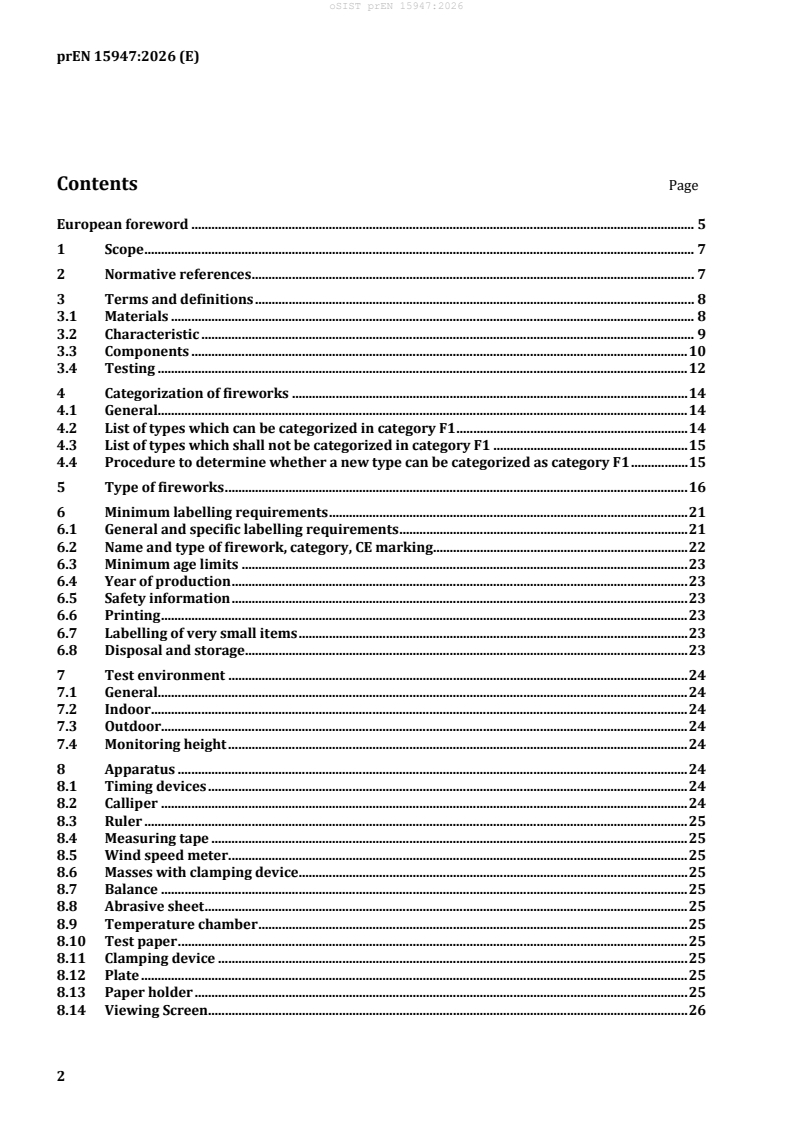
Contents Page
European foreword . 5
1 Scope . 7
2 Normative references . 7
3 Terms and definitions . 8
3.1 Materials . 8
3.2 Characteristic . 9
3.3 Components . 10
3.4 Testing . 12
4 Categorization of fireworks . 14
4.1 General. 14
4.2 List of types which can be categorized in category F1 . 14
4.3 List of types which shall not be categorized in category F1 . 15
4.4 Procedure to determine whether a new type can be categorized as category F1 . 15
5 Type of fireworks . 16
6 Minimum labelling requirements . 21
6.1 General and specific labelling requirements . 21
6.2 Name and type of firework, category, CE marking . 22
6.3 Minimum age limits . 23
6.4 Year of production . 23
6.5 Safety information . 23
6.6 Printing . 23
6.7 Labelling of very small items . 23
6.8 Disposal and storage . 23
7 Test environment . 24
7.1 General. 24
7.2 Indoor . 24
7.3 Outdoor. 24
7.4 Monitoring height . 24
8 Apparatus . 24
8.1 Timing devices . 24
8.2 Calliper . 24
8.3 Ruler . 25
8.4 Measuring tape . 25
8.5 Wind speed meter . 25
8.6 Masses with clamping device . 25
8.7 Balance . 25
8.8 Abrasive sheet . 25
8.9 Temperature chamber . 25
8.10 Test paper . 25
8.11 Clamping device . 25
8.12 Plate . 25
8.13 Paper holder . 25
8.14 Viewing Screen . 26
8.15 Pole . 27
8.16 Rack . 27
8.17 Sound level meter . 27
8.18 Shock apparatus . 27
8.19 Goniometer . 28
8.20 Frame . 28
8.21 Ignition source . 28
8.22 Transparent type size sheet . 28
8.23 Protractor . 29
8.24 Striking surface . 29
8.25 Post . 29
8.26 Cage . 29
8.27 Support pole . 29
8.28 Dropping tube . 29
8.29 Mass cylindrical in shape . 29
9 Test Methods . 30
9.1 Construction and stability . 30
9.2 Design – Verification . 32
9.3 Paper tests . 34
9.4 Angle of ascent and height of explosion . 38
9.5 Measurement of sound pressure level . 39
9.6 Time measurement . 41
9.7 Measuring of labelling . 42
9.8 Extinguishing of flames . 42
9.9 Burning rate of composition . 43
9.10 Droop test . 43
9.11 Debris and projected debris (outdoor) . 43
9.12 Incandescent matter . 43
9.13 Visual examinations . 44
9.14 Mechanical conditioning . 44
9.15 Thermal conditioning . 44
9.16 Striking surface test . 45
9.17 Function test . 45
9.18 Determination of tube angle . 45
10 Forbidden chemicals . 46
10.1 Forbidden substances . 46
10.2 Forbidden mixtures . 46
10.3 Verification methods (only for EU-type examination) . 47
11 Construction . 47
11.1 Construction materials . 47
11.2 Length of handle and pull string . 48
11.3 Permitted elements in battery, battery requiring external support, combination and
combination requiring external support . 49
11.4 Dimensions for mini rocket . 49
11.5 Specific requirements for compound firework . 49
11.6 Specific requirements for fireworks which eject pyrotechnic units with end closures . 50
11.7 Assessment of fireworks and components thereof that may end-up in the environment . 50
12 Pyrotechnic composition . 53
13 Means of initiation. 57
13.1 Permitted means of initiation . 57
13.2 Protection of means of initiation . 59
13.3 Attachment of means of initiation and resistance to ignition by an abrasive surface . 59
13.4 Requirements for means of initiation . 59
14 Performance . 60
14.1 Properties to be checked before functioning tests . 60
14.2 Properties to be checked during functioning tests. 61
14.3 Properties to be checked after functioning tests . 66
15 Primary pack or selection pack . 67
16 Type testing . 67
16.1 General. 67
16.2 Specific requirements for primary packs to be examined . 68
17 Batch testing . 69
17.1 General. 69
17.2 Sampling plans . 69
17.3 Unit of product . 69
17.4 Nonconformities . 69
17.5 Acceptance or rejection of a batch . 72
Annex A (informative) Safety Information . 73
Annex B (normative) Determination of silver fulminate . 100
B.1 Reagents . 100
B.2 Apparatus . 100
B.3 Procedure . 100
Annex C (informative) Mechanical conditioning (shock apparatus) . 102
Annex D (normative) Relevant standards for further assessment of requirements on fireworks of
categories F1, F2 and F3 . 105
Annex ZA (informative) Relationship between this European Standard and the essential safety
requirements of Directive 2013/29/EU aimed to be covered . 106
European foreword
This document (prEN 15947:2026) has been prepared by Technical Committee CEN/TC 212
“Pyrotechnic Articles”, the secretariat of which is held by NEN.
This document is currently submitted to the CEN Enquiry.
This document will supersede the series of standards EN 15947:2022.
series:
— merging of all five parts;
— improvement of the scope of the EN 15947 series, especially related to the applicability for fireworks
containing detonative explosives other than black powder or flash composition or pyrotechnic
composition;
— revision of normative references;
— update of terms and definitions by adding important terms and definitions, introducing groups and
highlighting only the English terms and definitions;
— revision of environmental terminology to harmonize EN 15947 and EN 16261 terminology;
— removal of duplicated definitions under “Categorization of fireworks”, taken from Directive
2013/29/EU;
— improvement of the EN 15947 series in relation to wordings and specifications of CEN Internal
Regulation 3;
— correction of Table 2 for applying an alphabetical order;
— printing has been amended in terms of type size;
— the labelling of very small items has been revised;
— the clause regarding labelling has been improved related to “tall buildings”;
— the procedure to attach a separate handle or separate base has been revised;
— test methods for cat. F1 have been revised;
— the EN 15947 series has been checked for missing tolerances and additions have been made;
— values within the EN 15947 series have been corrected to represent the needed precision;
— the lists of forbidden substances and mixtures have been reviewed and appropriately implemented;
— verification methods during EU-type examination of forbidden substances and mixtures have been
added;
— a clause for temperature resistance has been added;
— a list of fireworks without plastics has been created (prohibition of plastics);
— a decision-tree on how to determine what may end-up in the environment is incorporated;
— disposal and storage of fireworks is specified in a targeted manner (to cover ESR 2), less via
categorization and labelling rather than via requirements (e.g. via fireworks components that can be
separated for disposal);
— amendment of silver fulminate requirement for throwdowns to not duplicate the ESR of Directive
2013/29/EU;
— clarification about functioning of fireworks with a reserve fuse;
— clause on testing of report rockets of category F2 has been removed;
— revision of what aspects of conformity assessment are maintained and how;
— better specification about special holding devices in the placing instructions;
— ‘Do not inhale smoke’ has been removed in the EN 15947:2022 series, but is reinstated again for the
relevant types as before;
— modification of the testing of table bombs;
— improved use of the clamping device during testing;
— spinners have been added to the clause about extinguishing of flames (10 s group);
— Annex ZA has been updated to indicate support of each essential safety requirement (ESR).
This document has been prepared under a standardization request addressed to CEN by the European
Commission. The Standing Committee of the EFTA States subsequently approves these requests for its
Member States.
For the relationship with EU Legislation, see informative Annex ZA, which is an integral part of this
document.
1 Scope
This document defines various terms relating to the design, construction, primary packaging and testing
of fireworks of categories F1, F2 and F3 as defined by Article 6 Paragraph (1) clause (a) subclause (i) to
(iii) of Directive 2013/29/EU. It gives descriptions of fireworks types and establishes a system for
categorization. Minimum labelling requirements for fireworks as well as for primary and selection packs
of fireworks are specified. Firework specific test methods are defined. Specifications of requirements for
construction and performance of firework, primary packs and selection packs complete this standard.
This standard does not apply to fireworks intended to be kept or used at temperatures below −20 °C or
above 50 °C.
2 Normative references
The following documents are referred to in the text in such a way that some or all of their content
constitutes requirements of this document. For dated references, only the edition cited applies. For
undated references, the latest edition of the referenced document (including any amendments) applies.
EN 61672-1:2013, Electroacoustics — Sound level meters — Part 1: Specifications
EN ISO 660:2020, Animal and vegetable fats and oils — Determination of acid value and acidity
(ISO 660:2020)
EN ISO 3696:1995, Water for analytical laboratory use — Specification and test methods (ISO 3696:1987)
EN ISO 17556:2019, Plastics — Determination of the ultimate aerobic biodegradability of plastic materials
in soil by measuring the oxygen demand in a respirometer or the amount of carbon dioxide evolved
(ISO 17556:2019)
ISO 2859-1:2026, Sampling procedures for inspection by attributes — Part 1: Sampling schemes indexed by
acceptance quality limit (AQL) for lot-by-lot inspection
ISO 4793:1980, Laboratory sintered (fritted) filters — Porosity grading, classification and designation
ISO 6344-3:2021, Coated abrasives — Determination and designation of grain size distribution — Part 3:
Microgrit sizes P240 to P5000
ISO 21948:2001, Coated abrasives — Plain sheets
ISO 22863-7:2021, Fireworks — Test methods for determination of specific chemical substances — Part 7:
Chlorates content by chemical titration analysis
ISO 22863-8:2021, Fireworks — Test methods for determination of specific chemical substances — Part 8:
Arsenic content by hydride generation atomic fluorescence spectrometry
ISO 22863-10:2021, Fireworks — Test methods for determination of specific chemical substances —
Part 10: Nitrogen content in nitrocellulose by iron(II) sulfate titration
ISO 22863-11:2022, Fireworks — Test methods for determination of specific chemical substances —
Part 11: Phosphorus content by inductively coupled plasma optical emission spectrometry (ICP-OES)
ISO 22863-12:2022, Fireworks — Test methods for determination of specific chemical substances —
Part 12: Picrates and picric acid by high performance liquid chromatography
ISO/NP 22863-17, Fireworks — Test methods for determination of specific chemical substances — Part 17:
Determination of potassium chlorate by ion chromatography
3 Terms and definitions
For the purposes of this document, the following terms and definitions apply.
ISO and IEC maintain terminology databases for use in standardization at the following addresses:
— ISO Online browsing platform: available at https://www.iso.org/obp/
— IEC Electropedia: available at https://www.electropedia.org/
3.1 Materials
3.1.1
black powder
intimate mixture of charcoal and sodium nitrate or potassium nitrate with or without sulphur
3.1.2
bursting charge
pyrotechnic composition, which is intended to burst open the firework case and to expel one or more
pyrotechnic units, which can also transmit ignition
3.1.3
effect charge
pyrotechnic composition, other than propellant charge or bursting charge, which upon functioning will
burn or explode to produce a visual and/or aural effect
3.1.4
flash composition
inherent mixture of a metal and an oxidizer
Note 1 to entry: This is usually perchlorate or nitrate metal based.
3.1.5
microplastic
solid plastic particle with the longest dimension between 1 µm and 5 000 µm (= 5 mm), insoluble in water,
not biodegradable in the open environment and tending to accumulate
Note 1 to entry: Microplastics have regular and irregular shapes.
3.1.5.1
primary microplastic
polymer fragment, debris or alike resulting directly from an explosion
3.1.5.2
secondary microplastic
polymer fragments, debris or alike that end up in the environment
3.1.6
plastic
non-biodegradable material which contains, as an essential ingredient, a polymer (3.1.7) and which, at
some stage in its processing into finished products, can be shaped by heat and/or pressure
Note 1 to entry: Plastics consist mainly polymers and minor contents of additives.
Note 2 to entry: Plastics comprise both thermoplastic and thermoset materials.
3.1.7
polymer
chemical compound or mixture of compounds consisting of repeating structural units created through
polymerization
Note 1 to entry: In practice, the mass of polymer is above 10 000 Dalton.
3.1.8
propellant charge
pyrotechnic composition which will burn to evolve gas which, in turn, is intended to propel the firework
as a whole or to expel one or more pyrotechnic units without bursting the firework case, and which can
also transmit ignition
3.1.9
pyrotechnic composition
substance or mixture of substances which is designed to produce heat, light, sound, gas or smoke or a
combination of such effects through self-sustained exothermic chemical reactions
3.1.10
report charge
pyrotechnic composition which is solely intended to produce a report upon functioning
3.2 Characteristic
3.2.1
biodegradable
decomposable at the end of life in naturally occurring soil conditions
Note 1 to entry: Decomposition products can comprise carbon dioxide, water, microbial mass and minerals (non-
exhaustive list).
Note 2 to entry: Biodegradable materials can be both biobased or fossil-based.
3.2.2
burning rate of composition
net explosive content in grams divided by the effect time in seconds
3.2.3
droop
angle by which the tip of a composition-coated wire has been deflected from the horizontal, after the
firework has ceased to function
3.2.4
explosion
sudden release of energy accompanied by a report with or without a flash
3.2.5
first principal effect
principal effect of a firework which is the first to occur during the functioning of the firework
3.2.6
initial fuse burning
burning which immediately follows ignition and precedes any effect
3.2.7
invisible burning
burning occurring within the firework case which is not visible to the person who ignited the firework
3.2.8
invisible burning time
time between preliminary effect and first principal effect
3.2.9
net explosive content
NEC
mass of pyrotechnic composition in the firework
Note 1 to entry: For this standard series the NEC does not include the pyrotechnic composition in the initial fuse or
transmitting fuses, friction or ignition heads.
3.2.10
preliminary effect
visual and/or aural effect which follows the initial fuse burning and precedes the first principal effect of
a firework
Note 1 to entry: For example, for bangers or flash bangers; whistling, flames, sparks, crackling or combinations
thereof are preliminary effects.
3.2.11
principal effect
effects listed in the classification table as illustrated in Table 2 for a particular type of firework
3.2.12
sustainable substance
material that ensures the environmental and economic needs of the present without compromising the
future
Note 1 to entry: Potentially broader scopes exist. This definition neglects social aspects for the time being.
3.3 Components
3.3.1
debris
solid part of the firework which remains after the firework has ceased to function
Note 1 to entry: Chemical products resulting from the combustion of the pyrotechnic compositions are not
considered as “debris”.
3.3.2
end closure
component or crimp which is designed to seal one end of a firework case or pyrotechnic unit
3.3.3
external support
support which is not integral to the firework, or which must be fixed to the firework before use by the
user to provide stability
Note 1 to entry: External support includes but is not limited to: burying firework in soft ground or material, fixing
firework to a post or using heavy objects (for example sandbags).
3.3.4
firework case
casing which is designed to retain pyrotechnic compositions within a firework
3.3.5
friction head
ignition head designed to be ignited by friction
3.3.6
ignition head
initial fuse consisting of pyrotechnic composition only
3.3.7
initial fuse
component of a firework which is ignited to start the firework functioning
3.3.8
primary pack
package of one or more fireworks with the same registration number offered for retail sale as a single
unit or as a part in a selection pack
Note 1 to entry: For registration number see Directives 2013/29/EU, Article 9 and 2014/58/EU, Article 1.
3.3.9
projected debris
debris laterally projected at ground level while functioning
3.3.10
protruding fuse
initial fuse that extends from the firework case and is used to ignite the article with a given time delay
3.3.11
pyrotechnic unit
discrete unit that is part of a firework which, upon functioning, will burn or explode to produce a visual
and/or aural effect
Note 1 to entry: The effect produced by a pyrotechnic unit is normally part of a combination of effects produced by
the firework.
3.3.12
reserve fuse
component of a firework which is ignited in order to start the firework functioning when the initial fuse
fails
3.3.13
rocket launcher
tube, frame or base from which a rocket, report rocket or mini rocket, can be launched
3.3.14
sealing paper
thin paper that closes one end of the firework, covering the pyrotechnic composition which is ignited to
start the firework functioning
3.3.15
selection pack
package of fireworks of more than one registration number offered for retail sale as a single unit
Note 1 to entry: A selection pack may contain primary packs as well as individual fireworks.
Note 2 to entry: For registration number see Directives 2013/29/EU and 2014/58/EU.
3.3.16
transmitting fuse
component of a firework which is intended to transmit ignition from one part of a firework to another,
with or without a delay
3.4 Testing
3.4.1
AQL
quality level that is the worst tolerable process average when a continuing series of lots is submitted for
acceptance sampling
3.4.2
batch
collection of units of a product from which a sample is drawn and inspected in order to determine
whether that collection conforms to the acceptance criteria
Note 1 to entry: The term batch is based on the definition of “lot” in ISO 2859-1:2026.
3.4.3
batch test
test performed on one or more sample(s) of products taken at random from a batch to check compliance
with a given specification
Note 1 to entry: Batch testing aims at proving all products which are placed on the market are in conformity with
the type which is described in the EU-type examination certificate and has been successfully submitted to type test
determined by the standard.
3.4.4
critical nonconforming unit
nonconforming unit with one or more critical nonconformities, with or without major or minor
nonconformities
3.4.5
critical nonconformity
nonconformity that judgement and experience indicate is likely to result in hazardous or unsafe
conditions
Note 1 to entry: This type of nonconformity is referred to as a “class A nonconformity” in ISO 2859-1:2026.
3.4.6
major nonconforming unit
nonconforming unit with one or more major nonconformities, with or without minor nonconformities,
but with no critical nonconformities
3.4.7
major nonconformity
nonconformity, other than a critical nonconformity, which is likely to result in failure, to reduce
materially the usability of the firework, or to increase the potential hazard
Note 1 to entry: This type of nonconformity is referred to as a “class B nonconformity” in ISO 2859-1:2026.
3.4.8
minor nonconforming unit
nonconforming unit with one or more minor nonconformities, but with no critical or major
nonconformities
3.4.9
minor nonconformity
nonconformity that is not likely to reduce materially the usability of the firework
Note 1 to entry: This type of nonconformity is referred to as a “class C nonconformity” in ISO 2859-1:2026.
3.4.10
nonconforming unit
firework or a primary pack with one or more nonconformities
3.4.11
nonconformity
non-fulfilment of a specified requirement
3.4.12
testing point
location in the test area where the firework is placed at the beginning of a performance test
3.4.13
type test
test performed on a sample of product, representative of the production envisaged, in order to
demonstrate its compliance with the essential safety requirements of Annex I of Directive 2013/29/EU
Note 1 to entry: The successful submission to type tests leads to the attribution of an EU-type examination
certificate.
Note 2 to entry: Compliance with the essential safety requirements is given in Annex ZA.
4 Categorization of fireworks
4.1 General
Fireworks that are covered by this standard are categorized in accordance with Article 6 Paragraph (1)
Clauses (a) (i) to (a) (iii) of Directive 2013/29/EU.
Categorization based on NEC is described in Clause 13 “Pyrotechnic composition”. 4.2 to 4.4 are used to
categorize firework into category F1. Those which cannot be categorized in F1 can be categorized in
category F2 or F3 when meeting the requirements of this standard for category F2 or F3.
4.2 List of types which can be categorized in category F1
The following types of fireworks can be categorized in category F1, when meeting the requirements of
this standard for category F1:
— Bengal flame;
— Bengal match;
— Bengal stick;
— Christmas cracker;
— crackling granule;
— flash pellet;
— fountain;
— ground spinner;
— hand-held sparkler;
— non-hand-held sparkler;
— novelty match;
— party popper;
— senko-hanabi;
— serpent;
— snap;
— table bomb;
— throwdown.
4.3 List of types which shall not be categorized in category F1
Types of fireworks that shall not be categorized in category F1 are:
— aerial wheel;
— banger;
— battery;
— battery requiring external support;
— combination;
— combination requiring external support;
— compound firework;
— double banger;
— flash banger;
— ground mover;
— jumping cracker;
— jumping ground spinner;
— mine;
— mini rocket;
— report rocket;
— rocket;
— Roman candle;
— shot tube;
— spinner;
— wheel.
4.4 Procedure to determine whether a new type can be categorized as category F1
A new type of firework can only be categorized as category F1 if the answers to all the questions in Table 1
are negative. The questions shall be answered in the order given in Table 1.
Table 1 — Questions for articles that are not in category F1
Question Answer
1) Is the article in the list of excluded articles (see 4.3)? Yes → not in category F1
2) Does the article resemble a toy or food? Yes → not in category F1
3) Does the sound pressure level exceed 120 dB (A, imp) at the safety Yes → not in category F1
distance of category F1 fireworks (see 14.2.7)?
4) Is debris, burning, or incandescent matter projected laterally more than Yes → not in category F1
the safety distance of category F1 fireworks (see 14.2.9 and 14.2.11)?
5) Does the article, or parts of it, move outside the safety distance of Yes → not in category F1
category F1 fireworks from the testing point (see 14.2.4)?
6) Does the article lift from the ground by more than 0,5 m (see 14.2.4)? Yes → not in category F1
5 Type of fireworks
Fireworks are further subdivided into various types, as described in Table 2.
Table 2 — Types of fireworks
Type name Description of construction Principal effect(s)
Aerial wheel tubes containing propellant rotation and ascent, with
charges and spark-, flame- emission of sparks and flames,
Soucoupe volante
and/or noise-producing producing a visual and/or aural
Steigende Krone
pyrotechnic compositions, the effect in the air
tubes being fixed to a
supporting structure
Banger non-metallic case containing report
black powder as report charge,
Pétard
with or without a preliminary
Knallkörper
effect (e.g. whistling, flames,
sparks, crackling or
combinations thereof except
report)
Battery assembly including several as for the individual elements
elements, each of the same type
Batterie
and corresponding to one of the
Batterie
types of fireworks listed in this
table and in accordance with
11.3, with one or two points of
ignition, which does not require
external support
Type name Description of construction Principal effect(s)
Battery requiring external assembly including several as for the individual elements
support elements, each of the same type
and corresponding to one of the
Batterie nécessitant un support
types of fireworks listed in this
externe
table and in accordance with
Batterie, die externe
11.3, with one or two points of
Stabilisierung erfordert
ignition, which requires
external support
Bengal flame tube containing slow-burning emission of coloured flame
pyrotechnic composition
Feu de Bengale
designed to be placed on the
Bengalfeuer
ground, or to be fixed in the
ground, or to be fixed to a
support, or to be held in the
hand
Bengal match short wooden stick partially emission of coloured flame and
coated (along one end) with sparks
Allumette Bengale
slow-burning pyrotechnic
Bengalholz
composition, with a dot of
friction-sensitive pyrotechnic
composition at the tip and
designed to be held in the hand
Bengal stick
wooden stick partially coated emission of coloured flame and
(along one end) with slow- sparks
Baguette Bengale
burning pyrotechnic
Bengalfackel
c
...