


kSIST FprEN IEC 62933-5-3:2023
(Main)Electrical energy storage (EES) systems - Part 5-3: Safety requirements for grid-integrated EES systems - Performing unplanned modification of electrochemical based system
Electrical energy storage (EES) systems - Part 5-3: Safety requirements for grid-integrated EES systems - Performing unplanned modification of electrochemical based system
IEC 62933-5-3:2023 applies to those instances when a BESS undergoes unplanned modifications. Such modifications can involve one or more of the following:
- changes in energy storage capacity;
- changes of chemistries, design and manufacturer of the accumulation subsystem;
- changes of a subsystem component using non-OEM parts,
- changes to the mode of operation,
- changes of the installation site, or
- changes in an accumulation subsystem due to an installation of reused or repurposed batteries.
Any such modification can impair the original state of safety of the BESS.
This document complements IEC 62933-5-2, which relates to the overall safety aspects of a BESS. The requirements covered by this document are applied in addition to the requirements in IEC 62933-5-2 in accordance with each situation.
Systèmes de stockage de l’énergie électrique (EES) - Partie 5-3: Exigences de sécurité lors de la modification non programmée des systèmes EES électrochimiques
L’IEC 62933-5-3:2023 s’applique aux situations dans lesquelles un BESS subit des modifications non programmées. Ces modifications peuvent comporter un ou plusieurs des éléments suivants:
- modifications de la capacité de stockage énergétique;
- modifications des compositions chimiques et de la conception, et changement de fabricant du sous-système d’accumulation;
- modifications d’un composant de sous-système qui utilise des pièces non OEM;
- modifications du mode de fonctionnement;
- modifications du site d’installation; ou
- modifications d’un sous-système d’accumulation en raison d’une installation de batteries réutilisées ou réaffectées.
Une telle modification peut compromettre l’état de sécurité initial du BESS.
Le présent document complète l’IEC 62933-5-2 qui concerne les aspects liés à la sécurité globale d’un BESS. Les exigences couvertes par le présent document sont appliquées en plus des exigences de l’IEC 62933-5-2 conformément à chaque situation.
Električne naprave za shranjevanje energije (EES) - 5-3. del: Varnostne zahteve za sisteme EES, vključene v omrežje - Izvajanje nenačrtovanih sprememb elektrokemičnega sistema
General Information
- Status
- Not Published
- Public Enquiry End Date
- 31-Mar-2023
- Technical Committee
- I11 - Imaginarni 11
- Current Stage
- 98 - Abandoned project (Adopted Project)
- Start Date
- 17-Nov-2025
- Due Date
- 22-Nov-2025
- Completion Date
- 17-Nov-2025
Overview
FprEN IEC 62933-5-3:2023 provides safety requirements and guidance for unplanned modifications of electrochemical grid-integrated battery energy storage systems (BESS). It addresses situations where changes to a BESS during its lifecycle could impair the original safety state. This Part 5-3 complements IEC 62933-5-2 and is intended for stakeholders responsible for design, installation, commissioning, operation and maintenance of grid-connected EES systems.
Key unplanned modification scenarios covered include:
- Changes in energy storage capacity
- Changes of chemistry, design or manufacturer of the accumulation subsystem
- Use of non‑OEM components in subsystem replacement
- Changes to the mode of operation (control or dispatch behavior)
- Relocation or change of installation site
- Installation of reused or repurposed batteries
The standard emphasises a safety-led process across the re-design, installation & commissioning, and operation & maintenance phases to avoid introducing new hazards.
Key Topics
- Safety evaluation process: Guidance for assessing impacts of modifications on electrical, thermal and functional safety and for maintaining the original safety envelope.
- Phase-specific requirements: Recommended actions in the re-design phase, installation and commissioning checks, and ongoing operation & maintenance practices.
- Reused/repurposed batteries: Requirements for validating history data, estimating residual performance and incorporating safety design measures when reused cells or modules are installed.
- Non-OEM parts and chemistry changes: Identification of compatibility, interoperability and safety risks when replacing components or changing battery chemistries.
- Validation & monitoring: Use of safety validation methods (Annex A provides an example for lithium‑ion systems) and the importance of monitoring to detect degradation or abnormal behavior.
Applications
This standard is directly applicable to:
- Asset owners and operators implementing mid-life changes to grid-integrated BESS
- System integrators and designers evaluating retrofit options or capacity upgrades
- Maintenance teams who assess non-OEM replacements and reused battery installations
- Safety assessors and certification bodies verifying that unplanned modifications do not impair system safety
Practical benefits include reduced operational risk, clearer compliance pathways with IEC EES safety family documents, and improved lifetime management for electrochemical storage assets.
Related Standards
- IEC 62933-1 (vocabulary)
- IEC TS 62933-5-1 (safety considerations for grid-integrated EES)
- IEC 62933-5-2 (electrochemical BESS safety requirements)
- Future guidance: IEC 63330 / IEC 63338 (requirements and guidance for reuse of secondary batteries)
For implementation, follow the phase-based checklist and validation practices in FprEN IEC 62933-5-3:2023 to ensure any unplanned modification preserves or enhances BESS safety and regulatory compliance.

Get Certified
Connect with accredited certification bodies for this standard

DNV
DNV is an independent assurance and risk management provider.

BSI Group
BSI (British Standards Institution) is the business standards company that helps organizations make excellence a habit.

Bureau Veritas
Bureau Veritas is a world leader in laboratory testing, inspection and certification services.
Sponsored listings
Frequently Asked Questions
kSIST FprEN IEC 62933-5-3:2023 is a draft published by the Slovenian Institute for Standardization (SIST). Its full title is "Electrical energy storage (EES) systems - Part 5-3: Safety requirements for grid-integrated EES systems - Performing unplanned modification of electrochemical based system". This standard covers: IEC 62933-5-3:2023 applies to those instances when a BESS undergoes unplanned modifications. Such modifications can involve one or more of the following: - changes in energy storage capacity; - changes of chemistries, design and manufacturer of the accumulation subsystem; - changes of a subsystem component using non-OEM parts, - changes to the mode of operation, - changes of the installation site, or - changes in an accumulation subsystem due to an installation of reused or repurposed batteries. Any such modification can impair the original state of safety of the BESS. This document complements IEC 62933-5-2, which relates to the overall safety aspects of a BESS. The requirements covered by this document are applied in addition to the requirements in IEC 62933-5-2 in accordance with each situation.
IEC 62933-5-3:2023 applies to those instances when a BESS undergoes unplanned modifications. Such modifications can involve one or more of the following: - changes in energy storage capacity; - changes of chemistries, design and manufacturer of the accumulation subsystem; - changes of a subsystem component using non-OEM parts, - changes to the mode of operation, - changes of the installation site, or - changes in an accumulation subsystem due to an installation of reused or repurposed batteries. Any such modification can impair the original state of safety of the BESS. This document complements IEC 62933-5-2, which relates to the overall safety aspects of a BESS. The requirements covered by this document are applied in addition to the requirements in IEC 62933-5-2 in accordance with each situation.
kSIST FprEN IEC 62933-5-3:2023 is classified under the following ICS (International Classification for Standards) categories: 13.020.30 - Environmental impact assessment; 27.010 - Energy and heat transfer engineering in general. The ICS classification helps identify the subject area and facilitates finding related standards.
kSIST FprEN IEC 62933-5-3:2023 is available in PDF format for immediate download after purchase. The document can be added to your cart and obtained through the secure checkout process. Digital delivery ensures instant access to the complete standard document.
Standards Content (Sample)
SLOVENSKI STANDARD
oSIST prEN IEC 62933-5-3:2023
01-marec-2023
Električne naprave za shranjevanje energije (EES) - 5-3. del: Varnostne zahteve pri
izvajanju nenačrtovanih sprememb elektrokemičnih sistemov EES
Electrical energy storage (EES) systems - Part 5-3: Safety requirements when
performing unplanned modification of electrochemical based EES systems
Ta slovenski standard je istoveten z: prEN IEC 62933-5-3:2023
ICS:
27.010 Prenos energije in toplote na Energy and heat transfer
splošno engineering in general
oSIST prEN IEC 62933-5-3:2023 en
2003-01.Slovenski inštitut za standardizacijo. Razmnoževanje celote ali delov tega standarda ni dovoljeno.
oSIST prEN IEC 62933-5-3:2023
oSIST prEN IEC 62933-5-3:2023
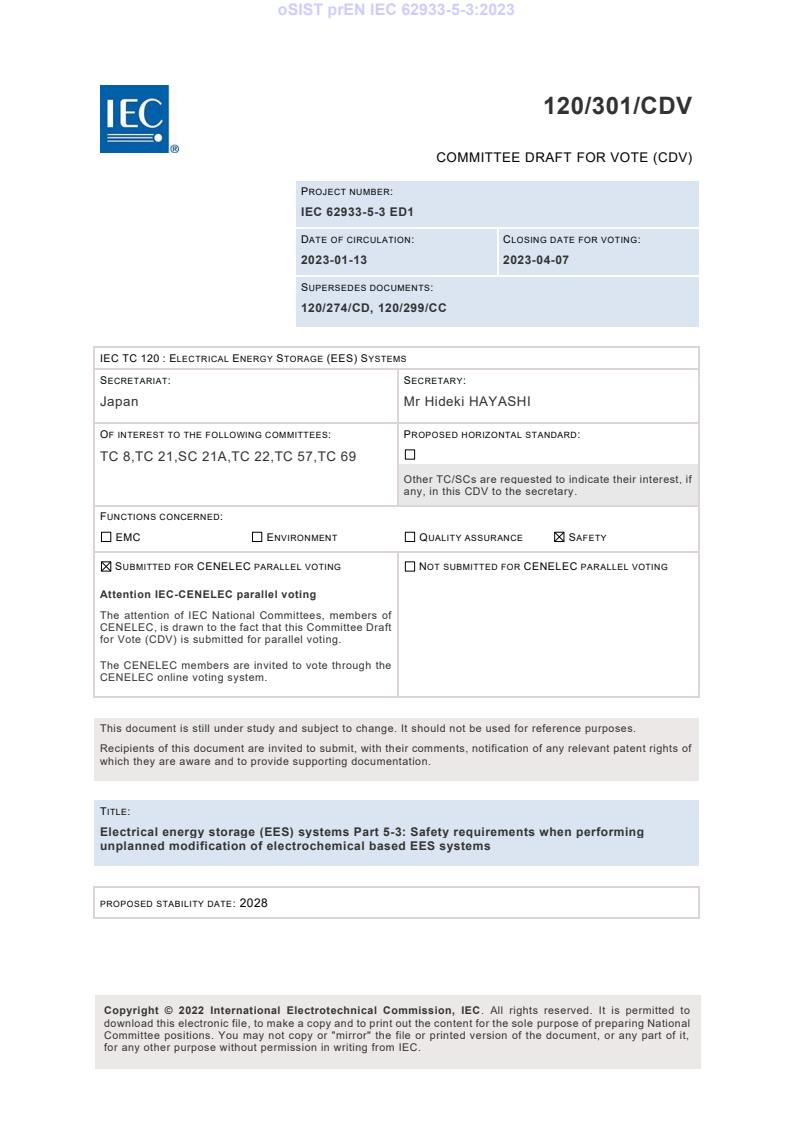
120/301/CDV
COMMITTEE DRAFT FOR VOTE (CDV)
PROJECT NUMBER:
IEC 62933-5-3 ED1
DATE OF CIRCULATION: CLOSING DATE FOR VOTING:
2023-01-13 2023-04-07
SUPERSEDES DOCUMENTS:
120/274/CD, 120/299/CC
IEC TC 120 : ELECTRICAL ENERGY STORAGE (EES) SYSTEMS
SECRETARIAT: SECRETARY:
Japan Mr Hideki HAYASHI
OF INTEREST TO THE FOLLOWING COMMITTEES: PROPOSED HORIZONTAL STANDARD:
TC 8,TC 21,SC 21A,TC 22,TC 57,TC 69
Other TC/SCs are requested to indicate their interest, if
any, in this CDV to the secretary.
FUNCTIONS CONCERNED:
EMC ENVIRONMENT QUALITY ASSURANCE SAFETY
SUBMITTED FOR CENELEC PARALLEL VOTING NOT SUBMITTED FOR CENELEC PARALLEL VOTING
Attention IEC-CENELEC parallel voting
The attention of IEC National Committees, members of
CENELEC, is drawn to the fact that this Committee Draft
for Vote (CDV) is submitted for parallel voting.
The CENELEC members are invited to vote through the
CENELEC online voting system.
This document is still under study and subject to change. It should not be used for reference purposes.
Recipients of this document are invited to submit, with their comments, notification of any relevant patent rights of
which they are aware and to provide supporting documentation.
TITLE:
Electrical energy storage (EES) systems Part 5-3: Safety requirements when performing
unplanned modification of electrochemical based EES systems
PROPOSED STABILITY DATE: 2028
download this electronic file, to make a copy and to print out the content for the sole purpose of preparing National
Committee positions. You may not copy or "mirror" the file or printed version of the document, or any part of it,
for any other purpose without permission in writing from IEC.
oSIST prEN IEC 62933-5-3:2023
IEC CDV 62933-5-3 © IEC 2022 2 120/301/CDV
NOTE FROM TC/SC OFFICERS:
This CDV has reflected the observations of 120/299/CC.
And the standard title has been reviewed by WG5 experts below. In addition, there is a
comment to review this title in CH01 (serial number 02) of 120/299/CC.
The reviewed title:
“Electrical energy storage (EES) systems Part 5-3: Safety requirements when performing
unplanned modification of electrochemical based EES systems”
oSIST prEN IEC 62933-5-3:2023
IEC CDV 62933-5-3 © IEC 2022 3 120/301/CDV
1 CONTENTS
3 FOREWORD . 5
4 INTRODUCTION . 7
5 1 Scope . 8
6 2 Normative references . 8
7 3 Terms and definitions . 8
8 4 Guidelines for safety when performing unplanned modifications . 10
9 4.1 General . 10
10 5 Changes to an accumulation subsystem . 11
11 5.1 General . 11
12 5.2 Changes in energy storage capacity . 12
13 5.2.1 General . 12
14 5.2.2 Safety requirements in the re-design phase . 13
15 5.2.3 Safety requirements in the installation and commissioning phase . 13
16 5.2.4 Safety requirements for the operation and maintenance . 14
17 5.3 Changes of chemistries, design and manufacturer of an accumulation subsystem . 14
18 5.3.1 General . 14
19 5.3.2 Safety requirements in the re-design phase . 15
20 5.3.3 Safety requirements in the installation and commissioning phase . 16
21 5.3.4 Safety requirements for the operation and maintenance . 17
22 6 Changes of a system component using non-OEM parts . 17
23 6.1 General . 17
24 6.2 Safety requirements in the re-design phase . 18
25 6.3 Safety requirements in the installation and commissioning phase. 18
26 6.4 Safety requirements for the operation and maintenance . 19
27 7 Changes to mode of operation . 20
28 7.1 General . 20
29 7.2 Safety requirements in the re-design phase . 20
30 7.3 Safety requirements in the installation and commissioning phase. 21
31 7.4 Safety requirements for the operation and maintenance . 21
32 8 Changes of installation site . 22
33 8.1 General . 22
34 8.2 Safety requirements in the re-design phase . 22
35 8.3 Safety requirements in the installation and commissioning phase. 23
36 8.4 Safety requirements for the operation and maintenance . 24
37 9 Changes in an accumulation subsystem due to an installation of reused or repurposed
38 batteries . 24
39 9.1 General . 24
40 9.2 Safety requirements in the design phase . 25
41 9.2.1 General . 25
42 9.2.2 Validation of history data . 25
43 9.2.3 Estimation of residual usable period and performance . 26
44 9.2.4 Safety requirements in the design of safety . 26
45 9.3 Safety requirements in the installation and commissioning phase. 29
46 9.3.1 General . 29
47 9.3.2 Safety requirements for installation and commissioning process . 29
48 9.4 Safety requirements for the operation and maintenance . 30
oSIST prEN IEC 62933-5-3:2023
IEC CDV 62933-5-3 © IEC 2022 4 120/301/CDV
49 9.4.1 General . 30
50 9.4.2 Safety requirements for monitoring data . 30
51 9.4.3 Safety requirements for operation and maintenance . 31
52 Annex A (informative) An example of a safety validation method when performing unplanned
53 modifications of a BESS using Lithium ion batteries . 33
54 A.1 General . 33
55 A.2 Estimation methods for deterioration of lithium-ion battery . 33
56 A.3 Safety estimation of BESS by deterioration estimation method . 33
57 Bibliography . 35
59 Figure 1 – Major modifications and their classification . 10
60 Figure 2 – An example of BESS architecture . 12
61 Figure 3 – Life cycle of reused/repurposed battery . 25
62 Figure A.1– An example of BESS mounted a safety estimation function . 34
63 Figure A.2 – An example of a safety assessment network using an estimation function . 34
65 Table 1 – Examples of relevant stakeholders . 11
66 Table 2 – Examples of different batteries chemistry modifications and their categorization . 15
67 Table 3 – Examples of subsystems or components related safety . 18
oSIST prEN IEC 62933-5-3:2023
IEC CDV 62933-5-3 © IEC 2022 5 120/301/CDV
71 INTERNATIONAL ELECTROTECHNICAL COMMISSION
72 ____________
74 ELECTRICAL ENERGY STORAGE (EES) SYSTEMS
76 Part 5-3: Safety requirements when performing unplanned modification of
77 electrochemical based EES systems
79 FOREWORD
80 1) The International Electrotechnical Commission (IEC) is a worldwide organization for standardization comprising all national
81 electrotechnical committees (IEC National Committees). The object of IEC is to promote international co-operation on all
82 questions concerning standardization in the electrical and electronic fields. To this end and in addition to other activities, IEC
83 publishes International Standards, Technical Specifications, Technical Reports, Publicly Available Specifications (PAS) and
84 Guides (hereafter referred to as “IEC Publication(s)”). Their preparation is entrusted to technical committees; any IEC
85 National Committee interested in the subject dealt with may participate in this preparatory work. International, governmental
86 and non-governmental organizations liaising with the IEC also participate in this preparation. IEC collaborates closely with
87 the International Organization for Standardization (ISO) in accordance with conditions determined by agreement between
88 the two organizations.
89 2) The formal decisions or agreements of IEC on technical matters express, as nearly as possible, an international consensus
90 of opinion on the relevant subjects since each technical committee has representation from all interested IEC National
91 Committees.
92 3) IEC Publications have the form of recommendations for international use and are Accepted by IEC National Committees in
93 that sense. While all reasonable efforts are made to ensure that the technical content of IEC Publications is accurate, IEC
94 cannot be held responsible for the way in which they are used or for any misinterpretation by any end user.
95 4) In order to promote international uniformity, IEC National Committees undertake to apply IEC Publications transparently to
96 the maximum extent possible in their national and regional publications. Any divergence between any IEC Publication and
97 the corresponding national or regional publication shall be clearly indicated in the latter.
98 5) IEC itself does not provide any attestation of conformity. Independent certification bodies provide conformity assessment
99 services and, in some areas, access to IEC marks of conformity. IEC is not responsible for any services carried out by
100 independent certification bodies.
101 6) All users should ensure that they have the latest edition of this publication.
102 7) No liability shall attach to IEC or its directors, employees, servants or agents including individual experts and members of its
103 technical committees and IEC National Committees for any personal injury, property damage or other damage of any nature
104 whatsoever, whether direct or indirect, or for costs (including legal fees) and expenses arising out of the publication, use of,
105 or reliance upon, this IEC Publication or any other IEC Publications.
106 8) Attention is drawn to the Normative references cited in this publication. Use of the referenced publications is indispensable
107 for the correct application of this publication.
108 9) Attention is drawn to the possibility that some of the elements of this IEC Publication may be the subject of patent rights.
109 IEC shall not be held responsible for identifying any or all such patent rights.
110 International Standard IEC 62933-5-3 has been prepared by IEC technical committee 120:
111 Electrical Energy Storage (EES) Systems.
112 The text of this International Standard is based on the following documents:
FDIS Report on voting
120/XX/FDIS 120/XX/RVD
114 Full information on the voting for the approval of this International Standard can be found in the
115 report on voting indicated in the above table.
116 This document has been drafted in accordance with the ISO/IEC Directives, Part 2.
117 The committee has decided that the contents of this document will remain unchanged until the
118 stability date indicated on the IEC website under "http://webstore.iec.ch" in the data related to
119 the specific document. At this date, the document will be
120 • reconfirmed,
121 • withdrawn,
oSIST prEN IEC 62933-5-3:2023
IEC CDV 62933-5-3 © IEC 2022 6 120/301/CDV
122 • replaced by a revised edition, or
123 • amended.
125 The National Committees are requested to note that for this document the stability date
126 is 202X.
127 THIS TEXT IS INCLUDED FOR THE INFORMATION OF THE NATIONAL COMMITTEES AND WILL BE DELETED
128 AT THE PUBLICATION STAGE.
oSIST prEN IEC 62933-5-3:2023
IEC CDV 62933-5-3 © IEC 2022 7 120/301/CDV
130 INTRODUCTION
131 The initial design or planning cannot cover all modifications that are made to a BESS over its lifetime.
132 Unplanned modifications require a careful evaluation of their potential impact on the safety of the
133 BESS.
135 This document provides safety requirements, considerations and process steps when unplanned
136 modifications of the BESS are to be carried out.
138 Such modification activities of the BESS require appropriate attention to safety issues in the relative
139 redesign, installation, commissioning, operation and maintenance phases.
140 Unplanned modifications which are dealt with in this standard are:
141 – changes in energy storage capacity;
142 – changes of chemistries, design and manufacturer of the accumulation subsystem;
143 – changes of a subsystem component using non-OEM parts;
144 – changes to mode of operation;
145 – changes of installation site;
146 – changes in an accumulation subsystem due to an installation of reused or repurposed
147 batteries.
oSIST prEN IEC 62933-5-3:2023
IEC CDV 62933-5-3 © IEC 2022 8 120/301/CDV
148 ELECTRICAL ENERGY STORAGE (EES) SYSTEMS
150 Part 5-3: Safety requirements when performing unplanned modification of
151 electrochemical based EES systems
153 1 Scope
154 This part of IEC 62933 applies to those instances when a BESS undergoes unplanned
155 modifications. Such modifications can involve one or more of the following:
156 – changes of a subsystem component using non-OEM parts,
157 – changes to mode of operation,
158 – changes of installation site, or
159 – changes in an accumulation subsystem due to an installation of reused or repurposed
160 batteries.
161 Any such modification shall not impair the original state of safety of the BESS.
162 This document complements IEC 62933-5-2, which relates to the overall safety aspects of a
163 BESS. The requirements covered by this document are applied in addition to the requirements
164 in IEC 62933-5-2 in accordance with each situation.
166 2 Normative references
167 The following documents are referred to in the text in such a way that some or all of their content
168 constitutes requirements of this document. For dated references, only the edition cited applies.
169 For undated references, the latest edition of the referenced document (including any
170 amendments) applies.
171 IEC 62933-1, Electrical Energy Storage (EES) systems - Part 1: Vocabulary
172 IEC TS 62933-5-1, Electrical Energy Storage (EES) systems – Part 5-1: Safety considerations
173 for grid integrated EES systems – General specifications
174 IEC 62933-5-2, Electrical Energy Storage (EES) systems – Part 5-2: Safety requirements for
175 grid integrated EES systems – Electrochemical based system
176 IEC 63330(future IEC), Requirements for reuse of secondary batteries
177 IEC 63338(future IEC), General guidance for reuse of secondary cells and batteries
179 3 Terms and definitions
180 3.1
181 accumulation subsystem
182 storage subsystem
183 EESS subsystem, comprising at least one electrical energy storage, where the energy is
184 stored in some form
186 Note 1 to entry: Mechanical energy, electrochemical energy, electromagnetic energy are frequent forms of stored
187 energy.
189 Note 2 to entry: Generally, the accumulation subsystem is connected to the power conversion
190 subsystem that performs the necessary power conversion to electrical energy; however, in some cases, a power
191 conversion is embedded in the accumulation subsystem (e.g. in electrochemical secondary cells the energy is
192 directly available in the electrical form).
193 [SOURCE: IEC 62933-1: 2018, 2.27]
oSIST prEN IEC 62933-5-3:2023
IEC CDV 62933-5-3 © IEC 2022 9 120/301/CDV
194 3.2
195 battery energy storage system
196 BESS
197 electrical energy storage system with accumulation subsystem based on batteries with
198 secondary cells
199 Note 1 to entry: Battery energy storage systems can include a flow battery energy system (IEC 62932-1:2020, 3.1.15).
200 3.3
201 battery operating range
202 range of voltage, current and temperature to ensure the safe use of the accumulation subsystem
203 3.4
204 critical stakeholder
205 party concerned with the critical part of BESS safety affected by the modification
206 3.5
207 unplanned modification
208 modification that has not been intended to be carried out or planned prior to the start of
209 operation of the BESS
210 Note 1 to entry: IEC 62933-5-2 7.13.1 “Operation and maintenance plan” deals with planned modification.
211 3.6
212 OEM part
213 part supplied to or by an original equipment manufacturer (OEM)
214 Note 1 to entry: OEM parts are generally used to manufacture new equipment and can also be purchased for
215 maintenance and repair.
216 Note 2 to entry: A part that is not an OEM part is called “non-OEM part”.
217 3.7
218 relocation
219 moving an installation physically from its current location
220 3.8
221 reused battery
222 battery that is used again in the same application as it was used for when commissioned the
223 first time
224 3.9
225 repurposed battery
226 battery that is used again in a different application as it used for when commissioned the first
227 time
228 3.10
229 residual usable period
230 actual or estimated remaining length of service life
231 3.11
232 safety margin,
233 margin defined within battery operating range considering system application, environmental
234 conditions and so on for safe operation of BESS
235 3.12
236 safe-operating range,
237 range excluding safety margin from battery operating range
238 3.13
239 state of energy,
240 state of charge,
241 EESS SOE
242 EESS SOC
243 ratio between the available energy from an EES system and the actual energy storage capacity
244 [SOURCE: IEC 62933-1:(future revision), 6.2.7]
oSIST prEN IEC 62933-5-3:2023
IEC CDV 62933-5-3 © IEC 2022 10 120/301/CDV
245 3.14
246 state of health,
247 EESS SOH
248 general condition of the EES system based on measurements that indicate its actual performance
249 compared with its either nominal or rated performances
250 Note 1 to entry: The state of health includes also the temporary degradation due to faults inside the EESS subsystems.
251 [SOURCE: IEC 62933-1:(future revision), 6.2.8]
253 4 Guidelines for safety when performing unplanned modifications
254 4.1 General
255 The BESS, including the batteries, can be exposed to the following changes in safety conditions
256 during its operation:
257 1) Changes in safety conditions due to changes in the surrounding environment,
258 2) Changes in safety conditions due to unplanned modifications of the BESS,
259 3) Changes in safety conditions due to aging, and
260 4) Changes in safety conditions due to modifications planned at the time of the initial design.
261 This standard describes the safety measures that shall be taken for BESS in the event of items
262 1) and 2) above. The events of items 3) and 4) should be considered and addressed at the time
263 of initial design of the BESS, which is under the scope of IEC 62933-5-2.
264 NOTE: The modifications that occur in the BESS can be at the component, subsystem or system level. While the
265 primary focus of this document is on changes in safety and their evaluation at the system level, the process can also
266 require evaluation at the component or subsystem level (e.g., interactions between subsystems).
267 Figure 1 shows the modifications that affect safety, which are made by subdivision of changes
268 in items 1) and 2). This standard deals with the modifications shown in the yellow boxes in
269 Figure 1.
Unplanned modification
Changes in surrounding
Changes to BESS
environment
Changes to
Accumulation Subsystem
Changes of
mode of operation
Surrounding
subsystem components
installation site Law or regulation
condition clause 7
clause 8
Changes of chemistry, Changes in an accumulation Changes of
Changes in
design and manufacturer of subsystem due to an installation of a system components
energy storage capacity
an accumulation subsystem reused or repurposed batteries
using non-OEM parts
sub-clause 5.2
sub-clause 5.3 clause 9 clause 6
271 Figure 1 – Major modifications and their classification
273 An unplanned modification of a BESS can result in conditions where multiple safety related
274 conditions are potentially affected at the same instance.
275 In such an event, the impact on safety of the individual modifications is to be assessed and all
276 the resulting risk mitigation actions are to be implemented. The detailed requirements of
277 assessment or measures etc., are described in each clause of this standard.
278 A wide range of stakeholders are involved in the modification process. Examples of
279 stakeholders are shown in Table 1. The requirements described in this standard shall be met
280 as appropriate in cooperation with the stakeholders.
oSIST prEN IEC 62933-5-3:2023
IEC CDV 62933-5-3 © IEC 2022 11 120/301/CDV
281 NOTE: Responsibility for ensuring the BESS safety depends on each case and local regulations.
282 Table 1 – Examples of relevant stakeholders
Type of stakeholders Specific examples of stakeholders
Owner
Ownership
User
Operator
Operation
Service provider
Project manager and administrator
Overall system integrator
Engineering, Procurement and
Construction (EPC)
Subsystem integrator
Integrator performing modification *
Component manufacturer
Component vendor
Component
Additional component manufacturer *
Additional component vendor *
Certification authority of original parts
Certification body
Certification authority of additional parts *
Local government
Local
Fire-fighting agency
283 Note: The stakeholders with “*” marking can be involved in cases where there are modifications with additional parts
284 (e.g. clause 5,6 and 9).
286 5 Changes to an accumulation subsystem
287 5.1 General
288 The intention of this clause is to describe safety requirements, considerations and processes
289 to follow for situations where changes are made to an accumulation subsystem in a BESS.
290 This section describes the requirements when an accumulation subsystem (See Figure 2)
291 undergoes unplanned modifications.
oSIST prEN IEC 62933-5-3:2023
IEC CDV 62933-5-3 © IEC 2022 12 120/301/CDV
Control subsystem
Communication subsystem
Management subsystem Communication
interface
Protection subsystem
Auxiliary
connection
Auxiliary subsystem Auxiliary POC
terminal
Primary subsystem
Power Primary
Accumulation
Primary POC
conversion connection
subsystem
subsystem terminal
293 Note: ”POC” is short for “point of connection”.
294 Figure 2 – An example of BESS architecture
296 The unplanned modifications of the accumulation subsystem described in this section are:
297 – changes in energy storage capacity;
298 – changes of chemistry and design of an accumulation subsystem.
300 5.2 Changes in energy storage capacity
301 5.2.1 General
302 This clause specifies the safety requirements, considerations and processes for situations
303 where the energy storage capacity of the electrochemical accumulation subsystem is changed.
304 The energy storage capacity of the BESS can be modified when batteries are removed due to
305 their failure or added to meet a higher energy demand or a modified operating mode.
306 Note: “Energy storage capacity of the BESS” means the total energy capacity of electrochemical
307 accumulation subsystems.
308 Such changes modify the voltage vs. time profile during discharge and charge and possibly
309 bring the batteries to voltage, temperature and SOC values that were not originally planned.
310 This can mean that the existing safety measures are not adequate and the safety of the BESS
311 can be impaired.
312 The possible negative consequences of capacity changes are:
313 a) Dielectric breakdown and loss of the electrical insulation levels resulting in dangerous
314 voltages on operator-accessible surfaces,
315 b) Electric shock risks arising from changes causing malfunction of protective measures
316 and devices,
317 c) An increase of the fire load level necessitating adjustment of firefighting measures and
318 their capabilities,
319 d) An increase in the amount of thermal energy released by the accumulation subsystem
320 to be handled by the heat, ventilation and air conditioning (HVAC),
321 e) An increase of the quantity of chemicals to be handled in an emergency,
oSIST prEN IEC 62933-5-3:2023
IEC CDV 62933-5-3 © IEC 2022 13 120/301/CDV
322 f) Voltage and capacity imbalances between aged and new batteries causing accelerated
323 aging,
324 g) Management/control subsystem errors when the batteries that are added to increase
325 capacity have different operating conditions and are installed in the same
326 management/control section of existing batteries, and
327 h) Increase in the occurrence of operator and maintenance personnel mistakes.
328 The risk assessment shall be repeated in accordance with IEC 62933-5-2 in the first stage of
329 planning and before any other work, and the needed corrective measures concerning hardware
330 and software shall be undertaken in accordance with the assessment results.
331 5.2.2 Safety requirements in the re-design phase
332 In order to maintain the safety level of the BESS, the following actions are required in the
333 redesign phase:
334 – The safety level of the capacity-modified BESS shall not be less than that present prior to
335 the modification.
336 – If the change of capacity results in a change of the BESS category as defined in Table 1 of
337 IEC 62933-5-2, then the appropriate safety measures shall be implemented in the modified
338 BESS.
339 – The suppliers of the existing BESS shall approve in writing the capacity modification.
340 – The general safety protection systems (e.g., deflagration protection, ventilation subsystem)
341 of the BESS shall be updated to reflect the capacity modification.
342 In cases where it is difficult to modify or add safety measures to an existing BESS due to space
343 or other restrictions, the following reinforcement of risk reduction measures shall be undertaken:
344 – Inherently safe design: Set the conditions and parameters sufficient to ensure the safety
345 of the accumulation subsystem. For example, make SOC range or the operation
346 temperature range narrowed, etc.
347 – Guards and protection: If the prevention of fire propagation at the accumulation subsystem
348 level cannot be ensured, add a protection measure against fire propagation (e.g. fireproof
349 boards or walls) to prevent fire propagation at the cubicle, building, or container levels .
350 – Information for use: Use on-site labels to distinguish between the added accumulation
351 subsystem and existing one. Set warning devices (audible alerts, visible signals) and
352 remote alerts to distinguish between the added one and the existing one so that prompt
353 and accurate responses can be made in the event of trouble.
355 5.2.3 Safety requirements in the installation and commissioning phase
356 The modification of the capacity of the BESS entails access, by installation personnel, to
357 components carrying dangerous voltages or containing toxic compounds.
358 In order to maintain the safety of the BESS and workers, the following actions are required in
359 the installation and commissioning phase:
360 – The necessary safety measures for the workers shall be defined prior to work
361 commencement.
362 – All activities shall be assessed in advance for the risk due to live electrical parts that cannot
363 be adequately protected, and shall comply with live electrical work the standards.
364 – All procedures shall be reviewed to ensure that all activities are carried out in accordance
365 with local regulations that are required for work on live power sources and toxic chemicals.
366 – All procedures shall be reviewed to ensure that only qualified personnel with an
367 established chain of command and open communication channels to the BESS
368 operator carry out the work.
369 If the capacity modification is carried out without powering down the BESS, then all safety
370 measures listed below are required.
371 – The battery string to be modified or added shall stay disconnected from any live circuit until
372 completion of the modification.
oSIST prEN IEC 62933-5-3:2023
IEC CDV 62933-5-3 © IEC 2022 14 120/301/CDV
373 – The battery string to be modified shall be broken down in subunits so that each subunit does
374 not carry dangerous voltage as defined by local regulations.
375 – A notification of appropriate protective measures for workers shall be taken.
376 During installation, particular attentions are required as follows:
377 – The BESS shall be powered down and all components carrying dangerous voltage shall be
378 fully insulated to the appropriate IP and insulation class level.
379 – The enclosure of the BESS, where the modification work is carried out, shall be free from
380 any toxic liquid, vapor and gas and well ventilated during any presence of installation
381 personnel.
382 – Personal protection equipment (PPE) for protection against the hazards in the BESS shall
383 be made available to the involved personnel.
384 – The inspection of the correct connection and placement of sensing and monitoring devices
385 and also of cooling and ventilation air channels of the BESS shall be carried out in
386 accordance with an installation checklist prior to the reactivation.
387 – The BESS control software shall be verified that necessary update is done in accordance
388 with the capacity modifications.
390 5.2.4 Safety requirements for the operation and maintenance
391 The modification of the capacity of the BESS entails a modification of operating conditions,
392 operating procedures and maintenance activities.
393 – Prior to the restart of operation and to minimize risks, the following items of the capacity-
394 modified BESS and associated operating procedures shall be verified and documented:
395 i) operation plan (incl. service life),
396 ii) operating conditions,
397 iii) monitored items (incl. parts, subsystem and whole system level),
398 iv) inspected items (incl. parts, subsystem and whole system level),
399 v) education and training,
400 vi) emergency procedure training, and
401 vii) all hardware and software changes carried out including their sources and
402 specifications.
403 – The documentations shall be reviewed by the critical stakeholders of the BESS and formally
404 approved.
405 – The revised operation and maintenance instruction document, with a clear identification of
406 its version and validity, shall be distributed to all stakeholders and the expired version
407 recalled.
409 5.3 Changes of chemistries, design and manufacturer of an accumulation subsystem
410 5.3.1 General
411 This subclause specifies the safety requirements, considerations and processes when the
412 chemistry and design of the electrochemical accumulation subsystem in BESS is changed.
413 Over its lifetime, a BESS and its batteries can be modified by replacement with or addition of
414 accumulation subsystems whose chemical and electrochemical make-up and design differs
415 from the existing ones.
416 If carried out without adequate precautions, such changes in the electrochemical energy
417 storage system can significantly impair the safety of the modified BESS.
418 The addition/replacement with a different battery chemistry can involve a change in category
419 “C”.
oSIST prEN IEC 62933-5-3:2023
IEC CDV 62933-5-3 © IEC 2022 15 120/301/CDV
420 The definition of "different battery chemistry" does not always depend on the definition in the
421 category “C” of IEC 62933-5-2. There are often multiple chemistries within a particular category
422 that can impact the BESS when mixed during a modification even though still falling within the
423 same category. Examples of different batteries chemistry modifications that do or do-not impact
424 their categorization is shown in Table 1.
425 Table 2 – Examples of different batteries chemistry modifications and their
426 categorization
Case No. Detail Change of category “C”
Case 1 Replacement of a part of the accumulation subsystem, which No change in category “C”
is composed of Mn-based lithium ion batteries with NMC
(Remains category “C-A”)
(Nickel-Manganese-Cobalt) lithium ion batteries
Case 2 Replacement with a battery whose model number has No change in category “C”
changed due to discontinuation
Case 3 Addition to an accumulation subsystem of a category “C-B” to Change from category “C-A” to
a category “C-A” BESS category “C-Z”
428 The multiplication of designs and chemistries of the accumulation subsystem present in a BESS,
429 results in a related increase in failure scenarios and hence the need for implementing multiple
430 safety measures in parallel.
431 The possible negative consequences of installing electrochemical accumulation subsystem
432 which have different chemistry and/or design from existing one are:
433 a) Electric shock risks arising from malfunctions of protective measures and devices
434 caused by incompatibilities of new and existing accumulation subsystem,
435 b) A change of the fire load level necessitating adjustment of firefighting measures and
436 their capabilities,
437 c) A change of the amount of thermal energy released by the accumulation subsystem to
438 be handled by the heat, ventilation and air conditioning (HVAC),
439 d) A change of the chemicals and its quantity to be handled in an emergency,
440 e) Management/control subsystem errors when the batteries that are added to increase
441 capacity have different specification and are installed in the same management/control
442 section of existing batteries, and
443 f) Increase in the occurrence of operator and maintenance personnel mistakes.
444 The risk assessment shall be repeated in accordance with IEC 62933-5-2 in the first stage of
445 planning and before any other work, and the needed corrective measures concerning hardware
446 and software shall be undertaken in accordance with the assessment results.
448 5.3.2 Safety requirements in the re-design phase
449 In order to maintain the safety level of the BESS, the following actions are required in the
450 redesign phase:
451 – The safety level of the chemistry and design of accumulation subsystem modified BESS
452 shall not be less than that present prior to the modification.
453 – If the change of chemistry and design of accumulation subsystem results in a change of the
454 BESS category as defined in Table 1 of IEC 62933-5-2, then the appropriate mandated
455 safety measures shall be implemented in the modified BESS.
456 – The suppliers of the existing BESS shall confirm the modification of the chemistry and
457 design of accumulation subsystem in the BESS and make a judgement on whether the
458 modification can be performed. The modification shall not be performed unless the suppliers
459 approve the implementation of the modification from a safety perspective.
oSIST prEN IEC 62933-5-3:2023
IEC CDV 62933-5-3 © IEC 2022 16 120/301/CDV
460 – When installing accumulation subsystems which have a different chemistry category “C”
461 from the existing one, the section where the accumulation subsystem is installed shall be
462 operated separately with its own and independent control and auxiliary subsystem.
463 – The general safety protection systems (e.g., deflagration protection, ventilation subsystem)
464 of the BESS shall be updated to reflect the presence of a new chemistry and design of the
465 accumulation subsystem.
466 Where it is difficult to modify or add safety measures to an existing BESS due to installation
467 space or other restrictions, the following additional risk reduction measures shall implemented:
468 – Inherently safe design: Set the conditions and parameters sufficient to ensure the safety
469 of the accumulation subsystem. For example, make SOC range or the operational
470 temperature range narrowed, etc.
471 – Guards and protection: If the prevention of fire propagation at the accumulation
472 subsystem level cannot be ensured, add a protection measure against fire propagation
473 (e.g. fireproof boards or walls) to prevent fire propagation at the cubicle, building, or
474 container levels.
475 – Information for use: Use on-site labels to distinguish between the added accumulation
476 subsystem and existing one. Set warning devices (audible alerts, visible signals) and
477 remote alerts to distinguish between the added one and the existing one so that prompt
478 and accurate responses can be made in the event of trouble.
480 5.3.3 Safety requirements in the installation and commissioning phase
481 The modification of the chemistry and design of accumulation subsystem in the BESS entails
482 access, by installation personnel to components carrying dangerous voltage or containing toxic
483 compounds.
484 In order to maintain the safety of both the BESS and workers, the following actions are required
485 in the installation and commissioning phase:
486 – The necessary safety measures for the workers shall be defined prior to work
487 commencement.
488 – All activities shall be assessed in advance for the risk due to live electrical parts that cannot
489 be adequately protected, and be made in compliance with the standards related to live
490 electrical work.
491 – All procedures shall be reviewed to ensure that all activities are carried out in
492 accordance with local regulations pertaining to work on live power sources and toxic
493 chemicals.
494 – All procedures shall be reviewed to ensure that only qualified personnel with an
495 established chain of command and open communication channels to the BESS
496 operator carry out the work.
497 If the modification is carried out without powering down the BESS, then all safety measures
498 listed below are required.
499 – The battery string to be modified or added shall stay disconnected from any live circuit until
500 completion of the modification.
501 – The battery string to be modified shall be broken down into subunits so that each subunit
502 does not carry dangerous voltages as defined by local regulations.
503 – A notification and appropriate protective measures to workers shall be taken.
504 During installation, particular attentions are required as follows:
505 – The BESS shall be powered down and all components carrying dangerous voltages shall be
506 fully insulated to the appropriate IP and insulation class level.
507 – The enclosure of the BESS, where the modification work is carried out, shall be free from
508 any toxic liquid, vapor and gas and well ventilated during any presence of installation
509 personnel.
510 – Personal protection equipment (PPE) for protection against the hazard in the BESS shall be
511 made available to the involver personnel.
oSIST prEN IEC 62933-5-3:2023
IEC CDV 62933-5-3 © IEC 2022 17 120/301/CDV
512 – The inspection of the correct connection and placement of sensing and monitoring devices
513 and also cooling and ventilation air channels of the BESS shall be carr
...
Questions, Comments and Discussion
Ask us and Technical Secretary will try to provide an answer. You can facilitate discussion about the standard in here.
Loading comments...