

SIST EN 14152:2014
(Main)Foodstuffs - Determination of vitamin B2 by high performance liquid chromatography
General Information
- Abstract
This European Standard specifies a method for the determination of vitamin B2 in food by high performance liquid chromatography (HPLC) and fluorescence detection. This method has been validated in two interlaboratory studies. The first study was for the analysis of samples of milk powder and pig's liver ranging from 1,45 mg/100 g to 10,68 mg/100 g. The second study was for the analysis of samples of tube feeding solution, baby food, powdered milk, meal with fruits, yeast, cereal and chocolate powder ranging from 0,21 mg/100 g to 87,1 mg/100 g. Vitamin B2 is the mass fraction of total riboflavin including its phosphorylated derivatives.
For further information on the validation, see Clause 8 and Annex B.
- Status
- Published
- Public Enquiry End Date
- 19-Jun-2012
- Publication Date
- 10-Aug-2014
- Technical Committee
- KŽP - Agricultural food products
- Current Stage
- 6060 - National Implementation/Publication (Adopted Project)
- Start Date
- 05-Aug-2014
- Due Date
- 10-Oct-2014
- Completion Date
- 11-Aug-2014

Overview
EN 14152:2014 (CEN) specifies a validated analytical method for the determination of vitamin B2 (riboflavin) in foodstuffs using high performance liquid chromatography (HPLC) with fluorescence detection. The standard defines the measurement of the mass fraction of total riboflavin, including phosphorylated derivatives, and has been validated in two interlaboratory studies covering sample ranges from 0.21 mg/100 g to 87.1 mg/100 g and 1.45 mg/100 g to 10.68 mg/100 g. For validation details see Clause 8 and Annex B.
Key topics and requirements
- Scope and analyte: Total riboflavin (vitamin B2), including phosphorylated forms (e.g., riboflavin-5′-phosphate).
- Sample types validated: milk powder, pig’s liver, tube feeding solutions, baby food, powdered milk, fruit meals, yeast, cereals, chocolate powder.
- Extraction & hydrolysis: Acid hydrolysis (e.g., HCl or H2SO4) at controlled temperature/time (autoclave or heating) to liberate bound riboflavin.
- Enzymatic dephosphorylation: Use of dephosphorylating enzymes (e.g., Taka-Diastase or α‑amylase) with optimal pH/temperature/time; enzyme contribution must be accounted for and checked by spiking with riboflavin-5′-phosphate.
- Chromatography & detection: Reversed-phase HPLC with fluorometric detection. Example conditions: Supelco® LC-18 stationary phase (5 µm, 250×4.6 mm), mobile phase methanol:phosphate buffer (35:65) with ion-pairing agents, flow 1.0 mL/min, injection 20 µL; fluorescence detection Excitation ~468 nm / Emission ~520 nm.
- Standards & calibration: Use riboflavin standard(s); determine stock concentration by UV spectrometry at ~444 nm. External standard quantification and linearity checks required.
- Quality & safety: Protect analyte from light (use brown glassware), use analytical-grade reagents and Grade 1 water (EN ISO 3696). Annexes A–C provide chromatogram examples, precision data and alternative HPLC systems.
Applications and users
This standard is intended for:
- Food testing laboratories performing nutritional analysis and label compliance.
- Manufacturers and quality control teams monitoring fortification and raw material riboflavin content.
- Clinical nutrition and tube-feeding product developers validating vitamin content.
- Regulatory authorities and research labs requiring a validated HPLC method for vitamin B2 measurement.
Practical uses include routine quality control, stability testing, process validation, comparison of products, and regulatory reporting.
Related standards and documentation
- Normative reference: EN ISO 3696 (Water for analytical laboratory use).
- EN 14152:2014 supersedes EN 14152:2003; consult Annex B for precision and Annex C for alternate HPLC systems and method adaptations.
Keywords: EN 14152:2014, vitamin B2, riboflavin determination, HPLC fluorescence, food analysis standard, CEN, riboflavin-5′-phosphate, enzymatic dephosphorylation.
Relations
- Effective Date
- 01-Sep-2014
- Effective Date
- 01-Sep-2014
- Effective Date
- 28-Jan-2026
- Effective Date
- 28-Jan-2026
- Effective Date
- 28-Jan-2026
- Effective Date
- 28-Jan-2026
- Effective Date
- 28-Jan-2026
Get Certified
Connect with accredited certification bodies for this standard

BSI Group
BSI (British Standards Institution) is the business standards company that helps organizations make excellence a habit.

Bureau Veritas
Bureau Veritas is a world leader in laboratory testing, inspection and certification services.

DNV
DNV is an independent assurance and risk management provider.
Sponsored listings
Frequently Asked Questions
SIST EN 14152:2014 is a standard published by the Slovenian Institute for Standardization (SIST). Its full title is "Foodstuffs - Determination of vitamin B2 by high performance liquid chromatography". This standard covers: This European Standard specifies a method for the determination of vitamin B2 in food by high performance liquid chromatography (HPLC) and fluorescence detection. This method has been validated in two interlaboratory studies. The first study was for the analysis of samples of milk powder and pig's liver ranging from 1,45 mg/100 g to 10,68 mg/100 g. The second study was for the analysis of samples of tube feeding solution, baby food, powdered milk, meal with fruits, yeast, cereal and chocolate powder ranging from 0,21 mg/100 g to 87,1 mg/100 g. Vitamin B2 is the mass fraction of total riboflavin including its phosphorylated derivatives. For further information on the validation, see Clause 8 and Annex B.
This European Standard specifies a method for the determination of vitamin B2 in food by high performance liquid chromatography (HPLC) and fluorescence detection. This method has been validated in two interlaboratory studies. The first study was for the analysis of samples of milk powder and pig's liver ranging from 1,45 mg/100 g to 10,68 mg/100 g. The second study was for the analysis of samples of tube feeding solution, baby food, powdered milk, meal with fruits, yeast, cereal and chocolate powder ranging from 0,21 mg/100 g to 87,1 mg/100 g. Vitamin B2 is the mass fraction of total riboflavin including its phosphorylated derivatives. For further information on the validation, see Clause 8 and Annex B.
SIST EN 14152:2014 is classified under the following ICS (International Classification for Standards) categories: 67.050 - General methods of tests and analysis for food products. The ICS classification helps identify the subject area and facilitates finding related standards.
SIST EN 14152:2014 has the following relationships with other standards: It is inter standard links to SIST EN 14152:2003, SIST EN 14152:2003/AC:2006, SIST EN ISO 3696:1998, SIST EN ISO 10297:2014, SIST EN ISO 17879:2018, SIST EN ISO 10524-4:2008, SIST EN ISO 15996:2018. Understanding these relationships helps ensure you are using the most current and applicable version of the standard.
SIST EN 14152:2014 is available in PDF format for immediate download after purchase. The document can be added to your cart and obtained through the secure checkout process. Digital delivery ensures instant access to the complete standard document.
Standards Content (Sample)
2003-01.Slovenski inštitut za standardizacijo. Razmnoževanje celote ali delov tega standarda ni dovoljeno.Lebensmittel - Bestimmung von Vitamin B2 mit Hochleistungs-FlüssigchromatographieProduits alimentaires - Détermination de la teneur en vitamine B2 par chromatographie liquide haute performanceFoodstuffs - Determination of vitamin B2 by high performance liquid chromatography67.050Splošne preskusne in analizne metode za živilske proizvodeGeneral methods of tests and analysis for food productsICS:Ta slovenski standard je istoveten z:EN 14152:2014SIST EN 14152:2014en,fr,de01-september-2014SIST EN 14152:2014SLOVENSKI
STANDARDSIST EN 14152:2003/AC:2006SIST EN 14152:20031DGRPHãþD
EUROPEAN STANDARD NORME EUROPÉENNE EUROPÄISCHE NORM
EN 14152
June 2014 ICS 67.050 Supersedes EN 14152:2003English Version
Foodstuffs - Determination of vitamin B2 by high performance liquid chromatography
Produits alimentaires - Détermination de la teneur en vitamine B2 par chromatographie liquide haute performance Lebensmittel - Bestimmung von Vitamin B2 mit Hochleistungs-Flüssigchromatographie This European Standard was approved by CEN on 17 April 2014.
CEN members are bound to comply with the CEN/CENELEC Internal Regulations which stipulate the conditions for giving this European Standard the status of a national standard without any alteration. Up-to-date lists and bibliographical references concerning such national standards may be obtained on application to the CEN-CENELEC Management Centre or to any CEN member.
This European Standard exists in three official versions (English, French, German). A version in any other language made by translation under the responsibility of a CEN member into its own language and notified to the CEN-CENELEC Management Centre has the same status as the official versions.
CEN members are the national standards bodies of Austria, Belgium, Bulgaria, Croatia, Cyprus, Czech Republic, Denmark, Estonia, Finland, Former Yugoslav Republic of Macedonia, France, Germany, Greece, Hungary, Iceland, Ireland, Italy, Latvia, Lithuania, Luxembourg, Malta, Netherlands, Norway, Poland, Portugal, Romania, Slovakia, Slovenia, Spain, Sweden, Switzerland, Turkey and United Kingdom.
EUROPEAN COMMITTEE FOR STANDARDIZATION
COMITÉ EUROPÉEN DE NORMALISATION EUROPÄISCHES KOMITEE FÜR NORMUNG
CEN-CENELEC Management Centre:
Avenue Marnix 17,
B-1000 Brussels © 2014 CEN All rights of exploitation in any form and by any means reserved worldwide for CEN national Members. Ref. No. EN 14152:2014 ESIST EN 14152:2014
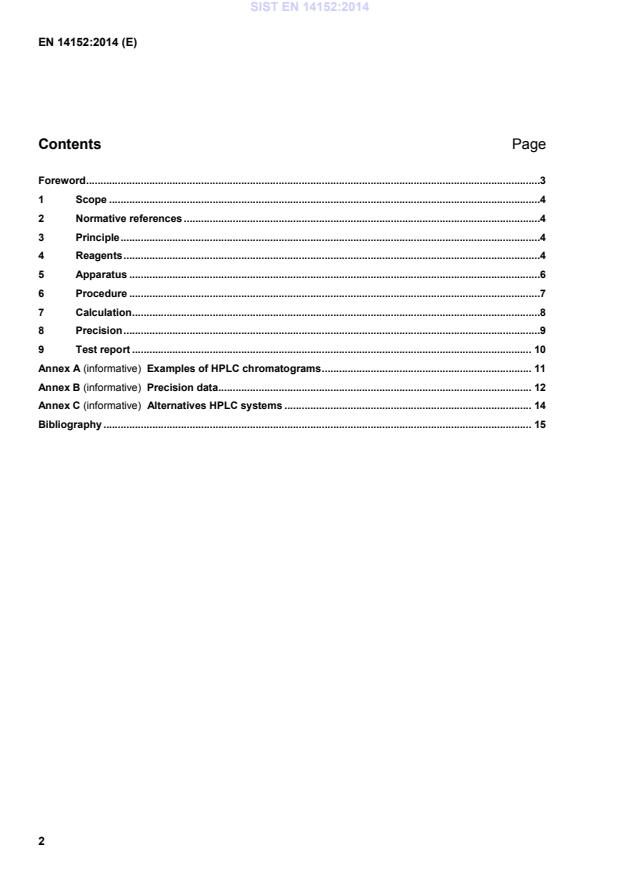
Examples of HPLC chromatograms . 11 Annex B (informative)
Precision data . 12 Annex C (informative)
Alternatives HPLC systems . 14 Bibliography . 15
Dissolve an amount of riboflavin standard substance (4.19.1) previously dried and stored in dark in a desiccator possibly under vacuum and/or over phosphorous pentoxide (4.13), weighed to the nearest milligram, e.g. approximately 50 mg in a defined volume, e.g. 500 ml in an appropriate solvent e.g. diluted acetic acid (4.6) using brown volumetric flasks. This solution can be stored at 4 °C in the dark for 2 months. Riboflavin is sparingly soluble. To facilitate dissolution warm with approximately 300 ml diluted acetic acid (4.6), on a steam bath with constant stirring until dissolved, cool and add diluted acetic acid (4.6) to make 500 ml. Alternatively add 5 ml of sodium hydroxide solution (4.12) to the standard substance in a 500 ml volumetric flask. Due to the instability in alkaline solutions immediately after dissolution add 1,5 ml of glacial acetic acid (4.5) and dilute to volume with diluted acetic acid (4.6), or another appropriate acid. The concentration of the freshly prepared and if necessary also stored solution should be tested (4.20.3).
1) The information of the suppliers of Taka-Diastase, Pfaltz & Bauer, Waterbury, CT 06708, USA (No T00040), and Serva is given for the convenience of users of this European standard and does not constitute an endorsement by CEN of the product named. Equivalent products may be used if they can be shown to lead to the same results. SIST EN 14152:2014
Prepare a 1:10 dilution of the riboflavin stock solution (4.20.2), e.g. pipette 10 ml of the riboflavin stock solution, into a 100 ml brown volumetric flask and add diluted acetic acid (4.6) or another appropriate solvent to make 100 ml. Prepare this solution fresh every day. 4.21.2 Riboflavin standard test solution, (C17H20N4O6) ≈ 0,1
Pipette corresponding volumes e.g. 1,0 ml to 10,0 ml of the standard solution (4.21.1), into brown volumetric flasks e.g. 100 ml and dilute with the mobile phase (4.15) to the mark. Prepare this solution fresh every day. 5 Apparatus Use laboratory apparatus, glassware, and, in particular, the following: 5.1 UV spectrometer, UV spectrometer capable of measuring absorption at defined wavelengths (444 nm), with appropriate cells, e.g. of 1 cm length. 5.2 Autoclave or heating device, autoclave for extraction purpose, e.g. pressure cooker type, with pressure or temperature reading device, electrical heating device or water bath. 5.3 HPLC system, consisting of a pump, a sample injecting device, a fluorescence detector with an excitation and emission wavelength set at e.g. 468 nm and 520 nm, respectively (see Annex C), and an evaluation system such as an integrator. 5.4 HPLC column Analytical reversed phase column, e.g. of diameter 4,0 mm to 4,6 mm, length 100 mm to 250 mm, filled with particle size 3
A) can be used providing that a satisfactory separation of riboflavin from other co-extractives is achieved. SIST EN 14152:2014
...