


SIST EN ISO 11607-2:2020/A1:2024
(Amendment)Packaging for terminally sterilized medical devices - Part 2: Validation requirements for forming, sealing and assembly processes - Amendment 1: Application of risk management (ISO 11607-2:2019/Amd 1:2023)
Packaging for terminally sterilized medical devices - Part 2: Validation requirements for forming, sealing and assembly processes - Amendment 1: Application of risk management (ISO 11607-2:2019/Amd 1:2023)
2021-11-09-JO-Following roundtable discussion on 2021-11-09 between EC desk officer, CCMC and CEN/TC 102, it was agreed that the assessment at ENQ will be performed by the Medical Device EC desk officer for a finale assessment at Enquiry. If positive, CEN/TC 102 may decide to skip the Formal Vote and proceed to publication.
Verpackungen für in der Endverpackung zu sterilisierende Medizinprodukte - Teil 2: Validierungsanforderungen an Prozesse der Formgebung, Siegelung und des Zusammenstellens - Änderung 1 (ISO 11607-2:2019/Amd 1:2023)
No scope available
Emballages des dispositifs médicaux stérilisés au stade terminal - Partie 2: Exigences de validation pour les procédés de formage, scellage et assemblage - Amendement 1: Application de la gestion des risques (ISO 11607-2:2019/Amd 1:2023)
Embalaža za končno sterilizirane medicinske pripomočke - 2. del: Zahteve za validacijo pri procesih oblikovanja, označevanja in sestavljanja - Dopolnilo A1: Uporaba obvladovanja tveganja (ISO 11607-2:2019/Amd 1:2023)
General Information
- Status
- Published
- Public Enquiry End Date
- 19-Oct-2022
- Publication Date
- 11-Jan-2024
- Technical Committee
- VAZ - Healthcare
- Current Stage
- 6060 - National Implementation/Publication (Adopted Project)
- Start Date
- 07-Dec-2023
- Due Date
- 11-Feb-2024
- Completion Date
- 12-Jan-2024
Relations
- Effective Date
- 01-Feb-2024
Overview
EN ISO 11607-2:2020/A1:2023 - Packaging for terminally sterilized medical devices - Part 2: Validation requirements for forming, sealing and assembly processes - Amendment 1: Application of risk management - is a CEN-adopted amendment that integrates risk management into the validation framework for packaging production processes. Approved by CEN on 12 September 2023 and published as the European version of ISO 11607-2:2019/Amd 1:2023, it supplements the existing Part 2 requirements for validating forming, sealing and assembly of sterile packaging systems (SBS).
Key topics and requirements
- Validation of forming, sealing and assembly processes: Reinforces the need for documented process development, qualification and control for packaging operations that maintain sterility until point of use.
- Application of risk management: Amendment A1 explicitly requires the application of a risk-management process across design, process development, validation, production control, change management and revalidation activities.
- Management of change and revalidation: Defines expectations for maintaining process control and for when revalidation is necessary following changes.
- Sterile barrier systems (SBS) considerations: Addresses assembly requirements for SBS, with specific clauses for reusable SBS and sterile fluid‑path SBS.
- Regulatory alignment: Annex ZA and ZB map the standard to the General Safety and Performance Requirements (GSPRs) of Regulation (EU) 2017/745 (MDR) and 2017/746 (IVDR). The amendment provides a voluntary means to demonstrate conformity with relevant GSPRs (partial coverage in several areas such as sterility protection, process validation and risk controls).
- Harmonised adoption: The amendment is adopted by CEN without modification and references EN ISO 11607‑1 for materials and SBS performance/stability requirements.
Applications and who uses it
This standard is essential for stakeholders involved in sterile medical device packaging and manufacture:
- Medical device manufacturers (packaging engineers, production managers) - to establish validated packaging processes and manage risk across production.
- Quality and regulatory affairs teams - to align packaging validation with MDR/IVDR requirements and to support conformity assessment.
- Contract packers and packaging suppliers - to demonstrate validated forming, sealing and assembly processes to OEM customers.
- Notified bodies and auditors - to assess compliance with packaging process validation and risk-management expectations.
- R&D and process validation specialists - to design robust sealing/assembly protocols and change-control strategies.
Related standards
- EN ISO 11607-1:2020/A1:2023 - materials, sterile barrier systems and packaging system performance and stability testing (normatively referenced).
- ISO/TC 198 outputs on sterilization of health care products - complementary guidance on sterilization compatibility and SBS design.
Keywords: EN ISO 11607-2:2020/A1:2023, packaging for terminally sterilized medical devices, validation requirements, forming sealing assembly, risk management, sterile barrier system, MDR 2017/745, process validation, CEN.

Frequently Asked Questions
SIST EN ISO 11607-2:2020/A1:2024 is a amendment published by the Slovenian Institute for Standardization (SIST). Its full title is "Packaging for terminally sterilized medical devices - Part 2: Validation requirements for forming, sealing and assembly processes - Amendment 1: Application of risk management (ISO 11607-2:2019/Amd 1:2023)". This standard covers: 2021-11-09-JO-Following roundtable discussion on 2021-11-09 between EC desk officer, CCMC and CEN/TC 102, it was agreed that the assessment at ENQ will be performed by the Medical Device EC desk officer for a finale assessment at Enquiry. If positive, CEN/TC 102 may decide to skip the Formal Vote and proceed to publication.
2021-11-09-JO-Following roundtable discussion on 2021-11-09 between EC desk officer, CCMC and CEN/TC 102, it was agreed that the assessment at ENQ will be performed by the Medical Device EC desk officer for a finale assessment at Enquiry. If positive, CEN/TC 102 may decide to skip the Formal Vote and proceed to publication.
SIST EN ISO 11607-2:2020/A1:2024 is classified under the following ICS (International Classification for Standards) categories: 11.080.30 - Sterilized packaging. The ICS classification helps identify the subject area and facilitates finding related standards.
SIST EN ISO 11607-2:2020/A1:2024 has the following relationships with other standards: It is inter standard links to SIST EN ISO 11607-2:2020. Understanding these relationships helps ensure you are using the most current and applicable version of the standard.
SIST EN ISO 11607-2:2020/A1:2024 is associated with the following European legislation: EU Directives/Regulations: 2017/745, 2017/746; Standardization Mandates: M/565, M/575, M/575 AMD 1, M/575 AMD 2. When a standard is cited in the Official Journal of the European Union, products manufactured in conformity with it benefit from a presumption of conformity with the essential requirements of the corresponding EU directive or regulation.
SIST EN ISO 11607-2:2020/A1:2024 is available in PDF format for immediate download after purchase. The document can be added to your cart and obtained through the secure checkout process. Digital delivery ensures instant access to the complete standard document.
Standards Content (Sample)
SLOVENSKI STANDARD
01-februar-2024
Embalaža za končno sterilizirane medicinske pripomočke - 2. del: Zahteve za
validacijo pri procesih oblikovanja, označevanja in sestavljanja - Dopolnilo A1:
Uporaba obvladovanja tveganja (ISO 11607-2:2019/Amd 1:2023)
Packaging for terminally sterilized medical devices - Part 2: Validation requirements for
forming, sealing and assembly processes - Amendment 1: Application of risk
management (ISO 11607-2:2019/Amd 1:2023)
Verpackungen für in der Endverpackung zu sterilisierende Medizinprodukte - Teil 2:
Validierungsanforderungen an Prozesse der Formgebung, Siegelung und des
Zusammenstellens - Änderung 1 (ISO 11607-2:2019/Amd 1:2023)
Emballages des dispositifs médicaux stérilisés au stade terminal - Partie 2: Exigences de
validation pour les procédés de formage, scellage et assemblage - Amendement 1:
Application de la gestion des risques (ISO 11607-2:2019/Amd 1:2023)
Ta slovenski standard je istoveten z: EN ISO 11607-2:2020/A1:2023
ICS:
11.080.30 Sterilizirana embalaža Sterilized packaging
2003-01.Slovenski inštitut za standardizacijo. Razmnoževanje celote ali delov tega standarda ni dovoljeno.
EN ISO 11607-2:2020/A1
EUROPEAN STANDARD
NORME EUROPÉENNE
October 2023
EUROPÄISCHE NORM
ICS 11.080.30
English Version
Packaging for terminally sterilized medical devices - Part
2: Validation requirements for forming, sealing and
assembly processes - Amendment 1: Application of risk
management (ISO 11607-2:2019/Amd 1:2023)
Emballages des dispositifs médicaux stérilisés au stade Verpackungen für in der Endverpackung zu
terminal - Partie 2: Exigences de validation pour les sterilisierende Medizinprodukte - Teil 2:
procédés de formage, scellage et assemblage - Validierungsanforderungen an Prozesse der
Amendement 1: Application de la gestion des risques Formgebung, Siegelung und des Zusammenstellens -
(ISO 11607-2:2019/Amd 1:2023) Änderung 1 (ISO 11607-2:2019/Amd 1:2023)
This amendment A1 modifies the European Standard EN ISO 11607-2:2020; it was approved by CEN on 12 September 2023.
CEN members are bound to comply with the CEN/CENELEC Internal Regulations which stipulate the conditions for inclusion of
this amendment into the relevant national standard without any alteration. Up-to-date lists and bibliographical references
concerning such national standards may be obtained on application to the CEN-CENELEC Management Centre or to any CEN
member.
This amendment exists in three official versions (English, French, German). A version in any other language made by translation
under the responsibility of a CEN member into its own language and notified to the CEN-CENELEC Management Centre has the
same status as the official versions.
CEN members are the national standards bodies of Austria, Belgium, Bulgaria, Croatia, Cyprus, Czech Republic, Denmark, Estonia,
Finland, France, Germany, Greece, Hungary, Iceland, Ireland, Italy, Latvia, Lithuania, Luxembourg, Malta, Netherlands, Norway,
Poland, Portugal, Republic of North Macedonia, Romania, Serbia, Slovakia, Slovenia, Spain, Sweden, Switzerland, Türkiye and
United Kingdom.
EUROPEAN COMMITTEE FOR STANDARDIZATION
COMITÉ EUROPÉEN DE NORMALISATION
EUROPÄISCHES KOMITEE FÜR NORMUNG
CEN-CENELEC Management Centre: Rue de la Science 23, B-1040 Brussels
© 2023 CEN All rights of exploitation in any form and by any means reserved Ref. No. EN ISO 11607-2:2020/A1:2023 E
worldwide for CEN national Members.
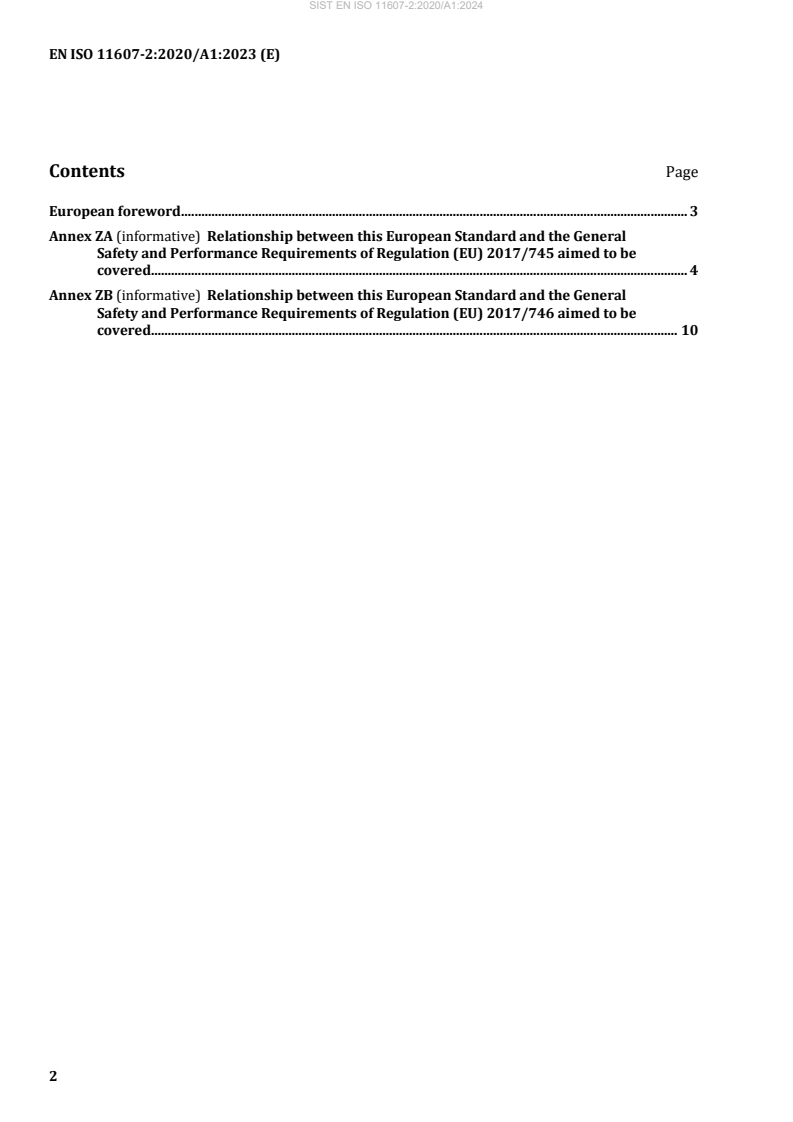
Contents Page
European foreword . 3
Annex ZA (informative) Relationship between this European Standard and the General
Safety and Performance Requirements of Regulation (EU) 2017/745 aimed to be
covered. 4
Annex ZB (informative) Relationship between this European Standard and the General
Safety and Performance Requirements of Regulation (EU) 2017/746 aimed to be
covered. 10
European foreword
This document (EN ISO 11607-2:2020/A1:2023) has been prepared by Technical Committee ISO/TC
198 "Sterilization of health care products" in collaboration with Technical Committee CEN/TC 102
“Sterilizers and associated equipment for processing of medical devices” the secretariat of which is held
by DIN.
This Amendment to the European Standard EN ISO 11607-2:2020 shall be given the status of a national
standard, either by publication of an identical text or by endorsement, at the latest by April 2024, and
conflicting national standards shall be withdrawn at the latest by April 2024.
Attention is drawn to the possibility that some of the elements of this document may be the subject of
patent rights. CEN shall not be held responsible for identifying any or all such patent rights.
This document has been prepared under a Standardization Request given to CEN by the European
Commission and the European Free Trade Association, and supports essential requirements of EU
Directive(s) / Regulation(s).
For relationship with EU Directive(s) / Regulation(s), see informative Annex ZA and Annex ZB, which
are integral parts of this document.
Any feedback and questions on this document should be directed to the users’ national standards
body/national committee. A complete listing of these bodies can be found on the CEN website.
According to the CEN-CENELEC Internal Regulations, the national standards organizations of the
following countries are bound to implement this European Standard: Austria, Belgium, Bulgaria,
Croatia, Cyprus, Czech Republic, Denmark, Estonia, Finland, France, Germany, Greece, Hungary, Iceland,
Ireland, Italy, Latvia, Lithuania, Luxembourg, Malta, Netherlands, Norway, Poland, Portugal, Republic of
North Macedonia, Romania, Serbia, Slovakia, Slovenia, Spain, Sweden, Switzerland, Türkiye and the
United Kingdom.
Endorsement notice
The text of ISO 11607-2:2019/Amd 1:2023 has been approved by CEN as EN ISO 11607-
2:2020/A1:2023 without any modification.
Annex ZA
(informative)
Relationship between this European Standard and the General Safety and
Performance Requirements of Regulation (EU) 2017/745 aimed to be
covered
This European standard has been prepared under M/575 to provide one voluntary means of
conforming to the General Safety and Performance Requirements of Regulation (EU) 2017/745 of 5
April 2017 concerning medical devices [OJ L 117] and to system or process requirements including
those relating to quality management systems, risk management, post-market surveillance systems,
clinical investigations, clinical evaluation or post-market clinical follow-up.
Once this standard is cited in the Official Journal of the European Union under that Regulation,
compliance with the normative clauses of this standard given in Table ZA.1 and application of the
edition of the normatively referenced standards as given in Table ZA.2 confers, within the limits of the
scope of this standard, a presumption of conformity with the corresponding General Safety and
Performance Requirements of that Regulation, and associated EFTA Regulations.
Where a definition in this harmonised standard differs from a definition of the same term set out in
Regulation (EU) 2017/745, the differences shall indicated in the Annex Z. For the purpose of using this
standard in support of the requirements set out in Regulation (EU) 2017/745, the definitions set out in
this Regulation prevail.
Where the European standard is an adoption of an International Standard, the scope of this document
can differ from the scope of the European Regulation that it supports. As the scope of the applicable
regulatory requirements differ from nation to nation and region to region the standard can only
support European regulatory requirements to the extent of the scope of the European Regulation for
medical devices ((EU) 2017/745).
NOTE 1 Where a reference from a clause of this standard to the risk management process is made, the risk
management process needs to be in compliance with Regulation (EU) 2017/745. This means that risks have to be
‘reduced as far as possible’, ‘reduced to the lowest possible level’, ‘reduced as far as possible and appropriate’,
‘removed or reduced as far as possible’, ‘eliminated or reduced as far as possible’, ’removed or minimized as far as
possible’, or ‘minimized’, according to the wording of the corresponding General Safety and Performance
Requirement.
NOTE 2 The manufacturer’s policy for determining acceptable risk must be in compliance with General Safety
and Performance Requirements 1, 2, 3, 4, 5, 8, 9, 10, 11, 14, 16, 17, 18, 19, 20, 21 and 22 of the Regulation.
NOTE 3 When a General Safety and Performance Requirement does not appear in Table ZA.1, it means that it is
not addressed by this European Standard.
Table ZA.1 — Correspondence between this European Standard and Annex I of
Regulation (EU) 2017/745 [OJ L 117] and to system or process requirements including those relating
to quality management systems, risk management, post-market surveillance systems, clinical
investigations, clinical evaluation or post-market clinical follow-up
General Safety and
Clause(s) / sub-
Performance
clause(s)
Requirements of Remarks / Notes
Regulation (EU)
of this EN
2017/745
1 4.2, Annex B Partially covered: Covers this GSPR for the packaging
of sterile medical devices through process
5.1, 5.2, 5.3, 5.4,
development, validation of the sealing and assembly
5.5, 5.6, 5.7,
process, production control by applying risk
6.1, 6.2, 6.3,
management to all these phases.
if applicable 7, 8
Does not cover the weighing against the benefits to
the patient as this needs to consider the specific
intended purpose of the medical device and cannot
be covered by sterile packaging alone.
3 4.2, Annex B Partially covered: Covered for sterile packaging by
providing a framework for applying risk
management to sterile packaging over the phases of
design, process development, validation and
production.
Does not cover the benefits-risk ratio to the patient
as this needs to consider the specific intended
purpose of the medical device and cannot be covered
by sterile packaging alone.
Evaluation of production and post market
surveillance information under GSPR 3 (e) against
overall risk and benefit risk-ratio is not covered, not
part of the scope of EN ISO 11607-2:2020/A1:2023.
GSPR 3 (f) only covered (see B.2) for production
phase and if post-production information is
available, to determine if risks are controlled
appropriately.
4 4.2, Annex B Partially covered: Applying this principle for
maintenance of sterility through rigorous
performance and stability testing and by
qualification of materials, design with systematic
risk reduction, process development to minimize
risk.
5 Not covered: Applicable only to EN ISO 11607-
1:2020/A1:2023.
6 Not covered: Applicable only to EN ISO 11607-
1:2020/A1:2023.
General Safety and
Clause(s) / sub-
Performance
clause(s)
Requirements of Remarks / Notes
Regulation (EU)
of this EN
2017/745
7 4.2, Annex B, Partially covered for sterile packaging by validating
the forming, assembly and sealing process.
5.1, 5.2, 5.3, 5.4,
5.5, 5.6, 5.7,
6.1, 6.2, 6.3,
if applicable: 7, 8
10 Not covered.
11.1 4.2, Annex B Partially covered: GSPR 11.1 (b) and (d) are covered
only in respect of the function of the sterile barrier
5.1, 5.2, 5.3, 5.4,
system(s) to protect the sterility of the device from
5.5, 5.6, 5.7,
the point of sterilisation to the point of use and to
6.1, 6.2, 6.3,
allow for aseptic presentation and only if the
if applicable: 7, 8
requirements of EN ISO 11607-1:2020/A1:2023 are
met as well.
GSPR 11.1 (a), and 11.1 (c) are not covered.
Clause 5 addresses the requirements of packaging
processes and the way to validate.
Subclause 5.7 addresses management of changes and
revalidations to maintain the process in the state of
control.
SBS assembly requirements are listed in Clause 6.
Specifics for reusable SBS are covered in Clause 7.
Specifics for sterile fluid-path SBS are covered in
Clause 8.
11.2 Not covered: Applicable only to reusable sterilization
containers and reusable materials (EN ISO 11607-
1:2020/A1:2023).
No presumption of conformity.
General Safety and
Clause(s) / sub-
Performance
clause(s)
Requirements of Remarks / Notes
Regulation (EU)
of this EN
2017/745
11.4 4.2, Annex B, 4.3, Partially covered: GSPR 11.4 is covered only in
respect of the function of sterile barrier system(s) to
5.1, 5.2, 5.3, 5.4,
protect the sterility of the device from the point of
5.5, 5.6, 5.7
sterilisation to the point of use and to allow for
6.1, 6.2, 6.3,
aseptic presentation but only if the requirements of
if applicable: 8
EN ISO 11607-1:2020/A1:2023 are met as well
(requirements for materials, sterile barrier systems
and packaging systems). In this respect damage to
the “packaging which is intended to maintain their
sterile condition” is taken to mean damage to or loss
of integrity of the sterile barrier system only.
Regarding the aspects of “clearly evident integrity of
the packaging”, this document includes
considerations for seals and closure quality
properties as supportive requirements for
compliance.
Clause 5 addresses the requirements of packaging
processes and the way to validate.
Subclause 5.7 addresses management of changes and
revalidations to maintain the process in the state of
control.
SBS assembly requirements are listed in clauses 6.
Specifics for sterile fluid-path SBS are covered in
Clause 8.
11.5 4.2, Annex B, Partially covered: GSPR 11.5 is covered only in
respect of the validation of forming, sealing and
5.1, 5.2, 5.3, 5.4,
assembling processes for packaging, assuming that
5.5, 5.6, 5.7
the requirements of EN ISO 11607-1:2020/A1:2023
6.1, 6.2, 6.3,
are met as well (requirements for materials, sterile
If applicable: 8
barrier systems and packaging systems which
includes compatibility between the packaging and
the selected sterilisation processes, packaging
system performance testing and sterile barrier
system stability testing).
Clause 5 addresses the requirements of packaging
processes and the way to validate.
Subclause 5.7 addresses management of changes and
revalidations to maintain the process in the state of
control.
SBS assembly requirements are listed in clauses 6.
Specifics for sterile fluid-path SBS are covered in
Clause 8.
11.6, 11.7, 11.8 Not covered.
General Safety and
Clause(s) / sub-
Performance
clause(s)
Requirements of Remarks / Notes
Regulation (EU)
of this EN
2017/745
13 Not covered.
22.1 4.2, annex B, Partially covered: No specific requirements for lay
persons. User and environment of use are factors to
5.1, 5.2, 5.3, 5.4,
include into the design (EN ISO 11607-
5.5, 5.6, 5.7
1:2020/A1:2023) which includes defining the
6.1, 6.2, 6.3,
sealing and closure specifications. EN ISO 11607-
If applicable: 8
2:2020/A1:2023 provides the framework for
validation of the sealing processes to meet those
requirements.
The last sentence of GSPR 22.1 is not covered by EN
ISO 11607-2:2020/A1:2023.
22.2 4.2, annex B Partially covered: No specific requirements for lay
persons. User and environment of use are factors to
5.1, 5.2, 5.3, 5.4,
include into the design (EN ISO 11607-
5.5, 5.6, 5.7,
1:2020/A1:2023) which includes defining the
6.1, 6.2, 6.3,
sealing and closure specifications. EN ISO 11607-
If applicable: 8
2:2020/A1:2023 provides the framework for
validation of the sealing and assembly processes
(manufacturing) to meet those requirements.
Dashes 2 and 3 are not covered.
23.3 Not covered.
23.4 Not covered.
Table ZA.2 — Applicable Standards to confer presumption of conformity as described in this
Annex ZA
Column 1 Column 2 Column 3 Column 4
Reference in International
Title Corresponding European
Clause 2 Standard Edition
Standard Edition
ISO 11607-1 ISO 11607-1:20181 Packaging for terminally sterilized EN ISO 11607-1:2020
medical devices — Part 2:
ISO 11607- EN ISO 11607-
Validation requirements for
1:2019/Amd1:202 1:2020/A11:2022
forming, sealing and assembly
EN ISO 11607-
processes
1:2020/A1:2023
The documents listed in the Column 1 of table ZA.2, in whole or in part, are normatively referenced in
this document, i.e. are indispensable for its application. The achievement of the presumption of
conformity is subject to the application of the edition of Standards as listed in Column 4 or, if no
European Standard Edition exists, the International Standard Edition given in Column 2 of table ZA.2.
WARNING 1 — Presumption of conformity stays valid only as long as a reference to this European
standard is maintained in the list published in the Official Journal of the European Union. Users of this
standard should consult frequently the latest list published in the Official Journal of the European
Union.
WARNING 2 — Other Union legislation may be applicable to the product(s) falling within the scope of
this standard.
Annex ZB
(informative)
Relationship between this European Standard and the General Safety and
Performance Requirements of Regulation (EU) 2017/746 aimed to be
covered
This European standard has been prepared under M/575 to provide one voluntary means of
conforming to the General Safety and Performance Requirements of Regulation (EU) 2017/746 of 5
April 2017 concerning in vitro diagnostic medical devices [OJ L 117] and to system or process
requirements including those relating to quality management systems, risk management, post-market
surveillance systems, performance studies, clinical evidence or post-market performance follow-up
Once this standard is cited in the Official Journal of the European Union under that Regulation,
compliance with the normative clauses of this standard given in Table ZB.1 and application of the
edition of the normatively referenced standards as given in Table ZA.2 confers, within the limits of the
scope of this standard, a presumption of conformity with the corresponding General Safety and
Performance Requirements of that Regulation, and associated EFTA Regulations.
Where a definition in this standard differs from a definition of the same term set out in Regulation (EU)
2017/746, the differences shall indicated in the Annex Z. For the purpose of using this standard in
support of the requirements set out in Regulation (EU) 2017/746, the definitions set out in this
Regulation prevail.
Where the European standard is an adoption of an International Standard, the scope of this standard
can differ from the scope of the European Regulation that it supports. As the scope of the applicable
regulatory requirements differ from nation to nation and region to region, the standard can only
support European regulatory requirements to the extent of the scope of the In vitro Diagnostic
Regulation (EU) 2017/746).
NOTE 1 Where a reference from a clause of this standard to the risk management process is made, the risk
management process needs to be in compliance with Regulation (EU) 2017/746. This means that risks have to be
‘reduced as far as possible’, ‘reduced to a level as low as reasonably practicable’, ‘reduced to the lowest possible
level’, ‘reduced as far as possible and appropriate’, ‘removed or reduced as far as possible’, ‘eliminated or reduced
as far as possible’, ‘prevented’ or ‘minimized’, according to the wording of the corresponding General Safety and
Performance Requirement.
NOTE 2 The manufacturer’s policy for determining acceptable risk must be in compliance with General Safety
and Performance Requirements 1, 2, 3, 4, 5, 8, 10, 11, 13, 15, 16, 17, 18 and 19 of the Regulation.
NOTE 3 When a General Safety and Performance Requirement does not appear in Table ZB.1, it means that it is
not addressed by this European Standard.
Table ZB.1 — Correspondence between this European Standard and Annex I of
Regulation (EU) 2017/746 [OJ L 117] and to system or process requirements including those relating
to quality management systems, risk management, post-market surveillance systems, clinical
investigations, clinical evaluation or post-market clinical follow-up
General Safety and
Clause(s) / sub-
Performance
clause(s)
Remarks / Notes
Requirements of
of this EN
Regulation (EU) 2017/746
1 4.2, Annex B Partially
...
Questions, Comments and Discussion
Ask us and Technical Secretary will try to provide an answer. You can facilitate discussion about the standard in here.
Loading comments...