


SIST EN 15146:2026
(Main)Solid softwood panelling and cladding - Machined profiles without tongue and groove
General Information
- Abstract
This document specifies characteristics of solid wood panelling and cladding without tongue and groove machined from softwoods (wood of trees of the botanical group gymnosperms). Products are intended for interior or exterior use.
This document covers treated, untreated and surface treated products, including those made of thermally and chemically modified wood, as well as finger jointed products.
This document does not cover processes for treatment, surface coating or modification.
NOTE Where further regulatory provisions (e.g. durability, reaction to fire, dangerous substances and generally CE-marking according to CPR) are required, EN 14915 applies.
- Status
- Not Published
- Public Enquiry End Date
- 16-Jul-2025
- Technical Committee
- LLZ - Les, lesni izdelki in zaščita lesa
- Current Stage
- 6060 - National Implementation/Publication (Adopted Project)
- Start Date
- 30-Jul-2026
- Due Date
- 04-Oct-2026

Overview
SIST EN 15146:2026 – Solid Softwood Panelling and Cladding - Machined Profiles without Tongue and Groove provides comprehensive specifications for solid wood panelling and cladding products made from softwoods, without tongue and groove profiles. Developed by SIST, this standard focuses on panelling and cladding elements designed for both interior and exterior applications. It includes requirements for treated, untreated, and surface treated products, including thermally and chemically modified wood, as well as finger-jointed profiles.
This standard helps manufacturers, suppliers, and builders ensure that softwood panelling and cladding products meet clearly defined performance and quality expectations. It does not cover the processes for wood treatment or surface modification-regulatory requirements for aspects such as durability, fire performance, or CE marking are handled by EN 14915.
Key Topics
- Scope of Products: Applies to solid softwood elements for panelling and cladding, intended for various environments (interior/exterior). Includes products that are surface-treated, chemically or thermally modified, or finger-jointed.
- Material Characteristics:
- Only gymnosperm (softwood) species are included.
- The wood species must be suitable for the intended end use.
- Finger jointing and special bonding processes are allowed when specified.
- Grading Requirements:
- Grading applies to the visible face of the product unless otherwise stated.
- Distinct grading classes for general softwoods and maritime pine.
- Optional “free grade” classification if standard grading is not suitable.
- Grading includes assessment of knots, fissures, resin pockets, colour, and more.
- Moisture Content:
- Specified ranges depend on application: 17±2% for exterior, 12±2% for interior use.
- Moisture measurement methods referenced from EN 13183 parts 1-3.
- Dimensional Tolerances:
- Minimum thickness: 13 mm (±0.5 mm).
- Minimum width: 40 mm (±1 mm), or 100 mm (±1.5 mm).
- Minimum length: 750 mm; delivered in standard increments if unspecified.
- Tolerances for length, deformation (bow, cup, twist) are defined.
- Surface Finish:
- Typically planed smooth on the face.
- Acceptable alternatives: rough sawn, brushed, sandblasted, or sanded finishes.
- Marking and Technical Documentation:
- Product labeling must include the standard reference, grading class, species, dimensions, moisture content, type of treatment, and intended application.
Applications
- Interior Panelling: Softwood profiles are used for decorative or functional interior wall and ceiling finishes, providing a natural wood aesthetic.
- Exterior Cladding: Elements serve as durable, weather-resistant facades for buildings, sheds, or outdoor structures.
- Renovation and New Build Projects: Supports architectural design with a wide range of machinable profiles, adaptable for modern or traditional settings.
- Prefab and Modular Construction: Facilitates efficient material selection for prefabricated timber elements.
- Commercial and Residential Use: Suitable for public buildings, homes, and industrial facilities where natural wood surfaces are desired.
Related Standards
- EN 14915: Solid wood panelling and cladding - Characteristics, requirements, and marking (applies to regulatory requirements like CE marking and fire performance).
- EN 844: Round and sawn timber - Terminology.
- EN 1309-1, EN 1309-3: Methods for measurement of dimensions and features of sawn timber.
- EN 13183 (Parts 1-3): Methods for determination of timber moisture content.
- EN 13647: Determination of geometrical characteristics for wood flooring and cladding.
- EN 13756: Wood flooring and parquet - Terminology.
- EN 13556: Nomenclature of timbers used in Europe.
- EN 13307-1: Requirements for timber blanks and semi-finished profiles (non-structural uses).
- CEN/TS 12169: Criteria for conformity assessment of sawn timber.
By complying with SIST EN 15146:2026, stakeholders can be confident in the quality, durability, and suitability of solid softwood panelling and cladding products for a wide variety of construction and building applications.
Relations
- Effective Date
- 19-Jan-2023
Get Certified
Connect with accredited certification bodies for this standard

Gozdarski inštitut Slovenije
Slovenian Forestry Institute. Forest management certification support, timber testing.
Sponsored listings
Frequently Asked Questions
SIST EN 15146:2026 is a draft published by the Slovenian Institute for Standardization (SIST). Its full title is "Solid softwood panelling and cladding - Machined profiles without tongue and groove". This standard covers: This document specifies characteristics of solid wood panelling and cladding without tongue and groove machined from softwoods (wood of trees of the botanical group gymnosperms). Products are intended for interior or exterior use. This document covers treated, untreated and surface treated products, including those made of thermally and chemically modified wood, as well as finger jointed products. This document does not cover processes for treatment, surface coating or modification. NOTE Where further regulatory provisions (e.g. durability, reaction to fire, dangerous substances and generally CE-marking according to CPR) are required, EN 14915 applies.
This document specifies characteristics of solid wood panelling and cladding without tongue and groove machined from softwoods (wood of trees of the botanical group gymnosperms). Products are intended for interior or exterior use. This document covers treated, untreated and surface treated products, including those made of thermally and chemically modified wood, as well as finger jointed products. This document does not cover processes for treatment, surface coating or modification. NOTE Where further regulatory provisions (e.g. durability, reaction to fire, dangerous substances and generally CE-marking according to CPR) are required, EN 14915 applies.
SIST EN 15146:2026 is classified under the following ICS (International Classification for Standards) categories: 79.080 - Semi-manufactures of timber. The ICS classification helps identify the subject area and facilitates finding related standards.
SIST EN 15146:2026 has the following relationships with other standards: It is inter standard links to SIST EN 15146:2007. Understanding these relationships helps ensure you are using the most current and applicable version of the standard.
SIST EN 15146:2026 is associated with the following European legislation: EU Directives/Regulations: 305/2011; Standardization Mandates: M/121. When a standard is cited in the Official Journal of the European Union, products manufactured in conformity with it benefit from a presumption of conformity with the essential requirements of the corresponding EU directive or regulation.
SIST EN 15146:2026 is available in PDF format for immediate download after purchase. The document can be added to your cart and obtained through the secure checkout process. Digital delivery ensures instant access to the complete standard document.
Standards Content (Sample)
SLOVENSKI STANDARD
oSIST prEN 15146:2025
01-julij-2025
Notranje in zunanje obloge iz masivnega lesa - Profili brez utora in peresa
Solid softwood panelling and cladding - Machined profiles without tongue and groove
Innen- und Außenbekleidungen aus massivem Nadelholz - Profilholz ohne Nut und
Feder
Lambris et bardages en bois massif résineux - Profilés usinés sans rainure et languette
Ta slovenski standard je istoveten z: prEN 15146
ICS:
79.080 Polizdelki iz lesa Semi-manufactures of timber
oSIST prEN 15146:2025 en,fr,de
2003-01.Slovenski inštitut za standardizacijo. Razmnoževanje celote ali delov tega standarda ni dovoljeno.
oSIST prEN 15146:2025
oSIST prEN 15146:2025
DRAFT
EUROPEAN STANDARD
prEN 15146
NORME EUROPÉENNE
EUROPÄISCHE NORM
April 2025
ICS 79.080 Will supersede EN 15146:2006
English Version
Solid softwood panelling and cladding - Machined profiles
without tongue and groove
Lambris et bardages en bois massif résineux - Profilés Innen- und Außenbekleidungen aus massivem
usinés sans rainure et languette Nadelholz - Profilholz ohne Nut und Feder
This draft European Standard is submitted to CEN members for enquiry. It has been drawn up by the Technical Committee
CEN/TC 175.
If this draft becomes a European Standard, CEN members are bound to comply with the CEN/CENELEC Internal Regulations
which stipulate the conditions for giving this European Standard the status of a national standard without any alteration.
This draft European Standard was established by CEN in three official versions (English, French, German). A version in any other
language made by translation under the responsibility of a CEN member into its own language and notified to the CEN-CENELEC
Management Centre has the same status as the official versions.
CEN members are the national standards bodies of Austria, Belgium, Bulgaria, Croatia, Cyprus, Czech Republic, Denmark, Estonia,
Finland, France, Germany, Greece, Hungary, Iceland, Ireland, Italy, Latvia, Lithuania, Luxembourg, Malta, Netherlands, Norway,
Poland, Portugal, Republic of North Macedonia, Romania, Serbia, Slovakia, Slovenia, Spain, Sweden, Switzerland, Türkiye and
United Kingdom.
Recipients of this draft are invited to submit, with their comments, notification of any relevant patent rights of which they are
aware and to provide supporting documentation.
Warning : This document is not a European Standard. It is distributed for review and comments. It is subject to change without
notice and shall not be referred to as a European Standard.
EUROPEAN COMMITTEE FOR STANDARDIZATION
COMITÉ EUROPÉEN DE NORMALISATION
EUROPÄISCHES KOMITEE FÜR NORMUNG
CEN-CENELEC Management Centre: Rue de la Science 23, B-1040 Brussels
© 2025 CEN All rights of exploitation in any form and by any means reserved Ref. No. prEN 15146:2025 E
worldwide for CEN national Members.
oSIST prEN 15146:2025
prEN 15146:2025 (E)
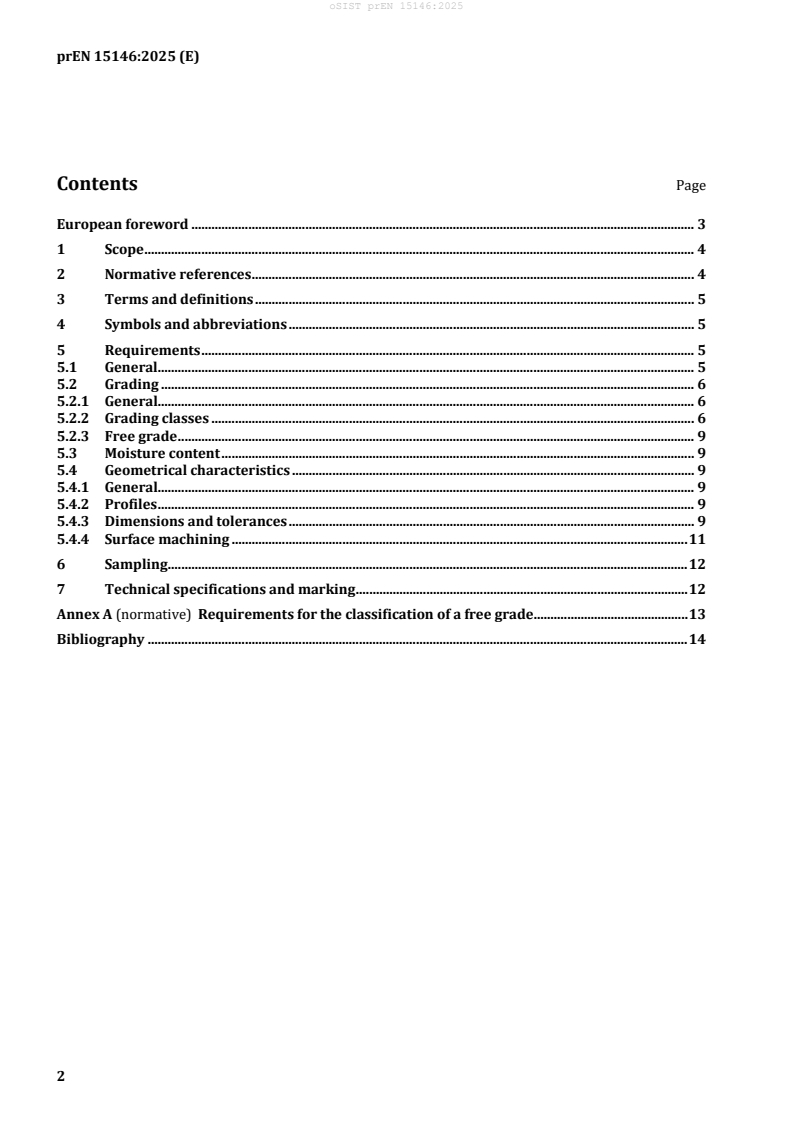
Contents Page
European foreword . 3
1 Scope . 4
2 Normative references . 4
3 Terms and definitions . 5
4 Symbols and abbreviations . 5
5 Requirements . 5
5.1 General. 5
5.2 Grading . 6
5.2.1 General. 6
5.2.2 Grading classes . 6
5.2.3 Free grade . 9
5.3 Moisture content . 9
5.4 Geometrical characteristics . 9
5.4.1 General. 9
5.4.2 Profiles . 9
5.4.3 Dimensions and tolerances . 9
5.4.4 Surface machining . 11
6 Sampling . 12
7 Technical specifications and marking . 12
Annex A (normative) Requirements for the classification of a free grade . 13
Bibliography . 14
oSIST prEN 15146:2025
prEN 15146:2025 (E)
European foreword
This document (prEN 15146:2025) has been prepared by Technical Committee CEN/TC 175 “Round and
sawn timber”, the secretariat of which is held by AFNOR.
This document is currently submitted to the CEN Enquiry.
This document will supersede EN 15146:2006.
In comparison with the previous edition, the following technical modifications have been made:
— alignment of the series of product standards: EN 14519, EN 15146 and EN 14951;
— scope, normative references and terms and definitions updated;
— scope opened to all softwood species:
— ranges of moisture content for panelling and cladding were specified more precisely;
— CEN/TS 12169 was referenced for sampling methods instead of Annex A;
— clauses “Technical specifications” and “Marking” were merged and aligned;
— Annex A deleted.
This document is one of a series of standards concerning solid wood panelling and cladding and wood
flooring (including parquet).
oSIST prEN 15146:2025
prEN 15146:2025 (E)
1 Scope
This document specifies characteristics of solid wood panelling and cladding without tongue and groove
machined from softwoods (wood of trees of the botanical group gymnosperms). Products are intended
for interior or exterior use.
This document covers treated, untreated and surface treated products, including those made of thermally
and chemically modified wood, as well as finger jointed products.
This document does not cover processes for treatment, surface coating or modification.
NOTE Where further regulatory provisions (e.g. durability, reaction to fire, dangerous substances and
generally CE-marking according to CPR) are required, EN 14915 applies.
2 Normative references
The following documents are referred to in the text in such a way that some or all of their content
constitutes requirements of this document. For dated references, only the edition cited applies. For
undated references, the latest edition of the referenced document (including any amendments) applies.
EN 844, Round and sawn timber - Terminology
EN 1309-1, Round and sawn timber - Method of measurement of dimensions - Part 1: Sawn timber
EN 1309-3, Round and sawn timber - Methods of measurements - Part 3: Features and biological
degradations
EN 13183-1, Moisture content of a piece of sawn timber - Part 1: Determination by oven dry method
EN 13183-2, Moisture content of a piece of sawn timber — Part 2: Estimation by electrical resistance
method
EN 13183-3, Moisture content of a piece of sawn timber — Part 3: Estimation by capacitance method
EN 13647, Wood flooring and wood panelling and cladding - Determination of geometrical characteristics
EN 13756, Wood flooring and parquet - Terminology
oSIST prEN 15146:2025
prEN 15146:2025 (E)
3 Terms and definitions
For the purposes of this document, the terms and definitions given in EN 13756, EN 844, EN 1309-1,
EN 1309-3 and the following apply.
ISO and IEC maintain terminology databases for use in standardization at the following addresses:
— ISO Online browsing platform: available at https://www.iso.org/obp/
— IEC Electropedia: available at https://www.electropedia.org/
3.1
panelling
elements of solid wood mainly for interior use which have been machined on the face and have been
regularised on the back
3.2
cladding
elements of solid wood mainly for exterior use which have been machined on the face and have been
regularised on the back
3.3
face
visible surfaces of an element when installed
Note 1 to entry: This includes edges and chamfers.
3.4
regularised (hit or missed)
feature of the surface of an element where some areas of a face remain untouched during the machining
process
3.5
end matching
profile at the end of the panelling or cladding including tongue and/or groove
4 Symbols and abbreviations
Symbols and abbreviations used in this document are given in Figure 1 and in Table 3 and Table 4.
5 Requirements
5.1 General
The softwood species shall be selected with regard to the appearance expected, the suitability for the
intended purpose and the general characteristics of the species itself. All requirements apply at the time
of production unless the manufacturer states otherwise.
Finger jointing according to EN 13307-1 is permitted if agreed upon and specified by the manufacturer.
NOTE Regarding the bonding and glue type other standards and regulations can apply.
oSIST prEN 15146:2025
prEN 15146:2025 (E)
5.2 Grading
5.2.1 General
Grading applies to the face only, unless otherwise specified. Machining requirements are covered in 5.4.4
and apply to all grades of all species.
The measurement of features shall be in accordance with EN 1309-3.
The elements may be finished with surface coating. The grading shall be done before coating.
Additionally, to the grading classes given in 5.2.2 different grading classes and quality criteria for
panelling and cladding exist on national and company levels in Europe. Hence, free grades according to
5.2.3 may also be used.
5.2.2 Grading classes
Grading and the features for softwoods (except maritime pine) are given in Table 1. Grading and the
features for maritime pine (Pinus pinaster) are given in Table 2.
A combined grading class, e.g. A/B, is permitted if agreed upon and specified by the manufacturer.
Table 1 — Grading classes of softwoods (except maritime pine)
a b
Features Grade A Grade B
Knots Permitted: Permitted:
— black pin knots up to 5 mm if not in — black pin knots up to 5 mm;
clusters;
— sound intergrown knots, partially
— sound intergrown knots up to 10 % of intergrown knots, barkringed knots,
the width plus 30 mm; splay knots, and dead knots up to
10 % of the width plus 50 mm;
— partially intergrown knots,
barkringed knots, splay knots and — occasional loose knots, knot-holes
dead knots (not loose); and unsound knots up to 15 mm;
— spruce/fir, and larch: up to 10 % of — knot p
...