

oSIST prEN 481:2026
(Main)Workplace exposure - Size fraction definitions for measurement of airborne particles
- Abstract
This document specifies sampling conventions for airborne particle size fractions to assess health-related exposure resulting from the inhalation of particles in workplace atmospheres. Conventions are defined for the inhalable, thoracic and respirable fractions. The sampling conventions only describe the inhalation of particles and their penetration in the respiratory tract as governed by inertia (impaction). Exhaled particles and deposition in the respiratory tract by other mechanisms, e.g. diffusion, are not considered in this document. The sampling conventions defined in this document apply to both indoor and outdoor workplaces. The conventions assume particles penetration and only oral breathing as a worst-case scenario. Nevertheless, the conventions are applicable to both oral and nasal breathing.
The conventions are defined based on assumptions given in Clause 6. The choice of convention for a specific application depends on the region of the respiratory tract affected by the health impact of the particle component of interest (see Clause 5). The conventions can be applied to various metrics, including particle number, length, surface area, volume, or mass, depending on the type of particle analysis performed on the sampled aerosol fraction. The health-related fraction concentrations defined in this document are often expressed as the mass of sampled particles per volume of sampled air to allow comparison with mass-based occupational exposure limit values.
The conventions primarily apply to the aforementioned metrics, however, they are not applicable to situations involving limit values expressed in a different metric, such as fibre limit values defined by length, diameter, and aspect ratio, unless a measurement procedure explicitly specifies sampling a particular health-related size fraction [11].
The primary objective of this document is to establish standardized conventions for health-related particle size fractions. Sampling is generally carried out using dedicated samplers, for which there is no need to measure the aerodynamic size distribution of the airborne particles to be sampled. Samplers separating airborne particles into one or more relevant fractions are currently available. In general, no assumptions or pre-knowledge are needed on the number of modes, modal diameter(s) or width of the particle aerodynamic size distribution of the airborne particles to be sampled.
The conventions in this document are intended to be used for the determination of the exposure of an average worker based on average penetration curves. This document is not intended to determine the deposited dose of an individual worker.
The conventions are primarily intended for assessing workers’ exposure to airborne particles by sampling the airborne particles. This document does not apply to large particles emitted at high speed that travel due to their initial momentum, instead of being carried by the air (airborne) and aspirated into humans’ respiratory tract and aerosol samplers by suction (see Annex B).
All wind speeds referenced throughout this document are based on the relative speed between the worker and the surrounding air.
- Status
- Not Published
- Public Enquiry End Date
- 01-Oct-2026
- Technical Committee
- KAZ - Air quality
- Current Stage
- 4020 - Public enquire (PE) (Adopted Project)
- Start Date
- 23-Jul-2026
- Due Date
- 10-Dec-2026
- Completion Date
- 08-Oct-2026

oSIST prEN 481:2026 is the Slovenian publication of CEN prEN 481, a draft European Standard on workplace exposure to airborne particles. It defines the inhalable, thoracic and respirable sampling conventions used to assess health-related exposure in workplace atmospheres, so laboratories, occupational hygienists and sampler users can compare results against exposure limits in a consistent way.
What does oSIST prEN 481:2026 specify?
oSIST prEN 481:2026 specifies sampling conventions for airborne particle size fractions in indoor and outdoor workplaces. The document sets out how to describe the inhalable, thoracic and respirable fractions, with the focus on particle entry into the respiratory tract by inertia and impaction.
The document is organized into clauses on scope, normative references, terms and definitions, symbols and abbreviated terms, the principle of the conventions, assumptions and approximations, and detailed specifications for the conventions and the corresponding fraction concentrations. It also has three informative annexes.
| Annex | What it covers |
|---|---|
| Annex A | Main arguments for the revision and the significant technical changes compared with EN 481:1993 |
| Annex B | Sampling situations where the health-related fractions are not directly applicable |
| Annex C | General information on particle inhalability and penetration, and on sampling conventions |
What are the key requirements of oSIST prEN 481:2026?
oSIST prEN 481:2026 requires users to choose the convention according to the part of the respiratory tract that is relevant to the health effect of the particle component. In practice, that means the selected sampler and result should match the biological region of concern, not just the total airborne dust level.
The conventions are built for the exposure of an average worker, using average penetration curves. The document is not intended to determine the deposited dose of an individual worker, so it supports workplace exposure assessment rather than personal dose reconstruction.
How the inhalable convention is defined
For the inhalable fraction, oSIST prEN 481:2026 distinguishes a low wind speed range, a medium wind speed range and an intermediate range between them. The low range applies at wind speeds up to 0.2 m/s, the medium range from 0.5 m/s to 4 m/s, and the intermediate range uses linear interpolation.
This matters because inhalability changes with local air movement around the worker. A sampler used in calm indoor areas is therefore treated differently from one used in moving air, and the document ties the convention to the relative speed between the worker and the surrounding air.
The inhalable convention is defined over aerodynamic diameters from 0.5 µm to 100 µm. Below 0.5 µm, inhalability is taken as 1; above 100 µm the convention is not extended. For practice, this means the standard gives a usable size range for routine occupational sampling, but it does not encourage extrapolation beyond the stated limits.
How the thoracic and respirable conventions are defined
oSIST prEN 481:2026 defines thoracic and respirable penetration probability conventions and then combines them with the inhalable convention for the relevant wind speed range. The thoracic convention represents particles that penetrate beyond the larynx, and the respirable convention represents particles that penetrate to the alveolar region.
This is important because the document separates the health-related penetration target from the sampler’s collection task. Users must therefore align the sampler with the region affected by the substance of interest, rather than assuming one sampler fits all hazards.
The thoracic and respirable conventions are expressed with lognormal functions. The document gives the median and geometric standard deviation used for each convention and then multiplies the penetration probability by the appropriate inhalable convention for low and medium wind speed ranges. In practice, that provides a standardized way to estimate the relevant fraction from the undisturbed airborne particle size distribution.
What the assumptions and limits mean in practice
Clause 6 sets the main assumptions: oral breathing is treated as the worst case, exposure is averaged, and wind speed ranges are limited. The document also assumes that very small particles below 0.5 µm follow the airflow ideally, while particles larger than 100 µm are outside the inhalable convention because of limited data.
The scope excludes particles that move mainly because of their initial momentum rather than because they are airborne. Annex B is the place to check for such high-speed particle “projectiles” and for other situations where the conventions are not directly suitable. For users, this means a sampler can be technically correct for aerosols and still be inappropriate for high-energy fragments or unusual release conditions.
Compliance-related use is tied to the EN 13205 series, and the document points to EN 482 for general performance requirements for samplers, instruments and analytical methods. In practice, the convention tells you what fraction to sample; the companion standards support how to test and judge the sampler.
What terms does oSIST prEN 481:2026 define?
- Airborne particle - A solid or liquid chemical or biological agent dispersed in air.
- Particle aerodynamic diameter - The diameter of a unit-density sphere with the same settling behavior as the particle under the prevailing conditions.
- Inhalability - The ratio between particles entering the respiratory tract and the undisturbed airborne particle size distribution.
- Undisturbed airborne particle size distribution - The particle size distribution before the sampler or person alters it.
- Sampling convention - The probability that undisturbed airborne particles are included in the relevant health-related fraction as a function of aerodynamic diameter.
- Inhalable sampling convention - The convention describing entry into the respiratory tract by inhalation through the mouth for a given wind speed range.
- Thoracic sampling convention - The convention describing penetration beyond the larynx for a given wind speed range.
- Respirable sampling convention - The convention describing penetration to the alveolar region for a given wind speed range.
Who uses oSIST prEN 481:2026?
oSIST prEN 481:2026 is used in occupational hygiene, workplace exposure assessment and sampler performance work. It is relevant to laboratory staff who test aerosol samplers, field hygienists who measure exposure, and manufacturers who design samplers to match a health-related size fraction.
It also matters to employers, quality managers and buyers who compare airborne particle measurements with occupational exposure limit values. Because the document supports both indoor and outdoor workplaces, it is useful wherever airborne particles are measured for health protection.
What changed in oSIST prEN 481:2026 from the previous edition?
oSIST prEN 481:2026 supersedes EN 481:1993. Annex A states that the revision adds a low wind speed inhalable convention, restricts the earlier inhalable convention to medium wind speeds, and introduces a linear transition for intermediate wind speeds.
Annex A also states that the thoracic and respirable definitions have been renamed as penetration probability conventions, are now expressed as fractions of the undisturbed particle size distribution, and are given as equations rather than percentages. The revision also adds informative Annexes A and B and clarifies that the conventions are not meant to be read as the true dose for a specific worker.
Which standards are used with oSIST prEN 481:2026?
- EN 1540 - Provides the terminology used in the document.
- EN 689 - Gives the strategy for testing compliance with occupational exposure limit values and is cited for exposure assessment context.
- CEN/TR 15230 - Gives guidance for sampling inhalable, thoracic and respirable aerosol fractions.
- EN 13205-1 to -6 - Describe performance tests and related methods for aerosol samplers used with these conventions.
- EN 482 - Sets basic performance requirements for samplers, instruments and analytical methods in occupational hygiene.
- EN ISO 13138 - Covers sampling conventions for airborne particle deposition in the human respiratory system.
What does the oSIST prEN 481:2026 document contain?
The document contains equations for the inhalable, thoracic and respirable conventions, including a linear interpolation for the intermediate wind speed range. It also contains a numerical table and figures that illustrate the conventions across aerodynamic particle size ranges and wind speed ranges.
Annex C gives background on inhalability, penetration and the experimental basis for the conventions. Annex B discusses workplace situations where the conventions are not directly applicable, and Annex A summarizes the reasons for revising the previous edition and the technical consequences of that revision.
Relations
- Effective Date
- 01-Sep-2026
Get Certified
Connect with accredited certification bodies for this standard

CIS Institut d.o.o.
Personal Protective Equipment (PPE) certification body. Notified Body NB-2890 for EU Regulation 2016/425 PPE.

Kiwa BDA Testing
Building and construction product certification.
Kmetijski inštitut Slovenije
Agricultural Institute of Slovenia. Soil testing, plant health, agricultural product analysis.
Sponsored listings
Frequently Asked Questions
oSIST prEN 481:2026 is a draft published by the Slovenian Institute for Standardization (SIST). Its full title is "Workplace exposure - Size fraction definitions for measurement of airborne particles". This standard covers: This document specifies sampling conventions for airborne particle size fractions to assess health-related exposure resulting from the inhalation of particles in workplace atmospheres. Conventions are defined for the inhalable, thoracic and respirable fractions. The sampling conventions only describe the inhalation of particles and their penetration in the respiratory tract as governed by inertia (impaction). Exhaled particles and deposition in the respiratory tract by other mechanisms, e.g. diffusion, are not considered in this document. The sampling conventions defined in this document apply to both indoor and outdoor workplaces. The conventions assume particles penetration and only oral breathing as a worst-case scenario. Nevertheless, the conventions are applicable to both oral and nasal breathing. The conventions are defined based on assumptions given in Clause 6. The choice of convention for a specific application depends on the region of the respiratory tract affected by the health impact of the particle component of interest (see Clause 5). The conventions can be applied to various metrics, including particle number, length, surface area, volume, or mass, depending on the type of particle analysis performed on the sampled aerosol fraction. The health-related fraction concentrations defined in this document are often expressed as the mass of sampled particles per volume of sampled air to allow comparison with mass-based occupational exposure limit values. The conventions primarily apply to the aforementioned metrics, however, they are not applicable to situations involving limit values expressed in a different metric, such as fibre limit values defined by length, diameter, and aspect ratio, unless a measurement procedure explicitly specifies sampling a particular health-related size fraction [11]. The primary objective of this document is to establish standardized conventions for health-related particle size fractions. Sampling is generally carried out using dedicated samplers, for which there is no need to measure the aerodynamic size distribution of the airborne particles to be sampled. Samplers separating airborne particles into one or more relevant fractions are currently available. In general, no assumptions or pre-knowledge are needed on the number of modes, modal diameter(s) or width of the particle aerodynamic size distribution of the airborne particles to be sampled. The conventions in this document are intended to be used for the determination of the exposure of an average worker based on average penetration curves. This document is not intended to determine the deposited dose of an individual worker. The conventions are primarily intended for assessing workers’ exposure to airborne particles by sampling the airborne particles. This document does not apply to large particles emitted at high speed that travel due to their initial momentum, instead of being carried by the air (airborne) and aspirated into humans’ respiratory tract and aerosol samplers by suction (see Annex B). All wind speeds referenced throughout this document are based on the relative speed between the worker and the surrounding air.
This document specifies sampling conventions for airborne particle size fractions to assess health-related exposure resulting from the inhalation of particles in workplace atmospheres. Conventions are defined for the inhalable, thoracic and respirable fractions. The sampling conventions only describe the inhalation of particles and their penetration in the respiratory tract as governed by inertia (impaction). Exhaled particles and deposition in the respiratory tract by other mechanisms, e.g. diffusion, are not considered in this document. The sampling conventions defined in this document apply to both indoor and outdoor workplaces. The conventions assume particles penetration and only oral breathing as a worst-case scenario. Nevertheless, the conventions are applicable to both oral and nasal breathing. The conventions are defined based on assumptions given in Clause 6. The choice of convention for a specific application depends on the region of the respiratory tract affected by the health impact of the particle component of interest (see Clause 5). The conventions can be applied to various metrics, including particle number, length, surface area, volume, or mass, depending on the type of particle analysis performed on the sampled aerosol fraction. The health-related fraction concentrations defined in this document are often expressed as the mass of sampled particles per volume of sampled air to allow comparison with mass-based occupational exposure limit values. The conventions primarily apply to the aforementioned metrics, however, they are not applicable to situations involving limit values expressed in a different metric, such as fibre limit values defined by length, diameter, and aspect ratio, unless a measurement procedure explicitly specifies sampling a particular health-related size fraction [11]. The primary objective of this document is to establish standardized conventions for health-related particle size fractions. Sampling is generally carried out using dedicated samplers, for which there is no need to measure the aerodynamic size distribution of the airborne particles to be sampled. Samplers separating airborne particles into one or more relevant fractions are currently available. In general, no assumptions or pre-knowledge are needed on the number of modes, modal diameter(s) or width of the particle aerodynamic size distribution of the airborne particles to be sampled. The conventions in this document are intended to be used for the determination of the exposure of an average worker based on average penetration curves. This document is not intended to determine the deposited dose of an individual worker. The conventions are primarily intended for assessing workers’ exposure to airborne particles by sampling the airborne particles. This document does not apply to large particles emitted at high speed that travel due to their initial momentum, instead of being carried by the air (airborne) and aspirated into humans’ respiratory tract and aerosol samplers by suction (see Annex B). All wind speeds referenced throughout this document are based on the relative speed between the worker and the surrounding air.
oSIST prEN 481:2026 is classified under the following ICS (International Classification for Standards) categories: 13.040.30 - Workplace atmospheres. The ICS classification helps identify the subject area and facilitates finding related standards.
oSIST prEN 481:2026 has the following relationships with other standards: It is inter standard links to SIST EN 481:1998. Understanding these relationships helps ensure you are using the most current and applicable version of the standard.
oSIST prEN 481:2026 is available in PDF format for immediate download after purchase. The document can be added to your cart and obtained through the secure checkout process. Digital delivery ensures instant access to the complete standard document.
Standards Content (Sample)
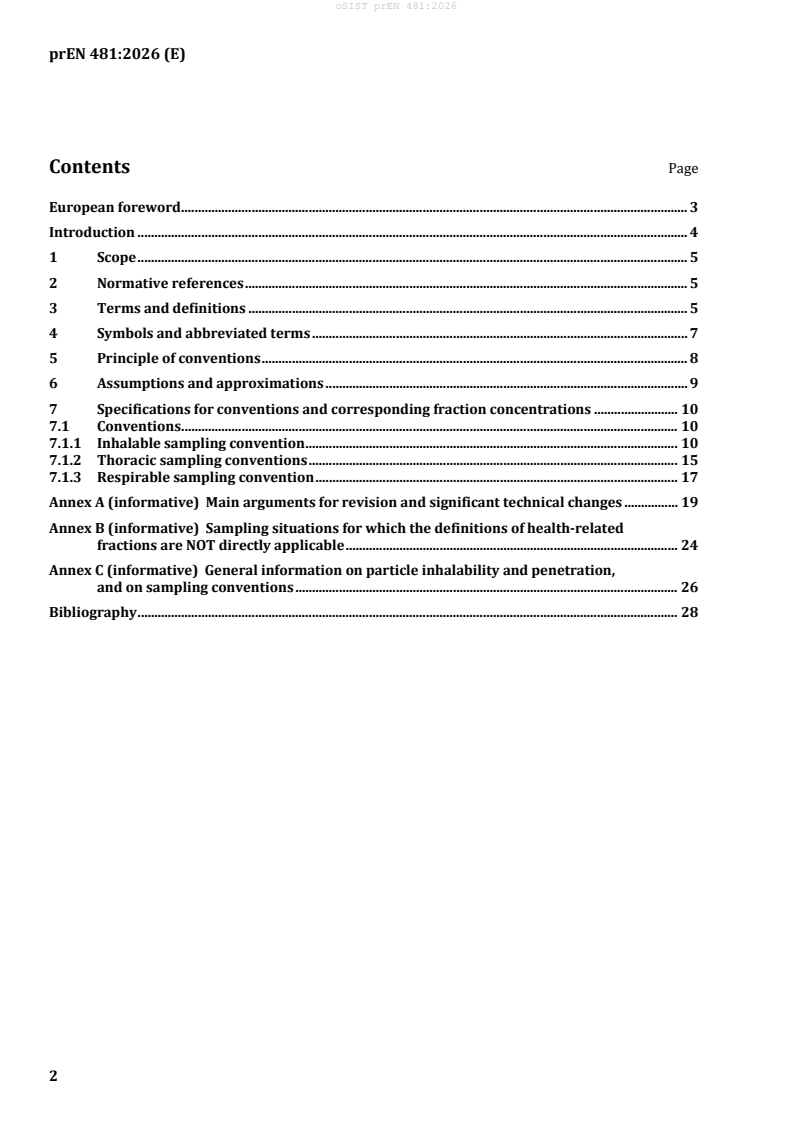
Contents
- Introduction
- 1 Scope
- 2 Normative references
- 3 Terms and definitions
- 3.1 airborne particle
- 3.2 alveolar region
- 3.3 inhalability
- 3.4 inhalable sampling convention
- 3.5 particle aerodynamic diameter
- 3.6 respirable penetration probability convention
- 3.7 respirable sampling convention
- 3.8 sampling convention
- 3.9 thoracic penetration probability convention
- 3.10 thoracic sampling convention
- 3.11 undisturbed airborne particle size distribution
- 3.12 undisturbed particle
- 4 Symbols and abbreviated terms
- 5 Principle of conventions
- 6 Assumptions and approximations
- 7 Specifications for conventions and corresponding fraction concentrations
- 7.1 Conventions
- Annex A
- 1 Inhalable sampling convention low wind speed range EI,lwsr
- Annex B
- Annex C
- Bibliography
Introduction
The proportion of total particulate matter that is inhaled into a human body depends on the aerodynamic diameter of the particles, on the speed and direction of air movement near the body, on the breathing rate of the individual, and whether breathing is through the nose or mouth. Inhaled particles can then deposit somewhere in the respiratory tract or can be exhaled. The site and amount of deposition, and probability of exhalation, depend on the aerodynamic diameter of the particle, respiratory tract anatomy, breathing pattern, and other factors.
Tissues in the respiratory tract can absorb soluble components from deposited particles at any site of deposition. Particles can cause health damage due to the constituents they carry which can be reactive, either chemically or biologically, depending on their composition. Insoluble particles can be transported to another part of the respiratory tract or body, where they can be taken up by cells and tissues and be detrimental to health.
There is considerable inter-individual variability in particle inhalation and deposition probabilities. Nevertheless, it is necessary to define conventions for size-selective sampling of airborne particles when the purpose of sampling is health-related, such as for compliance testing. This document defines the inhalable, thoracic, and respirable sampling conventions based on the penetration probability of particles into the respiratory tract. The separation of particles from the inhaled air by other mechanisms than impaction is disregarded in this document, because the transport of particles with an aerodynamic diameter less than 0,5 µm do not primarily depend on inertia. For these particles, the separation mechanism is instead mainly governed by diffusion, and the size of these particles is best described by the particle diffusive (equivalent) diameter. The particle diffusive (equivalent) diameter equals the diameter of a sphere with the same diffusion coefficient as the particle under the prevailing conditions of temperature, pressure and relative humidity. These conventions establish relationships between particle aerodynamic diameter and health-related fractions, which approximate the quantity of particles penetrating specific regions of the respiratory tract under average breathing conditions.
Measurements using sampling devices according to these conventions provide a more accurate correlation between the measured concentration and the health risk compared to measurements of undisturbed airborne particle size distribution. Relevant environmental conditions are stated in EN 689 [1].
Guidance for sampling the defined aerosol fractions is given in CEN/TR 15230 [2]. EN 13205-1 to −6 ([3] to [8]) describe performance tests for candidate aerosol samplers for any of the sampling conventions defined in this document. EN 482[9] outlines general performance requirements for samplers, instruments, and analytical methods used in occupational hygiene. A strategy for testing compliance with occupational exposure limits is given in EN 689 [1]. EN ISO 13138 [10] describes sampling conventions for fractions deposited in regions of the respiratory tract.
oSIST prEN 481:2026 prEN 481:2026 (E)
1 Scope
This document specifies sampling conventions for airborne particle size fractions to assess health-related exposure resulting from the inhalation of particles in workplace atmospheres. Conventions are defined for the inhalable, thoracic and respirable fractions. The sampling conventions only describe the inhalation of particles and their penetration in the respiratory tract as governed by inertia (impaction). Exhaled particles and deposition in the respiratory tract by other mechanisms, e.g. diffusion, are not considered in this document. The sampling conventions defined in this document apply to both indoor and outdoor workplaces. The conventions assume particles penetration and only oral breathing as a worst-case scenario. Nevertheless, the conventions are applicable to both oral and nasal breathing. The conventions are defined based on assumptions given in Clause 6. The choice of convention for a specific application depends on the region of the respiratory tract affected by the health impact of the particle component of interest (see Clause 5). The conventions can be applied to various metrics, including particle number, length, surface area, volume, or mass, depending on the type of particle analysis performed on the sampled aerosol fraction. The health-related fraction concentrations defined in this document are often expressed as the mass of sampled particles per volume of sampled air to allow comparison with mass-based occupational exposure limit values. The conventions primarily apply to the aforementioned metrics, however, they are not applicable to situations involving limit values expressed in a different metric, such as fibre limit values defined by length, diameter, and aspect ratio, unless a measurement procedure explicitly specifies sampling a particular health-related size fraction [11].
The primary objective of this document is to establish standardized conventions for health-related particle size fractions. Sampling is generally carried out using dedicated samplers, for which there is no need to measure the aerodynamic size distribution of the airborne particles to be sampled. Samplers separating airborne particles into one or more relevant fractions are currently available. In general, no assumptions or pre-knowledge are needed on the number of modes, modal diameter(s) or width of the particle aerodynamic size distribution of the airborne particles to be sampled. The conventions in this document are intended to be used for the determination of the exposure of an average worker based on average penetration curves. This document is not intended to determine the deposited dose of an individual worker.
The conventions are primarily intended for assessing workers’ exposure to airborne particles by sampling the airborne particles. This document does not apply to large particles emitted at high speed that travel due to their initial momentum, instead of being carried by the air (airborne) and aspirated into humans’ respiratory tract and aerosol samplers by suction (see Annex B). All wind speeds referenced throughout this document are based on the relative speed between the worker and the surrounding air.
2 Normative references
The following documents are referred to in the text in such a way that some or all of their content constitutes requirements of this document. For dated references, only the edition cited applies. For undated references, the latest edition of the referenced document (including any amendments) applies.
EN 1540, Workplace exposure — Terminology
3 Terms and definitions
For the purposes of this document, the terms and definitions given in EN 1540 and the following apply. NOTE The terms and definitions given in EN 1540 are reproduced here for improved readability.
oSIST prEN 481:2026 prEN 481:2026 (E) ISO and IEC maintain terminological databases for use in standardization at the following addresses:
- ISO Online browsing platform: available at https://www.iso.org/obp
- IEC Electropedia: available at https://www.electropedia.org/
3.1 airborne particle
chemical or biological agent, in solid or liquid form, dispersed in air Note 1 to entry: Smoke, fume, mist and fog consist of airborne particles. Note 2 to entry: This term describes a class of particles with a specific property, namely those that are airborne while being measured or sampled.
Note 3 to entry: Particle projectiles are a specific class of particles that move through air under its their own momentum, which they obtained when they were ejected into air. A typical example is particles generated by using grinding wheels. In order to be able to travel a long distance under its own momentum, a particle projectile needs to be large (much larger than 100 µm) and have been emitted at high speeds (exceeding 5 m/s to 10 m/s). Once drag has consumed all the original momentum of a particle projectile, it moves in the air as any other airborne particle, under the influence of air currents, air suction, drag and external forces, e.g. gravity. [SOURCE: EN 1540:2021, 3.1.1.5, modified — Notes 1 to 3 to entry have been added.]
3.2 alveolar region
compartment of the human respiratory tract consisting of respiratory bronchioles, alveolar ducts, alveolar sacs and alveoli Note 1 to entry: The American Conference of Governmental Industrial Hygienists uses the term Gas-Exchange region and the (US) National Commission on Radiological Protection uses the term Pulmonary region [12].
3.3 inhalability
ratio of the concentration of particles entering the respiratory tract as a function of the aerodynamic particle diameter to the corresponding concentration in the air before the particles are affected by the presence of the exposed individual and inhalation (i.e., the undisturbed airborne particle size distribution)
3.4 inhalable sampling convention
E Ix, sampling convention describing the probability of undisturbed particles entering the respiratory tract by inhalation through the mouth as a function of the aerodynamic particle diameter for wind speed range x
3.5 particle aerodynamic diameter
d ae
diameter of a sphere of 1 g/cm density with the same terminal settling velocity in calm air as the particle, under the prevailing conditions of temperature, pressure and relative humidity Note 1 to entry: The particle aerodynamic diameter is the diameter of an equivalent sphere that is used to describe the mass based transport phenomena of a particle of arbitrary shape and density like inertia or gravitational settling.
oSIST prEN 481:2026 prEN 481:2026 (E) [SOURCE: EN 1540:2021, 3.1.2.11, modified — Note 1 to entry has been deleted and a new Note 1 has been added.]
3.6 respirable penetration probability convention
e R convention describing the probability of inhaled particles penetrating to the alveolar region as a function of the aerodynamic particle diameter
3.7 respirable sampling convention
E R,x sampling convention describing the probability of undisturbed particles penetrating to the alveolar region as a function of the aerodynamic particle diameter for wind speed range x
3.8 sampling convention
the probability of the undisturbed airborne particles to be included in the health-related fraction in question as a function of their aerodynamic diameter that defines the target specification for the sampling efficiency of a sampling system for this fraction
3.9 thoracic penetration probability convention
e T convention describing the probability of inhaled particles penetrating beyond the larynx as a function of the aerodynamic particle diameter
3.10 thoracic sampling convention
E T,x sampling convention describing the probability of undisturbed particles penetrating beyond the larynx as a function of the aerodynamic particle diameter for wind speed range x
3.11 undisturbed airborne particle size distribution
size distribution of all airborne particles present in the air before the particles are affected by the presence of the sampler, or in the case of a personal sampler (mounted on a mannequin/person) by the presence of the mannequin/person
3.12 undisturbed particle
airborne particle before being disturbed by the presence of the sampler, or in the case of a personal sampler (mounted on a mannequin/person) by the presence of the mannequin/person
4 Symbols and abbreviated terms
For the purposes of this document, the following symbols and abbreviations apply:
particle aerodynamic diameter d ae median of the lognormal distribution expressing the definition of the d ae,R,p=0,50 respirable sampling convention
oSIST prEN 481:2026 prEN 481:2026 (E) median of the lognormal distribution expressing the definition of the thoracic d ae,,T p=0,50 sampling convention e respirable penetration probability convention R e thoracic penetration probability convention T E inhalable sampling convention I inhalable sampling convention for intermediate wind speed range E I, int inhalable sampling convention in the low wind speed range E I, lwsr inhalable sampling convention in the medium wind speed range E I, mwsr respirable sampling convention in the low wind speed range E R,lwsr respirable sampling convention in the medium wind speed range E R,mwsr thoracic sampling convention in the low wind speed range
E T,lwsr thoracic sampling convention in the medium wind speed range E T,mwsr geometric standard deviation of the lognormal distribution expressing the GSD T definition of the thoracic sampling convention; GSD = 1,50 T geometric standard deviation of the lognormal distribution expressing the GSD R definition of the respirable sampling convention; = 1,50 GSD R is the cumulative lognormal distribution function with argument z
Φ z
w wind speed x is an index for the wind speed range; x can be lwsr, mwsr or int for low, medium or intermediate medium wind speed range, respectively z is the argument of the cumulative lognormal distribution function;
5 Principle of conventions
The sampling conventions are designed on the principle that only fractions of the undisturbed airborne particle size distribution penetrate to different parts of the respiratory tract during breathing. These are estimated by the inhalable, thoracic and respirable fractions. This document presents probability functions approximating the inhalable fraction, the thoracic fraction (particles penetrating beyond the larynx), and the respirable fraction (particles penetrating to the alveolar region). These curves are called the inhalable sampling convention (see 3.4), the thoracic sampling convention (see 3.10) and the respirable sampling convention (see 3.7), respectively.
Annex C provides background information for the derivation of the sampling conventions. The conventions for the respirable and thoracic fractions are for the fraction that can penetrate to that respective region of the respiratory tract. These conventions are considered to be penetration-based as they represent the fraction of particles that penetrate to specific regions of the respiratory tract. The conventions in this document are not suitable for the determination of the deposited dose. Conventions for the deposited fraction in the extra-thoracic, tracheobronchial and alveolar regions are given in EN ISO 13138 [10].
oSIST prEN 481:2026 prEN 481:2026 (E) The sampling efficiency of an aerosol sampling system used for measurements of the inhalable, respirable or thoracic fraction concentrations shall comply with the sampling convention appropriate to the region of the respiratory tract where deposition of the substance being measured might lead to a negative health effect. Compliance criteria are stated in the EN 13205 series ([3] to [7]). For example, the inhalable sampling conventions can be applied when the substance may cause health effects regardless of the deposition site. The thoracic sampling convention is used when the substance targets regions beyond the larynx, such as the bronchi, and the respirable sampling convention is used when the substance primarily affects the alveolar region.
The measured concentration is a property of the air quality at the point of the measurement. Due to the large individual differences in the breathing patterns and the individual variability of the respiratory tract, the measured concentration can only be a proxy for what an individual worker is actually exposed to.
6 Assumptions and approximations
The definition of sampling conventions requires approximations and assumptions to represent the complex processes, that govern how particles enter and penetrate to different parts of the respiratory tract. In part this is due to the lack or variability of experimental data. The conventions are only approximations to particle behaviour. E.g. the inhalability and penetration of airborne particles to the different regions of the respiratory tract depend on the movement of air relative to the worker (speed and direction), worker’s breathing rate and whether breathing occurs through the nose or mouth, all of which vary between individuals.
The following assumptions and approximations are particularly important (see Annex C):
- The conventions assume a representative value of breathing rate, and are not taking into account individual variability; - The conventions assume only oral breathing as a worst case scenario; NOTE Nasal aspiration efficiency in literature is very diverse, but shows a tendency to be lower than the oral aspiration efficiency [13, 14, 15].
- The inhalable sampling conventions assume two workplace wind speed ranges: low wind speed (<0,2 m/s) and medium wind speed (0,5–4 m/s). The probability functions for each wind speed range are approximated by respective formulas, which are substantiated by experimental data. A probability function for the intermediate wind speed range (0,2 – 0,5 m/s) is derived from linear interpolation. Wind speeds > 4 m/s are out of the scope of this document;
- The conventions assume an individual to be evenly exposed to all wind directions;
- The conventions provide an approximation of average penetration to the relevant regions of the respiratory tract as a function of the aerodynamic particle diameter;
- Particles with aerodynamic diameters below 0,5 µm are assumed to ideally follow airflows and consequently, their inhalability is assumed to be 1. Although this assumption might not hold completely for very small particles with sizes below approximately 0,05 µm due to particle diffusion, the effect is neglected, since these small particles usually only have negligible contributions to the thoracic and inhalable mass concentration. If the inhalable or thoracic particle number concentration is determined, this assumption can lead to an overestimation;
- Particles with aerodynamic diameters larger than 100 µm are excluded from the convention, because there is too little experimental data to derive values for the inhalable conventions.
oSIST prEN 481:2026 prEN 481:2026 (E)
7 Specifications for conventions and corresponding fraction concentrations
7.1 Conventions
7.1.1 Inhalable sampling convention
7.1.1.1 General
The probability for a particle to be inhaled depends on the relative wind speed between the worker and the surrounding air (w), apart from the major dependence on d . In the low wind speed range, this ae inhalability is high and almost independent of w. In the medium wind speed range, the inhalability decreases but levels out from w ≈ 0,5 m/s, and it is approximately constant up to w ≈ 4 m/s. Two definitions have been established based on experimental data for the low and medium wind speed range. A third definition for the transition between the low and medium wind speed range has been established as a linear interpolation between the two.
NOTE The experimentally substantiated low and medium wind speed range cover the wind speeds of ≤ 0,1 m/s and 1 m/s, prescribed for the testing of samplers of the inhalable fraction according to EN 13205-2.
7.1.1.2 Inhalable sampling convention in low wind speed range
Sampling of the inhalable fraction in the low wind speed range (w ≤ 0,2 m/s) shall conform to the following convention: the fraction E of the undisturbed airborne particle concentration, I, lwsr at an aerodynamic diameter d that is to be sampled, shall be calculated by:
ae E 1+ ad (1) I, lwsr 1 ae where E is the inhalable sampling convention in the low wind speed range; I, lwsr is the particle aerodynamic diameter with 0,5 µm ≤ ≤ 100 µm, in micrometres (µm); d d ae ae is a constant with a value of – 0,0038 /µm.
a
...