

kSIST FprEN 14021:2026
(Main)Stone shields for off-road motorcycling suited to protect riders against stones and debris - Requirements and test methods
- Abstract
This document specifies requirements and test methods for stone shields for use by youths and adults of either sex, over clothing and not directly on the skin, to provide limited protection against lofted stones and debris while riding motorcycles in motocross and other off-road activities on dirt roads.
Hence this document contains general and performance requirements for the materials utilized and requirements for sizes, shapes, marking and assembly methodology.
This document does not apply to stone shields for children and for people with chest girth below 50 cm.
- Status
- Not Published
- Public Enquiry End Date
- 22-Oct-2025
- Technical Committee
- OVP - Personal protecting equipment
- Current Stage
- 5020 - Formal vote (FV) (Adopted Project)
- Start Date
- 28-Oct-2026
- Due Date
- 16-Dec-2026
- Completion Date
- 28-Oct-2026

kSIST FprEN 14021:2026 is a SIST draft European standard for stone shields for off-road motorcycling. It specifies requirements and test methods for garments worn by youths and adults over clothing, not directly on the skin, to provide limited protection against lofted stones and debris during motocross and other off-road riding. The document covers product construction, sizing, marking, manufacturer information, and performance testing for PPE use.
What does kSIST FprEN 14021:2026 specify?
kSIST FprEN 14021:2026 specifies the requirements and test methods for stone shields used in off-road motorcycling on dirt roads. It applies to products for youths and adults of either sex and excludes children and people with a chest girth below 50 cm.
The document is organized into these main clauses:
- Scope
- Normative references
- Terms and definitions
- Requirements
- Test equipment
- Test methods
- Marking
- Information supplied by the manufacturer
Annex ZA links the standard to Regulation (EU) 2016/425 on personal protective equipment (PPE).
What are the key requirements of kSIST FprEN 14021:2026?
Construction, coverage, and sizing
kSIST FprEN 14021:2026 requires the stone shield to have tightening or restraining devices so it can be worn close to the body without limiting movement. The product is built around a breast guard and may also include shoulder guards, biceps guards, and a back guard.
The standard sets minimum protected areas for each of these parts. In practice, this means the designer must make sure the protector covers the torso regions named in the document, not just provide a general shell.
Sizing is tied to chest girth measured on an upright, normally breathing person, with the tape routed over the scapulae and under the armpits. The breast guard size marking must follow EN ISO 13688:2013, and the proportions are scaled from the reference dimensions given in the document.
Surface continuity, attachment strength, and ergonomics
kSIST FprEN 14021:2026 requires the components to be shaped so that no gap accepts the circular probe used in the surface continuity test. This matters because openings and slots can create weak points or snag points.
Rigid attachments, straps, fasteners, and adjusters must withstand a pulling force of 120 N without failure. For users and buyers, this means the closures must survive ordinary fitting and movement without coming apart.
The ergonomic requirements are aimed at comfort and mobility. Rough edges are not allowed on the shells, padding is required on the inner surfaces of shells, and the protector must not unduly restrict arm movement or cause bruising.
Impact performance and test conditions
kSIST FprEN 14021:2026 requires impact testing with conditioned samples and a defined drop-test setup. The impact result must stay below the stated average peak force limit, and no shell may crack or shatter.
The test method uses a hemispherical impactor, a specified anvil, and force measurement instrumentation with the frequency response aligned to ISO 6487:2015. In practice, this gives a repeatable way to compare products and document pass or fail results.
The document also requires visual examination, dimensional checking, restraint testing, ergonomic assessment, and impact testing on at least three samples of each type.
What terms does kSIST FprEN 14021:2026 define?
- Stone shield - a product worn under or over outer clothing, but not directly on the skin, to protect against lofted stones and debris.
- Breast guard - the main front protective part of the stone shield, covering the chest and sternum area.
- Shoulder guards - optional or additional parts that cover the top portion of the shoulders.
- Biceps guards - parts that cover the outer portion of the upper arms.
- Back guard - the rear protective part that covers the scapulae and part of the spine.
- PPE - personal protective equipment, the regulatory category linked to the standard through Annex ZA.
Who uses kSIST FprEN 14021:2026?
kSIST FprEN 14021:2026 is used by manufacturers designing stone shields, laboratories performing type testing, and organizations checking product conformity for PPE placed on the market. It is also relevant to quality managers, importers, and buyers who need to verify sizing, marking, instructions, and impact performance for off-road motorcycling protective clothing.
What changed in kSIST FprEN 14021:2026 from the previous edition?
kSIST FprEN 14021:2026 supersedes EN 14021:2003. The stated changes are:
- the chest girth limit in the scope was reduced from 75 cm to 50 cm
- Annex ZA was updated to match the essential health and safety requirements in Annex II of Regulation (EU) 2016/425
Which standards are used with kSIST FprEN 14021:2026?
- EN ISO 13688:2013 - provides the general requirements for protective clothing and the basis for size marking referenced by this standard.
- ISO 6487:2015 - provides the instrumentation requirements used for impact-test measurement, including the channel frequency class referenced for the recording system.
What does the kSIST FprEN 14021:2026 document contain?
The document contains a sizing table for the main dimensions of the breast guard, plus figures showing the stone shield layout, measurement points, padding arrangement, the test anvil, and the circular probe. It also includes detailed procedures for visual checking, measuring, surface continuity testing, restraint testing, ergonomic assessment, and impact testing.
Annex ZA contains the correspondence table between this standard and the essential requirements of Regulation (EU) 2016/425. The bibliography cites EN 1621-1 as a related reference for motorcycle protective clothing test equipment.
Relations
- Effective Date
- 18-Jan-2023
Get Certified
Connect with accredited certification bodies for this standard

TÜV Rheinland
TÜV Rheinland is a leading international provider of technical services.

TÜV SÜD
TÜV SÜD is a trusted partner of choice for safety, security and sustainability solutions.

DEKRA Certification Inc.
DEKRA US certification services.
Sponsored listings
Frequently Asked Questions
kSIST FprEN 14021:2026 is a draft published by the Slovenian Institute for Standardization (SIST). Its full title is "Stone shields for off-road motorcycling suited to protect riders against stones and debris - Requirements and test methods". This standard covers: This document specifies requirements and test methods for stone shields for use by youths and adults of either sex, over clothing and not directly on the skin, to provide limited protection against lofted stones and debris while riding motorcycles in motocross and other off-road activities on dirt roads. Hence this document contains general and performance requirements for the materials utilized and requirements for sizes, shapes, marking and assembly methodology. This document does not apply to stone shields for children and for people with chest girth below 50 cm.
This document specifies requirements and test methods for stone shields for use by youths and adults of either sex, over clothing and not directly on the skin, to provide limited protection against lofted stones and debris while riding motorcycles in motocross and other off-road activities on dirt roads. Hence this document contains general and performance requirements for the materials utilized and requirements for sizes, shapes, marking and assembly methodology. This document does not apply to stone shields for children and for people with chest girth below 50 cm.
kSIST FprEN 14021:2026 is classified under the following ICS (International Classification for Standards) categories: 13.340.10 - Protective clothing; 43.140 - Motorcycles and mopeds. The ICS classification helps identify the subject area and facilitates finding related standards.
kSIST FprEN 14021:2026 has the following relationships with other standards: It is inter standard links to SIST EN 14021:2004. Understanding these relationships helps ensure you are using the most current and applicable version of the standard.
kSIST FprEN 14021:2026 is associated with the following European legislation: EU Directives/Regulations: 2016/425, 93/68/EEC, 93/95/EEC, 96/58/EC; Standardization Mandates: M/571, M/571 Amd 1. When a standard is cited in the Official Journal of the European Union, products manufactured in conformity with it benefit from a presumption of conformity with the essential requirements of the corresponding EU directive or regulation.
kSIST FprEN 14021:2026 is available in PDF format for immediate download after purchase. The document can be added to your cart and obtained through the secure checkout process. Digital delivery ensures instant access to the complete standard document.
Standards Content (Sample)
SLOVENSKI STANDARD
oSIST prEN 14021:2025
01-oktober-2025
Obojestranski ščitnik trupa motociklistov pred kamnito podlago in drobci,
primeren za vožnjo po brezpotju - Zahteve in preskusne metode
Stone shields for off-road motorcycling suited to protect riders against stones and debris
- Requirements and test methods
Protektoren gegen Aufprall von Steinen und Gesteinstrümmern für den Schutz von
Gelände-Motorradfahrern - Anforderungen und Prüfverfahren
Pare-pierres pour le motocyclisme tout-terrain destinés à protéger les motocyclistes
contre les pierres et autres menus projectiles - Exigences et méthodes d'essai
Ta slovenski standard je istoveten z: prEN 14021
ICS:
13.340.10 Varovalna obleka Protective clothing
43.140 Motorna kolesa in mopedi Motorcycles and mopeds
oSIST prEN 14021:2025 en,fr,de
2003-01.Slovenski inštitut za standardizacijo. Razmnoževanje celote ali delov tega standarda ni dovoljeno.
oSIST prEN 14021:2025
oSIST prEN 14021:2025
DRAFT
EUROPEAN STANDARD
prEN 14021
NORME EUROPÉENNE
EUROPÄISCHE NORM
July 2025
ICS 13.340.10 Will supersede EN 14021:2003
English Version
Stone shields for off-road motorcycling suited to protect
riders against stones and debris - Requirements and test
methods
Pare-pierres pour le motocyclisme tout-terrain Protektoren gegen Aufprall von Steinen und
destinés à protéger les motocyclistes contre les pierres Gesteinstrümmern für den Schutz von Gelände-
et autres menus projectiles - Exigences et méthodes Motorradfahrern - Anforderungen und Prüfverfahren
d'essai
This draft European Standard is submitted to CEN members for enquiry. It has been drawn up by the Technical Committee
CEN/TC 162.
If this draft becomes a European Standard, CEN members are bound to comply with the CEN/CENELEC Internal Regulations
which stipulate the conditions for giving this European Standard the status of a national standard without any alteration.
This draft European Standard was established by CEN in three official versions (English, French, German). A version in any other
language made by translation under the responsibility of a CEN member into its own language and notified to the CEN-CENELEC
Management Centre has the same status as the official versions.
CEN members are the national standards bodies of Austria, Belgium, Bulgaria, Croatia, Cyprus, Czech Republic, Denmark, Estonia,
Finland, France, Germany, Greece, Hungary, Iceland, Ireland, Italy, Latvia, Lithuania, Luxembourg, Malta, Netherlands, Norway,
Poland, Portugal, Republic of North Macedonia, Romania, Serbia, Slovakia, Slovenia, Spain, Sweden, Switzerland, Türkiye and
United Kingdom.
Recipients of this draft are invited to submit, with their comments, notification of any relevant patent rights of which they are
aware and to provide supporting documentation.
Warning : This document is not a European Standard. It is distributed for review and comments. It is subject to change without
notice and shall not be referred to as a European Standard.
EUROPEAN COMMITTEE FOR STANDARDIZATION
COMITÉ EUROPÉEN DE NORMALISATION
EUROPÄISCHES KOMITEE FÜR NORMUNG
CEN-CENELEC Management Centre: Rue de la Science 23, B-1040 Brussels
© 2025 CEN All rights of exploitation in any form and by any means reserved Ref. No. prEN 14021:2025 E
worldwide for CEN national Members.
oSIST prEN 14021:2025
prEN 14021:2025 (E)
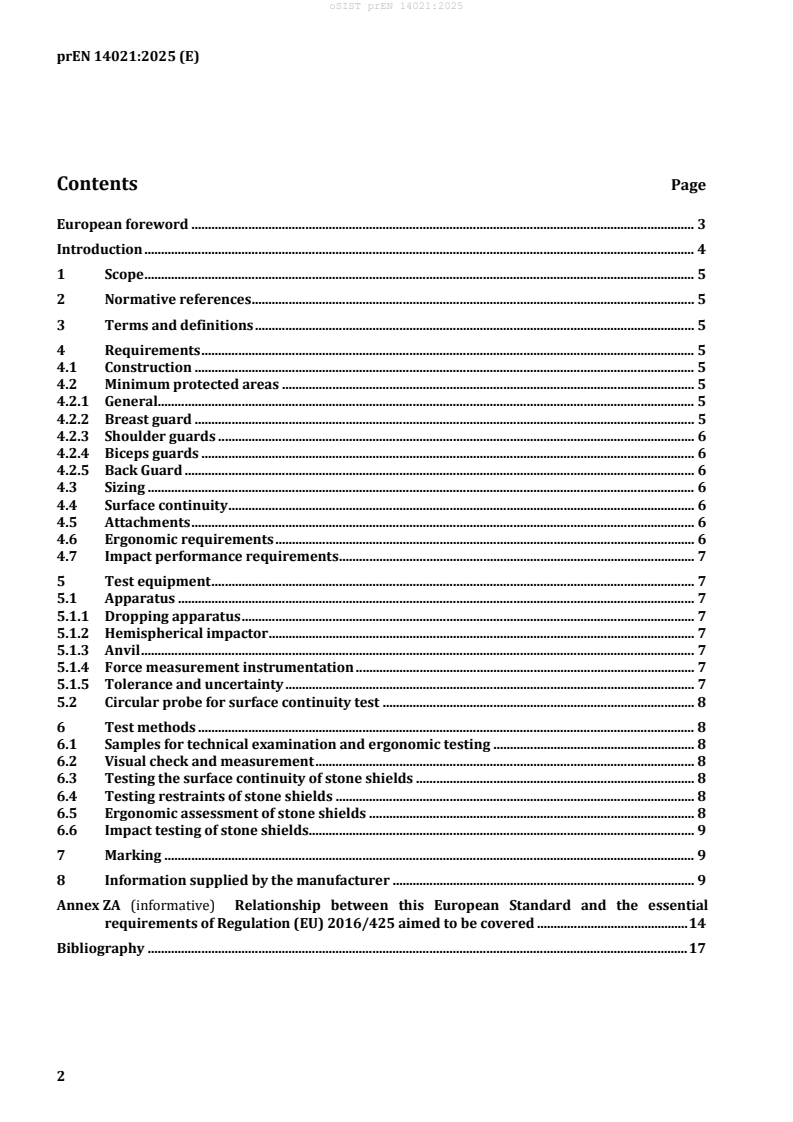
Contents Page
European foreword . 3
Introduction . 4
1 Scope . 5
2 Normative references . 5
3 Terms and definitions . 5
4 Requirements . 5
4.1 Construction . 5
4.2 Minimum protected areas . 5
4.2.1 General. 5
4.2.2 Breast guard . 5
4.2.3 Shoulder guards . 6
4.2.4 Biceps guards . 6
4.2.5 Back Guard . 6
4.3 Sizing . 6
4.4 Surface continuity . 6
4.5 Attachments . 6
4.6 Ergonomic requirements . 6
4.7 Impact performance requirements . 7
5 Test equipment . 7
5.1 Apparatus . 7
5.1.1 Dropping apparatus . 7
5.1.2 Hemispherical impactor . 7
5.1.3 Anvil . 7
5.1.4 Force measurement instrumentation . 7
5.1.5 Tolerance and uncertainty . 7
5.2 Circular probe for surface continuity test . 8
6 Test methods . 8
6.1 Samples for technical examination and ergonomic testing . 8
6.2 Visual check and measurement . 8
6.3 Testing the surface continuity of stone shields . 8
6.4 Testing restraints of stone shields . 8
6.5 Ergonomic assessment of stone shields . 8
6.6 Impact testing of stone shields. 9
7 Marking . 9
8 Information supplied by the manufacturer . 9
Annex ZA (informative) Relationship between this European Standard and the essential
requirements of Regulation (EU) 2016/425 aimed to be covered . 14
Bibliography . 17
oSIST prEN 14021:2025
prEN 14021:2025 (E)
European foreword
This document (prEN 14021:2025) has been prepared by Technical Committee CEN/TC 162 “Protective
clothing including hand and arm protection and lifejackets”, the secretariat of which is held by DIN.
This document is currently submitted to the CEN Enquiry.
This document has been prepared under a standardization request addressed to CEN by the European
Commission. The Standing Committee of the EFTA States subsequently approves these requests for its
Member States.
For relationship with EU Legislation, see informative Annex ZA, which is an integral part of this document.
This document will supersede EN 14021:2003.
The main changes compared with EN 14021:2003 are as follows:
— in the scope the value of the chest girth has been reduce from 75 cm to 50 cm;
— Annex ZA has been updated in accordance with the essential health and safety requirements set out
in Annex II to Regulation (EU) 2016/425.
oSIST prEN 14021:2025
prEN 14021:2025 (E)
Introduction
Stone Shields conforming to this document are articulate garments intended for the protection of chest,
optionally of shoulders, back and biceps specifically against lofted stones and debris such as those riders
often encounter in off-road motorcycling and in allied sports activities where these hazards can exist.
A complete stone shield provides protection to the whole of the torso.
The essential part of a stone shield is the breast guard, which can be associated with the shoulder guards,
the back guard and the biceps guards.
When the stone shields are in the form of articulate assemblies the parts can be held together by
diversified joining devices and can be made out of mixed soft/hard or hard materials (shells). In the latter
case they are fitted with suitable padding on the inner surface, and their edges are rounded to avoid
bruising of the skin.
oSIST prEN 14021:2025
prEN 14021:2025 (E)
1 Scope
This document specifies requirements and test methods for the stone shields to be worn by youths and
adults of either sex to provide limited protection against lofted stones and debris while riding
motorcycles in motocross and other off-road activities on dirt roads.
Hence this document contains general and performance requirements for the materials utilized and
requirements for sizes, shapes, marking and assembly methodology.
This document is not applicable to stone shield for children and for people with chest girth below 50 cm.
2 Normative references
The following documents are referred to in the text in such a way that some or all of their content
constitutes requirements of this document. For dated references, only the edition cited applies. For
undated references, the latest edition of the referenced document (including any amendments) applies.
EN ISO 13688:2013, Protective clothing — General requirements (ISO 13688:2013)
ISO 6487:2015, Road vehicles — Measurement techniques in impact tests — Instrumentation
3 Terms and definitions
For the purposes of this document, the following terms and definitions apply.
ISO and IEC maintain terminology databases for use in standardization at the following addresses:
— ISO Online browsing platform: available at https://www.iso.org/obp
— IEC Electropedia: available at https://www.electropedia.org/
3.1
stone shield
product designed to be worn under or over outer clothing (but not without underclothing and not directly
on the skin) and to provide protection from lofted stones and debris
Note to entry: The product consists mainly of a breast guard, which may be associated with or include shoulder
guards and other guards such as biceps guards and a back guard (see Figure 1).
4 Requirements
4.1 Construction
The stone shield shall be fitted with tightening or restraining devices or closures to allow them to be
donned tight to the body assuring freedom of movements. Check according to 6.5.
4.2 Minimum protected areas
4.2.1 General
The minimum protected areas of the breast guard is specified in Table 1 and in 4.2.2.
4.2.3 to 4.2.5 are applicable when other parts are present.
4.2.2 Breast guard
The breast guard shall cover the anterior portion of the rib cage including the sternum.
oSIST prEN 14021:2025
prEN 14021:2025 (E)
4.2.3 Shoulder guards
The shoulder guards shall cover the top portion of the shoulders.
4.2.4 Biceps guards
Biceps guards shall cover the outer portion of the upper arms.
4.2.5 Back Guard
The back guard shall cover the scapulae and a portion of the spine with a length corresponding of at least
C of Figure 2.
4.3 Sizing
Stone shields shall be marked on the breast guard with their size according to EN ISO 13688:2013 except
that the reference dimension is only the chest girth measured on a person in the upright position and
breathing normally with the tape-measure passed over the scapulae under the armpits and across the
chest and back.
For required minimum dimensions of a breast guard suited for a person with a chest girth of 105 cm, use
Table 1.
Other sizes will be scaled to the same proportions.
Table 1 — Dimensions
Dimensions A B C
Chest girth (%) 33 19 22
Example of chest girth 35 cm 22 cm 23 cm
of 105 cm
The dimensions A, B and C are defined below by reference to Figure 2 and do not include the padding.
A – the minimum distance between the lower edge of the breast guard and the mid point of the
subject's shoulder.
B – the minimum breadth of the breast guard at any point.
C – the minimum length between the mid point on the upper edge and the mid point on the lower edge
of the breast guard.
4.4 Surface continuity
The components of the stone shields shall be constructed so that there are no gaps that admit a circular
probe as described in 5.2.
4.5 Attachments
All rigid attachments and straps as well as fasteners and adjusters shall be able to withstand a pulling
force of 120 N without failure, when tested according to
...