

SIST EN 17709:2025
(Main)Plant biostimulants - Determination of Azotobacter spp.
General Information
- Abstract
This document was developed to provide the methodology for the enumeration and determination of Azotobacter spp. [2] [3] in microbial plant biostimulants in accordance with the Regulation (EU) 2019/1009 of the European Parliament and of the Council [1].
This document is applicable to the blends of fertilizing products where a blend is a mix of at least two of the following component EU fertilising products categories: Fertilizers, Liming Materials, Soil Improvers, Growing Media, Plant Biostimulants and where the following category Plant Biostimulants is the highest % in the blend by mass or volume, or in the case of liquid form by dry mass. If Plant Biostimulants is not the highest % in the blend, the European Standard for the highest % of the blend applies. In case a blend of fertilizing products is composed of components in equal quantity or in case the component EU fertilising products used for the blend have identical formulations , the user decides which standard to apply.
- Status
- Published
- Public Enquiry End Date
- 02-Jun-2023
- Publication Date
- 07-Jan-2025
- Technical Committee
- KAT - Soil quality
- Current Stage
- 6060 - National Implementation/Publication (Adopted Project)
- Start Date
- 20-Dec-2024
- Due Date
- 24-Feb-2025
- Completion Date
- 08-Jan-2025

Overview - EN 17709:2024 (Plant biostimulants - Determination of Azotobacter spp.)
EN 17709:2024 is a CEN European Standard that sets out a validated laboratory method for the enumeration and identification of Azotobacter spp. in microbial plant biostimulants. It supports compliance with Regulation (EU) 2019/1009 on EU fertilising products and applies to single-category plant biostimulants and blends where the plant biostimulant component is the largest fraction by mass/volume (or by dry mass for liquids).
Key topics and technical requirements
- Scope & applicability: Methods apply to multiple formulation types (water-based liquids, oil/EC, wettable powders, water-dispersible granules, pellets/microgranules, substrates).
- Sample preparation: Typical routine uses 25 ml (liquids) or 25 g (solids) suspended into 225 ml sterile diluent; shaking/sieving times and dispersion steps are specified per formulation to ensure representative sampling.
- Enumeration (CFU):
- Serial 10-fold dilutions followed by spread plating.
- Inoculation of 0.1 ml per plate in triplicate; use of Ashby’s Sucrose Agar (N-free medium).
- Incubation at approx. 30 °C ± 2 °C for ~4 days, then colony counting to calculate colony-forming units (CFU).
- Use of validated diluents (including newly added buffered peptone water) and media preparation/performance per EN ISO 11133.
- Species determination:
- Procedures for isolating organisms, genomic DNA extraction and storage.
- Partial PCR amplification of 16S rRNA genes for genetic confirmation of Azotobacter spp.
- Documentation & quality: Annexes cover media formulations (Annex A), repeatability/reproducibility data (Annex B) and relationship to EU legislative requirements (Annex ZA).
Practical applications and users
Who benefits:
- Biostimulant manufacturers for product quality control and regulatory compliance.
- Microbiology testing laboratories performing routine enumeration and species confirmation.
- Regulatory and conformity assessment bodies assessing claims under the Fertilising Products Regulation.
- R&D teams and agronomy specialists evaluating microbial product stability, formulation effects, and labeling. Practical uses include batch release testing, stability studies, blend assessments, and supporting documentation for market placement in the EU.
Related standards and regulations
- Regulation (EU) 2019/1009 - EU fertilising products regulation.
- EN 17702-1:2024 - Sampling and sample preparation for plant biostimulants.
- EN 17724:2024 - Terminology for plant biostimulants.
- EN ISO 11133:2014 - Performance of culture media and microbiological methods.
Keywords: EN 17709:2024, Plant biostimulants, Azotobacter spp., enumeration, CFU, Ashby’s Sucrose Agar, 16S rRNA, Regulation (EU) 2019/1009.
Relations
- Effective Date
- 01-Feb-2025
- Refers
SIST EN 17702-1:2025 - Plant biostimulants - Sampling and sample preparation - Part 1: Sampling - Effective Date
- 28-Jan-2026
- Effective Date
- 28-Jan-2026
- Effective Date
- 28-Jan-2026
Get Certified
Connect with accredited certification bodies for this standard

Control Union Certifications
Global certification for agriculture and sustainability.

ECOCERT
Organic and sustainability certification.

FSC International
Forest Stewardship Council certification.
Sponsored listings
Frequently Asked Questions
SIST EN 17709:2025 is a standard published by the Slovenian Institute for Standardization (SIST). Its full title is "Plant biostimulants - Determination of Azotobacter spp.". This standard covers: This document was developed to provide the methodology for the enumeration and determination of Azotobacter spp. [2] [3] in microbial plant biostimulants in accordance with the Regulation (EU) 2019/1009 of the European Parliament and of the Council [1]. This document is applicable to the blends of fertilizing products where a blend is a mix of at least two of the following component EU fertilising products categories: Fertilizers, Liming Materials, Soil Improvers, Growing Media, Plant Biostimulants and where the following category Plant Biostimulants is the highest % in the blend by mass or volume, or in the case of liquid form by dry mass. If Plant Biostimulants is not the highest % in the blend, the European Standard for the highest % of the blend applies. In case a blend of fertilizing products is composed of components in equal quantity or in case the component EU fertilising products used for the blend have identical formulations , the user decides which standard to apply.
This document was developed to provide the methodology for the enumeration and determination of Azotobacter spp. [2] [3] in microbial plant biostimulants in accordance with the Regulation (EU) 2019/1009 of the European Parliament and of the Council [1]. This document is applicable to the blends of fertilizing products where a blend is a mix of at least two of the following component EU fertilising products categories: Fertilizers, Liming Materials, Soil Improvers, Growing Media, Plant Biostimulants and where the following category Plant Biostimulants is the highest % in the blend by mass or volume, or in the case of liquid form by dry mass. If Plant Biostimulants is not the highest % in the blend, the European Standard for the highest % of the blend applies. In case a blend of fertilizing products is composed of components in equal quantity or in case the component EU fertilising products used for the blend have identical formulations , the user decides which standard to apply.
SIST EN 17709:2025 is classified under the following ICS (International Classification for Standards) categories: 65.080 - Fertilizers. The ICS classification helps identify the subject area and facilitates finding related standards.
SIST EN 17709:2025 has the following relationships with other standards: It is inter standard links to SIST-TS CEN/TS 17709:2023, SIST EN 17702-1:2025, SIST EN 17724:2025, SIST EN ISO 19650-4:2023. Understanding these relationships helps ensure you are using the most current and applicable version of the standard.
SIST EN 17709:2025 is associated with the following European legislation: EU Directives/Regulations: 2019/1009; Standardization Mandates: M/564, M/564 Amd 1, M/XXX. When a standard is cited in the Official Journal of the European Union, products manufactured in conformity with it benefit from a presumption of conformity with the essential requirements of the corresponding EU directive or regulation.
SIST EN 17709:2025 is available in PDF format for immediate download after purchase. The document can be added to your cart and obtained through the secure checkout process. Digital delivery ensures instant access to the complete standard document.
Standards Content (Sample)
SLOVENSKI STANDARD
01-februar-2025
Nadomešča:
SIST-TS CEN/TS 17709:2023
Rastlinski biostimulanti - Določanje Azotobacter spp.
Plant biostimulants - Determination of Azotobacter spp.
Pflanzen-Biostimulanzien - Bestimmung von Azotobacter spp.
Biostimulants des végétaux - Détermination d'Azotobacter spp.
Ta slovenski standard je istoveten z: EN 17709:2024
ICS:
65.080 Gnojila Fertilizers
2003-01.Slovenski inštitut za standardizacijo. Razmnoževanje celote ali delov tega standarda ni dovoljeno.
EN 17709
EUROPEAN STANDARD
NORME EUROPÉENNE
November 2024
EUROPÄISCHE NORM
ICS 65.080 Supersedes CEN/TS 17709:2022
English Version
Plant biostimulants - Determination of Azotobacter spp.
Biostimulants des végétaux - Détermination Pflanzen-Biostimulanzien - Bestimmung von
d'Azotobacter spp. Azotobacter spp.
This European Standard was approved by CEN on 26 August 2024.
CEN members are bound to comply with the CEN/CENELEC Internal Regulations which stipulate the conditions for giving this
European Standard the status of a national standard without any alteration. Up-to-date lists and bibliographical references
concerning such national standards may be obtained on application to the CEN-CENELEC Management Centre or to any CEN
member.
This European Standard exists in three official versions (English, French, German). A version in any other language made by
translation under the responsibility of a CEN member into its own language and notified to the CEN-CENELEC Management
Centre has the same status as the official versions.
CEN members are the national standards bodies of Austria, Belgium, Bulgaria, Croatia, Cyprus, Czech Republic, Denmark, Estonia,
Finland, France, Germany, Greece, Hungary, Iceland, Ireland, Italy, Latvia, Lithuania, Luxembourg, Malta, Netherlands, Norway,
Poland, Portugal, Republic of North Macedonia, Romania, Serbia, Slovakia, Slovenia, Spain, Sweden, Switzerland, Türkiye and
United Kingdom.
EUROPEAN COMMITTEE FOR STANDARDIZATION
COMITÉ EUROPÉEN DE NORMALISATIO N
EUROPÄISCHES KOMITEE FÜR NORMUN G
CEN-CENELEC Management Centre: Rue de la Science 23, B-1040 Brussels
© 2024 CEN All rights of exploitation in any form and by any means reserved Ref. No. EN 17709:2024 E
worldwide for CEN national Members.
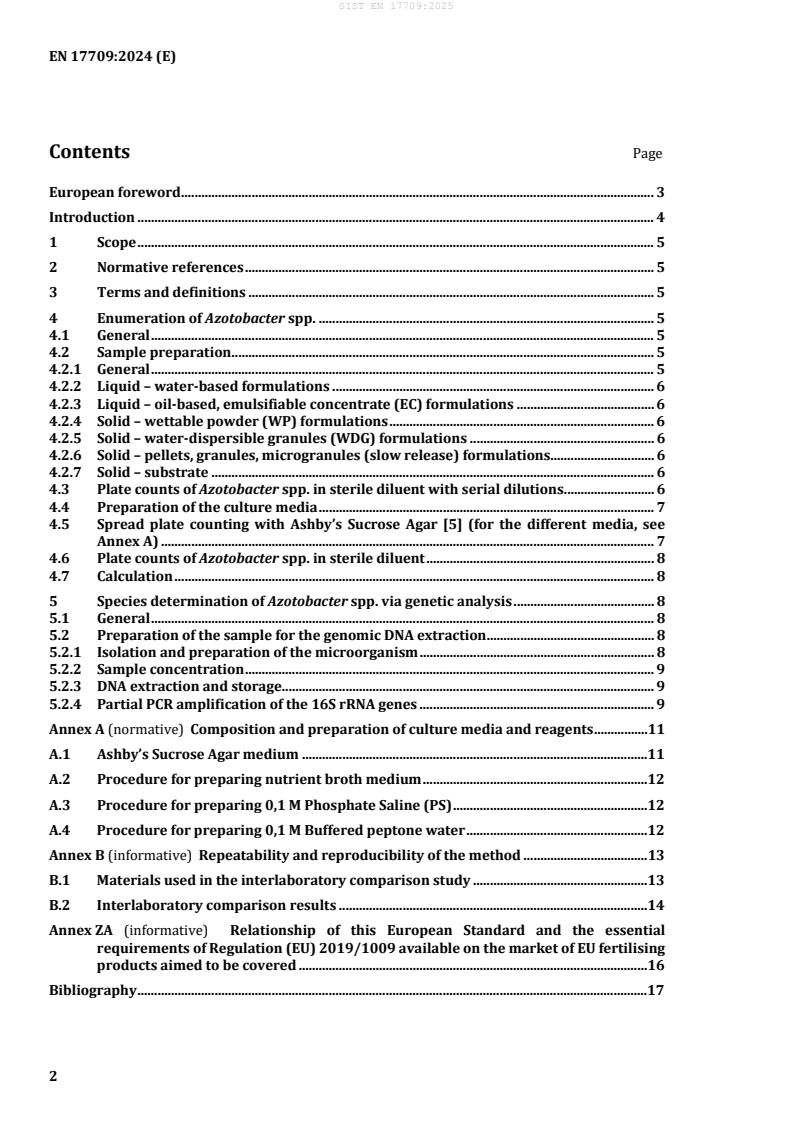
Contents Page
European foreword . 3
Introduction . 4
1 Scope . 5
2 Normative references . 5
3 Terms and definitions . 5
4 Enumeration of Azotobacter spp. . 5
4.1 General . 5
4.2 Sample preparation . 5
4.2.1 General . 5
4.2.2 Liquid – water-based formulations . 6
4.2.3 Liquid – oil-based, emulsifiable concentrate (EC) formulations . 6
4.2.4 Solid – wettable powder (WP) formulations . 6
4.2.5 Solid – water-dispersible granules (WDG) formulations . 6
4.2.6 Solid – pellets, granules, microgranules (slow release) formulations. 6
4.2.7 Solid – substrate . 6
4.3 Plate counts of Azotobacter spp. in sterile diluent with serial dilutions . 6
4.4 Preparation of the culture media . 7
4.5 Spread plate counting with Ashby’s Sucrose Agar [5] (for the different media, see
Annex A) . 7
4.6 Plate counts of Azotobacter spp. in sterile diluent . 8
4.7 Calculation . 8
5 Species determination of Azotobacter spp. via genetic analysis . 8
5.1 General . 8
5.2 Preparation of the sample for the genomic DNA extraction . 8
5.2.1 Isolation and preparation of the microorganism . 8
5.2.2 Sample concentration . 9
5.2.3 DNA extraction and storage . 9
5.2.4 Partial PCR amplification of the 16S rRNA genes . 9
Annex A (normative) Composition and preparation of culture media and reagents .11
A.1 Ashby’s Sucrose Agar medium .11
A.2 Procedure for preparing nutrient broth medium .12
A.3 Procedure for preparing 0,1 M Phosphate Saline (PS) .12
A.4 Procedure for preparing 0,1 M Buffered peptone water .12
Annex B (informative) Repeatability and reproducibility of the method .13
B.1 Materials used in the interlaboratory comparison study .13
B.2 Interlaboratory comparison results .14
Annex ZA (informative) Relationship of this European Standard and the essential
requirements of Regulation (EU) 2019/1009 available on the market of EU fertilising
products aimed to be covered .16
Bibliography .17
European foreword
This document (EN 17709:2024) has been prepared by Technical Committee CEN/TC 455 “Plant
biostimulants”, the secretariat of which is held by AFNOR.
This European Standard shall be given the status of a national standard, either by publication of an
identical text or by endorsement, at the latest by May 2025, and conflicting national standards shall be
withdrawn at the latest by May 2025.
Attention is drawn to the possibility that some of the elements of this document may be the subject of
patent rights. CEN shall not be held responsible for identifying any or all such patent rights.
This document supersedes CEN/TS 17709:2022.
— the European foreword has been updated;
— the Introduction has been updated;
— in Annex A, buffered peptone water has been added as diluent for the enumeration;
— in 4.5, a general description of the colonies of the different genera has been included;
— the recipe of phosphate buffered saline has been modified;
— the Bibliography has been updated;
— Annex ZA has been added.
This document has been prepared under a standardization request addressed to CEN by the European
Commission. The Standing Committee of the EFTA States subsequently approves these requests for its
Member States.
For the relationship with EU Legislation, see informative Annex ZA, which is an integral part of this
document.
Any feedback and questions on this document should be directed to the users’ national standards body.
A complete listing of these bodies can be found on the CEN website.
According to the CEN-CENELEC Internal Regulations, the national standards organisations of the
following countries are bound to implement this European Standard: Austria, Belgium, Bulgaria, Croatia,
Cyprus, Czech Republic, Denmark, Estonia, Finland, France, Germany, Greece, Hungary, Iceland, Ireland,
Italy, Latvia, Lithuania, Luxembourg, Malta, Netherlands, Norway, Poland, Portugal, Republic of North
Macedonia, Romania, Serbia, Slovakia, Slovenia, Spain, Sweden, Switzerland, Türkiye and the United
Kingdom.
Introduction
The European Committee for Standardization (CEN) was requested by the European Commission (EC) to
draft European Standards or European Standardization deliverables to support the implementation of
Regulation (EU) 2019/1009 of 5 June 2019 [1] laying down rules on the making available on the market
of EU fertilising products (“FPR” or “Fertilising Products Regulation”).
This standardization request, presented as SR M/564 and relevant amendments, also contributes to the
Communication on “Innovating for Sustainable Growth: A Bio economy for Europe”. The interest in plant
biostimulants has increased significantly in Europe as a valuable tool to use in agriculture.
Standardization was identified as having an important role in order to promote the use of biostimulants.
The work of CEN/TC 455 seeks to improve the reliability of the supply chain, thereby improving the
confidence of farmers, industry, and consumers in biostimulants, and will promote and support
commercialisation of the European biostimulant industry.
1 Scope
This document was developed to provide the methodology for the enumeration and determination of
Azotobacter spp. [2] [3] in microbial plant biostimulants in accordance with the Regulation (EU)
2019/1009 of the European Parliament and of the Council [1].
This document is applicable to the blends of fertilizing products where a blend is a mix of at least two of
the following component EU fertilising products categories: Fertilizers, Liming Materials, Soil Improvers,
Growing Media, Plant Biostimulants and where the following category Plant Biostimulants is the highest
% in the blend by mass or volume, or in the case of liquid form by dry mass. If Plant Biostimulants is not
the highest % in the blend, the European Standard for the highest % of the blend applies. In case a blend
of fertilizing products is composed of components in equal quantity or in case the component EU
fertilising products used for the blend have identical formulations , the user decides which standard to
apply.
2 Normative references
The following documents are referred to in the text in such a way that some or all of their content
constitutes requirements of this document. For dated references, only the edition cited applies. For
undated references, the latest edition of the referenced document (including any amendments) applies.
EN 17702-1:2024, Plant biostimulants — Sampling and sample preparation — Part 1: Sampling
EN 17724:2024, Plant biostimulants —Terminology
3 Terms and definitions
For the purposes of this document, the terms and definitions given in EN 17724:2024 apply.
ISO and IEC maintain terminological databases for use in standardization at the following addresses:
— ISO Online browsing platform: available at https://www.iso.org/obp
— IEC Electropedia: available at https://www.electropedia.org/
4 Enumeration of Azotobacter spp.
4.1 General
This procedure is meant to determine the number of colony-forming units (CFU) of the above-mentioned
bacteria. The method, in order to be fast, cheap, repeatable, is based on serial dilutions and plating.
4.2 Sample preparation
4.2.1 General
A representative sample of the product to be analysed, meeting the requirements of EN 17702-1:2024
shall be prepared according to the following procedure, which takes into consideration the different
formulations of plant biostimulants.
An example of such a blend is a product with 2 claimed functions consisting of a non-microbial plant biostimulant
and an organic fertilizer composed of 1kg/kg of plant biostimulant from seaweed.
4.2.2 Liquid – water-based formulations
25 ml of sample (or more for low concentrated products) shall be dispensed in 225 ml of sterile diluent
(see Annex A), maintained at room temperature, in a flask, and shaken for 10 min or more until the
distribution is optimal, with a magnetic stirrer at half of the maximum speed [5].
4.2.3 Liquid – oil-based, emulsifiable concentrate (EC) formulations
25 ml of sample (or more for low concentrated products) shall be dispensed in 225 ml of sterile diluent
(see Annex A), maintained at room temperature, in a flask, and shaken for 10 min or more until the
distribution is optimal, with a magnetic stirrer at half of the maximum speed [5].
4.2.4 Solid – wettable powder (WP) formulations
25 g of sample (or more for low concentrated products) shall be dispensed in 225 ml of sterile Phosphate
Buffer Solution (PBS), maintained at room temperature, in a flask, and shaken for 20 min or more until
the distribution is optimal, with a magnetic stirrer at half of the maximum speed [5].
4.2.5 Solid – water-dispersible granules (WDG) formulations
25 g of sample (or more for low concentrated products) shall be dispensed in 225 ml of sterile diluent
(see Annex A), maintained at room temperature, in a flask, and shaken for 40 min or more until the
distribution is optimal, with a magnetic stirrer at half of the maximum speed. If required, help the
dispersion of the formulations with another apparatus such as a laboratory paddle blender after having
sieved (150 µm sieve corresponding to a 100 mesh sieve) the particles and resuspend them in the same
suspension [5].
4.2.6 Solid – pellets, granules, microgranules (slow release) formulations
25 g of sample (or more for low concentrated products) shall be dispensed in 225 ml of sterile diluent
(see Annex A), maintained at room temperature, in a sterile bag, and dispersed using a magnetic stirrer
for 40 min at half of the maximum speed and then sieved in a 150 µm sieve corresponding to a 100 mesh
sieve. If material remains in the sieve, repeat the process for a maximum of three times. Put attention to
all the buffer used to make the exact final calculation [5].
4.2.7 Solid – substrate
25 g of sample (or more for low concentrated products) shall be dispensed in 225 ml of sterile diluent
(see Annex A), maintained at room temperature, in a flask, and shaken for 20 min or more until the
distribution is optimal, with a magnetic stirrer at half of the maximum speed [5].
4.3 Plate counts of Azotobacter spp. in sterile diluent with serial dilutions
The principle of counting bacteria by dilution is to serially dilute them to reduce the bacterial density to
the level where individual cells can be differentiated. This may be, for example, live cells under the
microscope, colonies that grow on plates from single cells, or cells estimated in the plant-infection
technique (considering that a single cell can multiply to initiate an infection). Serial dilution can be
applied to all kinds of formulations. A 10-fold serial dilution is most often used (Figure 1) but if the
number of Azotobacter spp. cells is expected to be low, then a lower number of dilutions can be adopted.
A sample of the product is shaken in a bulk diluent (see Annex A) which represents the first level of
dilution. This is then serially diluted with a sample at each level of dilution directly plated.
4.4 Preparation of the culture media
The preparation and the composition of N-free agar medium (Ashby’s Sucrose Agar) is described in
Annex A. The preparation and performance of culture media is a fundamental step to ensure the integrity
of microbiological examination. When ready-to-use media are used, the manufacturers of these available
media should have a quality program that ensures the quality of the media they supply, according to
EN ISO 11133:2014 . Under these conditions, the user/laboratory does not need to run additional testing
on such media but shall ensure storage conditions according to the ones recommended by the
manufacturers. For diluents and media prepared by the user/laboratory directly from commercially
available dehydrated formulations and/or from basic individual components, the performance of these
diluents/media should be evaluated according to EN ISO 11133:2014.
Key
A product suspended in sterile diluent
−8
B prepare dilution series at 10
C 3 replicates of Petri dishes with media
Figure 1 — Scheme of a serial dilution series
4.5 Spread plate counting with Ashby’s Sucrose Agar [5] (for the different media, see
Annex A)
The steps of the procedure are the following:
−5 −6 −7
1) inoculate 0,1 ml of the serial dilutions desired (e.g. 10 , 10 and 10 ) on the surface of the culture
medium in Petri dishes (Figure 1);
2) spread the 0,1 ml aliquot over the cult
...