


oSIST prEN IEC 60300-3-18:2026
(Main)Dependability Management - Application guide - Guide on Reliability
Dependability Management - Application guide - Guide on Reliability
Zuverlässigkeitsmanagement - Anwendungsleitfaden - Leitfaden zur Zuverlässigkeit
Vodenje zagotovljivosti - Navodilo za uporabo - Navodilo o zanesljivosti
General Information
- Status
- Not Published
- Public Enquiry End Date
- 28-Feb-2026
- Technical Committee
- I11 - Imaginarni 11
- Current Stage
- 4020 - Public enquire (PE) (Adopted Project)
- Start Date
- 24-Dec-2025
- Due Date
- 13-May-2026
- Completion Date
- 25-Feb-2026
Overview
The oSIST prEN IEC 60300-3-18:2026 standard, titled Dependability Management - Application guide - Guide on Reliability, developed by CLC and aligned with IEC TC 56: Dependability, provides comprehensive guidance on managing and improving reliability within systems, equipment, and processes. This document serves as an application-focused guide to support organizations in implementing robust reliability practices to enhance dependability outcomes.
This latest edition, proposed for stability until 2031, emphasizes life cycle management of reliability, practical reliability program design, verification methods, and integration of reliability into dependability management systems. It is designed to help quality managers, design engineers, and reliability professionals better understand reliability concepts, specify reliability requirements, and manage reliability throughout a product’s lifecycle.
Key Topics
The standard covers extensive topics essential for a thorough understanding and application of reliability principles:
Reliability Overview
Explains core concepts, including the definitions and benefits of reliability, its impact on maintainability, supportability, availability, and how reliability feeds into life cycle cost analysis.Specifying Reliability
Provides guidance on defining reliability requirements using both quantitative measures (e.g., mean time to failure (MTTF), mean failure rate, B10 life, software reliability metrics) and qualitative measures such as design criteria and continuous improvement activities.Reliability Program Management
Discusses setting objectives for reliability programs, designing reliability analyses, testing, measurement, verification, validation, data collection, and the evolution of reliability strategies over time.Life Cycle Reliability Management
Details how reliability must be managed across all life cycle stages-concept, development, realization, utilization, enhancement, and retirement-to ensure consistent dependability.Supplier Product Considerations
Addresses management of reliability risks with off-the-shelf products and customer-furnished items, highlighting critical factors when relying on external suppliers.Assurance and Verification
Explores assurance objectives, methods of verification, data acquisition and analysis, program audits, and maintaining a dependable verification process to guarantee reliability requirements are met.Reliability Data and Information Management
Focuses on configuration and document management practices critical to maintaining reliable data integrity throughout the product lifecycle.Associated Reliability Techniques and Tools
Annexes provide informative explanations of related tools such as stress-strength analysis, worst-case analysis, variation simulation modelling, parts de-rating, physics of failure, and design of experiments.
Applications
oSIST prEN IEC 60300-3-18:2026 is highly relevant across industries where dependable equipment and system operation are critical, including:
Manufacturing and Industrial Equipment
Enhancing machine and apparatus reliability to reduce downtime and maintenance costs.Transportation Systems
Improving safety and availability in automotive, aerospace, and rail sectors through rigorous reliability management.Energy and Utilities
Supporting dependable operation of power generation and distribution assets.Electronics and Software Systems
Applying specialized software reliability metrics and life cycle management for complex electronic products.Quality Management Programs
Integrating reliability management into overall quality assurance frameworks to optimize product lifecycle costs and customer satisfaction.
The standard helps organizations embed reliability thinking into design, development, production, operation, and retirement stages, enabling risk mitigation and supporting the long-term sustainability of assets.
Related Standards
Complementary standards and frameworks often used in conjunction with prEN IEC 60300-3-18 include:
- IEC 60300 Dependability Management series – overarching guidelines for dependability practices.
- IEC 61014, IEC 61164 – on failure data collection and analysis.
- ISO 9001 Quality Management Systems – for integrating quality and reliability.
- IEC 61508 Functional Safety – focusing on safety-related system reliability.
- IEC 62308 Software Reliability – detailing reliability aspects specific to software.
These interconnected standards help establish a holistic dependability management system addressing all aspects of quality, risk, and safety through a lifecycle approach.
Keywords: Dependability Management, Reliability Guide, Reliability Measures, Reliability Program, Reliability Life Cycle, Reliability Assurance, Reliability Testing, IEC 60300-3-18, Reliability Management Standard, Life Cycle Reliability, Reliability Verification, Reliability Techniques, Quality and Reliability, Industrial Equipment Reliability, Software Reliability Metrics.

Get Certified
Connect with accredited certification bodies for this standard

BSI Group
BSI (British Standards Institution) is the business standards company that helps organizations make excellence a habit.

Bureau Veritas
Bureau Veritas is a world leader in laboratory testing, inspection and certification services.

DNV
DNV is an independent assurance and risk management provider.
Sponsored listings
Frequently Asked Questions
oSIST prEN IEC 60300-3-18:2026 is a draft published by the Slovenian Institute for Standardization (SIST). Its full title is "Dependability Management - Application guide - Guide on Reliability". This standard covers: Dependability Management - Application guide - Guide on Reliability
Dependability Management - Application guide - Guide on Reliability
oSIST prEN IEC 60300-3-18:2026 is classified under the following ICS (International Classification for Standards) categories: 03.120.01 - Quality in general; 21.020 - Characteristics and design of machines, apparatus, equipment. The ICS classification helps identify the subject area and facilitates finding related standards.
oSIST prEN IEC 60300-3-18:2026 is available in PDF format for immediate download after purchase. The document can be added to your cart and obtained through the secure checkout process. Digital delivery ensures instant access to the complete standard document.
Standards Content (Sample)
SLOVENSKI STANDARD
01-februar-2026
Vodenje zagotovljivosti - Navodilo za uporabo - Navodilo o zanesljivosti
Dependability Management - Application guide - Guide on Reliability
Ta slovenski standard je istoveten z: prEN IEC 60300-3-18:2025
ICS:
03.120.01 Kakovost na splošno Quality in general
21.020 Značilnosti in načrtovanje Characteristics and design of
strojev, aparatov, opreme machines, apparatus,
equipment
2003-01.Slovenski inštitut za standardizacijo. Razmnoževanje celote ali delov tega standarda ni dovoljeno.
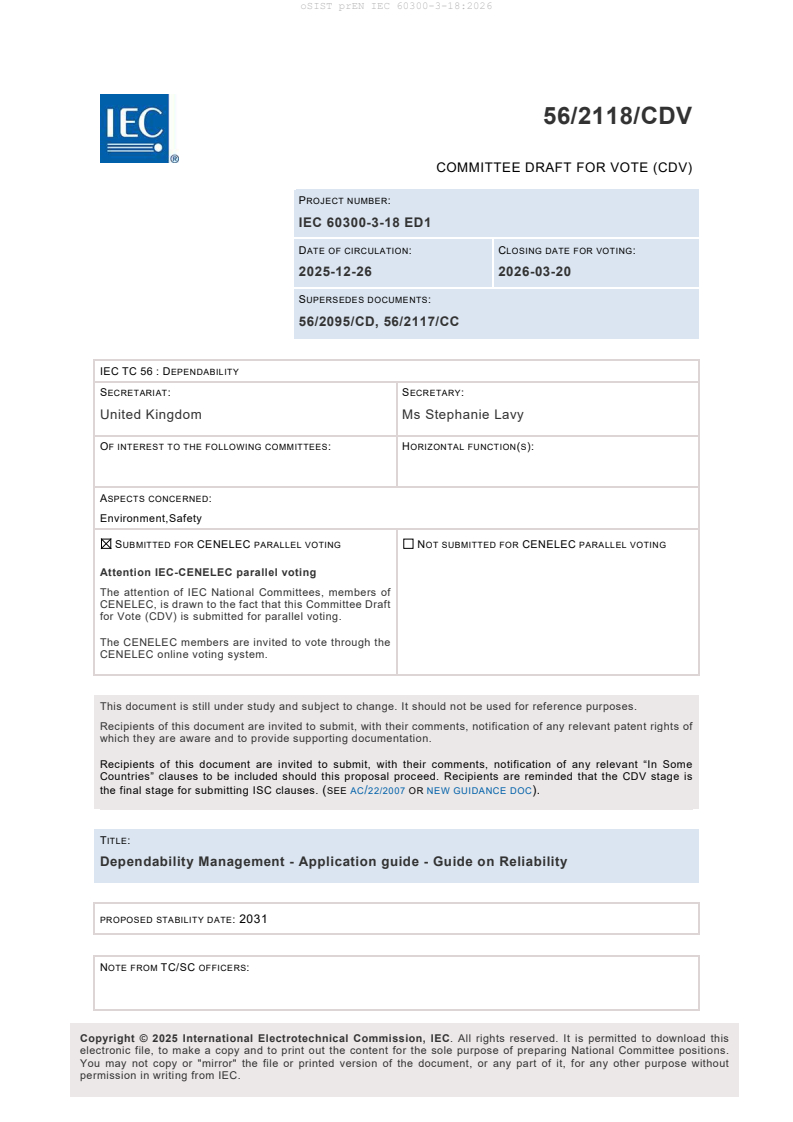
56/2118/CDV
COMMITTEE DRAFT FOR VOTE (CDV)
PROJECT NUMBER:
IEC 60300-3-18 ED1
DATE OF CIRCULATION: CLOSING DATE FOR VOTING:
2025-12-26 2026-03-20
SUPERSEDES DOCUMENTS:
56/2095/CD, 56/2117/CC
IEC TC 56 : DEPENDABILITY
SECRETARIAT: SECRETARY:
United Kingdom Ms Stephanie Lavy
OF INTEREST TO THE FOLLOWING COMMITTEES: HORIZONTAL FUNCTION(S):
ASPECTS CONCERNED:
Environment,Safety
SUBMITTED FOR CENELEC PARALLEL VOTING NOT SUBMITTED FOR CENELEC PARALLEL VOTING
Attention IEC-CENELEC parallel voting
The attention of IEC National Committees, members of
CENELEC, is drawn to the fact that this Committee Draft
for Vote (CDV) is submitted for parallel voting.
The CENELEC members are invited to vote through the
CENELEC online voting system.
This document is still under study and subject to change. It should not be used for reference purposes.
Recipients of this document are invited to submit, with their comments, notification of any relevant patent rights of
which they are aware and to provide supporting documentation.
Recipients of this document are invited to submit, with their comments, notification of any relevant “In Some
Countries” clauses to be included should this proposal proceed. Recipients are reminded that the CDV stage is
the final stage for submitting ISC clauses. (SEE AC/22/2007 OR NEW GUIDANCE DOC).
TITLE:
Dependability Management - Application guide - Guide on Reliability
PROPOSED STABILITY DATE: 2031
NOTE FROM TC/SC OFFICERS:
electronic file, to make a copy and to print out the content for the sole purpose of preparing National Committee positions.
You may not copy or "mirror" the file or printed version of the document, or any part of it, for any other purpose without
permission in writing from IEC.
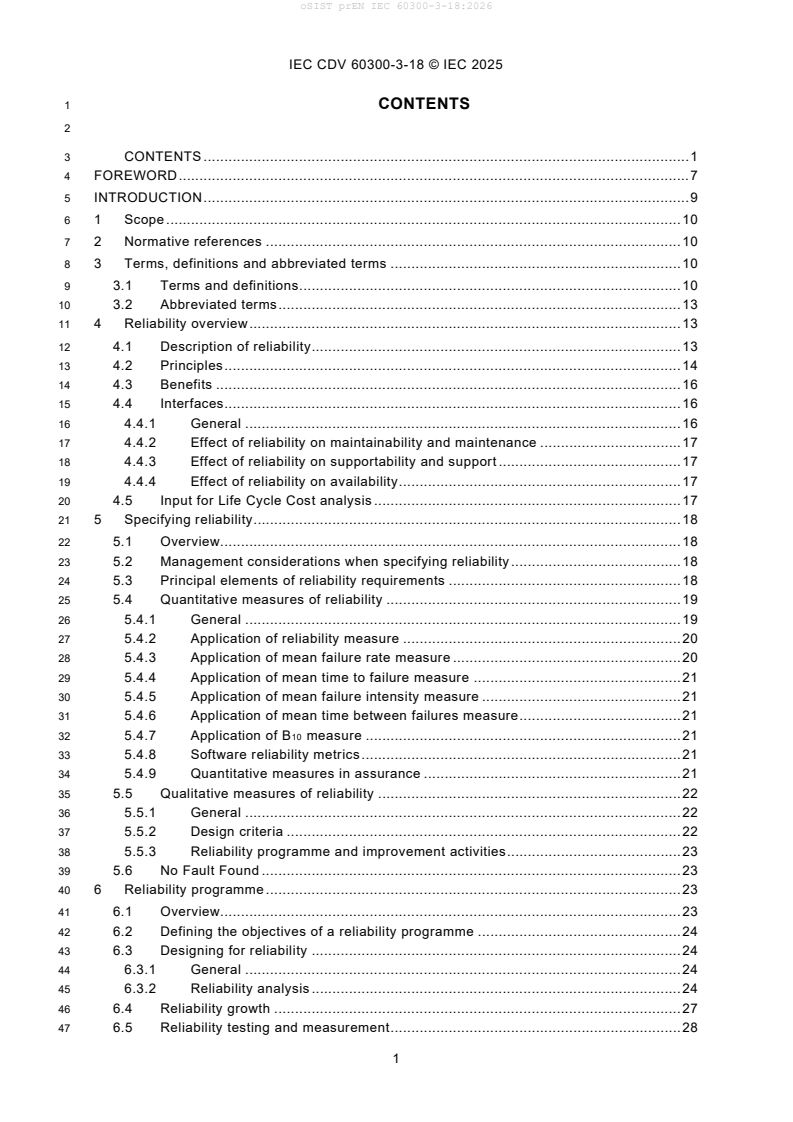
IEC CDV 60300-3-18 © IEC 2025
1 CONTENTS
3 CONTENTS . 1
4 FOREWORD . 7
5 INTRODUCTION . 9
6 1 Scope . 10
7 2 Normative references . 10
8 3 Terms, definitions and abbreviated terms . 10
9 3.1 Terms and definitions . 10
10 3.2 Abbreviated terms . 13
11 4 Reliability overview . 13
12 4.1 Description of reliability . 13
13 4.2 Principles . 14
14 4.3 Benefits . 16
15 4.4 Interfaces . 16
16 4.4.1 General . 16
17 4.4.2 Effect of reliability on maintainability and maintenance . 17
18 4.4.3 Effect of reliability on supportability and support . 17
19 4.4.4 Effect of reliability on availability . 17
20 4.5 Input for Life Cycle Cost analysis . 17
21 5 Specifying reliability . 18
22 5.1 Overview. 18
23 5.2 Management considerations when specifying reliability . 18
24 5.3 Principal elements of reliability requirements . 18
25 5.4 Quantitative measures of reliability . 19
26 5.4.1 General . 19
27 5.4.2 Application of reliability measure . 20
28 5.4.3 Application of mean failure rate measure . 20
29 5.4.4 Application of mean time to failure measure . 21
30 5.4.5 Application of mean failure intensity measure . 21
31 5.4.6 Application of mean time between failures measure . 21
32 5.4.7 Application of B10 measure . 21
33 5.4.8 Software reliability metrics . 21
34 5.4.9 Quantitative measures in assurance . 21
35 5.5 Qualitative measures of reliability . 22
36 5.5.1 General . 22
37 5.5.2 Design criteria . 22
38 5.5.3 Reliability programme and improvement activities . 23
39 5.6 No Fault Found . 23
40 6 Reliability programme . 23
41 6.1 Overview. 23
42 6.2 Defining the objectives of a reliability programme . 24
43 6.3 Designing for reliability . 24
44 6.3.1 General . 24
45 6.3.2 Reliability analysis . 24
46 6.4 Reliability growth . 27
47 6.5 Reliability testing and measurement . 28
IEC CDV 60300-3-18 © IEC 2025
48 6.6 Verification and validation of reliability . 29
49 6.7 Data collection and analysis . 29
50 6.8 Continuous improvement or evolution . 30
51 7 Managing reliability over the life cycle . 31
52 7.1 General . 31
53 7.1.1 Overview of reliability management activities . 31
54 7.1.2 Management responsibility . 31
55 7.1.3 Reliability management . 31
56 7.1.4 Provision of resources . 32
57 7.2 Life cycle activities during the concept stage . 32
58 7.2.1 Establish reliability strategy . 32
59 7.2.2 Identify technical approaches and feasibility for reliability realization . 33
60 7.2.3 Establish programme to manage risks to reliability . 33
61 7.2.4 Reliability verification plan . 33
62 7.3 Life cycle activities during the development stage . 33
63 7.3.1 General . 33
64 7.3.2 Reliability allocation . 34
65 7.3.3 Reliability verification . 35
66 7.4 Life cycle activities during the realization stage . 36
67 7.4.1 General . 36
68 7.4.2 Effect of manufacturing on reliability . 36
69 7.4.3 Quality assurance . 36
70 7.4.4 Effect of modifications on reliability . 37
71 7.4.5 Reliability verification . 37
72 7.4.6 Reliability demonstration or acceptance testing . 37
73 7.5 Life cycle activities during the utilisation stage . 38
74 7.5.1 General . 38
75 7.5.2 Effect of operation on reliability . 38
76 7.6 Life cycle activities during the enhancement stage . 39
77 7.7 Life cycle activities during the retirement stage . 39
78 8 Supplier products . 39
79 8.1 General . 39
80 8.2 Off-the-shelf products . 39
81 8.3 Customer furnished items . 40
82 9 Assurance of achieving requirements . 40
83 9.1 Assurance objectives . 40
84 9.2 Verification. 41
85 9.2.1 Verification Objectives . 41
86 9.2.2 Verification process . 41
87 9.2.3 Methods of verification . 42
88 9.2.4 Acquisition and analysis of data . 42
89 9.2.5 Measurement . 43
90 9.2.6 Presentation of results . 43
91 9.2.7 Dependability case . 43
92 9.3 Programme audits . 43
93 9.3.1 General . 43
94 9.3.2 Process management . 44
95 9.3.3 Competency management . 44
96 9.3.4 Contractor management . 44
IEC CDV 60300-3-18 © IEC 2025
97 10 Reliability information and data management . 44
98 10.1 General . 44
99 10.2 Configuration management . 45
100 10.3 Document management . 45
101 Annex A (informative) Associated reliability techniques and tools . 47
102 A.1 Stress-strength analysis . 47
103 A.1.1 Description and purpose . 47
104 A.1.2 Application . 47
105 A.1.3 Principal requirements . 47
106 A.1.4 Benefits . 47
107 A.1.5 Limitations . 48
108 A.1.6 Example . 48
109 A.2 Worst case analysis (WCA) . 49
110 A.2.1 Description and purpose . 49
111 A.2.2 Application . 49
112 A.2.3 Principal elements . 49
113 A.2.4 Benefits . 49
114 A.2.5 Limitations . 49
115 A.3 Variation simulation modelling . 49
116 A.3.1 Description and purpose . 49
117 A.3.2 Finite Element Method (FEM) . 51
118 A.4 Parts derating and selection . 51
119 A.4.1 Description and purpose . 51
120 A.4.2 Application . 52
121 A.4.3 Principal elements . 52
122 A.4.4 Benefits . 52
123 A.4.5 Limitations . 52
124 A.5 Failure Definition and Scoring Criteria . 52
125 A.5.1 Description and purpose . 52
126 A.5.2 Application . 52
127 A.5.3 Principal elements . 52
128 A.5.4 Benefits . 53
129 A.5.5 Limitations . 53
130 A.6 Physics of Failure . 53
131 A.6.1 Description and purpose . 53
132 A.6.2 Principal elements . 53
133 A.6.3 Benefits . 53
134 A.6.4 Limitations . 53
135 A.7 Design of experiments . 54
136 A.7.1 Description and purpose . 54
137 A.7.2 Principal elements . 54
138 A.7.3 Applications . 54
139 A.7.4 Benefits . 54
140 A.7.5 Limitations . 54
141 A.8 Truth Tables . 54
142 A.8.1 Description and purpose . 54
143 A.8.2 Application . 54
144 A.8.3 Benefits . 55
145 A.8.4 Limitations . 55
IEC CDV 60300-3-18 © IEC 2025
146 Annex B (informative) Software reliability . 56
147 B.1 General . 56
148 B.2 Software reliability engineering (SRE) . 56
149 B.2.1 Description and purpose . 56
150 B.2.2 Application . 56
151 B.2.3 Principal elements . 56
152 B.2.4 Benefits . 57
153 B.2.5 Limitations . 57
154 B.3 Reliability issues specific to software . 57
155 B.3.1 General . 57
156 B.3.2 Software requirement . 57
157 B.3.3 Environment of software . 57
158 B.3.4 Modularization . 58
159 B.3.5 Ageing . 58
160 B.3.6 Discontinuity of behaviour regarding varying input and environment . 58
161 B.3.7 Deterministic behaviour . 58
162 B.4 Data types . 58
163 B.4.1 Description and purpose . 58
164 B.4.2 Application . 59
165 B.4.3 Principal elements . 59
166 B.4.4 Benefits . 59
167 B.4.5 Limitations . 59
168 B.5 Object-oriented programming . 59
169 B.5.1 Description and purpose . 59
170 B.5.2 Application . 60
171 B.5.3 Benefits . 60
172 B.5.4 Limitations . 60
173 B.6 Abstraction . 60
174 B.6.1 Description and purpose . 60
175 B.6.2 Application . 60
176 B.6.3 Benefits . 60
177 B.6.4 Limitations . 60
178 B.7 Model checking . 61
179 B.7.1 Description and purpose . 61
180 B.7.2 Application . 61
181 B.7.3 Principal elements . 61
182 B.7.4 Benefits . 61
183 B.7.5 Limitations . 61
184 B.8 Theorem proving . 62
185 B.8.1 Description and purpose . 62
186 B.8.2 Application . 62
187 B.8.3 Principal elements . 62
188 B.8.4 Benefits . 62
189 B.8.5 Limitations . 62
190 B.9 Statistical methods . 63
191 B.9.1 Description and purpose . 63
192 B.9.2 Application . 63
193 B.9.3 Principal elements . 63
194 B.9.4 Benefits . 63
IEC CDV 60300-3-18 © IEC 2025
195 B.9.5 Limitations . 63
196 B.10 Debugging . 64
197 B.10.1 Description and purpose . 64
198 B.10.2 Application . 64
199 B.10.3 Principal elements . 64
200 B.10.4 Benefits . 64
201 B.10.5 Limitations . 64
202 Annex C (Informative) Reliability related statistical methods . 65
203 C.1 Statistical reliability approaches . 65
204 C.1.1 Description and purpose . 65
205 C.1.2 Application . 65
206 Annex D (informative) Summary of relevant IEC standards . 67
207 D.1 General . 67
208 D.2 Dependability management standards . 67
209 D.2.1 IEC 31010, Risk management – Risk assessment techniques . 67
210 D.2.2 IEC 60300-3-2, Dependability management – Part 3-2: Application
211 guide - Collection of dependability data from the field . 67
212 D.2.3 IEC 60300-3-3, Dependability management – Part 3-3: Application
213 guide – Life cycle costing . 67
214 D.2.4 IEC 60300-3-4, Dependability management – Part 3-4: Application
215 guide - Guide to the specification of dependability requirements . 67
216 D.2.5 IEC 62741, Demonstration of dependability requirements – The
217 dependability case . 67
218 D.2.6 IEC 62960, Dependability reviews during the life cycle . 68
219 D.3 Reliability Analysis . 68
220 D.3.1 IEC 31010, Risk management – Risk assessment techniques . 68
221 D.3.2 IEC 60812, Failure modes and effects analysis (FMEA and FMECA) . 68
222 D.3.3 IEC 61025, Fault tree analysis (FTA) . 69
223 D.3.4 IEC 61078, Reliability block diagrams . 69
224 D.3.5 IEC 61165, Application of Markov techniques . 69
225 D.3.6 IEC 61649, Weibull analysis . 69
226 D.3.7 IEC 61882, Hazard and operability studies (HAZOP studies) –
227 Application guide . 69
228 D.3.8 IEC 61709, Electric components - Reliability - Reference conditions for
229 failure rates and stress models for conversion . 70
230 D.3.9 IEC 61710, Power law model – Goodness-of-fit tests and estimation
231 methods . 70
232 D.3.10 IEC 62308, Equipment reliability – Reliability assessment methods . 70
233 D.3.11 IEC 62502, Analysis techniques for dependability – Event tree analysis
234 (ETA) . 71
235 D.3.12 IEC 62508, Guidance on human aspects of dependability . 71
236 D.3.13 IEC 62551, Analysis techniques for dependability – Petri net techniques . 71
237 D.3.14 IEC 62628, Guidance on software aspects of dependability . 71
238 D.3.15 IEC 62740, Root cause analysis (RCA) . 71
239 D.4 Reliability test . 71
240 D.4.1 IEC 60300-3-5, Dependability management – Part 3-5: Application
241 guide – Reliability test conditions and statistical test principles . 71
242 D.4.2 IEC 60605-2, Equipment reliability testing - Part 2: Design of test cycles . 72
243 D.4.3 IEC 60605-6:2007 Equipment reliability testing - Part 6: Tests for the
244 validity and estimation of the constant failure rate and constant failure
245 intensity . 72
IEC CDV 60300-3-18 © IEC 2025
246 D.4.4 IEC 61123, Reliability testing - Compliance test plans for success ratio . 72
247 D.4.5 IEC 61124, Reliability testing - Compliance tests for constant failure
248 rate and constant failure intensity . 72
249 D.4.6 IEC 61163-1, Reliability stress screening - Part 1: Repairable
250 assemblies manufactured in lots . 73
251 D.4.7 IEC 61163-2 Reliability stress screening - Part 2: Components . 73
252 D.4.8 IEC 62506, Methods for product accelerated testing . 73
253 D.4.9 ISO/IEC/IEEE 29119, Software and systems engineering – Software
254 testing . 73
255 D.5 Reliability growth . 74
256 D.5.1 IEC 61014, Programmes for reliability growth, . 74
257 D.5.2 IEC 61164, Reliability growth - Statistical test and estimation methods . 74
258 D.5.3 IEC 62429 Reliability growth - Stress testing for early failures in unique
259 complex systems . 74
260 D.6 Standards on software specific issues . 74
261 D.6.1 ISO/IEC/IEEE 29148 Requirements engineering . 74
IEC CDV 60300-3-18 © IEC 2025
265 INTERNATIONAL ELECTROTECHNICAL COMMISSION
266 ____________
268 DEPENDABILITY MANAGEMENT –
270 Application guide –
271 Guide on Reliability
274 FOREWORD
275 1) The International Electrotechnical Commission (IEC) is a worldwide organization for standardization comprising
276 all national electrotechnical committees (IEC National Committees). The object of IEC is to promote international
277 co-operation on all questions concerning standardization in the electrical and electronic fields. To this end and
278 in addition to other activities, IEC publishes International Standards, Technical Specifications, Technical Reports,
279 Publicly Available Specifications (PAS) and Guides (hereafter referred to as “IEC Publication(s)”). Their
280 preparation is entrusted to technical committees; any IEC National Committee interested in the subject dealt with
281 can participate in this preparatory work. International, governmental and non-governmental organizations liaising
282 with the IEC also participate in this preparation. IEC collaborates closely with the International Organization for
283 Standardization (ISO) in accordance with conditions determined by agreement between the two organizations.
284 2) The formal decisions or agreements of IEC on technical matters express, as nearly as possible, an international
285 consensus of opinion on the relevant subjects since each technical committee has representation from all
286 interested IEC National Committees.
287 3) IEC Publications have the form of recommendations for international use and are accepted by IEC National
288 Committees in that sense. While all reasonable efforts are made to ensure that the technical content of IEC
289 Publications is accurate, IEC cannot be held responsible for the way in which they are used or for any
290 misinterpretation by any end user.
291 4) In order to promote international uniformity, IEC National Committees undertake to apply IEC Publications
292 transparently to the maximum extent possible in their national and regional publications. Any divergence between
293 any IEC Publication and the corresponding national or regional publication shall be clearly indicated in the latter.
294 5) IEC itself does not provide any attestation of conformity. Independent certification bodies provide conformity
295 assessment services and, in some areas, access to IEC marks of conformity. IEC is not responsible for any
296 services carried out by independent certification bodies.
297 6) All users should ensure that they have the latest edition of this publication.
298 7) No liability shall attach to IEC or its directors, employees, servants or agents including individual experts and
299 members of its technical committees and IEC National Committees for any personal injury, property damage or
300 other damage of any nature whatsoever, whether direct or indirect, or for costs (including legal fees) and
301 expenses arising out of the publication, use of, or reliance upon, this IEC Publication or any other IEC
302 Publications.
303 8) Attention is drawn to the Normative references cited in this publication. Use of the referenced publications is
304 indispensable for the correct application of this publication.
305 9) Attention is drawn to the possibility that some of the elements of this IEC Publication can be the subject of patent
306 rights. IEC shall not be held responsible for identifying any or all such patent rights.
307 International Standard IEC XXXXX has been prepared by subcommittee XX: TITLE, of IEC
308 technical committee XX:XXX.
309 a) .;
310 The text of this International Standard is based on the following documents:
FDIS Report on voting
XX/XX/FDIS XX/XX/RVD
312 Full information on the voting for the approval of this International Standard can be found in the
313 report on voting indicated in the above table.
314 This document has been drafted in accordance with the ISO/IEC Directives, Part 2.
IEC CDV 60300-3-18 © IEC 2025
315 The committee has decided that the contents of this document will remain unchanged until the
316 stability date indicated on the IEC website under "http://webstore.iec.ch" in the data related to
317 the specific document. At this date, the document will be
318 • reconfirmed,
319 • withdrawn,
320 • replaced by a revised edition, or
321 • amended.
323 The National Committees are requested to note that for this document the stability date
324 is 20XX.
325 THIS TEXT IS INCLUDED FOR THE INFORMATION OF THE NATIONAL COMMITTEES AND WILL BE DELETED
326 AT THE PUBLICATION STAGE.
IEC CDV 60300-3-18 © IEC 2025
328 INTRODUCTION
329 This document provides guidance on how to identify and apply appropriate analysis and
330 assurance techniques for reliability and provides guidance on managing reliability throughout
331 an item’s life cycle.
332 Reliability is an inherent characteristic of a design solution and expresses the ability to provide
333 a required function for a given interval (e.g. time, operating cycles, distance etc.) under given
334 conditions (such as environment and operating profile). The requirements for this characteristic
335 are ideally identified as early in the design process as possible when other performance criteria
336 are also being set. If it is not considered at this stage, it is likely that the item will not deliver
337 the desired balance between, and assurance of, the performance, cost, and risk.
338 Item reliability provides value to the user by reducing or avoiding the costs of repair, loss of
339 service or increased risk exposure. In the case of systems with a safety implication, poor
340 reliability can have far more serious consequences. For a user or organisation, poor reliability
341 can directly affect reputation or result in direct and indirect financial penalties and, possibly,
342 risk to life and / or the environment.
343 To enable delivery of reliability requirements, a reliability programme is established to formally
344 assess the potential reliability of a design, identify mitigations for any short-falls and develop
345 verification strategies to demonstrate that requirements will be met.
346 Guidance in this document can be used at any time during the life cycle of an item or project to
347 guide the planning and implementation of a reliability programme with a balance between, and
348 assurance of, the resulting performance, cost, and risk. These attributes can be explicit in
349 contractual agreements and statutory obligations or implicit in commitments to all stakeholders.
350 The activities described within this document normally form part of an organization’s
351 dependability strategy and should therefore be aligned to, and consistent with, the
352 organizational objectives as expressed in the asset management strategy or other appropriate
353 high level strategy.
354 This document is one of a suite of "top level" interrelated IEC dependability standards that
355 provide managers and technical personnel, with guidance on how to effectively plan and
356 implement dependability activities. Other documents in the suite are:
357 • IEC 60300-1 which highlights the importance and benefits of managing dependability. It
358 gives guidance on dependability activities and how to integrate them into an existing
359 management system and life cycle processes;
360 • IEC 60300-3-4 which provides guidance for writing dependability requirements in
361 specifications, together with a means to assure the achievement of those requirements;
362 • IEC 60300-3-10 and IEC 60300-3-14 which provide guidance on how to identify and apply
363 appropriate analysis and assurance techniques for maintainability (and maintenance) and
364 supportability (and support) respectively;
365 • A standard to cover availability, which is under development as IEC 60300-3-17.
IEC CDV 60300-3-18 © IEC 2025
367 DEPENDABILITY MANAGEMENT –
369 Application guide –
370 Guide on reliability
373 1 Scope
374 This document gives guidance on managing reliability and reliability activities that are
375 applicable throughout the life cycle of an item and to any organization.
376 This part of the IEC 60300 series provides guidance to managers and technical personnel
377 involved in the specification, design, development, manufacture, acceptance, use of an item
378 and the item support services.
379 This document describes the:
380 • the principles of reliability;
381 • the benefits of reliability;
382 • the elements of reliability programmes;
383 • the specification of reliability;
384 • the measurement, analysis and assurance of reliability;
385 • reliability data, reliability documentation and their control.
386 The ability to retain the reliability of an item is not only dependent upon the design itself but
387 also on the design and management of its associated maintenance (IEC 60300-3-10) and
388 support (IEC 60300-3-14) programmes. The interaction between reliability, maintainability and
389 supportability activities are discussed within this document.
390 2 Normative references
391 There are no normative references in this document.
392 3 Terms, definitions and abbreviated terms
393 For the purposes of this document, the following terms and definitions apply.
394 3.1 Terms and definitions
395 3.1.1
396 reliability
397 ability to perform as required, without failure, for a given interval, under given conditions
398 Note 1 to entry: The interval can be expressed in units appropriate to the item concerned, e.g. calendar time,
399 operating cycles, distance run, etc., and the units should always be clearly stated
400 Note 2 to entry: Given conditions include aspects that affect reliability, such as: mode of operation, stress levels,
401 environmental conditions, and maintenance.
402 Note 3 to entry: Reliability can be quantified using measures defined in IEC 60300-192 section 05, Reliability related
403 concepts: measures.
404 [SOURCE: IEC 60050-192, 192-01-24]
405 3.1.2
406 reliability
407 probability of performing as required for given interval, under given conditions
408 Note 1 to entry: Given conditions include aspects that affect reliability, such as: mode of operation; stress levels;
409 environmental conditions; and maintenance, where applicable.
...
Questions, Comments and Discussion
Ask us and Technical Secretary will try to provide an answer. You can facilitate discussion about the standard in here.
Loading comments...