


SIST EN ISO 11607-1:2020/A11:2022
(Amendment)Packaging for terminally sterilized medical devices - Part 1: Requirements for materials, sterile barrier systems and packaging systems (ISO 11607-1:2019)
Packaging for terminally sterilized medical devices - Part 1: Requirements for materials, sterile barrier systems and packaging systems (ISO 11607-1:2019)
This document specifies requirements and test methods for materials, preformed sterile barrier systems, sterile barrier systems and packaging systems that are intended to maintain sterility of terminally sterilized medical devices until the point of use.
It is applicable to industry, to health care facilities, and to wherever medical devices are placed in sterile barrier systems and sterilized.
It does not cover all requirements for sterile barrier systems and packaging systems for medical devices that are manufactured aseptically. Additional requirements can be necessary for drug/device combinations.
It does not describe a quality assurance system for control of all stages of manufacture.
It does not apply to packaging materials and/or systems used to contain a contaminated medical device during transportation of the item to the site of reprocessing or disposal.
Verpackungen für in der Endverpackung zu sterilisierende Medizinprodukte - Teil 1: Anforderungen an Materialien, Sterilbarrieresysteme und Verpackungssysteme (ISO 11607-1:2019/A11:2020)
Dieses Dokument legt Anforderungen an und Prüfverfahren für Materialien, vorgefertigte Sterilbarrieresysteme, Sterilbarrieresysteme und Verpackungssysteme fest, die dazu vorgesehen sind, die Sterilität von in der Endverpackung sterilisierten Medizinprodukten bis zum Anwendungszeitpunkt zu erhalten.
Es gilt für die Industrie, für Einrichtungen des Gesundheitswesens und für alle anderen Einrichtungen, in denen Medizinprodukte in Sterilbarrieresysteme verpackt und sterilisiert werden.
Es erfasst nicht alle Anforderungen an Sterilbarrieresysteme und Verpackungssysteme für aseptisch hergestellte Medizinprodukte. Für Kombinationen von Medikamenten und Medizinprodukten können zusätzliche Anforderungen erforderlich sein.
Es beschreibt kein Qualitätssicherungssystem zur Lenkung aller Herstellungsschritte.
Es gilt nicht für Verpackungsmaterialien und/oder systeme, die dazu verwendet werden, ein verunreinigtes Medizinprodukt während des Transports zur Wiederaufbereitung oder Entsorgung aufzunehmen.
Packaging for terminally sterilized medical devices - Part 1: Requirements for materials, sterile barrier systems and packaging systems (ISO 11607-1:2019)
Le présent document spécifie les exigences et les méthodes d'essai pour les matériaux, les systèmes de barrière stérile préformés, les systèmes de barrière stérile et les systèmes d'emballage destinés à maintenir l'état de stérilité des dispositifs médicaux stérilisés de façon terminale jusqu'au point d'utilisation.
Il s'applique à l'industrie, aux établissements de santé et à tout lieu où des dispositifs médicaux sont insérés dans des systèmes de barrière stérile et stérilisés.
Il ne couvre pas toutes les exigences relatives aux systèmes de barrière stérile et systèmes d'emballage pour les dispositifs médicaux fabriqués de manière aseptique. Dans ce cas, des exigences supplémentaires peuvent être nécessaires pour garantir les combinaisons médicaments/dispositifs.
Il ne décrit pas de système d'assurance qualité pour le contrôle de toutes les étapes de fabrication.
Il ne s'applique pas aux matériaux d'emballage et/ou systèmes utilisés pour contenir un dispositif médical contaminé pendant le transport du dispositif vers le site de retraitement ou d'élimination.
Embalaža za končno sterilizirane medicinske pripomočke - 1. del: Zahteve za materiale, sterilne pregradne sisteme in sisteme embalaže - Dopolnilo A11 (ISO 11607-1:2019)
Ta dokument določa zahteve in preskusne metode za materiale, izvedene sterilne pregradne sisteme, sterilne pregradne sisteme in sisteme embalaže, ki so namenjeni za vzdrževanje sterilnosti končno steriliziranih medicinskih pripomočkov do njihove uporabe. Uporablja se za industrijo, zdravstvene ustanove in vse medicinske pripomočke, ki so sterilizirani v sterilnih pregradnih sistemih. Ne zajema vseh zahtev za sterilne pregradne sisteme in sisteme embalaže medicinskih pripomočkov, ki so izdelani aseptično. Za kombinacije zdravil/pripomočkov so morda potrebne dodatne zahteve. Ne opisuje sistema zagotavljanja kakovosti za nadzor vseh faz proizvodnje. Ne uporablja se za embalažo in/ali sisteme, ki se uporabljajo za hrambo kontaminiranega medicinskega pripomočka med prevozom elementa na mesto predelave ali odstranjevanja.
General Information
- Status
- Published
- Publication Date
- 21-Aug-2022
- Technical Committee
- VAZ - Healthcare
- Current Stage
- 6060 - National Implementation/Publication (Adopted Project)
- Start Date
- 22-Jun-2022
- Due Date
- 27-Aug-2022
- Completion Date
- 22-Aug-2022
Not Harmonized90/385/EEC - Active implantable medical devices
Not Harmonized93/42/EEC - Medical devices
Not Harmonized98/79/EC - In vitro diagnostic medical devices
Relations
- Effective Date
- 28-Jan-2026
- Effective Date
- 28-Jan-2026
- Effective Date
- 04-May-2022
Overview
SIST EN ISO 11607-1:2020/A11:2022 sets out the essential requirements and test methods for materials, sterile barrier systems, and packaging systems used to maintain the sterility of medical devices following terminal sterilization. Developed by CEN, this European Standard aligns with ISO 11607-1:2019 and is a key reference for manufacturers and health care providers who supply, use, or process terminally sterilized medical devices. The standard is widely recognized as an important element in ensuring product safety, integrity, and regulatory compliance throughout the medical device lifecycle.
Key Topics
- Sterile Barrier Systems: Defines properties and performance criteria for packaging systems designed to prevent microbial contamination after sterilization until the point of use.
- Material Requirements: Specifies the characteristics necessary for packaging materials to be suitable for sterilization processes and to maintain sterility, including compatibility with selected sterilization methods.
- Packaging Systems: Details on complete packaging configurations, including preformed barrier systems and additional protective elements, and the validation requirements related to forming, sealing, and assembly.
- Testing and Performance Validation: Outlines methods for evaluating packaging integrity, microbial barrier effectiveness, and usability (aseptic presentation), as well as the stability of the system during storage and transport.
- Regulatory Alignment: Includes informative annexes (ZA, ZB, ZC) describing how the standard addresses essential requirements of EU Directives relating to medical devices (93/42/EEC), active implantable medical devices (90/385/EEC), and in vitro diagnostic medical devices (98/79/EC).
- Exclusions: Does not address packaging for aseptically manufactured medical devices, contaminated devices in transit for reprocessing/disposal, or comprehensive quality assurance throughout manufacturing stages.
Applications
SIST EN ISO 11607-1:2020/A11:2022 applies in diverse settings within the medical device value chain:
- Medical Device Manufacturers: Ensures packaging systems selected and implemented will meet regulatory expectations for sterile supply chains. Supports risk management and performance validation activities.
- Healthcare Facilities: Guides sterile processing departments and hospital central sterilization units in choosing suitable packaging materials, ensuring devices remain sterile from processing through final use.
- Packaging Suppliers: Provides clear requirements for material suppliers and converters, helping them develop compliant products for the medical device industry.
- Regulatory Compliance: Demonstrates conformity with European Medical Device Directives and supports smooth CE marking and market access for devices across Europe.
Notably, this standard promotes patient safety by safeguarding the integrity of sterile barrier systems and facilitating aseptic presentations. It supports device usability while reducing infection risks associated with loss of sterility.
Related Standards
Organizations implementing SIST EN ISO 11607-1:2020/A11:2022 should also consider the following related standards:
- EN ISO 11607-2:2020 - Validation requirements for processes used to form, seal, and assemble sterile barrier systems and packaging systems for terminally sterilized medical devices.
- ISO 5636-5:2013 - Air permeance test methods, referenced for evaluating packaging material properties.
- Quality Management Standards (e.g., ISO 13485) - While not described within EN ISO 11607-1, a robust quality system underpins effective packaging processes and recall management.
- Relevant EU Directives - Including the Medical Devices Directive (93/42/EEC), Active Implantable Medical Devices Directive (90/385/EEC), and In Vitro Diagnostic Medical Devices Directive (98/79/EC).
Adherence to SIST EN ISO 11607-1:2020/A11:2022 is widely recognized as best practice for medical device packaging and a foundation for supply chain assurance across healthcare and industry.

Get Certified
Connect with accredited certification bodies for this standard

BSI Group
BSI (British Standards Institution) is the business standards company that helps organizations make excellence a habit.

TÜV Rheinland
TÜV Rheinland is a leading international provider of technical services.

TÜV SÜD
TÜV SÜD is a trusted partner of choice for safety, security and sustainability solutions.
Sponsored listings
Frequently Asked Questions
SIST EN ISO 11607-1:2020/A11:2022 is a amendment published by the Slovenian Institute for Standardization (SIST). Its full title is "Packaging for terminally sterilized medical devices - Part 1: Requirements for materials, sterile barrier systems and packaging systems (ISO 11607-1:2019)". This standard covers: This document specifies requirements and test methods for materials, preformed sterile barrier systems, sterile barrier systems and packaging systems that are intended to maintain sterility of terminally sterilized medical devices until the point of use. It is applicable to industry, to health care facilities, and to wherever medical devices are placed in sterile barrier systems and sterilized. It does not cover all requirements for sterile barrier systems and packaging systems for medical devices that are manufactured aseptically. Additional requirements can be necessary for drug/device combinations. It does not describe a quality assurance system for control of all stages of manufacture. It does not apply to packaging materials and/or systems used to contain a contaminated medical device during transportation of the item to the site of reprocessing or disposal.
This document specifies requirements and test methods for materials, preformed sterile barrier systems, sterile barrier systems and packaging systems that are intended to maintain sterility of terminally sterilized medical devices until the point of use. It is applicable to industry, to health care facilities, and to wherever medical devices are placed in sterile barrier systems and sterilized. It does not cover all requirements for sterile barrier systems and packaging systems for medical devices that are manufactured aseptically. Additional requirements can be necessary for drug/device combinations. It does not describe a quality assurance system for control of all stages of manufacture. It does not apply to packaging materials and/or systems used to contain a contaminated medical device during transportation of the item to the site of reprocessing or disposal.
SIST EN ISO 11607-1:2020/A11:2022 is classified under the following ICS (International Classification for Standards) categories: 11.080.30 - Sterilized packaging. The ICS classification helps identify the subject area and facilitates finding related standards.
SIST EN ISO 11607-1:2020/A11:2022 has the following relationships with other standards: It is inter standard links to SIST EN 455-4:2009, SIST EN 14180:2025, SIST EN ISO 11607-1:2020. Understanding these relationships helps ensure you are using the most current and applicable version of the standard.
SIST EN ISO 11607-1:2020/A11:2022 is associated with the following European legislation: EU Directives/Regulations: 2017/745, 2017/746, 90/385/EEC, 93/42/EEC, 98/79/EC; Standardization Mandates: M/023. When a standard is cited in the Official Journal of the European Union, products manufactured in conformity with it benefit from a presumption of conformity with the essential requirements of the corresponding EU directive or regulation.
SIST EN ISO 11607-1:2020/A11:2022 is available in PDF format for immediate download after purchase. The document can be added to your cart and obtained through the secure checkout process. Digital delivery ensures instant access to the complete standard document.
Standards Content (Sample)
SLOVENSKI STANDARD
01-september-2022
Embalaža za končno sterilizirane medicinske pripomočke - 1. del: Zahteve za
materiale, sterilne pregradne sisteme in sisteme embalaže - Dopolnilo A11 (ISO
11607-1:2019)
Packaging for terminally sterilized medical devices - Part 1: Requirements for materials,
sterile barrier systems and packaging systems (ISO 11607-1:2019)
Verpackungen für in der Endverpackung zu sterilisierende Medizinprodukte - Teil 1:
Anforderungen an Materialien, Sterilbarrieresysteme und Verpackungssysteme (ISO
11607-1:2019/A11:2020)
Packaging for terminally sterilized medical devices - Part 1: Requirements for materials,
sterile barrier systems and packaging systems (ISO 11607-1:2019)
Ta slovenski standard je istoveten z: EN ISO 11607-1:2020/A11:2022
ICS:
11.080.30 Sterilizirana embalaža Sterilized packaging
2003-01.Slovenski inštitut za standardizacijo. Razmnoževanje celote ali delov tega standarda ni dovoljeno.
EN ISO 11607-
EUROPEAN STANDARD
1:2020/A11
NORME EUROPÉENNE
EUROPÄISCHE NORM
June 2022
ICS 11.080.30
English Version
Packaging for terminally sterilized medical devices - Part
1: Requirements for materials, sterile barrier systems and
packaging systems (ISO 11607-1:2019)
Emballages des dispositifs médicaux stérilisés au stade Verpackungen für in der Endverpackung zu
terminal - Partie 1: Exigences relatives aux matériaux, sterilisierende Medizinprodukte - Teil 1:
aux systèmes de barrière stérile et aux systèmes Anforderungen an Materialien, Sterilbarrieresysteme
d'emballage (ISO 11607-1:2019) und Verpackungssysteme (ISO 11607-1:2019)
This amendment A11 modifies the European Standard EN ISO 11607-1:2020; it was approved by CEN on 13 April 2022.
CEN members are bound to comply with the CEN/CENELEC Internal Regulations which stipulate the conditions for inclusion of
this amendment into the relevant national standard without any alteration. Up-to-date lists and bibliographical references
concerning such national standards may be obtained on application to the CEN-CENELEC Management Centre or to any CEN
member.
This amendment exists in three official versions (English, French, German). A version in any other language made by translation
under the responsibility of a CEN member into its own language and notified to the CEN-CENELEC Management Centre has the
same status as the official versions.
CEN members are the national standards bodies of Austria, Belgium, Bulgaria, Croatia, Cyprus, Czech Republic, Denmark, Estonia,
Finland, France, Germany, Greece, Hungary, Iceland, Ireland, Italy, Latvia, Lithuania, Luxembourg, Malta, Netherlands, Norway,
Poland, Portugal, Republic of North Macedonia, Romania, Serbia, Slovakia, Slovenia, Spain, Sweden, Switzerland, Turkey and
United Kingdom.
EUROPEAN COMMITTEE FOR STANDARDIZATION
COMITÉ EUROPÉEN DE NORMALISATION
EUROPÄISCHES KOMITEE FÜR NORMUNG
CEN-CENELEC Management Centre: Rue de la Science 23, B-1040 Brussels
© 2022 CEN All rights of exploitation in any form and by any means reserved Ref. No. EN ISO 11607-1:2020/A11:2022 E
worldwide for CEN national Members.
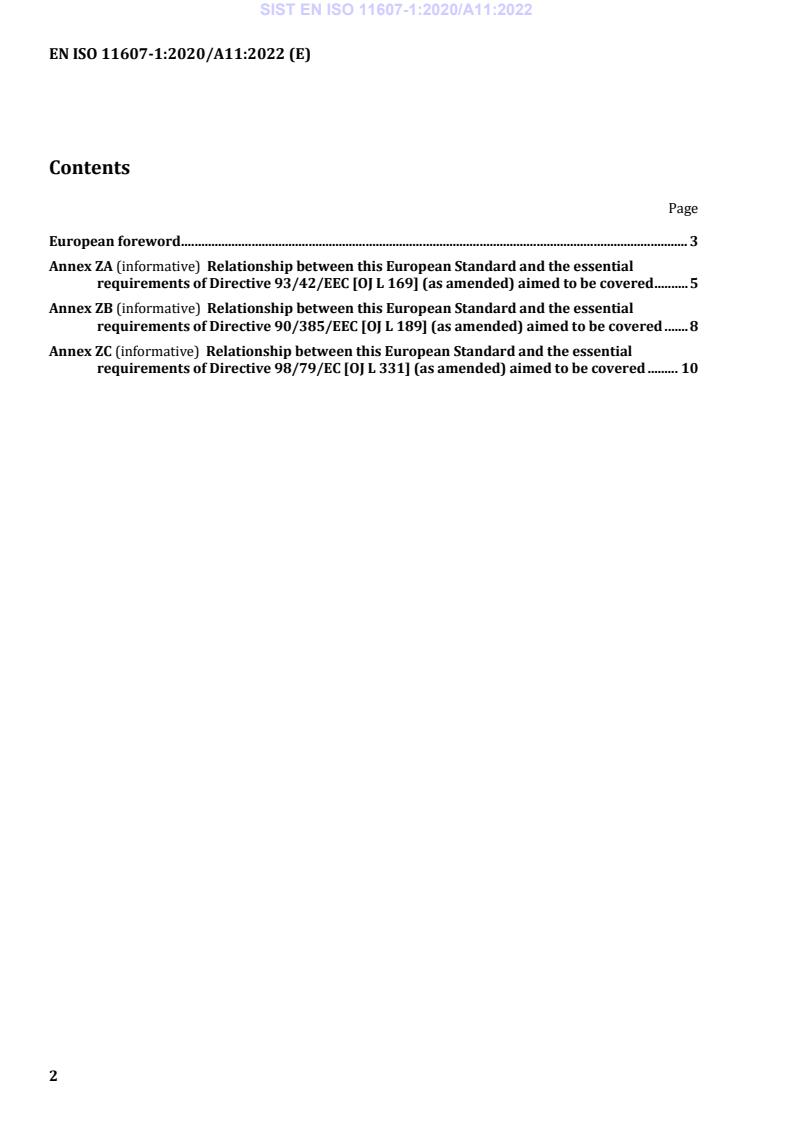
Contents
Page
European foreword . 3
Annex ZA (informative) Relationship between this European Standard and the essential
requirements of Directive 93/42/EEC [OJ L 169] (as amended) aimed to be covered . 5
Annex ZB (informative) Relationship between this European Standard and the essential
requirements of Directive 90/385/EEC [OJ L 189] (as amended) aimed to be covered . 8
Annex ZC (informative) Relationship between this European Standard and the essential
requirements of Directive 98/79/EC [OJ L 331] (as amended) aimed to be covered . 10
European foreword
This document (EN ISO 11607-1:2020/A11:2022) has been prepared by Technical Committee CEN/TC
102 “Sterilizers and associated equipment for processing of medical devices”, the secretariat of which is
held by DIN.
This Amendment to the European Standard EN ISO 11607-1:2020 shall be given the status of a national
standard, either by publication of an identical text or by endorsement, at the latest by December 2022,
and conflicting national standards shall be withdrawn at the latest by December 2022.
Attention is drawn to the possibility that some of the elements of this document may be the subject of
patent rights. CEN [and/or CENELEC] shall not be held responsible for identifying any or all such patent
rights.
This document amends EN ISO 11607-1:2020 with a revised European Foreword and European Annexes
ZA, ZB and ZC.
This Amendment to the European Standard EN ISO 11607-1:2020 has been prepared under a mandate
given to CEN by the European Commission and the European Free Trade Association, and supports
essential requirements of EU Directive(s).
For relationship with EU Directive(s), see informative Annexes ZA, ZB and ZC, which are an integral part
of this document.
Any feedback and questions on this document should be directed to the users’ national standards
body/national committee. A complete listing of these bodies can be found on the CEN websites.
The following referenced documents are indispensable for the application of this document. For undated
references, the latest edition of the referenced document (including any amendments) applies. For dated
references, only the edition cited applies. However, for any use of this standard ‘within the meaning of
Annex ZA, ZB or ZC', the user should always check that any referenced document has not been superseded
and that its relevant contents can still be considered the generally acknowledged state-of-art.
When an IEC or ISO standard is referred to in the ISO standard text, this shall be understood as a
normative reference to the corresponding EN standard, if available, and otherwise to the dated version
of the ISO or IEC standard, as listed below.
NOTE The way in which these referenced documents are cited in normative requirements determines the
extent (in whole or in part) to which they apply.
Table – Correlation between normative references and dated EN and ISO standards
Normative references as Equivalent dated standard
listed in Clause 2 of the ISO
standard EN ISO or IEC
ISO 5636-5 ISO 5636-5:2013
ISO 11607-2 EN ISO 11607-2:2020 ISO 11607-2:2019
According to the CEN-CENELEC Internal Regulations, the national standards organizations of the
following countries are bound to implement this European Standard: Austria, Belgium, Bulgaria, Croatia,
Cyprus, Czech Republic, Denmark, Estonia, Finland, Republic of North Macedonia, France, Germany,
Greece, Hungary, Iceland, Ireland, Italy, Latvia, Lithuania, Luxembourg, Malta, Netherlands, Norway,
Poland, Portugal, Romania, Serbia, Slovakia, Slovenia, Spain, Sweden, Switzerland, Turkey and the United
Kingdom.
Annex ZA
(informative)
Relationship between this European Standard and the essential
requirements of Directive 93/42/EEC [OJ L 169] (as amended) aimed to be
covered
This European Standard has been prepared under a Commission’s standardization mandate
BC/CEN/CENELEC/09/89 "Standardization mandate jointly to CEN and CENELEC concerning the
preparation of European standards relating to Horizontal aspects in the field of medical devices" referred
to in the mandate M/023, concerning the development of European standards relating to medical devices
to provide one voluntary means of conforming to essential requirements of Council Directive 93/42/EEC
of 14 June 1993 concerning medical devices [OJ L 169].
Once this standard is cited in the Official Journal of the European Union under that Directive and has been
implemented as a national standard in at least one Member State, compliance with the normative clauses
of this standard given in Table ZA.1 confers, within the limits of the scope of this standard, a presumption
of conformity with the corresponding essential requirements of that Directive and associated EFTA
regulations.
NOTE 1 Where a reference from a clause of this standard to the risk management process is made, the risk
management process needs to be in compliance with Directive 93/42/EEC as amended by 2007/47/EC. This means
that risks have to be reduced ‘as far as possible’, ‘to a minimum’, ‘to the lowest possible level’, ‘minimized’ or
‘removed’, according to the wording of the corresponding essential requirement.
NOTE 2 The manufacturer’s policy for determining acceptable risk must be in compliance with Essential
Requirements 1, 2, 5, 6, 7, 8, 9, 11 and 12 of the Directive.
NOTE 3 This Annex ZA is based on normative references according to the table of references in the European
foreword, replacing the references in the core text.
NOTE 4 When an Essential Requirement does not appear in Table ZA.1, it means that it is not addressed by this
European Standard.
Table ZA.1 — Correspondence between this European Standard and requirements of Annex I of
Directive 93/42/EEC [OJ L 169]
Essential Requirements of Clause(s)/sub-clause(s) of Remarks/Notes
Annex I of Directive this EN
93/42/EEC
8.1 6.1.1, 6.1.2, 6.1.3, 6.1.6, 6.1.8, 7 Partially covered. E.R. is covered
only in respect of the function of
the sterile barrier system(s) to
protect the sterility of the device
from the point of sterilisation to
the point of use and to allow for
aseptic presentation. The
standard includes a way to
evaluate the packaging design in
terms of usability to provide
supportive evidence for easy
Essential Requirements of Clause(s)/sub-clause(s) of Remarks/Notes
Annex I of Directive this EN
93/42/EEC
handling covering the aspect of
...
Questions, Comments and Discussion
Ask us and Technical Secretary will try to provide an answer. You can facilitate discussion about the standard in here.
Loading comments...