

SIST ISO 8:2019
(Main)Information and documentation -- Presentation and identification of periodicals
- Abstract
This document establishes the minimum characteristics required for the presentation and identification of periodicals including not only the obvious traditional elements that print periodicals typically display (e.g. title, ISSN, publisher, date), but also the "footprints" of periodicals published on digital dynamic media that enable them to be traced along the path of their history, such as changes of URL and publisher or content provider. Furthermore, this document provides information about persistent identifiers, using ISSN, and citation of periodicals (especially when published online or digitized and when titles have changed). It also makes specific recommendations for presentation and identification aspects of retrospective digitization of periodicals.
This document is applicable to a subcategory of continuing resources identifiable as "periodicals" (see Clause 3).
NOTE 1 For the purposes of this document, newspapers are not considered to be periodicals; therefore, specialized information relevant only to newspapers is not included.
This document does not specifically address or apply to books, including series of books, nor to content that is continuously updated such as loose-leaf services, databases, online reference works, and most websites.
NOTE 2 For information about series titles, see ISO 7275.
This document focuses only on elements of periodicals — printed, born-digital or retrospectively digitized — that relate to the presentation of title and supporting descriptive information, as well as practices related to title identification and content access over time. Therefore, this document is not concerned with the overall design of the periodical, except where that design affects the presentation of the title and has unintended consequences for resource discovery and access to earlier content. Neither is it concerned with the technical specifications for print, born-digital or digitized periodicals. The recommendations might not apply in all circumstances, and do not always accommodate certain artistic, technical or advertising considerations.
This document contains recommendations intended to enable editors and publishers of periodicals to identify and present key information in a form that will help users discover, cite and access their information over time and through any changes. This benefits all stakeholders of the periodical supply chain: publishers, content providers, authors, librarians, and researchers.
The recommendations address the following:
— display of periodical title(s) and other critical identifying information: issues, numbering systems, pagination, etc.;
— retention of title and citation information under which articles were originally published;
— display of title histories, i.e. changes in titles over time together with their dates of coverage;
— specification of appropriate metadata for digital periodicals;
NOTE 3 This document concentrates on metadata elements which are applicable at the title-level and does not provide guidelines for complete article-level metadata.
— display of correct ISSN, including different ISSN for each format, language edition, and for changed titles;
— retention and display of vital publication information across the duration of a periodical, including: publisher names, numbering and dates, editors, editorial boards, and sponsoring organizations, and frequency of publication;
— graphic design that supports clarity and consistency of information, particularly title information and inclusion of information that allows easy access to all content;
— special considerations for retrospective digitization;
— usage of persistent identifiers for identification of periodical titles and articles;
— long-term preservation of periodical information across time.
- Status
- Published
- Publication Date
- 03-Sep-2019
- Technical Committee
- IDT - Information, documentation, language and terminology
- Current Stage
- 6100 - Translation of adopted SIST standards (Adopted Project)
- Start Date
- 15-Apr-2025
- Due Date
- 14-Apr-2026
- Completion Date
- 27-Nov-2026
Buy Documents

ISO 8:2019 - Information and documentation — Presentation and identification of periodicals/1/2019
ISO 8:2019 - Information et documentation — Présentation et identification des périodiques/1/2019

Overview
SIST ISO 8:2019 - Information and documentation - Presentation and identification of periodicals - defines the minimum characteristics and recommendations for how periodicals should present and identify title and descriptive information across media. Updated in 2019 from the original 1977 edition, this standard expands guidance to print, born-digital and retrospectively digitized periodicals, covering title presentation, persistent identifiers (notably ISSN), citation practice, and the “footprints” of digital periodicals (URL and publisher changes) that affect long‑term discoverability and access.
Key topics and technical requirements
- Title presentation and variants: Clear display of title(s), parallel/multilingual titles, running and spine titles to support consistent discovery.
- Title history and changes: Documentation and display of title changes, with dates of coverage to preserve citation integrity when titles merge, divide or change.
- Persistent identifiers: Use and correct display of ISSN and other persistent identifiers; separate ISSNs for different formats, language editions and changed titles.
- Metadata for digital periodicals: Title-level metadata recommendations to enable reliable identification and linking across platforms (article-level metadata is out of scope).
- Retention of publication information: Consistent recording/display of publisher names, numbering, dates, editors, sponsoring organizations and publication frequency over a title’s lifespan.
- Enumeration, chronology and pagination: Guidance on numbering systems, chronological statements and pagination that affect citation and access.
- Graphic design for clarity: Design recommendations that ensure title and identification data are legible and discoverable without constraining artistic choices.
- Retrospective digitization: Specific recommendations for digitizing backfiles, including suitable preservation file formats (e.g., PDF/A, EPUB) and related practices.
- Long‑term preservation and linking: Advice on title-level linking, identifier persistence and maintaining access across URL/publisher/content-provider changes.
Practical applications and who uses SIST ISO 8:2019
- Publishers and editors: Implement consistent title display, ISSN management and title-history statements to support discoverability and citation.
- Content providers and platform developers: Design UI and metadata schemas that surface canonical title information and persistent identifiers.
- Librarians and cataloguers: Apply guidance for catalog records, linking, and handling title changes, mergers and divisions.
- Archivists and digital preservation teams: Inform digitization workflows, selection of archival file formats and preservation metadata.
- Researchers and authors: Understand proper citation of periodicals, especially for online or digitized material and titles that have changed.
Related standards and notes
- SIST ISO 8:2019 complements other documentation standards (see Annex A on linking and Annex B on metadata) and references practices such as NISO RP‑16‑2013. For series titles, consult ISO 7275. Implementers should align SIST ISO 8:2019 recommendations with local cataloguing and identifier policies to maximize interoperability and long‑term access.
Relations
- Effective Date
- 01-Oct-2019
Buy Documents
ISO 8:2019 - Information and documentation — Presentation and identification of periodicals/1/2019
ISO 8:2019 - Information et documentation — Présentation et identification des périodiques/1/2019
Frequently Asked Questions
SIST ISO 8:2019 is a standard published by the Slovenian Institute for Standardization (SIST). Its full title is "Information and documentation -- Presentation and identification of periodicals". This standard covers: This document establishes the minimum characteristics required for the presentation and identification of periodicals including not only the obvious traditional elements that print periodicals typically display (e.g. title, ISSN, publisher, date), but also the "footprints" of periodicals published on digital dynamic media that enable them to be traced along the path of their history, such as changes of URL and publisher or content provider. Furthermore, this document provides information about persistent identifiers, using ISSN, and citation of periodicals (especially when published online or digitized and when titles have changed). It also makes specific recommendations for presentation and identification aspects of retrospective digitization of periodicals. This document is applicable to a subcategory of continuing resources identifiable as "periodicals" (see Clause 3). NOTE 1 For the purposes of this document, newspapers are not considered to be periodicals; therefore, specialized information relevant only to newspapers is not included. This document does not specifically address or apply to books, including series of books, nor to content that is continuously updated such as loose-leaf services, databases, online reference works, and most websites. NOTE 2 For information about series titles, see ISO 7275. This document focuses only on elements of periodicals — printed, born-digital or retrospectively digitized — that relate to the presentation of title and supporting descriptive information, as well as practices related to title identification and content access over time. Therefore, this document is not concerned with the overall design of the periodical, except where that design affects the presentation of the title and has unintended consequences for resource discovery and access to earlier content. Neither is it concerned with the technical specifications for print, born-digital or digitized periodicals. The recommendations might not apply in all circumstances, and do not always accommodate certain artistic, technical or advertising considerations. This document contains recommendations intended to enable editors and publishers of periodicals to identify and present key information in a form that will help users discover, cite and access their information over time and through any changes. This benefits all stakeholders of the periodical supply chain: publishers, content providers, authors, librarians, and researchers. The recommendations address the following: — display of periodical title(s) and other critical identifying information: issues, numbering systems, pagination, etc.; — retention of title and citation information under which articles were originally published; — display of title histories, i.e. changes in titles over time together with their dates of coverage; — specification of appropriate metadata for digital periodicals; NOTE 3 This document concentrates on metadata elements which are applicable at the title-level and does not provide guidelines for complete article-level metadata. — display of correct ISSN, including different ISSN for each format, language edition, and for changed titles; — retention and display of vital publication information across the duration of a periodical, including: publisher names, numbering and dates, editors, editorial boards, and sponsoring organizations, and frequency of publication; — graphic design that supports clarity and consistency of information, particularly title information and inclusion of information that allows easy access to all content; — special considerations for retrospective digitization; — usage of persistent identifiers for identification of periodical titles and articles; — long-term preservation of periodical information across time.
This document establishes the minimum characteristics required for the presentation and identification of periodicals including not only the obvious traditional elements that print periodicals typically display (e.g. title, ISSN, publisher, date), but also the "footprints" of periodicals published on digital dynamic media that enable them to be traced along the path of their history, such as changes of URL and publisher or content provider. Furthermore, this document provides information about persistent identifiers, using ISSN, and citation of periodicals (especially when published online or digitized and when titles have changed). It also makes specific recommendations for presentation and identification aspects of retrospective digitization of periodicals. This document is applicable to a subcategory of continuing resources identifiable as "periodicals" (see Clause 3). NOTE 1 For the purposes of this document, newspapers are not considered to be periodicals; therefore, specialized information relevant only to newspapers is not included. This document does not specifically address or apply to books, including series of books, nor to content that is continuously updated such as loose-leaf services, databases, online reference works, and most websites. NOTE 2 For information about series titles, see ISO 7275. This document focuses only on elements of periodicals — printed, born-digital or retrospectively digitized — that relate to the presentation of title and supporting descriptive information, as well as practices related to title identification and content access over time. Therefore, this document is not concerned with the overall design of the periodical, except where that design affects the presentation of the title and has unintended consequences for resource discovery and access to earlier content. Neither is it concerned with the technical specifications for print, born-digital or digitized periodicals. The recommendations might not apply in all circumstances, and do not always accommodate certain artistic, technical or advertising considerations. This document contains recommendations intended to enable editors and publishers of periodicals to identify and present key information in a form that will help users discover, cite and access their information over time and through any changes. This benefits all stakeholders of the periodical supply chain: publishers, content providers, authors, librarians, and researchers. The recommendations address the following: — display of periodical title(s) and other critical identifying information: issues, numbering systems, pagination, etc.; — retention of title and citation information under which articles were originally published; — display of title histories, i.e. changes in titles over time together with their dates of coverage; — specification of appropriate metadata for digital periodicals; NOTE 3 This document concentrates on metadata elements which are applicable at the title-level and does not provide guidelines for complete article-level metadata. — display of correct ISSN, including different ISSN for each format, language edition, and for changed titles; — retention and display of vital publication information across the duration of a periodical, including: publisher names, numbering and dates, editors, editorial boards, and sponsoring organizations, and frequency of publication; — graphic design that supports clarity and consistency of information, particularly title information and inclusion of information that allows easy access to all content; — special considerations for retrospective digitization; — usage of persistent identifiers for identification of periodical titles and articles; — long-term preservation of periodical information across time.
SIST ISO 8:2019 is classified under the following ICS (International Classification for Standards) categories: 01.140.40 - Publishing. The ICS classification helps identify the subject area and facilitates finding related standards.
SIST ISO 8:2019 has the following relationships with other standards: It is inter standard links to SIST ISO 8:1996. Understanding these relationships helps ensure you are using the most current and applicable version of the standard.
SIST ISO 8:2019 is available in PDF format for immediate download after purchase. The document can be added to your cart and obtained through the secure checkout process. Digital delivery ensures instant access to the complete standard document.
Standards Content (Sample)
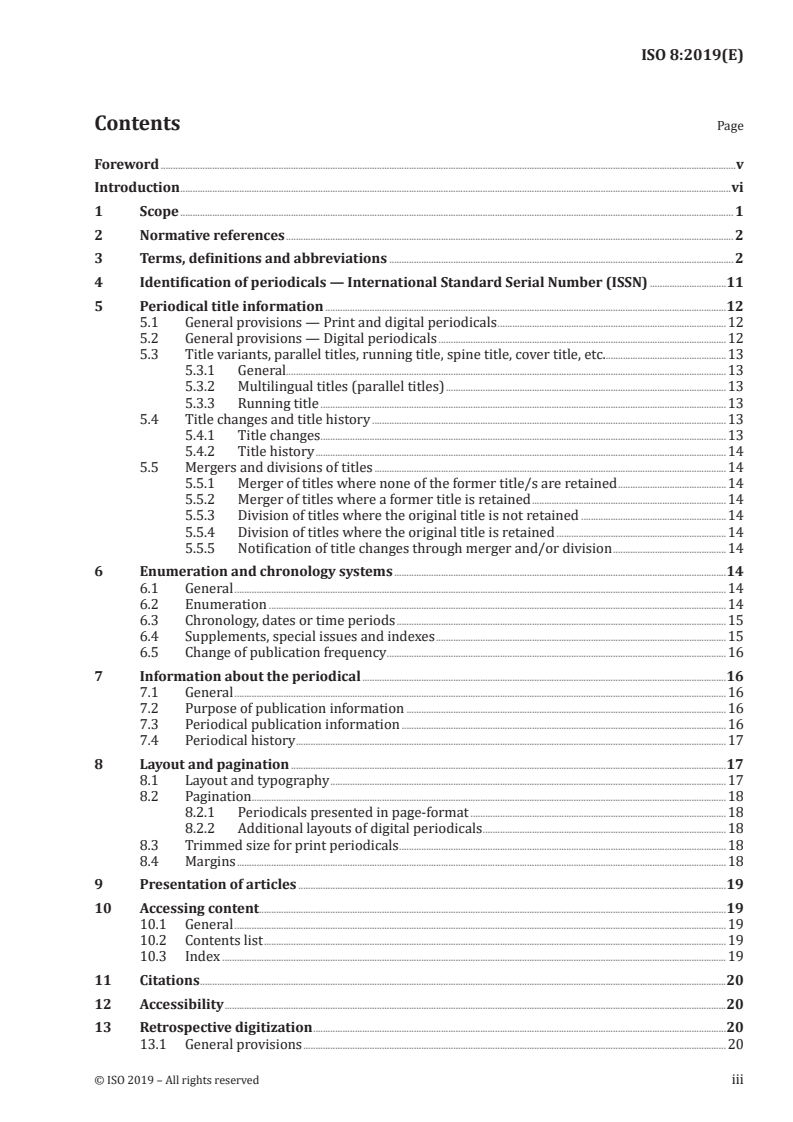
Contents
- Introduction
- 1 Scope
- 2 Normative references
- 3 Terms, definitions and abbreviations
- 3.1 Types of serial publications
- 3.1.1 born digital serial
- 3.1.2 continuing resource
- 3.1.3 integrating resource
- 3.1.4 digital serial
- 3.1.5 electronic journal
- 3.1.6 journal
- 3.1.7 periodical
- 3.1.8 serial
- 3.1.9 special issue
- 3.1.10 retrospectively digitized serial
- 3.2 Content of periodicals
- 3.2.1 article
- 3.2.2 back matter
- 3.2.3 citation
- 3.2.4 front matter
- 3.2.5 title page
- 3.3 Descriptive elements for periodicals
- 3.3.1 chronology
- 3.3.2 current title
- 3.3.3 date of publication
- 3.3.4 nominal date of publication
- 3.3.5 actual date of publication
- 3.3.6 enumeration
- 3.3.7 former title
- 3.3.8 frequency
- 3.3.9 issue
- 3.3.10 running title
- 3.3.11 succeeding title
- 3.3.12 title
- 3.3.13 volume
- 3.4 Identifiers and locators
- 3.4.1 bar code
- 3.4.2 Global Trade Item Number
- 3.4.3 digital object identifier
- 3.4.4 DOI name
- 3.4.5 DOI suffix
- 3.4.6 DOI system
- 3.4.7 International Standard Serial Number
- 3.4.8 ISSN-L
- 3.4.9 ISSN Manual
- 3.4.10 Uniform Resource Identifier
- 3.4.11 Uniform Resource Locator
- 3.4.12 Uniform Resource Name
- 3.5 Stakeholders
- 3.5.1 content provider
- 3.5.2 ISSN Network
- 3.5.3 International Digital Publishing Forum
- 3.5.4 publisher
- 3.5.5 sponsoring body
- 3.5.6 World Wide Web Consortium
- 3.6 Formats and protocols
- 3.6.1 EPUB
- 3.6.2 Hypertext Markup Language
- 3.6.3 Hypertext Transfer (or Transport) Protocol
- 3.6.4 article identifier
- 3.6.5 Journal Article Tag Suite
- 3.6.6 link resolver
- 3.6.7 OpenURL
- 3.6.8 Extensible Markup Language
- 3.6.9 MAchine-Readable Cataloguing
- 3.6.10 MAchine Readable Cataloging eXtensible Markup Language
- 3.6.11 Metadata Object Description Standard
- 3.6.12 Namespace Identifier
- 3.6.13 namespace-specific string
- 3.6.14 Dublin Core metadata
- 3.6.15 ONline Information eXchange
- 3.6.16 Portable Document Format
- 3.6.17 eXtensible Metadata Platform
- 3.7 Miscellaneous
- 3.7.1 digitization
- 3.7.2 major title change
- 3.7.3 metadata
- 3.7.4 point
- 4 Identification of periodicals — International Standard Serial Number (ISSN)
- 5 Periodical title information
Introduction
Periodicals, whatever their medium, play a critical role in the information society, and more specifically in the global information infrastructure. Citations to articles in scholarly journals, whether in print or in electronic journals, form the basis for much scholarly research. Popular trade magazines as well as newsletters are used by authors, researchers, and students of all ages. Search, discovery, and use of the wide range of today’s periodicals require that they provide reliable identification and display of key information by following standardized principles and procedures. When ISO/R 8-1954, the predecessor to ISO 8, was published, there was no digital publishing, nor were there identification standards such as ISSN or ISBN. The evolution of the publishing market in recent decades, the use of media other than paper, and the evolution of identification standards have made it necessary to revise ISO 8 to include recommendations applicable to all possible media. This document is based in part on the first edition of ISO 8 for its recommendations pertaining to print [1] periodicals, and on NISO RP-16-2013 , for its recommendations concerning digital periodicals.
SIST ISO 8:2019 INTERNATIONAL STANDARD ISO 8:2019(E) Information and documentation — Presentation and identification of periodicals
1 Scope
This document establishes the minimum characteristics required for the presentation and identification of periodicals including not only the obvious traditional elements that print periodicals typically display (e.g. title, ISSN, publisher, date), but also the “footprints” of periodicals published on digital dynamic media that enable them to be traced along the path of their history, such as changes of URL and publisher or content provider. Furthermore, this document provides information about persistent identifiers, using ISSN, and citation of periodicals (especially when published online or digitized and when titles have changed). It also makes specific recommendations for presentation and identification aspects of retrospective digitization of periodicals.
This document is applicable to a subcategory of continuing resources identifiable as “periodicals” (see Clause 3).
NOTE 1 For the purposes of this document, newspapers are not considered to be periodicals; therefore, specialized information relevant only to newspapers is not included. This document does not specifically address or apply to books, including series of books, nor to content that is continuously updated such as loose-leaf services, databases, online reference works, and most websites.
NOTE 2 For information about series titles, see ISO 7275.
This document focuses only on elements of periodicals — printed, born-digital or retrospectively digitized — that relate to the presentation of title and supporting descriptive information, as well as practices related to title identification and content access over time. Therefore, this document is not concerned with the overall design of the periodical, except where that design affects the presentation of the title and has unintended consequences for resource discovery and access to earlier content. Neither is it concerned with the technical specifications for print, born-digital or digitized periodicals. The recommendations might not apply in all circumstances, and do not always accommodate certain artistic, technical or advertising considerations.
This document contains recommendations intended to enable editors and publishers of periodicals to identify and present key information in a form that will help users discover, cite and access their information over time and through any changes. This benefits all stakeholders of the periodical supply chain: publishers, content providers, authors, librarians, and researchers. The recommendations address the following:
- display of periodical title(s) and other critical identifying information: issues, numbering systems, pagination, etc.; - retention of title and citation information under which articles were originally published; - display of title histories, i.e. changes in titles over time together with their dates of coverage; - specification of appropriate metadata for digital periodicals; NOTE 3 This document concentrates on metadata elements which are applicable at the title-level and does not provide guidelines for complete article-level metadata. - display of correct ISSN, including different ISSN for each format, language edition, and for changed titles;
SIST ISO 8:2019 ISO 8:2019(E)
- retention and display of vital publication information across the duration of a periodical, including:
publisher names, numbering and dates, editors, editorial boards, and sponsoring organizations, and frequency of publication; - graphic design that supports clarity and consistency of information, particularly title information and inclusion of information that allows easy access to all content; - special considerations for retrospective digitization; - usage of persistent identifiers for identification of periodical titles and articles; - long-term preservation of periodical information across time.
2 Normative references
The following documents are referred to in the text in such a way that some or all of their content constitutes requirements of this document. For dated references, only the edition cited applies. For undated references, the latest edition of the referenced document (including any amendments) applies. ISO 18, Documentation — Contents list of periodicals ISO 215, Documentation — Presentation of contributions to periodicals and other serials ISO 690, Information and documentation — Guidelines for bibliographic references and citations to information resources ISO 999, Information and documentation — Guidelines for the content, organization and presentation of indexes ISO 3297, Information and documentation — International standard serial number (ISSN) ISO 8601, Data elements and interchange formats — Information interchange — Representation of dates and times
3 Terms, definitions and abbreviations
For the purposes of this document, the following terms and definitions apply. ISO and IEC maintain terminological databases for use in standardization at the following addresses:
- ISO Online browsing platform: available at https: //www .iso .org/obp
- IEC Electropedia: available at http: //www .electropedia .org/
3.1 Types of serial publications
3.1.1 born digital serial
serial that from the outset has been created in digital form Note 1 to entry: See also ISO 18461:2016, 2.5.7.
Note 2 to entry: Compare to retrospectively digitized content. [SOURCE: ISO 5127:2017, 3.3.3.05, modified — The word "serial" has been added to the term and Note2 to entry has been added.]
SIST ISO 8:2019 ISO 8:2019(E)
3.1.2 continuing resource
publication, in any medium, that is issued over time with no predetermined conclusion and made available to the public [SOURCE: ISO 5127:2017, 3.4.1.05]
3.1.3 integrating resource
publication, either finite or with no predetermined conclusion, that is added to or changed by updates that do not remain discrete and are integrated into the whole and made available to the public in any product form [SOURCE: ISO 5127:2017, 3.4.1.06, modified — The example has been omitted.]
3.1.4 digital serial
serial that has been retrospectively digitized or born digital
3.1.5 electronic journal
e-journal serial digital document, licensed or not, where searchable text is prevalent, and which can be seen in analogy to a print serial publication [SOURCE: ISO 5127:2017, 3.3.3.35, modified — Notes to entry have been omitted.]
3.1.6 journal
periodical devoted to disseminating original research and commentary on current developments in a specific discipline, subdiscipline, field of study or profession, published over a period of time, or article by article online EXAMPLE Journal of Clinical Epidemiology.
3.1.7 periodical
serial generally characterized by variety of contents and contributors, both within one issue (3.3.9) of the publication and from one issue to another Note 1 to entry: Each issue or part is usually composed of more than one intellectual contribution (article, essay, review, note, etc.); issues or parts are not substituted by updating issues or parts. Note 2 to entry: The periodical has no predetermined conclusion. [SOURCE: ISO 5127:2017, 3.4.1.28.02]
3.1.8 serial
publication in print or in non-print form, issued in successive parts, usually having numerical or chronological designations, and intended to be continued indefinitely, whatever its periodicity Note 1 to entry: Serials can include periodicals, journals, newspapers, annuals, etc. Note 2 to entry: Publications of limited duration (e.g. newsletters of events) are also considered serials. [SOURCE: ISO 5127:2017, 3. 4.1.28.01]
3.1.9 special issue
issue (3.3.9) of a periodical focused on a certain topic and/or published with a chronology (3.3.1) outside of the official publication schedule
SIST ISO 8:2019 ISO 8:2019(E)
3.1.10 retrospectively digitized serial
serial that was not published in digital form initially but was converted to a digital medium at a later date
3.2 Content of periodicals
3.2.1 article
document in the form of an independent text forming a part of a publication [SOURCE: ISO 5127:2017, 3.5.8.06]
3.2.2 back matter
material appearing at the end of the periodical, after the main articles Note 1 to entry: This includes bibliography, index, endnotes, list of advertisers, reader response card, etc.
3.2.3 citation
reference in one document to another document or to part of it [SOURCE: ISO 5127:2017, 3.5.8.16]
3.2.4 front matter
material that precedes the first page of text, before the main articles Note 1 to entry: It includes the half title, frontispiece (illustration usually facing the first page or title page— more common in books), title page, contents list, letters to or from the editor, acknowledgements (or list of contributors), list of illustrations, list of tables, names of editors and editorial board members, and masthead information; may also include header information or journal leader, which usually includes the metadata concerning the periodical itself as well as metadata concerning the issue of the periodical and the individual article(s).
Note 2 to entry: See definition for preliminary pages ISO 5127:2017, 3.5.7.01, which includes front matter.
3.2.5 title page
page in a volume which contains full bibliographic information, normally found at the beginning of the publication/digitized document Note 1 to entry: A title page found in digital serials (3.1.4) is usually on the homepage. [SOURCE: ISO 5127:2017, 3.5.7.02, modified — Note 1 to entry has been replaced.]
3.3 Descriptive elements for periodicals
3.3.1 chronology
indication of the date of publication (3.3.3) or date of issue of a component of a multi-part resource, distinguishing it from other components of the same resource EXAMPLE October 2017.
Note 1 to entry: The chronology may reflect the date of coverage, publication, copyright, or printing. Note 2 to entry: See also enumeration (3.3.6).
[SOURCE: ISO 20775:2009, 3.1.3, modified — An example and two notes to entry have been added.]
SIST ISO 8:2019 ISO 8:2019(E)
3.3.2 current title
name of a periodical that is presently in use Note 1 to entry: See also former title (3.3.7) and succeeding title (3.3.11).
3.3.3 date of publication
date on which a work is published [SOURCE: ISO 5127:2017, 3.3.4.10]
3.3.4 nominal date of publication
date of publication (3.3.3) as formally indicated in the publication [SOURCE: ISO 5127:2017, 3.3.4.11]
3.3.5 actual date of publication
date on which a publication is actually available, particularly in respect to a given place or places [SOURCE: ISO 5127:2017, 3.3.4.12]
3.3.6 enumeration
sequential numeric/alphabetic designation used by a publisher on a multipart or serial unit to identify the individual bibliographic or physical parts and to show the relationship of each part to the bibliographic unit as a whole EXAMPLE 1 Volume 4, Number 10.
EXAMPLE 2 Volume 4, Issue 10.
Note 1 to entry: See also chronology (3.3.1).
[SOURCE: ISO 10324:1997, 3.22, modified — Example and note to entry have been added.]
3.3.7 former title
previous name of a periodical Note 1 to entry: See also current title (3.3.2) and succeeding title (3.3.11).
3.3.8 frequency
scheduled period of release of issues of a periodical EXAMPLE Quarterly.
3.3.9 issue
one of the usually regularly appearing, self-contained and physically independent parts, marketed individually, of which a serial is constituted, usually bearing a numerical or chronological designation, e.g. issue number [SOURCE: ISO 5127:2017, 3.4.1.28.17, modified — Notes to entry have been omitted; the definition has been modified to add an example of "chronological designation".]
SIST ISO 8:2019 ISO 8:2019(E)
3.3.10 running title
title, normally abridged, repeated on each text page within a serial [SOURCE: ISO 5127:2017, 3.7.4.13, modified — Note 1 to entry has been omitted.]
3.3.11 succeeding title
title of a periodical that continues another title (in whole or in part), or which absorbs it (in whole or in part), or which has resulted from a split of the title or its merger with another title Note 1 to entry: See also current title (3.3.2) and former title (3.3.7).
3.3.12 title
words or symbols at the head of a document that identify it and normally distinguish it from other documents Note 1 to entry: May define as precisely as possible the special field of knowledge and activity dealt with in that periodical.
[SOURCE: ISO 5127:2017, 3.7.4.01, modified — Note 1 to entry has been replaced.]
3.3.13 volume
set of several issues of a periodical published over a certain period of time, usually the year; it can be identified by a numerical or chronological designation, i.e. volume number
3.4 Identifiers and locators
3.4.1 bar code
digital coding system showing an eye-visible linear array of rectangular marks of (possibly) varying width, height and vertical alignment, separated by spaces of (possibly) varying width in which the positioning and size of marks and spaces are used to code information to identify various types of material objects [SOURCE: ISO 5127:2017, 3.2.5.11, modified — Note to entry has been omitted.]
3.4.2 Global Trade Item Number
GTIN unique number from a standard code used internationally to identify products and packaging units Note 1 to entry: See ISO 22742:2010, 3.25, 3.43 and 3.12; ISO/TS 16791:2014, 3.1.1. Note 2 to entry: Up to 2009, this number was known as the “European article number” / EAN. Note 3 to entry: Usually, the identifying number is incorporated in the bar code (3.4.1) and represented below the bar code.
[SOURCE: ISO 5127:2017, 3.2.5.12, modified — A third note to entry has been added.]
3.4.3 digital object identifier
DOI standardized string for identifying a physical, digital, or abstract object and providing persistent resolution to the object or information about it Note 1 to entry: DOI is specified in ISO 26324.
SIST ISO 8:2019 ISO 8:2019(E)
Note 2 to entry: The unqualified use of “DOI” alone can be ambiguous. Therefore, “DOI” is always used in conjunction with a specific noun.
[SOURCE: ISO 5127:2017, 3.2.5.17, modified — A second note to entry has been added.]
3.4.4 DOI name
string that specifies a unique object within the DOI system (3.4.6) [SOURCE: ISO 26324:2012, 3.4, modified — Notes to entry have been omitted.]
3.4.5 DOI suffix
character string of any length chosen by the DOI registrant which shall be unique to the prefix element that precedes it Note 1 to entry: The suffix can be a sequential number or it might incorporate an identifier generated from or based on another system used by the registrant, e.g. ISSN (3.4.7). Note 2 to entry: Adapted from ISO 26324:2012, 4.1.3.
3.4.6 DOI system
social and technical infrastructure for the assignment and administration of DOI names (3.4.4) as identifiers in computer-readable form through assignment, resolution, referent description, administration, etc.
[SOURCE: ISO 26324:2012, 3.6]
3.4.7 International Standard Serial Number
ISSN international standard code identifying a serial or continuing resource (3.1.2) Note 1 to entry: See ISO 3297.
Note 2 to entry: Identifier is unique and defined for a specific medium, assigned by the ISSN Network. [SOURCE: ISO 5127:2017, 3.2.5.03, modified — Notes to entry have been edited.]
3.4.8 ISSN-L
linking ISSN designated by the ISSN Network to enable collocation or linking among the different medium versions of a continuing resource (3.1.2) Note 1 to entry: See ISO 3297.
[SOURCE: ISO 5127:2017, 3.2.5.04, modified — A note to entry has been added.]
3.4.9 ISSN Manual
document published by the ISSN Registration Authority which complements the standard by providing technical guidelines for its implementation
3.4.10 Uniform Resource Identifier
URI compact sequence of characters that identifies an abstract or physical resource [SOURCE: ISO 5127:2017, 3.1.9.20, modified — Note to entry has been omitted.]
SIST ISO 8:2019 ISO 8:2019(E)
3.4.11 Uniform Resource Locator
URL mechanism for identifying resources on the internet such as webpages, by specifying the address of the resource and the access protocol used [SOURCE: ISO 5127:2017, 3.1.9.21, modified — Note to entry has been omitted.]
3.4.12 Uniform Resource Name
URN persistent, location-independent, resource identifier used for recognition of, and access to, characteristics of the resource or the resource itself [SOURCE: ISO 5127:2017, 3.1.9.22]
3.5 Stakeholders
3.5.1 content provider
organization whose function is to commission, create, collect, validate, host, distribute and trade information in electronic form [SOURCE: ISO 5127:2017, 3.2.3.22, modified — Note to entry has been omitted.]
3.5.2 ISSN Network
intergovernmental organization whose purpose is to identify serials and other continuing resources (3.1.2) globally Note 1 to entry: See ISO 3297.
Note 2 to entry: It is administered by the designated ISO 3297 Registration Authority.
3.5.3 International Digital Publishing Forum
IDPF trade association for the digital publishing industry, merged into W3C (3.5.6)
3.5.4 publisher
publishing house organization or individual whose predominant activity is to commission, create, collect, validate, host and distribute information in printed and/or in electronic form [SOURCE: ISO 5127:2017, 3.2.3.15, modified — Notes to entry have been omitted.]
3.5.5 sponsoring body
corporate body or organization that issued the item or that is associated with its authorship [SOURCE: ISO 10161-1:2014, 3.6.160]
3.5.6 World Wide Web Consortium
W3C international community that develops open standards to ensure the long-term growth of the Web
SIST ISO 8:2019 ISO 8:2019(E)
3.6 Formats and protocols
3.6.1 EPUB
distribution and interchange format standard for digital publications and documents based on Web Standards, which defines a means of representing, packaging and encoding structured and semantically enhanced Web content for distribution in a single-file format [SOURCE: W3C]
3.6.2 Hypertext Markup Language
HTML standardized system for tagging text files to achieve font, colour, graphic, and hyperlink effects on World Wide Web pages
3.6.3 Hypertext Transfer (or Transport) Protocol
HTTP system of rules used to move data on the World Wide Web
3.6.4 article identifier
unique string assigned to a digital article for identification
...
Contents
- Introduction
- 1 Scope
- 2 Normative references
- 3 Terms, definitions and abbreviations
- 3.1 Types of serial publications
- 3.1.1 born digital serial
- 3.1.2 continuing resource
- 3.1.3 integrating resource
- 3.1.4 digital serial
- 3.1.5 electronic journal
- 3.1.6 journal
- 3.1.7 periodical
- 3.1.8 serial
- 3.1.9 special issue
- 3.1.10 retrospectively digitized serial
- 3.2 Content of periodicals
- 3.2.1 article
- 3.2.2 back matter
- 3.2.3 citation
- 3.2.4 front matter
- 3.2.5 title page
- 3.3 Descriptive elements for periodicals
- 3.3.1 chronology
- 3.3.2 current title
- 3.3.3 date of publication
- 3.3.4 nominal date of publication
- 3.3.5 actual date of publication
- 3.3.6 enumeration
- 3.3.7 former title
- 3.3.8 frequency
- 3.3.9 issue
- 3.3.10 running title
- 3.3.11 succeeding title
- 3.3.12 title
- 3.3.13 volume
- 3.4 Identifiers and locators
- 3.4.1 bar code
- 3.4.2 Global Trade Item Number
- 3.4.3 digital object identifier
- 3.4.4 DOI name
- 3.4.5 DOI suffix
- 3.4.6 DOI system
- 3.4.7 International Standard Serial Number
- 3.4.8 ISSN-L
- 3.4.9 ISSN Manual
- 3.4.10 Uniform Resource Identifier
- 3.4.11 Uniform Resource Locator
- 3.4.12 Uniform Resource Name
- 3.5 Stakeholders
- 3.5.1 content provider
- 3.5.2 ISSN Network
- 3.5.3 International Digital Publishing Forum
- 3.5.4 publisher
- 3.5.5 sponsoring body
- 3.5.6 World Wide Web Consortium
- 3.6 Formats and protocols
- 3.6.1 EPUB
- 3.6.2 Hypertext Markup Language
- 3.6.3 Hypertext Transfer (or Transport) Protocol
- 3.6.4 article identifier
- 3.6.5 Journal Article Tag Suite
- 3.6.6 link resolver
- 3.6.7 OpenURL
- 3.6.8 Extensible Markup Language
- 3.6.9 MAchine-Readable Cataloguing
- 3.6.10 MAchine Readable Cataloging eXtensible Markup Language
- 3.6.11 Metadata Object Description Standard
- 3.6.12 Namespace Identifier
- 3.6.13 namespace-specific string
- 3.6.14 Dublin Core metadata
- 3.6.15 ONline Information eXchange
- 3.6.16 Portable Document Format
- 3.6.17 eXtensible Metadata Platform
- 3.7 Miscellaneous
- 3.7.1 digitization
- 3.7.2 major title change
- 3.7.3 metadata
- 3.7.4 point
- 4 Identification of periodicals — International Standard Serial Number (ISSN)
- 5 Periodical title information
Introduction
Periodicals, whatever their medium, play a critical role in the information society, and more specifically in the global information infrastructure. Citations to articles in scholarly journals, whether in print or in electronic journals, form the basis for much scholarly research. Popular trade magazines as well as newsletters are used by authors, researchers, and students of all ages. Search, discovery, and use of the wide range of today’s periodicals require that they provide reliable identification and display of key information by following standardized principles and procedures. When ISO/R 8-1954, the predecessor to ISO 8, was published, there was no digital publishing, nor were there identification standards such as ISSN or ISBN. The evolution of the publishing market in recent decades, the use of media other than paper, and the evolution of identification standards have made it necessary to revise ISO 8 to include recommendations applicable to all possible media. This document is based in part on the first edition of ISO 8 for its recommendations pertaining to print [1] periodicals, and on NISO RP-16-2013 , for its recommendations concerning digital periodicals.
INTERNATIONAL STANDARD ISO 8:2019(E) Information and documentation — Presentation and identification of periodicals
1 Scope
This document establishes the minimum characteristics required for the presentation and identification of periodicals including not only the obvious traditional elements that print periodicals typically display (e.g. title, ISSN, publisher, date), but also the “footprints” of periodicals published on digital dynamic media that enable them to be traced along the path of their history, such as changes of URL and publisher or content provider. Furthermore, this document provides information about persistent identifiers, using ISSN, and citation of periodicals (especially when published online or digitized and when titles have changed). It also makes specific recommendations for presentation and identification aspects of retrospective digitization of periodicals.
This document is applicable to a subcategory of continuing resources identifiable as “periodicals” (see Clause 3).
NOTE 1 For the purposes of this document, newspapers are not considered to be periodicals; therefore, specialized information relevant only to newspapers is not included. This document does not specifically address or apply to books, including series of books, nor to content that is continuously updated such as loose-leaf services, databases, online reference works, and most websites.
NOTE 2 For information about series titles, see ISO 7275.
This document focuses only on elements of periodicals — printed, born-digital or retrospectively digitized — that relate to the presentation of title and supporting descriptive information, as well as practices related to title identification and content access over time. Therefore, this document is not concerned with the overall design of the periodical, except where that design affects the presentation of the title and has unintended consequences for resource discovery and access to earlier content. Neither is it concerned with the technical specifications for print, born-digital or digitized periodicals. The recommendations might not apply in all circumstances, and do not always accommodate certain artistic, technical or advertising considerations.
This document contains recommendations intended to enable editors and publishers of periodicals to identify and present key information in a form that will help users discover, cite and access their information over time and through any changes. This benefits all stakeholders of the periodical supply chain: publishers, content providers, authors, librarians, and researchers. The recommendations address the following:
- display of periodical title(s) and other critical identifying information: issues, numbering systems, pagination, etc.; - retention of title and citation information under which articles were originally published; - display of title histories, i.e. changes in titles over time together with their dates of coverage; - specification of appropriate metadata for digital periodicals; NOTE 3 This document concentrates on metadata elements which are applicable at the title-level and does not provide guidelines for complete article-level metadata. - display of correct ISSN, including different ISSN for each format, language edition, and for changed titles;
ISO 8:2019(E)
- retention and display of vital publication information across the duration of a periodical, including:
publisher names, numbering and dates, editors, editorial boards, and sponsoring organizations, and frequency of publication; - graphic design that supports clarity and consistency of information, particularly title information and inclusion of information that allows easy access to all content; - special considerations for retrospective digitization; - usage of persistent identifiers for identification of periodical titles and articles; - long-term preservation of periodical information across time.
2 Normative references
The following documents are referred to in the text in such a way that some or all of their content constitutes requirements of this document. For dated references, only the edition cited applies. For undated references, the latest edition of the referenced document (including any amendments) applies. ISO 18, Documentation — Contents list of periodicals ISO 215, Documentation — Presentation of contributions to periodicals and other serials ISO 690, Information and documentation — Guidelines for bibliographic references and citations to information resources ISO 999, Information and documentation — Guidelines for the content, organization and presentation of indexes ISO 3297, Information and documentation — International standard serial number (ISSN) ISO 8601, Data elements and interchange formats — Information interchange — Representation of dates and times
3 Terms, definitions and abbreviations
For the purposes of this document, the following terms and definitions apply. ISO and IEC maintain terminological databases for use in standardization at the following addresses:
- ISO Online browsing platform: available at https: //www .iso .org/obp
- IEC Electropedia: available at http: //www .electropedia .org/
3.1 Types of serial publications
3.1.1 born digital serial
serial that from the outset has been created in digital form Note 1 to entry: See also ISO 18461:2016, 2.5.7.
Note 2 to entry: Compare to retrospectively digitized content. [SOURCE: ISO 5127:2017, 3.3.3.05, modified — The word "serial" has been added to the term and Note2 to entry has been added.]
ISO 8:2019(E)
3.1.2 continuing resource
publication, in any medium, that is issued over time with no predetermined conclusion and made available to the public [SOURCE: ISO 5127:2017, 3.4.1.05]
3.1.3 integrating resource
publication, either finite or with no predetermined conclusion, that is added to or changed by updates that do not remain discrete and are integrated into the whole and made available to the public in any product form [SOURCE: ISO 5127:2017, 3.4.1.06, modified — The example has been omitted.]
3.1.4 digital serial
serial that has been retrospectively digitized or born digital
3.1.5 electronic journal
e-journal serial digital document, licensed or not, where searchable text is prevalent, and which can be seen in analogy to a print serial publication [SOURCE: ISO 5127:2017, 3.3.3.35, modified — Notes to entry have been omitted.]
3.1.6 journal
periodical devoted to disseminating original research and commentary on current developments in a specific discipline, subdiscipline, field of study or profession, published over a period of time, or article by article online EXAMPLE Journal of Clinical Epidemiology.
3.1.7 periodical
serial generally characterized by variety of contents and contributors, both within one issue (3.3.9) of the publication and from one issue to another Note 1 to entry: Each issue or part is usually composed of more than one intellectual contribution (article, essay, review, note, etc.); issues or parts are not substituted by updating issues or parts. Note 2 to entry: The periodical has no predetermined conclusion. [SOURCE: ISO 5127:2017, 3.4.1.28.02]
3.1.8 serial
publication in print or in non-print form, issued in successive parts, usually having numerical or chronological designations, and intended to be continued indefinitely, whatever its periodicity Note 1 to entry: Serials can include periodicals, journals, newspapers, annuals, etc. Note 2 to entry: Publications of limited duration (e.g. newsletters of events) are also considered serials. [SOURCE: ISO 5127:2017, 3. 4.1.28.01]
3.1.9 special issue
issue (3.3.9) of a periodical focused on a certain topic and/or published with a chronology (3.3.1) outside of the official publication schedule
ISO 8:2019(E)
3.1.10 retrospectively digitized serial
serial that was not published in digital form initially but was converted to a digital medium at a later date
3.2 Content of periodicals
3.2.1 article
document in the form of an independent text forming a part of a publication [SOURCE: ISO 5127:2017, 3.5.8.06]
3.2.2 back matter
material appearing at the end of the periodical, after the main articles Note 1 to entry: This includes bibliography, index, endnotes, list of advertisers, reader response card, etc.
3.2.3 citation
reference in one document to another document or to part of it [SOURCE: ISO 5127:2017, 3.5.8.16]
3.2.4 front matter
material that precedes the first page of text, before the main articles Note 1 to entry: It includes the half title, frontispiece (illustration usually facing the first page or title page— more common in books), title page, contents list, letters to or from the editor, acknowledgements (or list of contributors), list of illustrations, list of tables, names of editors and editorial board members, and masthead information; may also include header information or journal leader, which usually includes the metadata concerning the periodical itself as well as metadata concerning the issue of the periodical and the individual article(s).
Note 2 to entry: See definition for preliminary pages ISO 5127:2017, 3.5.7.01, which includes front matter.
3.2.5 title page
page in a volume which contains full bibliographic information, normally found at the beginning of the publication/digitized document Note 1 to entry: A title page found in digital serials (3.1.4) is usually on the homepage. [SOURCE: ISO 5127:2017, 3.5.7.02, modified — Note 1 to entry has been replaced.]
3.3 Descriptive elements for periodicals
3.3.1 chronology
indication of the date of publication (3.3.3) or date of issue of a component of a multi-part resource, distinguishing it from other components of the same resource EXAMPLE October 2017.
Note 1 to entry: The chronology may reflect the date of coverage, publication, copyright, or printing. Note 2 to entry: See also enumeration (3.3.6).
[SOURCE: ISO 20775:2009, 3.1.3, modified — An example and two notes to entry have been added.]
ISO 8:2019(E)
3.3.2 current title
name of a periodical that is presently in use Note 1 to entry: See also former title (3.3.7) and succeeding title (3.3.11).
3.3.3 date of publication
date on which a work is published [SOURCE: ISO 5127:2017, 3.3.4.10]
3.3.4 nominal date of publication
date of publication (3.3.3) as formally indicated in the publication [SOURCE: ISO 5127:2017, 3.3.4.11]
3.3.5 actual date of publication
date on which a publication is actually available, particularly in respect to a given place or places [SOURCE: ISO 5127:2017, 3.3.4.12]
3.3.6 enumeration
sequential numeric/alphabetic designation used by a publisher on a multipart or serial unit to identify the individual bibliographic or physical parts and to show the relationship of each part to the bibliographic unit as a whole EXAMPLE 1 Volume 4, Number 10.
EXAMPLE 2 Volume 4, Issue 10.
Note 1 to entry: See also chronology (3.3.1).
[SOURCE: ISO 10324:1997, 3.22, modified — Example and note to entry have been added.]
3.3.7 former title
previous name of a periodical Note 1 to entry: See also current title (3.3.2) and succeeding title (3.3.11).
3.3.8 frequency
scheduled period of release of issues of a periodical EXAMPLE Quarterly.
3.3.9 issue
one of the usually regularly appearing, self-contained and physically independent parts, marketed individually, of which a serial is constituted, usually bearing a numerical or chronological designation, e.g. issue number [SOURCE: ISO 5127:2017, 3.4.1.28.17, modified — Notes to entry have been omitted; the definition has been modified to add an example of "chronological designation".]
ISO 8:2019(E)
3.3.10 running title
title, normally abridged, repeated on each text page within a serial [SOURCE: ISO 5127:2017, 3.7.4.13, modified — Note 1 to entry has been omitted.]
3.3.11 succeeding title
title of a periodical that continues another title (in whole or in part), or which absorbs it (in whole or in part), or which has resulted from a split of the title or its merger with another title Note 1 to entry: See also current title (3.3.2) and former title (3.3.7).
3.3.12 title
words or symbols at the head of a document that identify it and normally distinguish it from other documents Note 1 to entry: May define as precisely as possible the special field of knowledge and activity dealt with in that periodical.
[SOURCE: ISO 5127:2017, 3.7.4.01, modified — Note 1 to entry has been replaced.]
3.3.13 volume
set of several issues of a periodical published over a certain period of time, usually the year; it can be identified by a numerical or chronological designation, i.e. volume number
3.4 Identifiers and locators
3.4.1 bar code
digital coding system showing an eye-visible linear array of rectangular marks of (possibly) varying width, height and vertical alignment, separated by spaces of (possibly) varying width in which the positioning and size of marks and spaces are used to code information to identify various types of material objects [SOURCE: ISO 5127:2017, 3.2.5.11, modified — Note to entry has been omitted.]
3.4.2 Global Trade Item Number
GTIN unique number from a standard code used internationally to identify products and packaging units Note 1 to entry: See ISO 22742:2010, 3.25, 3.43 and 3.12; ISO/TS 16791:2014, 3.1.1. Note 2 to entry: Up to 2009, this number was known as the “European article number” / EAN. Note 3 to entry: Usually, the identifying number is incorporated in the bar code (3.4.1) and represented below the bar code.
[SOURCE: ISO 5127:2017, 3.2.5.12, modified — A third note to entry has been added.]
3.4.3 digital object identifier
DOI standardized string for identifying a physical, digital, or abstract object and providing persistent resolution to the object or information about it Note 1 to entry: DOI is specified in ISO 26324.
ISO 8:2019(E)
Note 2 to entry: The unqualified use of “DOI” alone can be ambiguous. Therefore, “DOI” is always used in conjunction with a specific noun.
[SOURCE: ISO 5127:2017, 3.2.5.17, modified — A second note to entry has been added.]
3.4.4 DOI name
string that specifies a unique object within the DOI system (3.4.6) [SOURCE: ISO 26324:2012, 3.4, modified — Notes to entry have been omitted.]
3.4.5 DOI suffix
character string of any length chosen by the DOI registrant which shall be unique to the prefix element that precedes it Note 1 to entry: The suffix can be a sequential number or it might incorporate an identifier generated from or based on another system used by the registrant, e.g. ISSN (3.4.7). Note 2 to entry: Adapted from ISO 26324:2012, 4.1.3.
3.4.6 DOI system
social and technical infrastructure for the assignment and administration of DOI names (3.4.4) as identifiers in computer-readable form through assignment, resolution, referent description, administration, etc.
[SOURCE: ISO 26324:2012, 3.6]
3.4.7 International Standard Serial Number
ISSN international standard code identifying a serial or continuing resource (3.1.2) Note 1 to entry: See ISO 3297.
Note 2 to entry: Identifier is unique and defined for a specific medium, assigned by the ISSN Network. [SOURCE: ISO 5127:2017, 3.2.5.03, modified — Notes to entry have been edited.]
3.4.8 ISSN-L
linking ISSN designated by the ISSN Network to enable collocation or linking among the different medium versions of a continuing resource (3.1.2) Note 1 to entry: See ISO 3297.
[SOURCE: ISO 5127:2017, 3.2.5.04, modified — A note to entry has been added.]
3.4.9 ISSN Manual
document published by the ISSN Registration Authority which complements the standard by providing technical guidelines for its implementation
3.4.10 Uniform Resource Identifier
URI compact sequence of characters that identifies an abstract or physical resource [SOURCE: ISO 5127:2017, 3.1.9.20, modified — Note to entry has been omitted.]
ISO 8:2019(E)
3.4.11 Uniform Resource Locator
URL mechanism for identifying resources on the internet such as webpages, by specifying the address of the resource and the access protocol used [SOURCE: ISO 5127:2017, 3.1.9.21, modified — Note to entry has been omitted.]
3.4.12 Uniform Resource Name
URN persistent, location-independent, resource identifier used for recognition of, and access to, characteristics of the resource or the resource itself [SOURCE: ISO 5127:2017, 3.1.9.22]
3.5 Stakeholders
3.5.1 content provider
organization whose function is to commission, create, collect, validate, host, distribute and trade information in electronic form [SOURCE: ISO 5127:2017, 3.2.3.22, modified — Note to entry has been omitted.]
3.5.2 ISSN Network
intergovernmental organization whose purpose is to identify serials and other continuing resources (3.1.2) globally Note 1 to entry: See ISO 3297.
Note 2 to entry: It is administered by the designated ISO 3297 Registration Authority.
3.5.3 International Digital Publishing Forum
IDPF trade association for the digital publishing industry, merged into W3C (3.5.6)
3.5.4 publisher
publishing house organization or individual whose predominant activity is to commission, create, collect, validate, host and distribute information in printed and/or in electronic form [SOURCE: ISO 5127:2017, 3.2.3.15, modified — Notes to entry have been omitted.]
3.5.5 sponsoring body
corporate body or organization that issued the item or that is associated with its authorship [SOURCE: ISO 10161-1:2014, 3.6.160]
3.5.6 World Wide Web Consortium
W3C international community that develops open standards to ensure the long-term growth of the Web
ISO 8:2019(E)
3.6 Formats and protocols
3.6.1 EPUB
distribution and interchange format standard for digital publications and documents based on Web Standards, which defines a means of representing, packaging and encoding structured and semantically enhanced Web content for distribution in a single-file format [SOURCE: W3C]
3.6.2 Hypertext Markup Language
HTML standardized system for tagging text files to achieve font, colour, graphic, and hyperlink effects on World Wide Web pages
3.6.3 Hypertext Transfer (or Transport) Protocol
HTTP system of rules used to move data on the World Wide Web
3.6.4 article identifier
unique string assigned to a digital article for identification
3.6.5 Journal Article Tag Suite
JATS set of XML elements and attributes for tagging journal articles and describes three article models [6] Note 1 to entry: It is an application of NISO Z39.96-2015 .
...
Contents
- Introduction
- 1 Domaine d’application
- 2 Références normatives
- 3 Termes, définitions et abréviations
- 3.1 Types de périodiques
- 3.1.1 périodique nativement numérique
- 3.1.2 ressource continue
- 3.1.3 ressource intégratrice
- 3.1.4 périodique numérique
- 3.1.5 revue électronique
- 3.1.6 revue
- 3.1.7 périodique
- 3.1.8 publication en série
- 3.1.9 hors-série
- 3.1.10 publication en série rétronumérisée
- 3.2 Contenu des périodiques
- 3.2.1 article
- 3.2.2 partie postliminaire
- 3.2.3 citation
- 3.2.4 partie préliminaire
- 3.2.5 page de titre
- 3.3 Éléments descriptifs des périodiques
- 3.3.1 indication chronologique
- 3.3.2 titre actuel
- 3.3.3 date de publication
- 3.3.4 date nominale de publication
- 3.3.5 date réelle de publication
- 3.3.6 numérotation
- 3.3.7 titre(s) précédent(s)
- 3.3.8 fréquence de parution
- 3.3.9 livraison
- 3.3.10 titre courant
- 3.3.11 titre suivant
- 3.3.12 titre
- 3.3.13 volume
- 3.4 Identifiants et adresses de localisation
- 3.4.1 code à barres
- 3.4.2 GTIN
- 3.4.3 identifiant numérique d'objet (digital object identifier)
- 3.4.4 nom DOI
- 3.4.5 suffixe DOI
- 3.4.6 système DOI
- 3.4.7 numéro international normalisé des publications en série
- 3.4.8 ISSN-L
- 3.4.9 Manuel de l’ISSN
- 3.4.10 Uniform Resource Identifier
- 3.4.11 Uniform Resource Locator
- 3.4.12 Uniform Resource Name
- 3.5 Parties prenantes
- 3.5.1 fournisseur de contenu
- 3.5.2 réseau de l'ISSN
- 3.5.3 International Digital Publishing Forum
- 3.5.4 éditeur
- 3.5.5 organisme de parrainage
- 3.5.6 World Wide Web Consortium
- 3.6 Formats et protocoles
- 3.6.1 EPUB
- 3.6.2 Hypertext Markup Language
- 3.6.3 Hypertext Transfer (or Transport) Protocol
- 3.6.4 identifiant de l'article
- 3.6.5 Journal Article Tag Suite
- 3.6.6 résolveur de lien
- 3.6.7 OpenURL
- 3.6.8 Extensible Markup Language
- 3.6.9 MAchine-Readable Cataloguing
- 3.6.10 MAchine Readable Cataloging eXtensible Markup Language
- 3.6.11 Metadata Object Description Standard
- 3.6.12 Namespace Identifier
- 3.6.13 namespace-specific string
- 3.6.14 métadonnées Dublin Core
- 3.6.15 ONline Information eXchange
- 3.6.16 Portable Document Format
- 3.6.17 eXtensible Metadata Platform
- 3.7 Divers
- 3.7.1 numérisation
- 3.7.2 changement majeur de titre
- 3.7.3 métadonnées
- 3.7.4 point
- 4 Identification des périodiques — Numéro international de publication
- 5 Informations sur le titre des périodiques
Introduction
Quel que soit leur support, les périodiques jouent un rôle primordial dans la société de l’information, et en particulier dans l’infrastructure globale de l’information. Les citations des articles dans les revues académiques, imprimées ou électroniques, constituent la base d’un grand nombre de recherches académiques. Les magazines spécialisés de grande diffusion ainsi que les lettres d'actualité sont utilisés par les auteurs, les chercheurs et les étudiants de tous âges. De nombreux périodiques actuels sont utilisés dans la recherche et pour la découverte de ressources. Il convient par conséquent d’identifier et de présenter correctement les informations essentielles qu’ils contiennent conformément à des principes et procédures normalisés.
Lorsque l’ISO/R 8-1954, qui a précédé l’ISO 8, a été publiée, ni les publications numériques ni les normes d’identification tels que l'ISSN ou l'ISBN n’existaient. L’évolution du marché de la publication aux cours des dernières décennies, l’utilisation de supports autres que le papier et l’évolution des normes d’identification ont rendu nécessaire la révision de l’ISO 8 et l'inclusion de recommandations applicables à tous les supports possibles.
Le présent document est en partie fondé sur la première édition de l’ISO 8 pour ses recommandations en [1] matière de périodiques imprimés, ainsi que sur le guide NISO RP-16-2013 , pour ses recommandations relatives aux périodiques numériques.
NORME INTERNATIONALE ISO 8:2019(F) Information et documentation — Présentation et identification des périodiques
1 Domaine d’application
Le présent document a pour objet d’établir les caractéristiques minimales requises en matière de présentation et d’identification des périodiques comprenant non seulement les éléments habituels évidents, généralement présents dans les périodiques imprimés (par exemple titre, ISSN, éditeur, date), mais également les éléments de traçabilité portés par les périodiques publiés sur un support dynamique numérique qui permettent de reconstituer leur parcours au fil du temps, tels que les changements d’URL et d’éditeur ou de fournisseur de contenu. Par ailleurs, le présent document fournit des informations sur les identifiants pérennes, utilisant l'ISSN, et sur les citations des périodiques (en particulier lorsqu’ils ont été publiés en ligne ou numérisés et lorsque les titres ont été modifiés). Il émet également des recommandations spécifiques en matière de présentation et d’identification des périodiques rétronumérisés.
Le présent document s’applique à une sous-catégorie de ressources continues identifiables en tant que «périodiques» (voir Article 3).
NOTE 1 Pour les besoins du présent document, les journaux ne sont pas considérés comme des périodiques; par conséquent, les informations concernant uniquement les journaux ne sont pas incluses. Le présent document ne s’adresse ou ne s’applique pas spécifiquement aux livres, y compris aux séries de livres, ni aux contenus mis à jour en continu tels que les publications à feuillets mobiles, les bases de données, les ouvrages de référence en ligne et la plupart des sites web. NOTE 2 Voir l’ISO 7275 pour des informations sur les titres des collections. Le présent document se concentre uniquement sur les éléments des périodiques (imprimés, nativement numériques ou rétronumérisés) relatifs à la présentation du titre et à d’autres informations descriptives, ainsi qu’aux pratiques associées à l’identification du titre et à l’accès au contenu au cours du temps. Le présent document ne concerne donc pas la conception générale du périodique excepté lorsque ladite conception a une incidence sur la présentation du titre et des conséquences imprévues sur la découverte des ressources et sur l’accès aux contenus déjà publiés. Il ne concerne pas non plus les spécifications techniques relatives aux périodiques imprimés, nativement numériques ou rétronumérisés. Les recommandations fournies peuvent ne pas s’appliquer à toutes les situations et ne sont pas toujours adaptées à certaines préoccupations d'ordre artistique, technique ou publicitaire. Le présent document contient des recommandations dont l’objectif est de permettre aux rédacteurs en chef et aux éditeurs de périodiques d’identifier et de présenter des informations essentielles dans un format qui aidera les utilisateurs à découvrir, à citer et à accéder, au fil du temps et au gré des modifications qu’elles subissent, aux informations données. Il constitue par conséquent une aide précieuse pour toutes les parties prenantes de la chaîne d'approvisionnement du périodique: éditeurs, fournisseurs de contenu, auteurs, bibliothécaires et chercheurs. Les recommandations traitent des aspects suivants:
- affichage des titres des périodiques et autres informations d’identification critiques: livraisons, systèmes de numérotation, pagination, etc.;
- conservation des informations relatives au titre et aux citations sous lesquels les articles ont été publiés à l’origine;
- affichage de l’historique des titres, c’est-à-dire des modifications subies par les titres au cours du temps avec leurs dates de couverture respectives;
ISO 8:2019(F)
- spécification des métadonnées appropriées aux périodiques numériques; NOTE 3 Le présent document se concentre sur les éléments de métadonnées applicables au niveau du titre et ne fournit pas de directives concernant les métadonnées exhaustives au niveau de l'article. - affichage de l'ISSN correct, y compris celui correspondant à chaque format, à chaque édition linguistique et aux titres modifiés; - conservation et affichage des informations primordiales relatives à la publication depuis la naissance du périodique, en particulier: le nom des éditeurs, la numérotation et les dates, les rédacteurs en chef, les comités de rédaction et les collectivités éditrices ainsi que la fréquence de publication; - conception graphique garantissant la clarté et la cohérence des informations, en particulier les informations sur les titres et l'inclusion d'informations facilitant l’accès à tous les contenus; - aspects spécifiques à la rétronumérisation; - utilisation d'identifiants pérennes pour l'identification des titres et des articles du périodique; - conservation à long terme des informations du périodique au cours du temps.
2 Références normatives
Les documents suivants cités dans le texte constituent, pour tout ou partie de leur contenu, des exigences du présent document. Pour les références datées, seule l'édition citée s'applique. Pour les références non datées, la dernière édition du document de référence s’applique (y compris les éventuels amendements).
ISO 18, Documentation — Sommaire des périodiques ISO 215, Documentation — Présentation des articles de périodiques et autres publications en série ISO 690, Information et documentation — Principes directeurs pour la rédaction des références bibliographiques et des citations des ressources d'information ISO 999, Information et documentation — Principes directeurs pour l'élaboration, la structure et la présentation des index ISO 3297, Information et documentation — Numéro international normalisé des publications en série (ISSN) ISO 8601, Éléments de données et formats d'échange — Échange d'information — Représentation de la date et de l'heure
3 Termes, définitions et abréviations
Pour les besoins du présent document, les termes et définitions suivants s'appliquent. L’ISO et l’IEC tiennent à jour des bases de données terminologiques destinées à être utilisées en normalisation, consultables aux adresses suivantes:
- ISO Online browsing platform: disponible à l'adresse https: //www .iso .org/obp
- IEC Electropedia: disponible à l'adresse http: //www .electropedia .org/
3.1 Types de périodiques
3.1.1 périodique nativement numérique
périodique créé dès l’origine sous forme numérique Note 1 à l'article: Voir aussi ISO 18461:2016, 2.5.7.
ISO 8:2019(F)
Note 2 à l'article: Par opposition à contenu rétronumérisé.
[SOURCE: ISO 5127:2017, 3.3.3.05, modifiée — Le mot «périodique» a été ajouté aux termes et la Note 2 à l'article a été ajoutée.]
3.1.2 ressource continue
ressource sur tout support dont la publication se poursuit au cours du temps sans que la fin en soit prédéterminée, et qui est mise à la disposition du public [SOURCE: ISO 5127:2017, 3.4.1.05]
3.1.3 ressource intégratrice
publication, dont la fin de parution est ou non prédéterminée, augmentée ou modifiée par des mises à jour qui ne restent pas distinctes, mais qui sont intégrées à l'ensemble de la ressource et publiées sous n’importe quelle forme de produit [SOURCE: ISO 5127:2017, 3.4.1.06, modifiée — L’exemple a été omis.]
3.1.4 périodique numérique
périodique rétronumérisé ou nativement numérique
3.1.5 revue électronique
revue en ligne périodique numérique, sous licence ou non, que l’on peut interroger majoritairement en mode plein texte, et qui se présente sous une forme analogue à celle d'une publication en série imprimée [SOURCE: ISO 5127:2017, 3.3.3.35, modifiée— Les notes à l'article ont été omises.]
3.1.6 revue
périodique dédié à la diffusion de la recherche originale et de commentaires relatifs à des développements en cours dans une discipline, une sous-discipline, un domaine d’étude ou une profession spécifique, publié au cours d’une certaine période, ou encore article par article en ligne EXEMPLE Revue d'épidémiologie et de santé publique.
3.1.7 périodique
publication en série généralement caractérisée par la variété de son contenu et de ses contributeurs, au sein d’une même livraison (3.3.9) de la publication mais aussi d’une livraison à l’autre Note 1 à l'article: Chaque livraison ou partie est habituellement composée de plusieurs contributions intellectuelles (articles, essais, comptes rendus critiques, notes, etc.). Les livraisons ou parties ne sont pas remplacées par des mises à jour de ces livraisons ou parties.
Note 2 à l'article: Le périodique ne comprend pas de conclusion prédéterminée. [SOURCE: ISO 5127:2017, 3.4.1.28.02]
3.1.8 publication en série
publication imprimée ou non, livrée en parties successives, s'enchaînant en général numériquement ou chronologiquement, pendant une durée non limitée à l’avance, quelle que soit sa périodicité Note 1 à l'article: Les publications en série comprennent les périodiques, les revues, les journaux, les publications annuelles, etc.
Note 2 à l'article: Les publications dont la durée de parution est limitée (par exemple les lettres d'actualité d'événements) sont considérées comme des publications en série.
ISO 8:2019(F)
[SOURCE: ISO 5127:2017, 3. 4.1.28.01]
3.1.9 hors-série
livraison (3.3.9) d’un périodique consacré pour l'essentiel à un sujet particulier et/ou publié avec une indication chronologique (3.3.1) en dehors de sa publication officielle habituelle
3.1.10 publication en série rétronumérisée
publication en série non publiée sous forme numérique à l’origine mais qui a été convertie par la suite en support numérique
3.2 Contenu des périodiques
3.2.1 article
document sous forme de texte indépendant formant une partie d'une publication [SOURCE: ISO 5127:2017, 3.5.8.06]
3.2.2 partie postliminaire
partie apparaissant à la fin du périodique, après les principaux articles Note 1 à l'article: Elle comprend la Bibliographie, l’index, les notes en fin d’ouvrage, la liste des annonceurs, le courrier des lecteurs, etc.
3.2.3 citation
référence dans un document à un autre document ou à une partie de celui-ci [SOURCE: ISO 5127:2017, 3.5.8.16]
3.2.4 partie préliminaire
contenu qui précède la première page du texte, avant les principaux articles Note 1 à l'article: Elle comprend habituellement le faux titre, le frontispice (illustration située généralement en en regard de la première page ou de la page de titre - plus courant dans les livres), la page de titre, le sommaire, les lettres adressées à la rédaction ou publiées par elle, les remerciements (ou la liste des contributeurs), la liste des illustrations, la liste des tableaux, le nom des rédacteurs et des membres du comité de rédaction, et l’ours. Elles peuvent également inclure des informations ou un bandeau de tête qui comprennent généralement les métadonnées associées au périodique lui-même ainsi que les métadonnées relatives à la livraison du périodique et aux articles individuels.
Note 2 à l'article: Voir définition des pages préliminaires ISO 5127:2017, 3.5.7.01, qui comprennent les parties préliminaires.
3.2.5 page de titre
page d’un volume qui contient toutes les informations bibliographiques, généralement située au début de la publication/document numérisé Note 1 à l'article: La page de titre des périodiques numériques (3.1.4) est généralement située sur la page d’accueil de ces derniers.
[SOURCE: ISO 5127:2017, 3.5.7.02, modifiée — La Note 1 à l’article a été remplacée.]
ISO 8:2019(F)
3.3 Éléments descriptifs des périodiques
3.3.1 indication chronologique
indication de la date de publication (3.3.3) ou de la date de livraison d’un composant d’une ressource en plusieurs parties, qui le distingue des autres composants de ladite ressource EXEMPLE Octobre 2017.
Note 1 à l'article: L'indication chronologique peut refléter la date de couverture, la date de publication, la date de copyright ou la date de l’achevé d’imprimer.
Note 2 à l'article: Voir aussi numérotation (3.3.6).
[SOURCE: ISO 20775:2009, 3.1.3, modifiée — Un exemple et deux notes à l’article ont été ajoutés.]
3.3.2 titre actuel
nom du périodique en cours d’utilisation Note 1 à l'article: Voir aussi titre précédent (3.3.7) et titre suivant (3.3.11).
3.3.3 date de publication
date à laquelle une œuvre a été publiée [SOURCE: ISO 5127:2017, 3.3.4.10]
3.3.4 date nominale de publication
date de publication (3.3.3) telle que formellement indiquée sur la publication [SOURCE: ISO 5127:2017, 3.3.4.11]
3.3.5 date réelle de publication
date à laquelle une publication est réellement mise à disposition, en particulier par rapport à une ou plusieurs localisations précises [SOURCE: ISO 5127:2017, 3.3.4.12]
3.3.6 numérotation
indication séquentielle numérique ou alphabétique utilisée par l'éditeur d’une unité en plusieurs parties ou publiée en série pour en identifier les différentes parties bibliographiques ou matérielles et pour indiquer la relation de chacune des parties avec l’unité bibliographique dans son ensemble EXEMPLE Volume 4, Numéro 10.
Note 1 à l'article: Voir également indication chronologique (3.3.1). [SOURCE: ISO 10324:1997, 3.22, modifiée — Exemple et note à l’article ont été ajoutés.]
3.3.7 titre(s) précédent(s)
ancien(s) nom(s) du périodique Note 1 à l'article: Voir aussi titre actuel (3.3.2) et titre suivant (3.3.11).
ISO 8:2019(F)
3.3.8 fréquence de parution
périodicité programmée pour la publication des livraisons d’un périodique EXEMPLE Trimestriel.
3.3.9 livraison
une des parties apparaissant en général régulièrement, autonome et physiquement indépendante, commercialisée à titre individuel, constituant un périodique, portant habituellement une mention numérique ou chronologique, par exemple, un numéro de livraison [SOURCE: ISO 5127:2017, 3.4.1.28.17, modifiée — Les notes à l’article ont été omises. La définition a été modifiée pour ajouter un exemple de mention chronologique.]
3.3.10 titre courant
titre, en principe abrégé, répété sur chaque page de texte dans un périodique [SOURCE: ISO 5127:2017, 3.7.4.13, modifiée — La Note 1 à l’article a été omise.]
3.3.11 titre suivant
titre d’un périodique qui constitue la suite totale ou partielle d’un autre titre ou qui l'absorbe (totalement ou en partie) ou encore qui résulte d’une division du titre ou de sa fusion avec un autre titre Note 1 à l'article: Voir aussi titre actuel (3.3.2) et titre précédent (3.3. 7).
3.3.12 titre
mots ou symboles en tête d’un document qui identifient celui-ci et le différencient généralement d’autres documents Note 1 à l'article: Il peut définir, le plus exactement possible, le domaine spécifique de connaissance et d'activité dont traite le périodique.
[SOURCE: ISO 5127:2017, 3.7.4.01, modifiée — La Note 1 à l’article a été remplacée.]
3.3.13 volume
ensemble de livraisons multiples d’un périodique publié sur une certaine période, en général une année; il peut être identifié par une mention numérique ou chronologique, par exemple, le numéro du volume
3.4 Identifiants et adresses de localisation
3.4.1 code à barres
système de codage numérique consistant en une succession linéaire visible à l’œil nu de marques rectangulaires présentant (éventuellement) des largeurs, des hauteurs et un alignement vertical variables, séparées par des espaces de (éventuellement) différentes largeurs, dans lequel le positionnement et la taille des marques et des espaces sont utilisés pour coder les informations servant à identifier différents types d'objets matériels [SOURCE: ISO 5127:2017, 3.2.5.11, modifiée — La Note à l’article a été omise.]
3.4.2 GTIN
code article international (Global Trade Item Number) numéro unique procédant d’un code standard utilisé au niveau international pour identifier des produits et des unités d’emballage Note 1 à l'article: Voir ISO 22742:2010, 3.25, 3.43 et 3.12; ISO/TS 16791:2014, 3.1.1.
ISO 8:2019(F)
Note 2 à l'article: Jusqu’en 2009, ce code était nommé «European article number» / EAN. Note 3 à l'article: Le code d’identification est généralement intégré dans le code à barre (3.4.1) et représenté sous celui-ci.
[SOURCE: ISO 5127:2017, 3.2.5.12, modifiée — Une troisième note à l’article a été ajoutée.]
3.4.3 identifiant numérique d'objet (digital object identifier)
DOI chaîne normalisée permettant d’identifier un objet physique, abstrait ou numérique et de fournir une résolution pérenne à l’objet ou aux informations relatives à cet objet Note 1 à l'article: Le DOI est défini dans l’ISO 26324.
Note 2 à l'article: L'utilisation non qualifiée de «DOI» seul peut être ambiguë. Par conséquent, «DOI» est toujours utilisé conjointement avec un nom spécifique.
[SOURCE: ISO 5127:2017, 3.2.5.17, modifiée — Une seconde note à l’article a été ajoutée.]
3.4.4 nom DOI
chaîne qui spécifie un objet unique au sein du système DOI (3.4.6) [SOURCE: ISO 26324:2012, 3.4, modifiée — Les notes à l'article ont été omises.]
3.4.5 suffixe DOI
chaîne de caractères de toute longueur sélectionnée par le déclarant du DOI, qui doit être unique par rapport au préfixe qui la précède Note 1 à l'article: Ce suffixe peut être un nombre séquentiel ou éventuellement incorporer un identifiant généré par un autre système utilisé par le déclarant ou fondé sur ce système, par exemple l'ISSN (3.4.7). Note 2 à l'article: Adapté de l’ISO 26324:2012, 4.1.3.
3.4.6 système DOI
infrastructure sociale et technique destinée à l'attribution et à l'administration de noms DOI (3.4.4) en tant qu'identifiants sous une forme lisible par un ordinateur passant par l'attribution, la résolution, la description du référent, l'administration, etc [SOURCE: ISO 26324:2012, 3.6]
3.4.7 numéro international normalisé des publications en série
ISSN code international normalisé identifiant un périodique ou une ressource continue (3.1.2) Note 1 à l'article: Voir l’ISO 3297.
Note 2 à l'article: L’identifiant est unique et est défini pour un support spécifique, attribué par le réseau de l'ISSN. [SOURCE: ISO 5127:2017, 3.2.5.03, modifiée— Les notes à l'article ont été éditées.]
3.4.8 ISSN-L
ISSN de liaison désigné par le réseau de l’ISSN pour permettre de regrouper ou de lier entre elles les versions sur différents supports d’une ressource continue (3.1.2) Note 1 à l'article: Voir l'ISO 3297 [SOURCE: ISO 5127:2017, 3.2.5.04, modifiée — Une note à l’article a été ajoutée.]
ISO 8:2019(F)
...
Vsebina
- Uvod
- 1 Področje uporabe
- 2 Zveze s standardi
- 3 Izrazi, definicije in kratice
- 4 Identifikacija periodičnih publikacij – Mednarodna standardna številka za serijske publikacije (ISSN)
- 5 Informacije o naslovih periodičnih publikacij
- 5.1 Splošne določbe – Tiskane in digitalne periodične publikacije
- 5.2 Splošne določbe – Digitalne periodične publikacije
- 5.3 Variantni naslovi, vzporedni naslovi, tekoči naslov, hrbtni naslov, ovojni naslov itd
- 5.3.1 Splošno
- 5.3.2 Naslovi v več jezikih (vzporedni naslovi)
- 5.3.3 Tekoči naslov
- 5.4 Spremembe in zgodovina naslova
- 5.4.1 Spremembe naslova
- 5.4.2 Zgodovina naslova
- 5.5 Združitve in razdružitve naslovov
- 5.5.1 Združitev naslovov, kjer noben prejšnji naslov ni ohranjen
- 5.5.2 Združitev naslovov, kjer prejšnji naslov je ohranjen
- 5.5.3 Razdružitev naslovov, kjer prvotni naslov ni ohranjen
- 5.5.4 Razdružitev naslovov, kjer prvotni naslov je ohranjen
- 5.5.5 Obveščanje o spremembah naslovov v primeru združitve in/ali razdružitve
- 6 Sistemi številčenja in kronološke ureditve
- 6.1 Splošno
- 6.2 Številčenje
- 6.3 Kronološka ureditev, datumi ali časovna obdobja
- 6.4 Priloge, posebne izdaje in kazala
- 6.5 Sprememba pogostosti izhajanja
- 7 Informacije o periodični publikaciji
- 7.1 Splošno
- 7.2 Namen informacij o publikaciji
- 7.3 Informacije o periodičnih publikacijah
- 7.4 Zgodovina periodične publikacije
- 8 Postavitev in številčenje strani
- 8.1 Postavitev in tisk
- 8.2 Številčenje strani
- 8.2.1 Periodične publikacije v obliki strani
- 8.2.2 Dodatne postavitve digitalnih periodičnih publikacij
- 8.3 Velikost obreza za tiskane periodične publikacije
1 Področje uporabe
Ta dokument določa minimalne značilnosti, ki so potrebne za oblikovanje in identifikacijo periodičnih publikacij, kar vključuje ne samo očitne tradicionalne elemente, ki jih običajno imajo tiskane periodične publikacije (npr. naslov, ISSN, založnik, datum), temveč tudi "sledi" periodičnih publikacij, objavljene v digitalnih dinamičnih medijih, tako da je mogoče slediti njihovi zgodovini, kot so spremembe URL in založnika ali ponudnika vsebine. Poleg tega ta dokument vsebuje informacije o trajnih identifikatorjih, uporabi številke ISSN in citiranju periodičnih publikacij (zlasti kadar so objavljene na spletu ali digitalizirane in so bili naslovi spremenjeni). Prav tako podaja posebna priporočila za oblikovanje in identifikacijo vidikov retrospektivne digitalizacije periodičnih publikacij.
Dokument se uporablja za podkategorijo kontinuiranih virov, ki jih je mogoče opredeliti kot "periodične publikacije" (glej točko 3).
OPOMBA 1: Za namene tega dokumenta se časniki ne obravnavajo kot periodične publikacije; zato v dokument niso vključene specializirane informacije, relevantne samo za časnike.
Ta dokument ne obravnava posebej knjig niti se ne navezuje nanje, vključno s serijami knjig, niti na vsebino, ki se stalno posodablja, kot so vsebine na nevezanih listih, podatkovne zbirke, spletna referenčna dela in večina spletnih mest.
OPOMBA 2: Za več informacij o naslovih serijskih publikacij glej ISO 7275.
Ta dokument se osredotoča le na elemente tiskanih, izvorno digitalnih ali retrospektivno digitaliziranih periodičnih publikacij, ki se navezujejo na predstavitev naslova in podpornih opisnih informacij, pa tudi prakse, povezane z identifikacijo naslovov in dostopom do vsebine skozi čas. Zato se ta dokument ne ukvarja s splošno zasnovo periodične publikacije, razen kadar ta zasnova vpliva na predstavitev naslova oziroma nenamerno vpliva na iskanje virov in dostop do starejših vsebin. Prav tako ne obravnava tehničnih specifikacij za tiskane, izvorno digitalne ali digitalizirane periodične publikacije. Priporočila morda ne veljajo v vseh okoliščinah in ne vključujejo vedno določenih umetniških, tehničnih ali reklamnih vidikov publikacij.
Ta dokument vsebuje priporočila, namenjena urednikom in založnikom periodičnih publikacij, za oblikovanje ključnih podatkov v obliki, ki bo uporabnikom olajšala iskanje, citiranje in dostop do njihovih informacij skozi čas ter ob morebitnih spremembah. Upoštevanje priporočil koristi vsem deležnikom v dobavni verigi periodičnih publikacij: založnikom, ponudnikom vsebin, avtorjem, knjižničarjem in raziskovalcem.
Priporočila obravnavajo:
‒ prikaz naslovov in drugih pomembnih identifikacijskih podatkov periodične publikacije (npr. zvezki, številčenje, številke strani itd.), ‒ hrambo naslova in citatnih informacij, pod katerimi so bili članki prvotno objavljeni, ‒ prikaz zgodovine naslovov, tj. spremembe naslovov skozi čas skupaj z obdobjem izhajanja, ‒ specifikacijo ustreznih metapodatkov za digitalne periodične publikacije,
OPOMBA 3: Ta dokument se osredotoča na elemente metapodatkov, ki se uporabljajo na ravni naslova, in ne podaja smernic za popolne metapodatke na ravni članka.
‒ prikaz pravilne številke ISSN, vključno z različnimi številkami ISSN za vsak format, jezikovno izdajo in za spremenjene naslove, ‒ hrambo in prikaz pomembnih informacij o publikaciji v času njenega izhajanja, vključno z imeni založnikov, številčenjem in datumi, uredniki, uredništvi in pokrovitelji ter pogostostjo izhajanja, ‒ grafično oblikovanje, ki podpira jasnost in doslednost informacij, zlasti v zvezi z naslovi in vključitvijo informacij, ki omogočajo preprost dostop do vseh vsebin, ‒ posebnosti glede retrospektivne digitalizacije, ‒ uporabo trajnih identifikatorjev za označevanje naslovov in člankov periodičnih publikacij, ‒ dolgoročno shranjevanje podatkov o periodičnih publikacijah skozi čas.
2 Zveze s standardi
Naslednji dokumenti so navedeni v besedilu na način, da njihov del ali celotna vsebina predstavlja zahteve tega dokumenta. Pri datiranih sklicevanjih se uporablja le navedena izdaja. Pri nedatiranih sklicevanjih se uporablja zadnja izdaja publikacije (vključno z dopolnili).
ISO 18, Dokumentacija – Kazala periodike
ISO 215, Dokumentacija – Oblikovanje prispevkov v periodičnih in drugih serijskih publikacijah
ISO 690, Informatika in dokumentacija – Smernice za bibliografske navedbe in citiranje virov informacij
ISO 999, Informatika in dokumentacija – Smernice za vsebino, urejanje in predstavljanje indeksov
ISO 3297, Informatika in dokumentacija – Mednarodna standardna številka serijske publikacije (ISSN)
ISO 8601, Podatkovni elementi in izmenjevalni formati – Izmenjava informacij – Prikaz datuma in časa
3 Izrazi, definicije in kratice
V tem dokumentu so uporabljeni naslednji izrazi in definicije.
ISO in IEC hranita terminološke podatkovne zbirke za uporabo pri standardizaciji na naslednjih naslovih:
‒ platforma za brskanje po spletu ISO: na voljo na spletnem mestu https://www.iso.org/obp ‒ IEC Electropedia: na voljo na spletnem mestu http://www.electropedia.org/ 3.1 Vrste serijskih publikacij
3.1.1 izvorno digitalna serijska publikacija
serijska publikacija, ki je bila izvorno ustvarjena v digitalni obliki
OPOMBA 1: Glej tudi ISO 18461:2016, 2.5.7.
OPOMBA 2: Izraz primerjaj z retrospektivno digitalizirano vsebino.
[VIR: ISO 5127:2017, 3.3.3.05, spremenjen – izrazu je bilo dodano besedilo "serijska publikacija" in dodana je bila opomba 2]
3.1.2 kontinuirani vir
publikacija, ki izhaja daljše časovno obdobje brez vnaprej določenega konca in je javnosti na voljo v katerikoli obliki medija
3.1.3 integrirni vir
časovno omejena ali neomejena publikacija, ki je dodana posodobitvam ali z njimi dopolnjena, pri čemer te posodobitve javnosti niso na voljo ločeno, ampak kot del celote v katerikoli obliki izdelka [VIR: ISO 5127:2017, 3.4.1.06, spremenjen – primer je bil izpuščen]
3.1.4 digitalna serijska publikacija
serijska publikacija, ki je bila naknadno digitalizirana ali izvorno ustvarjena v digitalni obliki
3.1.5 elektronska revija
e-revija serijski digitalni dokument, licenciran ali ne, v katerem prevladuje iskalno besedilo ter ga je mogoče obravnavati po analogiji s tiskano serijsko publikacijo [VIR: ISO 5127:2017, 3.3.3.35, spremenjen – opombe so bile izpuščene]
3.1.6 (strokovna) revija
periodična publikacija, namenjena razširjanju izvirnih raziskav in komentarjev o trenutnem razvoju v določeni disciplini, poddisciplini, na študijskem ali strokovnem področju, ki izhaja v določenem časovnem obdobju ali po člankih na spletu
PRIMER: Journal of Clinical Epidemiology.
3.1.7 periodična publikacija
serijska publikacija, za katero je značilna raznolikost vsebin in avtorjev v enem zvezku (3.3.9) ter v več zaporednih zvezkih publikacije
OPOMBA 1: Posamezni zvezek ali del publikacije običajno vključuje več kot en prispevek (članek, esej, recenzijo, zapis itd.), pri čemer teh zvezkov ali delov ne nadomestijo novejši zvezki oziroma deli.
OPOMBA 2: Periodična publikacija izhaja brez določenega konca.
[VIR: ISO 5127:2017, 3.4.1.28.02]
3.1.8 serijska publikacija
publikacija v tiskani ali netiskani obliki, ki izhaja v zaporednih delih brez vnaprej določenega konca (ne glede na časovne presledke), pri čemer imajo deli običajno številske ali kronološke oznake
OPOMBA 1: Serijske publikacije so lahko revije, strokovne revije, časniki, letopisi itd.
OPOMBA 2: Publikacije omejenega obsega (npr. glasila dogodkov) se prav tako štejejo kot serijske publikacije.
[VIR: ISO 5127:2017, 3. 4.1.28.01]
3.1.9 posebna izdaja
zvezek (3.3.9) periodične publikacije, ki se osredotoča na določeno temo in/ali je objavljen s kronološko ureditvijo (3.3.1) zunaj uradnega razporeda izhajanja
3.1.10 retrospektivno digitalizirana serijska publikacija
serijska publikacija, ki izvorno ni bila objavljena v digitalni obliki in je bila pozneje pretvorjena v digitalni medij 3.2 Vsebina periodičnih publikacij
3.2.1 članek
dokument v obliki samostojnega besedila, ki je del publikacije [VIR: ISO 5127:2017, 3.5.8.06]
3.2.2 zaključni del (publikacije)
gradivo, navedeno na koncu periodične publikacije (za članki)
OPOMBA: To vključuje literaturo, kazalo, končne opombe, seznam oglaševalcev, vprašanja za bralce itd.
3.2.3 citiranje
sklic v posameznem dokumentu na drug dokument ali njegov del [VIR: ISO 5127:2017, 3.5.8.16]
3.2.4 uvodni del (publikacije)
gradivo, navedeno pred prvo stranjo besedila (pred članki)
OPOMBA 1: Vključuje sprednji naslov, naslovno sliko (ilustracija, ki je običajno obrnjena proti prvi ali naslovni strani – pogosteje v knjigah), naslovno stran, kazalo vsebine, dopise uredniku ali od urednika, zahvale (ali seznam sodelujočih), seznam ilustracij, seznam preglednic, imena urednikov in članov uredništva ter impresum; lahko vključuje tudi informacije v glavi ali uvodnik revije, ki običajno vsebuje metapodatke v zvezi s periodično publikacijo ter metapodatke v zvezi z zvezkom periodične publikacije in posameznimi članki.
OPOMBA 2: Glej definicijo za uvodne strani v ISO 5127:2017, 3.5.7.01, ki vključuje izraz 'uvodni del (publikacije)'.
3.2.5 naslovna stran
stran v letniku, ki vsebuje vse bibliografske informacije, običajno na začetku publikacije/digitaliziranega dokumenta
OPOMBA: V digitalnih serijskih publikacijah (3.1.4) je naslovna stran običajno na domači strani publikacije.
[VIR: ISO 5127:2017, 3.5.7.02, spremenjen – opomba je bila nadomeščena] 3.3 Opisni elementi za periodične publikacije
3.3.1 kronološka ureditev
navedba datuma izdaje (3.3.3) publikacije ali datuma izdaje posameznega dela večdelnega vira, ki omogoča razlikovanje med njim in drugimi deli istega vira
PRIMER: Oktober 2017.
OPOMBA 1: Kronološka ureditev lahko vključuje obdobje izhajanja, datum izdaje, datum dodelitve avtorskih pravic ali datum tiskanja.
OPOMBA 2: Glej tudi številčenje (3.3.6).
[VIR: ISO 20775:2009, 3.1.3, spremenjen – dodani so bili primer in dve opombi]
3.3.2 trenutni naslov
ime periodične publikacije, ki se trenutno uporablja
OPOMBA: Glej tudi prejšnji naslov (3.3.7) in naslednji naslov (3.3.11).
3.3.3 datum izdaje
datum, ko je publikacija objavljena [VIR: ISO 5127:2017, 3.3.4.10]
3.3.4 formalni datum izdaje
datum izdaje (3.3.3), kot je formalno naveden v publikaciji [VIR: ISO 5127:2017, 3.3.4.11]
3.3.5 dejanski datum izdaje
datum, ko je publikacija dejansko na voljo, zlasti v zvezi z določenim mestom [VIR: ISO 5127:2017, 3.3.4.12]
3.3.6 številčenje
zaporedna številčna/abecedna oznaka, ki jo založnik uporablja v večdelni ali serijski enoti za identifikacijo bibliografskih ali fizičnih delov ter za prikaz povezave posameznih delov z bibliografsko enoto kot celoto
PRIMER 1: Letnik 4, številka 10.
PRIMER 2: Letnik 4, zvezek 10.
OPOMBA: Glej tudi kronološka ureditev (3.3.1).
[VIR: ISO 10324:1997, 3.22, spremenjen – dodana primer in opomba]
3.3.7 prejšnji naslov
prejšnje ime periodične publikacije
OPOMBA: Glej tudi trenutni naslov (3.3.2) in naslednji naslov (3.3.11).
3.3.8 pogostost izhajanja
načrtovano obdobje izida zvezkov periodične publikacije
PRIMER: Vsako četrtletje.
3.3.9 zvezek
eden od navadno redno pojavljajočih se samostojnih in fizično neodvisnih delov, ki se tržijo posamezno in iz katerih je sestavljena serijska publikacija, običajno s številsko ali kronološko oznako (npr. številka zvezka) [VIR: ISO 5127:2017, 3.4.1.28.17, spremenjen – opombe so bile izpuščene; definicija je bila spremenjena in vključuje primer "kronološke oznake"]
3.3.10 tekoči naslov
naslov, običajno skrajšan, ki se ponovi na vsaki strani besedila v serijski publikaciji [VIR: ISO 5127:2017, 3.7.4.13, spremenjen – opomba je bila izpuščena]
3.3.11 naslednji naslov
naslov periodične publikacije, ki nadaljuje drug naslov (v celoti ali delno) ali ga absorbira (v celoti ali delno) oziroma je posledica delitve naslova ali njegove združitve z drugim naslovom
OPOMBA: Glej tudi trenutni naslov (3.3.2) in prejšnji naslov (3.3.7).
3.3.12 naslov
besedilo v glavi dokumenta, po katerem ga je mogoče prepoznati in po katerem se razlikuje od drugih
OPOMBA: Naslov lahko čim natančneje opredeli posebno področje znanja in dejavnosti, ki jih obravnava publikacija.
[VIR: ISO 5127:2017, 3.7.4.01, spremenjen – opomba je bila nadomeščena]
3.3.13 letnik
sklop več zvezkov periodične publikacije, ki izhaja v določenem časovnem obdobju, običajno eno leto, in ga je mogoče prepoznati po številski ali kronološki oznaki (tj. številka letnika) 3.4 Identifikatorji in lokatorji
3.4.1 črtna koda
sistem digitalnega kodiranja, ki prikazuje viden linearni niz pravokotnih oznak z (morebitno) različno širino, višino in navpično poravnavo, ločenih s presledki z (morebitno) različno širino, pri čemer se položaj in velikost oznak ter presledkov uporabljata za kodiranje informacij, ki omogoča prepoznavo različnih vrst fizičnih objektov [VIR: ISO 5127:2017, 3.2.5.11, spremenjen – opomba je bila izpuščena]
3.4.2 globalna trgovinska številka izdelka
GTIN enolična številka iz standardne kode, ki se mednarodno uporablja za identifikacijo izdelkov in embalaže
OPOMBA 1: Glej ISO 22742:2010, 3.25, 3.43 in 3.12 ter ISO/TS 16791:2014, 3.1.1.
OPOMBA 2: Ta številka se je do leta 2009 imenovala "evropska številka izdelka" (EAN).
OPOMBA 3: Identifikacijska številka je običajno vključena v črtno kodo (3.4.1) in prikazana pod njo.
[VIR: ISO 5127:2017, 3.2.5.12, spremenjen – dodana tretja opomba]
3.4.3 digitalni identifikator objekta
DOI standardiziran niz za prepoznavanje fizičnega, digitalnega ali abstraktnega objekta in zagotavljanje trajne ločljivosti objekta ali informacij o njem
OPOMBA 1: Digitalni identifikator objekta je opredeljen v ISO 26324.
OPOMBA 2: Nekvalificirana uporaba zgolj DOI je lahko dvoumna, zato se identifikator vedno uporablja v povezavi z določenim samostalnikom.
[VIR: ISO 5127:2017, 3.2.5.17, spremenjen – dodana druga opomba]
3.4.4 ime DOI
niz, ki določa enolični objekt v sistemu DOI (3.4.6) [VIR: ISO 26324:2012, 3.4, spremenjen – opombe izpuščene]
3.4.5 pripona DOI
niz znakov poljubne dolžine, ki ga izbere registrant DOI in ki bo značilen za element predpone, ki je pred njim
OPOMBA 1: Pripona je lahko zaporedna številka ali lahko vključuje identifikator, ustvarjen iz drugega sistema, ki ga uporablja registrant, oziroma temelječ na njem, npr. ISSN (3.4.7).
OPOMBA 2: Prirejeno v skladu z ISO 26324:2012, 4.1.3.
3.4.6 sistem DOI
družbena in tehnična infrastruktura za dodeljevanje in upravljanje imen DOI (3.4.4) kot identifikatorjev v računalniško berljivi obliki, ki zajema dodelitev, razrešitev, opis referenta, upravljanje itd.
[VIR: ISO 26324:2012, 3.6]
3.4.7 mednarodna standardna številka za serijske publikacije
ISSN mednarodna standardna oznaka, ki opredeljuje serijsko publikacijo ali kontinuirani vir (3.1.2)
OPOMBA 1: Glej tudi ISO 3297.
OPOMBA 2: Identifikator je enoličen in opredeljen za določen medij, dodeli pa ga mreža ISSN.
[VIR: ISO 5127:2017, 3.2.5.03, spremenjen – opombe so bile urejene]
3.4.8 ISSN-L
povezovalna številka ISSN, določena v mreži ISSN, omogoča razporeditev ali povezovanje različnih različic medijev kontinuiranega vira (3.1.2)
OPOMBA: Glej tudi ISO 3297.
[VIR: ISO 5127:2017, 3.2.5.04, spremenjen – dodana opomba]
3.4.9 priročnik za ISSN
dokument, ki ga objavi registracijski organ ISSN in dopolnjuje standard s tehničnimi smernicami za njegovo izvajanje
3.4.10 enotni identifikator vira
URI strnjeno zaporedje znakov, ki identificira abstraktni ali fizični vir [VIR: ISO 5127:2017, 3.1.9.20, spremenjen – opomba je bila izpuščena]
3.4.11 enotni naslov vira
URL mehanizem za identifikacijo virov na internetu, kot so spletne strani, z navedbo naslova vira in uporabljenega protokola za dostop [VIR: ISO 5127:2017, 3.1.9.21, spremenjen – opomba je bila izpuščena]
3.4.12 enotno ime vira
URN trajni identifikator vira, ki je neodvisen od lokacije in se uporablja za prepoznavanje značilnosti vira ali dostop do njih oziroma za prepoznavanje samega vira [VIR: ISO 5127:2017, 3.1.9.22] 3.5 Deležniki
3.5.1 ponudnik vsebine
organizacija, katere funkcija je naročanje, ustvarjanje, zbiranje, potrjevanje, omogočanje gostovanja in razpošiljanje informacij ter trgovanje z njimi v elektronski obliki [VIR: ISO 5127:2017, 3.2.3.22, spremenjen – opomba je bila izpuščena]
3.5.2 mreža ISSN
medvladna organizacija, katere namen je globalna identifikacija serijskih publikacij in drugih kontinuiranih virov (3.1.2)
OPOMBA 1: Glej tudi ISO 3297.
OPOMBA 2: Mrežo upravlja za to določen registracijski organ ISO 3297.
3.5.3 mednarodni forum za digitalno založništvo
IDPF poslovno združenje za panogo digitalnega založništva, ki je del Konzorcija za svetovni splet (W3C) (3.5.6)
3.5.4 založnik
založba, založniška hiša organizacija ali posameznik, ki se pretežno ukvarja z naročanjem, ustvarjanjem, zbiranjem, potrjevanjem, omogočanjem gostovanja in razpošiljanjem informacij v tiskani in/ali elektronski obliki [VIR: ISO 5127:2017, 3.2.3.15, spremenjen – opombe so bile izpuščene]
3.5.5 sponzor
korporacija ali organizacija, ki je izdala publikacijo ali je povezana z njenim avtorstvom
3.5.6 Konzorcij za svetovni splet
W3C mednarodna skupnost, ki razvija odprte standarde za dolgoročno rast spleta 3.6 Formati in protokoli
3.6.1 EPUB
standard distribucijskih in izmenjevalnih formatov za digitalne publikacije in dokumente, ki temelji na spletnih standardih ter določa način predstavljanja, sestavljanja in kodiranja strukturirane ter semantično izboljšane spletne vsebine za distribucijo v enodatotečnem formatu [VIR: Konzorcij za svetovni splet (W3C)]
3.6.2 hipertekstni označevalni jezik
HTML standardiziran sistem za označevanje besedilnih datotek za doseganje učinkov pisave, barve, grafike in hiperpovezav na spletnih straneh
3.6.3 hipertekstni prenosni protocol
HTTP sistem pravil, ki se uporablja za premikanje podatkov v svetovnem spletu
3.6.4 identifikator članka
enolični niz, ki je dodeljen digitalnemu članku za identifikacijo 3.6.5 nabor oznak za znanstvene članke (JATS) (ang. Journal Article Tag Suite) JATS nabor elementov in atributov XML za označevanje člankov v revijah, ki opisuje tri modele člankov [6]
OPOMBA: V tem okviru se uporablja standard NISO Z39.96-2015 .
3.6.6 razreševalnik povezav
avtomatiziran sistem, ki temelji na protokolu OpenURL in pretvori metapodatke citiranja na eno ali več lokacij, na katerih je mogoče najti citirano vsebino
3.6.7 OpenURL
standardiziran URL, ki vključuje kontekstno občutljive informacije iz zahteve za storitev in uporablja posredovalno storitev razreševalnika povezav (3.6.6) za namene ugotavljanja, kateri od številnih potencialnih ciljev se najbolje ujema s kontekstom zahteve
OPOMBA: Protokol OpenURL je opredeljen v standardu ANSI/NISO Z39.88.
[VIR: ISO 5127:2017, 3.2.5.23]
3.6.8 razširljiv označevalni jezik
XML označevalni jezik, ki kodira informacije tako, da jih lahko naprava obdela in človek prebere
3.6.9 MAchine-Readable Cataloguing
MARC skupina standardov formatov za shranjevanje in izmenjavo bibliografskih zapisov ter povezanih informacij v strojno berljivi obliki
OPOMBA: Vsi standardi MARC so skladni z ISO 2709.
[VIR: ISO 25577:2017, 3.1]
3.6.10 MAchine Readable Cataloging eXtensible Markup Language
MARCXML prilagodljiv okvir ali shema za delo z zapisi MARC v okolju XML
OPOMBA: Glej ISO 25577.
3.6.11 Metadata Object Description Standard
MODS shema XML za nabor bibliografskih elementov, ki se uporablja za različne namene, vključno s knjižničnimi aplikacijami
...