

SIST EN 302 264-2 V1.1.1:2009
(Main)Electromagnetic compatibility and Radio spectrum Matters (ERM) - Short Range Devices - Road Transport and Traffic Telematics (RTTT) - Short Range Radar equipment operating in the 77 GHz to 81 GHz band - Part 2: Harmonized EN covering the essential requirements of article 3.2 of the R&TTE Directive
- Abstract
The present document specifies the technical requirements and methods of measurement for Short Range Devices (SRD) working as broadband devices with at least 50 MHz occupied bandwidth in the 77 GHz to 81 GHz frequency range, hereinafter referred to as the 79 GHz range, intended for Road Transport and Traffic Telematics (RTTT) applications. Applications include e.g. Short Range Radar (SRR) for obstacle detection, stop&go, blind spot detection, parking aid, backup aid, precrash and other automotive applications. Applications that might interfere with automotive SRR systems, e.g. road infrastructure systems, are explicitly excluded. The present document covers transmitters intended to operate in the frequency range as defined in the EC decision 2004/545/EC [i.2] and the ECC decision ECC/DEC/(04)03 [i.1]. The document applies to:
a) transmitters in the 79 GHz range operating as broadband devices;
b) receivers operating in the 79 GHz range;
c) integrated transceivers in the 79 GHz range.
The present document:
contains the technical characteristics and test methods for short range radar equipment fitted with integral antennas operating in the 79 GHz range;
covers short range radar vehicle applications in the 79 GHz range. It covers integrated transceivers and separate transmit/receive modules. The present document is intended to cover the provisions of Article 3.2 of Directive 1999/5/EC [i.3] (R&TTE Directive), which states that "... radio equipment shall be so constructed that it effectively uses the spectrum allocated to terrestrial/space radio communications and orbital resources so as to avoid harmful interference".
- Status
- Published
- Public Enquiry End Date
- 31-Dec-2008
- Publication Date
- 16-Aug-2009
- Technical Committee
- MOC - Mobile Communications
- Current Stage
- 6060 - National Implementation/Publication (Adopted Project)
- Start Date
- 29-Jul-2009
- Due Date
- 03-Oct-2009
- Completion Date
- 17-Aug-2009
- Mandate
- M/284
Buy Documents
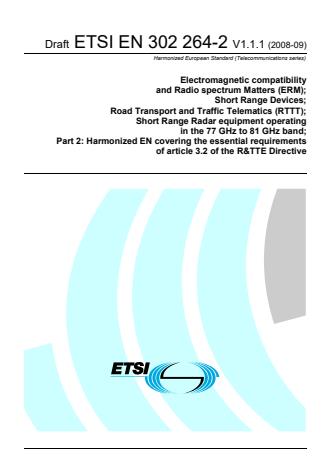
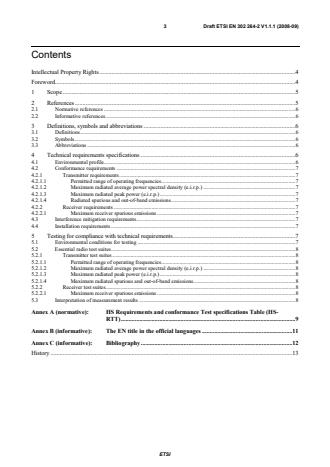
ETSI EN 302 264-2 V1.1.1 (2008-09) - Electromagnetic compatibility and Radio spectrum Matters (ERM); Short Range Devices; Road Transport and Traffic Telematics (RTTT); Short Range Radar equipment operating in the 77 GHz to 81 GHz band; Part 2: Harmonized EN covering the essential requirements of article 3.2 of the R&TTE Directive
ETSI EN 302 264-2 V1.1.1 (2009-04) - Electromagnetic compatibility and Radio spectrum Matters (ERM); Short Range Devices; Road Transport and Traffic Telematics (RTTT); Short Range Radar equipment operating in the 77 GHz to 81 GHz band; Part 2: Harmonized EN covering the essential requirements of article 3.2 of the R&TTE Directive
ETSI EN 302 264-2 V1.1.1 (2009-06) - Electromagnetic compatibility and Radio spectrum Matters (ERM); Short Range Devices; Road Transport and Traffic Telematics (RTTT); Short Range Radar equipment operating in the 77 GHz to 81 GHz band; Part 2: Harmonized EN covering the essential requirements of article 3.2 of the R&TTE Directive

SIST EN 302 264-2 V1.1.1:2009 is the Slovenian edition of ETSI EN 302 264-2 V1.1.1, a harmonized European Standard for short range radar equipment in the 77 GHz to 81 GHz band used in Road Transport and Traffic Telematics (RTTT). It specifies the technical requirements and measurement methods for transmitters, receivers and integrated transceivers so they use the spectrum effectively and avoid harmful interference under article 3.2 of the R&TTE Directive.
What does SIST EN 302 264-2 V1.1.1:2009 specify?
SIST EN 302 264-2 V1.1.1:2009 specifies requirements for Short Range Devices (SRD) that work as broadband devices in the 77 GHz to 81 GHz range, referred to in the document as the 79 GHz range. It covers short range radar vehicle applications such as obstacle detection, stop&go, blind spot detection, parking aid, backup aid and precrash applications, while excluding applications that might interfere with automotive SRR systems, such as road infrastructure systems.
| Annex | What it covers |
|---|---|
| Annex A | Normative HS Requirements and conformance Test specifications Table (HS-RTT) |
| Annex B | Informative title of the EN in the official languages |
| Annex C | Informative bibliography |
The main body is organized into Scope, References, Definitions, Technical requirements specifications, and Testing for compliance with technical requirements. That structure matters in practice because it separates what the equipment must meet from how compliance is shown.
What are the key requirements of SIST EN 302 264-2 V1.1.1:2009?
SIST EN 302 264-2 V1.1.1:2009 mainly sets transmitter and receiver limits, plus the test methods used to check them. It also requires the equipment to operate within a declared environmental profile and to meet additional interference mitigation and installation requirements taken from EN 302 264-1.
Operating conditions and environment
Clause 4.1 requires the provider to declare the environmental profile and says the equipment shall comply with all technical requirements within its boundary limits. In practice, this means the declared operating environment is part of conformity, not just a background assumption.
Transmitter requirements
Clause 4.2.1 covers the permitted operating frequency range, maximum radiated average power spectral density, maximum radiated peak power, and radiated spurious and out-of-band emissions. For designers and test labs, these are the core RF checks that determine whether the radar stays inside the allowed spectrum use and emission limits.
Receiver requirements
Clause 4.2.2 covers maximum receiver spurious emissions. This matters because unwanted receiver radiation can still create interference, so receiver performance is part of the compliance case, not only transmitter output.
Interference mitigation and installation
Clauses 4.3 and 4.4 require compliance with the additional interference mitigation requirements and installation requirements given in EN 302 264-1. In practice, integrators need to follow the companion part closely because the installation conditions can affect the final result as much as the radio design.
Testing and measurement
Clause 5 requires testing at representative points within the declared environmental profile, and at enough environmental conditions to give confidence of compliance when performance varies with environment. The transmitter and receiver test suites in clause 5.2 point back to EN 302 264-1, and clause 5.3 applies its rules for interpreting measurement results. That means the standard does not stand alone as a lab procedure - it relies on the test structure and result interpretation in the companion part.
Annex A is especially important because it links each requirement to its test specification and marks whether the test is part of the Essential Radio Test Suite. For conformity work, that table is the quick map between a requirement and the evidence needed to show it.
What terms does SIST EN 302 264-2 V1.1.1:2009 define?
- Short Range Devices (SRD) - Radio devices covered by the standard when they operate as broadband equipment in the 79 GHz range.
- Road Transport and Traffic Telematics (RTTT) - The automotive transport and traffic application area for which the radar equipment is intended.
- Short Range Radar (SRR) - The radar application category used for vehicle functions such as obstacle detection and parking aid.
- Equivalent isotropically radiated power (e.i.r.p.) - The radiated power measure used for the transmitter power and emission limits.
- Occupied bandwidth - The bandwidth the standard uses to identify broadband devices; the scope requires at least 50 MHz.
- Environmental profile - The declared operating conditions under which the equipment must continue to meet the technical requirements.
Who uses SIST EN 302 264-2 V1.1.1:2009?
Manufacturers and providers of 79 GHz automotive radar equipment use SIST EN 302 264-2 V1.1.1:2009 when defining the product and preparing the compliance file. Test laboratories use it to select the required measurement methods and verify emissions and frequency limits.
It is also relevant to vehicle and radar system integrators, conformity assessment teams, and regulatory users. The foreword notes that, for non-EU countries, the document may be used for regulatory type approval purposes.
Which standards are used with SIST EN 302 264-2 V1.1.1:2009?
- ETSI EN 302 264-1 (V1.1.1) - The companion part that supplies the detailed technical requirements, measurement methods, interpretation rules, and the additional annexes referenced throughout this part.
- ECC/DEC/(04)03 - Cited informatively for designation of the 77 GHz to 81 GHz band for automotive short range radars.
- EC decision 2004/545/EC - Cited informatively for harmonisation of radio spectrum in the 79 GHz range for automotive short-range radar equipment.
- Directive 1999/5/EC (R&TTE Directive) - The regulatory basis for the harmonized standard and the essential requirement addressed by this part.
- Directive 98/34/EC - Cited in the foreword as the procedure framework for technical standards and regulations.
What does the SIST EN 302 264-2 V1.1.1:2009 document contain?
The document contains a clause-by-clause set of RF requirements, the corresponding compliance test suites, and the links between them in Annex A. Clause 4 states the technical requirements for transmitter emissions, receiver spurious radiation, interference mitigation and installation, while clause 5 sets out how to test them.
It also contains a bibliography in Annex C and the official-language title note in Annex B. For someone preparing testing or certification, the most useful parts are the requirement summaries in clause 4, the test references in clause 5, and the HS-RTT mapping in Annex A.
Buy Documents
ETSI EN 302 264-2 V1.1.1 (2008-09) - Electromagnetic compatibility and Radio spectrum Matters (ERM); Short Range Devices; Road Transport and Traffic Telematics (RTTT); Short Range Radar equipment operating in the 77 GHz to 81 GHz band; Part 2: Harmonized EN covering the essential requirements of article 3.2 of the R&TTE Directive
ETSI EN 302 264-2 V1.1.1 (2009-04) - Electromagnetic compatibility and Radio spectrum Matters (ERM); Short Range Devices; Road Transport and Traffic Telematics (RTTT); Short Range Radar equipment operating in the 77 GHz to 81 GHz band; Part 2: Harmonized EN covering the essential requirements of article 3.2 of the R&TTE Directive
ETSI EN 302 264-2 V1.1.1 (2009-06) - Electromagnetic compatibility and Radio spectrum Matters (ERM); Short Range Devices; Road Transport and Traffic Telematics (RTTT); Short Range Radar equipment operating in the 77 GHz to 81 GHz band; Part 2: Harmonized EN covering the essential requirements of article 3.2 of the R&TTE Directive
Get Certified
Connect with accredited certification bodies for this standard

BSI Group
BSI (British Standards Institution) is the business standards company that helps organizations make excellence a habit.

NYCE
Mexican standards and certification body.

ANCE
Mexican certification and testing association.
Sponsored listings
Frequently Asked Questions
SIST EN 302 264-2 V1.1.1:2009 is a standard published by the Slovenian Institute for Standardization (SIST). Its full title is "Electromagnetic compatibility and Radio spectrum Matters (ERM) - Short Range Devices - Road Transport and Traffic Telematics (RTTT) - Short Range Radar equipment operating in the 77 GHz to 81 GHz band - Part 2: Harmonized EN covering the essential requirements of article 3.2 of the R&TTE Directive". This standard covers: The present document specifies the technical requirements and methods of measurement for Short Range Devices (SRD) working as broadband devices with at least 50 MHz occupied bandwidth in the 77 GHz to 81 GHz frequency range, hereinafter referred to as the 79 GHz range, intended for Road Transport and Traffic Telematics (RTTT) applications. Applications include e.g. Short Range Radar (SRR) for obstacle detection, stop&go, blind spot detection, parking aid, backup aid, precrash and other automotive applications. Applications that might interfere with automotive SRR systems, e.g. road infrastructure systems, are explicitly excluded. The present document covers transmitters intended to operate in the frequency range as defined in the EC decision 2004/545/EC [i.2] and the ECC decision ECC/DEC/(04)03 [i.1]. The document applies to: a) transmitters in the 79 GHz range operating as broadband devices; b) receivers operating in the 79 GHz range; c) integrated transceivers in the 79 GHz range. The present document: contains the technical characteristics and test methods for short range radar equipment fitted with integral antennas operating in the 79 GHz range; covers short range radar vehicle applications in the 79 GHz range. It covers integrated transceivers and separate transmit/receive modules. The present document is intended to cover the provisions of Article 3.2 of Directive 1999/5/EC [i.3] (R&TTE Directive), which states that "... radio equipment shall be so constructed that it effectively uses the spectrum allocated to terrestrial/space radio communications and orbital resources so as to avoid harmful interference".
The present document specifies the technical requirements and methods of measurement for Short Range Devices (SRD) working as broadband devices with at least 50 MHz occupied bandwidth in the 77 GHz to 81 GHz frequency range, hereinafter referred to as the 79 GHz range, intended for Road Transport and Traffic Telematics (RTTT) applications. Applications include e.g. Short Range Radar (SRR) for obstacle detection, stop&go, blind spot detection, parking aid, backup aid, precrash and other automotive applications. Applications that might interfere with automotive SRR systems, e.g. road infrastructure systems, are explicitly excluded. The present document covers transmitters intended to operate in the frequency range as defined in the EC decision 2004/545/EC [i.2] and the ECC decision ECC/DEC/(04)03 [i.1]. The document applies to: a) transmitters in the 79 GHz range operating as broadband devices; b) receivers operating in the 79 GHz range; c) integrated transceivers in the 79 GHz range. The present document: contains the technical characteristics and test methods for short range radar equipment fitted with integral antennas operating in the 79 GHz range; covers short range radar vehicle applications in the 79 GHz range. It covers integrated transceivers and separate transmit/receive modules. The present document is intended to cover the provisions of Article 3.2 of Directive 1999/5/EC [i.3] (R&TTE Directive), which states that "... radio equipment shall be so constructed that it effectively uses the spectrum allocated to terrestrial/space radio communications and orbital resources so as to avoid harmful interference".
SIST EN 302 264-2 V1.1.1:2009 is classified under the following ICS (International Classification for Standards) categories: 33.060.99 - Other equipment for radiocommunications; 33.100.01 - Electromagnetic compatibility in general; 35.240.60 - IT applications in transport. The ICS classification helps identify the subject area and facilitates finding related standards.
SIST EN 302 264-2 V1.1.1:2009 is associated with the following European legislation: EU Directives/Regulations: 2014/53/EU, TRRTP124; Standardization Mandates: M/284. When a standard is cited in the Official Journal of the European Union, products manufactured in conformity with it benefit from a presumption of conformity with the essential requirements of the corresponding EU directive or regulation.
SIST EN 302 264-2 V1.1.1:2009 is available in PDF format for immediate download after purchase. The document can be added to your cart and obtained through the secure checkout process. Digital delivery ensures instant access to the complete standard document.
Standards Content (Sample)
Draft ETSI EN 302 264-2 V1.1.1 (2008-09)
Harmonized European Standard (Telecommunications series)
Electromagnetic compatibility
and Radio spectrum Matters (ERM);
Short Range Devices;
Road Transport and Traffic Telematics (RTTT);
Short Range Radar equipment operating
in the 77 GHz to 81 GHz band;
Part 2: Harmonized EN covering the essential requirements
of article 3.2 of the R&TTE Directive
2 Draft ETSI EN 302 264-2 V1.1.1 (2008-09)
Reference
DEN/ERM-TG31B-001-2
Keywords
radar, radio, RTTT, testing, SRD, UWB
ETSI
650 Route des Lucioles
F-06921 Sophia Antipolis Cedex - FRANCE
Tel.: +33 4 92 94 42 00 Fax: +33 4 93 65 47 16
Siret N° 348 623 562 00017 - NAF 742 C
Association à but non lucratif enregistrée à la
Sous-Préfecture de Grasse (06) N° 7803/88
Important notice
Individual copies of the present document can be downloaded from:
http://www.etsi.org
The present document may be made available in more than one electronic version or in print. In any case of existing or
perceived difference in contents between such versions, the reference version is the Portable Document Format (PDF).
In case of dispute, the reference shall be the printing on ETSI printers of the PDF version kept on a specific network drive
within ETSI Secretariat.
Users of the present document should be aware that the document may be subject to revision or change of status.
Information on the current status of this and other ETSI documents is available at
http://portal.etsi.org/tb/status/status.asp
If you find errors in the present document, please send your comment to one of the following services:
http://portal.etsi.org/chaircor/ETSI_support.asp
Copyright Notification
No part may be reproduced except as authorized by written permission.
The copyright and the foregoing restriction extend to reproduction in all media.
© European Telecommunications Standards Institute 2008.
All rights reserved.
TM TM TM TM
DECT , PLUGTESTS , UMTS , TIPHON , the TIPHON logo and the ETSI logo are Trade Marks of ETSI registered
for the benefit of its Members.
TM
3GPP is a Trade Mark of ETSI registered for the benefit of its Members and of the 3GPP Organizational Partners.
ETSI
3 Draft ETSI EN 302 264-2 V1.1.1 (2008-09)
Contents
Intellectual Property Rights . 4
Foreword . 4
1 Scope . 5
2 References . 5
2.1 Normative references . 6
2.2 Informative references . 6
3 Definitions, symbols and abbreviations . 6
3.1 Definitions . 6
3.2 Symbols . 6
3.3 Abbreviations . 6
4 Technical requirements specifications . 6
4.1 Environmental profile . 6
4.2 Conformance requirements . 7
4.2.1 Transmitter requirements . 7
4.2.1.1 Permitted range of operating frequencies . 7
4.2.1.2 Maximum radiated average power spectral density (e.i.r.p.) . 7
4.2.1.3 Maximum radiated peak power (e.i.r.p.) . 7
4.2.1.4 Radiated spurious and out-of-band emissions . 7
4.2.2 Receiver requirements . 7
4.2.2.1 Maximum receiver spurious emissions . 7
4.3 Interference mitigation requirements. 7
4.4 Installation requirements . 7
5 Testing for compliance with technical requirements . 7
5.1 Environmental conditions for testing . 7
5.2 Essential radio test suites . 8
5.2.1 Transmitter test suites . 8
5.2.1.1 Permitted range of operating frequencies . 8
5.2.1.2 Maximum radiated average power spectral density (e.i.r.p.) . 8
5.2.1.3 Maximum radiated peak power (e.i.r.p.) . 8
5.2.1.4 Maximum radiated spurious and out-of-band emissions . 8
5.2.2 Receiver test suites. 8
5.2.2.1 Maximum receiver spurious emissions . 8
5.3 Interpretation of measurement results . 8
Annex A (normative): HS Requirements and conformance Test specifications Table (HS-
RTT) . 9
Annex B (informative): The EN title in the official languages . 11
Annex C (informative): Bibliography . 12
History . 13
ETSI
4 Draft ETSI EN 302 264-2 V1.1.1 (2008-09)
Intellectual Property Rights
IPRs essential or potentially essential to the present document may have been declared to ETSI. The information
pertaining to these essential IPRs, if any, is publicly available for ETSI members and non-members, and can be found
in ETSI SR 000 314: "Intellectual Property Rights (IPRs); Essential, or potentially Essential, IPRs notified to ETSI in
respect of ETSI standards", which is available from the ETSI Secretariat. Latest updates are available on the ETSI Web
server (http://webapp.etsi.org/IPR/home.asp).
Pursuant to the ETSI IPR Policy, no investigation, including IPR searches, has been carried out by ETSI. No guarantee
can be given as to the existence of other IPRs not referenced in ETSI SR 000 314 (or the updates on the ETSI Web
server) which are, or may be, or may become, essential to the present document.
Foreword
This Harmonized European Standard (Telecommunications series) has been produced by ETSI Technical Committee
Electromagnetic compatibility and Radio spectrum Matters (ERM), and is now submitted for the Public Enquiry phase
of the ETSI standards Two-step Approval Procedure.
For non EU countries the present document may be used for regulatory (Type Approval) purposes.
The present document has been produced by ETSI in response to a mandate from the European Commission issued
under Council Directive 98/34/EC [i.4] (as amended) laying down a procedure for the provision of information in the
field of technical standards and regulations.
The present document is intended to become a Harmonized Standard, the reference of which will be published in the
Official Journal of the European Communities referencing the Directive 1999/5/EC [i.3] of the European Parliament
and of the Council of 9 March 1999 on radio equipment and telecommunications terminal equipment and the mutual
recognition of their conformity ("the R&TTE Directive").
Technical specifications relevant to Directive 1999/5/EC [i.3] are given in annex A.
The present document is part 2 of a multi-part deliverable covering Electromagnetic compatibility and Radio spectrum
Matters (ERM); Short Range Devices, Road Transport and Traffic Telematics (RTTT); Short Range Radar equipment
operating in the 77 GHz to 81 GHz band, as identified below:
Part 1: "Technical requirements and methods of measurement";
Part 2: "Harmonized EN covering the essential requirements of article 3.2 of the R&TTE Directive".
Proposed national transposition dates
Date of latest announcement of this EN (doa): 3 months after ETSI publication
Date of latest publication of new National Standard
or endorsement of this EN (dop/e): 6 months after doa
Date of withdrawal of any conflicting National Standard (dow): 18 months after doa
ETSI
5 Draft ETSI EN 302 264-2 V1.1.1 (2008-09)
1 Scope
The present document specifies the technical requirements and methods of measurement for Short Range Devices
(SRD) working as broadband devices with at least 264 MHz occupied bandwidth in the 77 GHz to 81 GHz frequency
range, hereinafter referred to as the 79 GHz range, intended for Road Transport and Traffic Telematics (RTTT)
applications. Applications include e.g. Short Range Radar (SRR) for obstacle detection, stop&go, blind spot detection,
parking aid, backup aid, precrash and other automotive applications. Applications that might interfere with automotive
SRR systems, e.g. road infrastructure systems, are explicitly excluded.
The present document covers transmitters intended to operate in the frequency range as defined in the EC decision
2004/545/EC [i.2] and the ECC decision ECC/DEC/(04)03 [i.1].
The document applies to:
a) transmitters in the 79 GHz range operating as broadband devices;
b) receivers operating in the 79 GHz range;
c) integrated transceivers in the 79 GHz range.
The present document:
• contains the technical characteristics and test methods for short range radar equipment fitted with integral
antennas operating in the 79 GHz range;
• covers short range radar vehicle applications in the 79 GHz range. It covers integrated transceivers and
separate transmit/receive modules.
The present document is intended to cover the provisions of Article 3.2 of Directive 1999/5/EC [i.3] (R&TTE
Directive), which states that ". radio equipment shall be so constructed that it effectively uses the spectrum allocated to
terrestrial/space radio communications and orbital resources so as to avoid harmful interference".
2 References
References are either specific (identified by date of publication and/or edition number or ve
...
Final draft ETSI EN 302 264-2 V1.1.1 (2009-04)
Harmonized European Standard (Telecommunications series)
Electromagnetic compatibility
and Radio spectrum Matters (ERM);
Short Range Devices;
Road Transport and Traffic Telematics (RTTT);
Short Range Radar equipment operating
in the 77 GHz to 81 GHz band;
Part 2: Harmonized EN covering the essential requirements
of article 3.2 of the R&TTE Directive
2 Final draft ETSI EN 302 264-2 V1.1.1 (2009-04)
Reference
DEN/ERM-TG31B-001-2
Keywords
radar, radio, RTTT, testing, SRD, UWB
ETSI
650 Route des Lucioles
F-06921 Sophia Antipolis Cedex - FRANCE
Tel.: +33 4 92 94 42 00 Fax: +33 4 93 65 47 16
Siret N° 348 623 562 00017 - NAF 742 C
Association à but non lucratif enregistrée à la
Sous-Préfecture de Grasse (06) N° 7803/88
Important notice
Individual copies of the present document can be downloaded from:
http://www.etsi.org
The present document may be made available in more than one electronic version or in print. In any case of existing or
perceived difference in contents between such versions, the reference version is the Portable Document Format (PDF).
In case of dispute, the reference shall be the printing on ETSI printers of the PDF version kept on a specific network drive
within ETSI Secretariat.
Users of the present document should be aware that the document may be subject to revision or change of status.
Information on the current status of this and other ETSI documents is available at
http://portal.etsi.org/tb/status/status.asp
If you find errors in the present document, please send your comment to one of the following services:
http://portal.etsi.org/chaircor/ETSI_support.asp
Copyright Notification
No part may be reproduced except as authorized by written permission.
The copyright and the foregoing restriction extend to reproduction in all media.
© European Telecommunications Standards Institute 2009.
All rights reserved.
TM TM TM TM
DECT , PLUGTESTS , UMTS , TIPHON , the TIPHON logo and the ETSI logo are Trade Marks of ETSI registered
for the benefit of its Members.
TM
3GPP is a Trade Mark of ETSI registered for the benefit of its Members and of the 3GPP Organizational Partners.
LTE™ is a Trade Mark of ETSI currently being registered
for the benefit of its Members and of the 3GPP Organizational Partners.
GSM® and the GSM logo are Trade Marks registered and owned by the GSM Association.
ETSI
3 Final draft ETSI EN 302 264-2 V1.1.1 (2009-04)
Contents
Intellectual Property Rights . 4
Foreword . 4
1 Scope . 5
2 References . 5
2.1 Normative references . 6
2.2 Informative references . 6
3 Definitions, symbols and abbreviations . 6
3.1 Definitions . 6
3.2 Symbols . 6
3.3 Abbreviations . 6
4 Technical requirements specifications . 6
4.1 Environmental profile . 6
4.2 Conformance requirements . 7
4.2.1 Transmitter requirements . 7
4.2.1.1 Permitted range of operating frequencies . 7
4.2.1.2 Maximum radiated average power spectral density (e.i.r.p.) . 7
4.2.1.3 Maximum radiated peak power (e.i.r.p.) . 7
4.2.1.4 Radiated spurious and out-of-band emissions . 7
4.2.2 Receiver requirements . 7
4.2.2.1 Maximum receiver spurious emissions . 7
4.3 Interference mitigation requirements. 7
4.4 Installation requirements . 7
5 Testing for compliance with technical requirements . 7
5.1 Environmental conditions for testing . 7
5.2 Essential radio test suites . 8
5.2.1 Transmitter test suites . 8
5.2.1.1 Permitted range of operating frequencies . 8
5.2.1.2 Maximum radiated average power spectral density (e.i.r.p.) . 8
5.2.1.3 Maximum radiated peak power (e.i.r.p.) . 8
5.2.1.4 Maximum radiated spurious and out-of-band emissions . 8
5.2.2 Receiver test suites. 8
5.2.2.1 Maximum receiver spurious emissions . 8
5.3 Interpretation of measurement results . 8
Annex A (normative): HS Requirements and conformance Test specifications Table (HS-
RTT) . 9
Annex B (informative): The EN title in the official languages . 11
Annex C (informative): Bibliography . 12
History . 13
ETSI
4 Final draft ETSI EN 302 264-2 V1.1.1 (2009-04)
Intellectual Property Rights
IPRs essential or potentially essential to the present document may have been declared to ETSI. The information
pertaining to these essential IPRs, if any, is publicly available for ETSI members and non-members, and can be found
in ETSI SR 000 314: "Intellectual Property Rights (IPRs); Essential, or potentially Essential, IPRs notified to ETSI in
respect of ETSI standards", which is available from the ETSI Secretariat. Latest updates are available on the ETSI Web
server (http://webapp.etsi.org/IPR/home.asp).
Pursuant to the ETSI IPR Policy, no investigation, including IPR searches, has been carried out by ETSI. No guarantee
can be given as to the existence of other IPRs not referenced in ETSI SR 000 314 (or the updates on the ETSI Web
server) which are, or may be, or may become, essential to the present document.
Foreword
This Harmonized European Standard (Telecommunications series) has been produced by ETSI Technical Committee
Electromagnetic compatibility and Radio spectrum Matters (ERM), and is now submitted for the Vote phase of the
ETSI standards Two-step Approval Procedure.
For non EU countries the present document may be used for regulatory (Type Approval) purposes.
The present document has been produced by ETSI in response to a mandate from the European Commission issued
under Council Directive 98/34/EC [i.4] (as amended) laying down a procedure for the provision of information in the
field of technical standards and regulations.
The present document is intended to become a Harmonized Standard, the reference of which will be published in the
Official Journal of the European Communities referencing the Directive 1999/5/EC [i.3] of the European Parliament
and of the Council of 9 March 1999 on radio equipment and telecommunications terminal equipment and the mutual
recognition of their conformity ("the R&TTE Directive").
Technical specifications relevant to Directive 1999/5/EC [i.3] are given in annex A.
The present document is part 2 of a multi-part deliverable covering Electromagnetic compatibility and Radio spectrum
Matters (ERM); Short Range Devices, Road Transport and Traffic Telematics (RTTT); Short Range Radar equipment
operating in the 77 GHz to 81 GHz band, as identified below:
Part 1: "Technical requirements and methods of measurement";
Part 2: "Harmonized EN covering the essential requirements of article 3.2 of the R&TTE Directive".
Proposed national transposition dates
Date of latest announcement of this EN (doa): 3 months after ETSI publication
Date of latest publication of new National Standard
or endorsement of this EN (dop/e): 6 months after doa
Date of withdrawal of any conflicting National Standard (dow): 18 months after doa
ETSI
5 Final draft ETSI EN 302 264-2 V1.1.1 (2009-04)
1 Scope
The present document specifies the technical requirements and methods of measurement for Short Range Devices
(SRD) working as broadband devices with at least 50 MHz occupied bandwidth in the 77 GHz to 81 GHz frequency
range, hereinafter referred to as the 79 GHz range, intended for Road Transport and Traffic Telematics (RTTT)
applications. Applications include e.g. Short Range Radar (SRR) for obstacle detection, stop&go, blind spot detection,
parking aid, backup aid, precrash and other automotive applications. Applications that might interfere with automotive
SRR systems, e.g. road infrastructure systems, are explicitly excluded.
The present document covers transmitters intended to operate in the frequency range as defined in the EC decision
2004/545/EC [i.2] and the ECC decision ECC/DEC/(04)03 [i.1].
The document applies to:
a) transmitters in the 79 GHz range operating as broadband devices;
b) receivers operating in the 79 GHz range;
c) integrated transceivers in the 79 GHz range.
The present document:
• contains the technical characteristics and test methods for short range radar equipment fitted with integral
antennas operating in the 79 GHz range;
• covers short range radar vehicle applications in the 79 GHz range. It covers integrated transceivers and
separate transmit/receive modules.
The present document is intended to cover the provisions of Article 3.2 of Directive 1999/5/EC [i.3] (R&TTE
Directive), which s
...
Harmonized European Standard (Telecommunications series)
Electromagnetic compatibility
and Radio spectrum Matters (ERM);
Short Range Devices;
Road Transport and Traffic Telematics (RTTT);
Short Range Radar equipment operating
in the 77 GHz to 81 GHz band;
Part 2: Harmonized EN covering the essential requirements
of article 3.2 of the R&TTE Directive
2 ETSI EN 302 264-2 V1.1.1 (2009-06)
Reference
DEN/ERM-TG31B-001-2
Keywords
radar, radio, RTTT, testing, SRD, UWB
ETSI
650 Route des Lucioles
F-06921 Sophia Antipolis Cedex - FRANCE
Tel.: +33 4 92 94 42 00 Fax: +33 4 93 65 47 16
Siret N° 348 623 562 00017 - NAF 742 C
Association à but non lucratif enregistrée à la
Sous-Préfecture de Grasse (06) N° 7803/88
Important notice
Individual copies of the present document can be downloaded from:
http://www.etsi.org
The present document may be made available in more than one electronic version or in print. In any case of existing or
perceived difference in contents between such versions, the reference version is the Portable Document Format (PDF).
In case of dispute, the reference shall be the printing on ETSI printers of the PDF version kept on a specific network drive
within ETSI Secretariat.
Users of the present document should be aware that the document may be subject to revision or change of status.
Information on the current status of this and other ETSI documents is available at
http://portal.etsi.org/tb/status/status.asp
If you find errors in the present document, please send your comment to one of the following services:
http://portal.etsi.org/chaircor/ETSI_support.asp
Copyright Notification
No part may be reproduced except as authorized by written permission.
The copyright and the foregoing restriction extend to reproduction in all media.
© European Telecommunications Standards Institute 2009.
All rights reserved.
TM TM TM TM
DECT , PLUGTESTS , UMTS , TIPHON , the TIPHON logo and the ETSI logo are Trade Marks of ETSI registered
for the benefit of its Members.
TM
3GPP is a Trade Mark of ETSI registered for the benefit of its Members and of the 3GPP Organizational Partners.
LTE™ is a Trade Mark of ETSI currently being registered
for the benefit of its Members and of the 3GPP Organizational Partners.
GSM® and the GSM logo are Trade Marks registered and owned by the GSM Association.
ETSI
3 ETSI EN 302 264-2 V1.1.1 (2009-06)
Contents
Intellectual Property Rights . 4
Foreword . 4
1 Scope . 5
2 References . 5
2.1 Normative references . 6
2.2 Informative references . 6
3 Definitions, symbols and abbreviations . 6
3.1 Definitions . 6
3.2 Symbols . 6
3.3 Abbreviations . 6
4 Technical requirements specifications . 6
4.1 Environmental profile . 6
4.2 Conformance requirements . 7
4.2.1 Transmitter requirements . 7
4.2.1.1 Permitted range of operating frequencies . 7
4.2.1.2 Maximum radiated average power spectral density (e.i.r.p.) . 7
4.2.1.3 Maximum radiated peak power (e.i.r.p.) . 7
4.2.1.4 Radiated spurious and out-of-band emissions . 7
4.2.2 Receiver requirements . 7
4.2.2.1 Maximum receiver spurious emissions . 7
4.3 Interference mitigation requirements. 7
4.4 Installation requirements . 7
5 Testing for compliance with technical requirements . 7
5.1 Environmental conditions for testing . 7
5.2 Essential radio test suites . 8
5.2.1 Transmitter test suites . 8
5.2.1.1 Permitted range of operating frequencies . 8
5.2.1.2 Maximum radiated average power spectral density (e.i.r.p.) . 8
5.2.1.3 Maximum radiated peak power (e.i.r.p.) . 8
5.2.1.4 Maximum radiated spurious and out-of-band emissions . 8
5.2.2 Receiver test suites. 8
5.2.2.1 Maximum receiver spurious emissions . 8
5.3 Interpretation of measurement results . 8
Annex A (normative): HS Requirements and conformance Test specifications Table
(HS-RTT) . 9
Annex B (informative): The EN title in the official languages . 11
Annex C (informative): Bibliography . 12
History . 13
ETSI
4 ETSI EN 302 264-2 V1.1.1 (2009-06)
Intellectual Property Rights
IPRs essential or potentially essential to the present document may have been declared to ETSI. The information
pertaining to these essential IPRs, if any, is publicly available for ETSI members and non-members, and can be found
in ETSI SR 000 314: "Intellectual Property Rights (IPRs); Essential, or potentially Essential, IPRs notified to ETSI in
respect of ETSI standards", which is available from the ETSI Secretariat. Latest updates are available on the ETSI Web
server (http://webapp.etsi.org/IPR/home.asp).
Pursuant to the ETSI IPR Policy, no investigation, including IPR searches, has been carried out by ETSI. No guarantee
can be given as to the existence of other IPRs not referenced in ETSI SR 000 314 (or the updates on the ETSI Web
server) which are, or may be, or may become, essential to the present document.
Foreword
This Harmonized European Standard (Telecommunications series) has been produced by ETSI Technical Committee
Electromagnetic compatibility and Radio spectrum Matters (ERM).
For non EU countries the present document may be used for regulatory (Type Approval) purposes.
The present document has been produced by ETSI in response to a mandate from the European Commission issued
under Council Directive 98/34/EC [i.4] (as amended) laying down a procedure for the provision of information in the
field of technical standards and regulations.
The present document is intended to become a Harmonized Standard, the reference of which will be published in the
Official Journal of the European Communities referencing the Directive 1999/5/EC [i.3] of the European Parliament
and of the Council of 9 March 1999 on radio equipment and telecommunications terminal equipment and the mutual
recognition of their conformity ("the R&TTE Directive").
Technical specifications relevant to Directive 1999/5/EC [i.3] are given in annex A.
The present document is part 2 of a multi-part deliverable covering Electromagnetic compatibility and Radio spectrum
Matters (ERM); Short Range Devices, Road Transport and Traffic Telematics (RTTT); Short Range Radar equipment
operating in the 77 GHz to 81 GHz band, as identified below:
Part 1: "Technical requirements and methods of measurement";
Part 2: "Harmonized EN covering the essential requirements of article 3.2 of the R&TTE Directive".
National transposition dates
Date of adoption of this EN: 16 June 2009
Date of latest announcement of this EN (doa): 30 September 2009
Date of latest publication of new National Standard
or endorsement of this EN (dop/e): 31 March 2010
Date of withdrawal of any conflicting National Standard (dow): 31 March 2011
ETSI
5 ETSI EN 302 264-2 V1.1.1 (2009-06)
1 Scope
The present document specifies the technical requirements and methods of measurement for Short Range Devices
(SRD) working as broadband devices with at least 50 MHz occupied bandwidth in the 77 GHz to 81 GHz frequency
range, hereinafter referred to as the 79 GHz range, intended for Road Transport and Traffic Telematics (RTTT)
applications. Applications include e.g. Short Range Radar (SRR) for obstacle detection, stop&go, blind spot detection,
parking aid, backup aid, precrash and other automotive applications. Applications that might interfere with automotive
SRR systems, e.g. road infrastructure systems, are explicitly excluded.
The present document covers transmitters intended to operate in the frequency range as defined in the EC decision
2004/545/EC [i.2] and the ECC decision ECC/DEC/(04)03 [i.1].
The document applies to:
a) transmitters in the 79 GHz range operating as broadband devices;
b) receivers operating in the 79 GHz range;
c) integrated transceivers in the 79 GHz range.
The present document:
• contains the technical characteristics and test methods for short range radar equipment fitted with integral
antennas operating in the 79 GHz range;
• covers short range radar vehicle applications in the 79 GHz range. It covers integrated transceivers and
separate transmit/receive modules.
The present document is intended to cover the provisions of Article 3.2 of Directive 1999/5/EC [i.3] (R&TTE
Directive), which states that ". radio equipment shall be
...
2003-01.Slovenski inštitut za standardizacijo. Razmnoževanje celote ali delov tega standarda ni dovoljeno.577(Electromagnetic compatibility and Radio spectrum Matters (ERM) - Short Range Devices - Road Transport and Traffic Telematics (RTTT) - Short Range Radar equipment operating in the 77 GHz to 81 GHz band - Part 2: Harmonized EN covering the essential requirements of article 3.2 of the R&TTE Directive35.240.60Uporabniške rešitve IT v transportu in trgoviniIT applications in transport and trade33.100.01Elektromagnetna združljivost na splošnoElectromagnetic compatibility in general33.060.99Druga oprema za radijske komunikacijeOther equipment for radiocommunicationsICS:Ta slovenski standard je istoveten z:EN 302 264-2 Version 1.1.1SIST EN 302 264-2 V1.1.1:2009en01-september-2009SIST EN 302 264-2 V1.1.1:2009SLOVENSKI
STANDARD
ETSI ETSI EN 302 264-2 V1.1.1 (2009-06) 2
Reference DEN/ERM-TG31B-001-2 Keywords radar, radio, RTTT, testing, SRD, UWB ETSI 650 Route des Lucioles F-06921 Sophia Antipolis Cedex - FRANCE
Tel.: +33 4 92 94 42 00
Fax: +33 4 93 65 47 16
Siret N° 348 623 562 00017 - NAF 742 C Association à but non lucratif enregistrée à la Sous-Préfecture de Grasse (06) N° 7803/88
Important notice Individual copies of the present document can be downloaded from: http://www.etsi.org The present document may be made available in more than one electronic version or in print. In any case of existing or perceived difference in contents between such versions, the reference version is the Portable Document Format (PDF). In case of dispute, the reference shall be the printing on ETSI printers of the PDF version kept on a specific network drive within ETSI Secretariat. Users of the present document should be aware that the document may be subject to revision or change of status. Information on the current status of this and other ETSI documents is available at http://portal.etsi.org/tb/status/status.asp If you find errors in the present document, please send your comment to one of the following services: http://portal.etsi.org/chaircor/ETSI_support.asp Copyright Notification No part may be reproduced except as authorized by written permission. The copyright and the foregoing restriction extend to reproduction in all media.
© European Telecommunications Standards Institute 2009. All rights reserved.
DECTTM, PLUGTESTSTM, UMTSTM, TIPHONTM, the TIPHON logo and the ETSI logo are Trade Marks of ETSI registered for the benefit of its Members. 3GPPTM is a Trade Mark of ETSI registered for the benefit of its Members and of the 3GPP Organizational Partners. LTE™ is a Trade Mark of ETSI currently being registered for the benefit of its Members and of the 3GPP Organizational Partners. GSM® and the GSM logo are Trade Marks registered and owned by the GSM Association. SIST EN 302 264-2 V1.1.1:2009
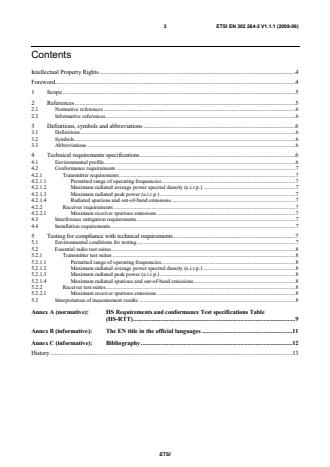
ETSI ETSI EN 302 264-2 V1.1.1 (2009-06) 3 Contents Intellectual Property Rights . 4 Foreword . 4 1 Scope . 5 2 References . 5 2.1 Normative references . 6 2.2 Informative references . 6 3 Definitions, symbols and abbreviations . 6 3.1 Definitions . 6 3.2 Symbols . 6 3.3 Abbreviations . 6 4 Technical requirements specifications . 6 4.1 Environmental profile . 6 4.2 Conformance requirements . 7 4.2.1 Transmitter requirements . 7 4.2.1.1 Permitted range of operating frequencies . 7 4.2.1.2 Maximum radiated average power spectral density (e.i.r.p.) . 7 4.2.1.3 Maximum radiated peak power (e.i.r.p.) . 7 4.2.1.4 Radiated spurious and out-of-band emissions . 7 4.2.2 Receiver requirements . 7 4.2.2.1 Maximum receiver spurious emissions . 7 4.3 Interference mitigation requirements. 7 4.4 Installation requirements . 7 5 Testing for compliance with technical requirements . 7 5.1 Environmental conditions for testing . 7 5.2 Essential radio test suites . 8 5.2.1 Transmitter test suites . 8 5.2.1.1 Permitted range of operating frequencies . 8 5.2.1.2 Maximum radiated average power spectral density (e.i.r.p.) . 8 5.2.1.3 Maximum radiated peak power (e.i.r.p.) . 8 5.2.1.4 Maximum radiated spurious and out-of-band emissions . 8 5.2.2 Receiver test suites. 8 5.2.2.1 Maximum receiver spurious emissions . 8 5.3 Interpretation of measurement results . 8 Annex A (normative): HS Requirements and conformance Test specifications Table (HS-RTT) . 9 Annex B (informative): The EN title in the official languages . 11 Annex C (informative): Bibliography . 12 History . 13
ETSI ETSI EN 302 264-2 V1.1.1 (2009-06) 4 Intellectual Property Rights IPRs essential or potentially essential to the present document may have been declared to ETSI. The information pertaining to these essential IPRs, if any, is publicly available for ETSI members and non-members, and can be found in ETSI SR 000 314: "Intellectual Property Rights (IPRs); Essential, or potentially Essential, IPRs notified to ETSI in respect of ETSI standards", which is available from the ETSI Secretariat. Latest updates are available on the ETSI Web server (http://webapp.etsi.org/IPR/home.asp). Pursuant to the ETSI IPR Policy, no investigation, including IPR searches, has been carried out by ETSI. No guarantee can be given as to the existence of other IPRs not referenced in ETSI SR 000 314 (or the updates on the ETSI Web server) which are, or may be, or may become, essential to the present document. Foreword This Harmonized European Standard (Telecommunications series) has been produced by ETSI Technical Committee Electromagnetic compatibility and Radio spectrum Matters (ERM). For non EU countries the present document may be used for regulatory (Type Approval) purposes. The present document has been produced by ETSI in response to a mandate from the European Commission issued under Council Directive 98/34/EC [i.4] (as amended) laying down a procedure for the provision of information in the field of technical standards and regulations. The present document is intended to become a Harmonized Standard, the reference of which will be published in the Official Journal of the European Communities referencing the Directive 1999/5/EC [i.3] of the European Parliament and of the Council of 9 March 1999 on radio equipment and telecommunications terminal equipment and the mutual recognition of their conformity ("the R&TTE Directive"). Technical specifications relevant to Directive 1999/5/EC [i.3] are given in annex A. The present document is part 2 of a multi-part deliverable covering Electromagnetic compatibility and Radio spectrum Matters (ERM); Short Range Devices, Road Transport and Traffic Telematics (RTTT); Short Range Radar equipment operating in the 77 GHz to 81 GHz band, as identified below: Part 1: "Technical requirements and methods of measurement"; Part 2: "Harmonized EN covering the essential requirements of article 3.2 of the R&TTE Directive".
National transposition dates Date of adoption of this EN: 16 June 2009 Date of latest announcement of this EN (doa): 30 September 2009 Date of latest publication of new National Standard or endorsement of this EN (dop/e):
31 March 2010 Date of withdrawal of any conflicting National Standard (dow): 31 March 2011
ETSI ETSI EN 302 264-2 V1.1.1 (2009-06) 5 1 Scope The present document specifies the technical requirements and methods of measurement for Short Range Devices (SRD) working as broadband devices with at least 50 MHz occupied bandwidth in the 77 GHz to 81 GHz frequency range, hereinafter referred to as the 79 GHz range, intended for Road Transport and Traffic Telematics (RTTT) applications. Applications include e.g. Short Range Radar (SRR) for obstacle detection, stop&go, blind spot detection, parking aid, backup aid, precrash and other automotive applications. Applications that might interfere with automotive SRR systems, e.g. road infrastructure systems, are explicitly excluded. The present document covers transmitters intended to operate in the frequency range as defined in the EC decision 2004/545/EC [i.2] and the ECC decision ECC/DEC/(04)03 [i.1]. The document applies to: a) transmitters in the 79 GHz range operating as broadband devices; b) receivers operating in the 79 GHz range; c)
...