

SIST EN 1466:2024
(Main)Child use and care articles - Carry cots and stands - Safety requirements and test methods
General Information
- Abstract
This document specifies safety requirements and test methods for products which provide a sleeping accommodation and are intended for the purpose of carrying a child in a lying position by means of handle(s) by using one hand and for stands which could be used in conjunction with these products (see B.2), intended for domestic use.
These products are intended for a child who cannot sit unaided, roll over or push up on its hands and knees, with a maximum weight of 9 kg. Hereafter, in this document these products are called "carry cots" and include all types of carry cot with rigid or non-rigid sides.
The following child products do not fall within the scope of this document: products for children with special needs; child products which are medical devices and child products that accommodate particular issues with child development such as prematurity or macrosomia.
NOTE If a product has or can be converted into other functions, additional European Standards can apply.
- Status
- Published
- Public Enquiry End Date
- 02-Feb-2020
- Publication Date
- 12-May-2024
- Technical Committee
- OTR - Child use and care article
- Current Stage
- 6060 - National Implementation/Publication (Adopted Project)
- Start Date
- 21-Dec-2023
- Due Date
- 25-Feb-2024
- Completion Date
- 13-May-2024
- Directive
- 2001/95/EC - General product safety

Overview
EN 1466:2023 (CEN) - "Child care articles - Carry cots and stands for domestic use - Safety requirements and test methods" specifies safety requirements and test procedures for carry cots (rigid or non‑rigid sides) and associated stands intended for domestic use. The standard covers products designed to provide a sleeping accommodation and to be carried by one hand using handle(s) for a child who cannot sit unaided, roll over or push up on hands and knees, with a maximum weight of 9 kg. Products for children with special needs, medical devices, or those addressing particular developmental conditions (e.g., prematurity) are excluded.
Key Topics
- Scope and definitions - types of carry cots and stands for domestic use and excluded products.
- Test equipment - articulated test plate, test masses, probes, small parts cylinder, test bars, datum board, dynamic strength apparatus and other specified tools for reproducible testing.
- Material hazards - organic and chemical risks including migration of elements, formaldehyde, colorants, and thermal hazards.
- Mechanical hazards - comprehensive requirements and tests addressing:
- Protective function (internal heights, retaining effectiveness for rigid and non‑rigid cots)
- Entrapment and moving‑part hazards
- Entanglement of cords, straps and loops
- Choking and small parts testing
- Suffocation risks (internal lining, packaging, filling materials, mattress sizing and base softness)
- Sharp edges, points, corners
- Stability and structural integrity - stability tests for cots and stands, longitudinal stability, retention of carry cot on stand, strength of handles and locking mechanisms, strength/durability of folding mechanisms and overall product strength.
- Marking and information - durable markings, purchase information, and detailed user instructions and warnings for safe use and maintenance.
- Annexes - informative warnings, rationales and relationship with EU safety legislation (Annex ZA).
Applications
EN 1466:2023 is used by:
- Manufacturers and product designers to ensure carry cot and stand designs meet European safety expectations.
- Testing laboratories and conformity assessors conducting mechanical, chemical and durability tests.
- Retailers and procurement specialists verifying product compliance before market placement.
- Regulators and safety bodies referencing the standard for market surveillance and consumer safety enforcement.
Keywords: EN 1466:2023, carry cots standard, carry cot safety, child care articles, stands, safety requirements, test methods, domestic use.
Related Standards
- EN 71-1 (Safety of toys) is cited as a normative reference where applicable.
- The standard references the CEN/TR 13387 revision and includes an Annex ZA showing the relationship with EU consumer safety legislation (e.g., Directive 2001/95/EC).
Relations
- Effective Date
- 01-Jun-2024
- Effective Date
- 01-Jun-2024
- Refers
SIST EN 71-11:2006 - Safety of toys - Part 11: Organic chemical compounds - Methods of analysis - Effective Date
- 28-Jan-2026
- Effective Date
- 28-Jan-2026
- Effective Date
- 28-Jan-2026
- Effective Date
- 28-Jan-2026
- Effective Date
- 28-Jan-2026
- Effective Date
- 28-Jan-2026
- Effective Date
- 28-Jan-2026
- Effective Date
- 28-Jan-2026
Frequently Asked Questions
SIST EN 1466:2024 is a standard published by the Slovenian Institute for Standardization (SIST). Its full title is "Child use and care articles - Carry cots and stands - Safety requirements and test methods". This standard covers: This document specifies safety requirements and test methods for products which provide a sleeping accommodation and are intended for the purpose of carrying a child in a lying position by means of handle(s) by using one hand and for stands which could be used in conjunction with these products (see B.2), intended for domestic use. These products are intended for a child who cannot sit unaided, roll over or push up on its hands and knees, with a maximum weight of 9 kg. Hereafter, in this document these products are called "carry cots" and include all types of carry cot with rigid or non-rigid sides. The following child products do not fall within the scope of this document: products for children with special needs; child products which are medical devices and child products that accommodate particular issues with child development such as prematurity or macrosomia. NOTE If a product has or can be converted into other functions, additional European Standards can apply.
This document specifies safety requirements and test methods for products which provide a sleeping accommodation and are intended for the purpose of carrying a child in a lying position by means of handle(s) by using one hand and for stands which could be used in conjunction with these products (see B.2), intended for domestic use. These products are intended for a child who cannot sit unaided, roll over or push up on its hands and knees, with a maximum weight of 9 kg. Hereafter, in this document these products are called "carry cots" and include all types of carry cot with rigid or non-rigid sides. The following child products do not fall within the scope of this document: products for children with special needs; child products which are medical devices and child products that accommodate particular issues with child development such as prematurity or macrosomia. NOTE If a product has or can be converted into other functions, additional European Standards can apply.
SIST EN 1466:2024 is classified under the following ICS (International Classification for Standards) categories: 97.190 - Equipment for children. The ICS classification helps identify the subject area and facilitates finding related standards.
SIST EN 1466:2024 has the following relationships with other standards: It is inter standard links to SIST EN 1466:2015, SIST EN 1466:2015/AC:2015, SIST EN 71-11:2006, SIST EN ISO 14184-1:2011, SIST EN 71-2:2021, SIST EN 71-10:2006, SIST EN 71-1:2015+A1:2018, SIST EN 717-1:2005, SIST EN ISO 105-A03:2019, SIST EN 71-3:2019+A1:2021. Understanding these relationships helps ensure you are using the most current and applicable version of the standard.
SIST EN 1466:2024 is associated with the following European legislation: EU Directives/Regulations: 2001/95/EC; Standardization Mandates: M/264. When a standard is cited in the Official Journal of the European Union, products manufactured in conformity with it benefit from a presumption of conformity with the essential requirements of the corresponding EU directive or regulation.
SIST EN 1466:2024 is available in PDF format for immediate download after purchase. The document can be added to your cart and obtained through the secure checkout process. Digital delivery ensures instant access to the complete standard document.
Standards Content (Sample)
SLOVENSKI STANDARD
01-junij-2024
Nadomešča:
SIST EN 1466:2015
SIST EN 1466:2015/AC:2015
Izdelki za otroke - Prenosne posteljice in podstavki - Varnostne zahteve in
preskusne metode
Child use and care articles - Carry cots and stands - Safety requirements and test
methods
Artikel für Säuglinge und Kleinkinder - Tragetaschen und Ständer -
Sicherheitstechnische Anforderungen und Prüfungen
Articles de puériculture - Couffins et supports - Exigences de sécurité et méthodes
d'essai
Ta slovenski standard je istoveten z: EN 1466:2023
ICS:
97.190 Otroška oprema Equipment for children
2003-01.Slovenski inštitut za standardizacijo. Razmnoževanje celote ali delov tega standarda ni dovoljeno.
EN 1466
EUROPEAN STANDARD
NORME EUROPÉENNE
June 2023
EUROPÄISCHE NORM
ICS 97.190 Supersedes EN 1466:2014
English Version
Child care articles - Carry cots and stands for domestic use
- Safety requirements and test methods
Articles de puériculture - Couffins et supports à usage Artikel für Säuglinge und Kleinkinder - Tragetaschen
domestique - Exigences de sécurité et méthodes d'essai und Ständer - Sicherheitstechnische Anforderungen
und Prüfverfahren
This European Standard was approved by CEN on 10 April 2023.
CEN members are bound to comply with the CEN/CENELEC Internal Regulations which stipulate the conditions for giving this
European Standard the status of a national standard without any alteration. Up-to-date lists and bibliographical references
concerning such national standards may be obtained on application to the CEN-CENELEC Management Centre or to any CEN
member.
This European Standard exists in three official versions (English, French, German). A version in any other language made by
translation under the responsibility of a CEN member into its own language and notified to the CEN-CENELEC Management
Centre has the same status as the official versions.
CEN members are the national standards bodies of Austria, Belgium, Bulgaria, Croatia, Cyprus, Czech Republic, Denmark, Estonia,
Finland, France, Germany, Greece, Hungary, Iceland, Ireland, Italy, Latvia, Lithuania, Luxembourg, Malta, Netherlands, Norway,
Poland, Portugal, Republic of North Macedonia, Romania, Serbia, Slovakia, Slovenia, Spain, Sweden, Switzerland, Türkiye and
United Kingdom.
EUROPEAN COMMITTEE FOR STANDARDIZATION
COMITÉ EUROPÉEN DE NORMALISATION
EUROPÄISCHES KOMITEE FÜR NORMUNG
CEN-CENELEC Management Centre: Rue de la Science 23, B-1040 Brussels
© 2023 CEN All rights of exploitation in any form and by any means reserved Ref. No. EN 1466:2023 E
worldwide for CEN national Members.
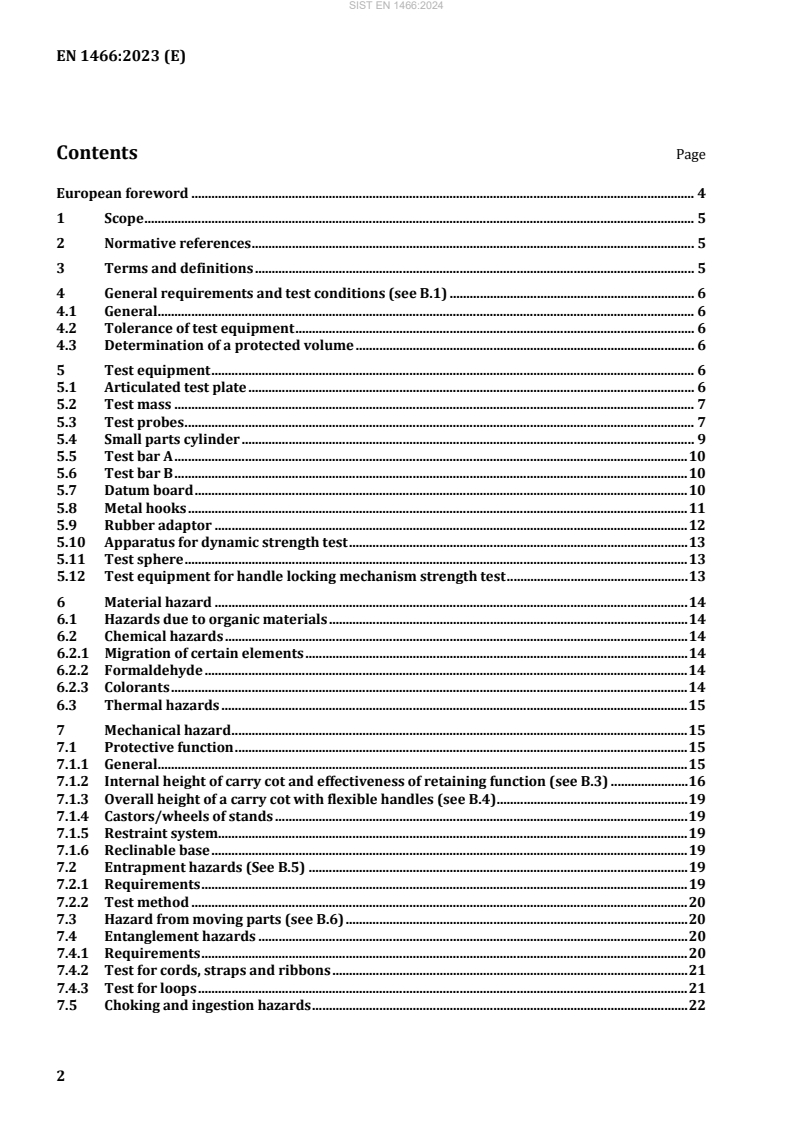
Contents Page
European foreword . 4
1 Scope . 5
2 Normative references . 5
3 Terms and definitions . 5
4 General requirements and test conditions (see B.1) . 6
4.1 General . 6
4.2 Tolerance of test equipment . 6
4.3 Determination of a protected volume . 6
5 Test equipment . 6
5.1 Articulated test plate . 6
5.2 Test mass . 7
5.3 Test probes . 7
5.4 Small parts cylinder . 9
5.5 Test bar A . 10
5.6 Test bar B . 10
5.7 Datum board . 10
5.8 Metal hooks . 11
5.9 Rubber adaptor . 12
5.10 Apparatus for dynamic strength test . 13
5.11 Test sphere . 13
5.12 Test equipment for handle locking mechanism strength test . 13
6 Material hazard . 14
6.1 Hazards due to organic materials . 14
6.2 Chemical hazards . 14
6.2.1 Migration of certain elements . 14
6.2.2 Formaldehyde . 14
6.2.3 Colorants . 14
6.3 Thermal hazards . 15
7 Mechanical hazard . 15
7.1 Protective function . 15
7.1.1 General . 15
7.1.2 Internal height of carry cot and effectiveness of retaining function (see B.3) . 16
7.1.3 Overall height of a carry cot with flexible handles (see B.4) . 19
7.1.4 Castors/wheels of stands . 19
7.1.5 Restraint system. 19
7.1.6 Reclinable base . 19
7.2 Entrapment hazards (See B.5) . 19
7.2.1 Requirements . 19
7.2.2 Test method . 20
7.3 Hazard from moving parts (see B.6) . 20
7.4 Entanglement hazards . 20
7.4.1 Requirements . 20
7.4.2 Test for cords, straps and ribbons . 21
7.4.3 Test for loops . 21
7.5 Choking and ingestion hazards . 22
7.5.1 Requirements . 22
7.5.2 Test methods for small parts . 22
7.6 Suffocation hazards (see B.7) . 22
7.6.1 Internal lining . 22
7.6.2 Plastic packaging . 23
7.6.3 Filling materials . 23
7.6.4 Hazards due to the softness of the base . 23
7.6.5 Mattress size . 24
7.7 Hazards edges, points and corners . 24
7.8 Stability . 24
7.8.1 Stability of carry cots (see B.8) . 24
7.8.2 Longitudinal stability of carry cots . 25
7.8.3 Stability of stands and retention of carry cot on the stand . 26
7.9 Structural integrity (see B.9) . 26
7.9.1 Flexible handles of carry cots . 26
7.9.2 Strength of carrying handle(s) locking mechanism(s). 27
7.9.3 Strength of carry cots . 28
7.9.4 Strength of stands . 30
7.9.5 Folding mechanisms of stands . 30
8 Durability of marking . 31
9 Product information . 31
9.1 General . 31
9.2 Purchase information . 31
9.2.1 General . 31
9.2.2 Carry cots . 31
9.2.3 Stands . 32
9.3 Markings . 32
9.4 Instructions for use and maintenance. 33
9.4.1 General . 33
9.4.2 Carry cots . 33
9.4.3 Stands . 35
Annex A (informative) Warnings . 36
Annex B (informative) Rationales . 49
Annex ZA (informative) Relationship between this European Standard and the safety
requirements of Directive 2001/95/EC aimed to be covered . 51
Bibliography. 54
European foreword
This document (EN 1466:2023) has been prepared by Technical Committee CEN/TC 252 “Child care articles”,
the secretariat of which is held by AFNOR.
This European Standard shall be given the status of a national standard, either by publication of an identical
text or by endorsement, at the latest by December 2023, and conflicting national standards shall be
withdrawn at the latest by June 2024.
Attention is drawn to the possibility that some of the elements of this document may be the subject of patent
rights. CEN shall not be held responsible for identifying any or all such patent rights.
This document supersedes EN 1466:2014.
— improvement of title to take into account the domestic use only;
— improvement of scope to clarify which products are involved (1);
— introduction of new chemical requirement following CEN/TR 13387 revision;
— clarification of clause of the restraints system (7.1.5);
— improvement of requirement and test method for non-rigid carry cot (7.1.2.3 and 7.1.2.4);
— introduction of new requirements and test methods to cover suffocation hazard (7.6.);
— improvement of stability test, strength test and folding mechanisms of stands (7.8.3,7.9.3 and 7.9.4);
— improvement of instruction of use especially concerning the use of non-rigid carry cot.
This document has been prepared under a Standardization Request given to CEN by the European Commission
and the European Free Trade Association, and supports essential requirements of EU Directive(s) /
Regulation(s).
For relationship with EU Directive(s) / Regulation(s), see informative Annex ZA, which is an integral part of
this document.
Any feedback and questions on this document should be directed to the users’ national standards body. A
complete listing of these bodies can be found on the CEN website.
According to the CEN-CENELEC Internal Regulations, the national standards organisations of the following
countries are bound to implement this European Standard: Austria, Belgium, Bulgaria, Croatia, Cyprus, Czech
Republic, Denmark, Estonia, Finland, France, Germany, Greece, Hungary, Iceland, Ireland, Italy, Latvia,
Lithuania, Luxembourg, Malta, Netherlands, Norway, Poland, Portugal, Republic of North Macedonia, Romania,
Serbia, Slovakia, Slovenia, Spain, Sweden, Switzerland, Türkiye and the United Kingdom.
1 Scope
This document specifies safety requirements and test methods for products which provide a sleeping
accommodation and are intended for the purpose of carrying a child in a lying position by means of handle(s)
by using one hand and for stands which could be used in conjunction with these products (see B.2), intended
for domestic use.
These products are intended for a child who cannot sit unaided, roll over or push up on its hands and knees,
with a maximum weight of 9 kg. Hereafter, in this document these products are called “carry cots” and include
all types of carry cot with rigid or non-rigid sides.
The following child products do not fall within the scope of this document: products for children with special
needs; child products which are medical devices and child products that accommodate particular issues with
child development such as prematurity or macrosomia.
NOTE If a product has or can be converted into other functions, additional European Standards can apply.
2 Normative references
The following documents are referred to in the text in such a way that some or all of their content constitutes
requirements of this document. For dated references, only the edition cited applies. For undated references, the
latest edition of the referenced document (including any amendments) applies.
EN 71-1:2014+A1:2018, Safety of toys - Part 1: Mechanical and physical properties
EN 71-2:2020, Safety of toys - Part 2: Flammability
EN 71-3:2019+A1:2021, Safety of toys - Part 3: Migration of certain elements
EN 71-10:2005, Safety of toys - Part 10: Organic chemical compounds - Sample preparation and extraction
EN 71-11:2005, Safety of toys - Part 11: Organic chemical compounds - Methods of analysis
EN 717-1:2004, Wood-based panels - Determination of formaldehyde release - Part 1: Formaldehyde emission by
the chamber method
EN ISO 14184-1:2011, Textiles - Determination of formaldehyde - Part 1: Free and hydrolysed formaldehyde
(water extraction method) (ISO 14184-1:2011)
EN ISO 105-A03:2019, Textiles - Tests for colour fastness - Part A03: Grey scale for assessing staining
(ISO 105-A03:2019)
3 Terms and definitions
For the purposes of this document, the following terms and definitions apply.
ISO and IEC maintain terminological databases for use in standardization at the following addresses:
— IEC Electropedia: available at http://www.electropedia.org/
— ISO Online browsing platform: available at http://www.iso.org/obp
3.1
carry cot
product comprising a base, sides, ends and carrying handle(s)
Note 1 to entry: A carry cot may be fitted with accessories, e.g. hood, apron.
3.2
stand
static structure designed to accommodate and support a carry cot
3.3
protected volume
volume accessible by the child (occupant) when lying in the carry cot where specific safety requirements are
necessary
3.4
apron
top cover normally located on the area of the feet opposite to the hood
3.5
mattress
case filled with padding material (e.g. foam, fiber filling …) used either alone or integrated in the internal lining
of the base of the carry cot
4 General requirements and test conditions (see B.1)
4.1 General
The carry cot shall be assembled for normal use in accordance with the manufacturer's instructions
Unless otherwise specified in the test methods, the carry cot shall be tested in its most onerous configuration.
Any other functions of the product shall comply with relevant European Standards.
4.2 Tolerance of test equipment
Unless otherwise stated the tolerance of the test equipment shall be:
— forces ± 5 %,
— masses ± 0,5 %,
— dimensions ± 0,5 mm,
— timing ± 1 s,
— angles ± 0,5°.
4.3 Determination of a protected volume
The protected volume is determined by
— the inner upper surface that supports the child, and
— the inner surface of the sides and ends of the carry cots.
5 Test equipment
5.1 Articulated test plate
A rigid steel plate (600 ± 5) mm long and (180 ± 5) mm wide, having a mass of 9 +0,1/-0,1 kg hinged along the
centre line (see Figure 1), the movement shall be free in the two directions.
Dimensions in millimetres
Figure 1 — Articulated test plate
5.2 Test mass
A rigid cylinder (160 ± 5) mm in diameter and (300 ± 5) mm in height, having a mass of 9 +0,1/-0,1 kg and with
its centre of gravity in the centre of the cylinder. All edges shall have a radius of (5 ± 1) mm (see Figure 2).
Dimensions in millimetres
Key
1 radius r = (5 ± 1) mm
Figure 2 — Test mass
5.3 Test probes
0 +01,
Probes made from plastic or other hard, smooth material of diameters 7 mm and 12 mm, with a full
( ) ( )
−01, 0
hemispherical end (see Figure 3a)).
Probe for assessing mesh made from plastics or other hard, smooth material (see Figure 3b)) which shall be
capable of being mounted on a force measuring device, so that the conical end can be presented to the opening
being assessed.
+01,
( )
Probe made from plastic or other hard, smooth material of diameter mm. One end shall be conical with
an angle of 30° with a radius of 10 mm at the end (see Figure 3a)).
Probe made from plastic or other hard, smooth material with the dimensions shown in Figure 3c).
Dimensions in millimetres
a) Test probes
b) Test probe for mesh
c) Shape assessment probe
Key
1 hemispherical end
2 scribed line around circumference
3 7 mm and 12 mm
A front view
B top view
C side view
D 3D view
Figure 3 — Test probes
5.4 Small parts cylinder
Cylinder having dimensions as shown in Figure 4.
Dimensions in millimetres
Figure 4 — Small parts cylinder
5.5 Test bar A
A metal bar having a cross section of 40 mm × 40 mm with edges having a radius of 5 mm.
5.6 Test bar B
A metal bar having a length at least the length of the carry cot, a cross section of (25 × 25) mm and with a mass
of 750 g.
5.7 Datum board
A rigid plate with a mass of 1,5 kg as shown in Figure 5.
Dimensions in millimetres
Key
1 front view
2 top view
Figure 5 — Datum board
5.8 Metal hooks
The distance between the central axis of two hooks shall be (70 ± 2) mm (see Figure 6).
Dimensions in millimetres
a) Side view and 3 D view of hook
b) Distance between the two hooks
NOTE For Figure 6a), tolerance of dimension: ± 2 excepted for the 12 mm diameter.
Figure 6 — Metal hooks
5.9 Rubber adaptor
Figure 7 shows an example of a rubber adaptor.
Hardness: 70 ± 5 Shore A
Dimensions in millimetres
Key
1 passing slots
Figure 7 — Rubber adaptor
5.10 Apparatus for dynamic strength test
As shown in Figure 8.
Dimensions in millimetres
Key
1 metal plate: (300 ± 5) mm × (300 ± 5) mm and thickness 6 mm
2 metal hooks (see Figure 6) rigidly fixed to the metal plate
3 stops: of 15 mm high, 30 mm diameter and 70 ± 5 shore A hardness which are screwed on the rigid frame
4 rigid frame made of steel square tube at least (30 ± 5) mm × (30 ± 5) mm and thickness 1,5 mm
Figure 8 — Apparatus for dynamic strength test
5.11 Test sphere
Sphere made from a hard smooth material of diameter (120 ± 2) mm and a mass of 5 kg.
5.12 Test equipment for handle locking mechanism strength test
Rotation point: L section made of steel or similar material with dimensions of 30 mm ⋅ 30 mm ⋅ 3 mm and a
length of 200 mm, fixed on the vertical surface as in Figure 9 and adjustable in height.
Vertical surface: Rigid and smooth vertical surface.
Suspension system: Chain (with links less than or equal to 45 mm) or steel wire (with a diameter less than or
equal to 2 mm) to suspend the carry cot.
S hook: an appropriate S hook to suspend the carry cot.
The distance between the S hook and the rotation point as well as the length of the suspension system shall be
adjustable to accommodate the positioning of carry cot at the required test angles (see 7.9.2.1 test method).
The suspension system shall be attached to the vertical surface using the S hook.
Key
1 rotation point
2 vertical surface
3 suspension system
4 S hook
Figure 9 — Test equipment for handle locking mechanism strength test
6 Material hazard
6.1 Hazards due to organic materials
Any organic materials shall be free from decay and insect attack when assessed by visual inspection.
6.2 Chemical hazards
6.2.1 Migration of certain elements
The migration of elements from materials on the surfaces of parts located within the protected volume defined
in 4.3 shall comply to EN 71-3:2019+A1:2021.
6.2.2 Formaldehyde
Textile components shall not contain free and hydrolyzed formaldehyde in excess of 30 mg/kg. When testing is
performed, the method described in EN ISO 14184-1:2011 shall be used.
Resin-bonded wood components shall not release formaldehyde in excess of 0,124 mg/m (class E1 according
to EN 622-1). When testing is performed, the method described in EN 717-1:2004 shall be used.
6.2.3 Colorants
When tested in accordance with EN 71-10:2005, if the colour fastness to sweat of accessible textile components
within the protected volume is lower than 3-4 on the grey scale as defined in EN ISO 105-A03:2019, the part
shall be tested for colorants with the methods described in EN 71-10:2005 and EN 71-11:2005 and the limits
in Table 1 shall be fulfilled.
Table 1 — Colorants limits
Colour Index Generic Name Colour Index Constitution CAS Number Limit
(CIGN) Number (CICN)
Disperse Blue 1 64500 2475–45–8 Action limit
Disperse Blue 3 61505 2475–46–9
Disperse Blue 106 111935 12223–01–7
Disperse Blue 124 111938 61951–51–7
Disperse Yellow 3 11855 2832–40–8
Disperse Orange 3 11005 730–40–5
Disperse Orange 37/76/59 11132 12223–33–5
13301–61–6
Disperse Red 1 11110 2872–52–8
Solvent Yellow 1 11000 60–09–3
Solvent Yellow 2 11020 60–11–7
Solvent Yellow 3 11160 97–56–3
Basic Red 9 42500 569–61–9
Basic Violet 1 42535 8004–87–3
Basic Violet 3 42555 548–62–9
Acid Red 26 16150 3761–53–3
Acid Violet 49 42640 1694–09–3
6.3 Thermal hazards
When tested in accordance with EN 71-2:2020, 5.4 there shall be no surface flash.
The flame propagation rate of textiles, coated textiles and plastic coverings shall not exceed 50 mm/s when
tested in accordance with EN 71-2:2020, 5.4. A separate sample may be used.
7 Mechanical hazard
7.1 Protective function
7.1.1 General
Carry cot with reclinable base shall be tested with the base in the lowest position unless otherwise specified.
NOTE The carry cot should be capable of providing a horizontal sleeping position.
7.1.2 Internal height of carry cot and effectiveness of retaining function (see B.3)
7.1.2.1 Rigidity of sides of carry cot
7.1.2.1.1 Assessment of rigidity of the sides
When the carry cot is tested in accordance with 7.1.2.1.2 if the difference between the two measurements is
less than 40 mm, the sides of the carry cot are considered as rigid.
7.1.2.1.2 Test for rigidity of the sides of carry cots
The mattress as supplied or recommended by the manufacturer shall be fitted.
Place the carry cot on a rigid flat horizontal surface.
If any, the apron shall be removed or opened as far as possible and any removable hood shall be removed.
Place the test plate (5.1), the rotation movement of the test plate shall be blocked, on the geometric centre of
the carry cot. Place the datum board (5.7) centrally across the top of the carry cot with the 15 mm protrusion
part of the datum board against one side of the inner surface of the carry cot. Suspend the carry cot by its
handle(s) on the test bar (A), and measure the vertical distance between the geometric centre of the top of the
test plate to the bottom of the datum board. Then return the carry cot to the rigid flat surface and release the
handle(s). Gradually apply a horizontal force of 30 N on the end of the datum board (see Figure 10) and
measure the vertical distance between the geometric centre of the top of the test plate to the bottom of the
datum board while maintaining the force.
Key
1 datum board
2 product
3 mattress
4 test plate
h height to be measured
Figure 10 — Test for rigidity of sides
7.1.2.2 Internal height of rigid carry cots
7.1.2.2.1 Requirements
The minimum internal height of the rigid carry cot sides and ends upper edges measured in accordance
with 7.1.2.2.2.3 shall be:
a) for a carry cot having an internal length of 800 mm or less, measured in accordance with 7.1.2.2.2.2:
1) the minimum internal height shall be 150 mm for at least 170 mm in both directions from the centre
line of the lengths; and
2) at all other points on the sides and/or ends the minimum internal height shall be 100 mm.
b) for a carry cot having an internal length greater than 800 mm measured in accordance with 7.1.2.2.2.2:
1) the minimum internal height shall be 180 mm for at least 180 mm in both directions from the centre
line of the lengths; and
2) at all other points on the sides and/or ends the minimum internal height shall be 130 mm.
c) for a carry cot intended to be used on a stand, having an internal length of 800 mm or less, measured in
accordance with 7.1.2.2.2.2.
1) the minimum internal height shall be 200 mm for at least 300 mm in both directions from the centre
line of the lengths; and
2) at all other points on the sides and/or ends the minimum internal height shall be 100 mm.
d) for a carry cot intended to be used on a stand, having an internal length greater than 800 mm measured in
accordance with 7.1.2.2.2.2:
1) the minimum internal height shall be 200 mm for at least 300 mm in both directions from the centre
line of the lengths; and
2) at all other points on the sides and/or ends the minimum internal height shall be 130 mm.
7.1.2.2.2 Test for measurement of length and internal height of rigid carry cots
7.1.2.2.2.1 General
Place the carry cot on a rigid flat surface. The handle(s) hanging loose shall not interfere with the measurement
test.
The mattress as supplied or recommended by the manufacturer shall be fitted
If any, the apron shall be removed or opened as far as possible and any removable hood shall be removed.
Place the test plate (5.1) on the geometric centre of the carry cot
7.1.2.2.2.2 Measurement of the length
Measure the internal length of the carry cot on a plane parallel to the base located at 40 mm from the lower
surface of the test plate (5.1) positioned in the centre and in the longitudinal axis of the carry cot (see Figure 11).
If the test plate is sloped, the 40 mm are measured along the lowest point of the test plate and parallel to the
base.
Dimensions in millimetres
Key
A internal length of the carry cot
Figure 11 — Measurement of the internal length of the carry cot
7.1.2.2.2.3 Measurement of the height
The internal heights of the carry cot shall be measured from the lower edge of the test bar B (5.6) placed on the
top edge of the carry cot, to the lower edge of test plate (5.1) placed on the mattress supplied or recommended
by the manufacturer.
The measurement of the height shall be carried out, longitudinally with the test bar B (5.6) placed across the
ends of the carry cot and laterally with the test bar B (5.6) placed across the sides of the carry cot.
7.1.2.3 Effectiveness of the retaining function of the sides of non-rigid carry cots
7.1.2.3.1 Requirement
When tested in accordance with 7.1.2.3.2 the test mass shall not roll out of the non-rigid carry cot.
7.1.2.3.2 Test for effectiveness of the retaining function of the sides
Place the carry cot, with the mattress supplied or recommended by the manufacturer on the bottom, on a 15°
slope with its longer side perpendicular to the slope.
Retain the base of the carry cot on the slope so it cannot tip over without having any effect on the structure of
the sides and without preventing the free movement of the test mass (5.2).
If any, the apron shall be opened as far as possible or removed.
Place the 9 kg test mass (5.2) in the geometric centre of the carry cot with its long axis parallel to the longer
side of the carry cot.
Release the test mass and allow the test mass to roll freely.
For both orientations, record if the test mass rolls out of the carry cot.
7.1.2.4 Effectiveness of the retaining function of the ends of non-rigid carry cots
7.1.2.4.1 Requirement
The test sphere (see 5.11) shall not fall out of the carry cot when tested in accordance with 7.1.2.4.2.
7.1.2.4.2 Test method
Place the carry cot with the mattress supplied or recommended by the manufacturer on the bottom on a plane
inclined at 20° with the head end towards the bottom of the slope. Prevent the slippage of the carry cot on the
test plane by suitable means that do not impair the result of the test, if necessary. Place the test sphere (5.11)
against the head end.
Repeat the test with the foot end towards the bottom of the slope with the ball against the foot end.
For both orientations, record if the test sphere rolls out of the carry cot.
7.1.3 Overall height of a carry cot with flexible handles (see B.4)
7.1.3.1 Requirement
The maximum overall height of the carry cot measured when tested in accordance with 7.1.3.2 shall be 520 mm.
7.1.3.2 Test for measurement of the total height of the carry cot
The mattress as supplied or recommended by the manufacturer shall be fitted.
Suspend the carry cot on the hooks of the dynamic test machine (Figure 8).
Place the test mass (5.2) on the geometric centre of the carry cot
Measure the vertical distance between the base of the hook and the lowest point of the test mass (5.2).
7.1.4 Castors/wheels of stands
The stand shall not be fitted with wheels or castors.
7.1.5 Restraint system
Carry cot shall not be equipped with restraint system unless the carry cot has other functions like Child
Restraint System according to ECE 44/R129 or convertible seat unit or convertible product. In that case, the
restraint system when used as a carry cot shall be capable of being removed or hidden or covered in accordance
with the manufacturer's instructions.
7.1.6 Reclinable base
7.1.6.1 Requirement
Carry cots with reclinable base shall have a maximum angle of 30° to the horizontal measured in accordance
with 7.1.6.2.
7.1.6.2 Test method
The mattress as supplied or recommended by the manufacturer shall be fitted.
Adjust the reclinable base so that it is its most upright position, place the test plate (5.1) positioned in the centre
and the longitudinal axis of the carry cot base. Measure the angle of the reclinable part of the base on the
reclined part of the test plate
7.2 Entrapment hazards (See B.5)
7.2.1 Requirements
When testing in accordance with 7.2.2 there shall be no completely bounded openings in rigid materials within
the protected volume that let the 7 mm probe go through unless the depth of penetration is less than 10 mm or
unless the shape assessment probe enters. This requirement is not applicable to the restraint system.
The size of the holes in mesh within the protected volume shall be less than 7 mm when measured in
accordance with 7.2.2.
When tested in accordance with 7.2.2 there shall be no holes and openings within the protected volume of the
carry cot and at the attachment point of the handle(s) greater than 65 mm.
7.2.2 Test method
Check all holes and openings as defined in 7.2.1 within the protected volume, using the appropriate probe (see
5.3), applying the appropriate force as given in Table 2.
Table 2 — Forces applying to the entrapment probes
Probes diameter Force
mm N
7 ≤ 30
Shape assessment probe ≤ 5
65 ≤ 30
7.3 Hazard from moving parts (see B.6)
To avoid shearing or crushing during the relative movement between moving parts, the following requirements
shall be fulfilled:
a) When the carry cot or the combination of the carry cot and the stand is ready for use, there shall be no
space greater than 5 mm and smaller than 12 mm between parts which can move relative to each other
inside the protected volume.
b) During the setting up or folding away of the carry cot or stand:
1) if the movement is not under the action of a powered mechanism, gaps between 5 mm and 12 mm are
allowed between moving parts providing the edges and ends comply with 7.7;
2) if the movement is under the action of a powered mechanisms, spring forces or other sources of energy,
there shall be no gap smaller than 18 mm between parts which move relative to each other.
7.4 Entanglement hazards
7.4.1 Requirements
This clause does not apply to the restraint system which complies with Child Restraint System according to
ECE 44/R129 and to the flexible handle(s).
For cords, straps, ribbons, strings and others narrow fabrics that originate within or extend inside the protected
volume the maximum free length shall be 220 mm when tested in accordance with 7.4.2.
The ends of any cords, straps, ribbons and other narrow materials shall be turned in or sealed or protected
from fraying.
Where two cords, strap and ribbons are attached to the carry cot together or within 80 mm of each other, any
single cord shall have a maximum free length of 220 mm and the combined length from one loose end to the
other end shall be a maximum of 360 mm.
Any loop that originate within or extend inside the protected volume shall have a maximum perimeter
of 360 mm when tested in accordance with 7.4.3.
See Figure 12 for an illustrative example.
Dimensions in millimetres
Key
D distance between attachment points
L length of cords, ribbons and parts used as ties
Figure 12 — Examples of measuring cords, ribbons or parts used as a tie
7.4.2 Test for cords, straps and ribbons
The maximum free length of the cord, strap, ribbon or other narrow fabrics shall be measured from the fixing
point to the end of the cord, strap, ribbon or other narrow fabrics when stretched by a force of 25 N.
7.4.3 Test for loops
The maximum perimeter of the loop shall be measured when a 25 N tensile force is applied.
7.5 Choking and ingestion hazards
7.5.1 Requirements
When tested in accordance with 7.5.2 any component or part of a component within the protected volume that
is removed, whether intended to be removed without the use of a tool or not, shall not fit entirely within the
small parts cylinder (5.4) in any orientation without compression.
Self-adhesive plastic labels shall not be used within the protected volume of a carry cot.
7.5.2 Test methods for small parts
7.5.2.1 Torque test
Apply a torque gradually to the component within a period of 5 s in a clockwise direction until either:
— a rotation of 180° from the original position has been attained; or
— a torque of 0,34 Nm is reached.
The maximum rotation or required torque shall be applied for 10 s.
The component shall then be allowed to return to a relaxed condition and the procedure repeated in an
anticlockwise direction.
Where projections, components or assemblies are rigidly mounted on an accessible rod or shaft designed to
rotate together with the projections, components or assemblies, during the test, the rod or shaft shall be
clamped to prevent rotation.
If a component which is attached by a screw thread becomes loosened during application of the required
torque, the torque shall continue to be applied until the required torque is exceeded or the component
disassembles or it becomes apparent that the component will not disassemble.
When using clamps and test equipment care shall be taken not to damage the attachment mechanism or body
of the component.
Check whether any component or part of a component that is removed during the test fits wholly within the
small parts cylinder.
7.5.2.2 Tensile test
The tensile test shall be carried out on the same components as the torque test.
Attach a suitable clamp to the component, taking care not to damage the component or any part of the product.
Apply a tensile force of up to 90 N to the component to be tested. Apply the force gradually within a period of 5 s
and maintain it for 10 s.
Check whether the component or any part of a component that is removed during the test fits wholly within
the small parts cylinder.
7.6 Suffocation hazards (see B.7)
7.6.1 Internal lining
Where the internal lining of carry cot is made of a fabric it shall be designed and tensioned so as not to present
any suffocation hazard to the child.
Where the internal lining of carry cot is made of plastic or of a plastic-coated material it shall have a minimum
thickness of 0,2 mm.
7.6.2 Plastic packaging
Plastic bags and plastic sheeting used for packaging shall conform to one of the following requirements:
a) bags made of flexible plastics with an opening perimeter greater than 360 mm used for
...