

oSIST prEN 17730:2026
(Main)Soil improvers and growing media - Methods for the determination of PAH16, macroscopic impurities above 2mm, the temperature-time profiles, oxygen uptake rate, self-heating factor and residual biogas potential in compost and digestate when used in fertilizing products
- Abstract
This document specifies references to methods to be used for the determination of specific parameters in compost, fresh crop digestate and digestate other than fresh crop digestate when used as components of fertilizing products, but does not contain the methods themselves. The specific parameters in this document are:
— the determination of the PAH16 content;
— macroscopic impurities above 2 mm;
— the determination of temperature-time profiles during composting and digestion;
— oxygen uptake rate;
— self-heating factor;
— the determination of the residual biogas potential in digestate.
This document is applicable to the fertilizing product blends where a blend is a mix of two or more fertilising products belonging to the categories of fertilizers, liming material, soil improvers, growing media, inhibitors and plant biostimulants, and where soil improvers and/or growing media are the components with the highest percentage in the blend by mass or volume, or in the case of products in liquid form by dry mass. If the soil improvers and/or growing media are not the components with the highest percentage in the blend, the European Standard relevant to the component with the highest percentage in the blend applies. In case a blend is composed of fertilising products mixed in equal quantities, the user of the standard decides which standard to apply.
NOTE A soil improver or a growing medium consists of a single bulky (volume-building) component or a mix of bulky (volume-building) components (for example peat, wood fibres, coconut coir, compost, expanded perlite).
- Status
- Not Published
- Public Enquiry End Date
- 19-Apr-2026
- Technical Committee
- KAT - Soil quality
- Current Stage
- 4020 - Public enquire (PE) (Adopted Project)
- Start Date
- 11-Feb-2026
- Due Date
- 01-Jul-2026
- Completion Date
- 29-Apr-2026
- Mandate
- M/XXX - M/XXX

oSIST prEN 17730:2026 is a draft European Standard from CEN about soil improvers and growing media used in fertilizing products. It points to the methods used to determine PAH16, macroscopic impurities above 2 mm, temperature-time profiles, oxygen uptake rate, self-heating factor and residual biogas potential in compost and digestate. The document is aimed at users who need to select the correct referenced test method and apply it to the right product type or blend.
What does oSIST prEN 17730:2026 specify?
oSIST prEN 17730:2026 specifies references to methods for determining defined parameters in compost, fresh crop digestate and digestate other than fresh crop digestate when these materials are used as components of fertilizing products. The standard itself gives the method links and the applicability rules, not the test procedures.
The document is organized into:
- Clause 1 - Scope
- Clause 2 - Normative references
- Clause 3 - Terms and definitions
- Clause 4 - Sampling and sample preparation
- Clause 5 - Determination
- Annex ZA - Relationship with Regulation (EU) 2019/1009
| Annex | What it covers |
|---|---|
| Annex ZA | Relationship between this European Standard and the essential requirements of Regulation (EU) 2019/1009 |
The scope also sets a blend rule. If soil improvers and/or growing media are the highest-percentage components in a fertilizing product blend, this standard applies; if not, the standard for the highest-percentage component applies instead.
What are the key requirements of oSIST prEN 17730:2026?
oSIST prEN 17730:2026 is mainly a routing standard: it tells the user which sample handling and which external method to use for each parameter. In practice, the important task is to follow the linked standard exactly and to choose the correct standard when the product is a blend.
- Scope and applicability - The document applies to compost, fresh crop digestate and digestate other than fresh crop digestate when they are used in fertilizing products. For blends, the decisive factor is which component category has the highest percentage by mass, volume, or for liquid products by dry mass. This matters because it determines which conformity route the lab or supplier must follow.
- Sampling - Clause 4.1 requires sampling for quality control to follow EN 12579:2024. This means the sample sent to the laboratory must be taken in a controlled and recognized way.
- Sample preparation - Clause 4.2 requires sample preparation according to prEN 13040-1:2025, Clauses 6 to 10. This matters because the test result depends on how the sample is reduced, mixed and prepared before analysis.
- PAH - Clause 5.1 sends the user to prEN 18261:2025, Clause 11 for PAH. This is the route for checking polycyclic aromatic hydrocarbons in the relevant compost or digestate.
- Macroscopic impurities above 2 mm - Clause 5.2 sends users to prEN 16202:2025, Clause 6 for glass, metal and plastics above 2 mm in compost and digestate other than fresh crop digestate. This helps control visible contamination.
- Temperature-time profile - Clause 5.3 refers to EN 17925:2024, Clause 6. This supports checking composting and digestion behavior through the temperature history.
- Biological activity and stability - Clauses 5.4 and 5.5 refer to prEN 16087-1:2025, Clause 8 for oxygen uptake rate and prEN 16087-2:2025, Clause 7 for self-heating factor. These indicate how active or stable the material is.
- Residual biogas potential - Clause 5.6 refers to prEN 18256:2025, Clause 8. This is the route for digestate that still may generate biogas.
What terms does oSIST prEN 17730:2026 define?
oSIST prEN 17730:2026 uses the terminology from prEN 17732:2025, and the text also uses a few key product and test terms.
- PAH16 - The group of 16 polycyclic aromatic hydrocarbons targeted for chemical determination in this document.
- Compost - An organic material covered here as a component of fertilizing products and linked in the introduction to CMC 3.
- Fresh crop digestate - Digestate covered in the introduction as CMC 4.
- Digestate other than fresh crop digestate - Digestate covered in the introduction as CMC 5.
- Oxygen uptake rate (OUR) - The measure used to express the aerobic biological degradation rate in Clause 5.4.
- Self-heating factor - The parameter used in Clause 5.5 to assess the heating behavior of compost.
- Residual biogas potential - The parameter used in Clause 5.6 to assess how much biogas can still be generated from digestate.
Who uses oSIST prEN 17730:2026?
oSIST prEN 17730:2026 is used by laboratories, producers of compost and digestate, and quality or compliance teams working with fertilizing products. It is also relevant to buyers and certifiers who need a clear test route for product release, acceptance checks or conformity assessment.
The standard is especially useful in the soil improvers and growing media sector, and in organizations handling fertilizing product blends. It gives a common way to decide which sampling and test standard applies to PAH16, impurities, biological activity and residual biogas potential.
What changed in oSIST prEN 17730:2026 from the previous edition?
oSIST prEN 17730:2026 will supersede CEN/TS 17730:2022. The foreword states these significant technical changes:
- the title has been revised
- PAH content and temperature-time profiles during composting and digestion have been added to the scope
- an applicability statement has been added to the scope
- Clause 2 has been updated
- Clause 5.1, Clause 5.3 and Clause 5.6 have been added
- Annex ZA has been added
Which standards are used with oSIST prEN 17730:2026?
oSIST prEN 17730:2026 relies on several referenced standards for the actual test work:
- EN 12579:2024 - sampling for quality control
- prEN 13040-1:2025 - sample preparation
- prEN 16087-1:2025 - oxygen uptake rate
- prEN 16087-2:2025 - self-heating test for compost
- prEN 16202:2025 - macroscopic impurities and stones
- prEN 17732:2025 - terminology
- EN 17925:2024 - temperature-time profiles during composting and digestion
- prEN 18256:2025 - residual biogas potential
- prEN 18261:2025 - PAH by GC and HPLC
What does the oSIST prEN 17730:2026 document contain?
oSIST prEN 17730:2026 contains the framework for deciding how to sample, prepare and test compost and digestate for the listed parameters. Clause 4 gives the sampling and sample preparation route, while Clause 5 points each parameter to a separate method standard and clause in that standard.
The document also contains Annex ZA, which links the normative clauses to the essential requirements of Regulation (EU) 2019/1009. Table ZA.1 shows which clauses support each covered requirement for compost, fresh crop digestate and digestate other than fresh crop digestate.
Relations
- Revises
SIST-TS CEN/TS 17730:2022 - Compost and digestate properties when used in fertilising products - Effective Date
- 20-Nov-2024
Get Certified
Connect with accredited certification bodies for this standard

Control Union Certifications
Global certification for agriculture and sustainability.

ECOCERT
Organic and sustainability certification.

FSC International
Forest Stewardship Council certification.
Sponsored listings
Frequently Asked Questions
oSIST prEN 17730:2026 is a draft published by the Slovenian Institute for Standardization (SIST). Its full title is "Soil improvers and growing media - Methods for the determination of PAH16, macroscopic impurities above 2mm, the temperature-time profiles, oxygen uptake rate, self-heating factor and residual biogas potential in compost and digestate when used in fertilizing products". This standard covers: This document specifies references to methods to be used for the determination of specific parameters in compost, fresh crop digestate and digestate other than fresh crop digestate when used as components of fertilizing products, but does not contain the methods themselves. The specific parameters in this document are: — the determination of the PAH16 content; — macroscopic impurities above 2 mm; — the determination of temperature-time profiles during composting and digestion; — oxygen uptake rate; — self-heating factor; — the determination of the residual biogas potential in digestate. This document is applicable to the fertilizing product blends where a blend is a mix of two or more fertilising products belonging to the categories of fertilizers, liming material, soil improvers, growing media, inhibitors and plant biostimulants, and where soil improvers and/or growing media are the components with the highest percentage in the blend by mass or volume, or in the case of products in liquid form by dry mass. If the soil improvers and/or growing media are not the components with the highest percentage in the blend, the European Standard relevant to the component with the highest percentage in the blend applies. In case a blend is composed of fertilising products mixed in equal quantities, the user of the standard decides which standard to apply. NOTE A soil improver or a growing medium consists of a single bulky (volume-building) component or a mix of bulky (volume-building) components (for example peat, wood fibres, coconut coir, compost, expanded perlite).
This document specifies references to methods to be used for the determination of specific parameters in compost, fresh crop digestate and digestate other than fresh crop digestate when used as components of fertilizing products, but does not contain the methods themselves. The specific parameters in this document are: — the determination of the PAH16 content; — macroscopic impurities above 2 mm; — the determination of temperature-time profiles during composting and digestion; — oxygen uptake rate; — self-heating factor; — the determination of the residual biogas potential in digestate. This document is applicable to the fertilizing product blends where a blend is a mix of two or more fertilising products belonging to the categories of fertilizers, liming material, soil improvers, growing media, inhibitors and plant biostimulants, and where soil improvers and/or growing media are the components with the highest percentage in the blend by mass or volume, or in the case of products in liquid form by dry mass. If the soil improvers and/or growing media are not the components with the highest percentage in the blend, the European Standard relevant to the component with the highest percentage in the blend applies. In case a blend is composed of fertilising products mixed in equal quantities, the user of the standard decides which standard to apply. NOTE A soil improver or a growing medium consists of a single bulky (volume-building) component or a mix of bulky (volume-building) components (for example peat, wood fibres, coconut coir, compost, expanded perlite).
oSIST prEN 17730:2026 is classified under the following ICS (International Classification for Standards) categories: 65.080 - Fertilizers. The ICS classification helps identify the subject area and facilitates finding related standards.
oSIST prEN 17730:2026 has the following relationships with other standards: It is inter standard links to SIST-TS CEN/TS 17730:2022. Understanding these relationships helps ensure you are using the most current and applicable version of the standard.
oSIST prEN 17730:2026 is associated with the following European legislation: EU Directives/Regulations: 2003/2003, 2019/1009; Standardization Mandates: M/564, M/564 AMD 1, M/564 AMD 2, M/XXX. When a standard is cited in the Official Journal of the European Union, products manufactured in conformity with it benefit from a presumption of conformity with the essential requirements of the corresponding EU directive or regulation.
oSIST prEN 17730:2026 is available in PDF format for immediate download after purchase. The document can be added to your cart and obtained through the secure checkout process. Digital delivery ensures instant access to the complete standard document.
Standards Content (Sample)
SLOVENSKI STANDARD
01-april-2026
Izboljševalci tal in rastni substrati - Metode za določanje PAH16, makroskopskih
nečistoč, večjih od 2 mm, temperaturno-časovnih profilov, stopnje porabe kisika,
faktorja samoogrevanja in preostalega potenciala bioplina v kompostu in
digestatu pri njuni uporabi v gnojilih
Soil improvers and growing media - Methods for the determination of PAH16,
macroscopic impurities above 2mm, the temperature-time profiles, oxygen uptake rate,
self-heating factor and residual biogas potential in compost and digestate when used in
fertilizing products
Eigenschaften von Kompost und Gärrückständen bei Verwendung in Düngeprodukten
Amendements du sol et supports de culture - Vue d'ensemble des méthodes pour la
détermination du PAH16, des impuretés macroscopiques supérieures à 2mm, des profils
de température et de temps, du taux d'absorption de l'oxygène, du facteur d'auto-
échauffement, et du potentiel résiduel du biogaz dans le compost et les digestats lors de
leur utilisation dans les matières fertilisantes
Ta slovenski standard je istoveten z: prEN 17730
ICS:
65.080 Gnojila Fertilizers
2003-01.Slovenski inštitut za standardizacijo. Razmnoževanje celote ali delov tega standarda ni dovoljeno.
DRAFT
EUROPEAN STANDARD
prEN 17730
NORME EUROPÉENNE
EUROPÄISCHE NORM
January 2026
ICS 65.080 Will supersede CEN/TS 17730:2022
English Version
Soil improvers and growing media - Methods for the
determination of PAH16, macroscopic impurities above
2mm, the temperature-time profiles, oxygen uptake rate,
self-heating factor and residual biogas potential in
compost and digestate when used in fertilizing products
Amendements du sol et supports de culture - Méthodes Bodenverbesserungsmittel und Kultursubstrate -
de détermination des HAP16, des impuretés Verfahren zur Bestimmung von PAK16,
macroscopiques supérieures à 2 mm, des profils makroskopischen Verunreinigungen über 2 mm,
température-temps, de la cinétique d'absorption de Temperatur-Zeit-Profilen, Sauerstoffaufnahmerate,
l'oxygène, du facteur d'auto-échauffement et du Selbsterhitzungsfaktor und Restbiogaspotenzial in
potentiel de production de biogaz résiduel dans le Kompost und Gärgut bei Verwendung in
compost et le digestat lorsqu'ils sont utilisés dans les Düngeprodukten
fertilisants
This draft European Standard is submitted to CEN members for enquiry. It has been drawn up by the Technical Committee
CEN/TC 223.
If this draft becomes a European Standard, CEN members are bound to comply with the CEN/CENELEC Internal Regulations
which stipulate the conditions for giving this European Standard the status of a national standard without any alteration.
This draft European Standard was established by CEN in three official versions (English, French, German). A version in any other
language made by translation under the responsibility of a CEN member into its own language and notified to the CEN-CENELEC
Management Centre has the same status as the official versions.
CEN members are the national standards bodies of Austria, Belgium, Bulgaria, Croatia, Cyprus, Czech Republic, Denmark, Estonia,
Finland, France, Germany, Greece, Hungary, Iceland, Ireland, Italy, Latvia, Lithuania, Luxembourg, Malta, Netherlands, Norway,
Poland, Portugal, Republic of North Macedonia, Romania, Serbia, Slovakia, Slovenia, Spain, Sweden, Switzerland, Türkiye and
United Kingdom.
Recipients of this draft are invited to submit, with their comments, notification of any relevant patent rights of which they are
aware and to provide supporting documentation.
Warning : This document is not a European Standard. It is distributed for review and comments. It is subject to change without
notice and shall not be referred to as a European Standard.
EUROPEAN COMMITTEE FOR STANDARDIZATION
COMITÉ EUROPÉEN DE NORMALISATION
EUROPÄISCHES KOMITEE FÜR NORMUNG
CEN-CENELEC Management Centre: Rue de la Science 23, B-1040 Brussels
© 2026 CEN All rights of exploitation in any form and by any means reserved Ref. No. prEN 17730:2026 E
worldwide for CEN national Members.
prEN 17730:2026 (E)
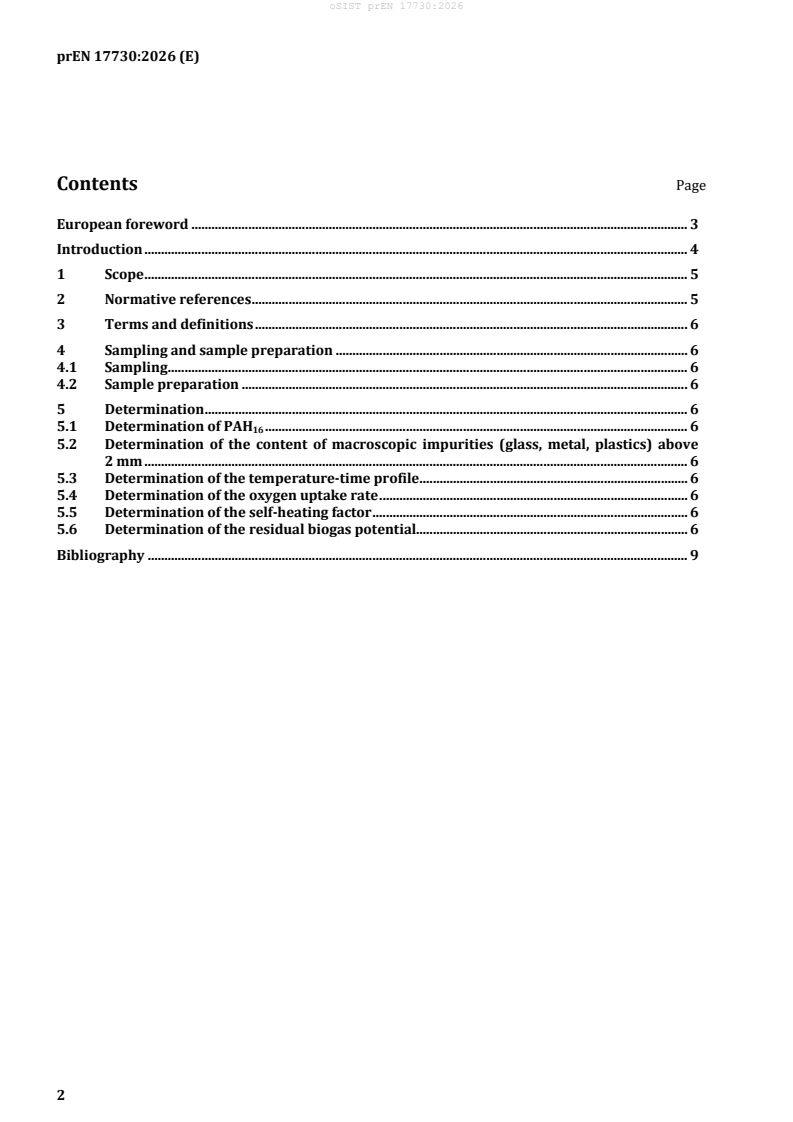
Contents Page
European foreword . 3
Introduction . 4
1 Scope . 5
2 Normative references . 5
3 Terms and definitions . 6
4 Sampling and sample preparation . 6
4.1 Sampling . 6
4.2 Sample preparation . 6
5 Determination . 6
5.1 Determination of PAH . 6
5.2 Determination of the content of macroscopic impurities (glass, metal, plastics) above
2 mm . 6
5.3 Determination of the temperature-time profile . 6
5.4 Determination of the oxygen uptake rate . 6
5.5 Determination of the self-heating factor . 6
5.6 Determination of the residual biogas potential. 6
Bibliography . 9
prEN 17730:2026 (E)
European foreword
This document (prEN 17730:2026) has been prepared by Technical Committee CEN/TC 223 “Soil
improvers and growing media”, the secretariat of which is held by NEN.
This document is currently submitted to the CEN Enquiry.
This document will supersede CEN/TS 17730:2022.
prEN 17730:2026 includes the following significant technical changes with respect to
CEN/TS 17730:2022:
— The title has been revised;
— The determination of the PAH content and the determination of temperature-time profiles during
composting and digestion have been included in the Scope;
— An applicability statement has been included in the Scope;
— Clause 2, Normative references, has been updated;
— The following has been added:
— Clause 5.1, Determination of PAH
— Clause 5.3, Determination of the temperature-time profile
— Clause 5.6, Determination of the residual biogas potential
— Annex ZA has been added.
This document has been prepared under a standardization request addressed to CEN by the European
Commission. The Standing Committee of the EFTA States subsequently approves these requests for its
Member States.
For the relationship with EU Legislation, see informative Annex ZA, which is an integral part of this
document.
prEN 17730:2026 (E)
Introduction
Different product functions warrant different product safety, quality and quantity requirements adapted
to their different intended uses. EU fertilizing products have therefore been divided into different product
function categories (PFCs), which are subject to specific safety, quality and quantity requirements, as
specified in the Regulation (EU) 2019/1009 [1]. EU fertilizing products consist of component materials
complying with the requirements for one or more of the component material categories (CMCs), as
specified in the Regulation (EU) 2019/1009 [1].
Compost has been classified as CMC 3, fresh crop digestate as CMC 4, and digestate other than fresh crop
digestate as CMC 5. The specific safety and quality requirements in relation to specific parameters are
specified in this document, as well as normative references of the test methods to be used to assess the
com
...