

SIST EN 17210:2021
(Main)Accessibility and usability of the built environment - Functional requirements
General Information
- Abstract
This document describes basic, minimum functional requirements and recommendations for an accessible and usable built environment, following "Design for All"/"Universal Design" principles which will facilitate equitable and safe use for a wide range of users, including persons with disabilities.
The requirements and recommendations given in this document are applicable across the full spectrum of the built environment.
These functional accessibility and usability requirements and recommendations are relevant to the design, construction, refurbishment or adaptation, and maintenance of built environments including outdoor pedestrian and urban areas.
NOTE 1 ‘Design for All’ and ‘Universal Design’ share a similar inclusive design philosophy. "Universal Design" means the design of products, environments, programmes and services to be usable by all people, to the greatest extent possible, without the need for adaptation or specialized design. "Universal Design" does not exclude assistive devices for particular groups of persons with disabilities where this is needed.
NOTE 2 Terms such as "design for all", "universal design", "accessible design", "barrier-free design", "inclusive design" and "transgenerational design" are often used interchangeably with the same meaning.
NOTE 3 This document does not cover management and maintenance issues, but provides basic information in Annex B.
NOTE 4 All figures are provided as examples. They are described by their title and key and do not provide additional information. Some figures show negative examples to be avoided; these are identified by the insertion of a red cross on them. A list of all the figures included is this document is given in the informative Annex C.
NOTE 5 In the case of refurbishment or adaptations of existing buildings or infrastructures, a specific study including feasibility determines the extent to which the functional requirements and recommendations can be met.
- Status
- Published
- Public Enquiry End Date
- 10-Jul-2019
- Publication Date
- 26-Jan-2021
- Technical Committee
- I11 - Imaginarni 11
- Current Stage
- 6060 - National Implementation/Publication (Adopted Project)
- Start Date
- 21-Jan-2021
- Due Date
- 28-Mar-2021
- Completion Date
- 27-Jan-2021

Overview
EN 17210:2021 - published by CEN - sets out basic, minimum functional requirements and recommendations for the accessibility and usability of the built environment. Grounded in Design for All/Universal Design principles, the standard aims to make buildings, outdoor pedestrian areas and urban infrastructure equitably safe and usable by a wide range of users, including persons with disabilities. EN 17210 is applicable to design, construction, refurbishment/adaptation and maintenance planning across the full spectrum of the built environment. The document includes informative annexes (e.g., Annex B on maintenance information) and notes that feasibility studies are needed when adapting existing structures.
Key topics and technical scope
EN 17210 covers a comprehensive set of functional topics relevant to accessible design, including:
- Wayfinding, signage and orientation (visual, tactile and audible information)
- Outdoor access: accessible routes, street furniture, crossings, plazas and shared spaces
- Arrival areas and parking: accessible parking locations, numbers and pedestrian links
- Horizontal and vertical circulation: entrances, corridors, doors, ramps, stairs, lifts, escalators and vertical platforms
- Sanitary accommodation: accessible toilets, showers and related facilities
- User interfaces and controls: public ICT screens, controls, switches and service counters
- Environmental conditions: lighting, acoustics and indoor air quality for usability
- Fire safety for all: evacuation concepts, assistive evacuation areas and emergency information
- Specific building types: hotels, auditoria, libraries, museums, retail, sports and heritage sites
- Explanatory content on legal/policy background, diversity of users, and Universal Design principles
The standard provides illustrative figures (including negative examples) and descriptive keys; figures are advisory and do not replace project-specific technical design.
Practical applications and users
EN 17210 is a practical reference for:
- Architects, urban planners and landscape designers
- Building engineers and contractors
- Facility and maintenance managers
- Accessibility consultants and occupational health specialists
- Public authorities, client bodies and procurement teams
- Heritage and transport planners
Use cases include new construction, major refurbishment, public realm design, transport interchange upgrades and accessibility audits. The standard helps embed accessibility at all project stages, informs specifications and supports compliance with national accessibility laws and procurement requirements.
Related standards and policy
EN 17210 complements other European and national accessibility regulations, CEN/CENELEC guidance and Universal Design frameworks. It should be used alongside local building codes and specialist technical standards when defining precise dimensions, materials and performance criteria for accessible design.
Relations
- Effective Date
- 09-Feb-2026
- Effective Date
- 28-Jan-2026
- Effective Date
- 28-Jan-2026
- Effective Date
- 28-Jan-2026
- Effective Date
- 28-Jan-2026
- Refers
SIST EN 115-1:2017 - Safety of escalators and moving walks - Part 1: Construction and installation - Effective Date
- 28-Jan-2026
- Effective Date
- 28-Jan-2026
- Effective Date
- 28-Jan-2026
- Effective Date
- 28-Jan-2026
- Effective Date
- 28-Jan-2026
- Effective Date
- 28-Jan-2026
- Effective Date
- 28-Jan-2026
- Effective Date
- 28-Jan-2026
- Effective Date
- 28-Jan-2026
- Effective Date
- 28-Jan-2026
Get Certified
Connect with accredited certification bodies for this standard

DIBt (Deutsches Institut für Bautechnik)
German Institute for Building Technology.
DIN CERTCO
DIN Group product certification.

Aboma Certification B.V.
Specialized in construction, metal, and transport sectors.
Sponsored listings
Frequently Asked Questions
SIST EN 17210:2021 is a standard published by the Slovenian Institute for Standardization (SIST). Its full title is "Accessibility and usability of the built environment - Functional requirements". This standard covers: This document describes basic, minimum functional requirements and recommendations for an accessible and usable built environment, following "Design for All"/"Universal Design" principles which will facilitate equitable and safe use for a wide range of users, including persons with disabilities. The requirements and recommendations given in this document are applicable across the full spectrum of the built environment. These functional accessibility and usability requirements and recommendations are relevant to the design, construction, refurbishment or adaptation, and maintenance of built environments including outdoor pedestrian and urban areas. NOTE 1 ‘Design for All’ and ‘Universal Design’ share a similar inclusive design philosophy. "Universal Design" means the design of products, environments, programmes and services to be usable by all people, to the greatest extent possible, without the need for adaptation or specialized design. "Universal Design" does not exclude assistive devices for particular groups of persons with disabilities where this is needed. NOTE 2 Terms such as "design for all", "universal design", "accessible design", "barrier-free design", "inclusive design" and "transgenerational design" are often used interchangeably with the same meaning. NOTE 3 This document does not cover management and maintenance issues, but provides basic information in Annex B. NOTE 4 All figures are provided as examples. They are described by their title and key and do not provide additional information. Some figures show negative examples to be avoided; these are identified by the insertion of a red cross on them. A list of all the figures included is this document is given in the informative Annex C. NOTE 5 In the case of refurbishment or adaptations of existing buildings or infrastructures, a specific study including feasibility determines the extent to which the functional requirements and recommendations can be met.
This document describes basic, minimum functional requirements and recommendations for an accessible and usable built environment, following "Design for All"/"Universal Design" principles which will facilitate equitable and safe use for a wide range of users, including persons with disabilities. The requirements and recommendations given in this document are applicable across the full spectrum of the built environment. These functional accessibility and usability requirements and recommendations are relevant to the design, construction, refurbishment or adaptation, and maintenance of built environments including outdoor pedestrian and urban areas. NOTE 1 ‘Design for All’ and ‘Universal Design’ share a similar inclusive design philosophy. "Universal Design" means the design of products, environments, programmes and services to be usable by all people, to the greatest extent possible, without the need for adaptation or specialized design. "Universal Design" does not exclude assistive devices for particular groups of persons with disabilities where this is needed. NOTE 2 Terms such as "design for all", "universal design", "accessible design", "barrier-free design", "inclusive design" and "transgenerational design" are often used interchangeably with the same meaning. NOTE 3 This document does not cover management and maintenance issues, but provides basic information in Annex B. NOTE 4 All figures are provided as examples. They are described by their title and key and do not provide additional information. Some figures show negative examples to be avoided; these are identified by the insertion of a red cross on them. A list of all the figures included is this document is given in the informative Annex C. NOTE 5 In the case of refurbishment or adaptations of existing buildings or infrastructures, a specific study including feasibility determines the extent to which the functional requirements and recommendations can be met.
SIST EN 17210:2021 is classified under the following ICS (International Classification for Standards) categories: 91.040.01 - Buildings in general. The ICS classification helps identify the subject area and facilitates finding related standards.
SIST EN 17210:2021 has the following relationships with other standards: It is inter standard links to SIST EN 60118-4:2015, SIST EN 13200-1:2019, SIST EN 81-76:2025, SIST-TP CEN/TR 15894:2009, SIST EN 81-70:2021+A1:2022, SIST EN 115-1:2017, SIST EN 12183:2022, SIST EN 81-72:2020, SIST EN 81-20:2020, SIST EN 12184:2022, SIST EN 16005:2024+A1:2024, SIST EN 54-23:2010, SIST EN 17984-6:2025, SIST EN 17680:2023, SIST EN 14504:2024. Understanding these relationships helps ensure you are using the most current and applicable version of the standard.
SIST EN 17210:2021 is associated with the following European legislation: Standardization Mandates: M/420. When a standard is cited in the Official Journal of the European Union, products manufactured in conformity with it benefit from a presumption of conformity with the essential requirements of the corresponding EU directive or regulation.
SIST EN 17210:2021 is available in PDF format for immediate download after purchase. The document can be added to your cart and obtained through the secure checkout process. Digital delivery ensures instant access to the complete standard document.
Standards Content (Sample)
SLOVENSKI STANDARD
01-marec-2021
Dostopnost in uporabnost grajenega okolja - Funkcionalne zahteve
Accessibility and usability of the built environment - Functional requirements
Barrierefreiheit und Nutzbarkeit der gebauten Umgebung. Funktionale Anforderungen
Ta slovenski standard je istoveten z: EN 17210:2021
ICS:
91.040.01 Stavbe na splošno Buildings in general
2003-01.Slovenski inštitut za standardizacijo. Razmnoževanje celote ali delov tega standarda ni dovoljeno.
EUROPEAN STANDARD
EN 17210
NORME EUROPÉENNE
EUROPÄISCHE NORM
January 2021
ICS 91.040.01
English version
Accessibility and usability of the built environment -
Functional requirements
Barrierefreiheit und Nutzbarkeit der gebauten
Umgebung - Funktionale Anforderungen
This European Standard was approved by CEN on 30 November 2020.
CEN and CENELEC members are bound to comply with the CEN/CENELEC Internal Regulations which stipulate the conditions for
giving this European Standard the status of a national standard without any alteration. Up-to-date lists and bibliographical
references concerning such national standards may be obtained on application to the CEN-CENELEC Management Centre or to
any CEN and CENELEC member.
This European Standard exists in three official versions (English, French, German). A version in any other language made by
translation under the responsibility of a CEN and CENELEC member into its own language and notified to the CEN-CENELEC
Management Centre has the same status as the official versions.
CEN and CENELEC members are the national standards bodies and national electrotechnical committees of Austria, Belgium,
Bulgaria, Croatia, Cyprus, Czech Republic, Denmark, Estonia, Finland, France, Germany, Greece, Hungary, Iceland, Ireland, Italy,
Latvia, Lithuania, Luxembourg, Malta, Netherlands, Norway, Poland, Portugal, Republic of North Macedonia, Romania, Serbia,
Slovakia, Slovenia, Spain, Sweden, Switzerland, Turkey and United Kingdom.
CEN-CENELEC Management Centre:
Rue de la Science 23, B-1040 Brussels
© 2021 CEN/CENELEC All rights of exploitation in any form and by any means Ref. No. EN 17210:2021 E
reserved worldwide for CEN national Members and for
CENELEC Members.
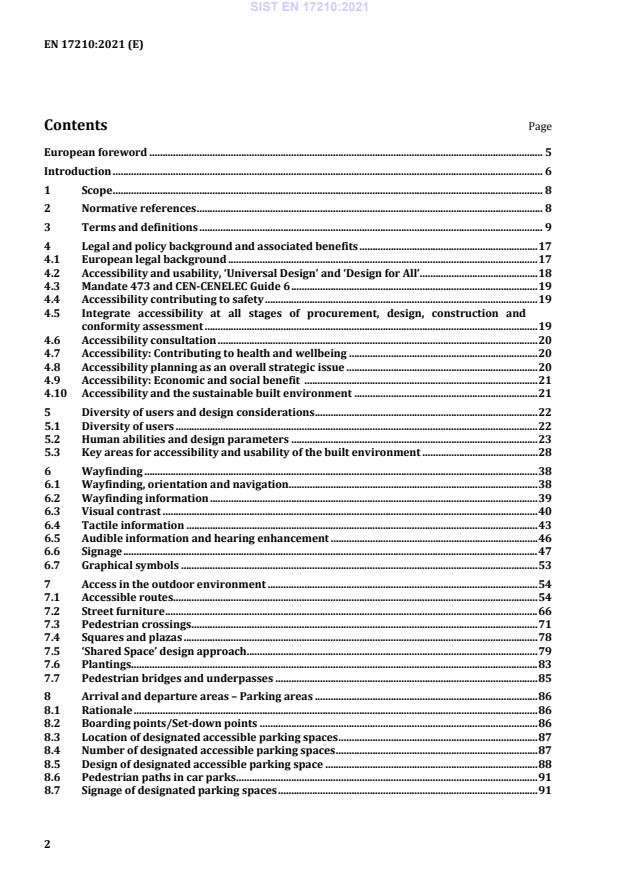
Contents Page
European foreword . 5
Introduction . 6
1 Scope . 8
2 Normative references . 8
3 Terms and definitions . 9
4 Legal and policy background and associated benefits . 17
4.1 European legal background . 17
4.2 Accessibility and usability, ‘Universal Design’ and ‘Design for All’ . 18
4.3 Mandate 473 and CEN-CENELEC Guide 6 . 19
4.4 Accessibility contributing to safety . 19
4.5 Integrate accessibility at all stages of procurement, design, construction and
conformity assessment . 19
4.6 Accessibility consultation . 20
4.7 Accessibility: Contributing to health and wellbeing . 20
4.8 Accessibility planning as an overall strategic issue . 20
4.9 Accessibility: Economic and social benefit . 21
4.10 Accessibility and the sustainable built environment . 21
5 Diversity of users and design considerations . 22
5.1 Diversity of users . 22
5.2 Human abilities and design parameters . 23
5.3 Key areas for accessibility and usability of the built environment . 28
6 Wayfinding . 38
6.1 Wayfinding, orientation and navigation. 38
6.2 Wayfinding information . 39
6.3 Visual contrast . 40
6.4 Tactile information . 43
6.5 Audible information and hearing enhancement . 46
6.6 Signage . 47
6.7 Graphical symbols . 53
7 Access in the outdoor environment . 54
7.1 Accessible routes. 54
7.2 Street furniture . 66
7.3 Pedestrian crossings . 71
7.4 Squares and plazas . 78
7.5 ‘Shared Space’ design approach. 79
7.6 Plantings. 83
7.7 Pedestrian bridges and underpasses . 85
8 Arrival and departure areas – Parking areas . 86
8.1 Rationale . 86
8.2 Boarding points/Set-down points . 86
8.3 Location of designated accessible parking spaces . 87
8.4 Number of designated accessible parking spaces . 87
8.5 Design of designated accessible parking space . 88
8.6 Pedestrian paths in car parks . 91
8.7 Signage of designated parking spaces . 91
8.8 Access from parking space to an adjacent higher pedestrian path . 91
8.9 Surface . 91
8.10 Indoor parking . 92
8.11 Cycle parking . 92
9 Horizontal circulation in buildings . 93
9.1 Entrances . 93
9.2 Corridors and passageways . 101
9.3 Doors . 107
9.4 Windows . 116
9.5 Patios, balconies, terraces . 118
9.6 Surface finishes and materials . 121
10 Vertical circulation in buildings and outdoors . 124
10.1 Ramps . 124
10.2 Steps and stairs . 129
10.3 Handrails . 133
10.4 Lifts . 137
10.5 Vertical and inclined lifting platforms . 145
10.6 Escalators and moving walks . 147
11 Specific indoor and outdoor areas, equipment and provisions . 148
11.1 Service counters for information, ticketing and reception . 148
11.2 Waiting and queuing areas . 152
11.3 Seating and resting areas . 153
11.4 Storage areas, lockers and baggage storage . 158
11.5 Kitchen areas and kitchenettes . 160
11.6 Facilities for assistance dogs (outdoor and indoor) . 162
12 Sanitary accommodation . 163
12.1 Accessible toilets . 163
12.2 Toilets for general use . 173
12.3 Sanitary facilities for other users . 174
12.4 Showers and bathrooms. 180
13 User interface, controls and switches . 183
13.1 Rationale . 183
13.2 Public ICT information screens . 184
13.3 ICT user interfaces . 185
13.4 Controls and switches . 187
13.5 Examples of general use elements . 188
14 Fire safety for all - Evacuation and emergency exits . 190
14.1 Concept for Fire safety for all . 190
14.2 Fire engineering design objectives . 191
14.3 Evacuation for all . 191
14.4 Assistive fire evacuation: Areas of rescue assistance . 193
14.5 Emerging fire evacuation technologies . 195
14.6 Fire defence plans. 195
14.7 Lifts for emergency evacuation . 195
14.8 Emergency warning systems, signals and information . 196
14.9 Emergency exit doors . 197
15 Environmental conditions in buildings . 197
15.1 Lighting . 197
15.2 Acoustics . 202
15.3 Indoor air quality . 208
16 Accommodation . 209
16.1 General . 209
16.2 Hotels . 209
16.3 Student accommodation . 213
16.4 Adaptable housing . 214
17 Cultural, leisure and sport buildings . 219
17.1 General . 219
17.2 Auditoriums, concert halls and similar . 219
17.3 Libraries . 222
17.4 Museums . 224
17.5 Heritage buildings and sites . 226
17.6 Retail and shopping buildings . 229
17.7 Sport facilities . 233
17.8 Restaurants, bars and cafés. 236
17.9 Swimming pools, saunas . 238
18 Administrative, service and employment buildings . 240
18.1 General . 240
18.2 Conference venues. 240
18.3 Offices . 241
18.4 Healthcare buildings . 242
18.5 Educational buildings . 247
18.6 Laboratories . 249
18.7 Banks, post offices . 250
18.8 Industrial buildings . 251
18.9 Courts, police stations and detention facilities . 252
18.10 Religious buildings . 254
19 Outdoor and urban areas . 255
19.1 General . 255
19.2 Playgrounds . 255
19.3 Garden, parks and nature parks . 256
19.4 Beaches . 258
20 Transport facilities . 262
20.1 General . 262
20.2 Taxi facilities . 262
20.3 Bus and Coach facilities . 263
20.4 Rail facilities . 266
20.5 Metro/underground facilities . 269
20.6 Tram and light rail facilities . 270
20.7 Airport facilities . 271
20.8 Ports facilities . 273
20.9 Cable car facilities . 276
20.10 Service stations . 276
Annex A (informative) Fire safety for all in buildings and assisted evacuation. 278
Annex B (informative) Management and maintenance issues . 280
Annex C (informative) List of figures . 283
Annex D (informative) A-deviations . 287
Bibliography. 290
European foreword
This document (EN 17210:2021) has been prepared by the Joint Technical Committee CEN-
CENELEC/JTC 11 “Accessibility in the built environment”, the secretariat of which is held by UNE.
This European Standard shall be given the status of a national standard, either by publication of an
identical text or by endorsement, at the latest by July 2021 and conflicting national standards shall be
withdrawn at the latest by January 2024.
Attention is drawn to the possibility that some of the elements of this document may be the subject of
patent rights. CEN shall not be held responsible for identifying any or all such patent rights.
This document has been prepared under Mandate M/420 given to CEN-CENELEC and ETSI by the
European Commission and the European Free Trade Association in support of European accessibility
requirements for public procurement in the built environment.
According to the CEN-CENELEC Internal Regulations, the national standards organizations of the
following countries are bound to implement this European Standard: Austria, Belgium, Bulgaria, Croatia,
Cyprus, Czech Republic, Denmark, Estonia, Finland, France, Germany, Greece, Hungary, Iceland, Ireland,
Italy, Latvia, Lithuania, Luxembourg, Malta, Netherlands, Norway, Poland, Portugal, Republic of North
Macedonia, Romania, Serbia, Slovakia, Slovenia, Spain, Sweden, Switzerland, Turkey and the United
Kingdom.
Introduction
This document has been developed in response to mandate M/420 of the European Commission,
providing a standard for procurement of an accessible and usable built environment. The main goal of
this document is to contribute to the implementation of the United Nations Convention on the Rights of
Persons with Disabilities (UNCRPD) in Europe.
The functional requirements and recommendations in this document are formulated with qualitative
terms and describe the objectives which have to be reached, based on the diversity that a wide range of
users presents (goals for protection) and can be used as criteria for awarding public contracts (in support
of the Public Procurement Directives) as well as for other purposes, i.e. for accessibility legislation. This
document does not prescribe or describe how these functional requirements should be met and thus it is
not intended that this document will conflict with national accessibility standards.
This document specifies a range of functional accessibility and usability requirements and
recommendations for many of the elements of construction, assembly, interior settings, components and
fittings, which comprise the built environment. These functional accessibility requirements relate to the
constructional aspects of outdoor pedestrian and urban areas, approaches and access to buildings, indoor
circulation and use of facilities within buildings, egress from buildings in the normal course of events, and
evacuation in the event of an emergency.
The functional accessibility and usability requirements in this document are based on the widest range
of user needs and target groups as identified in Phase I of Mandate M/420. These requirements support
the diversity of all persons and a life-course perspective, i.e. persons with physical impairments, persons
with sensory impairments, persons with allergies, persons with learning difficulties/cognitive
impairments and persons with mental-ill-health, persons with age-related conditions, but also persons
in different stages of life, as children, adults and older persons.
This document also specifies the functional accessibility and usability requirements and
recommendations to enable the use of wheeled mobility devices in the built environment. The type of
wheeled mobility devices to be facilitated, and consequently the amount of space to be allocated, may be
determined by national standards or regulations and/or a procuring body may specify the provision of
space for larger electric wheelchairs and mobility scooters in certain types of buildings.
For the purpose of this document, the term ’accessibility’ refers to both ‘accessibility and usability’.
For specific building uses (see Clauses 16 to 20), such as accommodation, cultural, leisure and sport use,
administrative, service and employment buildings, and outdoor and urban areas and transport facilities,
the basic functional accessibility requirements are supplemented by key requirements and
recommendations supported by other related standards or guidance documents.
This document is based to a great extent on ISO 21542:2011 Building construction – Accessibility and
usability of the built environment (under revision) and where not sufficient, supplemented with
references to alternative and/or complementary documents (identified in Phase I of Mandate M/420).
This document is intended to assist primarily public procurers and also architects, engineers, facility
managers, ergonomists and other stakeholders in their respective areas of work, enabling them to
require, specify, design and assess conformity related to the accessibility of the built environment, using
a common framework and a common language, thus ensuring accessibility for all.
As a general structure, explanations on the motives for the requirements and recommendations given in
this document are given in previous short informative ‘Rationale’, understood as a background.
The technical performance criteria to fulfil the functional requirements given in this document, based on
classes, detailed dimensions, etc. will be exemplified by a CEN-CENELEC Technical Report “Accessibility
and usability of the built environment - Technical performance criteria and specifications” (TR 1), currently
under development, and may also be determined by national building regulations, national standards, or
any other national guidance.
Another CEN-CENELEC Technical Report (TR 2) on the assessment of conformity to the functional
requirements given in this document and the technical specifications given in NWI JT011002 is currently
also under development.
1 Scope
This document describes basic, minimum functional requirements and recommendations for an
accessible and usable built environment, following "Design for All"/"Universal Design" principles which
will facilitate equitable and safe use for a wide range of users, including persons with disabilities.
The requirements and recommendations given in this document are applicable across the full spectrum
of the built environment.
These functional accessibility and usability requirements and recommendations are relevant to the
design, construction, refurbishment or adaptation, and maintenance of built environments including
outdoor pedestrian and urban areas.
NOTE 1 ‘Design for All’ and ‘Universal Design’ share a similar inclusive design philosophy. “Universal Design”
means the design of products, environments, programmes and services to be usable by all people, to the greatest
extent possible, without the need for adaptation or specialized design. “Universal Design” does not exclude assistive
devices for particular groups of persons with disabilities where this is needed.
NOTE 2 Terms such as "design for all", "universal design", "accessible design", "barrier-free design", "inclusive
design" and "transgenerational design" are often used interchangeably with the same meaning.
NOTE 3 This document does not cover management and maintenance issues, but provides basic information in
Annex B.
NOTE 4 All figures are provided as examples. They are described by their title and key and do not provide
additional information. Some figures show negative examples to be avoided; these are identified by the insertion of
a red cross on them. A list of all the figures included is this document is given in the informative Annex C.
NOTE 5 In the case of refurbishment or adaptations of existing buildings or infrastructures, a specific study
including feasibility determines the extent to which the functional requirements and recommendations can be met.
2 Normative references
The following documents are referred to in the text in such a way that some or all of their content
constitutes requirements of this document. For dated references, only the edition cited applies. For
undated references, the latest edition of the referenced document (including any amendments) applies.
EN 54-23, Fire detection and fire alarm systems - Part 23: Fire alarm dev ices - Visual alarm devices
EN 81-20, Safety rules for the construction and installation of lifts - Lifts for the transport of persons and
goods - Part 20: Passenger and goods passenger lifts
EN 81-70, Safety rules for the construction and installation of lifts - Particular applications for passenger
and goods passenger lifts - Part 70: Accessibility to lifts for persons including persons with disability
EN 81-72, Safety rules for the construction and installation of lifts - Particular applications for passenger
and goods passenger lifts - Part 72: Firefighters lifts
EN 115-1, Safety of escalators and moving walks - Part 1: Construction and installation
EN 12183, Manual wheelchairs - Requirements and test methods
EN 12184, Electrically powered wheelchairs, scooters and their chargers - Requirements and test methods
EN 13200-1, Spectator facilities - Part 1: General characteristics for spectator viewing area
EN 16005, Power operated pedestrian doorsets - safety in use - requirements and test methods
EN 301549, Accessibility requirements for ICT products and services
EN 60118-4, Electroacoustics - Hearing aids - Part 4: Induction-loop systems for hearing aid purposes -
System performance requirements (IEC 60118-4)
1)
EN 81-76 , Safety rules for the construction and installation of lifts - Particular applications for passengers
and goods passenger lifts - Part 76: Evacuation of persons with disabilities using lifts
CEN/TR 15894, Building hardware - Door fittings for use by children, elderly and disabled people in
domestic and public buildings - A guide for specifiers
3 Terms and definitions
For the purposes of this document, the following terms and definitions apply.
ISO and IEC maintain terminological databases for use in standardization at the following addresses:
— IEC Electropedia: available at http://www.electropedia.org/
— ISO Online browsing platform: available at https://www.iso.org/obp
3.1
accessibility
provision of buildings, parts of buildings, or outdoor built environments for people, regardless of
disability, age or gender, to be able to gain access to them, into them, to use them and exit from them
Note 1 to entry: Accessibility includes ease of independent approach, entry, evacuation and/or use of a building and
its services and facilities, and outdoor spaces by all of the potential users with an assurance of person health, safety
and welfare during the course of those activities.
[SOURCE: ISO 21542:2011, 3.2, modified]
3.2
accessible format
use of different presentations to make information accessible by the use of another sensory ability, e.g.
visual information presented in audio and tactile formats; audio information presented in visual formats
3.3
access statement
report that provides a framework to demonstrate how accessibility for all users is delivered in a
development and how design for all solutions have been adopted
3.4
area of rescue assistance
evacuation temporary refuge
building space directly adjoining, and visible from, a main vertical evacuation route, robustly and reliably
protected from heat, smoke and flame during and after a fire, where people requiring assistance can
temporarily wait with confidence for further information, instructions, and rescue assistance, without
obstructing or interfering with the evacuation of other building users
Note 1 to entry: “Robust” means structurally hardened and resistant to mechanical damage during the fire and for
a period of time afterwards, i.e. the cooling phase.
[SOURCE: ISO 21542:2011, 3.3]
1) Under preparation. Stage at the time of publication: prEN 81-76.
3.5
assistance dogs
dog, specifically trained to perform tasks to increase independence and to mitigate limitations of a person
with a disability and permanently paired with this person
Note 1 to entry: In some countries an assistance dog Is referred to as a service dog.
Note 2 to entry: Other animals can be used, but in this EN we use only “assistance dog”.
[SOURCE: CEN/TC 452 Approved Preliminary Work Item]
3.6
assisted evacuation
activity during an emergency when a designated person or persons provide(s) assistance to another
person to leave a building or a specific part of the built environment and to reach a ‘place of safety’
[SOURCE: ISO 21542:2011, 3.4, modified]
3.7
assistive product
product especially produced or generally available, for preventing, compensating for, monitoring,
relieving or neutralizing impairments, activity limitations and participation restrictions
EXAMPLE Devices, equipment, instruments, technology and software.
[SOURCE: ISO 21542:2011, 3.5]
3.8
assistive technology
assistive device
piece of equipment, product, system, hardware, software or service that is used to increase, maintain or
improve functional capabilities of persons with disabilities
Note 1 to entry: This can be acquired commercially off-the-shelf, modified or customized. The term includes
technical aids for persons with disabilities. Assistive devices do not eliminate an impairment but may lessen the
difficulty a person has in carrying out a task or activity in specific environments.
[SOURCE: CEN-CENELEC Guide 6:2014, 3.3, modified]
3.9
attention pattern
design of Tactile Walking Surface Indicator, calling attention to a hazard only, or to hazards and decision
points
Note 1 to entry: Attention patterns can be installed in the vicinity of pedestrian crossings, at-grade kerbs, railway
platforms, stairs, ramps, escalators, travellators, elevators, etc.
[SOURCE: ISO 23999:2012, 2.1, modified]
3.10
audio description
verbal narration that conveys the visual description of a presentation or performance
[SOURCE: ISO 21542:2011, 3.7]
3.11
bariatric patients
patients with large body weight requiring additional space and equipment to enable handling in health
care settings
3.12
built environment
external and internal environments and any element, component or fitting that is commissioned,
designed, constructed and managed for use by people
[SOURCE: ISO 21542:2011, 3.10, modified]
3.13
changing places toilet
room or facility with a toilet, hoist, basin, adult-sized changing bench and optional shower, for use by
people with complex and multiple impairments who require the help of assistants
[SOURCE: BS 8300-2:2018, 18.6 modified]
3.14
circulation space
unobstructed space available for people, including persons using mobility devices, to access, move
around in, and exit from any part of the built environment
[SOURCE: ISO 21542:2011, 3.11, modified]
3.15
contraflow
〈fire〉 emergency access by fire fighters or rescue teams into a building and towards a fire, while people
are still moving away from the fire and evacuating the building
[SOURCE: ISO 21542:2011, 3.14]
3.16
disorientation
permanent or temporary inability of people to orient themselves with regard to space, time and context
in either the built environment or virtual environment
Note 1 to entry: Acute disorientation brought on by the use of alcohol, “social” drugs and some medicines, or
dramatic alterations in a person's circumstances, e.g. involvement in a fire incident, is not uncommon. Long term
progressive disorientation is a symptom of a variety of psychological and/or neurological disorders.
[SOURCE: ISO 21542:2011, 3.15]
3.17
evacuation lift
lift designed to be used for the evacuation of persons with difficulty in using stairs, in automatic mode or
under the direction of building management, trained evacuation assistant or rescue services
2)
[SOURCE: EN 81-76:— , 3.3]
2) Under preparation. Stage at the time of publication: prEN 81-76:2019.
3.18
fire compartment
enclosed space, which may be subdivided, separated from adjoining spaces by fire barriers
[SOURCE: ISO 13943:2017, 3.120]
3.19
fire engineering strategy
coherent and purposeful arrangement of fire prevention, fire protection and fire management measures
which is developed in order to attain specified fire engineering design objectives
Note 1 to entry: Some “fire safety objectives” may be required by national legislation/regulations.
[SOURCE: ISO 21542:2011, 3.22]
3.20
fire prevention
measures intended to reduce the risk of an outbreak of fire in a building or outdoor built environment
Note 1 to entry: Fire prevention includes such secondary activities as fire research and education of the public
concerning fire hazards.
[SOURCE: ISO 21542:2011, 3.23 modified]
3.21
fire resistance
ability of an element of building construction, component or structure, to fulfil for a stated period of time
the required stability, integrity, thermal insulation and/or other expected duty specified, in a standard
fire resistance test
[SOURCE: ISO 8421-2:1987, 1,24 and ISO 15541:2016, 3.1, modified]
3.22
fire resisting door
door, that is designed to resist the passage of heat, smoke and flame for a specified time during a fire
3.23
footpath
path for the exclusive use of pedestrians and users of mobility devices, which is not adjacent to a
carriageway (road)
3.24
footway
part of the highway adjacent to the carriageway (road) on which the pedestrians and users of mobility
devices have exclusive access
3.25
functional requirements
type and level of functionality that is required by the widest range of users of a facility
[SOURCE: ISO 15686-10:2010, 3.12, modified]
3.26
going
〈stair〉 horizontal distance between two consecutive nosings, measured on the centre line
[SOURCE: ISO 21542:2011, 3.27]
3.27
going
〈ramp〉 horizontal distance between the start and finish of a flight of a ramp
[SOURCE: ISO 21542:2011, 3.28]
3.28
guiding pattern
design of tactile walking surface indicators to indicate a route from one place to another
Note 1 to entry: Guiding patterns can be used alone or in combination with attention pattern (3.8).
[SOURCE: ISO 21542:2011, 3.29 modified]
3.29
handrail
component of a stair or of a ramp or other building components that provides guidance, balance and
support
[SOURCE: ISO 6707-1:2017, 5.2.73 and ISO 21542:2011, 3.31]
3.30
hearing enhancement system
piece of equipment, product system, hardware, software or service that is used to increase, maintain or
improve listening capabilities of persons with hearing impairments
[SOURCE: ISO 21542:2011, 3.32, modified]
3.31
kerb ramp
construction, in the form of an inclined plane, that makes it possible to pass from road level to a footway
[SOURCE: ISO 21542:2011, 3.36, modified]
3.32
landing
level platform, structure at the end of a flight of stairs or a ramp, or at the entrance to a lift car or to a
lifting platform
[SOURCE: ISO 6701-1:2017, 3.3.5.23 and ISO 21542:2011, 3.38, modified]
3.33
levelling accuracy
...