

SIST EN 18206:2026
(Main)Algae and algae products - Methods of sampling and analysis - Determination of beta carotene and fucoxanthin content in microalgae
- Abstract
This document specifies a laboratory method for the determination of the carotenoid content in microalgae. This method is based on the principles of chlorophyll a determination described in EN 18034.
This method has been validated for the microalgae species Nannochloropsis and Phaodactylum. This document is only validated for betacarotene and fucoxanthin, but could be used for other carotenoids as well. Given small adaptations to be able to measure smaller concentrations, this method could also be used for macro algae.
NOTE This method has been validated in an interlaboratory study for the following carotenoids for levels of approximately 0,1 to 10 mg/g by weight:
− Beta-carotene;
− fucoxanthin.
For the validation, the following matrices were used:
− Nannochloropsis sp.;
− Phaedactylum.
For detailed information on the validation, see 9.2 and Annex B. Additionally, lutein was tested and Saccharina latissima was used as an additional matrix. However, these results could not be validated. The results of these studies have been included in informative Annex C.
- Status
- Published
- Public Enquiry End Date
- 09-Sep-2025
- Publication Date
- 29-Sep-2026
- Technical Committee
- I13 - Imaginarni 13
- Current Stage
- 6060 - National Implementation/Publication (Adopted Project)
- Start Date
- 29-Sep-2026
- Due Date
- 04-Dec-2026
- Completion Date
- 30-Sep-2026

SIST EN 18206:2026 is a CEN European Standard for measuring beta carotene and fucoxanthin in microalgae by a laboratory extraction and HPLC method. It specifies how to prepare the sample, verify carotenoid standards, run the chromatographic analysis, calculate the result, and report carotenoid content in mg/g dry weight for laboratories working with algae and algae products.
What does SIST EN 18206:2026 specify?
SIST EN 18206:2026 specifies a laboratory method for the determination of carotenoid content in microalgae. The method is based on the principles of chlorophyll a determination described in EN 18034, and its validated use is centered on beta-carotene and fucoxanthin.
The scope matters because it tells a laboratory what the method is meant to cover in practice. SIST EN 18206:2026 is validated for the microalgae species Nannochloropsis and Phaeodactylum, and the validation work supports beta-carotene and fucoxanthin at levels of about 0.1 to 10 mg/g by weight.
Sampling itself is not part of the method, and sample treatment is referenced to EN 17605:2022 with added handling conditions. The document also indicates that the method could be adapted for other carotenoids and, with small adaptations for lower concentrations, for macro algae.
| Annex | What it covers |
|---|---|
| Annex A | Carotenoid standards and standard curves for calibration |
| Annex B | Interlaboratory study results for beta-carotene and fucoxanthin in micro algae |
| Annex C | Interlaboratory study results for lutein in Nannochloropsis sp. and fucoxanthin in Saccharina |
What are the key requirements of SIST EN 18206:2026?
SIST EN 18206:2026 sets out a full analytical workflow, from handling the sample to reporting the result. In practice, the main requirements are about keeping the sample intact, running the extraction the same way, and using checked calibration standards so the result is traceable.
Sample handling and preparation
- Clause 7 states that the sample received by the laboratory shall not be damaged or changed during transport or storage. This matters because carotenoids can degrade, so the laboratory needs controlled handling from the start.
- Sample treatment is linked to EN 17605:2022, with fine grinding, transport on dry ice, and storage at -80 °C. The document also says to avoid long storage times and to protect samples from light and air.
- Three test portions are analysed so that a mean and standard deviation can be calculated, and the relative standard deviation should not exceed 10 %. This gives the laboratory a simple check on whether the replicate results are stable.
Extraction, standards, and calibration
- Clause 8.1 requires methanol extraction under a fume hood, using glass beads, vortexing, centrifugation, and four consecutive extractions pooled to 20 mL. In practice, this is the core step that pulls the carotenoids out of the biomass.
- Clause 8.2 requires the concentration of each carotenoid standard to be measured spectrophotometrically before calibration curves are prepared. That matters because the standard itself must be checked, not just accepted on supplier data.
- Clause 8.3 requires multipoint calibration with at least six dilutions, duplicate injections, and a linear calibration curve with a determination coefficient not below 0.99. A new curve is needed when the standard, carotenoid type, gradient, stationary phase, HPLC settings, or instrument location changes.
- Clause 8.4 adds routine quality checks at the start of a new HPLC sequence. The document uses known check solutions from the dilution series, and the measured concentration should not deviate by more than 10 % from the earlier value.
HPLC analysis, identification, and reporting
- Clause 8.5 gives two HPLC options. The triple gradient with a C18 stationary phase is recommended, while the double gradient with a C8 stationary phase is an alternative when the equipment cannot run the triple gradient.
- Detection is carried out at 440 nm with a photodiode array detector (PDA). The method identifies fucoxanthin and beta-carotene by matching retention time and spectra against the standards, with a maximum retention-time deviation of 5 %.
- Clause 9 calculates carotenoid concentration from the calibration curve and sample mass. This is what converts the chromatographic peak into a reported content in mg/g dry weight.
- Clause 10 requires the test report to identify the sample, state the sampling method if known, name SIST EN 18206:2026 and the chosen stationary phase and gradient, and give the result, uncertainty, and test date. That is the information a buyer, supplier, or audit team needs to interpret the number.
What terms does SIST EN 18206:2026 define?
- Carotenoid - an accessory pigment of the tetraterpenoid class, including carotenes and xanthophylls.
- Carotene - a carotenoid without oxygen; beta-carotene is one example.
- Xanthophyll - a carotenoid that contains oxygen; lutein is one example.
- Carotenoid standard - a solution with a defined concentration used to determine the analyte through standard curves.
- Pigment - any colouring matter in the cells and tissues of photosynthetic organisms.
- High Performance Liquid Chromatograph (HPLC) - the instrument used to separate the extracted carotenoids before detection.
- Photodiode Array detector (PDA) - the detector used to measure the separated compounds at 440 nm and compare their spectra.
Who uses SIST EN 18206:2026?
SIST EN 18206:2026 is used by laboratories and quality teams that need to measure carotenoids in microalgae and algae products. It is most relevant where the carotenoid content is part of product specification, batch release, incoming inspection, or method validation.
Typical users include:
- contract laboratories testing algae materials
- producers of algae and algae products or intermediates
- quality control and quality assurance teams
- buyers checking declared carotenoid content
- researchers and method developers working on algae analysis
The standard is relevant across the algae value chain described in the introduction, including food and feed, cosmetics, biopolymers, biofuel, and fertilizer/biostimulants applications.
Which standards are used with SIST EN 18206:2026?
- EN 17399 - provides the vocabulary used for algae and algae products.
- EN 17605:2022 - gives the sample treatment procedure that SIST EN 18206:2026 refers to, with added handling conditions for this method.
- EN 18034:2024 - supplies the chlorophyll a determination principles on which this method is based.
- ISO 5725-2:2025 - is used in the interlaboratory study analysis for precision and outlier treatment.
- AOAC collaborative study guidelines - support the validation approach used in the interlaboratory studies reported in the annexes.
What does the SIST EN 18206:2026 document contain?
SIST EN 18206:2026 contains a complete laboratory method, not just a result definition. The main clauses cover scope, references, terms, principle, apparatus, reagents, sampling and sample treatment, extraction, standard concentration measurement, calibration, quality control, HPLC analysis, calculation, and test report content.
The document also includes tables for reagents, columns, gradient conditions, detector settings, extinction coefficients, and validation results. Those tables are what a laboratory would use to set up the method in practice without having to invent its own operating conditions.
Annex A supports calibration by giving recommended carotenoid standards and calibration information. Annexes B and C give interlaboratory study data, precision figures, and conclusions, so readers can see how the method performed in tested matrices and which parts of the validation are informative only.
Relations
- Effective Date
- 28-Jan-2026
Get Certified
Connect with accredited certification bodies for this standard

BSI Group
BSI (British Standards Institution) is the business standards company that helps organizations make excellence a habit.

Bureau Veritas
Bureau Veritas is a world leader in laboratory testing, inspection and certification services.

DNV
DNV is an independent assurance and risk management provider.
Sponsored listings
Frequently Asked Questions
SIST EN 18206:2026 is a standard published by the Slovenian Institute for Standardization (SIST). Its full title is "Algae and algae products - Methods of sampling and analysis - Determination of beta carotene and fucoxanthin content in microalgae". This standard covers: This document specifies a laboratory method for the determination of the carotenoid content in microalgae. This method is based on the principles of chlorophyll a determination described in EN 18034. This method has been validated for the microalgae species Nannochloropsis and Phaodactylum. This document is only validated for betacarotene and fucoxanthin, but could be used for other carotenoids as well. Given small adaptations to be able to measure smaller concentrations, this method could also be used for macro algae. NOTE This method has been validated in an interlaboratory study for the following carotenoids for levels of approximately 0,1 to 10 mg/g by weight: − Beta-carotene; − fucoxanthin. For the validation, the following matrices were used: − Nannochloropsis sp.; − Phaedactylum. For detailed information on the validation, see 9.2 and Annex B. Additionally, lutein was tested and Saccharina latissima was used as an additional matrix. However, these results could not be validated. The results of these studies have been included in informative Annex C.
This document specifies a laboratory method for the determination of the carotenoid content in microalgae. This method is based on the principles of chlorophyll a determination described in EN 18034. This method has been validated for the microalgae species Nannochloropsis and Phaodactylum. This document is only validated for betacarotene and fucoxanthin, but could be used for other carotenoids as well. Given small adaptations to be able to measure smaller concentrations, this method could also be used for macro algae. NOTE This method has been validated in an interlaboratory study for the following carotenoids for levels of approximately 0,1 to 10 mg/g by weight: − Beta-carotene; − fucoxanthin. For the validation, the following matrices were used: − Nannochloropsis sp.; − Phaedactylum. For detailed information on the validation, see 9.2 and Annex B. Additionally, lutein was tested and Saccharina latissima was used as an additional matrix. However, these results could not be validated. The results of these studies have been included in informative Annex C.
SIST EN 18206:2026 is classified under the following ICS (International Classification for Standards) categories: 13.020.55 - Biobased products. The ICS classification helps identify the subject area and facilitates finding related standards.
SIST EN 18206:2026 has the following relationships with other standards: It is inter standard links to SIST EN ISO/ASTM 52945:2024. Understanding these relationships helps ensure you are using the most current and applicable version of the standard.
SIST EN 18206:2026 is associated with the following European legislation: Standardization Mandates: M/547. When a standard is cited in the Official Journal of the European Union, products manufactured in conformity with it benefit from a presumption of conformity with the essential requirements of the corresponding EU directive or regulation.
SIST EN 18206:2026 is available in PDF format for immediate download after purchase. The document can be added to your cart and obtained through the secure checkout process. Digital delivery ensures instant access to the complete standard document.
Standards Content (Sample)
SLOVENSKI STANDARD
01-november-2026
Alge in izdelki iz alg - Metode vzorčenja in analize - Ugotavljanje vsebnosti beta
karotena in fukoksantina v mikroalgah
Algae and algae products - Methods of sampling and analysis - Determination of beta
carotene and fucoxanthin content in microalgae
Algen und Algenprodukte - Verfahren zur Probenentnahme und Analyse - Bestimmung
des Gehalts an Fucoxanthin, Beta-Carotin und Lutein in Mikroalgen
Algues et produits à base d'algues - Méthodes d'échantillonnage et d'analyse -
Détermination de la teneur en fucoxanthine, bêta-carotène et lutéine
Ta slovenski standard je istoveten z: EN 18206:2026
ICS:
13.020.55 Biološki izdelki Biobased products
2003-01.Slovenski inštitut za standardizacijo. Razmnoževanje celote ali delov tega standarda ni dovoljeno.
EN 18206
EUROPEAN STANDARD
NORME EUROPÉENNE
September 2026
EUROPÄISCHE NORM
ICS 13.020.55
English Version
Algae and algae products - Methods of sampling and
analysis - Determination of beta carotene and fucoxanthin
content in microalgae
Algues et produits à base d'algues - Méthodes Algen und Algenprodukte - Verfahren zur
d'échantillonnage et d'analyse - Détermination de la Probenentnahme und Analyse - Bestimmung des
teneur en fucoxanthine, bêta-carotène et lutéine Gehalts an Fucoxanthin, Beta-Carotin und Lutein in
Mikroalgen
This European Standard was approved by CEN on 19 July 2026.
CEN members are bound to comply with the CEN/CENELEC Internal Regulations which stipulate the conditions for giving this
European Standard the status of a national standard without any alteration. Up-to-date lists and bibliographical references
concerning such national standards may be obtained on application to the CEN-CENELEC Management Centre or to any CEN
member.
This European Standard exists in three official versions (English, French, German). A version in any other language made by
translation under the responsibility of a CEN member into its own language and notified to the CEN-CENELEC Management
Centre has the same status as the official versions.
CEN members are the national standards bodies of Austria, Belgium, Bulgaria, Croatia, Cyprus, Czech Republic, Denmark, Estonia,
Finland, France, Germany, Greece, Hungary, Iceland, Ireland, Italy, Latvia, Lithuania, Luxembourg, Malta, Netherlands, Norway,
Poland, Portugal, Republic of North Macedonia, Romania, Serbia, Slovakia, Slovenia, Spain, Sweden, Switzerland, Türkiye and
United Kingdom.
EUROPEAN COMMITTEE FOR STANDARDIZATION
COMITÉ EUROPÉEN DE NORMALISATION
EUROPÄISCHES KOMITEE FÜR NORMUNG
CEN-CENELEC Management Centre: Rue de la Science 23, B-1040 Brussels
© 2026 CEN All rights of exploitation in any form and by any means reserved Ref. No. EN 18206:2026 E
worldwide for CEN national Members.
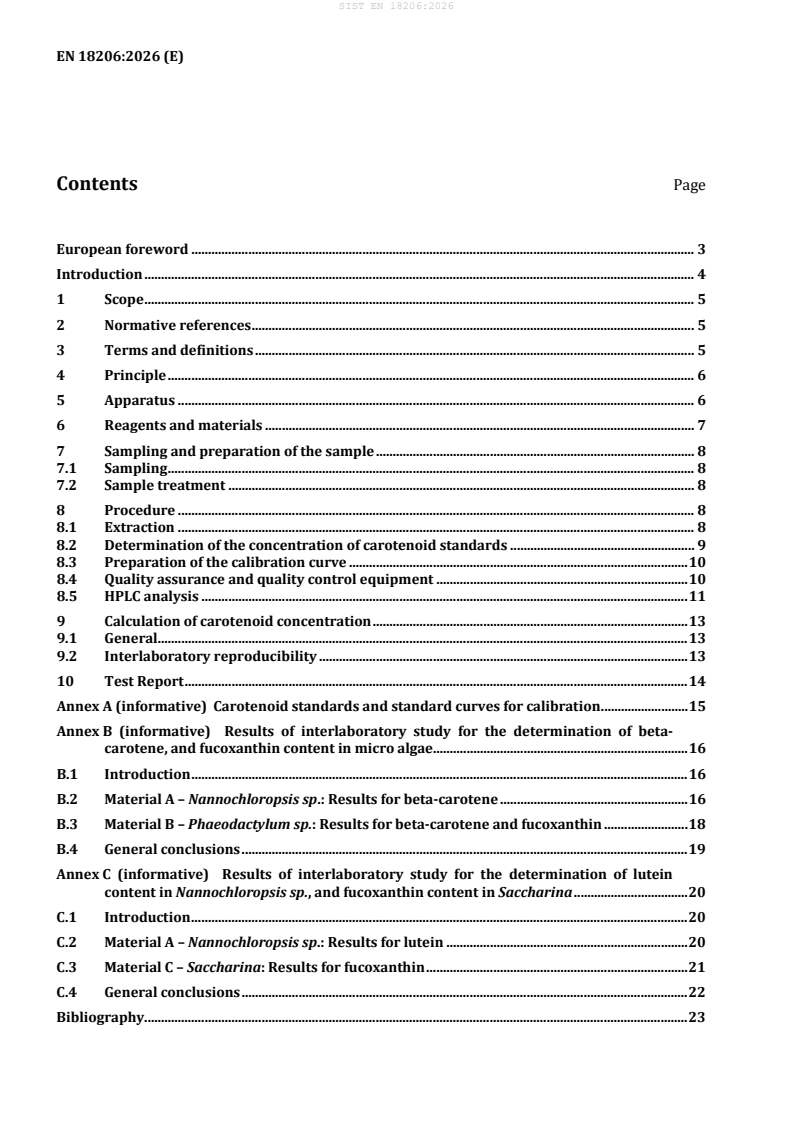
Contents Page
European foreword . 3
Introduction . 4
1 Scope . 5
2 Normative references . 5
3 Terms and definitions . 5
4 Principle . 6
5 Apparatus . 6
6 Reagents and materials . 7
7 Sampling and preparation of the sample . 8
7.1 Sampling . 8
7.2 Sample treatment . 8
8 Procedure . 8
8.1 Extraction . 8
8.2 Determination of the concentration of carotenoid standards . 9
8.3 Preparation of the calibration curve . 10
8.4 Quality assurance and quality control equipment . 10
8.5 HPLC analysis . 11
9 Calculation of carotenoid concentration . 13
9.1 General . 13
9.2 Interlaboratory reproducibility . 13
10 Test Report . 14
Annex A (informative) Carotenoid standards and standard curves for calibration . 15
Annex B (informative) Results of interlaboratory study for the determination of beta-
carotene, and fucoxanthin content in micro algae. 16
B.1 Introduction . 16
B.2 Material A – Nannochloropsis sp.: Results for beta-carotene . 16
B.3 Material B – Phaeodactylum sp.: Results for beta-carotene and fucoxanthin . 18
B.4 General conclusions . 19
Annex C (informative) Results of interlaboratory study for the determination of lutein
content in Nannochloropsis sp., and fucoxanthin content in Saccharina . 20
C.1 Introduction . 20
C.2 Material A – Nannochloropsis sp.: Results for lutein . 20
C.3 Material C – Saccharina: Results for fucoxanthin . 21
C.4 General conclusions . 22
Bibliography. 23
European foreword
This document (EN 18206:2026) has been prepared by Technical Committee CEN/TC 454 “Algae and
algae products”, the secretariat of which is held by NEN.
This European Standard shall be given the status of a national standard, either by publication of an
identical text or by endorsement, at the latest by March 2027, and conflicting national standards shall be
withdrawn at the latest by March 2027.
Attention is drawn to the possibility that some of the elements of this document may be the subject of
patent rights. CEN shall not be held responsible for identifying any or all such patent rights.
This document has been prepared under a standardization request addressed to CEN by the European
Commission.
Any feedback and questions on this document should be directed to the users’ national standards body.
A complete listing of these bodies can be found on the CEN website.
According to the CEN-CENELEC Internal Regulations, the national standards organisations of the
following countries are bound to implement this European Standard: Austria, Belgium, Bulgaria, Croatia,
Cyprus, Czech Republic, Denmark, Estonia, Finland, France, Germany, Greece, Hungary, Iceland, Ireland,
Italy, Latvia, Lithuania, Luxembourg, Malta, Netherlands, Norway, Poland, Portugal, Republic of North
Macedonia, Romania, Serbia, Slovakia, Slovenia, Spain, Sweden, Switzerland, Türkiye and the United
Kingdom.
Introduction
This document has been prepared by the experts of CEN/TC 454 'Algae and algae products'.
The European Committee for Standardization (CEN) was requested by the European Commission (EC) to
draft European standards or European standardization deliverables to support the implementation of
Article 3 of Directive 2009/28/EC for algae and algae-based products or intermediates.
This request, presented as Mandate M/547 , also contributes to the Communication on “Innovating for
Sustainable Growth: A Bio economy for Europe”.
The former working group CEN Technical Board Working Group 218 “Algae”, was created in 2016 to
develop a work programme as part of this Mandate. The technical committee CEN/TC 454 'Algae and
algae products' was established to carry out the work programme that will prepare a series of standards.
The interest in algae and algae-based products or intermediates has increased significantly in Europe as
a valuable source including but not limited to, carbohydrates, proteins, lipids, and several pigments.
These materials are suitable for use in a wide range of applications from food and feed purposes to other
sectors, such as textile, cosmetics, biopolymers, biofuel and fertilizer/biostimulants. Standardization was
identified as having an important role in order to promote the use of algae and algae products.
The work of CEN/TC 454 should improve the reliability of the supply chain, thereby improving the
confidence of industry and consumers in algae, which include macroalgae, microalgae, cyanobacteria,
Labyrinthulomycetes, algae-based products or intermediates and will promote and support
commercialisation of the European algae industry.
Given the importance of carotenoids in algae and algae products, it is important to have a good
standardized method to determine the amount of the carotenoids. Since there are a lot of carotenoids,
only the determination of beta-carotene and fucoxanthin is incorporated in this document.
Available at http://ec.europa.eu/growth/tools-databases/mandates/index.cfm?fuseaction=refSearch.search#
1 Scope
This document specifies a laboratory method for the determination of the carotenoid content in
microalgae. This method is based on the principles of chlorophyll a determination described in EN 18034.
This method has been validated for the microalgae species Nannochloropsis and Phaodactylum. This
document is only validated for betacarotene and fucoxanthin, but could be used for other carotenoids as
well. Given small adaptations to be able to measure smaller concentrations, this method could also be
used for macro algae.
NOTE This method has been validated in an interlaboratory study for the following carotenoids for levels of
approximately 0,1 to 10 mg/g by weight:
− Beta-carotene;
− fucoxanthin.
For the validation, the following matrices were used:
− Nannochloropsis sp.;
− Phaedactylum.
For detailed information on the validation, see 9.2 and Annex B. Additionally, lutein was tested and Saccharina
latissima was used as an additional matrix. However, these results could not be validated. The results of these
studies have been included in informative Annex C.
2 Normative references
The following documents are referred to in the text in such a way that some or all of their content
constitutes requirements of this document. For dated references, only the edition cited applies. For
undated references, the latest edition of the referenced document (including any amendments) applies.
EN 17399, Algae and algae products - Vocabulary
EN 17605:2022, Algae and algae products - Methods of sampling and analysis - Sample treatment
3 Terms and definitions
For the purpose of this document, the terms and definitions given in EN 17399 and the following apply.
ISO and IEC maintain terminological databases for use in standardization at the following addresses:
• ISO Online browsing platform: available at https://www.iso.org/obp
• IEC Electropedia: available at https://www.electropedia.org/
3.1
carotenoid
accessory pigment of the class of tetraterpenoids including carotenes and xanthophylls
3.2
carotene
unoxygenated (oxygen free) carotenoid
EXAMPLE 1 α-carotene.
EXAMPLE 2 β-carotene.
EXAMPLE 3 lycopene.
3.3
carotenoid standard
solution with defined concentration of the carotenoid of interest that is used to determine the analyte of
interest with the help of standard curves
Note 1 to entry: This is explained in further detail in Annex A.
3.4
pigment
any colouring matter in the cells and tissues of photosynthetic organisms
3.5
xanthophyll
carotenoid molecule containing oxygen
EXAMPLE 1 lutein.
EXAMPLE 2 zeaxanthin.
4 Principle
The carotenoids are extracted from the samples with methanol and separated using HPLC. The separated
components are analysed at 440 nm using a photodiode array detector. This method specifically aims at
determining beta-carotene and fucoxanthin content.
5 Apparatus
Usual laboratory apparatus and, in particular, the following:
5.1 Analytical balance, with an accuracy of preferably 0,01 mg.
5.2 High Performance Liquid Chromatograph (HPLC) with refrigerated sample changer and a
Photodiode Array detector (PDA).
5.3 Centrifuge.
5.4 Vortex.
5.5 Spectrophotometer.
5.6 Fume hood.
6 Reagents and materials
6.1 HPLC reagents
All reagents should be HPLC grade. For the triple gradient see 8.5.2.
6.1.1 Mixture of methanol with a volume fraction of 80 % and 0,5 M ammonium acetate buffer (pH
7.2) in purified water with a volume fraction of 20 %.
6.1.2 Mixture of acetonitrile with a volume fraction of 90 %, and purified water with a volume
fraction of 10 %.
6.1.3 Ethyl acetate
For the double gradient see 8.5.3.
6.1.4 Mixture of methanol with a volume fraction of 70 %, and 0,028 M tetrabutylammonium
acetate (TBAA) in purified water.
6.1.5 Methanol
6.1.6 Glass beads, ∅ 0,75 mm to 1 mm
6.2 HPLC column
For the triple gradient see 8.5.2.
6.2.1 C18 stationary phase, e.g. Nova-pak 4 μm (3,9 × 150 mm)
For the double gradient see 8.5.3.
NOTE Nova-pak is an example of a suitable product available commercially. This information is given for the
convenience of users of this document and does not constitute an endorsement by CEN of the product named.
Equivalent products may be used if they can be shown to lead to the same results.
6.2.2 C8 stationary phase e.g. Zorbax Eclipse XDB-C8 3,5 μm (4,6 × 150 mm)
NOTE Zorbax Eclipse is an example of a suitable product available commercially. This information is given for
the convenience of users of this document and does not constitute an endorsement by CEN of the product named.
Equivalent products may be used if they can be shown to lead to the same results.
6.3 Pyrex screw capped tubes, 10 mL (1 / test portion) and 20 mL (1 / test portion)
6.4 Micropipettes
6.5 Pasteur pipettes
6.6 HPLC vials and caps
6.7 Syringe with volume of 1 mL and PTFE or PVDF filters (0,20 μm, ∅ 15 mm)
6.8 Methanol with a volume fraction of ≥ 99,0 %
6.9 Quartz cuvettes
6.10 Carotenoid standards: for the identification and quantification of carotenoids (in particular: beta-
carotene and fucoxanthin content), that shall comply to the following quality parameters:
— a concentration range from 0,5 to 1,5 μg/ml;
— dissolved in solvent;
— transported on dry ice by the supplier;
— stored after arrival at least at −20 °C and preferably at −80 °C.
Recommendations for carotenoid standards are given in Annex A.
6.11 Aluminium foil
7 Sampling and preparation of the sample
7.1 Sampling
The sample received by the laboratory shall not be damaged or changed during transport or storage
Sampling is not part of the method specified in this document.
7.2 Sample treatment
Sample treatment is not part of the method specified in this document. A recommended sample handling
procedure is given in EN 17605:2022 with the following adaptations / additions:
— fine grinding shall be conducted as defined in 3.13 in EN 17605:2022;
— transport shall be performed on dry ice;
— storage shall be at −80 °C.
Extensive storage times of the test sample should be avoided. In case this could not be avoided, the test
sample should be freeze-dried again before usage.
Three test portions from the test sample shall be analysed as to be able to calculate the mean and standard
deviation. A maximum relative standard deviation of 10 % shall be obtained.
The samples shall be protected from light at any time before and during the analysis, by using e.g.
aluminium foil. The samples shall be protected from air by using e.g. a nitrogen blanket.
Samples shall not be stored for over one month, because storage can degrade carotenoids, even when the
samples are frozen.
8 Procedure
8.1 Extraction
The whole extraction procedure, except for the weighing, shall be performed under a fume hood.
The extraction procedure shall be conducted through the following steps:
1) Weigh a test portion of approximately 25 mg of the test sample in a 10 mL pyrex screw capped tube
(i.e. weight test portion);
2) Record the weight to the nearest 0,01 mg;
3) Add approximately 850 mg glass beads;
4) Add 5 mL methanol;
5) Vortex for 30 s;
6) Centrifuge at 450 g for 10 min;
7) Transfer the solvent to a 20 mL volumetric flask, e.g. by using a Pasteur pipette;
8) Leave the pellet in the 10 mL pyrex tube;
9) Repeat step 4) to 8) three more times, which should result in a pooled extract of 4 consecutive
extractions;
10) Add methanol to the volumetric flask until a volume of 20 mL is reached;
11) Transfer the contents of the volumetric flask to a 20 mL pyrex screw capped tube, e.g. by using a
Pasteur pipette;
12) Homogenize the pooled extract with a total volume of 20 mL by turning the tube upside down;
13) Transfer the extract to the HPLC vial with a syringe using a 0,20 μm filter.
The carotenoids concentration decreases during the storage of extracts, even at temperatures of −20 °C
and −80 °C. Therefore, extracts should be put on HPLC as soon as possible after the extraction.
8.2 Determination of the concentration of carotenoid standards
Before the preparation of the calibration curves, the concentration of the different carotenoid standards
shall be measured spectrophotometrically as described below using published extinction coefficients
found in Table 1.
Keep the different carotenoid standards in fume hood and far away from direct light.
The absorbance of each of the carotenoid standards is measured in a 1 cm cuvette at the standard’s
wavelength λ (given in Table 1) A (λ ) and at 750 nm A (750) to correct for light scattering. Note that
max i imax i
the absorbance at known λ of the carotenoids should be in the range of 0,2-0,8. If the absorbance is
max
outside this range then dilute the solution until the absorbance is within this range.
Also for newly purchased standards the concentration should be measured spectrophotometrically,
because some degradation can already have taken place after the concentration determin
...