

oSIST prEN 13209-2:2026
(Main)Child care articles - Baby carriers - Safety requirements and test methods - Part 2: Soft carrier
- Abstract
This document specifies the safety requirements and test methods for soft carriers without a framed support designed to carry one or two children hands free when attached to the carer’s torso.
If the soft carrier has functions not covered in this document, reference can be made to the relevant European Standard.
This document does not apply to garment or apparel carriers or carriers in the scope of prEN 13209-3:2026.
This document does not cover baby carriers designed for children with special needs.
- Status
- Not Published
- Public Enquiry End Date
- 19-Jul-2026
- Technical Committee
- OTR - Child use and care article
- Current Stage
- 4020 - Public enquire (PE) (Adopted Project)
- Start Date
- 14-May-2026
- Due Date
- 01-Oct-2026
- Completion Date
- 06-Aug-2026
- Directive
- 2001/95/EC - General product safety

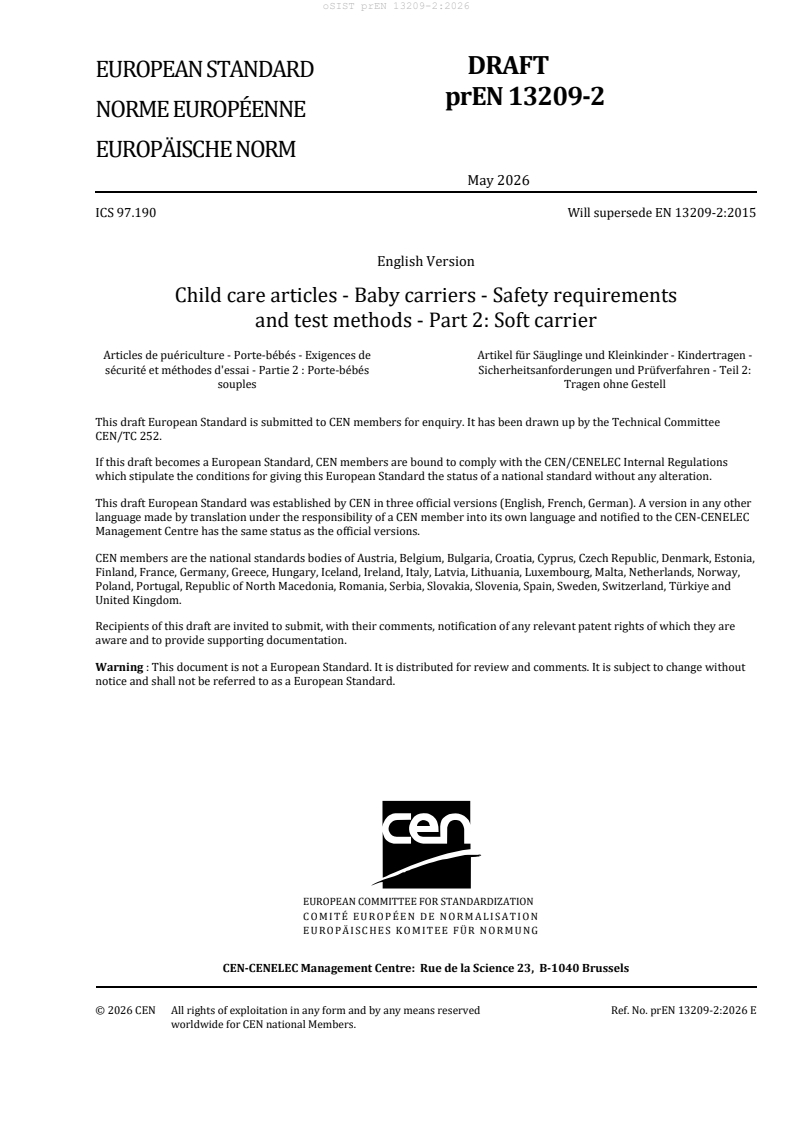
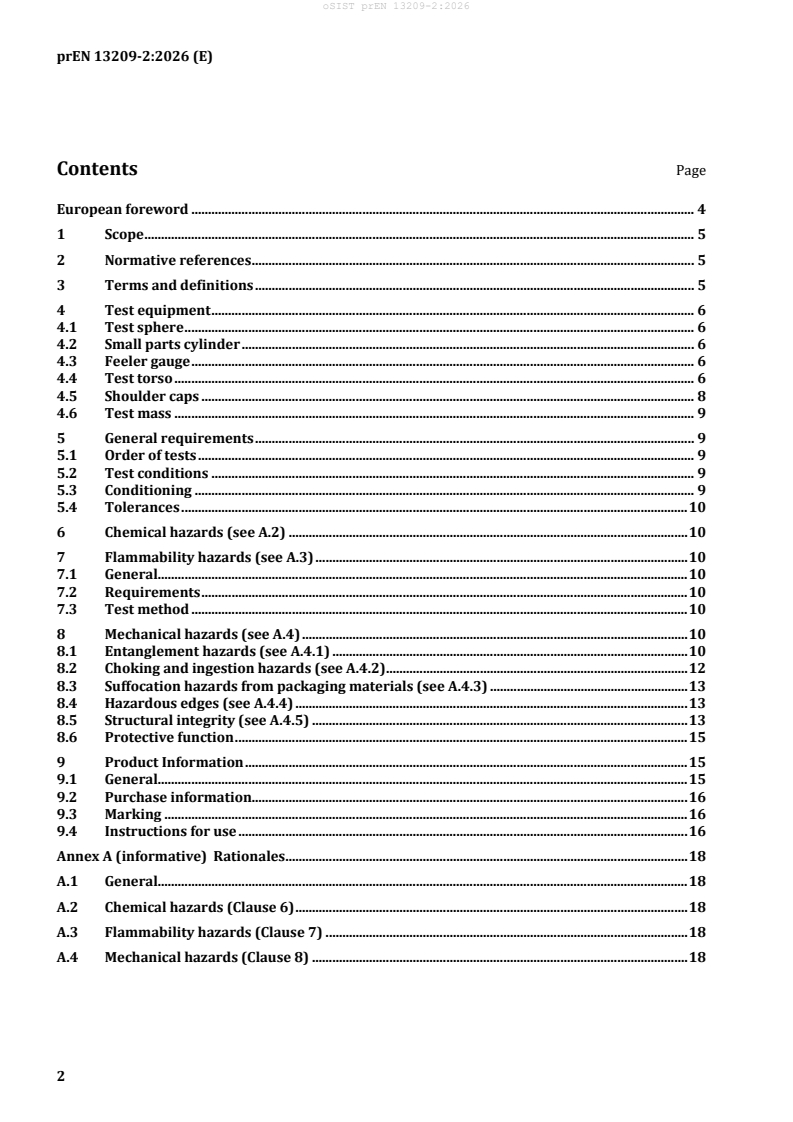
oSIST prEN 13209-2:2026 is the Slovenian publication of the CEN draft European Standard prEN 13209-2, prepared by SIST for child care articles. It specifies safety requirements and test methods for soft baby carriers without a framed support, intended to carry one or two children hands free when attached to the carer’s torso. It is aimed at manufacturers, test laboratories, quality teams, and buyers who need to check whether a soft carrier is designed, tested, marked, and supplied in line with the document.
What does oSIST prEN 13209-2:2026 specify?
oSIST prEN 13209-2:2026 specifies safety requirements and test methods for soft carriers without a framed support. It covers products for carrying one or two children hands free when attached to the carer’s torso, and it also sets out the product information that must accompany the carrier.
The document is organized into these main parts:
| Clause or annex | What it covers |
|---|---|
| 1 | Scope |
| 2 | Normative references |
| 3 | Terms and definitions |
| 4 | Test equipment |
| 5 | General requirements |
| 6 | Chemical hazards |
| 7 | Flammability hazards |
| 8 | Mechanical hazards |
| 9 | Product information |
| Annex A | Rationales |
| Annex ZA | Relationship with Regulation 2023/988/EU |
The scope excludes garment or apparel carriers, carriers in the scope of prEN 13209-3:2026, and baby carriers designed for children with special needs. If a soft carrier has other functions not covered here, the document points to the relevant European Standard for those functions.
What are the key requirements of oSIST prEN 13209-2:2026?
oSIST prEN 13209-2:2026 combines material, flame, mechanical, structural, and information requirements. In practice, that means a carrier is checked not only as a product but also as a user-facing item that must stay secure, avoid hazardous parts, and be supplied with clear warnings and instructions.
Test conditions, equipment, and conditioning
Clause 4 defines the main test equipment: a test sphere, small parts cylinder, feeler gauge, test torso, shoulder caps, and test mass. Clause 5 says tests are normally carried out on one fully assembled sample, in the order of the clause numbers, at 23 °C ± 10 °C, after the carrier has been washed and dried twice as instructed by the manufacturer.
This matters because the standard tests the carrier in a realistic state of use. For a designer or test lab, the conditioning and tolerances control how repeatable the results are.
Chemical and flammability hazards
Clause 6 requires chemical hazards to comply with EN 17826:2025 for migration of elements from exterior surfaces, and for textile parts in prolonged skin contact. Clause 7 requires soft carriers not to produce surface flash and limits the rate of spread of flame to 50 mm/s under EN 71-2:2020+A1:2025.
In practice, this means the materials in contact with a child, and the fabrics or coverings on the carrier, have to pass specific safety checks before the product can be claimed as conforming.
Mechanical hazards
Clause 8 covers the main physical safety risks. Clause 8.1 limits entanglement hazards by prohibiting extra child restraint systems beyond the closure and leg-opening mechanism, banning monofilament threads, and limiting the free length of cords, straps, ribbons, and loops. Clause 8.2 addresses choking and ingestion by checking detachable or loosened parts against the small parts cylinder, with grip assessment using the feeler gauge, torque testing, and tensile testing.
Clause 8.3 covers suffocation risks from packaging. Large plastic coverings must meet thickness or perforation requirements, and certain coverings need a suffocation warning and symbol. Clause 8.4 requires all edges to be rounded and free from burrs.
For a buyer or quality manager, these requirements show where the highest injury risks are concentrated: cords, detachable parts, packaging, and sharp edges.
Structural integrity and carrying security
Clause 8.5 checks that the carrier stays secure under load. The carrier is tested on the test torso with the shoulder caps where applicable, using a test mass equal to 150% of the maximum intended child weight for four hours. The carer’s attachment system must be adjustable, slippage must stay below 20 mm, and the carrier must withstand 50 000 cycles without release of the attachment system or fasteners used to secure the child.
This is the clause that most directly answers whether the product will stay in place during real use. It also shows that incremental size adjustments are not treated as separate configurations.
Protective function for the child
Clause 8.6 checks whether the carrier keeps the child safely positioned. The test sphere must not pass through any integral leg opening, and, where horizontal carrying is claimed, the sphere must not fall completely out of the carrier. Soft carriers intended for children up to 4 months of age must include head support, and carriers used in an essentially horizontal position must provide head protection against impact.
For practical use, this clause translates into stability of the child’s position, support for very young infants, and protection against slipping or impact in use.
Product information, markings, and instructions
Clause 9 requires all product information to be in the official language(s) of the country of sale. Purchase information must be visible at the point of sale, including the child’s minimum and maximum weight, minimum age, a health advice warning for low birthweight babies and children with medical conditions, the document reference, and the identification of the manufacturer, distributor, importer, or retailer.
Permanent marking and instructions must repeat key identification details, include cleaning and fitting guidance, state the intended weight and age range, and carry warnings about breastfeeding, suffocation, and falling hazards. For products worn on the back, the instructions must add a back-carry warning.
What terms does oSIST prEN 13209-2:2026 define?
- Soft carrier - A product without a framed support that is designed to hold the child in a predefined position when attached to the carer’s torso.
- Carer's attachment system - The straps, belts, fastenings, or similar parts that secure the carrier to the carer’s torso.
- Integral leg openings - Fully bound leg openings that are built into the product and exist before the carrier is fitted to the carer.
- Non-integral leg openings - Leg openings formed only when the carrier is installed on the carer’s torso.
- Test torso - The rigid body form used to simulate the carer during structural and slippage tests.
- Test mass - A sand-filled bag used to represent the maximum intended child weight during strength and durability testing.
Who uses oSIST prEN 13209-2:2026?
oSIST prEN 13209-2:2026 is used by manufacturers of baby carriers, testing laboratories, and conformity assessment teams that need to verify safety before placing a soft carrier on the market. It is also relevant to quality managers, importers, distributors, retailers, and responsible persons who handle product marking, warnings, and instructions.
In practice, users apply it when designing the carrier, selecting materials, planning type tests, checking packaging warnings, preparing purchase information, and reviewing whether the carrier can safely be used in the intended carrying positions.
What changed in oSIST prEN 13209-2:2026 from the previous edition?
oSIST prEN 13209-2:2026 supersedes EN 13209-2:2015. The foreword states these changes:
- the scope has been amended;
- EN 17826:2025 has been added to the normative references;
- the definition of soft carrier has been amended;
- Clause 6 has been updated to reference EN 17826:2025;
- Clauses 7 and A.3 have been renamed to flammability hazards and updated to EN 71-2:2020+A1:2025;
- Subclause 8.5 explains more clearly when shoulder caps are needed in testing;
- the total mass of 150% of the maximum intended weight is defined;
- testing with incremental adjustments is explained more clearly;
- the purpose of head support and head protection requirements is added;
- purchase information has been aligned with other TC 252 standards;
- the responsible person is recognized in 9.3 and 9.4.3;
- warnings about breastfeeding have been clarified;
- Annex A and the bibliography have been updated.
Which standards are used with oSIST prEN 13209-2:2026?
The normative references named in oSIST prEN 13209-2:2026 are:
- EN 71-2:2020+A1:2025 - provides the flammability test method and requirements used in Clause 7.
- EN 17826:2025 - provides the chemical hazard requirements used in Clause 6.
The bibliography also points readers to related standards and guidance, including the CEN/TS 13387 series for safety philosophy, chemical hazards, mechanical hazards, thermal hazards, and product information.
What does the oSIST prEN 13209-2:2026 document contain?
The document contains defined test equipment, test conditions, conditioning rules, and detailed methods for checking flammability, small parts, cords and loops, packaging, edges, structural strength, slippage, durability, leg openings, and head support. It also includes the purchase information, marking, and instructions for use that must accompany a conforming carrier.
Annex A gives the rationale behind the main safety requirements, which is useful when assessing why a requirement exists or how to interpret it during design reviews. Annex ZA maps the clauses to the essential safety requirements of Regulation 2023/988/EU for products within scope.
Relations
- Effective Date
- 01-Jul-2026
Frequently Asked Questions
oSIST prEN 13209-2:2026 is a draft published by the Slovenian Institute for Standardization (SIST). Its full title is "Child care articles - Baby carriers - Safety requirements and test methods - Part 2: Soft carrier". This standard covers: This document specifies the safety requirements and test methods for soft carriers without a framed support designed to carry one or two children hands free when attached to the carer’s torso. If the soft carrier has functions not covered in this document, reference can be made to the relevant European Standard. This document does not apply to garment or apparel carriers or carriers in the scope of prEN 13209-3:2026. This document does not cover baby carriers designed for children with special needs.
This document specifies the safety requirements and test methods for soft carriers without a framed support designed to carry one or two children hands free when attached to the carer’s torso. If the soft carrier has functions not covered in this document, reference can be made to the relevant European Standard. This document does not apply to garment or apparel carriers or carriers in the scope of prEN 13209-3:2026. This document does not cover baby carriers designed for children with special needs.
oSIST prEN 13209-2:2026 is classified under the following ICS (International Classification for Standards) categories: 97.190 - Equipment for children. The ICS classification helps identify the subject area and facilitates finding related standards.
oSIST prEN 13209-2:2026 has the following relationships with other standards: It is inter standard links to SIST EN 13209-2:2016. Understanding these relationships helps ensure you are using the most current and applicable version of the standard.
oSIST prEN 13209-2:2026 is associated with the following European legislation: EU Directives/Regulations: 2001/95/EC, 2023/988/EU; Standardization Mandates: M/264. When a standard is cited in the Official Journal of the European Union, products manufactured in conformity with it benefit from a presumption of conformity with the essential requirements of the corresponding EU directive or regulation.
oSIST prEN 13209-2:2026 is available in PDF format for immediate download after purchase. The document can be added to your cart and obtained through the secure checkout process. Digital delivery ensures instant access to the complete standard document.
Standards Content (Sample)
SLOVENSKI STANDARD
01-julij-2026
Izdelki za otroke - Oprema za nošenje dojenčkov - Varnostne zahteve in preskusne
metode - 2. del: Oprema za nošenje brez ogrodja
Child care articles - Baby carriers - Safety requirements and test methods - Part 2: Soft
carrier
Artikel für Säuglinge und Kleinkinder - Kindertragen - Sicherheitsanforderungen und
Prüfverfahren - Teil 2: Tragen ohne Gestell
Articles de puériculture - Porte-bébés - Exigences de sécurité et méthodes d'essai -
Partie 2 : Porte-bébés souples
Ta slovenski standard je istoveten z: prEN 13209-2
ICS:
97.190 Otroška oprema Equipment for children
2003-01.Slovenski inštitut za standardizacijo. Razmnoževanje celote ali delov tega standarda ni dovoljeno.
DRAFT
EUROPEAN STANDARD
NORME EUROPÉENNE
EUROPÄISCHE NORM
May 2026
ICS 97.190 Will supersede EN 13209-2:2015
English Version
Child care articles - Baby carriers - Safety requirements
and test methods - Part 2: Soft carrier
Articles de puériculture - Porte-bébés - Exigences de Artikel für Säuglinge und Kleinkinder - Kindertragen -
sécurité et méthodes d'essai - Partie 2 : Porte-bébés Sicherheitsanforderungen und Prüfverfahren - Teil 2:
souples Tragen ohne Gestell
This draft European Standard is submitted to CEN members for enquiry. It has been drawn up by the Technical Committee
CEN/TC 252.
If this draft becomes a European Standard, CEN members are bound to comply with the CEN/CENELEC Internal Regulations
which stipulate the conditions for giving this European Standard the status of a national standard without any alteration.
This draft European Standard was established by CEN in three official versions (English, French, German). A version in any other
language made by translation under the responsibility of a CEN member into its own language and notified to the CEN-CENELEC
Management Centre has the same status as the official versions.
CEN members are the national standards bodies of Austria, Belgium, Bulgaria, Croatia, Cyprus, Czech Republic, Denmark, Estonia,
Finland, France, Germany, Greece, Hungary, Iceland, Ireland, Italy, Latvia, Lithuania, Luxembourg, Malta, Netherlands, Norway,
Poland, Portugal, Republic of North Macedonia, Romania, Serbia, Slovakia, Slovenia, Spain, Sweden, Switzerland, Türkiye and
United Kingdom.
Recipients of this draft are invited to submit, with their comments, notification of any relevant patent rights of which they are
aware and to provide supporting documentation.
Warning : This document is not a European Standard. It is distributed for review and comments. It is subject to change without
notice and shall not be referred to as a European Standard.
EUROPEAN COMMITTEE FOR STANDARDIZATION
COMITÉ EUROPÉEN DE NORMALISATION
EUROPÄISCHES KOMITEE FÜR NORMUNG
CEN-CENELEC Management Centre: Rue de la Science 23, B-1040 Brussels
© 2026 CEN All rights of exploitation in any form and by any means reserved Ref. No. prEN 13209-2:2026 E
worldwide for CEN national Members.
Contents Page
European foreword . 4
1 Scope . 5
2 Normative references . 5
3 Terms and definitions . 5
4 Test equipment . 6
4.1 Test sphere . 6
4.2 Small parts cylinder . 6
4.3 Feeler gauge . 6
4.4 Test torso . 6
4.5 Shoulder caps . 8
4.6 Test mass . 9
5 General requirements . 9
5.1 Order of tests . 9
5.2 Test conditions . 9
5.3 Conditioning . 9
5.4 Tolerances . 10
6 Chemical hazards (see A.2) . 10
7 Flammability hazards (see A.3) . 10
7.1 General. 10
7.2 Requirements . 10
7.3 Test method . 10
8 Mechanical hazards (see A.4) . 10
8.1 Entanglement hazards (see A.4.1) . 10
8.2 Choking and ingestion hazards (see A.4.2) . 12
8.3 Suffocation hazards from packaging materials (see A.4.3) . 13
8.4 Hazardous edges (see A.4.4) . 13
8.5 Structural integrity (see A.4.5) . 13
8.6 Protective function . 15
9 Product Information . 15
9.1 General. 15
9.2 Purchase information. 16
9.3 Marking . 16
9.4 Instructions for use . 16
Annex A (informative) Rationales . 18
A.1 General. 18
A.2 Chemical hazards (Clause 6) . 18
A.3 Flammability hazards (Clause 7) . 18
A.4 Mechanical hazards (Clause 8) . 18
Annex ZA (informative) Relationship between this European Standard and the essential
requirements of Regulation 2023/988/EU aimed to be covered . 20
Bibliography . 23
European foreword
This document (prEN 13209-2:2026) has been prepared by Technical Committee CEN/TC 252 “Child use
articles”, the secretariat of which is held by AFNOR.
This document is currently submitted to the CEN Enquiry.
This document will supersede EN 13209-2:2015.
In comparison with the previous version, the following changes have been made:
— the Scope has been amended;
— reference to EN 17826:2025 has been added to the normative references;
— the definition of a ‘soft carrier’ has been amended;
— Clause 6 Chemical hazards updated to reference EN 17826:2025 and align with other CEN/TC 252
standards;
— Clauses 7 and A.3 renamed ‘Flammability hazards’ and the reference updated to
EN 71-2:2020+A1:2025 to address surface flash, flash over and rate of spread of flame;
— Subclause 8.5 updated to explain when the use of the shoulder caps during testing is required;
— the total mass of 150 % of the maximum weight intended for the product defined;
— testing of a carrier with incremental adjustments better explained;
— the purpose of the requirements for head support and head protection added;
— how the purchase information is provided updated to align with TC 252 standards;
— Subclauses 9.3 b) and 9.4.3 updated to recognize a responsible person;
— requirements in subclause 9.3 reordered for clarity;
— the warnings regarding breastfeeding in subclauses 9.3 and 9.4.2 have been improved for clarity;
— Clause A.2 Chemical hazards updated to align with the requirements in Clause 5 and to align with
other TC 252 standards;
— Subclause A.4.6 Structual integrity amended to better explain the risk;
— the Bibliography updated to reference relevant regulations.
This document has been prepared under a standardization request addressed to CEN by the European
Commission. The Standing Committee of the EFTA States subsequently approves these requests for its
Member States.
For the relationship with EU Legislation, see informative Annex ZA, which is an integral part of this
document.
1 Scope
This document specifies the safety requirements and test methods for soft carriers without a framed
support designed to carry one or two children hands free when attached to the carer’s torso.
If the soft carrier has functions not covered in this document, reference can be made to the relevant
European Standard.
This document does not apply to garment or apparel carriers or carriers in the scope of
prEN 13209-3:2026.
This document does not cover baby carriers designed for children with special needs.
2 Normative references
The following documents are referred to in the text in such a way that some or all of their content
constitutes requirements of this document. For dated references, only the edition cited applies. For
undated references, the latest edition of the referenced document (including any amendments) applies.
EN 71-2:2020+A1:2025, Safety of toys — Part 2: Flammability
EN 17826:2025, Child care articles — Chemical hazards — Requirements
3 Terms and definitions
For the purposes of this document, the following terms and definitions apply.
ISO and IEC maintain terminology databases for use in standardization at the following addresses:
— ISO Online browsing platform: available at https://www.iso.org/obp/
— IEC Electropedia: available at https://www.electropedia.org/
3.1
soft carrier
product without a framed support, incorporating a permanently designed element intended to support
the child in a predefined position(s), with or without integral leg openings, designed to carry the child
when the product is attached to the carer’s torso
3.2
carer's attachment system
fastenings, straps, belts or similar parts which are fitted to or are part of the soft carrier for the purpose
of securing the product to the carer's torso
3.3
integral leg openings
fully bound openings for each of the child’s legs which may be adjustable, which exist in the product and
are not formed by installing the soft carrier on the carer’s torso
3.4
non-integral leg openings
non-fully bound openings for the child’s legs which are formed only by installing the soft carrier on the
carer’s torso, between the soft carrier and the carer’s torso
4 Test equipment
4.1 Test sphere
Sphere made from a hard, smooth material of diameter (120 ± 2) mm and a mass of 2,27 kg.
4.2 Small parts cylinder
Cylinder with the dimensions given in Figure 1.
Dimensions in millimetres
Figure 1 — Small parts cylinder
4.3 Feeler gauge
Feeler gauge with thickness of (0,4 ± 0,02) mm, with the end to be inserted having a radius of
approximately 3 mm.
4.4 Test torso
Rigid torso made from a hard, smooth material with the dimensions specified in Figure 2.
The torso is fitted on a rigid plate which is capable of alternating vertical sinusoidal movement through
(120 ± 5) mm at a frequency of (2 ± 0,2) Hz.
Dimensions in millimetres
Figure 2 — Test torso
4.5 Shoulder caps
The shoulder caps are an additional element to the test torso. The shoulder caps shall be fitted one each
side of the test torso for testing soft carriers to be worn over the carer’s shoulder(s). See Figure 3 for
placement. The dimensions are given in Figure 4.
Dimensions in millimetres
Figure 3 — Shoulder caps
Figure 4 — Shoulder cap fitted to right hand side of test torso
4.6 Test mass
Bag filled with sand to a total mass of the maximum weight for which the manufacturer specifies the
product is suitable for, the shape and size of which shall be adjustable so that it can be firmly restrained
by the soft carrier.
5 General requirements
5.1 Order of tests
Unless otherwise stated, the specified tests shall be carried out on one sample in the order of the clause
numbers in this document.
5.2 Test conditions
The tests shall be carried out at a temperature of (23 ± 10) °C.
The tests shall be carried out on soft carriers that are fully assembled in accordance with the
manufacturer’s instructions and are ready for use.
5.3 Conditioning
Unless otherwise stated, the soft carrier shall be washed and dried twice in accordance with the
manufacturer’s instructions.
5.4 Tolerances
Unless otherwise stated, the following tolerances shall apply for testing and test equipment:
force: ± 5 %;
mass: ± 1 %;
dimension: ±1 mm;
time: ± 1 s;
angle: ± 1°.
6 Chemical hazards (see A.2)
The migration of elements from materials on exterior surfaces shall comply with EN 17826:2025, 4.2.
Parts made of textile materials intended to be in prolonged contact with the skin of the child shall comply
with EN 17826:2025, 4.4 and 4.6.
NOTE EN 17826:2025 4.1 gives a definition of prolonged skin contact.
If testing is required, a separate unconditioned sample may be used for these tests.
The rationale for these requirements is given in Annex A, A.2.
7 Flammability hazards (see A.3)
7.1 General
A separate unconditioned sample shall be used to assess these requirements.
7.2 Requirements
Soft carriers shall not produce surface flash when tested in accordance with EN 71-2:2020+A1:2025, 5.5.
Textiles, coated textile supports, and plastic coverings showing no sudden area of flame over the area
remote from the test flame are considered to meet this requirement.
Soft-filled toys shall be substituted by the soft carrier under test.
Soft carriers shall have a maximum rate of spread of flame of 50 mm/s when tested in accordance with
EN 71-2:2020+A1:2025, 5.5
A separate sample, conditioned according to 5.3, may be used for these tests.
7.3 Test method
To verify the surface flash effect, apply the test flame defined in EN 71-2:2020+A1:2025, 5.5 for (3 ± 0,5) s
to the soft carrier in different places likely to cause surface flash.
To verify rate of spread of flame, apply the test flame defined in EN 71-2:2020+A1:2025, 5.5.
8 Mechanical hazards (see A.4)
8.1 Entanglement hazards (see A.4.1)
8.1.1 General
There shall be no additional restraint systems for the child attached to the product, other than the
mechanism to close the soft carrier and create the leg openings.
Monofilament threads shall not be used.
8.1.2 Requirements
Cords, straps, ribbons and similar parts that are wider than 19 mm are excluded from these
requirements.
Cords, straps, ribbons and similar parts that are used to secure the product on to the carer’s torso are
excluded from these requirements.
Cords, straps, ribbons and similar parts shall have a maximum free length of 220 mm when tested in
accordance with 8.1.3.
Where cords, straps, ribbons and similar parts are attached to the product together or within 80 mm of
each other, any single cord shall have a maximum free length of 220 mm and the combined length from
one loose end to the end of another loose end shall be a maximum of 360 mm (see Figure 5).
Any loops shall have a maximum peripheral dimension of 360 mm when tested in accordance with 8.1.3.
The rationale for these requirements is given in A.4.1.
8.1.3 Test method
The length of cords, ribbons and similar parts is measured from the fixing point on the product to the free
end of the cord, ribbon or similar part whilst a 25 N tensile force is applied.
The peripheral dimension of a loop shall be measured whilst a 25 N tensile force is applied.
Key
D distance between attachment points
L length of cords, ribbons and parts used as ties
Figure 5 — Examples of measuring cords, ribbons or similar parts
8.2 Choking and ingestion hazards (see A.4.2)
8.2.1 Requirements
Any component not intended to be detachable, but which become detached, or any filling material that is
considered able to be gripped by a child when tested in accordance with 8.2.2.1 shall be tested in
accordance with 8.2.2.2 and 8.2.2.3.
Any component or part of a component or filling material that is removed shall not fit wholly in any
orientation, without compressing or manipulating it, within the small parts cylinder (see 4.1).
8.2.2 Test methods
8.2.2.1 Assessment of child’s ability to grip components
A component is considered capable of being gripped by a child if it can grip the component between its
thumb and forefinger or between its teeth.
Where it is difficult to assess whether a child can grip a component, establish whether it is capable of
being gripped by inserting the feeler gauge (see 4.2) between the component and the underlying layer or
body of the product at an angle between 0° and 10° from the surface of the underlying layer or product,
using a force of (10 ± 1) N. If the gauge can be inserted more than 2 mm, the component shall be
considered as capable of being gripped by the child.
If the component is able to be gripped, affix a suitable clamp behind the component, taking care not to
damage the attachment mechanism or the body of the soft carrier, and test in accordance with 8.2.2.2 and
8.2.2.3.
8.2.2.2 Torque test
Apply a torque gradually to the component within a period of 5 s in a clockwise direction until either:
a) rotation of 180° from the original position has been attained; or
b) torque of 0,34 Nm is reached.
The maximum rotation or required torque shall be applied for 10 s.
The component shall then be allowed to return to a relaxed condition and the procedure repeated in an
anticlockwise direction.
Where projections, components or assemblies are rigidly mounted on an accessible rod or shaft designed
to rotate together with the projections, components or assemblies, during the test the rod or shaft shall
be clamped to prevent rotation.
If a component attached by a screw thread becomes loosened during application of the required torque,
the torque shall continue to be applied until the required torque is exceeded or the component
disassembles or it becomes
...