

kSIST FprEN 17684:2026
(Main)Furniture - Electrically operated furniture - Stability, strength, durability and mechanical safety requirements
- Abstract
This document specifies stability, mechanical safety requirements and test methods for electrically operated furniture for indoor domestic and non-domestic use, including requirements on shear, compression, entrapment, strength and durability.
This document applies to electrically operated furniture for use in areas accessible by adults and children of all abilities, and domestic pets.
It is recognized that very vulnerable people and very young children can have needs beyond the level addressed in this document.
This document includes requirements related to all persons, including young children in and around the products and the associated hazards.
This document excludes considerations and requirements related to children playing with the furniture.
This document excludes considerations and requirements related to very young children operating the product.
This document excludes considerations and requirments related to furniture especially for use by children but includes furniture made for educational institutions.
The requirements in this document are intended to minimize the hazards that can occur during intended use and reasonably foreseeable misuse.
This document does not include requirements related to the electrical safety of the item of furniture.
In general, it does not take into account:
— damage to property or the environment.
This document does not apply to:
— seating incorporated in other machines,
— seats in vehicles,
— furniture for outdoor use.
If the electrically operated furniture has additional functions or can be converted into other products, other relevant European standards can apply.
If there are other relevant standards regarding mechanical safety for furniture, those apply.
This document is not applicable to any electrically operated furniture for medical purpose.
This document is not applicable to electrically operated furniture which is manufactured before the date of publication of this document.
This document does not deal with any specific requirements on noise emitted from furniture.
The generated noise is not considered to be a relevant hazard. Thus, the emission sound pressure level LpA is considered to be LpA ≤ 70 dB(A).
Wherever the term "furniture" is used in this document, it means electrically operated furniture.
- Status
- Not Published
- Public Enquiry End Date
- 02-Aug-2022
- Technical Committee
- POH - Furniture
- Current Stage
- 5020 - Formal vote (FV) (Adopted Project)
- Start Date
- 24-Nov-2026
- Due Date
- 12-Jan-2027

kSIST FprEN 17684:2026 is a SIST standard for electrically operated furniture. It specifies stability, strength, durability and mechanical safety requirements, together with test methods and user information, for indoor domestic and non-domestic furniture used by adults, children of all abilities and domestic pets. In practice, it helps manufacturers, test laboratories, buyers and safety authorities assess hazards from moving parts, overturning, shear, compression and structural failure.
What does kSIST FprEN 17684:2026 specify?
kSIST FprEN 17684:2026 specifies mechanical safety requirements and test methods for electrically operated furniture, and it organizes them into clauses on scope, normative references, terms, hazard identification, safety requirements, user information and marking.
The scope covers electrically operated furniture for indoor domestic and non-domestic use. It excludes electrical safety, outdoor furniture, seating incorporated in other machines, seats in vehicles, furniture for medical purpose, and furniture manufactured before the publication date. It also separates mechanical safety from child-play issues and from very young children operating the product.
| Annex | What it covers |
|---|---|
| Annex A | Significant hazards, hazardous situations and hazardous events covered by the document |
| Annex B | Normative test methods for finger entrapment and hole assessment |
| Annex C | Background and rationale for furniture standards |
| Annex ZA | Relationship with Directive 2006/42/EC |
What are the key requirements of kSIST FprEN 17684:2026?
kSIST FprEN 17684:2026 is built around a risk-based approach. Clause 4 requires hazard identification, risk assessment and risk reduction, and Clause 5 turns that into concrete stability, surface, shear/compression and durability requirements.
Clause 4 - hazard identification and risk reduction
Clause 4 requires a hazard analysis and a risk assessment that considers intended operation, maintenance, setting, cleaning, unexpected start-up, access from all directions, foreseeable misuse, control-system failure and any application-specific hazards. The document expects risks to be reduced first by design or substitution, then by guarding and other protective measures, and finally by warnings, signs or training for residual risks. In practice, manufacturers need to think through how the furniture is used, adjusted and maintained, not only how it is built.
Clause 5.2 - stability
Clause 5.2 requires seating, tables, storage furniture, beds, screens and writing boards to resist overturning. For each product family, the clause points to the relevant furniture standard used to verify stability, such as the standards for domestic, non-domestic, office, educational and outdoor furniture. In practice, this means the manufacturer must select the correct product family and prove the item stays stable in the intended use case.
Clause 5.3 - edges, holes, shear and compression
Clause 5.3 requires contact surfaces to avoid injury, so accessible edges must be rounded or chamfered where users touch them and other accessible edges must not have burrs or sharp edges. It also addresses holes in accessible tubular or rigid components and uses a probe-based method in Annex B to judge whether a finger entrapment hazard exists. For moving parts, the clause sets safe zones for fingers, hands, feet, head and torso, and if the gaps cannot be maintained the design must use guarding, force limits, speed limits or a hold-to-run control. That matters because many electrically operated furniture hazards come from closing gaps and moving parts rather than from the furniture shape alone.
Clause 5.4 - strength and durability
Clause 5.4 requires the furniture to remain safe during and after testing: no fractures of members, joints or components, no loosening of rigid joints, no significant deformation that affects safety, and no residual hazard from damage. Product-specific test programs are taken from the relevant furniture standards for seating, tables, storage furniture, beds, screens and writing boards. Electrically operated functions that are not already covered elsewhere are cycled with the declared nominal load. In practice, this is the clause that checks whether the furniture survives real use over time without becoming unsafe.
Clause 6 - user information
Clause 6 requires the manufacturer to provide user information in line with EN ISO 12100. The manual must include warnings about moving parts, children, unsupervised children under 4 years of age, operation by children under 4 years of age, pets before operation, and disconnecting the product before moving or cleaning. It also requires practical information such as safe positioning, controls, safety features, use restrictions, residual hazards, assembly, installation and maintenance. This matters because safe use depends on correct installation, correct operation and clear warnings.
Clause 7 - marking
Clause 7 requires durable and legible marking with the manufacturer identity, mandatory marking, model or serial reference and year of manufacture. The note states that, for products intended for the EEA, the mandatory marking is the CE marking as defined in the Machinery Directive. That helps trace the product and its responsible supplier throughout its life.
What terms does kSIST FprEN 17684:2026 define?
- Very young children - young persons aged from 0 up to and including 3 years.
- Young children - young persons older than 3 years and younger than 8 years.
- Older children - young persons aged from 8 years up to and including 14 years.
- Stability - the ability to withstand forces that tend to overturn the furniture.
- Overturn - the point at which furniture pivots and continues to fall.
- Nominal load - the load capacity declared by the manufacturer.
- Electrically operated functions - movement of furniture parts by electrical actuators, such as drawers, tabletops or reclining seats.
- Leading edge - the closing edge of two components that can create accessible shear or compression points.
Who uses kSIST FprEN 17684:2026?
kSIST FprEN 17684:2026 is aimed mainly at electrically operated furniture manufacturers, including small, medium and large enterprises. It is also relevant for health and safety bodies, regulators and market surveillance organizations that check whether products are safe.
In practice, buyers, test laboratories, designers, maintenance providers, employers and consumers use it to select product types, plan testing, prepare technical files, write instructions and verify safe installation and use. It is especially relevant for seating, tables, storage furniture, beds, screens and writing boards used in domestic, office, educational and non-domestic settings.
Which standards are used with kSIST FprEN 17684:2026?
kSIST FprEN 17684:2026 relies on EN ISO 12100 for the general process of risk assessment and risk reduction, and on prEN IEC 60335-2-116 for electrical safety of furniture with electrically motorised parts.
| Standard | What it contributes |
|---|---|
| EN 527-2 | Safety, strength and durability requirements for office work tables |
| EN 581-2 | Mechanical safety requirements and test methods for outdoor seating |
| EN 581-3 | Mechanical safety requirements for outdoor tables |
| EN 747-1 | Safety, strength and durability for bunk beds and high beds |
| EN 1023-2 | Mechanical safety requirements for office screens |
| EN 1129-1 | Safety requirements and testing for foldaway beds |
| EN 1335-2 | Safety requirements for office work chairs |
| EN 1725 | Safety requirements and test methods for domestic beds and mattresses |
| EN 1729-2 | Safety requirements and test methods for chairs and tables for educational institutions |
| EN 1730 | Test methods for tables, including stability and height-adjustment mechanisms |
| EN 12520 | Requirements for domestic seating and domestic tables |
| EN 12521 | Requirements for domestic tables |
| EN 13150 | Dimensions, safety and durability for laboratory workbenches in educational institutions |
| EN 13759 | Test methods for operating mechanisms for seating and sofa-beds |
| EN 14073-2 | Safety requirements for office storage furniture |
| EN 14434 | Ergonomic, technical and safety requirements for writing boards |
| EN 14749 | Safety requirements and test methods for domestic and kitchen storage units and kitchen-worktops |
| EN 15372 | Requirements for non-domestic tables |
| EN 16121 | Safety, strength, durability and stability for non-domestic storage furniture |
| EN 16139 | Strength, durability and safety requirements for non-domestic seating |
| EN 17191 | Safety requirements and test methods for children’s seating |
What does the kSIST FprEN 17684:2026 document contain?
kSIST FprEN 17684:2026 contains the full mechanical safety structure for electrically operated furniture, with product-specific clauses for seating, tables, storage furniture, beds, screens and writing boards. It includes a hazard list in Annex A, a probe-based finger entrapment method in Annex B, and background material in Annex C that explains why electrically operated furniture is treated as a furniture safety topic with machine-safety aspects.
The body of the standard also contains tables and cross-references for stability, forces, speeds and cycle testing, so users can match a product type to the right verification method without inventing their own test plan. Annex ZA links the standard to Directive 2006/42/EC, which is useful when the furniture is placed on the market as machinery-related product.
Frequently Asked Questions
kSIST FprEN 17684:2026 is a draft published by the Slovenian Institute for Standardization (SIST). Its full title is "Furniture - Electrically operated furniture - Stability, strength, durability and mechanical safety requirements". This standard covers: This document specifies stability, mechanical safety requirements and test methods for electrically operated furniture for indoor domestic and non-domestic use, including requirements on shear, compression, entrapment, strength and durability. This document applies to electrically operated furniture for use in areas accessible by adults and children of all abilities, and domestic pets. It is recognized that very vulnerable people and very young children can have needs beyond the level addressed in this document. This document includes requirements related to all persons, including young children in and around the products and the associated hazards. This document excludes considerations and requirements related to children playing with the furniture. This document excludes considerations and requirements related to very young children operating the product. This document excludes considerations and requirments related to furniture especially for use by children but includes furniture made for educational institutions. The requirements in this document are intended to minimize the hazards that can occur during intended use and reasonably foreseeable misuse. This document does not include requirements related to the electrical safety of the item of furniture. In general, it does not take into account: — damage to property or the environment. This document does not apply to: — seating incorporated in other machines, — seats in vehicles, — furniture for outdoor use. If the electrically operated furniture has additional functions or can be converted into other products, other relevant European standards can apply. If there are other relevant standards regarding mechanical safety for furniture, those apply. This document is not applicable to any electrically operated furniture for medical purpose. This document is not applicable to electrically operated furniture which is manufactured before the date of publication of this document. This document does not deal with any specific requirements on noise emitted from furniture. The generated noise is not considered to be a relevant hazard. Thus, the emission sound pressure level LpA is considered to be LpA ≤ 70 dB(A). Wherever the term "furniture" is used in this document, it means electrically operated furniture.
This document specifies stability, mechanical safety requirements and test methods for electrically operated furniture for indoor domestic and non-domestic use, including requirements on shear, compression, entrapment, strength and durability. This document applies to electrically operated furniture for use in areas accessible by adults and children of all abilities, and domestic pets. It is recognized that very vulnerable people and very young children can have needs beyond the level addressed in this document. This document includes requirements related to all persons, including young children in and around the products and the associated hazards. This document excludes considerations and requirements related to children playing with the furniture. This document excludes considerations and requirements related to very young children operating the product. This document excludes considerations and requirments related to furniture especially for use by children but includes furniture made for educational institutions. The requirements in this document are intended to minimize the hazards that can occur during intended use and reasonably foreseeable misuse. This document does not include requirements related to the electrical safety of the item of furniture. In general, it does not take into account: — damage to property or the environment. This document does not apply to: — seating incorporated in other machines, — seats in vehicles, — furniture for outdoor use. If the electrically operated furniture has additional functions or can be converted into other products, other relevant European standards can apply. If there are other relevant standards regarding mechanical safety for furniture, those apply. This document is not applicable to any electrically operated furniture for medical purpose. This document is not applicable to electrically operated furniture which is manufactured before the date of publication of this document. This document does not deal with any specific requirements on noise emitted from furniture. The generated noise is not considered to be a relevant hazard. Thus, the emission sound pressure level LpA is considered to be LpA ≤ 70 dB(A). Wherever the term "furniture" is used in this document, it means electrically operated furniture.
kSIST FprEN 17684:2026 is classified under the following ICS (International Classification for Standards) categories: 97.140 - Furniture. The ICS classification helps identify the subject area and facilitates finding related standards.
kSIST FprEN 17684:2026 is associated with the following European legislation: EU Directives/Regulations: 2006/42/EC, 2023/1230; Standardization Mandates: M/396, M/605. When a standard is cited in the Official Journal of the European Union, products manufactured in conformity with it benefit from a presumption of conformity with the essential requirements of the corresponding EU directive or regulation.
kSIST FprEN 17684:2026 is available in PDF format for immediate download after purchase. The document can be added to your cart and obtained through the secure checkout process. Digital delivery ensures instant access to the complete standard document.
Standards Content (Sample)
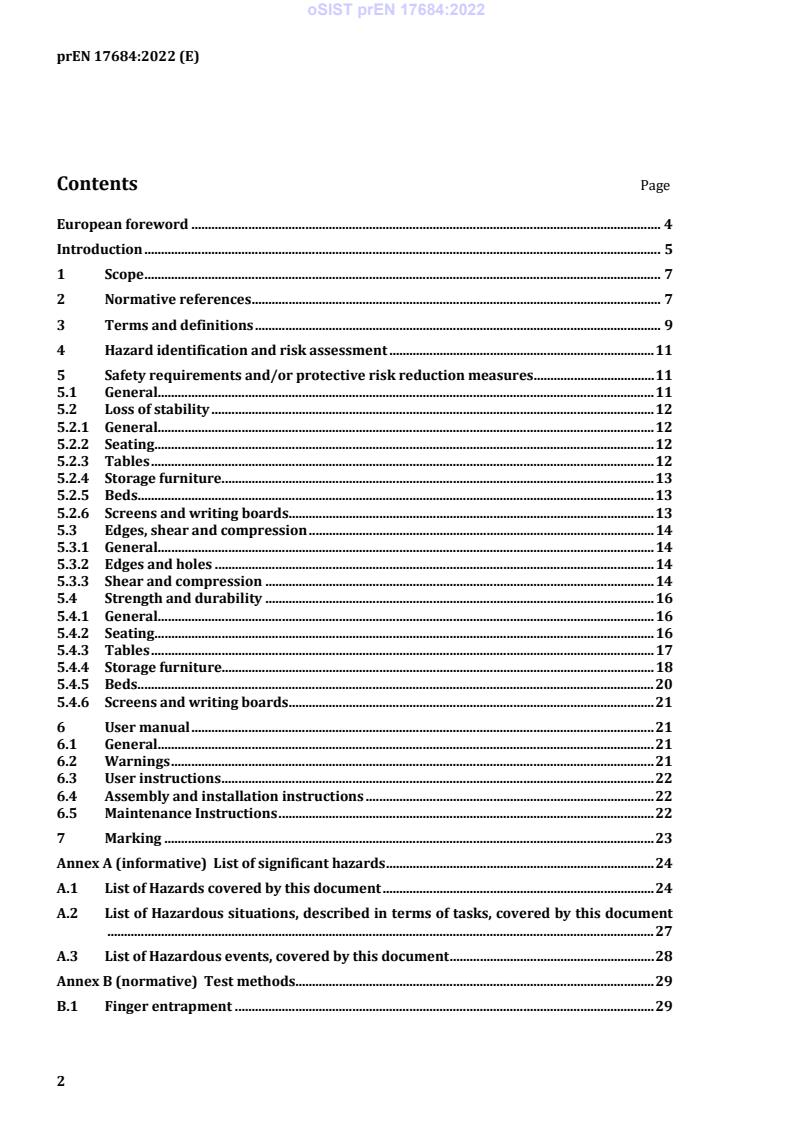
Contents
- Introduction
- 1 Scope
- 2 Normative references
- 3 Terms and definitions
- 3.1 children
- 3.2 very young children
- 3.3 young children
- 3.4 older children
- 3.5 stability
- 3.6 overturn
- 3.7 hazard
- 3.8 relevant hazard
- 3.9 significant hazard
- 3.10 designer
- 3.11 risk
- 3.12 furniture
- 3.13 nominal load
- 3.14 electrically operated functions
- 3.15 leading edge
- 4 Hazard identification and risk assessment
- 5 Safety requirements and/or protective risk reduction measures
- 5.1 General
- 5.2 Loss of stability
- 5.3 Edges, shear and compression
- 5.4 Strength and durability
- 6 User manual
- 6.1 General
- 6.2 Warnings
- 6.3 User instructions
- 6.4 Assembly and installation instructions
- 6.5 Maintenance Instructions
- 7 Marking
- Annex A
- Annex B
- 1 Hemispherical end
- 2 Line marked around circumference showing depth of penetration
- 3 Ø circumference
- 1 Radius 4 mm
- 2 Line marked around circumference showing depth of penetration
- 1 Shape assessment probe
- Annex C
- Annex ZA
- 1.3 Protection against mechanical
- Bibliography
Introduction
This document is a type-C document as stated in EN ISO 12100:2010. This document is of relevance, in particular, for the following stakeholder groups representing the market players with regard to machinery safety:
- electrically operated furniture manufacturers (small, medium and large enterprises);
- health and safety bodies (regulators, accident prevention organizations, market surveillance, etc.). Others can be affected by the level of machinery safety achieved with the means of the document by the above-mentioned stakeholder groups:
- electrically operated furniture users/employers (small, medium and large enterprises);
- electrically operated furniture users/employees (e.g. trade unions, organizations for people with special needs);
- service providers, e.g. for maintenance (small, medium and large enterprises);
- consumers (in case of electrically operated furniture intended for use by consumers). The above-mentioned stakeholder groups have been given the possibility to participate in the drafting process of this document.
The machinery concerned and the extent to which hazards, hazardous situations or hazardous events are covered are indicated in the Scope of this document.
When requirements of this type-C standard are different from those which are stated in type-A or type- B standards, the requirements of this type-C standard take precedence over the requirements of the other standards for machines that have been designed and built according to the requirements of this type-C standard.
This document has been prepared to meet the needs of manufacturers, users and safety enforcement authorities, with the primary purpose of providing design and performance for mechanical safety in use of electrically motorised furniture.
The safety requirements are based on the hazardous situations and events identified during intended use, and reasonably foreseeable misuse, throughout the expected lifetime of the furniture. The hazards identified in Clause 4 are based on the knowledge and experience of the design, incidents, accidents and other risks.
The requirements on edges, surfaces, shear and compression are intended to minimize the hazards from any moving parts, e.g. the movement of the product or the application or release of an external force by an electrically operated component.
The strength requirements are intended to minimize the hazards caused by the collapse of furniture when subjected to the highest levels of loading that might be reasonably expected to occur. The durability requirements are intended to minimize the hazards during the expected lifetime of the product, e.g when operating the electrical function.
It should be emphasized that the stability, strength and durability requirements are the same as for nonelectrically operated furniture. This document exclude any electrically operated furniture for medical purpose.
oSIST prEN 17684:2022 prEN 17684:2022 (E) Electrical aspects of electrically operated furniture are covered by normative references to prEN IEC 60335-2-116:2022.
oSIST prEN 17684:2022 prEN 17684:2022 (E)
1 Scope
This document specifies stability and mechanical safety requirements and test methods for electrically operated furniture for domestic and non-domestic use, including requirements on shear, compression, entrapment, strength and durability.
The document applies to electrically operated furniture for use in areas accessible by adults and children of all abilities, and domestic pets.
The requirements in this document are intended to minimize the hazards that can occur during intended use and reasonably foreseeable use.
This document includes requirements related to all persons, including children from the age of 4 years in and around the products and the associated hazards.
This document excludes considerations and requirements related to children less than 4 years old operating the product.
This document does not include requirements related to the electrical safety of the item of furniture. In general, it does not take into account:
- damage to property or the environment.
This document does not apply to:
- seating incorporated in other machines;
- seats in vehicles.
If the electrically operated furniture has additional functions or can be converted into other products, other relevant European Standards can apply.
This document is not applicable to electrically operated furniture which is manufactured before the date of publication of this document.
Wherever the term “furniture” is used in this document, it means electrically operated furniture.
2 Normative references
The following documents are referred to in the text in such a way that some or all of their content constitutes requirements of this document. For dated references, only the edition cited applies. For undated references, the latest edition of the referenced document (including any amendments) applies. EN 527-2:2016+A1:2019, Office furniture — Work tables — Part 2: Safety, strength and durability requirements EN 581-2:2015, Outdoor furniture — Seating and tables for camping, domestic and contract use — Part 2:
Mechanical safety requirements and test methods for seating EN 581-3:2017, Outdoor furniture — Seating and tables for camping, domestic and contract use — Part 3:
Mechanical safety requirements for tables EN 747-1:2012+A1:2015, Furniture — Bunk beds and high beds — Part 1: Safety, strength and durability requirements EN 1023-2:2000, Office furniture — Screens — Part 2: Mechanical safety requirements
oSIST prEN 17684:2022 prEN 17684:2022 (E) EN 1129-1:1995, Furniture — Foldaway beds — Safety requirements and testing — Part 1: Safety requirements EN 1335-2:2018, Office furniture — Office work chair — Part 2: Safety requirements EN 1725:1998, Domestic furniture — Beds and mattresses — Safety requirements and test methods EN 1729-2:2012+A1:2015, Furniture — Chairs and tables for educational institutions — Part 2: Safety requirements and test methods EN 1730:2012, Furniture — Tables — Test methods for the determination of stability, strength and durability EN 12520:2015, Furniture — Strength, durability and safety — Requirements for domestic seating EN 12521:2015, Furniture — Strength, durability and safety — Requirements for domestic tables EN 13150:2020, Workbenches for laboratories in educational institutions — Dimensions, safety and durability requirements and test methods EN 13759:2012, Furniture — Operating mechanisms for seating and sofa-beds — Test methods EN 14073-2:2004, Office furniture — Storage furniture — Part 2: Safety requirements EN 14434:2010, Writing boards for educational institutions — Ergonomic, technical and safety requirements and their test methods EN 14749:2016, Furniture — Domestic and kitchen storage units and kitchen-worktops — Safety requirements and test methods EN 15372:2016, Furniture — Strength, durability and safety — Requirements for non-domestic tables EN 16121:2013+A1:2017, Non-domestic storage furniture — Requirements for safety, strength, durability and stability EN 16139:2013, Furniture — Strength, durability and safety — Requirements for non-domestic seating EN 17191:2021, Children’s Furniture — Seating for children — Safety requirements and test methods EN ISO 12100:2010, Safety of machinery — General principles for design — Risk assessment and risk reduction (ISO 12100:2010) prEN IEC 60335-2-116:2022, Household and similar electrical appliances — Safety — Part 2-116:
Particular requirements for furniture with electrically motorised parts
oSIST prEN 17684:2022 prEN 17684:2022 (E)
3 Terms and definitions
For the purposes of this document, the following terms and definitions apply. ISO and IEC maintain terminological databases for use in standardization at the following addresses:
- ISO Online browsing platform: available at https://www.iso.org/obp
- IEC Electropedia: available at https://www.electropedia.org/
3.1 children
young persons comprising very young children, young children and older children [SOURCE: EN 60335-1:2012, definition 3.Z.1]
3.2 very young children
young persons aged from 0 up to and including 3 years [SOURCE: EN 60335-1:2012, definition 3.Z.2]
3.3 young children
young persons older than 3 years and younger than 8 years [SOURCE: EN 60335-1:2012, definition 3.Z.3]
3.4 older children
young persons aged from 8 years up to and including 14 years [SOURCE: EN 60335-1:2012, definition 3.Z.4]
3.5 stability
ability to withstand forces that tend to cause furniture to overturn
3.6 overturn
event at which furniture pivots to the point beyond which the furniture continues to fall
3.7 hazard
potential source of harm [SOURCE: EN ISO 12100:2010, 3.6]
oSIST prEN 17684:2022 prEN 17684:2022 (E)
3.8 relevant hazard
hazard, which is identified as being present at, or associated with, the furniture Note 1 to entry: A relevant hazard is identified as the result of one step of the process described in EN ISO 12100:2010, Clause 5.
Note 2 to entry: This term is included as basic terminology for type-B and type-C standards. [SOURCE: EN ISO 12100:2010, 3.7]
3.9 significant hazard
hazard which has been identified as relevant and which requires specific action by the designer (3.10) to eliminate or to reduce the risk according to the risk assessment Note 1 to entry: This term is included as basic terminology for type-B and type-C standards. [SOURCE: EN ISO 12100:2010, 3.8]
3.10 designer
person who prepares or modifies the designs, or gives instructions to any person under their control to do so
3.11 risk
combination of the probability of occurrence of harm and the severity of that harm
3.12 furniture
article intended to support human activities such as sitting, eating, sleeping, working or storing things [SOURCE: prEN 60335-2-116:2022, definition 3.5.101]
3.13 nominal load
load capacity of the furniture (3.12) declared by the manufacturer
3.14 electrically operated functions
movements of parts or components of furniture (3.12) by means of electrical actuators Note 1 to entry: Such as drawers, tabletops, reclining seats, etc.
3.15 leading edge
closing edge of two components that is likely to create significant shear or compression points, which are easily accessible,and likely to cause injury Note 1 to entry: One of the components could be the floor, ceiling or other structure.
oSIST prEN 17684:2022 prEN 17684:2022 (E)
4 Hazard identification and risk assessment
Annex A contains a list of hazards that can be present with electrically operated furniture (3.12). A hazard analysis shall be carried out to identify any further hazards that might be present. A risk assessment shall be carried out on those hazards identified in the hazard identification. This risk assessment shall give particular consideration to:
a) the intended operation of the furniture, including instructions available, maintenance, setting and cleaning; b) unexpected start-up/operation; c) access from all directions; d) reasonably foreseeable misuse of the furniture; e) the effect of failure in the control system; f) and where necessary, the hazards associated with the specific application. Risks (3.11) shall be eliminated or reduced first by design or by substitution, then by guarding and other complementary measures. Any residual risks shall then be reduced by other measures (e.g. warnings, signs, training).
The requirements contained in Clause 5 derive from the iterative process consisting of applying safeguarding measures that are described in EN ISO 12100:2010 to the hazards identified in Annex A. NOTE EN ISO 12100:2010 provides requirements and guidance in performing hazard identification and risk reduction.
The use and location of the furniture and the type of control system can influence the severity and probability of risk created by electrically operated furniture. Risks are increasing when:
- elderly or disabled people can come in contact with the moving parts of the furniture;
- children come in contact with the moving parts of the furniture;
- the furniture is equipped with a means of remote-control;
- the lack of visibility of a hazard;
- the velocity of the electrically operated moving parts relatively to other parts.
5 Safety requirements and/or protective risk reduction measures
5.1 General
The furniture shall comply with the safety requirements and/or protective/risk reduction measures of this clause. In addition, the furniture shall be designed according to the principles of EN ISO 12100:2010 for relevant but not significant hazards which are not dealt with by this document. The requirements in this clause shall be verified using the specified test methods. The tests may be carried out on an electrically operated furniture item representative of the production model.
oSIST prEN 17684:2022 prEN 17684:2022 (E)
5.2 Loss of stability
5.2.1 General
Hazards identified according to Clause 4. shall be prevented by design and construction. The conditions covered are listed below.
For furniture not covered by the use and applicability as listed in this clause (5.2), the requirement is verified by prEN IEC 60335-2-116:2022, 20.1.
5.2.2 Seating
5.2.2.1 General
The seating shall not overturn.
5.2.2.2 Seating for domestic use
Requirements specified in 5.2.2 are verified by EN 12520:2015, 5.3 Stability.
5.2.2.3 Seating for non-domestic use
Requirements specified in 5.2.2 are verified by EN 16139:2013, 4.3 Stability.
5.2.2.4 Work chair for office use
Requirements specified in 5.2.2 are verified by EN 1335-2:2018, 4.4 Stability tests and requirements.
5.2.2.5 Seating for educational use
Requirements specified in 5.2.2 are verified by EN 1729-2:2012+A1:2015, 5.2 Stability.
5.2.2.6 Seating for outdoor use
For loungers the requirements specified in 5.2.2 are verified by Test no 10, 11 and 12 in EN 581-2:2015, 6.2, Table 1.
For other seating for outdoor use the requirements specified in 5.2.2 are verified by Test no 11, 12 and 13 in EN 581-2:2015, 7.2, Table 2.
5.2.2.7 Seating for children
Requirements specified in 5.2.2 are verified by EN 17191:2021, Clause 10 Stability requirements.
5.2.3 Tables
5.2.3.1 General
The table shall not overturn.
5.2.3.2 Tables for domestic use
Requirements specified in 5.2.3 are verified by EN 12521:2015, 5.3 Stability.
5.2.3.3 Tables for non-domestic use
Requirements specified in 5.2.3 are verified by EN 15372:2016, 5.3 Stability.
5.2.3.4 Tables for office use
Requirements specified in 5.2.3 are verified by EN 527-2:2016+A1:2019, 4.3 Stability.
oSIST prEN 17684:2022 prEN 17684:2022 (E)
5.2.3.5 Tables for educational use
Requirements specified in 5.2.3 are verified by EN 1729-2:2012+A1:2015, 6.1 Stability.
5.2.3.6 Workbenches for laboratories in educational institutions
Requirements specified in 5.2.3 are verified by EN 13150:2020, 6.2 Stability.
5.2.3.7 Tables for outdoor use
Requirements specified in 5.2.3 are verified by EN 581-3:2017, 5.2 Stability.
5.2.4 Storage furniture
5.2.4.1 General
The storage furniture shall not overturn.
5.2.4.2 Storage furniture for domestic use
Requirements specified in 5.2.4 are verified by EN 14749:2016, 5.4 Stability.
5.2.4.3 Storage furniture for non-domestic use
Requirements specified in 5.2.4 are verified by EN 16121:2013+A1:2017, 5.6 Stability.
5.2.4.4 Storage furniture for office use
Requirements specified in 5.2.4 are verified by EN 14073-2:2004, 3.5.1, Table 2, test no 11 Stability.
5.2.5 Beds
5.2.5.1 General
The bed shall not overturn.
5.2.5.2 Beds for domestic use
Requirements specified in 5.2.5 are verified by EN 1725:1998, 7.2 Stability.
5.2.5.3 Bunk beds and high beds for domestic and non-domestic use
Requirements specified in 5.2.5 are verified by EN 747-1:2012+A1:2015, 4.4 Stability.
5.2.6 Screens and writing boards
5.2.6.1 General
The screen or writing board shall not overturn.
5.2.6.2 Screens
Requirements specified in 5.2.6 are verified by EN 1023-2:2000, 6.1 Stability for non-load bearing screens or EN 1023-2:2000, 6.2 Stability for load bearing screens.
5.2.6.3 Writing boards
Requirements specifies in 5.2.6 are verified by EN 14434:2010, 6.2 Stability of mobile boards.
oSIST prEN 17684:2022 prEN 17684:2022 (E)
5.3 Edges, shear and compression
5.3.1 General
Hazards identified according to Clause 4. shall be prevented by design and construction. The conditions covered are listed below.
5.3.2 Edges and holes
5.3.2.1 Edges
All parts of the furniture with which the user comes into contact during intended use, shall be designed so that physical injury and damage are avoided.
This requirement is met when:
a) edges which are directly in contact with the user are rounded or chamfered, b) all other edges accessible during intended use are free from burrs and/or sharp edges.
5.3.2.2 Holes in tubular/rigid components
There shall be no holes in the ends of tubular components or holes in rigid components in accessible parts between 8 mm and 12 mm, unless the depth of penetration is less than 10 mm. This requirement is fulfilled if there is no hazard present when tested in accordance with B.1.
5.3.3 Shear and compression
In order to minimize the effects shear and compression hazards safety distances for body part groups as shown below shall be maintained:
...