

ASTM C1790-21
(Specification)Standard Specification for Fly Ash Facing Brick
General Information
- Abstract
ABSTRACT
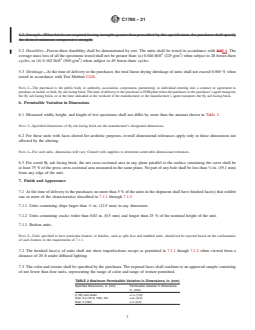
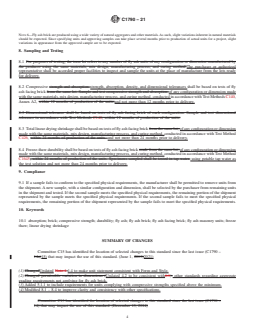
This specification covers fly ash brick intended for use in masonry, which are made from fly ash, water, and suitable mineral aggregates with or without the inclusion of other materials, and without the use of portland cement. Units that fall under this specification include a fly ash binder that undergoes hydraulic, pozzolanic, alkali-activated, or geopolymer reactions, or any combination thereof. These chemical reactions, in conjunction with the other materials in the units, provide the strength and durability necessary to meet the requirements of this specification. The specification includes cementitious materials, aggregates, and pigments for integrally colored concrete; physical requirements, strength, durability, and shrinkage; permissible variation in dimensions; finish and appearance; sampling and testing; and compliance. A table presents the strength, absorption, and density classification requirements addressed by this specification.
SCOPE
1.1 This specification covers fly ash brick intended for use in masonry, which are made from fly ash, water, and suitable mineral aggregates with or without the inclusion of other materials, and without the use of portland cement. This specification covers units intended for use in masonry, in both structural and facing applications.
1.2 Units covered under this specification include a fly ash binder that undergoes hydraulic, pozzolanic, alkali-activated, or geopolymer reactions, or any combination thereof. These chemical reactions, in conjunction with the other materials in the units, provide the strength and durability necessary to meet the requirements of this specification.
Note 1: This specification addresses properties of units formed using fly ash, aggregates, and other allowed binders. Although not required by this standard, users may request tests that establish assembly performance such as unit-mortar bond and fire resistance.
1.3 This specification references notes and footnotes, which provide explanatory material. These notes and footnotes (excluding those in tables and figures) shall not be considered as requirements of the standard.
1.4 The values stated in inch-pound units are to be regarded as standard. The values given in parentheses are mathematical conversions to SI units that are provided for information only and are not considered standard.
1.5 This standard does not purport to address all of the safety concerns, if any, associated with its use. It is the responsibility of the user of this standard to establish appropriate safety, health, and environmental practices and determine the applicability of regulatory limitations prior to use.
1.6 This international standard was developed in accordance with internationally recognized principles on standardization established in the Decision on Principles for the Development of International Standards, Guides and Recommendations issued by the World Trade Organization Technical Barriers to Trade (TBT) Committee.
- Status
- Published
- Publication Date
- 31-May-2021
- Technical Committee
- C15 - Masonry – Manufactured Masonry Units, Mortars and Grouts
- Drafting Committee
- C15.03 - Concrete Masonry Units and Related Units


Overview
ASTM C1790-21, Standard Specification for Fly Ash Facing Brick, defines the requirements for fly ash bricks used in masonry applications. These bricks are produced from fly ash, water, and appropriate mineral aggregates, with or without additional materials, and specifically exclude the use of portland cement. Instead, strength and durability are achieved through hydraulic, pozzolanic, alkali-activated, or geopolymer chemical reactions. The standard specifies physical properties, dimensional tolerances, finish and appearance criteria, and testing methods for fly ash facing brick. This specification is published by ASTM International and is intended for both structural and facing applications in construction.
Key Topics
- Material Composition:
- Bricks are made using fly ash, water, and mineral aggregates, without portland cement.
- Allowable binders include pozzolans, slag cement, and silica fume.
- Pigments may be added for integrally colored units.
- Physical Requirements:
- Minimum compressive strength and density classifications (lightweight, medium, normal weight).
- Requirements for maximum water absorption and dimensional tolerances.
- Limits on total linear drying shrinkage to ensure shape retention.
- Durability and Testing:
- Freeze-thaw resistance and mass loss are tested to demonstrate durability.
- Units are evaluated for defects and appearance, with criteria for chipped or cracked units.
- Compliance and Quality Control:
- Guidelines for sampling and testing procedures.
- Acceptance or rejection based on conformance to physical, dimensional, and appearance criteria.
- Environmental Scope:
- Exclusion of portland cement supports initiatives using recycled materials and lower embodied carbon in masonry.
Applications
Fly ash facing bricks specified by ASTM C1790-21 are widely used in:
- Commercial and Residential Masonry:
For construction of durable, environmentally sustainable facades and structural walls. - Public Infrastructure:
Including retaining walls, civic buildings, and architectural features that require consistent appearance and performance. - Structural and Non-Structural Components:
These bricks are suitable for both load-bearing and decorative elements in building design. - Sustainable Construction Projects:
Fly ash bricks contribute to improved sustainability by incorporating industrial byproducts, supporting recycling efforts, and minimizing reliance on traditional cementitious materials.
This standard provides a reliable basis for manufacturers, designers, specifiers, and builders to ensure consistent quality, performance, and aesthetics in masonry construction projects using fly ash facing bricks.
Related Standards
The following ASTM standards are referenced within ASTM C1790-21 and provide additional details on materials, testing, and definitions:
- ASTM C33 - Specification for Concrete Aggregates
- ASTM C140 - Test Methods for Sampling and Testing Concrete Masonry Units and Related Units
- ASTM C331 - Specification for Lightweight Aggregates for Concrete Masonry Units
- ASTM C426 - Test Method for Linear Drying Shrinkage of Concrete Masonry Units
- ASTM C618 - Specification for Coal Fly Ash and Raw or Calcined Natural Pozzolan for Use in Concrete
- ASTM C979 - Specification for Pigments for Integrally Colored Concrete
- ASTM C989 - Specification for Slag Cement for Use in Concrete and Mortars
- ASTM C1232 - Terminology for Masonry
- ASTM C1240 - Specification for Silica Fume Used in Cementitious Mixtures
- ASTM C1645 - Test Method for Freeze-thaw and De-icing Salt Durability of Solid Concrete Interlocking Paving Units
Utilizing ASTM C1790-21 ensures the production and use of high-quality fly ash facing bricks, supporting innovation, sustainability, and performance in modern masonry construction.
Relations
- Effective Date
- 15-Dec-2023
- Effective Date
- 01-Oct-2017
- Effective Date
- 01-Jun-2017
- Effective Date
- 01-Jun-2016
- Effective Date
- 01-Dec-2015
- Effective Date
- 01-Dec-2015
- Effective Date
- 01-Sep-2015
- Effective Date
- 15-Jun-2015
- Effective Date
- 01-Jun-2015
- Effective Date
- 15-Feb-2014
- Effective Date
- 15-Mar-2013
- Effective Date
- 15-Dec-2012
- Effective Date
- 01-Aug-2012
- Effective Date
- 01-Aug-2012
- Effective Date
- 01-Jun-2012
Get Certified
Connect with accredited certification bodies for this standard

DIBt (Deutsches Institut für Bautechnik)
German Institute for Building Technology.
DIN CERTCO
DIN Group product certification.

Aboma Certification B.V.
Specialized in construction, metal, and transport sectors.
Sponsored listings
Frequently Asked Questions
ASTM C1790-21 is a technical specification published by ASTM International. Its full title is "Standard Specification for Fly Ash Facing Brick". This standard covers: ABSTRACT This specification covers fly ash brick intended for use in masonry, which are made from fly ash, water, and suitable mineral aggregates with or without the inclusion of other materials, and without the use of portland cement. Units that fall under this specification include a fly ash binder that undergoes hydraulic, pozzolanic, alkali-activated, or geopolymer reactions, or any combination thereof. These chemical reactions, in conjunction with the other materials in the units, provide the strength and durability necessary to meet the requirements of this specification. The specification includes cementitious materials, aggregates, and pigments for integrally colored concrete; physical requirements, strength, durability, and shrinkage; permissible variation in dimensions; finish and appearance; sampling and testing; and compliance. A table presents the strength, absorption, and density classification requirements addressed by this specification. SCOPE 1.1 This specification covers fly ash brick intended for use in masonry, which are made from fly ash, water, and suitable mineral aggregates with or without the inclusion of other materials, and without the use of portland cement. This specification covers units intended for use in masonry, in both structural and facing applications. 1.2 Units covered under this specification include a fly ash binder that undergoes hydraulic, pozzolanic, alkali-activated, or geopolymer reactions, or any combination thereof. These chemical reactions, in conjunction with the other materials in the units, provide the strength and durability necessary to meet the requirements of this specification. Note 1: This specification addresses properties of units formed using fly ash, aggregates, and other allowed binders. Although not required by this standard, users may request tests that establish assembly performance such as unit-mortar bond and fire resistance. 1.3 This specification references notes and footnotes, which provide explanatory material. These notes and footnotes (excluding those in tables and figures) shall not be considered as requirements of the standard. 1.4 The values stated in inch-pound units are to be regarded as standard. The values given in parentheses are mathematical conversions to SI units that are provided for information only and are not considered standard. 1.5 This standard does not purport to address all of the safety concerns, if any, associated with its use. It is the responsibility of the user of this standard to establish appropriate safety, health, and environmental practices and determine the applicability of regulatory limitations prior to use. 1.6 This international standard was developed in accordance with internationally recognized principles on standardization established in the Decision on Principles for the Development of International Standards, Guides and Recommendations issued by the World Trade Organization Technical Barriers to Trade (TBT) Committee.
ABSTRACT This specification covers fly ash brick intended for use in masonry, which are made from fly ash, water, and suitable mineral aggregates with or without the inclusion of other materials, and without the use of portland cement. Units that fall under this specification include a fly ash binder that undergoes hydraulic, pozzolanic, alkali-activated, or geopolymer reactions, or any combination thereof. These chemical reactions, in conjunction with the other materials in the units, provide the strength and durability necessary to meet the requirements of this specification. The specification includes cementitious materials, aggregates, and pigments for integrally colored concrete; physical requirements, strength, durability, and shrinkage; permissible variation in dimensions; finish and appearance; sampling and testing; and compliance. A table presents the strength, absorption, and density classification requirements addressed by this specification. SCOPE 1.1 This specification covers fly ash brick intended for use in masonry, which are made from fly ash, water, and suitable mineral aggregates with or without the inclusion of other materials, and without the use of portland cement. This specification covers units intended for use in masonry, in both structural and facing applications. 1.2 Units covered under this specification include a fly ash binder that undergoes hydraulic, pozzolanic, alkali-activated, or geopolymer reactions, or any combination thereof. These chemical reactions, in conjunction with the other materials in the units, provide the strength and durability necessary to meet the requirements of this specification. Note 1: This specification addresses properties of units formed using fly ash, aggregates, and other allowed binders. Although not required by this standard, users may request tests that establish assembly performance such as unit-mortar bond and fire resistance. 1.3 This specification references notes and footnotes, which provide explanatory material. These notes and footnotes (excluding those in tables and figures) shall not be considered as requirements of the standard. 1.4 The values stated in inch-pound units are to be regarded as standard. The values given in parentheses are mathematical conversions to SI units that are provided for information only and are not considered standard. 1.5 This standard does not purport to address all of the safety concerns, if any, associated with its use. It is the responsibility of the user of this standard to establish appropriate safety, health, and environmental practices and determine the applicability of regulatory limitations prior to use. 1.6 This international standard was developed in accordance with internationally recognized principles on standardization established in the Decision on Principles for the Development of International Standards, Guides and Recommendations issued by the World Trade Organization Technical Barriers to Trade (TBT) Committee.
ASTM C1790-21 is classified under the following ICS (International Classification for Standards) categories: 91.100.15 - Mineral materials and products. The ICS classification helps identify the subject area and facilitates finding related standards.
ASTM C1790-21 has the following relationships with other standards: It is inter standard links to ASTM C1232-23, ASTM C618-17, ASTM C1232-17, ASTM C1645-16, ASTM C426-15e1, ASTM C426-15, ASTM C1232-15a, ASTM C1240-15, ASTM C1232-15, ASTM C1240-14, ASTM C140-13, ASTM C618-12a, ASTM C1240-12, ASTM C140-12a, ASTM C1232-12. Understanding these relationships helps ensure you are using the most current and applicable version of the standard.
ASTM C1790-21 is available in PDF format for immediate download after purchase. The document can be added to your cart and obtained through the secure checkout process. Digital delivery ensures instant access to the complete standard document.
Standards Content (Sample)
This international standard was developed in accordance with internationally recognized principles on standardization established in the Decision on Principles for the
Development of International Standards, Guides and Recommendations issued by the World Trade Organization Technical Barriers to Trade (TBT) Committee.
Designation: C1790 −21
Standard Specification for
Fly Ash Facing Brick
This standard is issued under the fixed designation C1790; the number immediately following the designation indicates the year of
original adoption or, in the case of revision, the year of last revision. A number in parentheses indicates the year of last reapproval. A
superscript epsilon (´) indicates an editorial change since the last revision or reapproval.
1. Scope* 2. Referenced Documents
1.1 This specification covers fly ash brick intended for use 2.1 ASTM Standards:
in masonry, which are made from fly ash, water, and suitable C33 Specification for Concrete Aggregates
mineral aggregates with or without the inclusion of other C140 Test Methods for Sampling and Testing Concrete
materials, and without the use of portland cement. This Masonry Units and Related Units
specification covers units intended for use in masonry, in both C331 Specification for LightweightAggregates for Concrete
structural and facing applications. Masonry Units
C426 Test Method for Linear Drying Shrinkage of Concrete
1.2 Units covered under this specification include a fly ash
Masonry Units
binder that undergoes hydraulic, pozzolanic, alkali-activated,
C618 Specification for Coal Fly Ash and Raw or Calcined
or geopolymer reactions, or any combination thereof. These
Natural Pozzolan for Use in Concrete
chemical reactions, in conjunction with the other materials in
C979 Specification for Pigments for Integrally Colored Con-
the units, provide the strength and durability necessary to meet
crete
the requirements of this specification.
C989 Specification for Slag Cement for Use in Concrete and
NOTE 1—This specification addresses properties of units formed using
Mortars
fly ash, aggregates, and other allowed binders. Although not required by
C1232 Terminology for Masonry
this standard, users may request tests that establish assembly performance
C1240 Specification for Silica Fume Used in Cementitious
such as unit-mortar bond and fire resistance.
Mixtures
1.3 This specification references notes and footnotes, which
C1645 Test Method for Freeze-thaw and De-icing Salt
provide explanatory material. These notes and footnotes (ex-
Durability of Solid Concrete Interlocking Paving Units
cluding those in tables and figures) shall not be considered as
requirements of the standard.
3. Terminology
1.4 The values stated in inch-pound units are to be regarded
3.1 TermsdefinedinTerminologyC1232shallapplyforthis
as standard. The values given in parentheses are mathematical
specification.
conversions to SI units that are provided for information only
3.2 Definitions of Terms Specific to This Standard:
and are not considered standard.
3.2.1 fly ash brick, n—a masonry unit made from fly ash,
1.5 This standard does not purport to address all of the
water, and suitable aggregates with or without the inclusion of
safety concerns, if any, associated with its use. It is the
other materials and specifically without the inclusion of port-
responsibility of the user of this standard to establish appro-
land cement.
priate safety, health, and environmental practices and deter-
4. Materials
mine the applicability of regulatory limitations prior to use.
1.6 This international standard was developed in accor-
4.1 Cementitious Materials—No portland cement shall be
dance with internationally recognized principles on standard-
used. Materials shall conform to the following applicable
ization established in the Decision on Principles for the
specifications:
Development of International Standards, Guides and Recom-
4.1.1 Pozzolans—Specification C618.
mendations issued by the World Trade Organization Technical
4.1.2 Slag Cement—Specification C989.
Barriers to Trade (TBT) Committee.
4.1.3 Silica Fume—Specification C1240.
4.2 Aggregates—Aggregates shall conform to the following
specifications, except for grading requirements:
This test method is under the jurisdiction of ASTM Committee C15 on
4.2.1 Normal Weight Aggregates—Specification C33.
Manufactured Masonry Units and is the direct responsibility of Subcommittee
C15.03 on Concrete Masonry Units and Related Units. 4.2.2 Lightweight Aggregates—Specification C331.
Current edition approved June 1, 2021. Published June 2021. Originally
4.3 Pigments for Integrally Colored Concrete—
approved in 2014. Last previous edition approved in 2015 as C1790 – 15. DOI:
10.1520/C1790-21. Specification C979.
*A Summary of Changes section appears at the end of this standard
Copyright © ASTM International, 100 Barr Harbor Drive, PO Box C700, West Conshohocken, PA 19428-2959. United States
C1790 − 21
TABLE 2 Maximum Permissible Variation in Dimensions, in. (mm)
4.4 Other Constituents—Otherconstituentmaterialsshallbe
previously established as suitable for use in fly ash units and Specified Dimensions, in. (mm) Permissible Variation in Dimensions,
in. (mm)
shall conform to applicableASTM standards or shall be shown
3 (76) and under ± ⁄16 (1.6)
by test or experience not to be detrimental to the durability of
Over 3-4 (76 to 102), incl ± ⁄32 (2.4)
the fly ash units or any material customarily used in masonry
Over 4 (102) ± ⁄8 (3.2)
construction.
5. Physical Properties
NOTE4—Forsuchunits,dimensionswillvary.Consultwithsuppliersto
5.1 Physical Requirements—At the time of delivery to the
determine achievable dimensional tolerances.
purchaser, units shall conform to the physical requirements
6.3 For cored fly ash facing brick, the net cross-sectional
prescribed in Table 1. All units shall be sound and free of
area in any plane parallel to the surface containing the cores
cracks or other defects that interfere with the proper placement
shall be at least 75 % of the gross cross-sectional area
of the units or significantly impair the strength or permanence
measured in the same plane. No part of any hole shall be less
of the construction. Minor cracks incidental to the usual
than ⁄4 in. (19.1 mm) from any edge of the unit.
method of manufacture or minor chipping resulting from
customary methods of handling in shipment and delivery are
7. Finish and Appearance
not grounds for rejection.
7.1 At the time of delivery to the purchaser, no more than
5.1.1 When higher compressive strengths than those listed
5 % of the units in the shipment shall have finished face(s) that
in Table 1 are specified, the tested average net area compres-
exhibit one or more of the characteristics described in 7.1.1
sive strength of three units shall equal or exceed the specified
through 7.1.3.
compressive strength, and the tested individual unit net area
7.1.1 Units containing chips larger than ⁄2 in. (12.5 mm) in
compressive strength of all three units shall exceed 90 % of the
any dimension.
specified compressive strength. Compressive strength shall be
7.1.2 Units containing cracks wider than 0.02 in. (0.5 mm)
tested in accordance with 8.2.
and longer than 25 % of the nominal height of the unit.
5.2 Durabili
...
This document is not an ASTM standard and is intended only to provide the user of an ASTM standard an indication of what changes have been made to the previous version. Because
it may not be technically possible to adequately depict all changes accurately, ASTM recommends that users consult prior editions as appropriate. In all cases only the current version
of the standard as published by ASTM is to be considered the official document.
Designation: C1790 − 15 C1790 − 21
Standard Specification for
Fly Ash Facing Brick
This standard is issued under the fixed designation C1790; the number immediately following the designation indicates the year of
original adoption or, in the case of revision, the year of last revision. A number in parentheses indicates the year of last reapproval. A
superscript epsilon (´) indicates an editorial change since the last revision or reapproval.
1. Scope*
1.1 This specification covers fly ash brick intended for use in masonry, which are made from fly ash, water, and suitable mineral
aggregates with or without the inclusion of other materials, and without the use of portland cement. This specification covers units
intended for use in masonry, in both structural and facing applications.
1.2 Units covered under this specification include a fly ash binder that undergoes hydraulic, pozzolanic, alkali-activated, or
geopolymer reactions, or any combination thereof. These chemical reactions, in conjunction with the other materials in the units,
provide the strength and durability necessary to meet the requirements of this specification.
NOTE 1—This specification addresses properties of units formed using fly ash, aggregates, and other allowed binders. Although not required by this
standard, users may request tests that establish assembly performance such as unit-mortar bond and fire resistance.
1.3 This specification references notes and footnotes, which provide explanatory material. These notes and footnotes (excluding
those in tables and figures) shall not be considered as requirements of the standard.
1.4 The values stated in inch-pound units are to be regarded as the standard. The values given in parentheses are for information
only.mathematical conversions to SI units that are provided for information only and are not considered standard.
1.5 This standard does not purport to address all of the safety concerns, if any, associated with its use. It is the responsibility
of the user of this standard to establish appropriate safety safety, health, and healthenvironmental practices and determine the
applicability of regulatory limitations prior to use.
1.6 This international standard was developed in accordance with internationally recognized principles on standardization
established in the Decision on Principles for the Development of International Standards, Guides and Recommendations issued
by the World Trade Organization Technical Barriers to Trade (TBT) Committee.
2. Referenced Documents
2.1 ASTM Standards:
C33 Specification for Concrete Aggregates
C140 Test Methods for Sampling and Testing Concrete Masonry Units and Related Units
C331 Specification for Lightweight Aggregates for Concrete Masonry Units
C426 Test Method for Linear Drying Shrinkage of Concrete Masonry Units
C618 Specification for Coal Fly Ash and Raw or Calcined Natural Pozzolan for Use in Concrete
C979 Specification for Pigments for Integrally Colored Concrete
This test method is under the jurisdiction of ASTM Committee C15 on Manufactured Masonry Units and is the direct responsibility of Subcommittee C15.03 on Concrete
Masonry Units and Related Units.
Current edition approved June 1, 2015June 1, 2021. Published June 2015June 2021. Originally approved in 2014. Last previous edition approved in 20142015 as C1790
– 14a.15. DOI: 10.1520/C1790-15.10.1520/C1790-21.
*A Summary of Changes section appears at the end of this standard
Copyright © ASTM International, 100 Barr Harbor Drive, PO Box C700, West Conshohocken, PA 19428-2959. United States
C1790 − 21
C989 Specification for Slag Cement for Use in Concrete and Mortars
C1232 Terminology for Masonry
C1240 Specification for Silica Fume Used in Cementitious Mixtures
C1645 Test Method for Freeze-thaw and De-icing Salt Durability of Solid Concrete Interlocking Paving Units
3. Terminology
3.1 Terms defined in Terminology C1232 shall apply for this specification.
3.2 Definitions of Terms Specific to This Standard:
3.2.1 fly ash brick, n—a masonry unit made from fly ash, water, and suitable aggregates with or without the inclusion of other
materials and specifically without the inclusion of portland cement.
4. Materials
4.1 Cementitious Materials—No portland cement shall be used. Materials shall conform to the following applicable specifications:
4.1.1 Pozzolans—Specification C618.
4.1.2 Slag Cement—Specification C989.
4.1.3 Silica Fume—Specification C1240.
4.2 Aggregates—Aggregates shall conform to the following specifications, except that grading requirements shall not necessarily
apply: for grading requirements:
4.2.1 Normal Weight Aggregates—Specification C33.
4.2.2 Lightweight Aggregates—Specification C331.
4.3 Pigments for Integrally Colored Concrete—Specification C979.
4.4 Other Constituents—Other constituent materials shall be previously established as suitable for use in fly ash units and shall
conform to applicable ASTM standards or shall be shown by test or experience not to be detrimental to the durability of the fly
ash units or any material customarily used in masonry construction.
5. Physical Properties
5.1 Physical Requirements—At the time of delivery to the purchaser, units shall conform to the physical requirements prescribed
in Table 1. All units shall be sound and free of cracks or other defects that interfere with the proper placement of the units or
significantly impair the strength or permanence of the construction. Minor cracks incidental to the usual method of manufacture
or minor chipping resulting from customary methods of handling in shipment and delivery are not grounds for rejection.
5.1.1 When higher compressive strengths than those listed in Table 1 are specified, the tested average net area compressive
strength of three units shall equal or exceed the specified compressive strength, and the tested individual unit net area compressive
strength of all three units shall exceed 90 % of the specified compressive strength. Compressive strength shall be tested in
accordance with 8.2.
A
TABLE 1 Strength, Absorption, and Density Classification Requirements
3 3 3 2
Density Oven-Dry Density, lb/ft Maximum Water Absorption, lb/ft (kg/m ) Minimum Net Area Compressive Strength, lb/in.
Classification (kg/m ) (MPa)
Average of Three Units Average of Three Units Individual Units Average of Three Units Individual Units
Lightweight Less than 105 (1680) 15 (240) 17 (272) 3500 (24.1) 3000 (20.7)
Medium Weight 105 to less than 125 13 (208) 15 (240) 3500 (24.1) 3000 (20.7)
(1680–2000)
Normal Weight 125 (2000) or more 10 (160) 12 (192) 3500 (24.1) 3000 (20.7)
A
Average oven-dry density, based on a set of three units, shall fall within ranges defined in the table to be classified as lightweight, medium weight, or normal weight.
C1790 − 21
5.2 Strength—When bricks are required having strengths greater than prescribed by this specification, the purchaser shall specify
the desired minimum compressive strength.
5.2 Durability—Freeze-thaw durability shall be demonstrated by test. The units shall be tested in accordance with 8.58.4. The
2 2
average mass loss of all the specimens tested shall not be greater than: (a) 0.046 lb/ft (225 g/m ) when subject to 28 freeze-thaw
2 2
cycles, or (b) 0.102 lb/ft (500 g/m ) when subject to 49 freeze-thaw cycles.
5.3 Shrinkage—At the time of delivery to the purchaser, the total linear drying shrinkage of units shall not exceed 0.065 % when
tested in accordance with Test Method C426.
NOTE 2—The purchaser is the public body or authority, association, corporation, partnership, or individual entering into a contract or ag
...