


ASTM E393-19
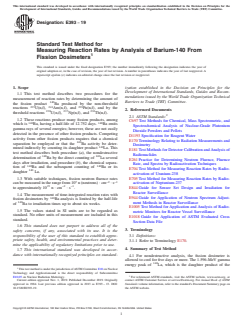
(Test Method)Standard Test Method for Measuring Reaction Rates by Analysis of Barium-140 From Fission Dosimeters
Standard Test Method for Measuring Reaction Rates by Analysis of Barium-140 From Fission Dosimeters
SIGNIFICANCE AND USE
5.1 Refer to Guide E844 for the selection, irradiation, and quality control of neutron dosimeters.
5.2 Refer to Practice E261 for a general discussion of the measurement of neutron fluence rate and fluence. The neutron spectrum must be known in order to measure neutron fluence rates with a single detector. Also it is noted that cross sections are continuously being reevaluated. The latest recommended cross sections and details on how they can be obtained are discussed in Guide E1018.
5.3 The reaction rate of a detector nuclide of known cross section, when combined with information about the neutron spectrum, permits the determination of the magnitude of the fluence rate impinging on the detector. Furthermore, if results from other detectors are available, the neutron spectrum can be defined more accurately. The techniques for fluence rate and fluence determinations are explained in Practice E261.
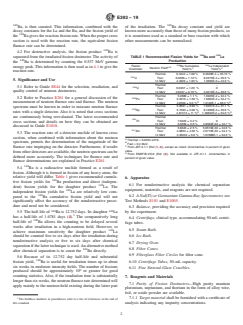
5.4 140Ba is a radioactive nuclide formed as a result of fission. Although it is formed in fission of any heavy atom, the relative yield will differ. Table 1 gives recommended cumulative fission yields for 140Ba production and direct (independent) fission yields for the daughter product 140La. The independent fission yields for 140La are relatively low compared to the 140Ba cumulative fission yield and will not significantly affect the accuracy of the nondestructive procedure and need not be considered. (A) Thermal = 0.0253 eV19.(B) Fast = 0.4 MeV.(C) From JEF-3.1.1 (Ref (1, 2)), except as noted. Uncertainties in percent of given value.(D) From ENDF/B-VIII.0 (Ref (3)). Not available in JEF-3.1.1. Uncertainties in percent of given value.
5.5 The half-life of 140Ba is 12.752 days. Its daughter 140La has a half-life of 1.6781 days (4).3 The comparatively long half-life of 140Ba allows the counting to be delayed several weeks after irradiation in a high-neutron field. However, to achieve maximum sensitivity the daughter product 140La should be counted five to...
SCOPE
1.1 This test method describes two procedures for the measurement of reaction rates by determining the amount of the fission product 140Ba produced by the non-threshold reactions 235U(n,f), 241Am(n,f), and 239Pu(n,f), and by the threshold reactions 238U(n,f), 237Np(n,f), and 232Th(n,f).
1.2 These reactions produce many fission products, among which is 140Ba, having a half-life of 12.752 days. 140Ba emits gamma rays of several energies; however, these are not easily detected in the presence of other fission products. Competing activity from other fission products requires that a chemical separation be employed or that the 140Ba activity be determined indirectly by counting its daughter product 140La. This test method describes both procedure (a), the nondestructive determination of 140Ba by the direct counting of 140La several days after irradiation, and procedure (b), the chemical separation of 140Ba and the subsequent counting of 140Ba or its daughter 140 La.
1.3 With suitable techniques, fission neutron fluence rates can be measured in the range from 107 n (neutrons) · cm−2 · s−1 to approximately 1015 n · cm−2 · s−1.
1.4 The measurement of time-integrated reaction rates with fission dosimeters by 140Ba analysis is limited by the half-life of 140Ba to irradiation times up to about six weeks.
1.5 The values stated in SI units are to be regarded as standard. No other units of measurement are included in this standard.
1.6 This standard does not purport to address all of the safety concerns, if any, associated with its use. It is the responsibility of the user of this standard to establish appropriate safety, health, and environmental practices and determine the applicability of regulatory limitations prior to use.
1.7 This international standard was developed in accordance with internationally recognized principles on standardization established in the Decision on Principles for the De...
General Information
- Status
- Published
- Publication Date
- 31-Oct-2019
- Technical Committee
- E10 - Nuclear Technology and Applications
- Drafting Committee
- E10.05 - Nuclear Radiation Metrology
Relations
- Effective Date
- 01-Nov-2019
- Effective Date
- 01-Mar-2020
- Effective Date
- 01-Mar-2020
- Refers
ASTM E704-19 - Standard Test Method for Measuring Reaction Rates by Radioactivation of Uranium-238 - Effective Date
- 01-Oct-2019
- Effective Date
- 01-Oct-2019
- Refers
ASTM E705-18 - Standard Test Method for Measuring Reaction Rates by Radioactivation of Neptunium-237 - Effective Date
- 01-Dec-2018
- Effective Date
- 01-Jun-2018
- Effective Date
- 01-Jun-2017
- Effective Date
- 01-Oct-2016
- Effective Date
- 01-Jun-2016
- Effective Date
- 15-Feb-2016
- Effective Date
- 01-Sep-2015
- Effective Date
- 01-Jul-2015
- Effective Date
- 01-Jun-2015
- Effective Date
- 15-Mar-2015
Overview
ASTM E393-19: Standard Test Method for Measuring Reaction Rates by Analysis of Barium-140 From Fission Dosimeters provides standardized procedures for the quantitative determination of reaction rates using the radiochemical analysis of barium-140 (^140Ba) produced in fission dosimeters. This method is essential for monitoring neutron fluence and assessing reactor performance and material irradiation environments. Developed by ASTM International, the standard is widely used in nuclear science and reactor surveillance programs to ensure accuracy and consistency in neutron dosimetry.
Key Topics
- Principle of Measurement: The standard describes two main procedures:
- Nondestructive Analysis: Determination of ^140Ba by directly counting its daughter product, lanthanum-140 (^140La), several days post-irradiation using gamma-ray spectrometry.
- Radiochemical (Destructive) Analysis: Chemical separation of ^140Ba from the dosimeter followed by direct or indirect measurement via gamma emissions.
- Applicable Reactions: The method covers measurement from non-threshold reactions such as ^235U(n,f), ^241Am(n,f), ^239Pu(n,f), and threshold reactions like ^238U(n,f), ^237Np(n,f), and ^232Th(n,f).
- Measurement Range: Techniques allow for the accurate measurement of fission neutron fluence rates in the range of 10^7 to 10^15 neutrons/cm²/s.
- Time Limitations: Due to the 12.752-day half-life of ^140Ba, the method is suitable for irradiation durations up to approximately six weeks.
- Data Interpretation: The measured ^140Ba activities, fluence rates, and reaction rates are related to the irradiation conditions, detector characteristics, and reactor neutron spectra.
- Quality and Safety: Emphasizes the use of high-purity reagents and materials, proper encapsulation of dosimeters, and adherence to safety protocols and regulatory practices.
Applications
The ASTM E393-19 standard offers significant practical value in nuclear engineering and reactor operations, including:
- Reactor Surveillance: Used for quantifying neutron exposure in surveillance capsule dosimeters for reactor pressure vessel integrity assessments.
- Material Testing: Supports evaluation of neutron-induced changes in reactor materials and components by providing accurate fluence data.
- Radiation Protection: Assists in validating neutron field characteristics for radiological safety, shielding design, and compliance with safety standards.
- Calibration and Benchmarking: Enables normalization and intercomparison of dosimetric measurements by providing a reliable method based on well-understood fission yields and decay characteristics.
- Research and Development: Facilitates experimental reactor physics studies, isotope production optimization, and fission product yield evaluations.
Related Standards
A number of ASTM and international standards complement and provide reference material for ASTM E393-19, including:
- ASTM E844: Guide for the selection, irradiation, and quality control of neutron dosimeters.
- ASTM E261: Practice for the determination of neutron fluence, fluence rate, and spectra by radioactivation techniques.
- ASTM E181 & E1005: Test methods for gamma-ray spectrometry in radionuclide analysis and monitoring.
- ASTM E1018: Guide for the application of evaluated nuclear data files, including updated neutron cross-sections and fission yields.
- ASTM E944: Guide for neutron spectrum adjustment methods in reactor surveillance.
Standardized methods like ASTM E393-19 ensure consistency, reliability, and traceability in neutron dosimetry across the nuclear industry, research institutions, and regulatory bodies.
Get Certified
Connect with accredited certification bodies for this standard

BSMI (Bureau of Standards, Metrology and Inspection)
Taiwan's standards and inspection authority.
Sponsored listings
Frequently Asked Questions
ASTM E393-19 is a standard published by ASTM International. Its full title is "Standard Test Method for Measuring Reaction Rates by Analysis of Barium-140 From Fission Dosimeters". This standard covers: SIGNIFICANCE AND USE 5.1 Refer to Guide E844 for the selection, irradiation, and quality control of neutron dosimeters. 5.2 Refer to Practice E261 for a general discussion of the measurement of neutron fluence rate and fluence. The neutron spectrum must be known in order to measure neutron fluence rates with a single detector. Also it is noted that cross sections are continuously being reevaluated. The latest recommended cross sections and details on how they can be obtained are discussed in Guide E1018. 5.3 The reaction rate of a detector nuclide of known cross section, when combined with information about the neutron spectrum, permits the determination of the magnitude of the fluence rate impinging on the detector. Furthermore, if results from other detectors are available, the neutron spectrum can be defined more accurately. The techniques for fluence rate and fluence determinations are explained in Practice E261. 5.4 140Ba is a radioactive nuclide formed as a result of fission. Although it is formed in fission of any heavy atom, the relative yield will differ. Table 1 gives recommended cumulative fission yields for 140Ba production and direct (independent) fission yields for the daughter product 140La. The independent fission yields for 140La are relatively low compared to the 140Ba cumulative fission yield and will not significantly affect the accuracy of the nondestructive procedure and need not be considered. (A) Thermal = 0.0253 eV19.(B) Fast = 0.4 MeV.(C) From JEF-3.1.1 (Ref (1, 2)), except as noted. Uncertainties in percent of given value.(D) From ENDF/B-VIII.0 (Ref (3)). Not available in JEF-3.1.1. Uncertainties in percent of given value. 5.5 The half-life of 140Ba is 12.752 days. Its daughter 140La has a half-life of 1.6781 days (4).3 The comparatively long half-life of 140Ba allows the counting to be delayed several weeks after irradiation in a high-neutron field. However, to achieve maximum sensitivity the daughter product 140La should be counted five to... SCOPE 1.1 This test method describes two procedures for the measurement of reaction rates by determining the amount of the fission product 140Ba produced by the non-threshold reactions 235U(n,f), 241Am(n,f), and 239Pu(n,f), and by the threshold reactions 238U(n,f), 237Np(n,f), and 232Th(n,f). 1.2 These reactions produce many fission products, among which is 140Ba, having a half-life of 12.752 days. 140Ba emits gamma rays of several energies; however, these are not easily detected in the presence of other fission products. Competing activity from other fission products requires that a chemical separation be employed or that the 140Ba activity be determined indirectly by counting its daughter product 140La. This test method describes both procedure (a), the nondestructive determination of 140Ba by the direct counting of 140La several days after irradiation, and procedure (b), the chemical separation of 140Ba and the subsequent counting of 140Ba or its daughter 140 La. 1.3 With suitable techniques, fission neutron fluence rates can be measured in the range from 107 n (neutrons) · cm−2 · s−1 to approximately 1015 n · cm−2 · s−1. 1.4 The measurement of time-integrated reaction rates with fission dosimeters by 140Ba analysis is limited by the half-life of 140Ba to irradiation times up to about six weeks. 1.5 The values stated in SI units are to be regarded as standard. No other units of measurement are included in this standard. 1.6 This standard does not purport to address all of the safety concerns, if any, associated with its use. It is the responsibility of the user of this standard to establish appropriate safety, health, and environmental practices and determine the applicability of regulatory limitations prior to use. 1.7 This international standard was developed in accordance with internationally recognized principles on standardization established in the Decision on Principles for the De...
SIGNIFICANCE AND USE 5.1 Refer to Guide E844 for the selection, irradiation, and quality control of neutron dosimeters. 5.2 Refer to Practice E261 for a general discussion of the measurement of neutron fluence rate and fluence. The neutron spectrum must be known in order to measure neutron fluence rates with a single detector. Also it is noted that cross sections are continuously being reevaluated. The latest recommended cross sections and details on how they can be obtained are discussed in Guide E1018. 5.3 The reaction rate of a detector nuclide of known cross section, when combined with information about the neutron spectrum, permits the determination of the magnitude of the fluence rate impinging on the detector. Furthermore, if results from other detectors are available, the neutron spectrum can be defined more accurately. The techniques for fluence rate and fluence determinations are explained in Practice E261. 5.4 140Ba is a radioactive nuclide formed as a result of fission. Although it is formed in fission of any heavy atom, the relative yield will differ. Table 1 gives recommended cumulative fission yields for 140Ba production and direct (independent) fission yields for the daughter product 140La. The independent fission yields for 140La are relatively low compared to the 140Ba cumulative fission yield and will not significantly affect the accuracy of the nondestructive procedure and need not be considered. (A) Thermal = 0.0253 eV19.(B) Fast = 0.4 MeV.(C) From JEF-3.1.1 (Ref (1, 2)), except as noted. Uncertainties in percent of given value.(D) From ENDF/B-VIII.0 (Ref (3)). Not available in JEF-3.1.1. Uncertainties in percent of given value. 5.5 The half-life of 140Ba is 12.752 days. Its daughter 140La has a half-life of 1.6781 days (4).3 The comparatively long half-life of 140Ba allows the counting to be delayed several weeks after irradiation in a high-neutron field. However, to achieve maximum sensitivity the daughter product 140La should be counted five to... SCOPE 1.1 This test method describes two procedures for the measurement of reaction rates by determining the amount of the fission product 140Ba produced by the non-threshold reactions 235U(n,f), 241Am(n,f), and 239Pu(n,f), and by the threshold reactions 238U(n,f), 237Np(n,f), and 232Th(n,f). 1.2 These reactions produce many fission products, among which is 140Ba, having a half-life of 12.752 days. 140Ba emits gamma rays of several energies; however, these are not easily detected in the presence of other fission products. Competing activity from other fission products requires that a chemical separation be employed or that the 140Ba activity be determined indirectly by counting its daughter product 140La. This test method describes both procedure (a), the nondestructive determination of 140Ba by the direct counting of 140La several days after irradiation, and procedure (b), the chemical separation of 140Ba and the subsequent counting of 140Ba or its daughter 140 La. 1.3 With suitable techniques, fission neutron fluence rates can be measured in the range from 107 n (neutrons) · cm−2 · s−1 to approximately 1015 n · cm−2 · s−1. 1.4 The measurement of time-integrated reaction rates with fission dosimeters by 140Ba analysis is limited by the half-life of 140Ba to irradiation times up to about six weeks. 1.5 The values stated in SI units are to be regarded as standard. No other units of measurement are included in this standard. 1.6 This standard does not purport to address all of the safety concerns, if any, associated with its use. It is the responsibility of the user of this standard to establish appropriate safety, health, and environmental practices and determine the applicability of regulatory limitations prior to use. 1.7 This international standard was developed in accordance with internationally recognized principles on standardization established in the Decision on Principles for the De...
ASTM E393-19 is classified under the following ICS (International Classification for Standards) categories: 17.240 - Radiation measurements. The ICS classification helps identify the subject area and facilitates finding related standards.
ASTM E393-19 has the following relationships with other standards: It is inter standard links to ASTM E393-13, ASTM E1018-20, ASTM E1018-20e1, ASTM E704-19, ASTM E944-19, ASTM E705-18, ASTM E844-18, ASTM E170-17, ASTM E170-16a, ASTM C697-16, ASTM E170-16, ASTM E170-15a, ASTM E1005-15, ASTM E261-15, ASTM E170-15. Understanding these relationships helps ensure you are using the most current and applicable version of the standard.
ASTM E393-19 is available in PDF format for immediate download after purchase. The document can be added to your cart and obtained through the secure checkout process. Digital delivery ensures instant access to the complete standard document.
Standards Content (Sample)
This international standard was developed in accordance with internationally recognized principles on standardization established in the Decision on Principles for the
Development of International Standards, Guides and Recommendations issued by the World Trade Organization Technical Barriers to Trade (TBT) Committee.
Designation: E393 − 19
Standard Test Method for
Measuring Reaction Rates by Analysis of Barium-140 From
Fission Dosimeters
This standard is issued under the fixed designation E393; the number immediately following the designation indicates the year of
original adoption or, in the case of revision, the year of last revision.Anumber in parentheses indicates the year of last reapproval.A
superscript epsilon (´) indicates an editorial change since the last revision or reapproval.
1. Scope ization established in the Decision on Principles for the
Development of International Standards, Guides and Recom-
1.1 This test method describes two procedures for the
mendations issued by the World Trade Organization Technical
measurement of reaction rates by determining the amount of
140 Barriers to Trade (TBT) Committee.
the fission product Ba produced by the non-threshold
235 241 239
reactions U(n,f), Am(n,f), and Pu(n,f), and by the
2. Referenced Documents
238 237 232
threshold reactions U(n,f), Np(n,f), and Th(n,f).
2.1 ASTM Standards:
1.2 These reactions produce many fission products, among
C697Test Methods for Chemical, Mass Spectrometric, and
140 140
which is Ba, having a half-life of 12.752 days. Ba emits
Spectrochemical Analysis of Nuclear-Grade Plutonium
gamma rays of several energies; however, these are not easily
Dioxide Powders and Pellets
detected in the presence of other fission products. Competing
D1193Specification for Reagent Water
activity from other fission products requires that a chemical
E170Terminology Relating to Radiation Measurements and
separation be employed or that the Ba activity be deter-
Dosimetry
mined indirectly by counting its daughter product La. This
E181Test Methods for Detector Calibration andAnalysis of
test method describes both procedure (a), the nondestructive
Radionuclides
140 140
determination of Ba by the direct counting of La several
E261Practice for Determining Neutron Fluence, Fluence
days after irradiation, and procedure (b), the chemical separa-
Rate, and Spectra by Radioactivation Techniques
140 140
tion of Ba and the subsequent counting of Ba or its
E704Test Method for Measuring Reaction Rates by Radio-
daughter La.
activation of Uranium-238
1.3 With suitable techniques, fission neutron fluence rates E705Test Method for Measuring Reaction Rates by Radio-
7 −2 −1
canbemeasuredintherangefrom10 n(neutrons)·cm ·s activation of Neptunium-237
15 −2 −1
to approximately 10 n·cm ·s .
E844Guide for Sensor Set Design and Irradiation for
Reactor Surveillance
1.4 The measurement of time-integrated reaction rates with
E944Guide for Application of Neutron Spectrum Adjust-
fission dosimeters by Ba analysis is limited by the half-life
140 ment Methods in Reactor Surveillance
of Ba to irradiation times up to about six weeks.
E1005Test Method for Application and Analysis of Radio-
1.5 The values stated in SI units are to be regarded as
metric Monitors for Reactor Vessel Surveillance
standard. No other units of measurement are included in this
E1018Guide for Application of ASTM Evaluated Cross
standard.
Section Data File
1.6 This standard does not purport to address all of the
3. Terminology
safety concerns, if any, associated with its use. It is the
responsibility of the user of this standard to establish appro-
3.1 Definitions:
priate safety, health, and environmental practices and deter-
3.1.1 Refer to Terminology E170.
mine the applicability of regulatory limitations prior to use.
4. Summary of Test Method
1.7 This international standard was developed in accor-
dance with internationally recognized principles on standard-
4.1 For nondestructive analysis, the fission dosimeter is
allowed to cool for five days or more. The 1.596-MeV gamma
energy peak of La, which is the daughter product of the
ThistestmethodisunderthejurisdictionofASTMCommitteeE10onNuclear
Technology and Applicationsand is the direct responsibility of Subcommittee
E10.05 on Nuclear Radiation Metrology. For referenced ASTM standards, visit the ASTM website, www.astm.org, or
Current edition approved Nov. 1, 2019. Published December 2019. Originally contact ASTM Customer Service at service@astm.org. For Annual Book of ASTM
approved in 1984. Last previous edition approved in 2013 as E393–13. DOI: Standards volume information, refer to the standard’s Document Summary page on
10.1520/E0393-19. the ASTM website.
Copyright © ASTM International, 100 Barr Harbor Drive, PO Box C700, West Conshohocken, PA 19428-2959. United States
E393 − 19
140 140
Ba, is then counted. This information, combined with the of the irradiation. The Ba decay constant and yield are
decay constants for the La and the Ba, and the fission yield of knownmoreaccuratelythanthoseofmanyfissionproducts,so
the Bagivesthereactionfissionrate.Whenthepropercross it is sometimes used as a standard or base reaction with which
section is used with the reaction rate, the equivalent fission other measurements can be normalized.
fluence rate can be determined.
4.2 For destructive analysis, the fission product Ba is
140 140
TABLE 1 Recommended Fission Yields for Ba and La
separated from the irradiated fission dosimeter. The activity of
Production
the Ba is determined by counting the 0.537 MeV gamma
140 140
Fission Ba Cumulative La Independent
energypeak.Thisinformationisthenusedasin4.1togivethe A,B
Neutron Field
C C
Dosimeter Yield,% Yield,%
reaction rate.
Thermal 6.3444 ± 1.00 % 6.4628E-4 ± 35.15 %
U Fast 6.0586 ± 1.10 % 8.2570E-4 ± 35.5 %
5. Significance and Use
14 MeV 4.4929 ± 1.93 % 1.3695E-0 ± 24.0 %
Thermal . .
5.1 Refer to Guide E844 for the selection, irradiation, and
U Fast 6.0457 ± 1.29 % 0
quality control of neutron dosimeters.
14 MeV 4.6437 ± 0.70 % 4.3219E-3 ± 36.6 %
Thermal 5.2880 ± 1.1 % 1.0926E-2 ± 34.4 %
5.2 Refer to Practice E261 for a general discussion of the
Pu Fast 5.2916 ± 1.50 % 1.5084E-2 ± 34.4 %
D D
measurement of neutron fluence rate and fluence. The neutron 14 MeV 4.0556 ± 5.0 % 1.3124E-1 ± 68.3 %
Thermal 5.8591 ± 9.90 % 7.0201E-3 ± 37.1 %
spectrum must be known in order to measure neutron fluence
Np Fast 5.7593 ± 2.00 % 8.1060E-3 ± 35.6 %
rates with a single detector.Also it is noted that cross sections
D D
14 MeV 4.81313 ± 11 % 1.49832E-2 ± 64.0 %
are continuously being reevaluated. The latest recommended Thermal . .
Th Fast 7.6222 ± 3.2 % 0
cross sections and details on how they can be obtained are
14 MeV 5.6939 ± 3.6 % 4.9384E-04 ± 34.7 %
discussed in Guide E1018.
Thermal 5.8045 ± 2.5 % 5.0519E-02 ± 34.6 %
Am Fast 4.8853 ± 4.50 % 4.5716E-02 ± 34.4 %
5.3 The reaction rate of a detector nuclide of known cross
14 MeV 3.36204 ± 6.0 % 1.67888E-1 ± 64.0 %
section, when combined with information about the neutron
A
Thermal = 0.0253 eV19.
spectrum, permits the determination of the magnitude of the
B
Fast = 0.4 MeV.
C
fluence rate impinging on the detector. Furthermore, if results From JEF-3.1.1 (Ref (1, 2)), except as noted. Uncertainties in percent of given
value.
fromotherdetectorsareavailable,theneutronspectrumcanbe
D
From ENDF/B-VIII.0 (Ref (3)). Not available in JEF-3.1.1. Uncertainties in
defined more accurately. The techniques for fluence rate and
percent of given value.
fluence determinations are explained in Practice E261.
5.4 Ba is a radioactive nuclide formed as a result of
fission.Although it is formed in fission of any heavy atom, the
relative yield will differ. Table 1 gives recommended cumula-
6. Apparatus
tive fission yields for Ba production and direct (indepen-
6.1 For nondestructive analysis the chemical separation
dent) fission yields for the daughter product La. The
equipment, materials, and reagents are not required.
independent fission yields for La are relatively low com-
6.2 ANaI(Tl) or Germanium Gamma-Ray Spectrometer,see
pared to the Ba cumulative fission yield and will not
Test Methods E181 and E1005.
significantly affect the accuracy of the nondestructive proce-
dure and need not be considered.
6.3 Balance, providing the accuracy and precision required
140 140
by the experiment.
5.5 The half-life of Ba is 12.752 days. Its daughter La
has a half-life of 1.6781 days (4). The comparatively long
6.4 Centrifuge, clinical type, accommodating 50-mLcentri-
half-life of Ba allows the counting to be delayed several
fuge tubes.
weeks after irradiation in a high-neutron field. However, to
6.5 Steam Bath.
achieve maximum sensitivity the daughter product La
should be counted five to six days after the irradiation during 6.6 Ice Bath.
nondestructive analysis or five to six days after chemical
6.7 Drying Oven.
separationifthelattertechniqueisused.Analternativemethod
6.8 Filter Cones.
after chemical separation is to count the Ba directly.
6.9 Fiberglass Filter Circles for filter cone.
5.6 Because of its 12.752 day half-life and substantial
6.10 Centrifuge Tubes, 50-mL capacity.
fission yield, Ba is useful for irradiation times up to about
six weeks in moderate intensity fields. The number of fissions
6.11 Fine Sintered-Glass Crucibles.
produced should be approximately 10 or greater for good
counting statistics.Also, if the irradiation time is substantially
7. Reagents and Materials
longerthansixweeks,theneutronfluenceratedeterminedwill
7.1 Purity of Fission Dosimeters—High purity uranium
apply mainly to the neutron field existing during the latter part
plutonium, neptunium, and thorium in the form of alloy wire,
foil, or oxide powder are available.
7.1.1 Target material shall be furnished with a certificate of
The boldface numbers in parentheses refer to a list of references at the end of
this standard. analysis indicating any impurity concentrations.
E393 − 19
7.1.2 Fission dosimeters shall be encapsulated in hermeti- 8. Preparation and Standardization of Barium Carrier
cally sealed containers to avoid loss of materials and for
8.1 Preparation and Standardization of Barium Carrier:
health-hazard requirements.
8.1.1 Dissolve 19.0 g of barium nitrate (Ba(NO ))in
3 2
7.1.3 In thermal reactors threshold reaction dosimeters (for
deionizedwateranddiluteto1L.Filterthroughglasswooland
238 237 232
example, U, Np, Th) shall be shielded from thermal
store in a polyethylene bottle.
neutrons with elemental, or compounds of, cadmium,
8.2 Standardization of Barium Carrier:
gadolinium, or boron to prevent fission production from trace
235 239
8.2.1 Pipet 5.0 mL of the carrier solution into a 250-mL
quantities (>40 ppm) of U, and Pu and to suppress
beakeranddilutetoapproximately100mL.Add5mLofacetic
buildup of interfering fissionable nuclides, for example, Pu
238 238 238 237
acid(36%)and10mLofammoniumacetatesolution.Bringto
inthe Udosimeter, Npand Puinthe Npdosimeter,
233 232
boiling; add 5 mLof Na CrO solution dropwise with stirring;
2 4
and Uinthe Th dosimeter (see Guide E844).
boil for 1 min with stirring. Cool the mixture to room
7.2 Purity of Reagents—Reagent grade chemicals shall be
temperature and filter the precipitated barium chromate
used in all tests. Unless otherwise indicated, it is intended that
(BaCrO ) through a fine preweighed sintered-glass crucible.
all reagents shall conform to the specifications of the Commit-
8.2.2 Washtheprecipitatethreetimeswith5-mLportionsof
tee onAnalytical Reagents of theAmerican Chemical Society,
deionized water and three times with 5-mL portions of ethyl
where such specifications are available. Other grades may be
alcohol. Dry at 110°C, cool, and weigh. Calculate the barium
used, provided it is first ascertained that the reagent is of
content as follows:
sufficiently high purity to permit its use without lessening the
Ba , mg/mL 5 W/V 30.5421 (1)
~ !
accuracy of the determination.
where:
7.3 Purity of Water—Unless otherwise indicated, references
to water shall be understood to mean reagent water as defined W = milligrams of BaCrO , and
V = millilitres of carrier used.
by Type II of Specification D1193.
7.4 Acetic Acid (36 %)—Dilute 360 mL of glacial acetic
9. Procedure for Nondestructive Analysis
acid to 1 L with water.
9.1 Decide on the size and shape of sample to be irradiated
7.5 Acetic Acid (6 %)—Dilute 60 mL of glacial acetic acid
(see Guide E844).
to 1 L with water.
9.2 Weigh the sample to the accuracy and precision of the
7.6 Ammonium Acetate Solution (231 g/L)—Dissolve 231 g
experiment.
of ammonium acetate in water and dilute to 1 L.
9.3 Place the sample in a cadmium, gadolinium, or boron
7.7 Ammonium Hydroxide (sp gr 0.90)—Concentrated am-
cover if desired (see Guide E844). Seal into a capsule when
monium hydroxide (NH OH).
required by safety considerations.
7.8 Barium Carr
...
Questions, Comments and Discussion
Ask us and Technical Secretary will try to provide an answer. You can facilitate discussion about the standard in here.
Loading comments...