

ASTM D6759-16
(Practice)Standard Practice for Sampling Liquids Using Grab and Discrete Depth Samplers
General Information
- Abstract
SIGNIFICANCE AND USE
4.1 Sampling at specified depth(s) within a liquid may be needed to confirm or rule out variations within a target population. This practice describes the design and operation of commercially available grab and discrete depth samplers for persons responsible for designing or implementing sampling programs, or both.
4.2 These sampling devices are used for sampling liquids in tanks, ponds, impoundments, and other open bodies of water. Some may be used from the edge or bank of the sampling site, whereas some can only be used from a platform, boat, or bridge over the sampling site. Some of the devices described are suitable for sampling slurries and sludges as well as aqueous and other liquids with few or no suspended solids.
4.3 Practice D5743 provides guidance for sampling drums, tanks, or similar containers.
4.4 This practice does not address general guidelines for planning waste sampling activities (Guide D4687), development of data quality objectives (Practice D5792), the design of monitoring systems and determination of the number of samples to collect (Practice D6311), in situ measurement of parameters of interest, data assessment and statistical interpretation of resultant data (Guide D6233), sample preservation, sampling and field quality assurance (Guide D5612), or the selection of sampling locations or obtaining a representative sample (Guide D6044).
SCOPE
1.1 This practice describes sampling devices and procedures for collecting samples of liquids or sludges, or both, whose upper surface can be accessed by the suitable device. These devices may be used to sample tanks that have an appropriately sized and located sampling port.
1.2 This practice describes and discusses the advantages and limitations of the following commonly used equipment, some of which can be used for both grab and discrete depth sampling: dipper, liquid grab sampler, swing jar sampler, Bacon Bomb, Kemmerer sampler, Discrete Level sampler, liquid profiler, peristaltic pump, and the Syringe sampler.
1.3 This practice provides instructions on the use of these samplers.
1.4 This practice does not address sampling devices for collecting ground water.
1.5 This standard does not purport to address all of the safety concerns, if any, associated with its use. It is the responsibility of the user of this standard to establish appropriate safety and health practices and determine the applicability of regulatory limitations prior to use.
- Status
- Published
- Publication Date
- 14-Oct-2016
- Technical Committee
- D34 - Waste Management
- Drafting Committee
- D34.01.03 - Sampling Equipment
Overview
ASTM D6759-16 is a standard practice developed by ASTM International that outlines reliable procedures for sampling liquids using grab and discrete depth samplers. These samplers are used to collect representative samples from tanks, ponds, impoundments, and other open bodies of water where the surface is accessible. The standard covers both the selection and correct operation of various sampling devices, helping users ensure that collected samples accurately represent the desired depth or strata within a liquid body.
Consistent and representative liquid sampling is vital for environmental monitoring, quality control, regulatory compliance, and waste management activities. ASTM D6759-16 provides practical guidance for professionals responsible for designing or implementing liquid sampling programs across industrial, environmental, and laboratory settings.
Key Topics
- Sampling Techniques: The standard describes how to utilize grab and discrete depth sampling devices to ensure the accuracy and precision of collected liquid or sludge samples.
- Equipment Guidance: Detailed instructions are provided for commonly used sampling devices, including:
- Dipper
- Liquid grab sampler
- Swing jar sampler
- Bacon Bomb
- Kemmerer sampler
- Discrete level sampler
- Liquid profiler
- Peristaltic pump
- Syringe sampler
- Procedural Steps: The document offers best practices for:
- Preparing and cleaning equipment before and after use
- Correctly lowering and retrieving samplers to capture specific liquid strata
- Handling, transferring, and preserving collected samples for analysis
- Safety and Quality Assurance: While specifics are referenced in other standards, ASTM D6759-16 emphasizes the importance of clean, compatible materials and adherence to established safety practices.
- Method Selection: The standard discusses the advantages and limitations of each sampling method, helping users choose the most suitable device based on liquid characteristics, location, and project objectives.
Applications
ASTM D6759-16 is widely applicable in scenarios where proper liquid or sludge sampling is critical, such as:
- Environmental Monitoring: Collecting water or wastewater samples from ponds, rivers, or treatment facilities to assess pollution, compliance, or remediation needs.
- Industrial Operations: Sampling process liquids or storage tanks to monitor product quality and consistency.
- Waste Management: Acquiring liquid and sludge samples from impoundments or contaminated sites for regulatory reporting, risk assessment, or cleanup verification.
- Laboratory Sampling Programs: Supporting data generation for research, analysis, or performance evaluation where accurate sample representation from varied depths is needed.
The standard does not cover groundwater sampling or general waste sampling program design but serves as a vital reference for field technicians, environmental scientists, and quality control personnel performing surface-accessible liquid sampling.
Related Standards
For a comprehensive sampling program, ASTM D6759-16 should be used in conjunction with related ASTM standards and guides, such as:
- ASTM D5612: Guide for Quality Planning and Field Implementation of a Water Quality Measurement Program
- ASTM D5743: Practice for Sampling Single or Multilayered Liquids in Drums or Similar Containers
- ASTM D4687: Guide for General Planning of Waste Sampling
- ASTM D5792: Practice for Generation of Environmental Data Related to Waste Management Activities
- ASTM D6311: Guide for Sampling Design in Environmental Data Generation
- ASTM D6044: Guide for Representative Sampling for Waste and Contaminated Media
These related standards provide direction on sampling plan development, data quality objectives, composite sampling, field quality assurance, and other aspects not directly addressed in ASTM D6759-16.
Keywords: ASTM D6759-16, liquid sampling, discrete depth, grab sampler, environmental sampling, sludge sampling, waste management, field sampling, water sampling, representative sample, sampling equipment, quality assurance.
Relations
- Replaces
ASTM D6759-09 - Standard Practice for Sampling Liquids Using Grab and Discrete Depth Samplers - Effective Date
- 15-Oct-2016
- Effective Date
- 01-Nov-2023
- Effective Date
- 01-Nov-2023
- Effective Date
- 01-May-2020
- Effective Date
- 01-Sep-2019
- Effective Date
- 01-Feb-2019
- Effective Date
- 01-Feb-2019
- Effective Date
- 01-Nov-2018
- Effective Date
- 15-Oct-2018
- Effective Date
- 15-Aug-2018
- Effective Date
- 01-May-2018
- Effective Date
- 01-Sep-2017
- Effective Date
- 01-Nov-2016
- Effective Date
- 01-Sep-2016
- Effective Date
- 01-Feb-2016
Get Certified
Connect with accredited certification bodies for this standard

CIS Institut d.o.o.
Personal Protective Equipment (PPE) certification body. Notified Body NB-2890 for EU Regulation 2016/425 PPE.

Kiwa BDA Testing
Building and construction product certification.
Kmetijski inštitut Slovenije
Agricultural Institute of Slovenia. Soil testing, plant health, agricultural product analysis.
Sponsored listings
Frequently Asked Questions
ASTM D6759-16 is a standard published by ASTM International. Its full title is "Standard Practice for Sampling Liquids Using Grab and Discrete Depth Samplers". This standard covers: SIGNIFICANCE AND USE 4.1 Sampling at specified depth(s) within a liquid may be needed to confirm or rule out variations within a target population. This practice describes the design and operation of commercially available grab and discrete depth samplers for persons responsible for designing or implementing sampling programs, or both. 4.2 These sampling devices are used for sampling liquids in tanks, ponds, impoundments, and other open bodies of water. Some may be used from the edge or bank of the sampling site, whereas some can only be used from a platform, boat, or bridge over the sampling site. Some of the devices described are suitable for sampling slurries and sludges as well as aqueous and other liquids with few or no suspended solids. 4.3 Practice D5743 provides guidance for sampling drums, tanks, or similar containers. 4.4 This practice does not address general guidelines for planning waste sampling activities (Guide D4687), development of data quality objectives (Practice D5792), the design of monitoring systems and determination of the number of samples to collect (Practice D6311), in situ measurement of parameters of interest, data assessment and statistical interpretation of resultant data (Guide D6233), sample preservation, sampling and field quality assurance (Guide D5612), or the selection of sampling locations or obtaining a representative sample (Guide D6044). SCOPE 1.1 This practice describes sampling devices and procedures for collecting samples of liquids or sludges, or both, whose upper surface can be accessed by the suitable device. These devices may be used to sample tanks that have an appropriately sized and located sampling port. 1.2 This practice describes and discusses the advantages and limitations of the following commonly used equipment, some of which can be used for both grab and discrete depth sampling: dipper, liquid grab sampler, swing jar sampler, Bacon Bomb, Kemmerer sampler, Discrete Level sampler, liquid profiler, peristaltic pump, and the Syringe sampler. 1.3 This practice provides instructions on the use of these samplers. 1.4 This practice does not address sampling devices for collecting ground water. 1.5 This standard does not purport to address all of the safety concerns, if any, associated with its use. It is the responsibility of the user of this standard to establish appropriate safety and health practices and determine the applicability of regulatory limitations prior to use.
SIGNIFICANCE AND USE 4.1 Sampling at specified depth(s) within a liquid may be needed to confirm or rule out variations within a target population. This practice describes the design and operation of commercially available grab and discrete depth samplers for persons responsible for designing or implementing sampling programs, or both. 4.2 These sampling devices are used for sampling liquids in tanks, ponds, impoundments, and other open bodies of water. Some may be used from the edge or bank of the sampling site, whereas some can only be used from a platform, boat, or bridge over the sampling site. Some of the devices described are suitable for sampling slurries and sludges as well as aqueous and other liquids with few or no suspended solids. 4.3 Practice D5743 provides guidance for sampling drums, tanks, or similar containers. 4.4 This practice does not address general guidelines for planning waste sampling activities (Guide D4687), development of data quality objectives (Practice D5792), the design of monitoring systems and determination of the number of samples to collect (Practice D6311), in situ measurement of parameters of interest, data assessment and statistical interpretation of resultant data (Guide D6233), sample preservation, sampling and field quality assurance (Guide D5612), or the selection of sampling locations or obtaining a representative sample (Guide D6044). SCOPE 1.1 This practice describes sampling devices and procedures for collecting samples of liquids or sludges, or both, whose upper surface can be accessed by the suitable device. These devices may be used to sample tanks that have an appropriately sized and located sampling port. 1.2 This practice describes and discusses the advantages and limitations of the following commonly used equipment, some of which can be used for both grab and discrete depth sampling: dipper, liquid grab sampler, swing jar sampler, Bacon Bomb, Kemmerer sampler, Discrete Level sampler, liquid profiler, peristaltic pump, and the Syringe sampler. 1.3 This practice provides instructions on the use of these samplers. 1.4 This practice does not address sampling devices for collecting ground water. 1.5 This standard does not purport to address all of the safety concerns, if any, associated with its use. It is the responsibility of the user of this standard to establish appropriate safety and health practices and determine the applicability of regulatory limitations prior to use.
ASTM D6759-16 is classified under the following ICS (International Classification for Standards) categories: 13.030.20 - Liquid wastes. Sludge. The ICS classification helps identify the subject area and facilitates finding related standards.
ASTM D6759-16 has the following relationships with other standards: It is inter standard links to ASTM D6759-09, ASTM D5681-23, ASTM D5792-10(2023), ASTM D5088-20, ASTM D6538-12(2019), ASTM D5358-93(2019), ASTM D6323-19, ASTM D5681-18, ASTM D5612-94(2018), ASTM D4840-99(2018)e1, ASTM D5283-18, ASTM D5681-17, ASTM D5681-16a, ASTM D6699-16, ASTM D5681-16. Understanding these relationships helps ensure you are using the most current and applicable version of the standard.
ASTM D6759-16 is available in PDF format for immediate download after purchase. The document can be added to your cart and obtained through the secure checkout process. Digital delivery ensures instant access to the complete standard document.
Standards Content (Sample)
This international standard was developed in accordance with internationally recognized principles on standardization established in the Decision on Principles for the
Development of International Standards, Guides and Recommendations issued by the World Trade Organization Technical Barriers to Trade (TBT) Committee.
Designation: D6759 − 16
Standard Practice for
Sampling Liquids Using Grab and Discrete Depth Samplers
This standard is issued under the fixed designation D6759; the number immediately following the designation indicates the year of
original adoption or, in the case of revision, the year of last revision. A number in parentheses indicates the year of last reapproval. A
superscript epsilon (´) indicates an editorial change since the last revision or reapproval.
1. Scope D5612 Guide for Quality Planning and Field Implementa-
tion of a Water Quality Measurement Program
1.1 Thispracticedescribessamplingdevicesandprocedures
D5681 Terminology for Waste and Waste Management
for collecting samples of liquids or sludges, or both, whose
D5743 Practice for Sampling Single or Multilayered
upper surface can be accessed by the suitable device. These
Liquids, With or Without Solids, in Drums or Similar
devicesmaybeusedtosampletanksthathaveanappropriately
Containers
sized and located sampling port.
D5792 Practice for Generation of Environmental Data Re-
1.2 Thispracticedescribesanddiscussestheadvantagesand
lated to Waste Management Activities: Development of
limitations of the following commonly used equipment, some
Data Quality Objectives
of which can be used for both grab and discrete depth
D5956 Guide for Sampling Strategies for Heterogeneous
sampling: dipper, liquid grab sampler, swing jar sampler,
Wastes
Bacon Bomb, Kemmerer sampler, Discrete Level sampler,
D6044 Guide for Representative Sampling for Management
liquid profiler, peristaltic pump, and the Syringe sampler.
of Waste and Contaminated Media
D6051 Guide for Composite Sampling and Field Subsam-
1.3 This practice provides instructions on the use of these
samplers. pling for Environmental Waste Management Activities
D6232 Guide for Selection of Sampling Equipment for
1.4 This practice does not address sampling devices for
WasteandContaminatedMediaDataCollectionActivities
collecting ground water.
D6233 Guide for DataAssessment for Environmental Waste
1.5 This standard does not purport to address all of the
Management Activities (Withdrawn 2016)
safety concerns, if any, associated with its use. It is the
D6311 Guide for Generation of Environmental Data Related
responsibility of the user of this standard to establish appro-
to Waste ManagementActivities: Selection and Optimiza-
priate safety and health practices and determine the applica-
tion of Sampling Design
bility of regulatory limitations prior to use.
D6323 Guide for Laboratory Subsampling of Media Related
to Waste Management Activities
2. Referenced Documents
D6538 Guide for Sampling Wastewater With Automatic
2.1 ASTM Standards: Samplers
D4687 Guide for General Planning of Waste Sampling D6699 Practice for Sampling Liquids Using Bailers
D4840 Guide for Sample Chain-of-Custody Procedures
3. Terminology
D5088 Practice for Decontamination of Field Equipment
Used at Waste Sites
3.1 discrete depth sample, n—sample obtained from a de-
D5283 Practice for Generation of Environmental Data Re-
fined level within the liquid being sampled.
lated to Waste ManagementActivities: QualityAssurance
3.2 grab sample, n—individual sample collected over a
and Quality Control Planning and Implementation
period of time usually not exceeding 15 min and in such a
D5358 PracticeforSamplingwithaDipperorPondSampler
manner as to be representative of conditions at the time of
sampling. Grab samples are sometimes called individual or
discrete samples.
This practice is under the jurisdiction of ASTM Committee D34 on Waste
3.3 representative sample, n—sample collected such that it
Management and is the direct responsibility of Subcommittee D34.01.03 on
reflects one or more characteristics of interest (as defined by
Sampling Equipment.
Current edition approved Oct. 15, 2016. Published November 2016. Originally
the project objectives) of a population from which it was
approved in 2002. Last previous edition approved in 2009 as D6759 – 09. DOI:
collected. D5956
10.1520/D6759-16.
For referenced ASTM standards, visit the ASTM website, www.astm.org, or
contact ASTM Customer Service at service@astm.org. For Annual Book of ASTM
Standards volume information, refer to the standard’s Document Summary page on The last approved version of this historical standard is referenced on
the ASTM website. www.astm.org.
Copyright © ASTM International, 100 Barr Harbor Drive, PO Box C700, West Conshohocken, PA 19428-2959. United States
D6759 − 16
3.4 sample, n—see Terminology D5681. 5.6 Some discrete samples can be taken using bailers (see
Practice D6699).Additional information on selecting sampling
3.5 sludge, n—any mixture of solids that settles out of
equipment, based on the sample matrix, and the constraints on
solution. Sludges contain liquids that are not apparent as free
the use of equipment, based on the physical and chemical
liquids (see Practice D5743). D6323
properties of the equipment, can be found in Guide D6232.
4. Significance and Use
6. Sampling Equipment and Procedures
4.1 Sampling at specified depth(s) within a liquid may be
6.1 Dipper:
needed to confirm or rule out variations within a target
population. This practice describes the design and operation of 6.1.1 Description—A dipper can consist of a variety of
pieces of equipment assembled in a manner to obtain a sample.
commercially available grab and discrete depth samplers for
persons responsible for designing or implementing sampling 6.1.1.1 Onetypehasanadjustableclampattachedtotheend
of a metal rod or tube, which may be extendable (see Fig. 1).
programs, or both.
The rod or tube forms the handle and the clamp is used to
4.2 These sampling devices are used for sampling liquids in
secure it to a beaker or other sample container.
tanks, ponds, impoundments, and other open bodies of water.
6.1.1.2 Another type of device is made using a stainless
Some may be used from the edge or bank of the sampling site,
steel tube clamped to a moveable bracket that is attached to a
whereassomecanonlybeusedfromaplatform,boat,orbridge
rigid handle. The angle of the cup to the handle is adjustable
over the sampling site. Some of the devices described are
(Practice D5358).
suitable for sampling slurries and sludges as well as aqueous
6.1.2 Procedure:
and other liquids with few or no suspended solids.
6.1.2.1 With the beaker facing downward, lower the dipper
4.3 Practice D5743 provides guidance for sampling drums,
beaker into the liquid slowly until it is submerged.Try to cause
tanks, or similar containers.
a minimum of surface disturbance.
6.1.2.2 Rotate the beaker through 180°. If there is a current,
4.4 This practice does not address general guidelines for
the mouth of the beaker should face upstream during the
planning waste sampling activities (Guide D4687), develop-
rotation.
ment of data quality objectives (Practice D5792), the design of
6.1.2.3 Allow the beaker to fill.
monitoring systems and determination of the number of
6.1.2.4 Slowly bring it to the surface.
samples to collect (Practice D6311), in situ measurement of
6.1.2.5 Transfer the sample, usually by gently pouring the
parameters of interest, data assessment and statistical interpre-
dipper’s contents into a clean sample container.
tation of resultant data (Guide D6233), sample preservation,
6.1.3 Advantages and Limitations:
sampling and field quality assurance (Guide D5612), or the
selection of sampling locations or obtaining a representative
Advantages Limitations
It is inexpensive. It can be used to obtain only
sample (Guide D6044).
When attached to a rigid surface samples.
pole, it can reach to 4 m Because the sample collection
5. Pre-Sampling
(10–13 ft) away from chamber is always open, it cannot
the person collecting obtain a sample containing the
5.1 Samples should be collected in accordance with an
samples. same strata proportions as the strata
appropriate work plan (Practice D5283 and Guide D4687) and
at the location being sampled.
in accordance with the Data Quality Objectives (Practice
D5792). The plan should include a worker health and safety
section because of the potential hazards associated with sam-
pling wastes.
5.2 All equipment shall be clean, dry, and compatible with
the anticipated composition of the material being sampled
(Practice D5088). When sampling a hazardous material, if the
exteriorofthesamplebottleorsamplingapparatuscontactsthe
hazardous material, it needs to be cleaned before subsequent
steps, such as labelling or sample transfer, are taken.
5.3 For samplers with long handles, if high voltage electri-
cal wires could come into contact with the handle, the handle
should be made of nonconductive material, such as wood.
5.4 For guidance in obtaining a representative sample, see
Guide D6044.
5.5 For guidance in how to prepare composite samples and
subsamples in the field, see Guide D6051.
Occupational Safety and Health Guidance Manual for Hazardous Waste Site
Activities, DHHS (NIOSH) Publication No. 85-115 (NTIS No. PB87-162855/LL),
NIOSH, OSHA, USCG, EPA, October 1985. FIG. 1 Dipper
D6759 − 16
6.2 Liquid Grab Sampler:
6.2.1 Description—Aliquid grab sampler consists of a rigid
handle with a bottle attached to one end. The bottle is sealed
with a plunger that can be opened or closed by moving the
cable that is attached to it (see Fig. 2).
FIG. 3 Swing Jar Sampler
6.3.2 Procedure:
FIG. 2 Liquid Grab Sampler
6.3.2.1 Select the bottle clamp that best fits the desired
sample bottle.
6.2.2 Procedure—Assemble the liquid grab sampler per the
6.3.2.2 Connect the pole to the bottle holder and turn it
manufacturer’s instructions.
clockwise until snug.
6.2.2.1 When assembled, thread the bottle onto the grab
6.3.2.3 Slide the clamp onto the bottle to a point midway
sampler head and tighten by turning the bottle clockwise.
between the bottle shoulder and heel.
6.2.2.2 Submerge the sampler to the desired depth and pull
6.3.2.4 Tighten the screw located in the inner pole screw
the split key ring to allow liquid to enter the bottle.
threads of the bottle holder.
6.2.2.3 Release the ring to close the bottle.
6.3.2.5 Lower the sampler into the liquid slowly with the
6.2.2.4 Raise the sampler from the liquid.
bottle facing downward until it is submerged to cause minimal
6.2.2.5 Remove the filled sample bottle and seal it.
surface disturbance.
6.2.2.6 Clean the outside surface of the sample bottle.
6.3.2.6 Rotate the bottle through 180°.
6.2.3 Advantages and Limitations:
NOTE 1—If there is a current, the mouth of the bottle should face
Advantages Limitations
upstream during the rotation.
The sample jar is available True depth of sample unknown
6.3.2.7 Allow the bottle to fill and slowly bring it to the
commercially in a range of unless device is vertically
materials, providing the choice of deployed.
surface.
one that is chemically inert Not able to collect stratified
6.3.2.8 Loosen the screw holding the bottle to the device.
to the contaminants of interest. samples of proper proportions.
Handles of various lengths can be Exterior of sample bottle needs 6.3.2.9 Remove the bottle from the holder.
used to obtain samples from cleaning after immersion in
6.3.2.10 For transport to the laboratory, either seal the bottle
different depths. hazardous waste.
and clean the exterior or transfer the bottle’s contents into a
The sample does not need to be
transferred to another container clean sample container.
for shipping.
6.3.3 Advantages and Limitations:
The sampler is not opened until
the desired sampling depth is Advantages Limitations
reached, that is, it can be used The sampler can Not suitable for discrete depth
as a discrete depth sampler accommodate different sampling.
(see Practice D6699). sample bottle sizes up to Exterior of sample bottle needs
960 mL. cleaning after immersion in
6.3 Swing Jar Sampler:
It allows collection from hazardous waste.
6.3.1 Description—This sampling device consists of a pole various angles, including
vertical.
that screws into a bottle holder (see Fig. 3). The angle of the
bottle with respect to the pole can be varied.
D6759 − 16
6.4 Bacon Bomb:
Advantages Limitations
Sampler is closed to the material The lowering and activation lines
6.4.1 Description—The Bacon Bomb sampler consists of a
being sampled until it has tend to cross each other during
sealed hollow tube or chamber. It is attached to a primary
reached its intended depth, that descent, which could allow
is, it can be used as a sample collection to occur
cable/line, with length markings and an actuator rod (labeled
discrete depth sampler. at the wrong depth.
Secondary Activation in Fig. 4) connected to a second line,
It is available in 118-mL to The commercially available
1000-mL volumes in plated stainless steel unit has a
which opens and closes the chamber’s valves.
brass, stainless steel, maximum capacity of 500 mL.
6.4.2 Procedure:
acrylic and PTFE. PTFE device is expensive
The stainless steel unit is relative to stainless steel.
6.4.2.1 Measure and mark the support line or cable with the
effective for use in high Not effective in turbid sample
desired length or depth.
viscosity non aqueous media, according to the
liquids, for example, oil. manufacturer.
6.4.2.2 Close the chamber.
Slight leakage into the interior
may occur with the stainless
6.4.2.3 Lower the Bacon Bomb sampler using the primary
steel unit during descent,
support line or cable to the desired depth, as marked on the
according to the manufacturer
support line. The second line must remain slack during the With viscous material, an excess
of the material being sampled
lowering procedure to avoid accidentally opening the sampler.
may adhere to the outside of
Secure the line.
the Bacon Bomb sampler.
6.4.2.4 Open the chamber by pulling on the actuator rod
6.5 Syringe Sampler:
line, thereby allowing the sampler to fill.
6.5.1 Description—The Syringe sampler is a hollow tube
type sampler with a bottom fill valve. A Syringe sampler
6.4.2.5 When the chamber is full, release the second line to
normally consists of a piston assembly with a T-handle, safety
close the sampler.
locking nut, and control rod (PTFE-covered aluminum to
6.4.2.6 Return the sampler to the surface by raising the
facilitate operation of the piston), a piston body assembly, a
primary support line.
sampling tube assembly, and a standard bottom valve or coring
6.4.2.7 Transfer the contents of the Bacon Bomb sampler to
bottom (see Fig. 5).
a clean dry sample container. Hold the Bacon Bomb sampler
over the sample container. Open the lower stopper by raising
the actuator rod. Drain the contents into a clean sample
container(s).
6.4.3 Advantages and Limitations:
FIG. 5 Syringe Sampler
6.5.2 Procedure:
6.5.2.1 Open the bottom valve.
6.5.2.2 Slowly lower the assembled sampler to the desired
depth.
6.5.2.3 Raise the T-handle, drawing the sample into the
FIG. 4 Bacon Bomb sampler body.
D6759 − 16
6.5.2.4 Close the bottom valve by pressing the sampler or cable that runs through the cylinder.At the upper end of the
down against the side or bottom of the container being line is a weight called a “messenger.”
sampled.
6.6.2 Procedure:
6.5.2.5 Raise the sampler to the surface using the support
6.6.2.1 Measure and mark the support line or cable with the
line.
desired length or depth.
6.5.2.6 Transfer the contents to a clean dry sample con-
6.6.2.2 Open the stoppers at both ends of the collection
tainer. Hold the Syringe sampler over the sample container.
cylinder.
Open the bottom valve and push down on the T-handle to
6.6.2.3 Place clamps on the top of the ring to prevent the
extrude the sample into a clean sample container.
stoppers from falling and sealing the cylinder prematurely.
6.5.3 Advantages and Limitations:
6.6.2.4 KeeptheKemmererinaverticalpositionandslowly
Advantages Limitations lower it to the intended depth.
It can be used to sample highly The bottom of the syringe
6.6.2.5 Send the “messenger” down the line to release the
viscous liquids, sludges, and sample must be pushed
clamps and close the stop
...
This document is not an ASTM standard and is intended only to provide the user of an ASTM standard an indication of what changes have been made to the previous version. Because
it may not be technically possible to adequately depict all changes accurately, ASTM recommends that users consult prior editions as appropriate. In all cases only the current version
of the standard as published by ASTM is to be considered the official document.
Designation: D6759 − 09 D6759 − 16
Standard Practice for
Sampling Liquids Using Grab and Discrete Depth Samplers
This standard is issued under the fixed designation D6759; the number immediately following the designation indicates the year of
original adoption or, in the case of revision, the year of last revision. A number in parentheses indicates the year of last reapproval. A
superscript epsilon (´) indicates an editorial change since the last revision or reapproval.
1. Scope
1.1 This practice describes sampling devices and procedures for collecting samples of liquids or sludges, or both, whose upper
surface can be accessed by the suitable device. These devices may be used to sample tanks that have an appropriately sized and
located sampling port.
1.2 This practice describes and discusses the advantages and limitations of the following commonly used equipment, some of
which can be used for both grab and discrete depth sampling: dipper, liquid grab sampler, swing jar sampler, Bacon Bomb,
Kemmerer sampler, Discrete Level sampler, liquid profiler, lidded sludge/water sampler, peristaltic pump, and the Syringe sampler.
1.3 This practice provides instructions on the use of these samplers.
1.4 This practice does not address sampling devices for collecting ground water.
1.5 This standard does not purport to address all of the safety concerns, if any, associated with its use. It is the responsibility
of the user of this standard to establish appropriate safety and health practices and determine the applicability of regulatory
limitations prior to use.
2. Referenced Documents
2.1 ASTM Standards:
D4687 Guide for General Planning of Waste Sampling
D4840 Guide for Sample Chain-of-Custody Procedures
D5088 Practice for Decontamination of Field Equipment Used at Waste Sites
D5283 Practice for Generation of Environmental Data Related to Waste Management Activities: Quality Assurance and Quality
Control Planning and Implementation
D5358 Practice for Sampling with a Dipper or Pond Sampler
D5612 Guide for Quality Planning and Field Implementation of a Water Quality Measurement Program
D5681 Terminology for Waste and Waste Management
D5743 Practice for Sampling Single or Multilayered Liquids, With or Without Solids, in Drums or Similar Containers
D5792 Practice for Generation of Environmental Data Related to Waste Management Activities: Development of Data Quality
Objectives
D5956 Guide for Sampling Strategies for Heterogeneous Wastes
D6044 Guide for Representative Sampling for Management of Waste and Contaminated Media
D6051 Guide for Composite Sampling and Field Subsampling for Environmental Waste Management Activities
D6232 Guide for Selection of Sampling Equipment for Waste and Contaminated Media Data Collection Activities
D6233 Guide for Data Assessment for Environmental Waste Management Activities (Withdrawn 2016)
D6311 Guide for Generation of Environmental Data Related to Waste Management Activities: Selection and Optimization of
Sampling Design
D6323 Guide for Laboratory Subsampling of Media Related to Waste Management Activities
D6538 Guide for Sampling Wastewater With Automatic Samplers
D6699 Practice for Sampling Liquids Using Bailers
This practice is under the jurisdiction of ASTM Committee D34 on Waste Management and is the direct responsibility of Subcommittee D34.01.03 on Sampling
Equipment.
Current edition approved Feb. 1, 2009Oct. 15, 2016. Published March 2009November 2016. Originally approved in 2002. Last previous edition approved in 20072009
as D6759D6759 – 09.-07. DOI: 10.1520/D6759-09.10.1520/D6759-16.
For referenced ASTM standards, visit the ASTM website, www.astm.org, or contact ASTM Customer Service at service@astm.org. For Annual Book of ASTM Standards
volume information, refer to the standard’s Document Summary page on the ASTM website.
The last approved version of this historical standard is referenced on www.astm.org.
Copyright © ASTM International, 100 Barr Harbor Drive, PO Box C700, West Conshohocken, PA 19428-2959. United States
D6759 − 16
3. Terminology
3.1 discrete depth sample, n—sample obtained from a defined level within the liquid being sampled.
3.2 grab sample, n—individual sample collected over a period of time usually not exceeding 15 min and in such a manner as
to be representative of conditions at the time of sampling. Grab samples are sometimes called individual or discrete samples.
3.3 representative sample, n—sample collected such that it reflects one or more characteristics of interest (as defined by the
project objectives) of a population from which it was collected. D5956
3.4 sample, n—see Terminology D5681.
3.5 sludge, n—any mixture of solids that settles out of solution. Sludges contain liquids that are not apparent as free liquids (see
Practice D5743). D6323
4. Significance and Use
4.1 Sampling at specified depth(s) within a liquid may be needed to confirm or rule out variations within a target population.
This practice describes the design and operation of commercially available grab and discrete depth samplers for persons
responsible for designing or implementing sampling programs, or both.
4.2 These sampling devices are used for sampling liquids in tanks, ponds, impoundments, and other open bodies of water. Some
may be used from the edge or bank of the sampling site, whereas some can only be used from a platform, boat, or bridge over
the sampling site. Some of the devices described are suitable for sampling slurries and sludges as well as aqueous and other liquids
with few or no suspended solids.
4.3 Practice D5743 provides guidance for sampling drums, tanks, or similar containers.
4.4 This practice does not address general guidelines for planning waste sampling activities (Guide D4687), development of
data quality objectives (Practice D5792), the design of monitoring systems and determination of the number of samples to collect
(Practice D6311), in situ measurement of parameters of interest, data assessment and statistical interpretation of resultant data
(Guide D6233), sample preservation, sampling and field quality assurance (Guide D5612), or the selection of sampling locations
or obtaining a representative sample (Guide D6044).
5. Pre-Sampling
5.1 Samples should be collected in accordance with an appropriate work plan (Practice D5283 and Guide D4687) and in
accordance with the Data Quality Objectives (Practice D5792). The plan should include a worker health and safety section because
of the potential hazards associated with sampling wastes.
5.2 All equipment shall be clean, dry, and compatible with the anticipated composition of the material being sampled (Practice
D5088). When sampling a hazardous material, if the exterior of the sample bottle or sampling apparatus contacts the hazardous
material, it needs to be cleaned before subsequent steps, such as labelling or sample transfer, are taken.
5.3 For samplers with long handles, if high voltage electrical wires could come into contact with the handle, the handle should
be made of nonconductive material, such as wood.
5.4 For guidance in obtaining a representative sample, see Guide D6044.
5.5 For guidance in how to prepare composite samples and subsamples in the field, see Guide D6051.
5.6 Some discrete samples can be taken using bailers (see Practice D6699). Additional information on selecting sampling
equipment, based on the sample matrix, and the constraints on the use of equipment, based on the physical and chemical properties
of the equipment, can be found in Guide D6232.
6. Sampling Equipment and Procedures
6.1 Dipper:
6.1.1 Description—A dipper can consist of a variety of pieces of equipment assembled in a manner to obtain a sample.
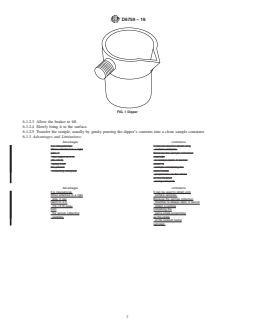
6.1.1.1 One type has an adjustable clamp attached to the end of a metal rod or tube, which may be extendable (see Fig. 1). The
rod or tube forms the handle and the clamp is used to secure it to a beaker or other sample container.
6.1.1.2 Another type of device is made using a stainless steel tube clamped to a moveable bracket that is attached to a rigid
handle. The angle of the cup to the handle is adjustable (Practice D5358).
6.1.2 Procedure:
6.1.2.1 With the beaker facing downward, lower the dipper beaker into the liquid slowly until it is submerged. Try to cause a
minimum of surface disturbance.
6.1.2.2 Rotate the beaker through 180°. If there is a current, the mouth of the beaker should face upstream during the rotation.
Occupational Safety and Health Guidance Manual for Hazardous Waste Site Activities, DHHS (NIOSH) Publication No. 85-115 (NTIS No. PB87-162855/LL), NIOSH,
OSHA, USCG, EPA, October 1985.
D6759 − 16
FIG. 1 Dipper
6.1.2.3 Allow the beaker to fill.
6.1.2.4 Slowly bring it to the surface.
6.1.2.5 Transfer the sample, usually by gently pouring the dipper’s contents into a clean sample container.
6.1.3 Advantages and Limitations:
Advantages Limitations
It is inexpensive. It can be used to obtain only
When attached to a rigid surface samples.
pole, it Because the sample collection
can reach to 4 m chamber
(10–13 ft) is always open, it cannot
away from obtain a
the person sample containing the
collecting samples. same strata
proportions as the strata
at the location
being sampled.
Advantages Limitations
It is inexpensive. It can be used to obtain only
When attached to a rigid surface samples.
pole, it can Because the sample collection
reach to 4 m chamber is always open, it cannot
(10–13 ft) away obtain a sample
from containing the
the person collecting same strata proportions
samples. as the strata
at the location being
sampled.
D6759 − 16
6.2 Liquid Grab Sampler:
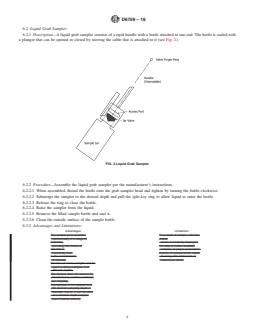
6.2.1 Description—A liquid grab sampler consists of a rigid handle with a bottle attached to one end. The bottle is sealed with
a plunger that can be opened or closed by moving the cable that is attached to it (see Fig. 2).
FIG. 2 Liquid Grab Sampler
6.2.2 Procedure—Assemble the liquid grab sampler per the manufacturer’s instructions.
6.2.2.1 When assembled, thread the bottle onto the grab sampler head and tighten by turning the bottle clockwise.
6.2.2.2 Submerge the sampler to the desired depth and pull the split key ring to allow liquid to enter the bottle.
6.2.2.3 Release the ring to close the bottle.
6.2.2.4 Raise the sampler from the liquid.
6.2.2.5 Remove the filled sample bottle and seal it.
6.2.2.6 Clean the outside surface of the sample bottle.
6.2.3 Advantages and Limitations:
Advantages Limitations
The sample jar is available True depth of sample unknown
commercially in a range of unless
materials, device is vertically deployed.
providing the choice of Not able to collect stratified
one that is samples of proper proportions.
chemically inert Exterior of sample bottle needs
to the contaminants cleaning after immersion in
of interest. hazardous waste.
Handles of various lengths can be
used to obtain samples from
different depths.
The sample does not need to be
transferred to another container
for shipping.
The sampler is not opened until
the desired sampling depth is
reached, that is, it can be used
as a discrete depth sampler
(see Practice D6699).
D6759 − 16
Advantages Limitations
The sample jar is available True depth of sample unknown
commercially in a range of unless device is vertically
materials, providing the choice of deployed.
one that is chemically Not able to collect stratified
inert samples of proper proportions.
to the contaminants of Exterior of sample bottle needs
interest. cleaning after immersion in
Handles of various lengths can be hazardous waste.
used to obtain samples from
different depths.
The sample does not need to be
transferred to another container
for shipping.
The sampler is not opened until
the desired sampling depth is
reached, that is, it can be used
as a discrete depth sampler
(see Practice D6699).
6.3 Swing Jar Sampler:
6.3.1 Description—This sampling device consists of a pole that screws into a bottle holder (see Fig. 3). The angle of the bottle
FIG. 3 Swing Jar Sampler
with respect to the pole can be varied.
6.3.2 Procedure:
6.3.2.1 Select the bottle clamp that best fits the desired sample bottle.
6.3.2.2 Connect the pole to the bottle holder and turn it clockwise until snug.
6.3.2.3 Slide the clamp onto the bottle to a point midway between the bottle shoulder and heel.
6.3.2.4 Tighten the screw located in the inner pole screw threads of the bottle holder.
6.3.2.5 Lower the sampler into the liquid slowly with the bottle facing downward until it is submerged to cause minimal surface
disturbance.
6.3.2.6 Rotate the bottle through 180°.
NOTE 1—If there is a current, the mouth of the bottle should face upstream during the rotation.
6.3.2.7 Allow the bottle to fill and slowly bring it to the surface.
6.3.2.8 Loosen the screw holding the bottle to the device.
6.3.2.9 Remove the bottle from the holder.
D6759 − 16
6.3.2.10 For transport to the laboratory, either seal the bottle and clean the exterior or transfer the bottle’s contents into a clean
sample container.
6.3.3 Advantages and Limitations:
Advantages Limitations
The sampler can Not suitable for discrete depth
accommodate sampling.
different sample Exterior of sample bottle needs
bottle sizes cleaning after immersion in
up to 960 hazardous waste.
mL.
It allows collection from
various
angles, including
vertical.
Advantages Limitations
The sampler can Not suitable for discrete depth
accommodate different sampling.
sample bottle sizes Exterior of sample bottle needs
up to cleaning after immersion in
960 mL. hazardous waste.
It allows collection from
various angles, including
vertical.
D6759 − 16
6.4 Bacon Bomb:
6.4.1 Description—The Bacon Bomb sampler consists of a sealed hollow tube or chamber. It is attached to a primary cable/line,
with length markings and an actuator rod (labeled Secondary Activation in Fig. 4) connected to a second line, which opens and
closes the chamber’s valves.
6.4.2 Procedure:
6.4.2.1 Measure and mark the support line or cable with the desired length or depth.
6.4.2.2 Close the chamber.
6.4.2.3 Lower the Bacon Bomb sampler using the primary support line or cable to the desired depth, as marked on the support
line. The second line must remain slack during the lowering procedure to avoid accidentally opening the sampler. Secure the line.
6.4.2.4 Open the chamber by pulling on the actuator rod line, thereby allowing the sampler to fill.
6.4.2.5 When the chamber is full, release the second line to close the sampler.
6.4.2.6 Return the sampler to the surface by raising the primary support line.
6.4.2.7 Transfer the contents of the Bacon Bomb sampler to a clean dry sample container. Hold the Bacon Bomb sampler over
the sample container. Open the lower stopper by raising the actuator rod. Drain the contents into a clean sample container(s).
6.4.3 Advantages and Limitations:
FIG. 4 Bacon Bomb
D6759 − 16
Advantages Limitations
Sampler is closed to the material The lowering and activation lines
being sampled until it has tend to cross each other during
reached descent, which could allow
its intended depth, that sample collection to occur
is, it can at the wrong depth.
be used as a The commercially available
discrete depth stainless
sampler. steel unit has a maximum
It is available in 118-mL to capacity of 500 mL.
1000-mL volumes in plated PTFE device is expensive
brass, stainless steel, relative to stainless steel.
acrylic and PTFE. Not effective in turbid sample
The stainless steel unit is media, according to the
effective for use in high manufacturer.
viscosity non aqueous Slight leakage into the interior
liquids, for example, oil. may occur with the stainless
steel unit during descent,
according to the manufacturer
With viscous material, an excess
of the material being sampled
may adhere to the outside of
the Bacon Bomb sampler.
Advantages Limitations
Sampler is closed to the material The lowering and activation lines
being sampled until it has tend to cross each other during
reached its intended depth, that descent, which could allow
is, it can be sample collection to occur
used as a at the wrong depth.
discrete depth sampler. The commercially available
It is available in 118-mL to stainless steel unit has a
1000-mL volumes in plated maximum capacity of 500 mL.
brass, stainless steel, PTFE device is expensive
acrylic and PTFE. relative to stainless steel.
The stainless steel unit is Not effective in turbid sample
effective for use in high media, according to the
viscosity non aqueous manufacturer.
liquids, for example, oil. Slight leakage into the interior
may occur with the stainless
steel unit during descent,
according to the manufacturer
With viscous material, an excess
of the material being sampled
may adhere to the outside of
the Bacon Bomb sampler.
6.5 Syringe Sampler:
6.5.1 Description—The Syringe sampler is a hollow tube type sampler with a bottom fill valve. A Syringe sampler normally
consists of a piston assembly with a T-handle, safety locking nut, and control rod (PTFE-covered aluminum to facilitate operation
of the piston), a piston body assembly, a sampling tube assembly, and a standard bottom valve or coring bottom (see Fig. 5).
6.5.2 Procedure:
6.5.2.1 Open the bottom valve.
6.5.2.2 Slowly lower the assembled sampler to the desired depth.
6.5.2.3 Raise the T-handle, drawing the sample into the sampler body.
6.5.2.4 Close the bottom valve by pressing the sampler down against the side or bottom of the container being sampled.
6.5.2.5 Raise the sampler to the surface using the support line.
6.5.2.6 Transfer the contents to a clean dry sample container. Hold the Syringe sampler over the sample container. Open the
bottom valve and push down on the T-handle to extrude the sample into a clean sample container.
6.5.3 Advantages and Limitations:
D6759 − 16
FIG. 5 Syringe Sampler
Advantages Limitations
It can be used to sample highly The bottom of the syringe
viscous liquids, sludges, and sample
tar-like substances. must be pushed
It can collect samples even when against the
only a small amount remains at bottom or side to close
the bottom of a tank or drum. the bottom valve.
All sample contacting parts are With viscous material, more of
made of PTFE. the material being sampled
It is simple to use and may end up on the outside
decontaminate. of the sampler than inside it
May be used to depths of about
1.8 m (6 ft).
Sampler is closed to the material
being sampled until it has
reached its intended depth,
that is, it can be used as a
discrete depth sampler.
Advantages Limitations
It can be used to sample highly The bottom of the syringe
viscous liquids, sludges, and sample must be pushed
tar-like substances. against the bottom
It can collect samples even when or side to
only a small amount remains at close the bottom valve.
the bottom of a tank or drum. With viscous material, more of
All sample contacting parts are the material being sampled
made of PTFE. may end up on the outside
It is simple to use and of the sampler than inside it
decontaminate.
May be used to depths of about
1.8 m (6 ft).
Sampler is closed to the material
being sampled until it has
reached its intended depth,
that is, it can be used as a
discrete depth sampler.
6.6 Kemmerer Sampler:
6.6.1 Description—The Kemmerer sampler consists of a cylinder with a stopper at
...