

ASTM F3064/F3064M-24
(Specification)Standard Specification for Aircraft Powerplant Control, Operation, and Indication
General Information
- Abstract
ABSTRACT
This specification provides minimum requirements for the control, indication, and operational characteristics of propulsion systems. It was developed based on propulsion system installed on aeroplanes, but may be applicable to other applications. The applicant for a design approval must seek the individual guidance to their respective civil aviation authority (CAA) body concerning the use of this specification as part of a certification plan.
SCOPE
1.1 This specification covers minimum requirements for the control, indication, and operational characteristics of propulsion systems. It was developed based on propulsion system installed on aeroplanes, but may be applicable to other applications as well.
1.2 The applicant for a design approval must seek the individual guidance to their respective CAA body concerning the use of this standard as part of a certification plan. For information on which CAA regulatory bodies have accepted this standard (in whole or in part) as a means of compliance to their Aeroplane Airworthiness regulations (Hereinafter referred to as “the Rules”), refer to ASTM F44 webpage (www.ASTM.org/COMITTEE/F44.htm) which includes CAA website links. Annex A1 maps the Means of Compliance described in this specification to EASA CS-23, amendment 5, or later, and FAA 14 CFR Part 23, amendment 64, or later.
1.3 Units—The values stated are SI units followed by imperial units in brackets. The values stated in each system are not necessarily exact equivalents; therefore, to ensure conformance with the standard, each system shall be used independently of the other, and values from the two systems shall not be combined.
1.4 This standard does not purport to address all of the safety concerns, if any, associated with its use. It is the responsibility of the user of this standard to establish appropriate safety, health, and environmental practices and determine the applicability of regulatory limitations prior to use.
1.5 This international standard was developed in accordance with internationally recognized principles on standardization established in the Decision on Principles for the Development of International Standards, Guides and Recommendations issued by the World Trade Organization Technical Barriers to Trade (TBT) Committee.
- Status
- Published
- Publication Date
- 29-Feb-2024
- Technical Committee
- F44 - General Aviation Aircraft
- Drafting Committee
- F44.40 - Powerplant
Buy Documents
ASTM F3064/F3064M-24 - Standard Specification for Aircraft Powerplant Control, Operation, and Indication
REDLINE ASTM F3064/F3064M-24 - Standard Specification for Aircraft Powerplant Control, Operation, and Indication
Overview
ASTM F3064/F3064M-24 – Standard Specification for Aircraft Powerplant Control, Operation, and Indication establishes the minimum requirements for the control systems, operational characteristics, and indication of propulsion systems installed on aeroplanes. Developed by ASTM Committee F44, this international standard guides design approval applicants in achieving compliance with civil aviation airworthiness regulations for powerplant systems. While its primary focus is on aeroplanes, the specification’s content may also be relevant for other propulsion system applications. This standard aligns with internationally recognized standardization principles and serves as a valuable reference in aircraft certification plans.
Key Topics
Powerplant Control Requirements:
- Ensures controls are properly located, arranged, and secured, minimising inadvertent movement and preventing unsafe operation.
- Details redundancy considerations and fire-resistance requirements for critical controls.
Indication Systems:
- Specifies requirements for the reliable measurement and display of essential powerplant parameters (e.g., fuel, oil quantity, temperature, and pressure).
- Covers installation and calibration practices for both analog and digital displays to support clear pilot awareness.
Operational Characteristics:
- Requires thorough evaluation of both normal and emergency operating conditions, such as engine starting/stopping, cooling, and response to negative acceleration.
- Addresses operational limitations, fuel type and grade, temperature ranges, and compatibility with auxiliary systems like APR (Automatic Power Reserve).
Electronic Engine Control and Safety:
- Outlines expectations for electronic engine control system integrity, high-intensity radiated field (HIRF) and lightning resilience, and prevention of loss-of-thrust/control (LOTC/LOPC) events.
- Calls for comprehensive safety assessments and compliance with applicable regulatory guidance (e.g., FAA and EASA standards).
Compliance Mapping:
- Provides correlation tables and annexes mapping requirements to EASA CS-23 and FAA 14 CFR Part 23, facilitating regulatory acceptance and streamlined certification.
Applications
ASTM F3064/F3064M-24 is utilized by:
- Aircraft Designers & Manufacturers: Assisting in the design, validation, and certification of powerplant controls and indication systems for aeroplanes, including engine control levers, mixture controls, and engine status indicators.
- Certification Consultants & Compliance Specialists: Supporting preparation of certification plans that meet regulatory authority (CAA/FAA/EASA) requirements for airworthiness.
- Maintenance, Repair & Overhaul (MRO) Organizations: Referring to operational and indication standards to ensure ongoing compliance in servicing aircraft propulsion systems.
- Avionics Developers: Designing display and alerting systems that meet the standard’s human factors and performance requirements.
- Regulatory Authorities: Benchmarking national airworthiness rules and interoperability with global standards.
Related Standards
The following ASTM and regulatory documents are closely associated with ASTM F3064/F3064M-24:
- ASTM F3060: Terminology for Aircraft
- ASTM F3061/F3061M: Specification for Systems and Equipment in Aircraft
- ASTM F3062/F3062M: Specification for Aircraft Powerplant Installation
- ASTM F3063/F3063M: Specification for Aircraft Fuel Storage and Delivery
- ASTM F3116/F3116M: Specification for Design Loads and Conditions
- ASTM F3117/F3117M: Specification for Crew Interface in Aircraft
- ASTM F3233/F3233M: Specification for Flight and Navigation Instrumentation in Aircraft
- ASTM F3432: Practice for Powerplant Instruments
Referenced regulatory standards include:
- EASA CS-23: Certification Specifications for Normal-Category Aeroplanes
- FAA 14 CFR Part 23: Airworthiness Standards: Normal Category Airplanes
For updated acceptance status and further guidance, consult the ASTM F44 committee webpage and relevant CAA resources.
Keywords: aircraft powerplant control, powerplant operation, powerplant indication, engine control systems, aviation standards, FAA Part 23, EASA CS-23, electronic engine control, LOTC, aircraft certification, ASTM F3064
Relations
- Effective Date
- 01-Mar-2024
- Effective Date
- 01-Mar-2024
- Effective Date
- 01-Mar-2024
- Effective Date
- 01-Mar-2024
- Effective Date
- 01-Mar-2024
- Referred By
ASTM F3397/F3397M-21 - Standard Practice for Aeroplane Turbine Fuel System Hot Weather Operations - Effective Date
- 01-Mar-2024
- Effective Date
- 01-Mar-2024
- Effective Date
- 01-Mar-2024
Buy Documents
ASTM F3064/F3064M-24 - Standard Specification for Aircraft Powerplant Control, Operation, and Indication
REDLINE ASTM F3064/F3064M-24 - Standard Specification for Aircraft Powerplant Control, Operation, and Indication
Get Certified
Connect with accredited certification bodies for this standard

BUREAU VERITAS Certification Germany
Bureau Veritas certification in Germany.

Element Materials Technology
Materials testing and product certification.

AQMS Ltd.
AQMS provides ISO certification to SMEs across the UK.
Sponsored listings
Frequently Asked Questions
ASTM F3064/F3064M-24 is a technical specification published by ASTM International. Its full title is "Standard Specification for Aircraft Powerplant Control, Operation, and Indication". This standard covers: ABSTRACT This specification provides minimum requirements for the control, indication, and operational characteristics of propulsion systems. It was developed based on propulsion system installed on aeroplanes, but may be applicable to other applications. The applicant for a design approval must seek the individual guidance to their respective civil aviation authority (CAA) body concerning the use of this specification as part of a certification plan. SCOPE 1.1 This specification covers minimum requirements for the control, indication, and operational characteristics of propulsion systems. It was developed based on propulsion system installed on aeroplanes, but may be applicable to other applications as well. 1.2 The applicant for a design approval must seek the individual guidance to their respective CAA body concerning the use of this standard as part of a certification plan. For information on which CAA regulatory bodies have accepted this standard (in whole or in part) as a means of compliance to their Aeroplane Airworthiness regulations (Hereinafter referred to as “the Rules”), refer to ASTM F44 webpage (www.ASTM.org/COMITTEE/F44.htm) which includes CAA website links. Annex A1 maps the Means of Compliance described in this specification to EASA CS-23, amendment 5, or later, and FAA 14 CFR Part 23, amendment 64, or later. 1.3 Units—The values stated are SI units followed by imperial units in brackets. The values stated in each system are not necessarily exact equivalents; therefore, to ensure conformance with the standard, each system shall be used independently of the other, and values from the two systems shall not be combined. 1.4 This standard does not purport to address all of the safety concerns, if any, associated with its use. It is the responsibility of the user of this standard to establish appropriate safety, health, and environmental practices and determine the applicability of regulatory limitations prior to use. 1.5 This international standard was developed in accordance with internationally recognized principles on standardization established in the Decision on Principles for the Development of International Standards, Guides and Recommendations issued by the World Trade Organization Technical Barriers to Trade (TBT) Committee.
ABSTRACT This specification provides minimum requirements for the control, indication, and operational characteristics of propulsion systems. It was developed based on propulsion system installed on aeroplanes, but may be applicable to other applications. The applicant for a design approval must seek the individual guidance to their respective civil aviation authority (CAA) body concerning the use of this specification as part of a certification plan. SCOPE 1.1 This specification covers minimum requirements for the control, indication, and operational characteristics of propulsion systems. It was developed based on propulsion system installed on aeroplanes, but may be applicable to other applications as well. 1.2 The applicant for a design approval must seek the individual guidance to their respective CAA body concerning the use of this standard as part of a certification plan. For information on which CAA regulatory bodies have accepted this standard (in whole or in part) as a means of compliance to their Aeroplane Airworthiness regulations (Hereinafter referred to as “the Rules”), refer to ASTM F44 webpage (www.ASTM.org/COMITTEE/F44.htm) which includes CAA website links. Annex A1 maps the Means of Compliance described in this specification to EASA CS-23, amendment 5, or later, and FAA 14 CFR Part 23, amendment 64, or later. 1.3 Units—The values stated are SI units followed by imperial units in brackets. The values stated in each system are not necessarily exact equivalents; therefore, to ensure conformance with the standard, each system shall be used independently of the other, and values from the two systems shall not be combined. 1.4 This standard does not purport to address all of the safety concerns, if any, associated with its use. It is the responsibility of the user of this standard to establish appropriate safety, health, and environmental practices and determine the applicability of regulatory limitations prior to use. 1.5 This international standard was developed in accordance with internationally recognized principles on standardization established in the Decision on Principles for the Development of International Standards, Guides and Recommendations issued by the World Trade Organization Technical Barriers to Trade (TBT) Committee.
ASTM F3064/F3064M-24 is classified under the following ICS (International Classification for Standards) categories: 49.140 - Space systems and operations. The ICS classification helps identify the subject area and facilitates finding related standards.
ASTM F3064/F3064M-24 has the following relationships with other standards: It is inter standard links to ASTM F3064/F3064M-21, ASTM F3264-23, ASTM F3179/F3179M-23, ASTM F3117/F3117M-23a, ASTM F3239-22a, ASTM F3397/F3397M-21, ASTM F3563-22, ASTM F3432-20a. Understanding these relationships helps ensure you are using the most current and applicable version of the standard.
ASTM F3064/F3064M-24 is available in PDF format for immediate download after purchase. The document can be added to your cart and obtained through the secure checkout process. Digital delivery ensures instant access to the complete standard document.
Standards Content (Sample)
This international standard was developed in accordance with internationally recognized principles on standardization established in the Decision on Principles for the
Development of International Standards, Guides and Recommendations issued by the World Trade Organization Technical Barriers to Trade (TBT) Committee.
Designation: F3064/F3064M − 24
Standard Specification for
Aircraft Powerplant Control, Operation, and Indication
This standard is issued under the fixed designation F3064/F3064M; the number immediately following the designation indicates the year
of original adoption or, in the case of revision, the year of last revision. A number in parentheses indicates the year of last reapproval.
A superscript epsilon (´) indicates an editorial change since the last revision or reapproval.
1. Scope 2. Referenced Documents
2.1 ASTM Standards:
1.1 This specification covers minimum requirements for the
F3060 Terminology for Aircraft
control, indication, and operational characteristics of propul-
F3061/F3061M Specification for Systems and Equipment in
sion systems. It was developed based on propulsion system
Aircraft
installed on aeroplanes, but may be applicable to other appli-
F3062/F3062M Specification for Aircraft Powerplant Instal-
cations as well.
lation
1.2 The applicant for a design approval must seek the
F3063/F3063M Specification for Aircraft Fuel Storage and
individual guidance to their respective CAA body concerning
Delivery
the use of this standard as part of a certification plan. For
F3116/F3116M Specification for Design Loads and Condi-
information on which CAA regulatory bodies have accepted
tions
this standard (in whole or in part) as a means of compliance to F3117/F3117M Specification for Crew Interface in Aircraft
their Aeroplane Airworthiness regulations (Hereinafter referred
F3233/F3233M Specification for Flight and Navigation In-
to as “the Rules”), refer to ASTM F44 webpage strumentation in Aircraft
(www.ASTM.org/COMITTEE/F44.htm) which includes CAA F3367 Practice for Simplified Methods for Addressing High-
Intensity Radiated Fields (HIRF) and Indirect Effects of
website links. Annex A1 maps the Means of Compliance
Lightning on Aircraft
described in this specification to EASA CS-23, amendment 5,
F3432 Practice for Powerplant Instruments
or later, and FAA 14 CFR Part 23, amendment 64, or later.
2.2 EASA Standard:
1.3 Units—The values stated are SI units followed by
CS-23 Certification Specifications for Normal-Category
imperial units in brackets. The values stated in each system are
Aeroplanes
not necessarily exact equivalents; therefore, to ensure confor-
2.3 FAA Documents:
mance with the standard, each system shall be used indepen-
14 CFR Part 23 Airworthiness Standards: Normal Category
dently of the other, and values from the two systems shall not
Airplanes
be combined.
AC 33.28-1 Compliance Criteria For 14 CFR §33.28, Air-
craft Engines, Electrical And Electronic Engine Control
1.4 This standard does not purport to address all of the
Systems
safety concerns, if any, associated with its use. It is the
AC 33.28-2 Guidance Material For 14 CFR §33.28, Recip-
responsibility of the user of this standard to establish appro-
rocating Engines, Electrical And Electronic Engine Con-
priate safety, health, and environmental practices and deter-
trol Systems
mine the applicability of regulatory limitations prior to use.
AC 33.28-3 Guidance Material For 14 CFR §33.28, Engine
1.5 This international standard was developed in accor-
Control Systems
dance with internationally recognized principles on standard-
ization established in the Decision on Principles for the
3. Terminology
Development of International Standards, Guides and Recom-
3.1 The following are a selection of relevant terms. See
mendations issued by the World Trade Organization Technical
Terminology F3060 for more definitions and abbreviations.
Barriers to Trade (TBT) Committee.
For referenced ASTM standards, visit the ASTM website, www.astm.org, or
contact ASTM Customer Service at service@astm.org. For Annual Book of ASTM
This specification is under the jurisdiction of ASTM Committee F44 on General Standards volume information, refer to the standard’s Document Summary page on
Aviation Aircraft and is the direct responsibility of Subcommittee F44.40 on the ASTM website.
Powerplant. Available from European Union Aviation Safety Agency (EASA), Konrad-
Current edition approved March 1, 2024. Published March 2024. Originally Adenauer-Ufer 3, D-50668 Cologne, Germany, https://www.easa.europa.eu.
approved in 2015. Last previous edition approved in 2021 as F3064/F3064M–21. Available from Federal Aviation Administration (FAA), 800 Independence
DOI: 10.1520/F3064_F3064M-24. Ave., SW, Washington, DC 20591, http://www.faa.gov.
Copyright © ASTM International, 100 Barr Harbor Drive, PO Box C700, West Conshohocken, PA 19428-2959. United States
F3064/F3064M − 24
3.2 Definitions: 4. Powerplant Controls
3.2.1 automatic power reserve (APR) system, n—the auto-
4.1 General Requirements:
matic system used only during takeoff, including all devices
4.1.1 Powerplant controls must be located and arranged per
both mechanical and electrical that sense engine failure,
Specification F3117/F3117M.
transmit signals, actuate fuel/energy controls or power levers
4.1.2 Each flexible control must be shown to be suitable for
on operating engines, including power sources, to achieve the
the particular application.
scheduled power increase and furnish cockpit information on
4.1.3 Each control must be able to maintain any necessary
system operation.
position without:
3.2.2 critical time interval, n—period starting at V minus
4.1.3.1 Constant attention by flight crew members; or
one second and ending at the intersection of the engine and
4.1.3.2 Tendency to creep due to control loads or vibration.
APR failure flight path line with the minimum performance all
4.1.4 Each control must be able to withstand operating loads
engine flight path line. The engine and APR failure flight path
without failure or excessive deflection that will impede or
line intersects the one-engine-inoperative flight path line at
negatively affect intended operation.
122 m [400 ft] above the takeoff surface. The engine and APR
4.1.5 For turbine engine powered airplanes, no single failure
failure flight path is based on the airplane’s performance and
or malfunction, or probable combination thereof, in any
must have a positive gradient of at least 0.5 % at 122 m [400 ft]
powerplant control system may cause the failure of any
above the takeoff surface. See Fig. 1.
powerplant function necessary for safety.
3.2.3 loss-of-thrust-control/loss of power control (LOTC/
4.1.6 The portion of each powerplant control located in the
LOPC), n—loss of capability to modulate and maintain thrust
engine compartment that is required to be operated in the event
or power between flight idle and a specified percent of
of fire must be at least fire resistant.
maximum rated power or thrust, at all operating conditions.
4.1.7 Powerplant valve controls located in the cockpit must
3.2.4 powerplant instrument, n—the visual presentation of a
have:
powerplant (Terminology F3060) parameter, a powerplant
4.1.7.1 For manual valves, positive stops or in the case of
installation (Terminology F3060) parameter, a parameter re-
fuel valves suitable index provisions, in the open and closed
quired by the engine manufacturer, or fuel/energy system
position; and
parameter necessary to provide performance and condition
4.1.7.2 For power-assisted valves, a means to indicate to the
information for the airplane operation.
flight crew when the valve is in the fully open or fully closed
3.2.5 selected takeoff power, n—the power obtained from position; or is moving between the fully open and fully closed
each initial power setting approved for takeoff. position.
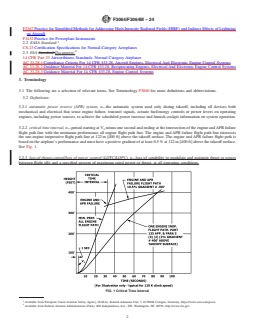
FIG. 1 Critical Time Interval
F3064/F3064M − 24
4.2 Ignition Switches: 4.7.1 For carburetor equipped airplanes there must be a
4.2.1 Aeroplanes with combustion based engines that utilize separate carburetor air temperature control for each engine.
spark ignition must have independent ignition switches that
4.8 Auxiliary Power Unit Controls:
must control and shut off each ignition circuit on each engine.
4.8.1 Means must be provided on the flight deck for the
4.3 Power, Thrust, Supercharger Controls: starting, stopping, monitoring, and emergency shutdown of
4.3.1 There must be a separate power or thrust control for each installed auxiliary power unit.
each engine and a separate control for each supercharger that
4.9 Powered Operated Valves:
requires a control.
4.9.1 Power Operated valves must have a means to:
4.3.2 Each power, thrust, or supercharger control must give
4.9.1.1 Indicate to the flight crew when the valve has
a positive and immediate responsive means of controlling its
reached the selected position; and
engine or supercharger.
4.9.1.2 Not move from the selected position under vibration
4.3.3 The power, thrust, or supercharger controls for each
conditions likely to exist at the valve location.
engine or supercharger must be independent of those for every
4.10 Fuel Valves and Energy Controls:
other engine or supercharger.
4.10.1 There must be a means to allow appropriate flight
4.3.4 For each fluid injection (other than fuel) system and its
crew members to rapidly shut off, in flight, the supply of
controls not provided and approved as part of the engine, the
fuel/energy to each engine individually.
applicant must show that the flow of the injection fluid is
4.10.2 No shutoff valve may be on the engine side of any
adequately controlled.
firewall. In addition, there must be means to:
4.3.5 If a power, thrust, or a fuel control (other than a
4.10.2.1 Guard against inadvertent operation of each shutoff
mixture control) incorporates a fuel shutoff feature, the control
valve; and
must have a means to prevent the inadvertent movement of the
4.10.2.2 Allow appropriate flight crew members to reopen
control into the shutoff position. This means must:
each valve rapidly after it has been closed.
4.3.5.1 Have a positive lock or stop at the idle position; and
4.10.3 Each valve and fuel system control must be sup-
4.3.5.2 Require a separate and distinct operation to place the
ported so that loads resulting from its operation or from
control in the shutoff position.
accelerated flight conditions are not transmitted to the lines
4.3.6 Each power or thrust control must be designed so that
connected to the valve.
if a control separates at the engine fuel/energy metering device,
4.10.4 Each valve and fuel system control must be installed
the airplane is capable of continued safe flight and landing.
so that gravity and vibration will not affect the selected
4.4 Fuel/Energy Mixture Controls:
position.
4.4.1 If there are mixture controls, each engine must have a
4.10.5 Each shutoff valve handle and its connections to the
separate control.
valve mechanism must have design features that minimize the
4.4.2 Aeroplanes with a manual engine mixture control
possibility of incorrect installation.
must be designed so that, if the control separates at the engine
4.10.6 Fuel tank selector valves must:
fuel/energy metering device, the airplane is capable of contin-
4.10.6.1 Have a separate and distinct action to place the
ued safe flight and landing.
selector in the “OFF” position; and
4.5 Propeller Speed Pitch and Feathering Controls:
4.10.6.2 Have the tank selector positions located in such a
4.5.1 If there are propeller speed or pitch controls, they
manner that it is impossible for the selector to pass through the
must:
“OFF” position when changing from one tank to another.
4.5.1.1 Allow separate control of each propeller.
4.11 Electronic Engine Control (EECS):
4.5.1.2 Allow ready synchronization of all propellers on
4.11.1 For electronic engine control system (EECS) (Termi-
multiengine airplanes.
nology F3060) installations, no single failure or malfunction or
4.5.2 If there are propeller feathering controls installed:
foreseeable combinations of failures of EECS components
4.5.2.1 It must be possible to feather each propeller sepa-
shall have an effect on the installed system that causes the
rately.
probability of loss-of-thrust-control/loss of power control
4.5.2.2 Each control must have a means to prevent inadver-
(LOTC/LOPC) to exceed that which was required in the engine
tent operation.
certification.
4.6 Reverse Thrust and Propeller Pitch Settings:
NOTE 1—The term “foreseeable" in this context is defined as those
4.6.1 For turbine engine installations, each control for
failures or failure combinations which could occur a few times when
reverse thrust and for propeller pitch settings below the flight
considering the entire operational life of all airplanes of one type. A
qualitative assessment is required for each EECS installation considering
regime must have means to prevent its inadvertent operation
all foreseeable events that may not have been considered in the part 33
that includes:
EECS safety assessment which may invalidate the approved LOTC/LOPC
4.6.1.1 A positive lock or stop at the flight idle position.
rates (reference AC33.28-1 (paragraph 6-3(a)(2), AC33.28-2 tables 5-1
4.6.1.2 A separate and distinct operation by the crew to
and 5-2, and AC33.28-3 paragraph 62(d)).
displace the control from the flight regime (forward thrust
4.11.2 Electronic engine control system installations shall
regime for turbojet powered airplanes).
be evaluated for environmental and atmospheric conditions,
4.7 Carburetor Air Temperature Controls: including lightning and HIRF (Terminology F3060) as follows:
F3064/F3064M − 24
4.11.2.1 The EECS lightning and HIRF effects that result in and fluids within the limits established for those components
LOTC/LOPC shall be analyzed utilizing the threat levels and fluids under the most adverse ground, and water condi-
associated with a catastrophic failure. tions; and
4.11.2.2 The EECS as installed in the aircraft shall be shown
5.3.1.2 Demonstrate flight operations to the maximum alti-
to meet the requirements of Specification F3061/F3061M for
tude and maximum ambient atmospheric temperature condi-
Indirect Effects of Lightning and High Intensity Radiated
tions for which approval is requested, including after normal
Fields (HIRF) protection.
engine and auxiliary power unit shutdown.
4.11.2.3 If Practice F3367 is used, single reciprocating
5.4 Cooling Tests—Correction Factors:
engine installations shall meet the requirements defined for
5.4.1 General—Compliance with 5.3 must be shown on the
airplane assessment level I or higher for HIRF and airplane
basis of tests, for which the following apply:
assessment level II or higher for indirect effects of lightning.
5.4.1.1 If the tests are conducted under ambient atmospheric
4.11.3 The components of the installation shall be
temperature conditions deviating from the maximum for which
constructed, arranged, and installed to ensure their continued
approval is requested, the recorded powerplant temperatures
safe operation between normal inspections or overhauls.
must be corrected under 5.4.3 and 5.4.4, unless a more rational
4.11.4 Functions incorporated into any electronic engine
control system that make it part of any equipment, systems, or correction method is applicable.
installation whose functions are beyond that of basic engine
5.4.1.2 No corrected temperature determined under 5.4.1.1
control, and which could also introduce system failures and
of this standard may exceed established limits.
malfunctions, are not exempt from normal category airplane
5.4.1.3 The fuel used during the cooling tests must be of the
system safety certification requirements and shall be shown to
minimum grade approved for the engine.
meet normal category airplane certification levels of safety as
5.4.1.4 For turbocharged engines, each turbocharger must
derived from those requirements. Engine certification data, if
be operated through that part of the climb profile for which
applicable, is acceptable to support compliance with any
operation with the turbocharger is requested.
normal category airplane certification requirements.
5.4.1.5 For a reciprocating engine, the mixture settings must
NOTE 2—If engine certification data is to be used to support substan-
be the leanest recommended for climb.
tiation of compliance with normal category airplane certification
5.4.2 Maximum Ambient Atmospheric Temperature—A
requirements, then the normal category airplane certification applicant
maximum ambient atmospheric temperature corresponding to
should be able to provide this data to support their showing of compliance.
sea level conditions of at least 38 °C [100 °F] must be
established. The assumed temperature lapse rate is 2 °C per
5. Powerplant Operational Characteristics and
305 meter [3.6 °F per thousand feet] of altitude above sea level
Installation
until a temperature of –56.5 °C [–69.7 °F] is reached, above
5.1 Powerplant Operating Characteristics:
which altitude the temperature is considered constant at
5.1.1 Turbine engine powerplant operating characteristics
–56.5 °C [–69.7 °F].
must:
5.4.2.1 For winterization installations, the applicant may
5.1.1.1 Be investigated in flight to determine that no adverse
select a maximum ambient atmospheric temperature corre-
characteristics (such as stall, surge, or flameout) are present, to
sponding to sea level conditions of less than 38 °C [100 °F].
a hazardous degree, during normal and emergency operations
5.4.3 Correction Factor (Except for Cylinder Barrels)—
within the range of operating limitations of the airplane and of
Temperatures of engine fluids and powerplant components
the engine.
(except cylinder barrels) for which temperature limits are
5.1.2 Forced air induction engine operating characteristics
established, must be corrected by adding to them the difference
must be investigated in flight to assure that no adverse
between the maximum ambient atmospheric temperature for
characteristics, as a result of an inadvertent overboost, surge,
the relevant altitude for which approval has been requested and
flooding, or vapor lock, are present during normal or emer-
the temperature of the ambient air at the time of the first
gency operation of the engine(s) throughout the range of
occurrence of the maximum fluid or component temperature
operating limitations of both airplane and engine.
recorded during the cooling test.
5.2 Negative Acceleration:
5.4.4 Correction Factor for Cylinder Barrel Temperatures—
5.2.1 No hazardous malfunction of an engine, an auxiliary
Cylinder barrel temperatures must be corrected by adding to
power unit approved for use in flight, or any component or
them 0.7 times the difference between the maximum ambient
system associated with the powerplant or auxiliary power unit
atmospheric temperature for the relevant altitude for which
may occur when the airplane is operated at the negative
approval has been requested and the temperature of the
accelerations within the flight envelopes prescribed in Speci-
ambient air at the time of the first occurrence of the maximum
fication F3116/F3116M. This must be shown for the greatest
cylinder barrel temperature recorded during the cooling test.
value and duration of the acceleration expected in service.
5.5 Cooling Test Procedures for Turbine Engine Powered
5.3 Cooling—General:
Airplanes:
5.3.1 The powerplant and auxiliary power unit cooling
provisions must: 5.5.1 Compliance with 5.3 must be shown for all phases of
5.3.1.1 Maintain the temperatures of powerplant compo- operation. The airplane must be flown in the configurations, at
nents and engine fluids, and auxiliary power unit components the speeds, and following the procedures recommended in the
F3064/F3064M − 24
Airplane Flight Manual for the relevant stage of flight, that 5.7.2.4 If hydraulic propeller feathering systems are used
correspond to the applicable performance requirements that are for stopping the engine, the hydraulic feathering lines or hoses
critical to cooling. must be fire resistant.
5.5.2 Temperatures must be stabilized under the conditions 5.7.2.5 It must be possible to restart an engine in flight.
from which entry is made into each stage of flight being
5.7.2.6 Any techniques and associated limitations must be
investigated, unless the entry condition normally is not one established and included in the Airplane Flight Manual, ap-
during which component and engine fluid temperatures would
proved manual material, or applicable operating placards.
stabilize (in which case, operation through the full entry 5.7.2.7 It must be demonstrated in flight that when restarting
condition must be conducted before entry into the stage of
engines following a false start, all fuel or vapor is discharged
flight being investigated in order to allow temperatures to reach in such a way that it does not constitute a fire hazard.
their natural levels at the time of entry).
5.7.3 Starting and Stopping—Level 4 Aeroplane:
5.5.3 The takeoff cooling test must be preceded by a period
5.7.3.1 Each component of the stopping system on the
during which the powerplant component and engine fluid
engine side of the firewall that might be exposed to fire must be
temperatures are stabilized with the engines at ground idle.
at least fire resistant.
5.5.4 Cooling tests for each stage of flight must be contin-
5.7.3.2 If hydraulic propeller feathering systems are used
ued until:
for this purpose, the feathering lines must be at least fire
5.5.4.1 The component and engine fluid temperatures stabi-
resistant under the operating conditions that may be expected
lize;
to exist during feathering.
5.5.4.2 The stage of flight is completed; or
5.7.4 Restart Envelope—An altitude and airspeed envelope
5.5.4.3 An operating limitation is reached.
must be established for the airplane for inflight engine restart-
ing and each installed engine must have a restart capability
5.6 Cooling Test Procedures for Reciprocating Engine Pow-
within that envelope.
ered Airplanes:
5.7.5 Restart Capability—For turbine engine powered
5.6.1 Compliance with 5.3 must be shown for the climb (or,
airplanes, if the minimum windmilling speed of the engines,
for multiengine airplanes with negative one-engine-inoperative
following the inflight shutdown of all engines, is insufficient to
rates of climb, the descent) stage of flight.
provide the necessary electrical power for engine ignition, a
5.6.2 The airplane must be flown in the configurations, at
power source independent of the engine-driven electrical
the speeds and following the procedures recommended in the
power generating system must be provided to permit inflight
Airplane Flight Manual that correspond to the applicable
engine ignition for restarting.
performance requirements that are critical to cooling.
5.8 Powerplant Limitations:
5.7 Engine Starting and Stopping:
5.8.1 General—The powerplant limitations prescribed in
5.7.1 Starting and Stopping (Piston Engine):
this subsection must:
5.7.1.1 The design of the installation must be such that:
5.8.1.1 Be established so that they do not exceed the
(1) Risk of fire or mechanical damage to the engine or
corresponding limits established by the manufacturer in the
airplane, as a result of starting the engine in any conditions in
case of all powerplants including those that do not have a type
which starting is to be permitted, is reduced to a minimum.
certificate.
(2) Any techniques and associated limitations for engine
5.8.1.2 Be established so that they do not exceed the
starting must be established and included in the Airplane Flight
corresponding limits for which certificated engines or propel-
Manual, approved manual material, or applicable operating
lers are type certificated (as applicable).
placards.
5.8.1.3 Include other powerplant limitations used in deter-
(3) Means must be provided for restarting any engine in
mining compliance.
flight.
5.8.2 Takeoff Operation—The powerplant takeoff operations
(4) Means must be provided for stopping any engine in
must be limited by:
flight, after engine failure, if continued engine rotation would
5.8.2.1 The maximum rotational speed (rpm);
cause a hazard to the airplane.
5.8.2.2 The maximum allowable manifold pressure (for
5.7.2 Starting and Stopping (Turbine E
...
This document is not an ASTM standard and is intended only to provide the user of an ASTM standard an indication of what changes have been made to the previous version. Because
it may not be technically possible to adequately depict all changes accurately, ASTM recommends that users consult prior editions as appropriate. In all cases only the current version
of the standard as published by ASTM is to be considered the official document.
Designation: F3064/F3064M − 21 F3064/F3064M − 24
Standard Specification for
Aircraft Powerplant Control, Operation, and Indication
This standard is issued under the fixed designation F3064/F3064M; the number immediately following the designation indicates the year
of original adoption or, in the case of revision, the year of last revision. A number in parentheses indicates the year of last reapproval.
A superscript epsilon (´) indicates an editorial change since the last revision or reapproval.
1. Scope
1.1 This specification covers minimum requirements for the control, indication, and operational characteristics of propulsion
systems. It was developed based on propulsion system installed on aeroplanes, but may be applicable to other applications as well.
1.2 The applicant for a design approval must seek the individual guidance to their respective CAA body concerning the use of this
standard as part of a certification plan. For information on which CAA regulatory bodies have accepted this standard (in whole
or in part) as a means of compliance to their Aeroplane Airworthiness regulations (Hereinafter referred to as “the Rules”), refer
to ASTM F44 webpage (www.ASTM.org/COMITTEE/F44.htm) which includes CAA website links. Annex A1 maps the Means
of Compliance described in this specification to EASA CS-23, amendment 5, or later, and FAA 14 CFR Part 23, amendment 64,
or later.
1.3 Units—The values stated are SI units followed by imperial units in brackets. The values stated in each system are not
necessarily exact equivalents; therefore, to ensure conformance with the standard, each system shall be used independently of the
other, and values from the two systems shall not be combined.
1.4 This standard does not purport to address all of the safety concerns, if any, associated with its use. It is the responsibility
of the user of this standard to establish appropriate safety, health, and environmental practices and determine the applicability of
regulatory limitations prior to use.
1.5 This international standard was developed in accordance with internationally recognized principles on standardization
established in the Decision on Principles for the Development of International Standards, Guides and Recommendations issued
by the World Trade Organization Technical Barriers to Trade (TBT) Committee.
2. Referenced Documents
2.1 ASTM Standards:
F3060 Terminology for Aircraft
F3061/F3061M Specification for Systems and Equipment in Aircraft
F3062/F3062M Specification for Aircraft Powerplant Installation
F3063/F3063M Specification for Aircraft Fuel Storage and Delivery
F3116/F3116M Specification for Design Loads and Conditions
F3117/F3117M Specification for Crew Interface in Aircraft
F3233/F3233M Specification for Flight and Navigation Instrumentation in Aircraft
This specification is under the jurisdiction of ASTM Committee F44 on General Aviation Aircraft and is the direct responsibility of Subcommittee F44.40 on Powerplant.
Current edition approved May 1, 2021March 1, 2024. Published May 2021March 2024. Originally approved in 2015. Last previous edition approved in 20202021 as
F3064/F3064M–20a. DOI: 10.1520/F3064_F3064M-21.–21. DOI: 10.1520/F3064_F3064M-24.
For referenced ASTM standards, visit the ASTM website, www.astm.org, or contact ASTM Customer Service at service@astm.org. For Annual Book of ASTM Standards
volume information, refer to the standard’s Document Summary page on the ASTM website.
Copyright © ASTM International, 100 Barr Harbor Drive, PO Box C700, West Conshohocken, PA 19428-2959. United States
F3064/F3064M − 24
F3367 Practice for Simplified Methods for Addressing High-Intensity Radiated Fields (HIRF) and Indirect Effects of Lightning
on Aircraft
F3432 Practice for Powerplant Instruments
2.2 EASA Standard:
CS-23 Certification Specifications for Normal-Category Aeroplanes
2.3 FAA Standard:Documents:
14 CFR Part 23 Airworthiness Standards: Normal Category Airplanes
AC 33.28-1 Compliance Criteria For 14 CFR §33.28, Aircraft Engines, Electrical And Electronic Engine Control Systems
AC 33.28-2 Guidance Material For 14 CFR §33.28, Reciprocating Engines, Electrical And Electronic Engine Control Systems
AC 33.28-3 Guidance Material For 14 CFR §33.28, Engine Control Systems
3. Terminology
3.1 The following are a selection of relevant terms. See Terminology F3060 for more definitions and abbreviations.
3.2 Definitions:
3.2.1 automatic power reserve (APR) system, n—the automatic system used only during takeoff, including all devices both
mechanical and electrical that sense engine failure, transmit signals, actuate fuel/energy controls or power levers on operating
engines, including power sources, to achieve the scheduled power increase and furnish cockpit information on system operation.
3.2.2 critical time interval, n—period starting at V minus one second and ending at the intersection of the engine and APR failure
flight path line with the minimum performance all engine flight path line. The engine and APR failure flight path line intersects
the one-engine-inoperative flight path line at 122 m [400 ft] above the takeoff surface. The engine and APR failure flight path is
based on the airplane’s performance and must have a positive gradient of at least 0.5 % at 122 m [400 ft] above the takeoff surface.
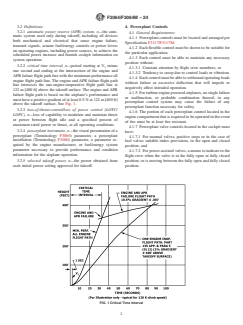
See Fig. 1.
3.2.3 loss-of-thrust-control/loss of power control (LOTC/LOPC), n—loss of capability to modulate and maintain thrust or power
between flight idle and a specified percent of maximum rated power or thrust, at all operating conditions.
FIG. 1 Critical Time Interval
Available from European Union Aviation Safety Agency (EASA), Konrad-Adenauer-Ufer 3, D-50668 Cologne, Germany, https://www.easa.europa.eu.
Available from Federal Aviation Administration (FAA), 800 Independence Ave., SW, Washington, DC 20591, http://www.faa.gov.
F3064/F3064M − 24
3.2.4 powerplant instrument, n—the visual presentation of a powerplant (Terminology F3060) parameter, a powerplant installation
(Terminology F3060) parameter, a parameter required by the engine manufacturer, or fuel/energy system parameter necessary to
provide performance and condition information for the airplane operation.
3.2.5 selected takeoff power, n—the power obtained from each initial power setting approved for takeoff.
4. Powerplant Controls
4.1 General Requirements:
4.1.1 Powerplant controls must be located and arranged per Specification F3117/F3117M.
4.1.2 Each flexible control must be shown to be suitable for the particular application.
4.1.3 Each control must be able to maintain any necessary position without:
4.1.3.1 Constant attention by flight crew members; or
4.1.3.2 Tendency to creep due to control loads or vibration.
4.1.4 Each control must be able to withstand operating loads without failure or excessive deflection that will impede or negatively
affect intended operation.
4.1.5 For turbine engine powered airplanes, no single failure or malfunction, or probable combination thereof, in any powerplant
control system may cause the failure of any powerplant function necessary for safety.
4.1.6 The portion of each powerplant control located in the engine compartment that is required to be operated in the event of fire
must be at least fire resistant.
4.1.7 Powerplant valve controls located in the cockpit must have:
4.1.7.1 For manual valves, positive stops or in the case of fuel valves suitable index provisions, in the open and closed position;
and
4.1.7.2 For power-assisted valves, a means to indicate to the flight crew when the valve is in the fully open or fully closed position;
or is moving between the fully open and fully closed position.
4.2 Ignition Switches:
4.2.1 Aeroplanes with combustion based engines that utilize spark ignition must have independent ignition switches that must
control and shut off each ignition circuit on each engine.
4.3 Power, Thrust, Supercharger Controls:
4.3.1 There must be a separate power or thrust control for each engine and a separate control for each supercharger that requires
a control.
4.3.2 Each power, thrust, or supercharger control must give a positive and immediate responsive means of controlling its engine
or supercharger.
4.3.3 The power, thrust, or supercharger controls for each engine or supercharger must be independent of those for every other
engine or supercharger.
4.3.4 For each fluid injection (other than fuel) system and its controls not provided and approved as part of the engine, the
applicant must show that the flow of the injection fluid is adequately controlled.
F3064/F3064M − 24
4.3.5 If a power, thrust, or a fuel control (other than a mixture control) incorporates a fuel shutoff feature, the control must have
a means to prevent the inadvertent movement of the control into the shutoff position. This means must:
4.3.5.1 Have a positive lock or stop at the idle position; and
4.3.5.2 Require a separate and distinct operation to place the control in the shutoff position.
4.3.6 Each power or thrust control must be designed so that if a control separates at the engine fuel/energy metering device, the
airplane is capable of continued safe flight and landing.
4.4 Fuel/Energy Mixture Controls:
4.4.1 If there are mixture controls, each engine must have a separate control.
4.4.2 Aeroplanes with a manual engine mixture control must be designed so that, if the control separates at the engine fuel/energy
metering device, the airplane is capable of continued safe flight and landing.
4.5 Propeller Speed Pitch and Feathering Controls:
4.5.1 If there are propeller speed or pitch controls, they must:
4.5.1.1 Allow separate control of each propeller.
4.5.1.2 Allow ready synchronization of all propellers on multiengine airplanes.
4.5.2 If there are propeller feathering controls installed:
4.5.2.1 It must be possible to feather each propeller separately.
4.5.2.2 Each control must have a means to prevent inadvertent operation.
4.6 Reverse Thrust and Propeller Pitch Settings:
4.6.1 For turbine engine installations, each control for reverse thrust and for propeller pitch settings below the flight regime must
have means to prevent its inadvertent operation that includes:
4.6.1.1 A positive lock or stop at the flight idle position.
4.6.1.2 A separate and distinct operation by the crew to displace the control from the flight regime (forward thrust regime for
turbojet powered airplanes).
4.7 Carburetor Air Temperature Controls:
4.7.1 For carburetor equipped airplanes there must be a separate carburetor air temperature control for each engine.
4.8 Auxiliary Power Unit Controls:
4.8.1 Means must be provided on the flight deck for the starting, stopping, monitoring, and emergency shutdown of each installed
auxiliary power unit.
4.9 Powered Operated Valves:
4.9.1 Power Operated valves must have a means to:
4.9.1.1 Indicate to the flight crew when the valve has reached the selected position; and
F3064/F3064M − 24
4.9.1.2 Not move from the selected position under vibration conditions likely to exist at the valve location.
4.10 Fuel Valves and Energy Controls:
4.10.1 There must be a means to allow appropriate flight crew members to rapidly shut off, in flight, the supply of fuel/energy to
each engine individually.
4.10.2 No shutoff valve may be on the engine side of any firewall. In addition, there must be means to:
4.10.2.1 Guard against inadvertent operation of each shutoff valve; and
4.10.2.2 Allow appropriate flight crew members to reopen each valve rapidly after it has been closed.
4.10.3 Each valve and fuel system control must be supported so that loads resulting from its operation or from accelerated flight
conditions are not transmitted to the lines connected to the valve.
4.10.4 Each valve and fuel system control must be installed so that gravity and vibration will not affect the selected position.
4.10.5 Each shutoff valve handle and its connections to the valve mechanism must have design features that minimize the
possibility of incorrect installation.
4.10.6 Fuel tank selector valves must:
4.10.6.1 Have a separate and distinct action to place the selector in the “OFF” position; and
4.10.6.2 Have the tank selector positions located in such a manner that it is impossible for the selector to pass through the “OFF”
position when changing from one tank to another.
4.11 Electronic Engine Control (EECS):
4.11.1 For electronic engine control system (EECS) (Terminology F3060) installations, no single failure or malfunction or
foreseeable combinations of failures of EECS components shall have an effect on the installed system that causes the probability
of loss-of-thrust-control/loss of power control (LOTC/LOPC) to exceed that which was required in the engine certification.
NOTE 1—The term “foreseeable" in this context is defined as those failures or failure combinations which could occur a few times when considering the
entire operational life of all airplanes of one type. A qualitative assessment is required for each EECS installation considering all foreseeable events that
may not have been considered in the part 33 EECS safety assessment which may invalidate the approved LOTC/LOPC rates (reference AC33.28-1
(paragraph 6-3(a)(2), AC33.28-2 tables 5-1 and 5-2, and AC33.28-3 paragraph 62(d)).
4.11.2 Electronic engine control system installations shall be evaluated for environmental and atmospheric conditions, including
lightning and HIRF (Terminology F3060) as follows:
4.11.2.1 The EECS lightning and HIRF effects that result in LOTC/LOPC shall be analyzed utilizing the threat levels associated
with a catastrophic failure.
4.11.2.2 The EECS as installed in the aircraft shall be shown to meet the requirements of Specification F3061/F3061M for Indirect
Effects of Lightning and High Intensity Radiated Fields (HIRF) protection.
4.11.2.3 If Practice F3367 is used, single reciprocating engine installations shall meet the requirements defined for airplane
assessment level I or higher for HIRF and airplane assessment level II or higher for indirect effects of lightning.
4.11.3 The components of the installation shall be constructed, arranged, and installed to ensure their continued safe operation
between normal inspections or overhauls.
4.11.4 Functions incorporated into any electronic engine control system that make it part of any equipment, systems, or installation
whose functions are beyond that of basic engine control, and which could also introduce system failures and malfunctions, are not
exempt from normal category airplane system safety certification requirements and shall be shown to meet normal category
F3064/F3064M − 24
airplane certification levels of safety as derived from those requirements. Engine certification data, if applicable, is acceptable to
support compliance with any normal category airplane certification requirements.
NOTE 2—If engine certification data is to be used to support substantiation of compliance with normal category airplane certification requirements, then
the normal category airplane certification applicant should be able to provide this data to support their showing of compliance.
5. Powerplant Operational Characteristics and Installation
5.1 Powerplant Operating Characteristics:
5.1.1 Turbine engine powerplant operating characteristics must:
5.1.1.1 Be investigated in flight to determine that no adverse characteristics (such as stall, surge, or flameout) are present, to a
hazardous degree, during normal and emergency operations within the range of operating limitations of the airplane and of the
engine.
5.1.2 Forced air induction engine operating characteristics must be investigated in flight to assure that no adverse characteristics,
as a result of an inadvertent overboost, surge, flooding, or vapor lock, are present during normal or emergency operation of the
engine(s) throughout the range of operating limitations of both airplane and engine.
5.2 Negative Acceleration:
5.2.1 No hazardous malfunction of an engine, an auxiliary power unit approved for use in flight, or any component or system
associated with the powerplant or auxiliary power unit may occur when the airplane is operated at the negative accelerations within
the flight envelopes prescribed in Specification F3116/F3116M. This must be shown for the greatest value and duration of the
acceleration expected in service.
5.3 Cooling—General:
5.3.1 The powerplant and auxiliary power unit cooling provisions must:
5.3.1.1 Maintain the temperatures of powerplant components and engine fluids, and auxiliary power unit components and fluids
within the limits established for those components and fluids under the most adverse ground, and water conditions; and
5.3.1.2 Demonstrate flight operations to the maximum altitude and maximum ambient atmospheric temperature conditions for
which approval is requested, including after normal engine and auxiliary power unit shutdown.
5.4 Cooling Tests—Correction Factors:
5.4.1 General—Compliance with 5.3 must be shown on the basis of tests, for which the following apply:
5.4.1.1 If the tests are conducted under ambient atmospheric temperature conditions deviating from the maximum for which
approval is requested, the recorded powerplant temperatures must be corrected under 5.4.3 and 5.4.4, unless a more rational
correction method is applicable.
5.4.1.2 No corrected temperature determined under 5.4.1.1 of this standard may exceed established limits.
5.4.1.3 The fuel used during the cooling tests must be of the minimum grade approved for the engine.
5.4.1.4 For turbocharged engines, each turbocharger must be operated through that part of the climb profile for which operation
with the turbocharger is requested.
5.4.1.5 For a reciprocating engine, the mixture settings must be the leanest recommended for climb.
5.4.2 Maximum Ambient Atmospheric Temperature—A maximum ambient atmospheric temperature corresponding to sea level
conditions of at least 38 °C [100 °F] must be established. The assumed temperature lapse rate is 2 °C per 305 meter [3.6 °F per
F3064/F3064M − 24
thousand feet] of altitude above sea level until a temperature of –56.5 °C [–69.7 °F] is reached, above which altitude the
temperature is considered constant at –56.5 °C [–69.7 °F].
5.4.2.1 For winterization installations, the applicant may select a maximum ambient atmospheric temperature corresponding to sea
level conditions of less than 38 °C [100 °F].
5.4.3 Correction Factor (Except for Cylinder Barrels)—Temperatures of engine fluids and powerplant components (except
cylinder barrels) for which temperature limits are established, must be corrected by adding to them the difference between the
maximum ambient atmospheric temperature for the relevant altitude for which approval has been requested and the temperature
of the ambient air at the time of the first occurrence of the maximum fluid or component temperature recorded during the cooling
test.
5.4.4 Correction Factor for Cylinder Barrel Temperatures—Cylinder barrel temperatures must be corrected by adding to them 0.7
times the difference between the maximum ambient atmospheric temperature for the relevant altitude for which approval has been
requested and the temperature of the ambient air at the time of the first occurrence of the maximum cylinder barrel temperature
recorded during the cooling test.
5.5 Cooling Test Procedures for Turbine Engine Powered Airplanes:
5.5.1 Compliance with 5.3 must be shown for all phases of operation. The airplane must be flown in the configurations, at the
speeds, and following the procedures recommended in the Airplane Flight Manual for the relevant stage of flight, that correspond
to the applicable performance requirements that are critical to cooling.
5.5.2 Temperatures must be stabilized under the conditions from which entry is made into each stage of flight being investigated,
unless the entry condition normally is not one during which component and engine fluid temperatures would stabilize (in which
case, operation through the full entry condition must be conducted before entry into the stage of flight being investigated in order
to allow temperatures to reach their natural levels at the time of entry).
5.5.3 The takeoff cooling test must be preceded by a period during which the powerplant component and engine fluid temperatures
are stabilized with the engines at ground idle.
5.5.4 Cooling tests for each stage of flight must be continued until:
5.5.4.1 The component and engine fluid temperatures stabilize;
5.5.4.2 The stage of flight is completed; or
5.5.4.3 An operating limitation is reached.
5.6 Cooling Test Procedures for Reciprocating Engine Powered Airplanes:
5.6.1 Compliance with 5.3 must be shown for the climb (or, for multiengine airplanes with negative one-engine-inoperative rates
of climb, the descent) stage of flight.
5.6.2 The airplane must be flown in the configurations, at the speeds and following the procedures recommended in the Airplane
Flight Manual that correspond to the applicable performance requirements that are critical to cooling.
5.7 Engine Starting and Stopping:
5.7.1 Starting and Stopping (Piston Engine):
5.7.1.1 The design of the installation must be such that:
(1) Risk of fire or mechanical damage to the engine or airplane, as a result of starting the engine in any conditions in which
starting is to be permitted, is reduced to a minimum.
(2) Any techniques and associated limitations for engine starting must be established and included in the Airplane Flight
Manual, approved manual material, or applicable operating placards.
(3) Means must be provided for restarting any engine in flight.
F3064/F3064M − 24
(4) Means must be provided for stopping any engine in flight, after engine failure, if continued engine rotation would cause
a hazard to the airplane.
5.7.2 Starting and Stopping (Turbine Engine)—Turbine engine installations must comply with the following:
5.7.2.1 The design of the installation must be such that risk of fire or mechanical damage to the engine or the airplane, as a result
of starting the engine in any conditions in which starting is to be permitted, is reduced to a minimum. Any techniques and
associated limitations must be established and included in the Airplane Flight Manual, approved manual material, or applicable
operating placards.
5.7.2.2 There must be means for stopping combustion within any engine and for stopping the rotation of any engine if continued
rotation would cause a hazard to the airplane.
5.7.2.3 Each component of the engine stopping system located in any fire zone must be fire resistant.
5.7.2.4 If hydraulic propeller feathering systems are used for stopping the engine, the hydraulic feathering lines or hoses must be
fire resistant.
5.7.2.5 It must be possible to restart an engine in flight.
5.7.2.6 Any techniques and associated limitations must be established and included in the Airplane Flight Manual, approved
manual material, or applicable operating placards.
5.7.2.7 It must be demonstrated in flight that when restarting engines following a false start, all fuel or vapor is discharged in such
a way that it does not constitute a fire hazard.
5.7.3 Starting and Stopping—Level 4 Aeroplane:
5.7.3.1 Each component of the stopping system on the engine side of the firewall that might be exposed to fire must be at least
fire resistant.
5.7.3.2 If hydraulic propeller feathering systems are used for this purpose, the feathering lines must be at least fire resistant under
the operating conditions that may be expected to exist during feathering.
5.7.4 Restart Envelope—An altitude and airspeed envelope must be established for the airplane for inflight engine restarting and
each installed engine must have a restart capability within that envelope.
5.7.5 Restart Capability—For turbine engine powered airplanes, if the minimum windmilling speed of the engines, following the
inflight shutdown of all engines, is insufficient to provide the necessary electrical power for engine ignition, a power source
independent of the engine-driven electrical power genera
...