

ASTM E930-18
(Test Method)Standard Test Methods for Estimating the Largest Grain Observed in a Metallographic Section (ALA Grain Size)
General Information
- Abstract
SIGNIFICANCE AND USE
4.1 The presence of large grains has been correlated with anomalous mechanical behavior in, for example, crack initiation, crack propagation, and fatigue. Thus there is engineering justification for reporting the ALA grain size.
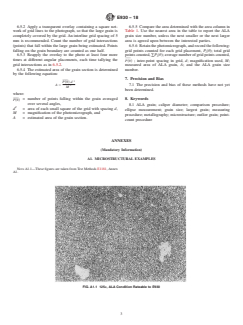
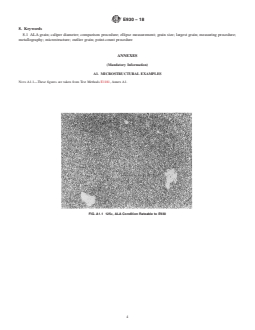
4.2 These methods shall only be used with the presence of outlier coarse grains, 3 or more ASTM grain size numbers larger than the rest of the microstructure and comprising 5 % or less of the specimen area. A typical example is shown in Annex A1 as Fig. A1.1.
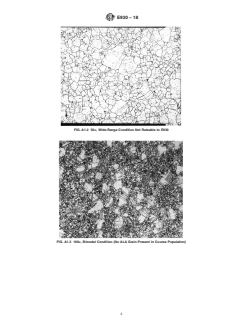
4.3 These methods shall not be used for the determination of average grain size, which is treated in Test Methods E112. Examples of microstructures that do not qualify for ALA treatment are shown in Annex A1 as Fig. A1.2, Fig. A1.3, and Fig. A1.4.
4.4 These methods may be applied in the characterization of duplex grain sizes, as instructed in the procedures for Test Methods E1181.
SCOPE
1.1 These test methods describe simple manual procedures for measuring the size of the largest grain cross-section observed on a metallographically prepared plane section.
1.2 These test methods shall only be valid for microstructures containing outlier coarse grains, where their population is too sparse for grain size determination by Test Methods E112.
1.3 This standard does not purport to address all of the safety concerns, if any, associated with its use. It is the responsibility of the user of this standard to establish appropriate safety, health, and environmental practices and determine the applicability of regulatory limitations prior to use.
1.4 This international standard was developed in accordance with internationally recognized principles on standardization established in the Decision on Principles for the Development of International Standards, Guides and Recommendations issued by the World Trade Organization Technical Barriers to Trade (TBT) Committee.
- Status
- Published
- Publication Date
- 30-Nov-2018
- Technical Committee
- E04 - Metallography
- Drafting Committee
- E04.08 - Grain Size
Buy Documents
ASTM E930-18 - Standard Test Methods for Estimating the Largest Grain Observed in a Metallographic Section (ALA Grain Size)
REDLINE ASTM E930-18 - Standard Test Methods for Estimating the Largest Grain Observed in a Metallographic Section (ALA Grain Size)
Overview
ASTM E930-18 - Standard Test Methods for Estimating the Largest Grain Observed in a Metallographic Section (ALA Grain Size) provides procedures for determining the size of the largest grain in a metallographic specimen. This standard is essential where the presence of isolated coarse grains - known as outlier grains or ALA grains - can affect material performance, notably in relation to mechanical properties like crack initiation, crack propagation, and fatigue. Unlike average grain size tests, ASTM E930-18 specifically targets specimens with sparse, unusually large grains that represent 5% or less of the total area and are significantly larger than the surrounding microstructure.
Key Topics
- Definition of ALA Grain: An ALA (As Large As) grain is the largest observable grain that stands out from the bulk microstructure by at least three ASTM grain size numbers and comprises a low fraction of the total area.
- Applicability: Methods are only valid for microstructures with outlier coarse grains too sporadic for average grain size analysis methods, as detailed in ASTM E112.
- Significance: Large, isolated grains are linked to unexpected mechanical failures. Documenting the largest observed grain provides critical data for engineering assessments.
- Testing Procedures:
- Comparison Procedure: Visually compare the largest grain to a standardized visual aid to estimate its size.
- Measuring Procedure: Quantitatively measure the grain’s caliper diameters to calculate area, then relate to grain size tables.
- Referee Methods: Use image analysis or overlay grid counting on photomicrographs for further precision and documentation.
- Sampling and Preparation: Specimens are prepared per established metallographic practices (ASTM E3 and E407), and specific planes of polish are described with each reported result.
- Limitations: ASTM E930-18 is not intended for average grain size measurement or for microstructures where outlier grains are absent.
Applications
- Materials Qualification: Used to assess metallic materials where sporadic large grains could compromise integrity, such as in aerospace, defense, and critical engineering structures.
- Failure Analysis: Essential in root-cause investigations of fatigue or crack failures linked to microstructural anomalies.
- Quality Control: Ensures compliance with material specifications that stipulate maximum grain sizes.
- Research and Development: Facilitates metallurgical studies where grain size variability and outliers influence mechanical performance.
Practical examples include the evaluation of forgings, castings, or other components where localized processing may occasionally create abnormally large grains.
Related Standards
- ASTM E112: Test Methods for Determining Average Grain Size - covers average grain size analysis, recommended for homogeneous microstructures.
- ASTM E1181: Test Methods for Characterizing Duplex Grain Sizes - applicable when dual grain size populations exist.
- ASTM E3: Guide for Preparation of Metallographic Specimens - foundational for preparing samples suited to grain size measurement.
- ASTM E407: Practice for Microetching Metals and Alloys - outlines etching methods to reveal microstructure.
- ASTM E7: Terminology Relating to Metallography - offers definitive terminology used in metallographic analysis.
Summary
ASTM E930-18 provides a focused, reliable methodology for identifying and quantifying the largest grain observed in a metallographic section, addressing cases where coarse outlier grains could have a disproportionate impact on material properties. Adhering to these standardized grain size estimation procedures supports safe, consistent material performance and strengthens compliance with international quality expectations. For accurate metallographic analysis and enhanced material integrity, ASTM E930-18 remains a key reference in the field of metallography and materials testing.
Relations
- Effective Date
- 01-Nov-2023
- Effective Date
- 01-Jun-2015
- Effective Date
- 01-Jun-2015
- Effective Date
- 01-Nov-2014
- Effective Date
- 15-Nov-2012
- Effective Date
- 01-Nov-2010
- Effective Date
- 01-Oct-2009
- Effective Date
- 01-Jul-2007
- Effective Date
- 01-Jul-2007
- Effective Date
- 01-May-2007
- Effective Date
- 23-Oct-2006
- Effective Date
- 01-Nov-2004
- Effective Date
- 01-Nov-2004
- Effective Date
- 10-May-2003
- Effective Date
- 10-Apr-2002
Buy Documents
ASTM E930-18 - Standard Test Methods for Estimating the Largest Grain Observed in a Metallographic Section (ALA Grain Size)
REDLINE ASTM E930-18 - Standard Test Methods for Estimating the Largest Grain Observed in a Metallographic Section (ALA Grain Size)
Get Certified
Connect with accredited certification bodies for this standard

IMP NDT d.o.o.
Non-destructive testing services. Radiography, ultrasonic, magnetic particle, penetrant, visual inspection.
Inštitut za kovinske materiale in tehnologije
Institute of Metals and Technology. Materials testing, metallurgical analysis, NDT.
Q Techna d.o.o.
NDT and quality assurance specialist. 30+ years experience. NDT personnel certification per ISO 9712, nuclear and thermal power plant inspections, QA/
Sponsored listings
Frequently Asked Questions
ASTM E930-18 is a standard published by ASTM International. Its full title is "Standard Test Methods for Estimating the Largest Grain Observed in a Metallographic Section (ALA Grain Size)". This standard covers: SIGNIFICANCE AND USE 4.1 The presence of large grains has been correlated with anomalous mechanical behavior in, for example, crack initiation, crack propagation, and fatigue. Thus there is engineering justification for reporting the ALA grain size. 4.2 These methods shall only be used with the presence of outlier coarse grains, 3 or more ASTM grain size numbers larger than the rest of the microstructure and comprising 5 % or less of the specimen area. A typical example is shown in Annex A1 as Fig. A1.1. 4.3 These methods shall not be used for the determination of average grain size, which is treated in Test Methods E112. Examples of microstructures that do not qualify for ALA treatment are shown in Annex A1 as Fig. A1.2, Fig. A1.3, and Fig. A1.4. 4.4 These methods may be applied in the characterization of duplex grain sizes, as instructed in the procedures for Test Methods E1181. SCOPE 1.1 These test methods describe simple manual procedures for measuring the size of the largest grain cross-section observed on a metallographically prepared plane section. 1.2 These test methods shall only be valid for microstructures containing outlier coarse grains, where their population is too sparse for grain size determination by Test Methods E112. 1.3 This standard does not purport to address all of the safety concerns, if any, associated with its use. It is the responsibility of the user of this standard to establish appropriate safety, health, and environmental practices and determine the applicability of regulatory limitations prior to use. 1.4 This international standard was developed in accordance with internationally recognized principles on standardization established in the Decision on Principles for the Development of International Standards, Guides and Recommendations issued by the World Trade Organization Technical Barriers to Trade (TBT) Committee.
SIGNIFICANCE AND USE 4.1 The presence of large grains has been correlated with anomalous mechanical behavior in, for example, crack initiation, crack propagation, and fatigue. Thus there is engineering justification for reporting the ALA grain size. 4.2 These methods shall only be used with the presence of outlier coarse grains, 3 or more ASTM grain size numbers larger than the rest of the microstructure and comprising 5 % or less of the specimen area. A typical example is shown in Annex A1 as Fig. A1.1. 4.3 These methods shall not be used for the determination of average grain size, which is treated in Test Methods E112. Examples of microstructures that do not qualify for ALA treatment are shown in Annex A1 as Fig. A1.2, Fig. A1.3, and Fig. A1.4. 4.4 These methods may be applied in the characterization of duplex grain sizes, as instructed in the procedures for Test Methods E1181. SCOPE 1.1 These test methods describe simple manual procedures for measuring the size of the largest grain cross-section observed on a metallographically prepared plane section. 1.2 These test methods shall only be valid for microstructures containing outlier coarse grains, where their population is too sparse for grain size determination by Test Methods E112. 1.3 This standard does not purport to address all of the safety concerns, if any, associated with its use. It is the responsibility of the user of this standard to establish appropriate safety, health, and environmental practices and determine the applicability of regulatory limitations prior to use. 1.4 This international standard was developed in accordance with internationally recognized principles on standardization established in the Decision on Principles for the Development of International Standards, Guides and Recommendations issued by the World Trade Organization Technical Barriers to Trade (TBT) Committee.
ASTM E930-18 is classified under the following ICS (International Classification for Standards) categories: 19.120 - Particle size analysis. Sieving. The ICS classification helps identify the subject area and facilitates finding related standards.
ASTM E930-18 has the following relationships with other standards: It is inter standard links to ASTM E407-23, ASTM E7-15, ASTM E407-07(2015)e1, ASTM E7-14, ASTM E112-12, ASTM E112-10, ASTM E7-03(2009), ASTM E3-01(2007), ASTM E3-01(2007)e1, ASTM E407-07, ASTM E112-96(2004)e2, ASTM E112-96(2004), ASTM E112-96(2004)e1, ASTM E7-03, ASTM E1181-02. Understanding these relationships helps ensure you are using the most current and applicable version of the standard.
ASTM E930-18 is available in PDF format for immediate download after purchase. The document can be added to your cart and obtained through the secure checkout process. Digital delivery ensures instant access to the complete standard document.
Standards Content (Sample)
This international standard was developed in accordance with internationally recognized principles on standardization established in the Decision on Principles for the
Development of International Standards, Guides and Recommendations issued by the World Trade Organization Technical Barriers to Trade (TBT) Committee.
Designation: E930 − 18
Standard Test Methods for
Estimating the Largest Grain Observed in a Metallographic
Section (ALA Grain Size)
This standard is issued under the fixed designation E930; the number immediately following the designation indicates the year of
original adoption or, in the case of revision, the year of last revision. A number in parentheses indicates the year of last reapproval. A
superscript epsilon (´) indicates an editorial change since the last revision or reapproval.
This standard has been approved for use by agencies of the U.S. Department of Defense.
INTRODUCTION
Commercial material specifications sometimes include, in size limits for grain structures, the need
for identification of the largest grain observed in a sample, often expressed asALA(as large as) grain
size. The methods presented here are for use when the number of large grains is too few for
measurement by Test Methods E112. It shall be understood that larger (but unobserved) grains may
exist in the local volume sampled.
1. Scope E112 Test Methods for Determining Average Grain Size
E407 Practice for Microetching Metals and Alloys
1.1 These test methods describe simple manual procedures
E1181 Test Methods for Characterizing Duplex Grain Sizes
for measuring the size of the largest grain cross-section
observed on a metallographically prepared plane section. 2.2 ASTM Adjuncts:
ALAGrain SizeVisualAid for Comparison Procedure (One
1.2 These test methods shall only be valid for microstruc-
Opaque Print and One Transparency)
tures containing outlier coarse grains, where their population is
too sparse for grain size determination by Test Methods E112.
3. Terminology
1.3 This standard does not purport to address all of the
3.1 Definitions:
safety concerns, if any, associated with its use. It is the
3.1.1 For definitions of terms used in these test methods, see
responsibility of the user of this standard to establish appro-
Terminology E7.
priate safety, health, and environmental practices and deter-
3.2 Definitions:
mine the applicability of regulatory limitations prior to use.
3.2.1 ALA grain, n—the largest grain observed in a random
1.4 This international standard was developed in accor-
scatterofindividualcoarsegrainscomprising5 %orlessofthe
dance with internationally recognized principles on standard-
specimen area, where the apparent grain size of the coarse
ization established in the Decision on Principles for the
grain(s) differs by 3 or more ASTM grain size numbers from
Development of International Standards, Guides and Recom-
the balance of the microstructure.
mendations issued by the World Trade Organization Technical
Barriers to Trade (TBT) Committee. 3.2.2 outlier grain, n—a grain substantially different in size
from the predominant grain size in a microstructure; for
2. Referenced Documents
example, an ALA grain.
2.1 ASTM Standards:
4. Significance and Use
E3 Guide for Preparation of Metallographic Specimens
E7 Terminology Relating to Metallography
4.1 The presence of large grains has been correlated with
anomalous mechanical behavior in, for example, crack
initiation, crack propagation, and fatigue. Thus there is engi-
This test method is under the jurisdiction of ASTM Committee E04 on
neering justification for reporting the ALA grain size.
Metallographyand is the direct responsibility of Subcommittee E04.08 on Grain
Size.
4.2 These methods shall only be used with the presence of
Current edition approved Dec. 1, 2018. Published February 2019. Originally
outlier coarse grains, 3 or more ASTM grain size numbers
approvedin1983.Lastpreviouseditionapprovedin2015asE930 – 99(2015).DOI:
10.1520/E0930-18.
For referenced ASTM standards, visit the ASTM website, www.astm.org, or
contact ASTM Customer Service at service@astm.org. For Annual Book of ASTM
Standards volume information, refer to the standard’s Document Summary page on Available from ASTM International Headquarters. Order Adjunct No.
the ASTM website. ADJE0930.
Copyright © ASTM International, 100 Barr Harbor Drive, PO Box C700, West Conshohocken, PA 19428-2959. United States
E930 − 18
TABLE 1 Relationship of ALA Grain Area to ALA Micro-Grain Size
largerthantherestofthemicrostructureandcomprising5 %or
A
Number
lessofthespecimenarea.AtypicalexampleisshowninAnnex
Area, mm Size
A1 as Fig. A1.1.
2.06 00000 or − 4.0
4.3 Thesemethodsshallnotbeusedforthedeterminationof
1.46 −3.5
1.03 0000 or − 3.0
average grain size, which is treated in Test Methods E112.
0.703 −2.5
Examples of microstructures that do not qualify for ALA
0.516 000 or − 2.0
treatment are shown in Annex A1 as Fig. A1.2, Fig. A1.3, and
0.365 −1.5
0.258 00 or − 1.0
Fig. A1.4.
0.182 −0.5
4.4 These methods may be applied in the characterization of 0.129 0
0.0912 0.5
duplex grain sizes, as instructed in the procedures for Test
0.0645 1.0
Methods E1181.
0.0456 1.5
0.0323 2.0
5. Sampling
0.0228 2.5
0.0161 3.0
5.1 Sampling shall have been performed according to sam-
0.0114 3.5
0.00807 4.0
pling procedures in Test Method E112.
0.00570 4.5
5.2 Thegenerallyintendedplaneofpolishisaplanepassing 0.00403 5.0
0.00285 5.5
through the center of the thickness and exhibiting maximum
0.00202 6.0
grain aspect ratio.
0.00143 6.5
0.00101 7.0
5.3 Other polishing planes which may be more useful or
A
Adapted from Test Methods E112, Table 2.
predictive in specific products or applications are allowed.
5.4 An unambiguous description of the plane of polish or a
reference to a description or drawing of the plane of polish
6.3.3 Multiply the product of these two measurements by
shall be a part of the test report.
0.785, to obtain the area of an ellipse with axes equal to the
5.5 Specimens shall be prepared in accordance with Meth- caliper diameters at the magnification used.
ods E3 and Practice E407. 6.3.4 Divide this area by the square of the magnification
used, to obtain the true grain area at 1X.
6. Procedures
6.3.5 Compare this area with the grain areas in Table 1. Use
6.1 In 6.2 a comparison procedure is presented with accu- the nearest area in the table to obtain the ALA grain size
racy near to 61ASTM grain size number, for the apparent size number,unlessthenextsmallerorthenextlargerareaisagreed
of the largest grain. For greater accuracy, a measuring proce- upon between the interested parties.
dureisdescribedin6.3.Amanualquantitativemethod,toserve
6.4 Referee Procedure (Image Analysis):
as referee procedure, is described in 6.4. (The measuring
6.4.1 Photograph the largest grain, using the largest magni-
procedure is especially recomme
...
This document is not an ASTM standard and is intended only to provide the user of an ASTM standard an indication of what changes have been made to the previous version. Because
it may not be technically possible to adequately depict all changes accurately, ASTM recommends that users consult prior editions as appropriate. In all cases only the current version
of the standard as published by ASTM is to be considered the official document.
Designation: E930 − 99 (Reapproved 2015) E930 − 18
Standard Test Methods for
Estimating the Largest Grain Observed in a Metallographic
Section (ALA Grain Size)
This standard is issued under the fixed designation E930; the number immediately following the designation indicates the year of
original adoption or, in the case of revision, the year of last revision. A number in parentheses indicates the year of last reapproval. A
superscript epsilon (´) indicates an editorial change since the last revision or reapproval.
This standard has been approved for use by agencies of the U.S. Department of Defense.
INTRODUCTION
Commercial material specifications sometimes include, in size limits for grain structures, the need
for identification of the largest grain observed in a sample, often expressed as ALA (as large as) grain
size. The methods presented here are for use when the number of large grains is too few for
measurement by Test Methods E112. It shall be understood that larger (but unobserved) grains may
exist in the local volume sampled.
1. Scope
1.1 These test methods describe simple manual procedures for measuring the size of the largest grain cross-section observed
on a metallographically prepared plane section.
1.2 These test methods shall only be valid for microstructures containing outlier coarse grains, where their population is too
sparse for grain size determination by Test Methods E112.
1.3 This standard does not purport to address all of the safety problems,concerns, if any, associated with its use. It is the
responsibility of the user of this standard to establish appropriate safety safety, health, and healthenvironmental practices and
determine the applicability of regulatory limitations prior to use.
1.4 This international standard was developed in accordance with internationally recognized principles on standardization
established in the Decision on Principles for the Development of International Standards, Guides and Recommendations issued
by the World Trade Organization Technical Barriers to Trade (TBT) Committee.
2. Referenced Documents
2.1 ASTM Standards:
E3 Guide for Preparation of Metallographic Specimens
E7 Terminology Relating to Metallography
E112 Test Methods for Determining Average Grain Size
E407 Practice for Microetching Metals and Alloys
E1181 Test Methods for Characterizing Duplex Grain Sizes
2.2 ASTM Adjuncts:
ALA Grain Size Visual Aid for Comparison Procedure (One Opaque Print and One Transparency)
3. Terminology
3.1 Definitions:
3.1.1 All For definitions of terms used in these test methods are either defined in methods, see Terminology E7, or are discussed
in 3.2.
3.2 Definitions of Terms Specific to This Standard:Definitions:
This test method is under the jurisdiction of ASTM Committee E04 on Metallographyand is the direct responsibility of Subcommittee E04.08 on Grain Size.
Current edition approved Oct. 1, 2015Dec. 1, 2018. Published November 2015February 2019. Originally approved in 1983. Last previous edition approved in 20072015
as E930 – 99(2007).(2015). DOI: 10.1520/E0930-99R15.10.1520/E0930-18.
For referenced ASTM standards, visit the ASTM website, www.astm.org, or contact ASTM Customer Service at service@astm.org. For Annual Book of ASTM Standards
volume information, refer to the standard’s Document Summary page on the ASTM website.
Available from ASTM International Headquarters. Order Adjunct No. ADJE0930.
Copyright © ASTM International, 100 Barr Harbor Drive, PO Box C700, West Conshohocken, PA 19428-2959. United States
E930 − 18
3.2.1 ALA grain, n—the largest grain observed in a random scatter of individual coarse grains comprising 5 % or less of the
specimen area, where the apparent grain size of thesethe coarse grainsgrain(s) differs by 3 or more ASTM grain size numbers from
the balance of the microstructure.
3.2.2 outlier grain, n—a grain substantially different in size from the predominant grain size in a microstructure; for example,
an ALA grain.
4. Significance and Use
4.1 The presence of large grains has been correlated with anomalous mechanical behavior in, for example, crack initiation, crack
propagation, and fatigue. Thus there is engineering justification for reporting the ALA grain size.
4.2 These methods shall only be used with the presence of outlier coarse grains, 3 or more ASTM grain size numbers larger
than the rest of the microstructure and comprising 5 % or less of the specimen area. A typical example is shown in Annex A1 as
Fig. A1.1.
4.3 These methods shall not be used for the determination of average grain size, which is treated in Test Methods E112.
Examples of microstructures that do not qualify for ALA treatment are shown in Annex A1 as Fig. A1.2, Fig. A1.3, and Fig. A1.4.
4.4 These methods may be applied in the characterization of duplex grain sizes, as instructed in the procedures for Test Methods
E1181.
5. Sampling
5.1 Sampling shall have been performed according to sampling procedures in Test Method E112.
5.2 The generally intended plane of polish is a plane passing through the center of the thickness and exhibiting maximum grain
aspect ratio.
5.3 Other polishing planes which may be more useful or predictive in specific products or applications are allowed.
5.4 An unambiguous description of the plane of polish or a reference to a description or drawing of the plane of polish shall
be a part of the test report.
5.5 Specimens shall be prepared in accordance with Methods E3 and Practice E407.
6. Procedures
6.1 In 6.2 a comparison procedure is presented with accuracy near to 61 ASTM grain size number, for the apparent size of the
largest grain. For greater accuracy, a measuring procedure is described in 6.3. A manual quantitative method, to serve as referee
procedure, is described in 6.4. (The measuring procedure is especially recommended over the comparison procedure when the ALA
grain section’s shape is substantially different from those shown in Annex A2.)
6.2 Comparison Procedure:
6.2.1 Scan the entire microsection at a convenient magnification to locate the larger grains.
6.2.2 Position the largest grain in the middle of the microscope viewing screen, eyepiece, or on a photomicrograph.
6.2.3 Estimate the grain size by comparing the ALA grain to a visual aid that is based on the relationship of area to grain size
expressed in Table 1. Examples of visual aids are shown in Annex A2, with their specifications in Annex A3. Fig. A2.1 may be
used only at the magnification specified on the aid.
NOTE 1—The use of Test Methods E112 comparison plates is not allowed, since few of the grain sections illustrated correspond to the average area
for that grain size number.
6.3 Measuring Procedure (for greater accuracy than with comparison procedure):
6.3.1 Locate and position the largest grain in a microscope image or in a
...