

ASTM D7247-17
(Test Method)Standard Test Method for Evaluating the Shear Strength of Adhesive Bonds in Laminated Wood Products at Elevated Temperatures
General Information
- Abstract
SIGNIFICANCE AND USE
4.1 A discussion of the issues and limitations associated with the measurement of strength properties of adhesive bonds in shear by compression loading is found in Test Method D905.
4.2 While various combinations of test temperature and heat exposure duration can be used, the provisions specified in 7.2.4 shall be based on the understanding that the objective of this test method is to evaluate adhesive bond performance just before wood begins to burn and the elevated temperature is selected to be slightly below the unpiloted ignition temperature for wood when taken into account the specific product and its end-use applications.
4.3 When using this test method, consideration shall be given to the unique production conditions, such as wood moisture content, applied spread rate, press pressure, and curing temperature of the adhesive.
SCOPE
1.1 This standard describes a test method for evaluating the comparative shear strength of a planar adhesive bond at both ambient and elevated temperatures relative to the performance of solid wood under the same conditions. The test method is based on the breaking load after the specimen is exposed to either ambient or a constant elevated temperature for a specified duration as described in Section 7. This standard does not preclude the development and implementation of other methods that provide equivalent performance meeting the intent of this method.
1.2 This test method is intended for the evaluation of adhesives that can be used to assemble test specimens in accordance with Test Method D905. The evaluation of other types of adhesives, such as the binder systems used for strand-based products, is beyond the scope of this test method, except as noted in 1.4.
1.3 This test method is intended for the evaluation of adhesives as a component of laminated wood products at elevated temperatures. The evaluation of fire performance on fire-rated laminated wood products or assemblies is beyond the scope of this test method.
1.4 This test method may be used for the evaluation of heat durability for binder adhesives used in strand-based structural wood composites, such as oriented strand lumber (OSL) and laminated strand lumber (LSL), by substituting strand-based composite specimens for the bonded specimens.
1.5 The formulation of adhesive supplied to the manufacturer of laminated wood products shall be evaluated. Modifications to the adhesive formulation require a separate evaluation unless approved by the manufacturer of the laminated wood product, qualified agency, and code evaluation agency.
1.6 The values stated in SI units are to be regarded as the standard. The values given in parentheses are for information only.
1.7 This standard does not purport to address all of the safety concerns, if any, associated with its use. It is the responsibility of the user of this standard to establish appropriate safety, health, and environmental practices and determine the applicability of regulatory limitations prior to use.
1.8 This international standard was developed in accordance with internationally recognized principles on standardization established in the Decision on Principles for the Development of International Standards, Guides and Recommendations issued by the World Trade Organization Technical Barriers to Trade (TBT) Committee.
- Status
- Published
- Publication Date
- 14-Oct-2017
- Technical Committee
- D14 - Adhesives
- Drafting Committee
- D14.30 - Wood Adhesives
Buy Documents
ASTM D7247-17 - Standard Test Method for Evaluating the Shear Strength of Adhesive Bonds in Laminated Wood Products at Elevated Temperatures
REDLINE ASTM D7247-17 - Standard Test Method for Evaluating the Shear Strength of Adhesive Bonds in Laminated Wood Products at Elevated Temperatures
Overview
ASTM D7247-17, titled "Standard Test Method for Evaluating the Shear Strength of Adhesive Bonds in Laminated Wood Products at Elevated Temperatures," is a widely used ASTM International standard. This test method provides procedures for determining the shear strength of adhesive bonds in planar laminated wood products, both at ambient and elevated temperatures. The standard is critical for manufacturers, researchers, and certification agencies interested in the structural integrity and performance of wood adhesive bonds under exposure to high temperatures, closely simulating real-world fire conditions.
Accurately quantifying adhesive bond strength at elevated temperatures is essential for ensuring the reliability and safety of laminated wood products in demanding applications, such as structural components subjected to fire or high heat environments.
Key Topics
- Shear Strength Evaluation: The test measures the breaking load of adhesive bonds compared to solid wood under controlled temperature conditions. Both ambient and elevated temperatures are assessed to benchmark adhesive performance.
- Test Specimen Preparation: The method specifies preparation of both bonded specimens (with adhesive) and side-matched solid wood control specimens, typically using industry-standard wood species.
- Testing Conditions: Procedures include drying specimens, heating to targeted elevated temperatures, and using specific equipment (testing machine, oven, thermocouples) to ensure precise control and measurement.
- Temperature Selection: Elevated temperatures are set slightly below the wood’s unpiloted ignition temperature, reflecting practical safety margins for actual use.
- Measurement and Reporting: The standard requires detailed recording of bondline temperatures, loads at failure, weight loss ratios, and residual shear strength ratios. This data supports quality control and code compliance.
- Production Considerations: Factors such as adhesive formulation, wood moisture content, press pressure, and curing temperature are considered for relevance to real product manufacturing.
Applications
ASTM D7247-17 is essential in several key areas:
- Structural Wood Product Manufacturing: Used by producers of glued laminated timber, cross-laminated timber, and similar engineered wood products to validate adhesive bond durability.
- Product Approval and Certification: Provides a standardized approach for regulatory and code evaluation agencies to approve adhesives or products used in fire-rated or high-temperature applications.
- Research and Development: Supports R&D efforts into new adhesives, formulations, or production processes by offering comparative data on adhesive performance at elevated temperatures.
- Quality Assurance: Enables ongoing monitoring and verification of product consistency and performance in response to changes in adhesive chemistry or production processes.
- Strand-Based Composite Assessment: With modifications, the test may be applied to strand-based structural wood composites like OSL (Oriented Strand Lumber) and LSL (Laminated Strand Lumber) to evaluate heat durability.
Related Standards
- ASTM D905: Test Method for Strength Properties of Adhesive Bonds in Shear by Compression Loading
- ASTM D907: Terminology of Adhesives
- ASTM D2395: Test Methods for Density and Specific Gravity (Relative Density) of Wood and Wood-Based Materials
- ASTM D2915: Practice for Sampling and Data-Analysis for Structural Wood and Wood-Based Products
- ASTM D4933: Guide for Moisture Conditioning of Wood and Wood-Based Materials
- ASTM D5266: Practice for Estimating the Percentage of Wood Failure in Adhesive Bonded Joints
- ASTM D5456: Specification for Evaluation of Structural Composite Lumber Products
- ANSI A190.1: American National Standard for Wood Products – Structural Glued Laminated Timber
- ANSI/AWC NDS: National Design Specification for Wood Construction
Practical Value
Adhering to ASTM D7247-17 enables wood product manufacturers and adhesive suppliers to demonstrate compliance with international best practices. This ensures the safety, durability, and regulatory acceptance of laminated wood products in structural and fire-exposed roles, supporting robust quality assurance and fostering market trust in engineered wood construction solutions.
Keywords: ASTM D7247, shear strength, adhesive bonds, laminated wood products, elevated temperature testing, structural wood adhesives, engineered timber, wood adhesives standard, quality assurance.
Relations
- Effective Date
- 15-Oct-2017
- Effective Date
- 01-Apr-2020
- Effective Date
- 01-Apr-2018
- Refers
ASTM D5456-17e1 - Standard Specification for Evaluation of Structural Composite Lumber Products - Effective Date
- 01-Mar-2017
- Effective Date
- 01-Mar-2017
- Refers
ASTM D5456-14b - Standard Specification for Evaluation of Structural Composite Lumber Products - Effective Date
- 01-Oct-2014
- Effective Date
- 01-May-2014
- Refers
ASTM D5456-14a - Standard Specification for Evaluation of Structural Composite Lumber Products - Effective Date
- 01-May-2014
- Effective Date
- 01-May-2014
- Effective Date
- 01-Feb-2014
- Refers
ASTM D5456-13a - Standard Specification for Evaluation of Structural Composite Lumber Products - Effective Date
- 01-Oct-2013
- Effective Date
- 01-May-2013
- Effective Date
- 01-May-2013
- Effective Date
- 15-Oct-2012
- Effective Date
- 01-Jul-2012
Buy Documents
ASTM D7247-17 - Standard Test Method for Evaluating the Shear Strength of Adhesive Bonds in Laminated Wood Products at Elevated Temperatures
REDLINE ASTM D7247-17 - Standard Test Method for Evaluating the Shear Strength of Adhesive Bonds in Laminated Wood Products at Elevated Temperatures
Get Certified
Connect with accredited certification bodies for this standard

DIN CERTCO
DIN Group product certification.

Smithers Quality Assessments
US management systems and product certification.
Sponsored listings
Frequently Asked Questions
ASTM D7247-17 is a standard published by ASTM International. Its full title is "Standard Test Method for Evaluating the Shear Strength of Adhesive Bonds in Laminated Wood Products at Elevated Temperatures". This standard covers: SIGNIFICANCE AND USE 4.1 A discussion of the issues and limitations associated with the measurement of strength properties of adhesive bonds in shear by compression loading is found in Test Method D905. 4.2 While various combinations of test temperature and heat exposure duration can be used, the provisions specified in 7.2.4 shall be based on the understanding that the objective of this test method is to evaluate adhesive bond performance just before wood begins to burn and the elevated temperature is selected to be slightly below the unpiloted ignition temperature for wood when taken into account the specific product and its end-use applications. 4.3 When using this test method, consideration shall be given to the unique production conditions, such as wood moisture content, applied spread rate, press pressure, and curing temperature of the adhesive. SCOPE 1.1 This standard describes a test method for evaluating the comparative shear strength of a planar adhesive bond at both ambient and elevated temperatures relative to the performance of solid wood under the same conditions. The test method is based on the breaking load after the specimen is exposed to either ambient or a constant elevated temperature for a specified duration as described in Section 7. This standard does not preclude the development and implementation of other methods that provide equivalent performance meeting the intent of this method. 1.2 This test method is intended for the evaluation of adhesives that can be used to assemble test specimens in accordance with Test Method D905. The evaluation of other types of adhesives, such as the binder systems used for strand-based products, is beyond the scope of this test method, except as noted in 1.4. 1.3 This test method is intended for the evaluation of adhesives as a component of laminated wood products at elevated temperatures. The evaluation of fire performance on fire-rated laminated wood products or assemblies is beyond the scope of this test method. 1.4 This test method may be used for the evaluation of heat durability for binder adhesives used in strand-based structural wood composites, such as oriented strand lumber (OSL) and laminated strand lumber (LSL), by substituting strand-based composite specimens for the bonded specimens. 1.5 The formulation of adhesive supplied to the manufacturer of laminated wood products shall be evaluated. Modifications to the adhesive formulation require a separate evaluation unless approved by the manufacturer of the laminated wood product, qualified agency, and code evaluation agency. 1.6 The values stated in SI units are to be regarded as the standard. The values given in parentheses are for information only. 1.7 This standard does not purport to address all of the safety concerns, if any, associated with its use. It is the responsibility of the user of this standard to establish appropriate safety, health, and environmental practices and determine the applicability of regulatory limitations prior to use. 1.8 This international standard was developed in accordance with internationally recognized principles on standardization established in the Decision on Principles for the Development of International Standards, Guides and Recommendations issued by the World Trade Organization Technical Barriers to Trade (TBT) Committee.
SIGNIFICANCE AND USE 4.1 A discussion of the issues and limitations associated with the measurement of strength properties of adhesive bonds in shear by compression loading is found in Test Method D905. 4.2 While various combinations of test temperature and heat exposure duration can be used, the provisions specified in 7.2.4 shall be based on the understanding that the objective of this test method is to evaluate adhesive bond performance just before wood begins to burn and the elevated temperature is selected to be slightly below the unpiloted ignition temperature for wood when taken into account the specific product and its end-use applications. 4.3 When using this test method, consideration shall be given to the unique production conditions, such as wood moisture content, applied spread rate, press pressure, and curing temperature of the adhesive. SCOPE 1.1 This standard describes a test method for evaluating the comparative shear strength of a planar adhesive bond at both ambient and elevated temperatures relative to the performance of solid wood under the same conditions. The test method is based on the breaking load after the specimen is exposed to either ambient or a constant elevated temperature for a specified duration as described in Section 7. This standard does not preclude the development and implementation of other methods that provide equivalent performance meeting the intent of this method. 1.2 This test method is intended for the evaluation of adhesives that can be used to assemble test specimens in accordance with Test Method D905. The evaluation of other types of adhesives, such as the binder systems used for strand-based products, is beyond the scope of this test method, except as noted in 1.4. 1.3 This test method is intended for the evaluation of adhesives as a component of laminated wood products at elevated temperatures. The evaluation of fire performance on fire-rated laminated wood products or assemblies is beyond the scope of this test method. 1.4 This test method may be used for the evaluation of heat durability for binder adhesives used in strand-based structural wood composites, such as oriented strand lumber (OSL) and laminated strand lumber (LSL), by substituting strand-based composite specimens for the bonded specimens. 1.5 The formulation of adhesive supplied to the manufacturer of laminated wood products shall be evaluated. Modifications to the adhesive formulation require a separate evaluation unless approved by the manufacturer of the laminated wood product, qualified agency, and code evaluation agency. 1.6 The values stated in SI units are to be regarded as the standard. The values given in parentheses are for information only. 1.7 This standard does not purport to address all of the safety concerns, if any, associated with its use. It is the responsibility of the user of this standard to establish appropriate safety, health, and environmental practices and determine the applicability of regulatory limitations prior to use. 1.8 This international standard was developed in accordance with internationally recognized principles on standardization established in the Decision on Principles for the Development of International Standards, Guides and Recommendations issued by the World Trade Organization Technical Barriers to Trade (TBT) Committee.
ASTM D7247-17 is classified under the following ICS (International Classification for Standards) categories: 83.180 - Adhesives. The ICS classification helps identify the subject area and facilitates finding related standards.
ASTM D7247-17 has the following relationships with other standards: It is inter standard links to ASTM D7247-16, ASTM D5266-13(2020), ASTM D5456-18, ASTM D5456-17e1, ASTM D5456-17, ASTM D5456-14b, ASTM D2395-14, ASTM D5456-14a, ASTM D2395-14e1, ASTM D5456-14, ASTM D5456-13a, ASTM D5266-13, ASTM D5456-13, ASTM D5456-12, ASTM D907-12a. Understanding these relationships helps ensure you are using the most current and applicable version of the standard.
ASTM D7247-17 is available in PDF format for immediate download after purchase. The document can be added to your cart and obtained through the secure checkout process. Digital delivery ensures instant access to the complete standard document.
Standards Content (Sample)
This international standard was developed in accordance with internationally recognized principles on standardization established in the Decision on Principles for the
Development of International Standards, Guides and Recommendations issued by the World Trade Organization Technical Barriers to Trade (TBT) Committee.
Designation: D7247 − 17
Standard Test Method for
Evaluating the Shear Strength of Adhesive Bonds in
Laminated Wood Products at Elevated Temperatures
This standard is issued under the fixed designation D7247; the number immediately following the designation indicates the year of
original adoption or, in the case of revision, the year of last revision. A number in parentheses indicates the year of last reapproval. A
superscript epsilon (´) indicates an editorial change since the last revision or reapproval.
1. Scope 1.7 This standard does not purport to address all of the
safety concerns, if any, associated with its use. It is the
1.1 This standard describes a test method for evaluating the
responsibility of the user of this standard to establish appro-
comparative shear strength of a planar adhesive bond at both
priate safety, health, and environmental practices and deter-
ambient and elevated temperatures relative to the performance
mine the applicability of regulatory limitations prior to use.
of solid wood under the same conditions. The test method is
1.8 This international standard was developed in accor-
based on the breaking load after the specimen is exposed to
dance with internationally recognized principles on standard-
either ambient or a constant elevated temperature for a speci-
ization established in the Decision on Principles for the
fied duration as described in Section 7. This standard does not
Development of International Standards, Guides and Recom-
preclude the development and implementation of other meth-
mendations issued by the World Trade Organization Technical
ods that provide equivalent performance meeting the intent of
Barriers to Trade (TBT) Committee.
this method.
1.2 This test method is intended for the evaluation of
2. Referenced Documents
adhesives that can be used to assemble test specimens in
accordance with Test Method D905. The evaluation of other 2.1 ASTM Standards:
types of adhesives, such as the binder systems used for
D905 Test Method for Strength Properties of Adhesive
strand-based products, is beyond the scope of this test method, Bonds in Shear by Compression Loading
except as noted in 1.4.
D907 Terminology of Adhesives
D2395 TestMethodsforDensityandSpecificGravity(Rela-
1.3 This test method is intended for the evaluation of
tive Density) of Wood and Wood-Based Materials
adhesives as a component of laminated wood products at
D2915 Practice for Sampling and Data-Analysis for Struc-
elevated temperatures. The evaluation of fire performance on
tural Wood and Wood-Based Products
fire-rated laminated wood products or assemblies is beyond the
D4933 Guide for Moisture Conditioning of Wood and
scope of this test method.
Wood-Based Materials
1.4 This test method may be used for the evaluation of heat
D5266 Practice for Estimating the Percentage of Wood
durability for binder adhesives used in strand-based structural
Failure in Adhesive Bonded Joints
wood composites, such as oriented strand lumber (OSL) and
D5456 Specification for Evaluation of Structural Composite
laminated strand lumber (LSL), by substituting strand-based
Lumber Products
composite specimens for the bonded specimens.
2.2 Other Documents:
1.5 The formulation of adhesive supplied to the manufac-
ANSI A190.1 American National Standard for Wood Prod-
turer of laminated wood products shall be evaluated. Modifi- 3
ucts — Structural Glued Laminated Timber
cations to the adhesive formulation require a separate evalua-
ANSI/AWCNDS-2015 NationalDesign—Specificationfor
tion unless approved by the manufacturer of the laminated 3
Wood Construction (NDS)
wood product, qualified agency, and code evaluation agency. 4
Wood Handbook Wood as an Engineering Material
1.6 The values stated in SI units are to be regarded as the
standard. The values given in parentheses are for information
only.
For referenced ASTM standards, visit the ASTM website, www.astm.org, or
contact ASTM Customer Service at service@astm.org. For Annual Book of ASTM
This test method is under the jurisdiction of ASTM Committee D14 on Standards volume information, refer to the standard’s Document Summary page on
Adhesives and is the direct responsibility of Subcommittee D14.30 on Wood the ASTM website.
Adhesives. APA — The Engineered Wood Association, 7011 S. 19th St., Tacoma, WA
Current edition approved Oct. 15, 2017. Published November 2017. Originally 98466, www.apaword.org.
approved in 2006. Last previous edition approved in 2016 as D7247 – 16. DOI: AvailablefromU.S.DepartmentofAgriculture,ForestService,ForestProducts
10.1520/D7247-17. Laboratory, One Gifford Pinchot Drive Madison, WI 53726, www.fpl.fs.fed.us.
Copyright © ASTM International, 100 Barr Harbor Drive, PO Box C700, West Conshohocken, PA 19428-2959. United States
D7247 − 17
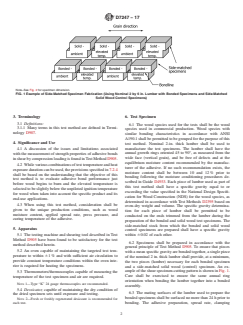
Note–See Fig. 2 for specimen dimension.
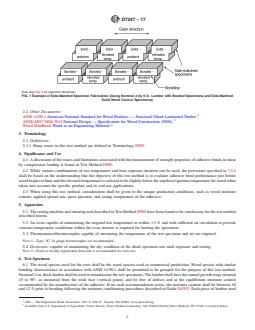
FIG. 1 Example of Side-Matched Specimen Fabrication (Using Nominal 2 by 6 in. Lumber with Bonded Specimens and Side-Matched
Solid Wood Control Specimens)
3. Terminology 6. Test Specimen
3.1 Definitions:
6.1 The wood species used for the tests shall be the wood
3.1.1 Many terms in this test method are defined in Termi-
species used in commercial production. Wood species with
nology D907.
similar bonding characteristics in accordance with ANSI
A190.1 shall be permitted to be grouped for the purpose of this
4. Significance and Use
test method. Nominal 2-in. thick lumber shall be used to
manufacture the test specimens. The lumber shall have the
4.1 A discussion of the issues and limitations associated
annual growth rings oriented 45 to 90°, as measured from the
with the measurement of strength properties of adhesive bonds
wide face (vertical grain), and be free of defects and at the
inshearbycompressionloadingisfoundinTestMethodD905.
equilibrium moisture content recommended by the manufac-
4.2 Whilevariouscombinationsoftesttemperatureandheat
turer of the adhesive. If no such recommendation exists, the
exposuredurationcanbeused,theprovisionsspecifiedin7.2.4
moisture content shall be between 10 and 12 % prior to
shall be based on the understanding that the objective of this
bonding following the moisture conditioning procedures de-
test method is to evaluate adhesive bond performance just
scribed in Guide D4933. Each piece of lumber used as part of
before wood begins to burn and the elevated temperature is
this test method shall have a specific gravity equal to or
selected to be slightly below the unpiloted ignition temperature
exceeding the value specified in the National Design Specifi-
for wood when taken into account the specific product and its
cation for Wood Construction (NDS) for the wood species, as
end-use applications.
determined in accordance with Test Methods D2395 based on
4.3 When using this test method, consideration shall be
oven-dry weight and volume. The specific gravity determina-
given to the unique production conditions, such as wood
tion for each piece of lumber shall be permitted to be
moisture content, applied spread rate, press pressure, and
conducted on the ends trimmed from the lumber during the
curing temperature of the adhesive.
preparation of the bonded and solid wood test specimens. The
side-matched stock from which the bonded and solid wood
5. Apparatus
control specimens are prepared shall have a specific gravity
5.1 The testing machine and shearing tool described in Test within 60.02 of each other.
Method D905 have been found to be satisfactory for the test
6.2 Specimens shall be prepared in accordance with the
method described herein.
general principle of Test Method D905. To ensure that pieces
5.2 An oven capable of maintaining the targeted test tem-
withameanspecificgravityarebondedtogether,asinglepiece
perature to within 61 % and with sufficient air circulation to
of the nominal 2 in. thick lumber shall provide, at a minimum,
provide constant temperature conditions within the oven inte-
the two pieces (lumber) necessary for each bonded specimen
rior is required for heating the specimens.
and a side-matched solid wood (control) specimen. An ex-
ample of the shear specimen-cutting pattern is shown in Fig. 1.
5.3 Thermometers/thermocouples capable of measuring the
Care shall be exercised to ensure the same annual ring
temperature of the test specimen and air are required.
orientation when bonding the lumber together into a bonded
NOTE 1—Type “K” 24 gauge thermocouples are recommended.
assembly.
5.4 Dessicator, capable of maintaining the dry condition of
6.3 The mating surfaces of the lumber used to prepare the
the dried specimen sets until exposure and testing.
bonded specimens shall be surfaced no more than 24 h prior to
NOTE 2—Fresh or freshly regenerated desiccant is recommended for
each test. bonding. The adhesive preparation, spread rate, clamping
D7247 − 17
solid wood control specimen.The tip of the thermocouple wire
shall have a maximum of 1 mm (0.040 in.) of insulation
removed.
NOTE 3—Experience has shown that stripping the wire insulation
approximately 12.7 mm (0.5 in.), twisting the wires together, and cutting
the exposed wire back to 1 mm (0.040 in.) gives consistent results.
Damage-to or improper-removal-of thermocouple wire insulation in-
creases the possibility of inaccurate temperature readings in the oven.
Prior to re-using thermocouple wire, it is to be re-tested to ensure that
accurate temperature readings are being provided.
6.7 All specimens shall be oven dried for 48 h at 60 6 2°C
(140 6 4°F) and placed in an atmosphere, such as a desiccator,
to allow for cooling in dry conditions.
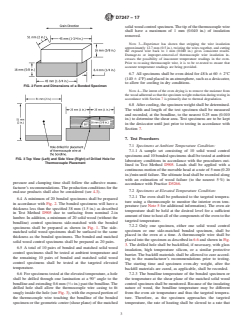
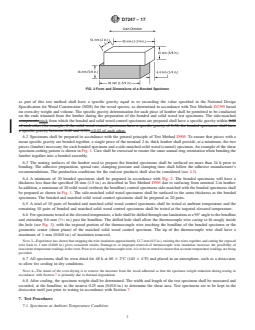
FIG. 2 Form and Dimensions of a Bonded Specimen
NOTE 4—The intent of the oven drying is to remove the moisture from
thewoodadherendsothatthespecimenweightreductionduringtestingin
accordance with Section 7 is primarily due to thermal degradation.
6.8 After cooling, the specimen weight shall be determined.
The width and length of the test specimen shall be measured
and recorded, at the bondline, to the nearest 0.25 mm (0.010
in.) to determine the shear area. Test specimens are to be kept
in the desiccator until just prior to testing in accordance with
Section 7.
7. Test Procedures
7.1 Specimens at Ambient Temperature Condition:
7.1.1 A sample set consisting of 10 solid wood control
specimens and 10 bonded specimens shall be tested at ambient
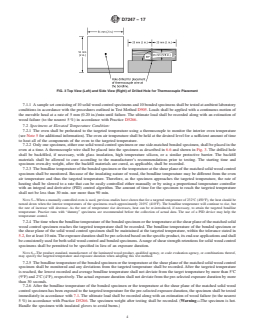
FIG. 3 Top View (Left) and Side View (Right) of Drilled Hole for
laboratory conditions in accordance with the procedures out-
Thermocouple Placement
lined in Test Method D905. Loads shall be applied with a
continuous motion of the movable head at a rate of 5 mm (0.20
in.)/min until failure.The ultimate load shall be recorded along
with an estimation of wood failure (to the nearest 5 %) in
pressure and clamping time shall follow the adhesive manu-
accordance with Practice D5266.
facturer’s recommendations. The production conditions for the
7.2 Specimens at Elevated Temperature Condition:
end-use products shall also be considered (see 4.3).
7.2.1 The oven shall be preheated to the targeted tempera-
6.4 A minimum of 20 bonded specimens shall be prepared
ture using a thermocouple to monitor the interior oven tem-
in accordance with Fig. 2. The bonded specimens will have a
perature (see Note 5 for additional information). The oven air
thickness less than the specified 38 mm (1.5 in.) as described
temperature shall be held at the desired level for a sufficient
in Test Method D905 due to surfacing from nominal 2-in
amount of time to heat all of the components of the oven to the
lumber. In addition, a minimum of 20 solid wood (without the
targeted temperature.
bondline) control specimens side-matched with the bonded
7.2.2 Only one specimen, either one solid wood control
specimens shall be prepared as shown in Fig. 1. The side-
specimen or one side-matched bonded specimen, shall be
matched solid wood specimens shall be surfaced to the same
placed in the oven at a time. A thermocouple wire shall be
thickness as the bonded specimens. The bonded and matched
placed into the specimen as described in 6.6 and shown in Fig.
solid wood control specimens shall be prepared as 20 pairs.
3. The drilled hole shall be backfilled, if necessary, with glass
6.5 A total of 10 pairs of bonded and matched solid wood
insulation, high temperature silicon, or a similar protective
control specimens shall be tested at ambient temperature and
barrier. The backfill materials shall be allowed to cure accord-
the remaining 10 pairs of bonded and matched solid wood
ing to the manufacturer’s recommendations prior to testing.
control specimens shall be tested at the targeted elevated
The starting time and specimen oven-dry weight, after the
temperature.
backfill materials are cured, as applicable, shall be recorded.
6.6 For specimens tested at the elevated temperature, a hole 7.2.3 The bondline temperature of the bonded specimen o
...
This document is not an ASTM standard and is intended only to provide the user of an ASTM standard an indication of what changes have been made to the previous version. Because
it may not be technically possible to adequately depict all changes accurately, ASTM recommends that users consult prior editions as appropriate. In all cases only the current version
of the standard as published by ASTM is to be considered the official document.
Designation: D7247 − 16 D7247 − 17
Standard Test Method for
Evaluating the Shear Strength of Adhesive Bonds in
Laminated Wood Products at Elevated Temperatures
This standard is issued under the fixed designation D7247; the number immediately following the designation indicates the year of
original adoption or, in the case of revision, the year of last revision. A number in parentheses indicates the year of last reapproval. A
superscript epsilon (´) indicates an editorial change since the last revision or reapproval.
1. Scope
1.1 This standard describes a test method for evaluating the comparative shear strength of a planar adhesive bond at both
ambient and elevated temperatures relative to the performance of solid wood under the same conditions. The test method is based
on the breaking load after the specimen is exposed to either ambient or a constant elevated temperature for a specified duration
as described in Section 7. This standard does not preclude the development and implementation of other methods that provide
equivalent performance meeting the intent of this method.
1.2 This test method is intended for the evaluation of adhesives that can be used to assemble test specimens in accordance with
Test Method D905. The evaluation of other types of adhesives, such as the binder systems used for strand-based products, is
beyond the scope of this test method.method, except as noted in 1.4.
1.3 This test method is intended for the evaluation of adhesives as a component of laminated wood products at elevated
temperatures. The evaluation of fire performance on fire-rated laminated wood products or assemblies is beyond the scope of this
test method.
1.4 This test method may be used for the evaluation of heat durability for binder adhesives used in strand-based structural wood
composites, such as oriented strand lumber (OSL) and laminated strand lumber (LSL), by substituting strand-based composite
specimens for the bonded specimens.
1.5 The exact formulation of adhesive supplied to the manufacturer of laminated wood products shall be evaluated.
Modifications to the adhesive formulation require a separate evaluation unless approved by the manufacturer of the laminated
wood product, qualified agency, and code evaluation agency.
1.6 The values stated in SI units are to be regarded as the standard. The values given in parentheses are for information only.
1.7 This standard does not purport to address all of the safety concerns, such as the fire hazard, if any, associated with its use.
It is the responsibility of the user of this standard to establish appropriate safety safety, health, and healthenvironmental practices
and determine the applicability of regulatory limitations prior to use.
1.8 This international standard was developed in accordance with internationally recognized principles on standardization
established in the Decision on Principles for the Development of International Standards, Guides and Recommendations issued
by the World Trade Organization Technical Barriers to Trade (TBT) Committee.
2. Referenced Documents
2.1 ASTM Standards:
D905 Test Method for Strength Properties of Adhesive Bonds in Shear by Compression Loading
D907 Terminology of Adhesives
D2395 Test Methods for Density and Specific Gravity (Relative Density) of Wood and Wood-Based Materials
D2915 Practice for Sampling and Data-Analysis for Structural Wood and Wood-Based Products
D4933 Guide for Moisture Conditioning of Wood and Wood-Based Materials
D5266 Practice for Estimating the Percentage of Wood Failure in Adhesive Bonded Joints
D5456 Specification for Evaluation of Structural Composite Lumber Products
This test method is under the jurisdiction of ASTM Committee D14 on Adhesives and is the direct responsibility of Subcommittee D14.30 on Wood Adhesives.
Current edition approved April 1, 2016Oct. 15, 2017. Published April 2016November 2017. Originally approved in 2006. Last previous edition approved in 20072016
ɛ1
as D7247 – 07a which was withdrawn January 2016 and reinstated in April 2016 as D7247 – 16. DOI: 10.1520/D7247-16.10.1520/D7247-17.
For referenced ASTM standards, visit the ASTM website, www.astm.org, or contact ASTM Customer Service at service@astm.org. For Annual Book of ASTM Standards
volume information, refer to the standard’s Document Summary page on the ASTM website.
Copyright © ASTM International, 100 Barr Harbor Drive, PO Box C700, West Conshohocken, PA 19428-2959. United States
D7247 − 17
Note–See Fig. 2 for specimen dimension.
FIG. 1 Example of Side-Matched Specimen Fabrication (Using Nominal 2 by 6 in. Lumber with Bonded Specimens and Side-Matched
Solid Wood Control Specimens)
2.2 Other Documents:
ANSI A190.1 American National Standard for Wood Products — Structural Glued Laminated Timber
ANSI/AWC NDS-2015 National Design — Specification for Wood Construction (NDS)
Wood Handbook Wood as an Engineering Material
3. Terminology
3.1 Definitions:
3.1.1 Many terms in this test method are defined in Terminology D907.
4. Significance and Use
4.1 A discussion of the issues and limitations associated with the measurement of strength properties of adhesive bonds in shear
by compression loading is found in Test Method D905.
4.2 While various combinations of test temperature and heat exposure duration can be used, the provisions specified in 7.2.4
shall be based on the understanding that the objective of this test method is to evaluate adhesive bond performance just before
wood begins to burn and the elevated temperature is selected to be slightly below the unpiloted ignition temperature for wood when
taken into account the specific product and its end-use applications.
4.3 When using this test method, consideration shall be given to the unique production conditions, such as wood moisture
content, applied spread rate, press pressure, and curing temperature of the adhesive.
5. Apparatus
5.1 The testing machine and shearing tool described in Test Method D905 have been found to be satisfactory for the test method
described herein.
5.2 An oven capable of maintaining the targeted test temperature to within 61 % and with sufficient air circulation to provide
constant temperature conditions within the oven interior is required for heating the specimens.
5.3 Thermometers/thermocouples capable of measuring the temperature of the test specimen and air are required.
NOTE 1—Type “K” 24 gauge thermocouples are recommended.
5.4 Dessicator, capable of maintaining the dry condition of the dried specimen sets until exposure and testing.
NOTE 2—Fresh or freshly regenerated desiccant is recommended for each test.
6. Test Specimen
6.1 The wood species used for the tests shall be the wood species used in commercial production. Wood species with similar
bonding characteristics in accordance with ANSI A190.1 shall be permitted to be grouped for the purpose of this test method.
Nominal 2-in. thick lumber shall be used to manufacture the test specimens. The lumber shall have the annual growth rings oriented
45 to 90°, as measured from the wide face (vertical grain), and be free of defects and at the equilibrium moisture content
recommended by the manufacturer of the adhesive. If no such recommendation exists, the moisture content shall be between 10
and 12 % prior to bonding following the moisture conditioning procedures described in Guide D4933. Each piece of lumber used
APA — The Engineered Wood Association, 7011 S. 19th St., Tacoma, WA 98466, www.apaword.org.
Available from U.S. Department of Agriculture, Forest Service, Forest Products Laboratory, One Gifford Pinchot Drive Madison, WI 53726, www.fpl.fs.fed.us.
D7247 − 17
FIG. 2 Form and Dimensions of a Bonded Specimen
as part of this test method shall have a specific gravity equal to or exceeding the value specified in the National Design
Specification for Wood Construction (NDS) for the wood species, as determined in accordance with Test Methods D2395 based
on oven-dry weight and volume. The specific gravity determination for each piece of lumber shall be permitted to be conducted
on the ends trimmed from the lumber during the preparation of the bonded and solid wood test specimens. The side-matched
componentsstock from which the bonded and solid wood control specimens are prepared shall have a specific gravity within 0.02
of each other (for example, if the solid wood control specimens have a specific gravity of 0.50, the bonded specimens shall have
a specific gravity between 0.48 and 0.52).60.02 of each other.
6.2 Specimens shall be prepared in accordance with the general principle of Test Method D905. To ensure that pieces with a
mean specific gravity are bonded together, a single piece of the nominal 2 in. thick lumber shall provide, at a minimum, the two
pieces (lumber) necessary for each bonded specimen and a side-matched solid wood (control) specimen. An example of the shear
specimen-cutting pattern is shown in Fig. 1. Care shall be exercised to ensure the same annual ring orientation when bonding the
lumber together into a bonded assembly.
6.3 The mating surfaces of the lumber used to prepare the bonded specimens shall be surfaced no more than 24 h prior to
bonding. The adhesive preparation, spread rate, clamping pressure and clamping time shall follow the adhesive manufacturer’s
recommendations. The production conditions for the end-use products shall also be considered (see 4.3).
6.4 A minimum of 20 bonded specimens shall be prepared in accordance with Fig. 2. The bonded specimens will have a
thickness less than the specified 38 mm (1.5 in.) as described in Test Method D905 due to surfacing from nominal 2-in lumber.
In addition, a minimum of 20 solid wood (without the bondline) control specimens side-matched with the bonded specimens shall
be prepared as shown in Fig. 1. The side-matched solid wood specimens shall be surfaced to the same thickness as the bonded
specimens. The bonded and matched solid wood control specimens shall be prepared as 20 pairs.
6.5 A total of 10 pairs of bonded and matched solid wood control specimens shall be tested at ambient temperature and the
remaining 10 pairs of bonded and matched solid wood control specimens shall be tested at the targeted elevated temperature.
6.6 For specimens tested at the elevated temperature, a hole shall be drilled through one lamination at a 90° angle to the bondline
and extending 0.6 mm ( ⁄32 in.) past the bondline. The drilled hole shall allow the thermocouple wire casing to fit snugly inside
the hole (see Fig. 3), with the exposed portion of the thermocouple wire touching the bondline of the bonded specimen or the
geometric center (shear plane) of the matched solid wood control specimen. The tip of the thermocouple wire shall have a
maximum of 1 mm (0.040 in.) of insulation removed.
NOTE 3—Experience has shown that stripping the wire insulation approximately 12.7 mm (0.5 in.), twisting the wires together, and cutting the exposed
wire back to 1 mm (0.040 in.) gives consistent results. Damage-to or improper-removal-of thermocouple wire insulation increases the possibility of
inaccurate temperature readings in the oven. Prior to re-using thermocouple wire, it is to be re-tested to ensure that accurate temperature readings are being
provided.
6.7 All specimens shall be oven dried for 48 h at 60 6 2°C (140 6 4°F) and placed in an atmosphere, such as a desiccator,
to allow for cooling in dry conditions.
NOTE 4—The intent of the oven drying is to remove the moisture from the wood adherend so that the specimen weight reduction during testing in
accordance with Section 7 is primarily due to thermal degradation.
6.8 After cooling, the specimen weight shall be determined. The width and length of the test specimen shall be measured and
recorded, at the bondline, to the nearest 0.25 mm (0.010 in.) to determine the shear area. Test specimens are to be kept in the
desiccator until just prior to testing in accordance with Section 7.
7. Test Procedures
7.1 Specimens at Ambient Temperature Condition:
D7247 − 17
FIG. 3 Top View (Left) and Side View (Right) of Drilled Hole for Thermocouple Placement
7.1.1 A sample set consisting of 10 solid wood control specimens and 10 bonded specimens shall be tested at ambient laboratory
conditions in accordance with the procedures outlined in Test Method D905. Loads shall be applied with a continuous motion of
the movable head at a rate of 5 mm (0.20 in.)/min until failure. The ultimate load shall be recorded along with an estimation of
wood failure (to the nearest 5 %) in accordance with Practice D5266.
7.2 Specimens at Elevated Temperature Condition:
7.2.1 The oven shall be preheated to the targeted temperature using a thermocouple to monitor the interior oven temperature
(see Note 5 for additional information). The oven air temperature shall be held at the desired level for a sufficient amount of time
to heat all of the components of the oven to the targeted temperature.
7.2.2 Only one specimen, either
...