

ASTM D2915-17(2022)
(Practice)Standard Practice for Sampling and Data-Analysis for Structural Wood and Wood-Based Products
General Information
- Abstract
ABSTRACT
This practice covers sampling and analysis procedures for the investigation and evaluation of allowable properties of specified populations of stress-graded structural lumber. This practice generally assumes that the population is sufficiently large so that, for sampling purposes, it may be considered infinite. The population shall be clearly defined where it may be necessary to specify the following: (1) grade name and description, (2) geographical area over which sampling will take place, (3) species or species group, (4) time span for sampling (5) lumber size, and (6) moisture content. Two statistical techniques are described under this practice, namely: parametric and nonparametric analysis. The sampling methods include: (1) random sampling, (2) sampling with unequal probabilities, and (3) sequential sampling. Selection and method of determining sample size are detailed. The results of the tests performed shall be presented as (1) a set of summarizing statistics, and (2) an appendix of unadjusted individual test specimen results. The procedures and requirements for analysis of results are detailed and includes the following: (1) adjustment factors used to reduce the test statistics to the level of allowable properties, (2) formula for calculating apparent modulus of elasticity, sample mean, sample standard deviation, and confidence interval for the mean (3) sample nonparametric percent point estimate, (4) nonparametric lower tolerance limit, (5) parametric point estimate, (6) lower parametric tolerance limit, and (7) histogram and empirical cumulative distribution function. This practice does not specify the action to be taken after the results have been analyzed.
SCOPE
1.1 This practice covers sampling and analysis procedures for the investigation of specified populations of wood and wood-based structural products referred to in this standard as products. Appropriate product standards should be referenced for presentation requirements for data. Depending on the interest of the user, the population from which samples are taken may range from the products produced at a specific manufacturing site to all the products produced in a particular grade from a particular geographic area, during some specified interval of time. This practice generally assumes that the population is sufficiently large so that, for sampling purposes, it may be considered infinite. Where this assumption is inadequate, that is, the population is assumed finite, many of the provisions of this practice may be employed but the sampling and analysis procedure must be designed to reflect a finite population. The statistical techniques embodied in this practice provide procedures to summarize data so that logical judgments can be made. This practice does not specify the action to be taken after the results have been analyzed. The action to be taken depends on the particular requirements of the user of the product.
1.2 The values stated in inch-pound units are to be regarded as standard. The values given in parentheses are mathematical conversions to SI units that are provided for information only and are not considered standard.
1.3 This practice does not purport to address the adjustment factors needed to adjust test data to standardized mechanical and environmental conditions (that is, temperature, moisture, test span, or load duration). Additionally, it provides a basis for statistical estimates that will typically require further adjustment to determine design values for use with an accepted design methodology (that is, allowable stress, limit states, or load and resistance factor design). It shall be the responsibility of the user to seek out the appropriate adjustments in specific product standards.
1.4 This standard does not purport to address all of the safety concerns, if any, associated with its use. It is the responsibility of the user of this standard to establish appropriate safety, health, and environmental prac...
- Status
- Published
- Publication Date
- 31-Jan-2022
- Technical Committee
- D07 - Wood
- Drafting Committee
- D07.02 - Lumber and Engineered Wood Products
Overview
ASTM D2915-17(2022): Standard Practice for Sampling and Data-Analysis for Structural Wood and Wood-Based Products is a widely recognized standard developed by ASTM International. This standard establishes procedures for sampling and statistical analysis when evaluating the allowable properties of large populations of stress-graded structural lumber and wood-based structural products. It is particularly relevant for the wood products and construction industries where the reliability and consistency of structural materials are critical for safety and performance.
ASTM D2915-17(2022) provides a rigorous statistical framework for investigating, summarizing, and interpreting the mechanical properties of wood products. By following this standard, organizations can ensure their products meet necessary quality and safety benchmarks set forth in relevant product standards. While the standard describes data analysis approaches, it leaves the selection of actions based on the results to the discretion of the user.
Key Topics
Population Definition: The standard emphasizes the importance of clearly defining the population under test. Key factors include grade, geographic area, species or group, time span, lumber size, and moisture content, ensuring that results are applicable and meaningful within the context of intended use.
Sampling Methods: Several sampling techniques are covered:
- Random Sampling: Ensures unbiased selection from a defined population.
- Sampling with Unequal Probabilities: Allows weighting where appropriate, while maintaining statistical integrity.
- Sequential Sampling: Useful for characterizing products as they may be selected for actual use.
Determining Sample Size: Detailed guidance is provided for selecting adequate sample sizes to ensure statistical confidence in estimated properties, such as the mean or minimum strength, taking into account variability and required precision.
Analysis Techniques: Both parametric (assuming known data distribution, such as normal) and nonparametric (distribution-free) analysis methods are described. Each has specific applications and requirements for data validation.
Statistical Reporting: The standard details how to summarize and present results, including means, standard deviations, confidence intervals, nonparametric estimates, tolerance limits, histograms, and empirical cumulative distribution functions.
Adjustment and Presentation: Procedures for adjusting data (e.g., moisture content, load duration) prior to statistical analysis and aligning results to various product standards are outlined.
Applications
ASTM D2915-17(2022) is essential for quality control and product evaluation in:
- Lumber and Engineered Wood Manufacturing: Used to verify that batches of structural lumber and wood-based components meet established strength and serviceability criteria.
- Product Development and Certification: Provides a statistical basis for assigning design values needed for allowable stress design, load and resistance factor design (LRFD), and limit states design.
- Regulatory and Code Compliance: Helps manufacturers demonstrate that structural wood products adhere to building codes and international standards.
- Research and Development: Supports academic and industrial research by offering a repeatable methodology for assessing the mechanical properties of innovative wood-based products.
- Supplier and Procurement Assessment: Facilitates objective comparison among suppliers or between lots, ensuring reliability and structural integrity for construction projects.
Related Standards
Several standards are often used in conjunction with ASTM D2915-17(2022) to complete the evaluation and assignment of structural properties for wood products:
- ASTM D245: Establishing structural grades and related allowable properties for visually graded lumber.
- ASTM D1990: Establishing allowable properties for visually-graded dimension lumber from in-grade tests.
- ASTM D2555: Establishing clear wood strength values.
- ASTM D3737: Establishing allowable properties for structural glued laminated timber (Glulam).
- ASTM D5055: Establishing and monitoring structural capacities of prefabricated wood I-joists.
- ASTM D5456: Evaluation of structural composite lumber products.
- ASTM D6570: Assigning allowable properties for mechanically graded lumber.
- ASTM E105: Guide for probability sampling of materials.
- ASTM E29: Using significant digits in test data to determine conformance with specifications.
- ASTM D9: Terminology relating to wood and wood-based products.
Practical Value
Utilizing ASTM D2915-17(2022) ensures statistically sound sampling and analysis of structural wood and wood-based products, leading to reliable, consistent, and appropriately rated materials. This standard underpins critical decisions about product design values, enabling manufacturers, engineers, and regulatory authorities to make informed, objective assessments rooted in globally recognized methodologies for sampling and data analysis in the wood products sector.
Relations
- Effective Date
- 01-Feb-2024
- Effective Date
- 01-Feb-2024
- Effective Date
- 01-Oct-2023
- Effective Date
- 01-Oct-2019
- Effective Date
- 01-Mar-2019
- Refers
ASTM D6570-18 - Standard Practice for Assigning Allowable Properties for Mechanically Graded Lumber - Effective Date
- 01-Sep-2018
- Effective Date
- 01-Apr-2018
- Effective Date
- 01-Apr-2018
- Effective Date
- 01-Apr-2018
- Effective Date
- 01-Aug-2017
- Effective Date
- 15-Apr-2017
- Refers
ASTM D5456-17e1 - Standard Specification for Evaluation of Structural Composite Lumber Products - Effective Date
- 01-Mar-2017
- Effective Date
- 01-Mar-2017
- Effective Date
- 01-Aug-2016
- Effective Date
- 01-Jun-2016
Get Certified
Connect with accredited certification bodies for this standard

Gozdarski inštitut Slovenije
Slovenian Forestry Institute. Forest management certification support, timber testing.
Sponsored listings
Frequently Asked Questions
ASTM D2915-17(2022) is a standard published by ASTM International. Its full title is "Standard Practice for Sampling and Data-Analysis for Structural Wood and Wood-Based Products". This standard covers: ABSTRACT This practice covers sampling and analysis procedures for the investigation and evaluation of allowable properties of specified populations of stress-graded structural lumber. This practice generally assumes that the population is sufficiently large so that, for sampling purposes, it may be considered infinite. The population shall be clearly defined where it may be necessary to specify the following: (1) grade name and description, (2) geographical area over which sampling will take place, (3) species or species group, (4) time span for sampling (5) lumber size, and (6) moisture content. Two statistical techniques are described under this practice, namely: parametric and nonparametric analysis. The sampling methods include: (1) random sampling, (2) sampling with unequal probabilities, and (3) sequential sampling. Selection and method of determining sample size are detailed. The results of the tests performed shall be presented as (1) a set of summarizing statistics, and (2) an appendix of unadjusted individual test specimen results. The procedures and requirements for analysis of results are detailed and includes the following: (1) adjustment factors used to reduce the test statistics to the level of allowable properties, (2) formula for calculating apparent modulus of elasticity, sample mean, sample standard deviation, and confidence interval for the mean (3) sample nonparametric percent point estimate, (4) nonparametric lower tolerance limit, (5) parametric point estimate, (6) lower parametric tolerance limit, and (7) histogram and empirical cumulative distribution function. This practice does not specify the action to be taken after the results have been analyzed. SCOPE 1.1 This practice covers sampling and analysis procedures for the investigation of specified populations of wood and wood-based structural products referred to in this standard as products. Appropriate product standards should be referenced for presentation requirements for data. Depending on the interest of the user, the population from which samples are taken may range from the products produced at a specific manufacturing site to all the products produced in a particular grade from a particular geographic area, during some specified interval of time. This practice generally assumes that the population is sufficiently large so that, for sampling purposes, it may be considered infinite. Where this assumption is inadequate, that is, the population is assumed finite, many of the provisions of this practice may be employed but the sampling and analysis procedure must be designed to reflect a finite population. The statistical techniques embodied in this practice provide procedures to summarize data so that logical judgments can be made. This practice does not specify the action to be taken after the results have been analyzed. The action to be taken depends on the particular requirements of the user of the product. 1.2 The values stated in inch-pound units are to be regarded as standard. The values given in parentheses are mathematical conversions to SI units that are provided for information only and are not considered standard. 1.3 This practice does not purport to address the adjustment factors needed to adjust test data to standardized mechanical and environmental conditions (that is, temperature, moisture, test span, or load duration). Additionally, it provides a basis for statistical estimates that will typically require further adjustment to determine design values for use with an accepted design methodology (that is, allowable stress, limit states, or load and resistance factor design). It shall be the responsibility of the user to seek out the appropriate adjustments in specific product standards. 1.4 This standard does not purport to address all of the safety concerns, if any, associated with its use. It is the responsibility of the user of this standard to establish appropriate safety, health, and environmental prac...
ABSTRACT This practice covers sampling and analysis procedures for the investigation and evaluation of allowable properties of specified populations of stress-graded structural lumber. This practice generally assumes that the population is sufficiently large so that, for sampling purposes, it may be considered infinite. The population shall be clearly defined where it may be necessary to specify the following: (1) grade name and description, (2) geographical area over which sampling will take place, (3) species or species group, (4) time span for sampling (5) lumber size, and (6) moisture content. Two statistical techniques are described under this practice, namely: parametric and nonparametric analysis. The sampling methods include: (1) random sampling, (2) sampling with unequal probabilities, and (3) sequential sampling. Selection and method of determining sample size are detailed. The results of the tests performed shall be presented as (1) a set of summarizing statistics, and (2) an appendix of unadjusted individual test specimen results. The procedures and requirements for analysis of results are detailed and includes the following: (1) adjustment factors used to reduce the test statistics to the level of allowable properties, (2) formula for calculating apparent modulus of elasticity, sample mean, sample standard deviation, and confidence interval for the mean (3) sample nonparametric percent point estimate, (4) nonparametric lower tolerance limit, (5) parametric point estimate, (6) lower parametric tolerance limit, and (7) histogram and empirical cumulative distribution function. This practice does not specify the action to be taken after the results have been analyzed. SCOPE 1.1 This practice covers sampling and analysis procedures for the investigation of specified populations of wood and wood-based structural products referred to in this standard as products. Appropriate product standards should be referenced for presentation requirements for data. Depending on the interest of the user, the population from which samples are taken may range from the products produced at a specific manufacturing site to all the products produced in a particular grade from a particular geographic area, during some specified interval of time. This practice generally assumes that the population is sufficiently large so that, for sampling purposes, it may be considered infinite. Where this assumption is inadequate, that is, the population is assumed finite, many of the provisions of this practice may be employed but the sampling and analysis procedure must be designed to reflect a finite population. The statistical techniques embodied in this practice provide procedures to summarize data so that logical judgments can be made. This practice does not specify the action to be taken after the results have been analyzed. The action to be taken depends on the particular requirements of the user of the product. 1.2 The values stated in inch-pound units are to be regarded as standard. The values given in parentheses are mathematical conversions to SI units that are provided for information only and are not considered standard. 1.3 This practice does not purport to address the adjustment factors needed to adjust test data to standardized mechanical and environmental conditions (that is, temperature, moisture, test span, or load duration). Additionally, it provides a basis for statistical estimates that will typically require further adjustment to determine design values for use with an accepted design methodology (that is, allowable stress, limit states, or load and resistance factor design). It shall be the responsibility of the user to seek out the appropriate adjustments in specific product standards. 1.4 This standard does not purport to address all of the safety concerns, if any, associated with its use. It is the responsibility of the user of this standard to establish appropriate safety, health, and environmental prac...
ASTM D2915-17(2022) is classified under the following ICS (International Classification for Standards) categories: 79.040 - Wood, sawlogs and sawn timber. The ICS classification helps identify the subject area and facilitates finding related standards.
ASTM D2915-17(2022) has the following relationships with other standards: It is inter standard links to ASTM D2555-17a(2024)e1, ASTM D2555-17a(2024), ASTM D3737-18(2023)e1, ASTM D1990-19, ASTM D5055-19, ASTM D6570-18, ASTM D5456-18, ASTM D3737-18e1, ASTM D3737-18, ASTM D2555-17a, ASTM D2555-17, ASTM D5456-17e1, ASTM D5456-17, ASTM D2555-16, ASTM D5055-16. Understanding these relationships helps ensure you are using the most current and applicable version of the standard.
ASTM D2915-17(2022) is available in PDF format for immediate download after purchase. The document can be added to your cart and obtained through the secure checkout process. Digital delivery ensures instant access to the complete standard document.
Standards Content (Sample)
This international standard was developed in accordance with internationally recognized principles on standardization established in the Decision on Principles for the
Development of International Standards, Guides and Recommendations issued by the World Trade Organization Technical Barriers to Trade (TBT) Committee.
Designation: D2915 − 17 (Reapproved 2022)
Standard Practice for
Sampling and Data-Analysis for Structural Wood and Wood-
Based Products
This standard is issued under the fixed designation D2915; the number immediately following the designation indicates the year of
original adoption or, in the case of revision, the year of last revision.Anumber in parentheses indicates the year of last reapproval.A
superscript epsilon (´) indicates an editorial change since the last revision or reapproval.
INTRODUCTION
Sampling and data analysis should be integrated in the design and evaluation of wood and
wood-basedstructuralproducts.Thispracticeisusefulinassessingtheappropriatenessoftheassigned
properties and for checking the effectiveness of grading procedures. Statistical methodologies are
providedtoserveasabasisfortheempiricalestablishmentandevaluationofmeanandnearminimum
property estimates.These population estimates are then used by product standards to assign structural
design values for use with an established design methodology (that is, allowable stress design, load
and resistance factor design, limit states design, etc.). Near-minimum property estimates are typically
used by the product standards to define the performance for a variety of structural properties where
strength is a primary consideration (that is, extreme fiber stress in bending, axial tension, axial
compression, shear, and elasticity for buckling concerns). Population mean estimates are often used
to assess serviceability design criteria where strength is not the primary design concern (that is,
elasticity estimates used for deformation calculations, permissible compression stress at a
deformation, etc.).
Forsituationswhereamanufacturedproductissampledrepeatedlyorlotsizesaresmall,alternative
test methods as described in Ref (1) may be more applicable.
1. Scope inadequate, that is, the population is assumed finite, many of
the provisions of this practice may be employed but the
1.1 This practice covers sampling and analysis procedures
sampling and analysis procedure must be designed to reflect a
for the investigation of specified populations of wood and
finite population. The statistical techniques embodied in this
wood-based structural products referred to in this standard as
practice provide procedures to summarize data so that logical
products. Appropriate product standards should be referenced
judgments can be made. This practice does not specify the
for presentation requirements for data. Depending on the
action to be taken after the results have been analyzed. The
interest of the user, the population from which samples are
actiontobetakendependsontheparticularrequirementsofthe
taken may range from the products produced at a specific
user of the product.
manufacturing site to all the products produced in a particular
grade from a particular geographic area, during some specified
1.2 Thevaluesstatedininch-poundunitsaretoberegarded
interval of time. This practice generally assumes that the
as standard. The values given in parentheses are mathematical
population is sufficiently large so that, for sampling purposes,
conversions to SI units that are provided for information only
it may be considered infinite. Where this assumption is
and are not considered standard.
1.3 This practice does not purport to address the adjustment
This practice is under the jurisdiction ofASTM Committee D07 on Wood and
factors needed to adjust test data to standardized mechanical
is the direct responsibility of Subcommittee D07.02 on Lumber and Engineered
and environmental conditions (that is, temperature, moisture,
Wood Products.
Current edition approved Feb. 1, 2022. Published March 2022. Originally
testspan,orloadduration).Additionally,itprovidesabasisfor
approved in 1970 as D2915–70 T. Last previous edition approved in 2017 as
statistical estimates that will typically require further adjust-
D2915–17. DOI: 10.1520/D2915-17R22.
2 ment to determine design values for use with an accepted
Theboldfacenumbersinparenthesesrefertothelistofreferencesattheendof
this practice. design methodology (that is, allowable stress, limit states, or
Copyright © ASTM International, 100 Barr Harbor Drive, PO Box C700, West Conshohocken, PA 19428-2959. United States
D2915 − 17 (2022)
load and resistance factor design). It shall be the responsibility structures includes factors such as durability, overall stability,
of the user to seek out the appropriate adjustments in specific fire resistance, deflection, cracking, and excessive vibration.
product standards.
3.2.4 strength, n—levelofstressexpressedintermsofforce
1.4 This standard does not purport to address all of the per area being evaluated for design.
safety concerns, if any, associated with its use. It is the
3.2.5 structural design values, n—unit stresses and stiffness
responsibility of the user of this standard to establish appro-
values utilized in design.
priate safety, health, and environmental practices and deter-
3.2.5.1 Discussion—Structural design values are test results
mine the applicability of regulatory limitations prior to use.
adjusted for duration of load, factor of safety, and expected
1.5 This international standard was developed in accor-
service conditions.
dance with internationally recognized principles on standard-
3.2.6 tolerance limit (TL), n—tolerance limit with 95%
ization established in the Decision on Principles for the
content and 75% confidence.
Development of International Standards, Guides and Recom-
mendations issued by the World Trade Organization Technical
4. Statistical Methodology
Barriers to Trade (TBT) Committee.
4.1 Two general analysis procedures are described under
2. Referenced Documents
this practice: parametric and nonparametric. A nonparametric
approach requires fewer assumptions and is generally more
2.1 ASTM Standards:
conservative than a parametric procedure. The parametric
D9Terminology Relating to Wood and Wood-Based Prod-
approach assumes a known distribution of the underlying
ucts
population, an assumption which, if incorrect, may lead to
D245Practice for Establishing Structural Grades and Re-
inaccurate results. Some examples of parametric distributions
lated Allowable Properties for Visually Graded Lumber
are normal, lognormal and Weibull. Therefore, if a parametric
D1990Practice for Establishing Allowable Properties for
approachisused,appropriatestatisticaltestsshallbeemployed
Visually-Graded Dimension Lumber from In-Grade Tests
to substantiate this choice along with measures of test ad-
of Full-Size Specimens
equacy (2). For parametric approaches in this practice, the
D2555PracticeforEstablishingClearWoodStrengthValues
examples provided are based on assuming normality.
D3737Practice for Establishing Allowable Properties for
Structural Glued Laminated Timber (Glulam)
NOTE 1—The assumption of “normality” in the examples is not a given
D5055Specification for Establishing and Monitoring Struc- and should be verified before using in real cases. A nonparametric
approach requires fewer assumptions and is generally more conservative
tural Capacities of Prefabricated Wood I-Joists
than a parametric procedure.
D5456Specification for Evaluation of Structural Composite
4.2 Population:
Lumber Products
4.2.1 It is imperative that the population to be evaluated be
D6570Practice forAssigningAllowable Properties for Me-
chanically Graded Lumber clearly defined, as inferences made pertain only to that popu-
lation.Inordertodefinethepopulation,itmaybenecessaryto
E29Practice for Using Significant Digits in Test Data to
Determine Conformance with Specifications specify (1) grade name and description, (2) geographical area
over which sampling will take place (nation, state, manufac-
E105Guide for Probability Sampling of Materials
turingsite,etc.),(3)speciesorspeciesgroup,(4)timespanfor
3. Terminology
sampling (a day’s production, a month, a year, etc.), (5)
material dimensions, and ( 6) moisture content.
3.1 Definitions—For definitions of terms related to wood,
4.2.2 The sampling program should consider the population
refer to Terminology D9.
from which the test specimens originated, including types of
3.2 Definitions of Terms Specific to This Standard:
processing methods or marketing practices with respect to any
3.2.1 established design methodology, n—methodology
influence they may have on the representative nature of the
used to determine if a structure will perform adequately using
sample. Test specimens may be collected from stock at
structural design values.
manufacturingsites,centersofdistribution,atpointsofenduse
3.2.1.1 Discussion—Established design methods currently
ordirectlyfromcurrentproduction.Samplingprogramsshould
usedincludeallowablestressdesign,loadandresistancefactor
consider potential effects of the sample source, timing, and
design, limit states design.
location on the variability of specimen properties.
3.2.2 products, n—wood and wood-based structural prod-
4.3 Sampling Procedure:
ucts.
4.3.1 Random Sampling—The sampling unit is commonly
3.2.3 serviceability, n—condition other than the building
the individual test specimen. When this is not the case, see
strength under which a building is still considered useful.
4.3.3. The sampling shall assure random selection of sampling
3.2.3.1 Discussion—Serviceability limit state design of
units from the population described in 4.2 with all members of
the population sharing equal probability of selection. The
principles of Practice E105 shall be maintained. When sam-
For referenced ASTM standards, visit the ASTM website, www.astm.org, or
pling current production, refer to Practice E105 for a recom-
contact ASTM Customer Service at service@astm.org. For Annual Book of ASTM
mended sampling procedure (see Appendix X3 of this practice
Standards volume information, refer to the standard’s Document Summary page on
the ASTM website. foranexampleofthisprocedure).Ifsamplesareselectedfrom
D2915 − 17 (2022)
TABLE 1 Values of the t Statistics Used in Calculating
inventory, random number tables may be used to determine
A
Confidence Intervals
which pieces will be taken for the sample.
df
4.3.2 Sampling with Unequal Probabilities—Under some CI=75% CI=95% CI=99%
n −1
circumstances, it may be advisable to sample with unequal but
1 2.414 12.706 63.657
known probabilities.Where this is done, the general principles
2 1.604 4.303 9.925
3 1.423 3.182 5.841
ofPracticeE105shallbemaintained,andthesamplingmethod
4 1.344 2.776 4.604
shall be completely reported.
5 1.301 2.571 4.032
4.3.3 Sequential Sampling—When trying to characterize
6 1.273 2.447 3.707
how a certain population may perform in a structure, it may be
7 1.254 2.365 3.499
deemed more appropriate to choose a sampling unit, such as a
8 1.240 2.306 3.355
package,thatismorerepresentativeofhowtheproductwillbe 9 1.230 2.262 3.250
10 1.221 2.228 3.169
selectedforuse.Suchacompositesamplingunitmightconsist
of a sequential series of pieces chosen to permit estimation of
11 1.214 2.201 3.106
the properties of the unit as well as the pieces. Where this is 12 1.209 2.179 3.055
13 1.204 2.160 3.012
done,theprinciplesin4.3.1and4.3.2applytothesecomposite
14 1.200 2.145 2.977
sampling units and the sampling method shall be completely
15 1.197 2.131 2.947
reported.
16 1.194 2.120 2.921
4.4 Sample Size: 17 1.191 2.110 2.898
18 1.189 2.101 2.878
4.4.1 Selection of a sample size depends upon the property
19 1.187 2.093 2.861
or properties to be estimated, the actual variation in properties
20 1.185 2.086 2.845
occurring in the population, and the precision with which the
21 1.183 2.080 2.831
property is to be estimated. For any property, strength values,
22 1.182 2.074 2.891
or the modulus of elasticity, various percentiles of the popula-
23 1.180 2.069 2.807
24 1.179 2.064 2.797
tion may be estimated and for all properties, nonparametric or
25 1.178 2.060 2.787
parametric techniques are applicable. Commonly, the mean is
estimated for properties which will eventually be used by the
26 1.177 2.056 2.779
27 1.176 2.052 2.771
product standard to evaluate a serviceability design concern.
28 1.175 2.048 2.763
Near minimum property estimates are typically evaluated for
29 1.174 2.045 2.756
properties where strength is the primary objective.
30 1.173 2.042 2.750
4.4.2 Determine sample size sufficient for estimating the
40 1.167 2.021 2.704
mean by a two-stage method, with the use of the following
60 1.162 2.000 2.660
equation. This equation assumes the data is normally distrib- 120 1.156 1.980 2.617
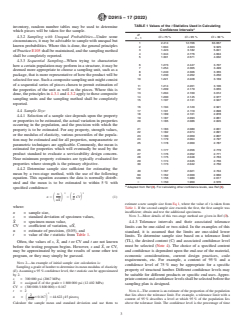
` 1.150 1.960 2.576
uted and the mean is to be estimated to within 5% with
A
Adapted from Ref (3). For calculating other confidence levels, see Ref (3).
specified confidence:
2 2
ts t
n 5 5 CV (1)
S D
S D
¯ α
αX
estimate a new sample size from Eq 1, where the value of t is taken from
where:
Table 1. If the second sample size exceeds the first, the first sample was
insufficient; obtain and test the additional specimens.
n = sample size,
NOTE 3—More details of this two-stage method are given in Ref (3).
s = standard deviation of specimen values,
¯
X = specimen mean value,
4.4.3 Tolerance intervals and their associated tolerance
¯
CV = coefficient of variation, s/X,
limits can be one-sided or two-sided. In the examples of this
α = estimate of precision, (0.05), and
standard, it is assumed that the limits are one-sided lower
t = value of the t statistic from Table 1.
limits. To determine sample size based on a tolerance limit
¯
(TL), the desired content (C) and associated confidence level
Often, the values of s, X, and t or CV and t are not known
¯ must be selected (Note 4). The choice of a specified content
before the testing program begins. However, s and X,orCV,
and confidence is dependent upon the end-use of the material,
may be approximated by using the results of some other test
economic considerations, current design practices, code
program, or they may simply be guessed.
requirements, etc. For example, a content of 95% and a
NOTE 2—An example of initial sample size calculation is:
confidence level of 75% may be appropriate for a specific
Samplingagradeoflumbertodetermineitsmeanmodulusofelasticity
property of structural lumber. Different confidence levels may
(E).Assuminga95%confidencelevel,the tstatisticcanbeapproximated
be suitable for different products or specific end uses. Appro-
by 2.
s = 300000 psi (2067 MPa)
priatecontentandconfidencelevelsshallbeselectedbeforethe
¯
X = assigned E of the grade=1800000 psi (12402 MPa)
sampling plan is designed.
CV = (300000⁄1800000)=0.167
t =2 NOTE 4—The content is an estimate of the proportion of the population
that lies above the tolerance limit. For example, a tolerance limit with a
n = 30.167 544.622 45pieces
S D ~ !
content of 95% describes a level at which 95% of the population lies
0.05
Calculate the sample mean and standard deviation and use them to above the tolerance limit. The confidence level is the percentage of time
D2915 − 17 (2022)
that the desired content is expected to be achieved through sampling.
where:
4.4.3.1 To determine the sample size for near-minimum s = standard deviation of specimen values,
properties,thenonparametrictolerancelimitconceptofRef (3) n = sample size, and
K = confidence level factor from Table 3.
may be used (Table 2). This will provide the sample size
suitable for several options in subsequent near-minimum
The sample size, n, may be chosen to make the standard
analyses. Although the frequency with which the tolerance
errorsufficientlysmallfortheintendedenduseofthematerial.
limit will fall above (or below) the population value, corre-
NOTE 5—An example of sample size calculation where the purpose is
sponding to the required content, is controlled by the confi-
toestimateanearminimumpropertyisshowninthefollowingcalculation
dence level selected, the larger the sample size the more likely
based on the assumption of normality of population.
the tolerance limit will be close to the population value. It is,
Estimatethesamplesize, n,foracompressivestrengthparalleltograin
therefore, desirable to select a sample size as large as possible
test in which normality will be assumed. A CV of 22% and a mean
strength of 4600 psi are assumed based on other tests. The target PTL of
commensurate with the cost of sampling and testing (see also
the grade is 2700 psi. The PTL is to be estimated with a content of 95%
5.4).
(5% PTL) and a confidence of 75%.
4.4.3.2 If a parametric approach is used, then a tolerance
limit with stated content and confidence can be obtained for
CV = 0.22
¯
X = 4600 psi (31.7 MPa)
any sample size; however, the limitation expressed in 4.4.3.1
s = (0.22) (4600)=1012 psi (7.0 MPa)
applies.That is, although the frequency that the tolerance limit
¯
K =(X− PTL)/s=(4600-2700)⁄1012=1.877
falls above (or below) the population value, corresponding to
From Table 3:
the required content is controlled, the probability that the
tolerancelimitwillbeclosetothepopulationvaluedependson
K = 1.869 for n=30
the sample size. For example, if normality is assumed, the Therefore, n ≈ 30 specimens.
parametric tolerance limit (PTL) will be of the form
1 1.877
¯
PTL= X−Ks,(seeRef (3)),andthestandarderror(SE)ofthis
SE 51012Π1 (3)
30 2~30 21!
statistic may be approximated by the following equation:
2 5310psi 2.14MPa
~ !
1 K
SE 5 s 1 (2)
ΠConsequently, although 30 specimens is sufficient to estimate the 5%
n 2 n 21
~ !
PTLwith 75% confidence, the standard error (approximately 12% of the
PTL)illustratesthat,withthissizesample,thePTLestimatedbytestmay
not be as close to the true population fifth percentile as desired. A larger
n may be desirable.
4.4.4 Often, the objective of the evaluation program will be
toestimatemeanandnear-minimumpropertiessimultaneously.
When this is the case, only one sample size need be used. It
should be the greater of the two obtained in accordance with
4.4.2 and 4.4.3.
4.4.5 If a sampling unit other than an individual test
specimen is to be used, as provided for in 4.3.3, then the
requiredsamplesizemustbedeterminedbyproceduresthatare
statisticallyappropriateforthesamplingmethodchosen.Inthe
case of multisource data, as in the sampling of some or all
manufacturing sites in a defined region, special procedures
mayberequired,forexample,thosebasedonthemethodology
introducedinRef (4).Inallcases,theproceduresshallbefully
described.
5. Analysis and Presentation of Results
5.1 If the goal is to evaluate the data against published
design properties or to develop new design properties, the data
shall be adjusted for moisture content, test conditions (envi-
ronment and mechanical arrangement), and other factors in
accordance with the subject product requirements. Depending
on the product standard used to establish allowable properties
fortheparticularproduct,theseadjustmentstothedatamaybe
required before data analysis and presentation. Table 4 shows
a listing of currently developed product standards that use
adjustment procedures applied to test data developed in accor-
dance with this procedure. An example of an adjustment of
various properties are given in Appendix X1 – Appendix X4.
D2915 − 17 (2022)
5.1.1 Properties shall be adjusted to a single moisture 5.2 The results of the tests performed in accordance with
content if appropriate for the objective of the testing program consensus standard testing procedures shall be analyzed and
and relevant product standard. Although test results can be
presented as (1) a set of summarizing statistics, and (2)an
adjusted for moisture content, these adjustments decrease in
appendix of unadjusted individual test specimen results. If
accuracy with increasing change in moisture content. For this
parametric procedures are to be used, a description of the
reason, it is suggested that the specimens be conditioned as
selectionproceduresandatabulationofdistributionparameters
closely as possible to the target moisture content prior to test.
shall be provided.Any “best-fit” judgment between competing
Properties also must be adjusted for the duration of load
distributions shall be documented.
condition anticipated.
D2915 − 17 (2022)
TABLE 4 Product Standards That Use Adjustment Procedures
¯
CI 5 X6~ts/= n! (6)
Applied To Test Data Developed With Practice D2915
Product Standards Designation wheretdependsonthesamplesizeandconfidencelevel,and
is given in Table 1. A CI of this type provides that, if the
Standard Practice for Establishing D245
structural Grades and Related
population is normally distributed, a given percent of all
Allowable Properties for
intervals found in this manner are expected to contain the true
Visually Graded Lumber
Standard Practice for Establishing D1990 population mean.
Allowable Properties for
5.3.4 The sample nonparametric percent point estimate
Visually-Graded Dimension Lumber
(NPE) may be interpolated from the sample. To perform the
from In-Grade Tests of Full-Size
Specimens interpolation, arrange the test values in ascending order.
Standard Practice for Establishing D2555
Symbolically, call them x , x , x ,. x . Beginning with the
1 2 3 n
Clear Wood Strength Values
lowest value (that is, first order statistic, see Note 7), calculate
Standard Practice for Establishing D3737
Allowable Properties for
i/( n+1), where i is the order of the value, for each succes-
Structural Glued Laminated th
sively higher value until i/(n+1) ≥ k/100, call it the j value,
Timber (Glulam)
equals or exceeds the sample k percentile point estimate.
Standard Specification for Establish- D5055
ing
Interpolate the nonparametric k percentage point estimate by:
and Monitoring Structural Capacities
k
of Prefabricated Wood I-Joist
NPE 5 n11 2 j 21 x 2 x 1x (7)
F ~ ! ~ !G @ #
Standard Specification for Evaluation D5456 j j21 j21
~ ! ~ !
of Structural Composite
Lumber Products
where k is the desired percentile point estimate.
Standard Practice for Assigning D6570
Allowable Properties for
NOTE 7—Order statistics are ranked test values from the lowest to the
Mechanically Graded Lumber
highest. For example, the first order statistic is the lowest test value or the
weakest piece in the sample, the second order statistic is the second
weakest piece, etc.
5.3.5 The nonparametric lower tolerance limit (NTL) of a
NOTE 6—Abest-fit procedure should recognize the low power of some th
specified content is the m order statistic, where m depends
published procedures. To check the fit, the series of tests outlined in Ref
upon the sample size and confidence level. Table 2 depicts the
(5) represents seve
...