

ASTM D8534-23
(Test Method)Standard Test Method for Determination of Trace Peroxides in Liquid, Liquefied, and Reagents Soluble Hydrocarbon Streams using Flow Injection System with Ultraviolet/Visible Detector
General Information
- Abstract
SIGNIFICANCE AND USE
5.1 This test method is suitable for determining the quantity of hydrogen peroxide, organic hydroperoxides, and organic peroxides as total active oxygen in various hydrocarbon streams for both quality control and quality assurance of the product.
SCOPE
1.1 This test method covers the determination of trace peroxides in various hydrocarbon streams. A list of typical hydrocarbon streams can be found in Appendix X2.
1.2 This test method is applicable to the determination of peroxides in petroleum liquids including, but not limited to, 1,3-butadiene, styrene, methylcyclohexane, and alpha olefins in the range of 0.1 mg/kg to 100 mg/kg active oxygen. The limit of detection (LOD) is 0.03 mg/kg for active oxygen and the limit of quantitation (LOQ) is 0.11 mg/kg active oxygen. The upper limit has been determined by the calibration range.
Note 1: LOD and LOQ were calculated using data obtained during development of the method.
1.3 In determining the conformance of the test results using this method to applicable specifications, results shall be rounded off in accordance with the rounding-off method of Practice E29.
1.4 Units—The values stated in SI units are to be regarded as standard. No other units of measurement are included in this standard.
1.5 This standard does not purport to address all of the safety concerns, if any, associated with its use. It is the responsibility of the user of this standard to establish appropriate safety, health, and environmental practices and determine the applicability of regulatory limitations prior to use. For specific hazard statements, see Section 9.
1.6 This international standard was developed in accordance with internationally recognized principles on standardization established in the Decision on Principles for the Development of International Standards, Guides and Recommendations issued by the World Trade Organization Technical Barriers to Trade (TBT) Committee.
- Status
- Published
- Publication Date
- 14-Nov-2023
- Technical Committee
- D16 - Aromatic, Industrial, Specialty and Related Chemicals
- Drafting Committee
- D16.04 - Instrumental Analysis
Overview
ASTM D8534-23 provides a standardized test method for determining trace levels of hydrogen peroxide, organic hydroperoxides, and organic peroxides in various hydrocarbon streams. This method employs a flow injection system with an ultraviolet/visible (UV/Vis) detector, offering highly sensitive and reliable results. The standard supports both routine quality control and quality assurance in industries handling petroleum, petrochemicals, and related products by quantifying total active oxygen in concentrations ranging from 0.1 mg/kg to 100 mg/kg.
Key Topics
Scope and Applicability:
- Covers liquid, liquefied, and reagent-soluble hydrocarbon streams.
- Applicable to a wide range of petroleum liquids, such as 1,3-butadiene, styrene, methylcyclohexane, and alpha olefins.
- Effective in the 0.1 to 100 mg/kg active oxygen range, supporting detection and quantitation limits suitable for trace analysis.
- Only SI units are used for reporting results.
Test Method Overview:
- Utilizes high-performance liquid chromatography (HPLC) hardware with a flow injection approach.
- Peroxide-containing samples react with acidified iodide; the formed iodine is measured via UV/Vis absorbance.
- Quantitation is achieved through external calibration, commonly using dibenzoyl peroxide as a reference.
Significance:
- Determines total active oxygen - critical for monitoring peroxide content in hydrocarbon products for regulatory, safety, and quality reasons.
- Aids in preventing unwanted reactions or hazardous conditions caused by peroxide accumulation.
Quality Control:
- Laboratories are required to implement effective QA/QC systems.
- Regular calibration and inclusion of quality control samples ensure data accuracy and compliance.
Reporting:
- Results are reported as mg/kg active oxygen, rounded per ASTM E29.
- Method includes instructions for converting active oxygen measurements to specific peroxide content when required.
Safety:
- Users must implement appropriate safety, health, and environmental precautions, referencing relevant regulations and hazard statements.
Applications
ASTM D8534-23 is essential for:
- Petrochemical and Refinery Operations:
- Assessing peroxide levels in processing streams, ensuring compliance with safety and performance specifications, and monitoring product purity.
- Chemical Manufacturing:
- Controlling and verifying peroxide concentrations in feedstocks, intermediates, and finished products.
- Upholding Product Quality:
- Used in the routine quality assurance of aromatic hydrocarbons, alpha olefins, ethers, and alcohols commonly sampled in industry.
- Safety Assessments:
- Mitigates risks associated with peroxide accumulation in storage and transportation.
Common sample streams tested with this method include benzene, toluene, xylene, cyclohexane, isooctane, ethylene glycol, various ethers, and multiple unsaturated hydrocarbons like 1,3-butadiene and 1-hexene.
Related Standards
- ASTM D1193: Specification for Reagent Water
- ASTM D1265: Sampling Liquefied Petroleum Gases
- ASTM D3437: Sampling and Handling Liquid Cyclic Products
- ASTM D3700: Obtaining LPG Samples Using a Floating Piston Cylinder
- ASTM D4790: Terminology for Aromatic Hydrocarbons
- ASTM D6809: Guide for Quality Control for Aromatic Hydrocarbons
- ASTM E29: Rounding-Off Methods
- ASTM E691: Conducting Interlaboratory Studies
These standards provide additional protocols and definitions relevant to sampling, data handling, and terminology, supporting thorough and accurate use of ASTM D8534-23 in analytical laboratories and industrial settings.
Keywords: ASTM D8534-23, trace peroxide determination, hydrocarbon streams, flow injection analysis, ultraviolet-visible detection, petroleum product quality, active oxygen, hydrogen peroxide, organic peroxides, quality control, HPLC, petrochemical testing, peroxide safety, industrial chemicals.
Relations
- Effective Date
- 01-Dec-2023
- Effective Date
- 01-Mar-2023
Frequently Asked Questions
ASTM D8534-23 is a standard published by ASTM International. Its full title is "Standard Test Method for Determination of Trace Peroxides in Liquid, Liquefied, and Reagents Soluble Hydrocarbon Streams using Flow Injection System with Ultraviolet/Visible Detector". This standard covers: SIGNIFICANCE AND USE 5.1 This test method is suitable for determining the quantity of hydrogen peroxide, organic hydroperoxides, and organic peroxides as total active oxygen in various hydrocarbon streams for both quality control and quality assurance of the product. SCOPE 1.1 This test method covers the determination of trace peroxides in various hydrocarbon streams. A list of typical hydrocarbon streams can be found in Appendix X2. 1.2 This test method is applicable to the determination of peroxides in petroleum liquids including, but not limited to, 1,3-butadiene, styrene, methylcyclohexane, and alpha olefins in the range of 0.1 mg/kg to 100 mg/kg active oxygen. The limit of detection (LOD) is 0.03 mg/kg for active oxygen and the limit of quantitation (LOQ) is 0.11 mg/kg active oxygen. The upper limit has been determined by the calibration range. Note 1: LOD and LOQ were calculated using data obtained during development of the method. 1.3 In determining the conformance of the test results using this method to applicable specifications, results shall be rounded off in accordance with the rounding-off method of Practice E29. 1.4 Units—The values stated in SI units are to be regarded as standard. No other units of measurement are included in this standard. 1.5 This standard does not purport to address all of the safety concerns, if any, associated with its use. It is the responsibility of the user of this standard to establish appropriate safety, health, and environmental practices and determine the applicability of regulatory limitations prior to use. For specific hazard statements, see Section 9. 1.6 This international standard was developed in accordance with internationally recognized principles on standardization established in the Decision on Principles for the Development of International Standards, Guides and Recommendations issued by the World Trade Organization Technical Barriers to Trade (TBT) Committee.
SIGNIFICANCE AND USE 5.1 This test method is suitable for determining the quantity of hydrogen peroxide, organic hydroperoxides, and organic peroxides as total active oxygen in various hydrocarbon streams for both quality control and quality assurance of the product. SCOPE 1.1 This test method covers the determination of trace peroxides in various hydrocarbon streams. A list of typical hydrocarbon streams can be found in Appendix X2. 1.2 This test method is applicable to the determination of peroxides in petroleum liquids including, but not limited to, 1,3-butadiene, styrene, methylcyclohexane, and alpha olefins in the range of 0.1 mg/kg to 100 mg/kg active oxygen. The limit of detection (LOD) is 0.03 mg/kg for active oxygen and the limit of quantitation (LOQ) is 0.11 mg/kg active oxygen. The upper limit has been determined by the calibration range. Note 1: LOD and LOQ were calculated using data obtained during development of the method. 1.3 In determining the conformance of the test results using this method to applicable specifications, results shall be rounded off in accordance with the rounding-off method of Practice E29. 1.4 Units—The values stated in SI units are to be regarded as standard. No other units of measurement are included in this standard. 1.5 This standard does not purport to address all of the safety concerns, if any, associated with its use. It is the responsibility of the user of this standard to establish appropriate safety, health, and environmental practices and determine the applicability of regulatory limitations prior to use. For specific hazard statements, see Section 9. 1.6 This international standard was developed in accordance with internationally recognized principles on standardization established in the Decision on Principles for the Development of International Standards, Guides and Recommendations issued by the World Trade Organization Technical Barriers to Trade (TBT) Committee.
ASTM D8534-23 has the following relationships with other standards: It is inter standard links to ASTM D1265-23a, ASTM D1265-23. Understanding these relationships helps ensure you are using the most current and applicable version of the standard.
ASTM D8534-23 is available in PDF format for immediate download after purchase. The document can be added to your cart and obtained through the secure checkout process. Digital delivery ensures instant access to the complete standard document.
Standards Content (Sample)
This international standard was developed in accordance with internationally recognized principles on standardization established in the Decision on Principles for the
Development of International Standards, Guides and Recommendations issued by the World Trade Organization Technical Barriers to Trade (TBT) Committee.
Designation: D8534 − 23
Standard Test Method for
Determination of Trace Peroxides in Liquid, Liquefied, and
Reagents Soluble Hydrocarbon Streams using Flow
Injection System with Ultraviolet/Visible Detector
This standard is issued under the fixed designation D8534; the number immediately following the designation indicates the year of
original adoption or, in the case of revision, the year of last revision. A number in parentheses indicates the year of last reapproval. A
superscript epsilon (´) indicates an editorial change since the last revision or reapproval.
1. Scope 2. Referenced Documents
2.1 ASTM Standards:
1.1 This test method covers the determination of trace
D1193 Specification for Reagent Water
peroxides in various hydrocarbon streams. A list of typical
D1265 Practice for Sampling Liquefied Petroleum (LP)
hydrocarbon streams can be found in Appendix X2.
Gases, Manual Method
1.2 This test method is applicable to the determination of
D3437 Practice for Sampling and Handling Liquid Cyclic
peroxides in petroleum liquids including, but not limited to,
Products
1,3-butadiene, styrene, methylcyclohexane, and alpha olefins
D3700 Practice for Obtaining LPG Samples Using a Float-
in the range of 0.1 mg ⁄kg to 100 mg ⁄kg active oxygen. The
ing Piston Cylinder
limit of detection (LOD) is 0.03 mg ⁄kg for active oxygen and
D4790 Terminology of Aromatic Hydrocarbons and Related
the limit of quantitation (LOQ) is 0.11 mg ⁄kg active oxygen.
Chemicals
The upper limit has been determined by the calibration range.
D6809 Guide for Quality Control and Quality Assurance
Procedures for Aromatic Hydrocarbons and Related Ma-
NOTE 1—LOD and LOQ were calculated using data obtained during
terials
development of the method.
E29 Practice for Using Significant Digits in Test Data to
1.3 In determining the conformance of the test results using
Determine Conformance with Specifications
this method to applicable specifications, results shall be
E691 Practice for Conducting an Interlaboratory Study to
rounded off in accordance with the rounding-off method of
Determine the Precision of a Test Method
Practice E29.
2.2 Other Documents:
1.4 Units—The values stated in SI units are to be regarded 29 CFR 1910.1000 OSHA Regulations, Toxic and Hazard-
as standard. No other units of measurement are included in this
ous Substances—Air Contaminants
standard. 29 CFR 1910.1200 OSHA Regulations, Toxic and Hazard-
ous Substances—Hazard Communication
1.5 This standard does not purport to address all of the
safety concerns, if any, associated with its use. It is the
3. Terminology
responsibility of the user of this standard to establish appro-
3.1 Acronyms:
priate safety, health, and environmental practices and deter-
3.1.1 DBP—dibenzoyl peroxide
mine the applicability of regulatory limitations prior to use.
3.1.2 DLP—dilauroyl peroxide
For specific hazard statements, see Section 9.
1.6 This international standard was developed in accor-
4. Summary of Test Method
dance with internationally recognized principles on standard-
4.1 This method uses a Flow Injection System (FIS) based
ization established in the Decision on Principles for the
Development of International Standards, Guides and Recom- on High Performance Liquid Chromatography (HPLC) hard-
ware. A sample suspected of containing peroxides is injected in
mendations issued by the World Trade Organization Technical
Barriers to Trade (TBT) Committee. a reagent stream of acidified iodide. Peroxides present in the
For referenced ASTM standards, visit the ASTM website, www.astm.org, or
This test method is under the jurisdiction of ASTM Committee D16 on contact ASTM Customer Service at service@astm.org. For Annual Book of ASTM
Aromatic, Industrial, Specialty and Related Chemicals and is the direct responsi- Standards volume information, refer to the standard’s Document Summary page on
bility of Subcommittee D16.04 on Instrumental Analysis. the ASTM website.
Current edition approved Nov. 15, 2023. Published November 2023. DOI: Available from DLA Document Services, Building 4/D, 700 Robbins Ave.,
10.1520/D8534-23. Philadelphia, PA 19111-5094, http://quicksearch.dla.mil.
Copyright © ASTM International, 100 Barr Harbor Drive, PO Box C700, West Conshohocken, PA 19428-2959. United States
D8534 − 23
sample react with the iodide to form iodine. The formed iodine 7.1.1 HPLC System—Any high-performance liquid chro-
is detected using UV-Vis and is directly proportional to the matograph capable of delivering four liquids at flow rates
peroxide content. The concentration of peroxides in the hydro-
between 0.5 mL ⁄min and 3.0 mL ⁄min. A degasser is highly
carbon sample is determined by an external calibration with
recommended.
dibenzoyl peroxide (DBP).
7.1.2 Liquid Sample Injection System—A manual and/or
automated sample injection system capable of injecting sample
5. Significance and Use
of 10 μL (nominal) with a repeatability better than 2 %. For
5.1 This test method is suitable for determining the quantity
samples that exhibit auto-polymerization or evaporate quickly
of hydrogen peroxide, organic hydroperoxides, and organic
at room temperature, it is highly recommended to equip the
peroxides as total active oxygen in various hydrocarbon
automated sample injection system with an integrated cooler.
streams for both quality control and quality assurance of the
7.1.3 Liquefied Sample Injection System—A pressure station
product.
that supplies high pressure nitrogen to a suitable sample
6. Interferences
cylinder and therefore maintains sample in the liquid phases
6.1 Bulk carbonyl compounds interfere by partially and/or during the injection procedure. Typical nitrogen supply pres-
fully reacting with the formed iodine. If the user desires to test sures range from 1500 kPa for 1,3-butadiene to 10 000 kPa for
carbonyl products for peroxides, the calibration shall be made ethylene. The pressure station shall be connected to a sampling
in identical bulk material. valve capable of injecting sample volumes of 10 μL (nominal)
with a repeatability better than 2 %.
6.2 Samples that exhibit absorbance in the range of 350 nm
7.1.4 Reaction Module—A reaction module, holding the
to 370 nm will interfere and require a correction.
reaction coil, capable of maintaining a constant temperature
6.3 Peracids have identical reactivity to peroxides and will
(61 °C) within the range from 140 °C to 180 °C with a
add to the total active oxygen.
minimum accuracy of 7 °C.
6.4 Compounds present in samples having a higher reduc-
7.1.5 Variable Wavelength Detector—Any ultra-violet/
tion potential iodine will interfere by reacting iodide to iodine.
visible detector, capable of recording the absorbance of a single
6.5 Double sterically hindered peroxides, like di-tert-butyl
wavelength in a range of 300 nm to 400 nm.
peroxide and di-cumyl peroxide, will not or only partially react
7.1.6 Data Acquisition—Any commercial integrator or com-
with the iodide.
puterized data acquisition system may be used for display of
6.6 Dissolved oxygen in the sample might interfere by
the detector signal and peak integration. Chromatographic data
partially and/or fully reacting with iodide, adding to the total
systems are preferred but electronic integration may be used if
active oxygen.
the user can demonstrate that the results are consistent with the
precision statement.
7. Apparatus
7.2 Analytical Balance, capable of weighing to 0.1 mg
7.1 The instrument consists of the following modules,
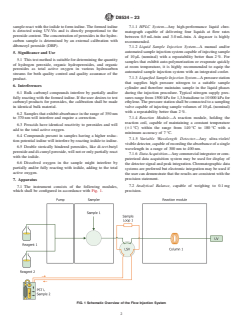
which shall be configured in accordance with Fig. 1. precision.
FIG. 1 Schematic Overview of the Flow Injection System
D8534 − 23
7.3 Glass Erlenmeyer Flask, with a minimum capacity of 10. Sampling and Handling
300 mL, with stopper.
10.1 Collect the sample as directed in Practices D1265,
7.4 Weighing Boats, paper or polystyrene. D3437, or D3700.
7.5 HPLC Bottles, amber and transparent glass, with 1 L 10.2 Cool samples with tendency to auto-polymerize at
capacity. room temperature.
7.6 Volumetric Cylinders, capable of measuring 500 mL or 10.3 Use amber glass for light sensitive samples.
1000 mL and 50 mL.
11. Apparatus Preparation
7.7 LC Autosampler Vials, 1.5 mL capacity with crimp or
screw cap and poly-isobutene septa. 11.1 The HPLC shall be tuned, purged, and equilibrated
according to the manufacturer’s recommendation.
8. Reagents and Materials
11.2 Prior to the first use of the apparatus, the coil should be
conditioned overnight, using the method described in Table 1.
8.1 Purity of Reagents—Reagent grade chemicals shall be
used in all tests. Unless otherwise indicated, it is intended that
11.3 To prepare the instrument after shutdown without
all reagents shall conform to the specifications of the Commit-
exchanging the column, condition using the method described
tee on Analytical Reagents of the American Chemical Society
in Table 1 for 30 min.
where such specifications are available. Other grades may be
11.4 Regularly flush the coil with water, to dissolve any
used, provided it is first ascertained that the reagent is of
precipitated salts (for example, before system standby).
sufficiently high purity to permit its use without lessening the
Afterwards, flush with 1-propanol to prevent algae growth.
accuracy of the determination.
8.2 1-Propanol (CAS 71-23-8)—Analytical reagent grade,
12. Calibration
containing less then 50 μg ⁄kg active oxygen.
12.1 Calibration:
8.3 Glacial Acetic Acid (CAS 64-19-7) 1-Propanol Solution
12.1.1 Weigh 0.2 g 6 0.02 g of DBP to the nearest 0.1 mg
(5 % v/v)—Measure 950 mL 1-propanol in a clear HPLC bottle
in stoppered flask and record the weight. Add 1-propanol to a
and add 50 mL of glacial acetic acid (100 %). Stir the solution
total of 100 g 6 1 g to the nearest 0.1 mg and record the total
vigorously for approximately 30 s. Alternative volumes of
weight. Add a magnetic stirring bar, stopper the flask and stir
solutions may be prepared so long as the preparation meets the
the solution for 3 h 6 0.5 h until no more DBP crystals are
concentration specified.
observed. The concentration of this stock is approxi-
mately 100 mg ⁄kg active oxygen. Calculate the actual concen-
8.4 Sodium Iodide (CAS 7681-82-5) 1–Propanol Solution
tration in parts per million active oxygen (mg/kg):
(1 % m/v)—Dissolve 10 g 6 0.1 g of analytical grade (99.5 %)
sodium iodide in 1000 mL of 1-propanol under gentle stirring
m *a*M *10
DBP O
c 5 (1)
DBP
until no more solid sodium iodide can be observed. Prepare and
M *m *100
DBP total
store the solution in an amber HPLC bottle. Alternative
where:
volumes of solutions may be prepared so long as the prepara-
c = concentration of the calibration stock solution
tion meets the concentration specified. DBP
(mg/kg active oxygen),
8.5 Water (CAS 7732-18-5)—Type I reagent water conform-
m = total mass of the dissolved DBP (g),
DBP
ing to Specification D1193.
a = purity of the DBP as stated in on certificate provided
8.6 Dibenzoyl Peroxide (CAS 94-36-0)—73 % minimum by the supplier (%),
M = molar mass of oxygen (15.9994 g ⁄mol),
purity, water stabilized.
O
M = molar mass of DBP (242.23 g ⁄mol), and
DBP
8.7 Dilauroyl Peroxide (CAS 105-74-8)—97 % minimum
m = total mass of the solution (g).
total
purity.
12.1.2 Prepare a series of calibration standards by diluting
NOTE 2—Peroxides are reactive products and may show limited
the stock solution to final concentrations in the range of
stability, observe supplier’s recommendations for storage and shelf life.
0.1 mg ⁄kg to 100 mg ⁄kg active oxygen, with a minimum of
four concentration levels. An example of a calibration series is
9. Hazards
shown in Table 2.
9.1 Consult the latest OSHA regulations, supplier’s Safety
Data Sheets, and local regulations regarding all materials used
in this test method.
TABLE 1 Typical Operating Conditions
Reaction coil length 30 m
Typical injection volumes 5.0 μL to 10
...