

ASTM C506-22a
(Specification)Standard Specification for Reinforced Concrete Arch Culvert, Storm Drain, and Sewer Pipe
General Information
- Abstract
ABSTRACT
This specification covers reinforced arch-shaped concrete pipe to be used for the conveyance of sewage, industrial wastes, storm water, and for the construction of culverts. Pipe manufactured according to this specification shall be of three classes identified as Class A-II, A-III, and A-IV. The reinforced concrete shall consist of cementitious materials, mineral aggregates, and water, in which steel has been embedded in such a manner that the steel and concrete act together. The pipe shall be designed to meet both the 0.01 in. crack and ultimate strength requirements determined by conducting plant load bearing tests, material tests, and inspection of manufactured pipe for visual defects and imperfections. The reinforcement, joint, and manufacture are detailed.
SCOPE
1.1 This specification covers reinforced arch-shaped concrete pipe to be used for the conveyance of sewage, industrial wastes, storm water, and for the construction of culverts.
1.2 This specification is the inch-pound companion to C506M; therefore, no SI equivalents are presented in the specification. Reinforced concrete pipe that conform to the requirements of C506M are acceptable under this Specification C506 unless prohibited by the owner.
Note 1: This specification is a manufacturing and purchase specification only, and does not include requirements for bedding, backfill, or the relationship between field load condition and the strength classification of pipe. However, experience has shown that the successful performance of this product depends upon the proper selection of the class of pipe, type of bedding and backfill, and care that the installation conforms to the construction specifications. The owner of the reinforced concrete pipe specified herein is cautioned that he must correlate the field requirements with the class of pipe specified and provide inspection at the construction site.
1.3 This international standard was developed in accordance with internationally recognized principles on standardization established in the Decision on Principles for the Development of International Standards, Guides and Recommendations issued by the World Trade Organization Technical Barriers to Trade (TBT) Committee.
- Status
- Published
- Publication Date
- 14-Sep-2022
- Technical Committee
- C13 - Concrete Pipe
- Drafting Committee
- C13.02 - Reinforced Sewer and Culvert Pipe
Buy Documents
ASTM C506-22a - Standard Specification for Reinforced Concrete Arch Culvert, Storm Drain, and Sewer Pipe
REDLINE ASTM C506-22a - Standard Specification for Reinforced Concrete Arch Culvert, Storm Drain, and Sewer Pipe
Overview
ASTM C506-22a – Standard Specification for Reinforced Concrete Arch Culvert, Storm Drain, and Sewer Pipe provides requirements for the manufacture and acceptance of reinforced arch-shaped concrete pipe. This specification covers pipes used for the conveyance of sewage, industrial waste, stormwater, and for constructing culverts. The standard focuses on three classes of reinforced concrete pipe: Class A-II, A-III, and A-IV, each defined by specific design and strength criteria. It establishes manufacturing, material, design, reinforcement, testing, and marking requirements to ensure durability and performance for buried infrastructure.
Key Topics
- Pipe Classes and Strength: Defines three classes (A-II, A-III, A-IV) with specific strength requirements measured by the 0.01-in. crack load and ultimate strength. Acceptance is based on plant load-bearing tests, material tests, and inspection for visual defects.
- Materials and Composition: Specifies the use of cementitious materials, mineral aggregates, water, and embedded steel reinforcement to ensure structural integrity. Permits a variety of cement types, mineral admixtures, and both synthetic and nonsynthetic fibers as nonstructural additives.
- Design and Manufacturing: Details wall thickness, sizes, reinforcement configurations, and allowable dimensions. Pipe must meet strength and absorption requirements through standardized mixing, curing, and reinforcement placement.
- Joint Requirements: Covers types of joints, including flexible sealant and rubber gasket joints, to ensure watertight and structurally sound installations.
- Quality Assurance: Requires thorough inspection, including physical, compressive strength, and absorption testing. Outlines methods for sample testing and retests for large and small orders to guarantee product performance.
- Marking: Mandates clear marking of class, specification, manufacturer, plant identification, and production date on each pipe section for traceability.
Applications
The ASTM C506-22a specification is essential in projects involving:
- Stormwater Management: Used for storm drain systems to manage runoff and prevent flooding.
- Sewage Conveyance: Suitable for gravity flow sewer networks in municipal, industrial, or private developments.
- Culverts: Preferred in highway and railway embankments where large flows or live loads demand robust, durable arch culvert solutions.
- Industrial Wastewater: Applicable in transporting industrial wastes where reinforced concrete durability is necessary.
- Infrastructure and Utility Projects: Ensures consistent quality in public works projects requiring underground piping for water and waste management.
By adhering to this standard, project owners and engineers can specify reliable, durable arch-shaped reinforced concrete pipes for critical infrastructure, reducing risks associated with failure and ensuring long service life under variable field conditions.
Related Standards
The following ASTM standards are frequently referenced with ASTM C506-22a for reinforced concrete arch pipe:
- ASTM C506M: Metric companion specification for reinforced concrete arch pipes.
- ASTM C33/C33M: Standard for concrete aggregates.
- ASTM C150/C150M, ASTM C595/C595M, ASTM C618: Various standards for cementitious materials used in concrete pipe.
- ASTM C260/C260M, C494/C494M, C1116/C1116M: Admixture and fiber specifications.
- ASTM A615/A615M, ASTM A706/A706M, ASTM A1064/A1064M: Reinforcing steel standards.
- ASTM C497: Test methods for concrete pipe testing.
- ASTM C990, ASTM C1896: Specifications for joints utilizing flexible sealants and profile rubber gaskets.
- ASTM C822: Terminology related to concrete pipe and products.
Utilization of these related standards helps ensure compliance with industry best practices, facilitating coordinated design, specification, purchasing, and installation of reinforced concrete arch pipe.
Keywords: reinforced concrete arch pipe, ASTM C506-22a, storm drain pipe, sewer pipe, culvert, concrete pipe standard, pipe testing, ASTM standards for pipe, infrastructure, quality assurance
Relations
- Effective Date
- 15-Apr-2024
- Effective Date
- 01-Feb-2024
- Effective Date
- 01-Oct-2019
- Effective Date
- 01-Sep-2019
- Refers
ASTM C309-19 - Standard Specification for Liquid Membrane-Forming Compounds for Curing Concrete - Effective Date
- 15-Jun-2019
- Effective Date
- 01-Apr-2019
- Effective Date
- 01-Jan-2019
- Effective Date
- 01-Nov-2018
- Effective Date
- 01-Jun-2018
- Effective Date
- 01-May-2018
- Effective Date
- 01-Jan-2018
- Effective Date
- 01-Jan-2018
- Effective Date
- 01-Oct-2017
- Effective Date
- 01-Oct-2017
- Effective Date
- 01-Apr-2017
Buy Documents
ASTM C506-22a - Standard Specification for Reinforced Concrete Arch Culvert, Storm Drain, and Sewer Pipe
REDLINE ASTM C506-22a - Standard Specification for Reinforced Concrete Arch Culvert, Storm Drain, and Sewer Pipe
Get Certified
Connect with accredited certification bodies for this standard

Institut za varilstvo d.o.o. (Welding Institute)
Slovenia's leading welding institute since 1952. ISO 3834, EN 1090, pressure equipment certification, NDT personnel, welder qualification. Only IIW Au
Sponsored listings
Frequently Asked Questions
ASTM C506-22a is a technical specification published by ASTM International. Its full title is "Standard Specification for Reinforced Concrete Arch Culvert, Storm Drain, and Sewer Pipe". This standard covers: ABSTRACT This specification covers reinforced arch-shaped concrete pipe to be used for the conveyance of sewage, industrial wastes, storm water, and for the construction of culverts. Pipe manufactured according to this specification shall be of three classes identified as Class A-II, A-III, and A-IV. The reinforced concrete shall consist of cementitious materials, mineral aggregates, and water, in which steel has been embedded in such a manner that the steel and concrete act together. The pipe shall be designed to meet both the 0.01 in. crack and ultimate strength requirements determined by conducting plant load bearing tests, material tests, and inspection of manufactured pipe for visual defects and imperfections. The reinforcement, joint, and manufacture are detailed. SCOPE 1.1 This specification covers reinforced arch-shaped concrete pipe to be used for the conveyance of sewage, industrial wastes, storm water, and for the construction of culverts. 1.2 This specification is the inch-pound companion to C506M; therefore, no SI equivalents are presented in the specification. Reinforced concrete pipe that conform to the requirements of C506M are acceptable under this Specification C506 unless prohibited by the owner. Note 1: This specification is a manufacturing and purchase specification only, and does not include requirements for bedding, backfill, or the relationship between field load condition and the strength classification of pipe. However, experience has shown that the successful performance of this product depends upon the proper selection of the class of pipe, type of bedding and backfill, and care that the installation conforms to the construction specifications. The owner of the reinforced concrete pipe specified herein is cautioned that he must correlate the field requirements with the class of pipe specified and provide inspection at the construction site. 1.3 This international standard was developed in accordance with internationally recognized principles on standardization established in the Decision on Principles for the Development of International Standards, Guides and Recommendations issued by the World Trade Organization Technical Barriers to Trade (TBT) Committee.
ABSTRACT This specification covers reinforced arch-shaped concrete pipe to be used for the conveyance of sewage, industrial wastes, storm water, and for the construction of culverts. Pipe manufactured according to this specification shall be of three classes identified as Class A-II, A-III, and A-IV. The reinforced concrete shall consist of cementitious materials, mineral aggregates, and water, in which steel has been embedded in such a manner that the steel and concrete act together. The pipe shall be designed to meet both the 0.01 in. crack and ultimate strength requirements determined by conducting plant load bearing tests, material tests, and inspection of manufactured pipe for visual defects and imperfections. The reinforcement, joint, and manufacture are detailed. SCOPE 1.1 This specification covers reinforced arch-shaped concrete pipe to be used for the conveyance of sewage, industrial wastes, storm water, and for the construction of culverts. 1.2 This specification is the inch-pound companion to C506M; therefore, no SI equivalents are presented in the specification. Reinforced concrete pipe that conform to the requirements of C506M are acceptable under this Specification C506 unless prohibited by the owner. Note 1: This specification is a manufacturing and purchase specification only, and does not include requirements for bedding, backfill, or the relationship between field load condition and the strength classification of pipe. However, experience has shown that the successful performance of this product depends upon the proper selection of the class of pipe, type of bedding and backfill, and care that the installation conforms to the construction specifications. The owner of the reinforced concrete pipe specified herein is cautioned that he must correlate the field requirements with the class of pipe specified and provide inspection at the construction site. 1.3 This international standard was developed in accordance with internationally recognized principles on standardization established in the Decision on Principles for the Development of International Standards, Guides and Recommendations issued by the World Trade Organization Technical Barriers to Trade (TBT) Committee.
ASTM C506-22a is classified under the following ICS (International Classification for Standards) categories: 23.040.50 - Pipes and fittings of other materials. The ICS classification helps identify the subject area and facilitates finding related standards.
ASTM C506-22a has the following relationships with other standards: It is inter standard links to ASTM A1064/A1064M-24, ASTM C989/C989M-24, ASTM C497-19a, ASTM C990-09(2019), ASTM C309-19, ASTM C150/C150M-19, ASTM C497-19, ASTM A1064/A1064M-18, ASTM C497-18b, ASTM C497-18a, ASTM C497-18, ASTM C822-18, ASTM C989/C989M-17, ASTM C618-17, ASTM C497-17. Understanding these relationships helps ensure you are using the most current and applicable version of the standard.
ASTM C506-22a is available in PDF format for immediate download after purchase. The document can be added to your cart and obtained through the secure checkout process. Digital delivery ensures instant access to the complete standard document.
Standards Content (Sample)
This international standard was developed in accordance with internationally recognized principles on standardization established in the Decision on Principles for the
Development of International Standards, Guides and Recommendations issued by the World Trade Organization Technical Barriers to Trade (TBT) Committee.
Designation: C506 −22a
Standard Specification for
Reinforced Concrete Arch Culvert, Storm Drain, and Sewer
Pipe
This standard is issued under the fixed designation C506; the number immediately following the designation indicates the year of
original adoption or, in the case of revision, the year of last revision. A number in parentheses indicates the year of last reapproval. A
superscript epsilon (´) indicates an editorial change since the last revision or reapproval.
This standard has been approved for use by agencies of the U.S. Department of Defense.
1. Scope* Steel Bars for Concrete Reinforcement
A706/A706M Specification for Deformed and Plain Low-
1.1 This specification covers reinforced arch-shaped con-
Alloy Steel Bars for Concrete Reinforcement
crete pipe to be used for the conveyance of sewage, industrial
A1064/A1064M Specification for Carbon-Steel Wire and
wastes, storm water, and for the construction of culverts.
Welded Wire Reinforcement, Plain and Deformed, for
1.2 This specification is the inch-pound companion to
Concrete
C506M; therefore, no SI equivalents are presented in the
C33/C33M Specification for Concrete Aggregates
specification. Reinforced concrete pipe that conform to the
C150/C150M Specification for Portland Cement
requirements of C506M are acceptable under this Specification
C260/C260M Specification for Air-Entraining Admixtures
C506 unless prohibited by the owner.
for Concrete
C309 Specification for Liquid Membrane-Forming Com-
NOTE 1—This specification is a manufacturing and purchase specifica-
tion only, and does not include requirements for bedding, backfill, or the pounds for Curing Concrete
relationship between field load condition and the strength classification of
C494/C494M Specification for Chemical Admixtures for
pipe. However, experience has shown that the successful performance of
Concrete
this product depends upon the proper selection of the class of pipe, type
C497 Test Methods for Concrete Pipe, Concrete Box
of bedding and backfill, and care that the installation conforms to the
Sections, Manhole Sections, or Tile
construction specifications. The owner of the reinforced concrete pipe
specified herein is cautioned that he must correlate the field requirements
C595/C595M Specification for Blended Hydraulic Cements
with the class of pipe specified and provide inspection at the construction
C618 Specification for Coal Fly Ash and Raw or Calcined
site.
Natural Pozzolan for Use in Concrete
1.3 This international standard was developed in accor-
C822 Terminology Relating to Concrete Pipe and Related
dance with internationally recognized principles on standard-
Products
ization established in the Decision on Principles for the
C989/C989M Specification for Slag Cement for Use in
Development of International Standards, Guides and Recom-
Concrete and Mortars
mendations issued by the World Trade Organization Technical
C990 Specification for Joints for Concrete Pipe, Manholes,
Barriers to Trade (TBT) Committee.
and Precast Box Sections Using Preformed Flexible Joint
Sealants
2. Referenced Documents
C1017/C1017M Specification for Chemical Admixtures for
2.1 ASTM Standards:
Use in Producing Flowing Concrete (Withdrawn 2022)
A36/A36M Specification for Carbon Structural Steel
C1116/C1116M Specification for Fiber-Reinforced Concrete
A615/A615M SpecificationforDeformedandPlainCarbon-
C1602/C1602M Specification for Mixing Water Used in the
Production of Hydraulic Cement Concrete
C1896 Specification for Joints for ConcreteArch Pipe Using
This specification is under the jurisdiction of ASTM Committee C13 on
Profile Rubber Gaskets
Concrete Pipe and is the direct responsibility of Subcommittee C13.02 on
Reinforced Sewer and Culvert Pipe.
3. Terminology
Current edition approved Sept. 15, 2022. Published September 2022. Originally
approved in 1963. Last previous edition approved in 2022 as C506 – 22. DOI:
3.1 Definitions—Fordefinitionsoftermsrelatingtoconcrete
10.1520/C0506-22A.
pipe, see Terminology C822.
For referenced ASTM standards, visit the ASTM website, www.astm.org, or
contact ASTM Customer Service at service@astm.org. For Annual Book of ASTM
Standards volume information, refer to the standard’s Document Summary page on The last approved version of this historical standard is referenced on
the ASTM website. www.astm.org.
*A Summary of Changes section appears at the end of this standard
Copyright © ASTM International, 100 Barr Harbor Drive, PO Box C700, West Conshohocken, PA 19428-2959. United States
C506 − 22a
4. Classification of the concrete from the wall of the pipe as required in 11.9;
and by visual inspection of the finished pipe to determine its
4.1 Pipe manufactured according to this specification shall
conformance with the accepted design and its freedom from
beofthreeclassesidentifiedasClassA-II,A-III,andA-IV.The
defects.
strength requirements are prescribed in Table 1.
5.1.2 Acceptance on Basis of Material Tests and Inspection
5. Basis of Acceptance
of Manufactured Pipe for Defects and Imperfections—
Acceptability of the pipe in all diameters and classes produced
5.1 Unlessotherwisedesignatedbytheowneratthetimeof,
in accordance with 7.1 or 7.2 shall be determined by the results
or before placing an order, there are two separate and alterna-
of such material tests as are required in 6.2, 6.3, 6.5, and 6.6;
tive bases of acceptance. Independent of the method of
bycrushingtestsonconcretecoresorcuredconcretecylinders;
acceptance, the pipe shall be designed to meet both the 0.01-in.
by an absorption test of the concrete from the wall of the pipe
crack and ultimate strength requirements.
for each mix design that is used on an order; and by inspection
5.1.1 Acceptance on Basis of Plant Load Bearing Tests,
of the finished pipe, including amount and placement of
Material Tests, and Inspection of Manufactured Pipe for Visual
reinforcement, to determine its conformance with the accepted
Defects and Imperfections—Acceptability of the pipe in all
design and its freedom from defects.
diameters and classes produced in accordance with 7.1 or 7.2,
shall be determined by the results of the three-edge-bearing 5.1.3 Whenagreeduponbytheownerandthemanufacturer,
tests as defined in 11.3.1; by such material tests as are required any portion or any combination of the tests itemized in 5.1.1 or
in accordance with 6.2, 6.3, 6.5, and 6.6, by an absorption test 5.1.2 may form the basis of acceptance.
A
TABLE 1 Strength Requirements for Reinforced Concrete Pipe
C
Double Line Reinforcement
B
f'c, ksi
Continuous Basic
D
Additional Reinforcement = A Single Line
Approx- D s
Reinforcement = A
Mini- Mini- s
Reinforcement
imate
T, mum mum
“U” “V”
Equivalent
Class Inner Cage Outer Cage
in. Rise, Span,
(Inner Cage) (Outer Cage)
Round
in. in.
Size, in.
Dimen- Dimen-
A-II A-III A-IV A-II A-III A-IV A-II A-III A-IV sion, A-II A-III A-IV sion, A-II A-III A-IV A-II A-III A-IV
in. in.
15 2 ⁄4 11 18 4 4 4 . . . . . . . . . . . . . . 0.08 0.12 0.17
1 1
18 2 ⁄2 13 ⁄2 22 4 4 4 . . . . . . . . . . . . . . 0.11 0.14 0.26
3 1
21 2 ⁄8 15 ⁄2 26 4 4 4 . . . . . . . . . . . . . . 0.12 0.17 0.29
24 3 18 28 ⁄2 4 4 4 . . . . . . . . . . . . . . 0.16 0.21 0.32
1 1 1
30 3 ⁄2 22 ⁄2 36 ⁄4 4 4 4 0.09 0.12 0.18 0.07 0.09 0.14 26 0.09 0.12 0.18 29 0.07 0.09 0.12 0.18 0.24 0.36
5 3
36 4 26 ⁄8 43 ⁄8 4 4 4 0.11 0.15 0.21 0.09 0.12 0.17 30 0.11 0.15 0.21 34 0.09 0.12 0.16 0.21 0.30 0.44
1 5 1
42 4 ⁄2 31 ⁄16 51 ⁄8 4 4 4 0.12 0.18 0.27 0.10 0.14 0.21 34 0.12 0.18 0.27 39 0.10 0.14 0.21 0.26 0.36 0.54
48 5 36 58 ⁄2 4 4 . 0.15 0.21 . 0.12 0.17 . 42 0.15 0.21 . 43 0.12 0.17 . 0.30 0.44 .
54 5 ⁄2 40 65 4 4 . 0.18 0.24 . 0.14 0.19 . 48 0.18 0.24 . 49 0.14 0.19 . 0.36 0.48 .
60 6 45 73 4 4 . 0.21 0.27 . 0.17 0.21 . 52 0.21 0.27 . 55 0.17 0.21 . 0.42 0.56 .
72 7 54 88 4 5 . 0.26 0.36 . 0.20 0.27 . 60 0.26 0.36 . 67 0.20 0.27 . 0.52 0.72 .
84 8 62 102 4 5 . 0.32 0.44 . 0.24 0.34 . 68 0.32 0.44 . 77 0.24 0.34 . 0.64 0.88 .
90 8 ⁄2 72 115 . . . . . . . . . . . . . . . . . . . .
96 9 77 ⁄2 122 . . . . . . . . . . . . . . . . . . . .
108 10 87 ⁄8 138 . . . . . . . . . . . . . . . . . . . .
120 11 96 ⁄8 154 . . . . . . . . . . . . . . . . . . . .
1 3
132 10 106 ⁄2 168 ⁄4 . . . . . . . . . . . . . . . . . . . .
D-Loads for 3-Edge-Bearing Method
Class 0.01-in. Ultimate
Crack
II 1000 1500
III 1350 2000
IV 2000 3000
Note—Test load in pounds per linear foot
equals D-load × inside span in feet.
A
For modified or special designs, see 7.3.
B
f'c, ksi = minimum compressive strength of concrete in thousands of pounds-force per square inch.
C
As an alternative to designs requiring double line reinforcement, the reinforcement may be positioned and proportioned so that the total reinforcement of the inner cage
plus the middle cage shall not be less than that specified for the inner cage continuous basic reinforcement, and the additional reinforcement “U” and the total reinforcement
of the outer cage plus the middle cage shall not be less than that specified for the outer cage continuous basic reinforcement and the additional reinforcement “V.”
D
A = circumferential steel area in square inches per longitudinal foot of pipe barrel in each continuous basic cage and additional cages in area denoted “U” and “V.”
s
Dimensions “U” and “V” are measured on the center line of the culvert wall.
C506 − 22a
5.2 Age for Acceptance—Pipe shall be considered ready for pipeasanonstructuralmanufacturingmaterial.Syntheticfibers
acceptancewhentheyconformtotherequirementsasindicated (Type II and Type III) and nonsynthetic fiber (Type I) designed
by the specified tests. andmanufacturedspecificallyforuseinconcreteandconform-
ing to the requirements of Specification C1116/C1116M shall
6. Materials
be accepted.
6.1 Reinforced Concrete—The reinforced concrete shall
6.7 Water—Water used in the production of concrete shall
consist of cementitious materials; mineral aggregates;
be potable or nonpotable water that meets the requirements of
admixtures, if used; and water in which steel has been
Specification C1602/C1602M.
embedded in such a manner that the steel and concrete act
together.
7. Design
6.2 Cementitious Materials:
7.1 Size and Dimensions—The standard sizes of arch pipe
6.2.1 Cement—Cement shall conform to the requirements
are listed in Table 1. The internal dimensions for each standard
for portland cement of Specification C150/C150M, or shall be
size shall be as defined in Fig. 1, subject to the permissible
portland blast-furnace slag cement, portland-limestone cement,
variations of Section 12.
or portland-pozzolan cement conforming to the requirements
7.2 Design Tables—The wall thickness, compressive
of Specification C595/C595M, except that the pozzolan con-
strength of concrete, and the area of circumferential reinforce-
stituent in the Type IP portland-pozzolan cement shall be fly
ment shall be as prescribed in Table 1, subject to the provisions
ash.
of 7.3 and Sections 11 and 12.
6.2.2 Slag Cement—Slag cement shall conform to the re-
7.2.1 Footnotes to the tables herein are intended to be
quirementsofGrade100or120ofSpecificationC989/C989M.
amplifications of the tabulated requirements and are to be
6.2.3 Fly Ash—Fly ash shall conform to the requirements of
considered applicable and binding as if they were contained in
Class F or Class C of Specification C618.
the body of the specification.
6.2.4 Allowable Combinations of Cementitious Materials—
7.3 Modified and Special Designs:
Thecombinationofcementitiousmaterialsusedintheconcrete
7.3.1 If permitted by the owner, the manufacturer may
shall be one of the following:
request approval by the owner of modified designs that differ
6.2.4.1 Portland cement only,
from the designs in this Section 7 or special designs for sizes
6.2.4.2 Portland blast-furnace slag cement only,
andloadsbeyondthoseshowninTable1,orspecialdesignsfor
6.2.4.3 Portland-pozzolan cement only,
pipe sizes that do not have steel reinforcement areas shown in
6.2.4.4 Portland-limestone cement only,
Table 1.
6.2.4.5 A combination of portland cement or portland-
7.3.2 Such modified or special designs shall be based on
limestone cement and slag cement,
rational or empirical evaluations of the ultimate strength and
6.2.4.6 A combination of portland cement or portland-
cracking behavior of pipe and shall fully describe to the owner
limestone cement and fly ash,
any deviations from the requirements of this Section 7. The
6.2.4.7 A combination of portland cement or portland-
descriptions of modified or special designs shall include the
limestone cement, slag cement, and fly ash, or
wall thickness, the concrete strength, and the area, type,
6.2.4.8 A combination of portland-pozzolan cement and fly
placement, number of layers, and strength of the steel rein-
ash.
forcement.
6.3 Aggregates—Aggregates shall conform to the require-
7.3.3 The manufacturer shall submit to the owner proof of
ments of Specification C33/C33M except that the requirement
the adequacy of the proposed modified or special design. Such
for gradation shall not apply.
proof may comprise the submission of certified three-edge-
6.4 Admixtures—The following admixtures and blends are
bearing tests already made, which are acceptable to the owner
allowable:
or, if such three-edge-bearing tests are not available or
6.4.1 Air-entraining admixture conforming to Specification
acceptable, the manufacturer may be required to perform proof
C260/C260M;
tests on sizes and classes selected by the owner to demonstrate
6.4.2 Chemical admixture conforming to Specification
the adequacy of the proposed design.
C494/C494M;
7.3.4 Such pipe must meet all of the test and performance
6.4.3 Chemical admixture for use in producing flowing
requirements specified by the owner in accordance with
concrete conforming to Specification C1017/C1017M; and
Section 5.
6.4.4 Chemical admixture or blend approved by the owner.
7.4 Area—In this specification, when the word area is not
6.5 Steel Reinforcement—Reinforcement shall consist of
described by adjectives, such as cross-section or single wire, it
wire or welded wire conforming to Specification A1064/
shall be understood to be the cross-sectional area of reinforce-
A1064M, or of bars conforming to Specification A36/A36M,
ment per unit lengths of pipe.
Specification A615/A615M Grade 40 or 60, or Specification
A706/A706M Grade 60. For helically wound cages only, weld 8. Reinforcement
shear tests are not required.
8.1 Circumferential Reinforcement—A line of circumferen-
6.6 Fibers—Syntheticfibersandnonsyntheticfibersshallbe tial reinforcement for any given total area may be composed of
allowed to be used, at the manufacturer’s option, in concrete two layers for pipe with wall thicknesses of less than 7 in. or
C506 − 22a
A5 Rise2 R
2 2
B5 A1 sR 2 R d 2 C
œ 2 3
Span
C5 2 R
Approximate
Equivalent Water
Rise, in. Span, in. A,in. B,in. C,in. R ,in. R ,in. R ,in.
2 1 2 3
Round Area, ft
Size, in.
3 11 31 7 5 1
15 1.1 11 18 ⁄8 4 ⁄16 4 ⁄32 22 ⁄8 10 ⁄8 4 ⁄32
1 1 3 1 3 1
18 1.65 13 ⁄2 22 − ⁄4 65 ⁄4 27 ⁄2 13 ⁄4 5 ⁄4
1 3 1 3 1 3 1
21 2.2 15 ⁄2 26 ⁄4 6 ⁄4 7 ⁄4 35 ⁄2 14 ⁄4 5 ⁄4
1 7 29 21 11 9 19
24 2.8 18 28 ⁄2 3 ⁄16 5 ⁄32 9 ⁄32 40 ⁄16 14 ⁄16 4 ⁄32
1 1 3 11 3 3 1
30 4.4 22 ⁄2 36 ⁄4 3 ⁄4 7 ⁄16 12 ⁄32 51 18 ⁄4 6 ⁄32
5 3 1 9 1 1 3
36 6.4 26 ⁄8 43 ⁄4 4 ⁄8 8 ⁄16 15 ⁄2 62 22 ⁄2 6 ⁄8
5 1 1 1 1 9
42 8.8 31 ⁄16 51 ⁄8 5 ⁄16 10 ⁄16 18 73 26 ⁄4 7 ⁄16
1 19 1 3
48 11.4 36 58 ⁄2 611 ⁄32 20 ⁄2 84 30 8 ⁄4
5 11 1 3 13
54 14.3 40 65 6 ⁄8 13 22 ⁄16 92 ⁄2 33 ⁄8 9 ⁄16
1 11 9 1 7
60 17.7 45 73 7 ⁄2 14 ⁄16 25 ⁄32 105 37 ⁄2 11 ⁄32
7 9
72 25.6 54 88 9 17 31 ⁄16 126 45 12 ⁄16
21 1 1 31
84 34.6 62 102 10 18 ⁄32 37 ⁄32 162 ⁄2 52 13 ⁄32
13 7 9
90 44.5 72 115 13 23 ⁄16 38 ⁄32 183 59 19 ⁄32
1 1 11 15 1
96 51.7 77 ⁄4 122 15 ⁄4 24 ⁄32 40 ⁄16 218 62 20 ⁄16
1 1 27 5 3
108 66.0 87 ⁄8 138 17 ⁄8 26 ⁄32 46 ⁄8 269 70 22 ⁄8
7 7 7 3
120 81.8 96 ⁄8 154 18 ⁄8 29 ⁄32 53 301 ⁄8 78 24
1 3 7 15 1 5 7
132 99.1 106 ⁄2 168 ⁄4 20 ⁄8 32 ⁄16 57 ⁄2 329 85 ⁄8 26 ⁄8
FIG. 1 Cross-Sectional Shape of Arch Pipe
three layers for pipe with wall thicknesses of 7 in. or greater. 8.1.3.1 Where the wall reinforcement does not extend into
The layers shall not be separated by more than the thickness of the joint, the maximum longitudinal distance to the last
one longitudinal plus ⁄4 in. The multiple layers shall be circumferential from the inside shoulder of the bell or the
fastened together to form a single cage. All other specification shoulder of the spigot shall be 3 in. except that if this distance
requirements such as laps, welds, and tolerances of placement exceed one-half the wall thickness, the pipe wall shall contain
in the wall of the pipe, etc., shall apply to this method of at least a total reinforcement area of the minimum specified
fabricating a line of reinforcement. area per linear foot times the laying length of the pipe section.
8.1.1 Where one line of reinforcement is used, it shall be The minimum cover on the last circumferential near the spigot
placedsothatthecoveroftheconcreteoverthecircumferential shoulder shall be ⁄2 in.
reinforcement at the vertical and horizontal diameters of the 8.1.3.2 Where the reinforcement is in the bell or spigot the
pipe is 1 in. from the inside and outside surfaces of the pipe, minimum end cover on the last circumferential shall be ⁄2 in.
1 1
except for wall thicknesses less than 2 ⁄2 in., the protective in the bell or ⁄4 in. in the spigot.
cover of the concrete over the circumferential reinforcement in 8.1.4 The spacing center to center of circumferential rein-
the wall of the pipe shall be ⁄8 in. forcement in a cage shall not exceed 4 in. for pipe up to and
8.1.2 Where two lines of reinforcement of arch shape including pipe having a 4-in. wall thickness nor exceed the
corresponding to the contour of the pipe are used, each line wall thickness for larger pipe, and shall in no case exceed 6 in.
shall be so placed that the covering of concrete over the 8.1.5 The continuity of the circumferential reinforcing steel
reinforcement is 1 in. shall not be destroyed during the manufacture of the pipe,
8.1.3 The location of the reinforcement shall be subject to except that when agreed upon by the owner, lift eyes or holes
the permissible variations in dimensions given in 12.5. Re- may be provided in each pipe for the purpose of handling.
quirements for placement and protective covering of the 8.1.6 If splices are not welded, the reinforcement shall be
concrete from the inner or outer surface of the pipe do not lapped not less than 20 diameters for deformed bars and
apply to that portion of a cage which is flared so as to extend deformed cold-worked wire, and 40 diameters for plain bars
into the bell or reduced in diameter so as to extend into the and cold-worked wire. The measurement of this lap length
spigot. shall be tip-to-tip from the ends of the circumferential wires. In
C506 − 22a
addition, where lapped cages of welded wire reinforcement are lower cementitious materials content demonstrate that the
used without w
...
This document is not an ASTM standard and is intended only to provide the user of an ASTM standard an indication of what changes have been made to the previous version. Because
it may not be technically possible to adequately depict all changes accurately, ASTM recommends that users consult prior editions as appropriate. In all cases only the current version
of the standard as published by ASTM is to be considered the official document.
Designation: C506 − 22 C506 − 22a
Standard Specification for
Reinforced Concrete Arch Culvert, Storm Drain, and Sewer
Pipe
This standard is issued under the fixed designation C506; the number immediately following the designation indicates the year of
original adoption or, in the case of revision, the year of last revision. A number in parentheses indicates the year of last reapproval. A
superscript epsilon (´) indicates an editorial change since the last revision or reapproval.
This standard has been approved for use by agencies of the U.S. Department of Defense.
1. Scope*
1.1 This specification covers reinforced arch-shaped concrete pipe to be used for the conveyance of sewage, industrial wastes,
storm water, and for the construction of culverts.
1.2 This specification is the inch-pound companion to C506M; therefore, no SI equivalents are presented in the specification.
Reinforced concrete pipe that conform to the requirements of C506M are acceptable under this Specification C506 unless
prohibited by the owner.
NOTE 1—This specification is a manufacturing and purchase specification only, and does not include requirements for bedding, backfill, or the relationship
between field load condition and the strength classification of pipe. However, experience has shown that the successful performance of this product
depends upon the proper selection of the class of pipe, type of bedding and backfill, and care that the installation conforms to the construction
specifications. The owner of the reinforced concrete pipe specified herein is cautioned that he must correlate the field requirements with the class of pipe
specified and provide inspection at the construction site.
1.3 This international standard was developed in accordance with internationally recognized principles on standardization
established in the Decision on Principles for the Development of International Standards, Guides and Recommendations issued
by the World Trade Organization Technical Barriers to Trade (TBT) Committee.
2. Referenced Documents
2.1 ASTM Standards:
A36/A36M Specification for Carbon Structural Steel
A615/A615M Specification for Deformed and Plain Carbon-Steel Bars for Concrete Reinforcement
A706/A706M Specification for Deformed and Plain Low-Alloy Steel Bars for Concrete Reinforcement
A1064/A1064M Specification for Carbon-Steel Wire and Welded Wire Reinforcement, Plain and Deformed, for Concrete
C33/C33M Specification for Concrete Aggregates
C150/C150M Specification for Portland Cement
C260/C260M Specification for Air-Entraining Admixtures for Concrete
C309 Specification for Liquid Membrane-Forming Compounds for Curing Concrete
C494/C494M Specification for Chemical Admixtures for Concrete
C497 Test Methods for Concrete Pipe, Concrete Box Sections, Manhole Sections, or Tile
This specification is under the jurisdiction of ASTM Committee C13 on Concrete Pipe and is the direct responsibility of Subcommittee C13.02 on Reinforced Sewer
and Culvert Pipe.
Current edition approved Sept. 1, 2022Sept. 15, 2022. Published September 2022. Originally approved in 1963. Last previous edition approved in 20202022 as
ɛ1
C506 – 20C506 – 22. . DOI: 10.1520/C0506-22.10.1520/C0506-22A.
For referenced ASTM standards, visit the ASTM website, www.astm.org, or contact ASTM Customer Service at service@astm.org. For Annual Book of ASTM Standards
volume information, refer to the standard’s Document Summary page on the ASTM website.
*A Summary of Changes section appears at the end of this standard
Copyright © ASTM International, 100 Barr Harbor Drive, PO Box C700, West Conshohocken, PA 19428-2959. United States
C506 − 22a
C595/C595M Specification for Blended Hydraulic Cements
C618 Specification for Coal Fly Ash and Raw or Calcined Natural Pozzolan for Use in Concrete
C822 Terminology Relating to Concrete Pipe and Related Products
C989/C989M Specification for Slag Cement for Use in Concrete and Mortars
C990 Specification for Joints for Concrete Pipe, Manholes, and Precast Box Sections Using Preformed Flexible Joint Sealants
C1017/C1017M Specification for Chemical Admixtures for Use in Producing Flowing Concrete (Withdrawn 2022)
C1116/C1116M Specification for Fiber-Reinforced Concrete
C1602/C1602M Specification for Mixing Water Used in the Production of Hydraulic Cement Concrete
C1896 Specification for Joints for Concrete Arch Pipe Using Profile Rubber Gaskets
3. Terminology
3.1 Definitions—For definitions of terms relating to concrete pipe, see Terminology C822.
4. Classification
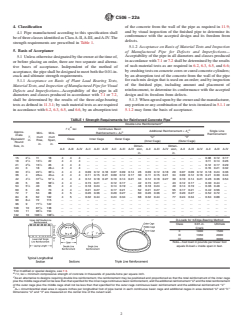
4.1 Pipe manufactured according to this specification shall be of three classes identified as Class A-II, A-III, and A-IV. The strength
requirements are prescribed in Table 1.
A
TABLE 1 Strength Requirements for Reinforced Concrete Pipe
C
Double Line Reinforcement
B
f 'c, ksi
Continuous Basic
D
Additional Reinforcement = A Single Line
Approx- D s
Reinforcement = A
Mini- Mini- s
Reinforcement
imate
T, mum mum
“U” “V”
Equivalent
Class Inner Cage Outer Cage
in. Rise, Span,
(Inner Cage) (Outer Cage)
Round
in. in.
Size, in. Dimen- Dimen-
A-II A-III A-IV A-II A-III A-IV A-II A-III A-IV sion, A-II A-III A-IV sion, A-II A-III A-IV A-II A-III A-IV
in. in.
15 2 ⁄4 11 18 4 4 4 . . . . . . . . . . . . . . 0.08 0.12 0.17
1 1
18 2 ⁄2 13 ⁄2 22 4 4 4 . . . . . . . . . . . . . . 0.11 0.14 0.26
3 1
21 2 ⁄8 15 ⁄2 26 4 4 4 . . . . . . . . . . . . . . 0.12 0.17 0.29
24 3 18 28 ⁄2 4 4 4 . . . . . . . . . . . . . . 0.16 0.21 0.32
1 1 1
30 3 ⁄2 22 ⁄2 36 ⁄4 4 4 4 0.09 0.12 0.18 0.07 0.09 0.14 26 0.09 0.12 0.18 29 0.07 0.09 0.12 0.18 0.24 0.36
5 3
36 4 26 ⁄8 43 ⁄8 4 4 4 0.11 0.15 0.21 0.09 0.12 0.17 30 0.11 0.15 0.21 34 0.09 0.12 0.16 0.21 0.30 0.44
1 5 1
42 4 ⁄2 31 ⁄16 51 ⁄8 4 4 4 0.12 0.18 0.27 0.10 0.14 0.21 34 0.12 0.18 0.27 39 0.10 0.14 0.21 0.26 0.36 0.54
48 5 36 58 ⁄2 4 4 . 0.15 0.21 . 0.12 0.17 . 42 0.15 0.21 . 43 0.12 0.17 . 0.30 0.44 .
54 5 ⁄2 40 65 4 4 . 0.18 0.24 . 0.14 0.19 . 48 0.18 0.24 . 49 0.14 0.19 . 0.36 0.48 .
60 6 45 73 4 4 . 0.21 0.27 . 0.17 0.21 . 52 0.21 0.27 . 55 0.17 0.21 . 0.42 0.56 .
72 7 54 88 4 5 . 0.26 0.36 . 0.20 0.27 . 60 0.26 0.36 . 67 0.20 0.27 . 0.52 0.72 .
84 8 62 102 4 5 . 0.32 0.44 . 0.24 0.34 . 68 0.32 0.44 . 77 0.24 0.34 . 0.64 0.88 .
90 8 ⁄2 72 115 . . . . . . . . . . . . . . . . . . . .
96 9 77 ⁄2 122 . . . . . . . . . . . . . . . . . . . .
108 10 87 ⁄8 138 . . . . . . . . . . . . . . . . . . . .
120 11 96 ⁄8 154 . . . . . . . . . . . . . . . . . . . .
1 3
132 10 106 ⁄2 168 ⁄4 . . . . . . . . . . . . . . . . . . . .
D-Loads for 3-Edge-Bearing Method
Class 0.01-in. Ultimate
Crack
II 1000 1500
III 1350 2000
IV 2000 3000
Note—Test load in pounds per linear foot
equals D-load × inside span in feet.
A
For modified or special designs, see 7.3.
B
f 'c, ksi = minimum compressive strength of concrete in thousands of pounds-force per square inch.
C
As an alternative to designs requiring double line reinforcement, the reinforcement may be positioned and proportioned so that the total reinforcement of the inner cage
plus the middle cage shall not be less than that specified for the inner cage continuous basic reinforcement, and the additional reinforcement “U” and the total reinforcement
of the outer cage plus the middle cage shall not be less than that specified for the outer cage continuous basic reinforcement and the additional reinforcement “V.”
D
A = circumferential steel area in square inches per longitudinal foot of pipe barrel in each continuous basic cage and additional cages in area denoted “U” and “V.”
s
Dimensions “U” and “V” are measured on the center line of the culvert wall.
The last approved version of this historical standard is referenced on www.astm.org.
C506 − 22a
5. Basis of Acceptance
5.1 Unless otherwise designated by the owner at the time of, or before placing an order, there are two separate and alternative bases
of acceptance. Independent of the method of acceptance, the pipe shall be designed to meet both the 0.01-in. crack and ultimate
strength requirements.
5.1.1 Acceptance on Basis of Plant Load Bearing Tests, Material Tests, and Inspection of Manufactured Pipe for Visual Defects
and Imperfections—Acceptability of the pipe in all diameters and classes produced in accordance with 7.1 or 7.2, shall be
determined by the results of the three-edge-bearing tests as defined in 11.3.1; by such material tests as are required in accordance
with 6.2, 6.3, 6.5, and 6.6, by an absorption test of the concrete from the wall of the pipe as required in 11.9; and by visual
inspection of the finished pipe to determine its conformance with the accepted design and its freedom from defects.
5.1.2 Acceptance on Basis of Material Tests and Inspection of Manufactured Pipe for Defects and Imperfections—Acceptability
of the pipe in all diameters and classes produced in accordance with 7.1 or 7.2 shall be determined by the results of such material
tests as are required in 6.2, 6.3, 6.5, and 6.6; by crushing tests on concrete cores or cured concrete cylinders; by an absorption test
of the concrete from the wall of the pipe for each mix design that is used on an order; and by inspection of the finished pipe,
including amount and placement of reinforcement, to determine its conformance with the accepted design and its freedom from
defects.
5.1.3 When agreed upon by the owner and the manufacturer, any portion or any combination of the tests itemized in 5.1.1 or 5.1.2
may form the basis of acceptance.
5.2 Age for Acceptance—Pipe shall be considered ready for acceptance when they conform to the requirements as indicated by
the specified tests.
6. Materials
6.1 Reinforced Concrete—The reinforced concrete shall consist of cementitious materials; mineral aggregates; admixtures, if used;
and water in which steel has been embedded in such a manner that the steel and concrete act together.
6.2 Cementitious Materials:
6.2.1 Cement—Cement shall conform to the requirements for portland cement of Specification C150/C150M, or shall be portland
blast-furnace slag cement, portland-limestone cement, or portland-pozzolan cement conforming to the requirements of
Specification C595/C595M, except that the pozzolan constituent in the Type IP portland-pozzolan cement shall be fly ash.
6.2.2 Slag Cement—Slag cement shall conform to the requirements of Grade 100 or 120 of Specification C989/C989M.
6.2.3 Fly Ash—Fly ash shall conform to the requirements of Class F or Class C of Specification C618.
6.2.4 Allowable Combinations of Cementitious Materials—The combination of cementitious materials used in the concrete shall
be one of the following:
6.2.4.1 Portland cement only,
6.2.4.2 Portland blast-furnace slag cement only,
6.2.4.3 Portland-pozzolan cement only,
6.2.4.4 Portland-limestone cement only,
6.2.4.5 A combination of portland cement or portland-limestone cement and slag cement,
6.2.4.6 A combination of portland cement or portland-limestone cement and fly ash,
6.2.4.7 A combination of portland cement or portland-limestone cement, slag cement, and fly ash, or
C506 − 22a
6.2.4.8 A combination of portland-pozzolan cement and fly ash.
6.3 Aggregates—Aggregates shall conform to the requirements of Specification C33/C33M except that the requirement for
gradation shall not apply.
6.4 Admixtures—The following admixtures and blends are allowable:
6.4.1 Air-entraining admixture conforming to Specification C260/C260M;
6.4.2 Chemical admixture conforming to Specification C494/C494M;
6.4.3 Chemical admixture for use in producing flowing concrete conforming to Specification C1017/C1017M; and
6.4.4 Chemical admixture or blend approved by the owner.
6.5 Steel Reinforcement—Reinforcement shall consist of wire or welded wire conforming to Specification A1064/A1064M, or of
bars conforming to Specification A36/A36M, Specification A615/A615M Grade 40 or 60, or Specification A706/A706M Grade
60. For helically wound cages only, weld shear tests are not required.
6.6 Fibers—Synthetic fibers and nonsynthetic fibers shall be allowed to be used, at the manufacturer’s option, in concrete pipe as
a nonstructural manufacturing material. Synthetic fibers (Type II and Type III) and nonsynthetic fiber (Type I) designed and
manufactured specifically for use in concrete and conforming to the requirements of Specification C1116/C1116M shall be
accepted.
6.7 Water—Water used in the production of concrete shall be potable or nonpotable water that meets the requirements of
Specification C1602/C1602M.
7. Design
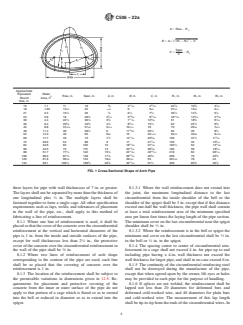
7.1 Size and Dimensions—The standard sizes of arch pipe are listed in Table 1. The internal dimensions for each standard size shall
be as defined in Fig. 1, subject to the permissible variations of Section 12.
7.2 Design Tables—The wall thickness, compressive strength of concrete, and the area of circumferential reinforcement shall be
as prescribed in Table 1, subject to the provisions of 7.3 and Sections 11 and 12.
7.2.1 Footnotes to the tables herein are intended to be amplifications of the tabulated requirements and are to be considered
applicable and binding as if they were contained in the body of the specification.
7.3 Modified and Special Designs:
7.3.1 If permitted by the owner, the manufacturer may request approval by the owner of modified designs that differ from the
designs in this Section 7 or special designs for sizes and loads beyond those shown in Table 1, or special designs for pipe sizes
that do not have steel reinforcement areas shown in Table 1.
7.3.2 Such modified or special designs shall be based on rational or empirical evaluations of the ultimate strength and cracking
behavior of pipe and shall fully describe to the owner any deviations from the requirements of this Section 7. The descriptions of
modified or special designs shall include the wall thickness, the concrete strength, and the area, type, placement, number of layers,
and strength of the steel reinforcement.
7.3.3 The manufacturer shall submit to the owner proof of the adequacy of the proposed modified or special design. Such proof
may comprise the submission of certified three-edge-bearing tests already made, which are acceptable to the owner or, if such
three-edge-bearing tests are not available or acceptable, the manufacturer may be required to perform proof tests on sizes and
classes selected by the owner to demonstrate the adequacy of the proposed design.
7.3.4 Such pipe must meet all of the test and performance requirements specified by the owner in accordance with Section 5.
C506 − 22a
A 5Rise 2R
2 2
B 5A1 sR 2R d 2C
œ 2 3
Span
C 5 2R
Approximate
Equivalent Water
Rise, in. Span, in. A, in. B, in. C, in. R , in. R , in. R , in.
2 1 2 3
Round Area, ft
Size, in.
3 11 31 7 5 1
15 1.1 11 18 ⁄8 4 ⁄16 4 ⁄32 22 ⁄8 10 ⁄8 4 ⁄32
1 1 3 1 3 1
18 1.65 13 ⁄2 22 − ⁄4 6 5 ⁄4 27 ⁄2 13 ⁄4 5 ⁄4
1 3 1 3 1 3 1
21 2.2 15 ⁄2 26 ⁄4 6 ⁄4 7 ⁄4 35 ⁄2 14 ⁄4 5 ⁄4
1 7 29 21 11 9 19
24 2.8 18 28 ⁄2 3 ⁄16 5 ⁄32 9 ⁄32 40 ⁄16 14 ⁄16 4 ⁄32
1 1 3 11 3 3 1
30 4.4 22 ⁄2 36 ⁄4 3 ⁄4 7 ⁄16 12 ⁄32 51 18 ⁄4 6 ⁄32
5 3 1 9 1 1 3
36 6.4 26 ⁄8 43 ⁄4 4 ⁄8 8 ⁄16 15 ⁄2 62 22 ⁄2 6 ⁄8
5 1 1 1 1 9
42 8.8 31 ⁄16 51 ⁄8 5 ⁄16 10 ⁄16 18 73 26 ⁄4 7 ⁄16
1 19 1 3
48 11.4 36 58 ⁄2 6 11 ⁄32 20 ⁄2 84 30 8 ⁄4
5 11 1 3 13
54 14.3 40 65 6 ⁄8 13 22 ⁄16 92 ⁄2 33 ⁄8 9 ⁄16
1 11 9 1 7
60 17.7 45 73 7 ⁄2 14 ⁄16 25 ⁄32 105 37 ⁄2 11 ⁄32
7 9
72 25.6 54 88 9 17 31 ⁄16 126 45 12 ⁄16
21 1 1 31
84 34.6 62 102 10 18 ⁄32 37 ⁄32 162 ⁄2 52 13 ⁄32
13 7 9
90 44.5 72 115 13 23 ⁄16 38 ⁄32 183 59 19 ⁄32
1 1 11 15 1
96 51.7 77 ⁄4 122 15 ⁄4 24 ⁄32 40 ⁄16 218 62 20 ⁄16
1 1 27 5 3
108 66.0 87 ⁄8 138 17 ⁄8 26 ⁄32 46 ⁄8 269 70 22 ⁄8
7 7 7 3
120 81.8 96 ⁄8 154 18 ⁄8 29 ⁄32 53 301 ⁄8 78 24
1 3 7 15 1 5 7
132 99.1 106 ⁄2 168 ⁄4 20 ⁄8 32 ⁄16 57 ⁄2 329 85 ⁄8 26 ⁄8
FIG. 1 Cross-Sectional Shape of Arch Pipe
7.4 Area—In this specification, when the word area is not described by adjectives, such as cross-section or single wire, it shall be
understood to be the cross-sectional area of reinforcement per unit lengths of pipe.
8. Reinforcement
8.1 Circumferential Reinforcement—A line of circumferential reinforcement for any given total area may be composed of two
layers for pipe with wall thicknesses of less than 7 in. or three layers for pipe with wall thicknesses of 7 in. or greater. The layers
shall not be separated by more than the thickness of one longitudinal plus ⁄4 in. The multiple layers shall be fastened together to
form a single cage. All other specification requirements such as laps, welds, and tolerances of placement in the wall of the pipe,
etc., shall apply to this method of fabricating a line of reinforcement.
8.1.1 Where one line of reinforcement is used, it shall be placed so that the cover of the concrete over the circumferential
reinforcement at the vertical and horizontal diameters of the pipe is 1 in. from the inside and outside surfaces of the pipe, except
for wall thicknesses less than 2 ⁄2 in., the protective cover of the concrete over the circumferential reinforcement in the wall of the
pipe shall be ⁄8 in.
8.1.2 Where two lines of reinforcement of arch shape corresponding to the contour of the pipe are used, each line shall be so placed
that the covering of concrete over the reinforcement is 1 in.
8.1.3 The location of the reinforcement shall be subject to the permissible variations in dimensions given in 12.5. Requirements
for placement and protective covering of the concrete from the inner or outer surface of the pipe do not apply to that portion of
a cage which is flared so as to extend into the bell or reduced in diameter so as to extend into the spigot.
8.1.3.1 Where the wall reinforcement does not extend into the joint, the maximum longitudinal distance to the last circumferential
from the inside shoulder of the bell or the shoulder of the spigot shall be 3 in. except that if this distance exceed one-half the wall
C506 − 22a
thickness, the pipe wall shall contain at least a total reinforcement area of the minimum specified area per linear foot times the
laying length of the pipe section. The minimum cover on the last circumferential near the spigot shoulder shall be ⁄2 in.
8.1.3.2 Where the reinforcement is in the bell or spigot the minimum end cover on the last circumferential shall be ⁄2 in. in the
bell or ⁄4 in. in the spigot.
8.1.4 The spacing center to center of circumferential reinforcement in a cage shall not exceed 4 in. for pipe up to and including
pipe having a 4-in. wall thickness nor exceed the wall thickness for larger pipe, and shall in no case exceed 6 in.
8.1.5 The continuity of the circumferential reinforcing steel shall not be destroyed during the manufacture of the pipe, except that
when agreed upon by the owner, lift eyes or holes may be provided in each pipe for the purpose of handling.
8.1.6 If splices are not welded, the reinforcement shall be lapped not less than 20 diameters for deformed bars and deformed
cold-worked wire, and 40 diameters for plain bars and cold-worked wire. The measurement of this lap length shall be tip-to-tip
from the ends of the circumferential wires. In addition, where lapped cages of welded wire reinforcement are used without welding,
the lap shall contain a
...