

ASTM C1675-22
(Practice)Standard Practice for Installation of Precast Reinforced Concrete Monolithic Box Sections for Culverts, Storm Drains, and Sewers
General Information
- Abstract
SIGNIFICANCE AND USE
4.1 This practice is useful as a reference by an owner and the owner’s engineer in preparing project specifications.
SCOPE
1.1 This practice covers the installation of precast reinforced concrete box sections cast monolithically and intended to be used for the conveyance of storm water, industrial wastes and sewage, and for passageways.
1.2 The values stated in inch-pound units are to be regarded as standard. The values given in parentheses are mathematical conversions to SI units that are provided for information only and are not considered standard.
1.3 This international standard was developed in accordance with internationally recognized principles on standardization established in the Decision on Principles for the Development of International Standards, Guides and Recommendations issued by the World Trade Organization Technical Barriers to Trade (TBT) Committee.
- Status
- Published
- Publication Date
- 30-Sep-2022
- Technical Committee
- C13 - Concrete Pipe
- Drafting Committee
- C13.05 - Special Projects
Buy Documents
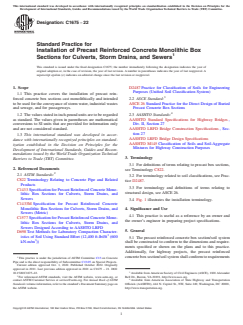
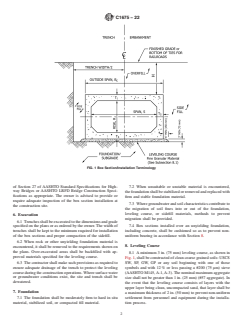
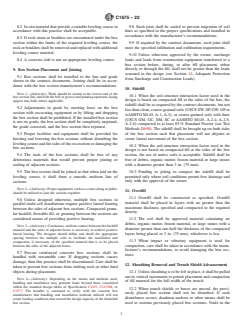

ASTM C1675-22 - Standard Practice for Installation of Precast Reinforced Concrete Monolithic Box Sections for Culverts, Storm Drains, and Sewers
REDLINE ASTM C1675-22 - Standard Practice for Installation of Precast Reinforced Concrete Monolithic Box Sections for Culverts, Storm Drains, and Sewers
Overview
ASTM C1675-22: Standard Practice for Installation of Precast Reinforced Concrete Monolithic Box Sections for Culverts, Storm Drains, and Sewers provides guidelines for the proper installation of precast reinforced concrete box sections cast as a monolithic unit. These box sections are widely used for conveyance of stormwater, industrial waste, and sewage, as well as for passageways. The standard, developed by ASTM International, serves as a valuable reference for owners, engineers, and contractors when preparing project specifications and ensuring industry best practices in construction.
Key Topics
- Scope and Applicability: This practice applies to the installation of precast reinforced concrete box sections intended for stormwater, sewage, industrial waste, and passageways.
- Units of Measurement: Inch-pound units are standard, with SI units provided for reference.
- Terminology: Definitions related to concrete box sections, soil classifications, and structural design are provided or referenced.
- Installation Requirements:
- Excavation: Trenches should be excavated to required dimensions and grades, with careful management of groundwater and over-excavation.
- Foundations: Stable, firm, and suitable foundation material is essential. Unstable material must be managed or replaced.
- Leveling Course: Specification for suitable leveling material and its preparation to support box sections.
- Box Placement and Joining: Procedures for handling, alignment, joining, and sealing of box sections to ensure structural integrity and prevent infiltration.
- Sidefill and Overfill: Guidance on the selection, placement, and compaction of sidefill and overfill materials to maintain structural performance.
- Appurtenances: Installation methods for manholes, junction boxes, and fittings to minimize settlement and ensure compatibility with box sections.
- Construction Loads and Safety: Protection measures against excess loads during construction and adherence to safety regulations are emphasized.
Applications
ASTM C1675-22 is widely used in infrastructure projects where precast concrete box culverts or storm drain systems are required. Typical applications include:
- Road and Highway Construction: Ensures proper installation of culverts and drainage structures under roadways.
- Municipal Stormwater Management: Used for installation of storm drains and sewers to handle surface and subsurface water conveyance.
- Industrial and Residential Developments: Supports the installation of large-scale drainage and sewage systems in new developments or upgrade projects.
- Utility Tunnels and Passageways: Provides guidance for constructing underground passageways with precast box sections.
- Bridge and Embankment Support: Aligns with AASHTO specifications for box systems in bridge approaches and embankment installations.
By following ASTM C1675-22, project stakeholders can ensure that installations achieve required safety, durability, and performance standards, reducing long-term maintenance costs and risks of system failure.
Related Standards
Several related standards and specifications support and complement the requirements of ASTM C1675-22, including:
- ASTM C1433 / C1433M: Specifications for precast reinforced concrete monolithic box sections.
- ASTM C1577: Precast box sections designed according to AASHTO LRFD.
- ASTM D698: Test methods for compaction characteristics of soil.
- ASTM D2487: Classification of soils for engineering purposes.
- ASCE 26: Standard practice for the direct design of buried precast concrete box sections.
- AASHTO Standards: Including Bridge Construction and Design Specifications and soil classification standards.
Practical Value
Adhering to ASTM C1675-22 helps ensure compliance with international construction practices for precast concrete culverts, drain systems, and sewers, promotes effective project planning, and minimizes construction errors. Its comprehensive guidelines cover crucial aspects such as proper materials selection, foundation preparation, installation procedures, and load management, making it an indispensable resource for civil engineers and contractors involved in underground infrastructure projects.
Relations
- Effective Date
- 15-Jul-2019
- Effective Date
- 01-Apr-2019
- Effective Date
- 15-Sep-2018
- Effective Date
- 01-Jan-2018
- Effective Date
- 01-Jan-2018
- Effective Date
- 15-Dec-2017
- Effective Date
- 15-Dec-2017
- Effective Date
- 01-Jan-2017
- Effective Date
- 01-Nov-2016
- Effective Date
- 01-Nov-2016
- Effective Date
- 01-Feb-2016
- Effective Date
- 01-Feb-2016
- Effective Date
- 01-Feb-2016
- Effective Date
- 15-Jan-2016
- Effective Date
- 15-Jan-2016
Buy Documents
ASTM C1675-22 - Standard Practice for Installation of Precast Reinforced Concrete Monolithic Box Sections for Culverts, Storm Drains, and Sewers
REDLINE ASTM C1675-22 - Standard Practice for Installation of Precast Reinforced Concrete Monolithic Box Sections for Culverts, Storm Drains, and Sewers
Get Certified
Connect with accredited certification bodies for this standard

Institut za varilstvo d.o.o. (Welding Institute)
Slovenia's leading welding institute since 1952. ISO 3834, EN 1090, pressure equipment certification, NDT personnel, welder qualification. Only IIW Au
Sponsored listings
Frequently Asked Questions
ASTM C1675-22 is a standard published by ASTM International. Its full title is "Standard Practice for Installation of Precast Reinforced Concrete Monolithic Box Sections for Culverts, Storm Drains, and Sewers". This standard covers: SIGNIFICANCE AND USE 4.1 This practice is useful as a reference by an owner and the owner’s engineer in preparing project specifications. SCOPE 1.1 This practice covers the installation of precast reinforced concrete box sections cast monolithically and intended to be used for the conveyance of storm water, industrial wastes and sewage, and for passageways. 1.2 The values stated in inch-pound units are to be regarded as standard. The values given in parentheses are mathematical conversions to SI units that are provided for information only and are not considered standard. 1.3 This international standard was developed in accordance with internationally recognized principles on standardization established in the Decision on Principles for the Development of International Standards, Guides and Recommendations issued by the World Trade Organization Technical Barriers to Trade (TBT) Committee.
SIGNIFICANCE AND USE 4.1 This practice is useful as a reference by an owner and the owner’s engineer in preparing project specifications. SCOPE 1.1 This practice covers the installation of precast reinforced concrete box sections cast monolithically and intended to be used for the conveyance of storm water, industrial wastes and sewage, and for passageways. 1.2 The values stated in inch-pound units are to be regarded as standard. The values given in parentheses are mathematical conversions to SI units that are provided for information only and are not considered standard. 1.3 This international standard was developed in accordance with internationally recognized principles on standardization established in the Decision on Principles for the Development of International Standards, Guides and Recommendations issued by the World Trade Organization Technical Barriers to Trade (TBT) Committee.
ASTM C1675-22 is classified under the following ICS (International Classification for Standards) categories: 23.040.50 - Pipes and fittings of other materials. The ICS classification helps identify the subject area and facilitates finding related standards.
ASTM C1675-22 has the following relationships with other standards: It is inter standard links to ASTM C1577-19a, ASTM C1577-19, ASTM C1577-18, ASTM C822-18, ASTM C1433M-18, ASTM D2487-17, ASTM D2487-17e1, ASTM C1577-17, ASTM C1433-16b, ASTM C1433M-16b, ASTM C1433M-16a, ASTM C1433-16a, ASTM C1577-16, ASTM C1433M-16, ASTM C1433-16. Understanding these relationships helps ensure you are using the most current and applicable version of the standard.
ASTM C1675-22 is available in PDF format for immediate download after purchase. The document can be added to your cart and obtained through the secure checkout process. Digital delivery ensures instant access to the complete standard document.
Standards Content (Sample)
This international standard was developed in accordance with internationally recognized principles on standardization established in the Decision on Principles for the
Development of International Standards, Guides and Recommendations issued by the World Trade Organization Technical Barriers to Trade (TBT) Committee.
Designation: C1675 − 22
Standard Practice for
Installation of Precast Reinforced Concrete Monolithic Box
Sections for Culverts, Storm Drains, and Sewers
This standard is issued under the fixed designation C1675; the number immediately following the designation indicates the year of
original adoption or, in the case of revision, the year of last revision. A number in parentheses indicates the year of last reapproval. A
superscript epsilon (´) indicates an editorial change since the last revision or reapproval.
1. Scope D2487 Practice for Classification of Soils for Engineering
Purposes (Unified Soil Classification System)
1.1 This practice covers the installation of precast rein-
forced concrete box sections cast monolithically and intended 2.2 ASCE Standard:
to be used for the conveyance of storm water, industrial wastes ASCE 26 Standard Practice for the Direct Design of Buried
and sewage, and for passageways. Precast Concrete Box Sections
1.2 The values stated in inch-pound units are to be regarded 2.3 AASHTO Standards:
as standard. The values given in parentheses are mathematical AASHTO Standard Specifications for Highway Bridges ,
conversions to SI units that are provided for information only Div. II, Section 27
and are not considered standard. AASHTO LRFD Bridge Construction Specifications , Sec-
tion 27
1.3 This international standard was developed in accor-
AASHTO LRFD Bridge Design Specifications
dance with internationally recognized principles on standard-
AASHTO M145 Classification of Soils and Soil-Aggregate
ization established in the Decision on Principles for the
Mixtures for Highway Construction Purposes
Development of International Standards, Guides and Recom-
mendations issued by the World Trade Organization Technical
3. Terminology
Barriers to Trade (TBT) Committee.
3.1 For definitions of terms relating to precast box sections,
2. Referenced Documents
see Terminology C822.
2.1 ASTM Standards:
3.2 For terminology related to soil classifications, see Prac-
C822 Terminology Relating to Concrete Pipe and Related
tice D2487.
Products
3.3 For terminology and definitions of terms relating to
C1433 Specification for Precast Reinforced Concrete Mono-
structural design, see ASCE 26.
lithic Box Sections for Culverts, Storm Drains, and
Sewers
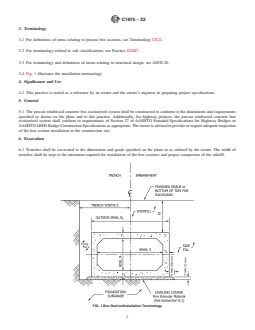
3.4 Fig. 1 illustrates the installation terminology.
C1433M Specification for Precast Reinforced Concrete
Monolithic Box Sections for Culverts, Storm Drains, and
4. Significance and Use
Sewers (Metric)
4.1 This practice is useful as a reference by an owner and
C1577 Specification for Precast Reinforced Concrete Mono-
the owner’s engineer in preparing project specifications.
lithic Box Sections for Culverts, Storm Drains, and
Sewers Designed According to AASHTO LRFD
5. General
D698 Test Methods for Laboratory Compaction Character-
istics of Soil Using Standard Effort (12,400 ft-lbf/ft (600
5.1 The precast reinforced concrete box section/soil system
kN-m/m ))
shall be constructed to conform to the dimensions and require-
ments specified or shown on the plans and to this practice.
Additionally, for highway projects, the precast reinforced
concrete box section/soil system shall conform to requirements
This practice is under the jurisdiction of ASTM Committee C13 on Concrete
Pipe and is the direct responsibility of Subcommittee C13.05 on Special Projects.
Current edition approved Oct. 1, 2022. Published October 2022. Originally
approved in 2011. Last previous edition approved in 2021 as C1675 – 21. DOI:
10.1520/C1675–22. Available from American Society of Civil Engineers (ASCE), 1801 Alexander
For referenced ASTM standards, visit the ASTM website, www.astm.org, or Bell Dr., Reston, VA 20191, http://www.asce.org.
contact ASTM Customer Service at service@astm.org. For Annual Book of ASTM Available from American Association of State Highway and Transportation
Standards volume information, refer to the standard’s Document Summary page on Officials (AASHTO), 444 N. Capitol St., NW, Suite 249, Washington, DC 20001,
the ASTM website. http://www.transportation.org.
Copyright © ASTM International, 100 Barr Harbor Drive, PO Box C700, West Conshohocken, PA 19428-2959. United States
C1675 − 22
FIG. 1 Box Section/Installation Terminology
of Section 27 of AASHTO Standard Specifications for High- 7.2 When unsuitable or unstable material is encountered,
way Bridges or AASHTO LRFD Bridge Construction Speci-
thefoundationshallbestabilizedorremovedandreplacedwith
fications as appropriate. The owner is advised to provide or
firm and stable foundation material.
require adequate inspection of the box section installation at
7.3 Wheregroundwaterandsoilcharacteristicscontributeto
the construction site.
the migration of soil fines into or out of the foundation,
leveling course, or sidefill materials, methods to prevent
6. Excavation
migration shall be provided.
6.1 Trenchesshallbeexcavatedtothedimensionsandgrade
specified on the plans or as ordered by the owner.The width of 7.4 Box sections installed over an unyielding foundation,
trenches shall be kept to the minimum required for installation including concrete, shall be cushioned so as to prevent non-
of the box sections and proper compaction of the sidefill.
uniform bearing in accordance with Section 8.
6.2 When rock or other unyielding foundation material is
8. Leveling Course
encountered, it shall be removed to the requirements shown on
the plans. Over-excavated areas shall be backfilled with ap-
8.1 Aminimum 3 in. (75 mm) leveling course, as shown in
proved materials specified for the leveling course.
Fig.1,shallbeconstructedofcleancoarsegrainedsoils:USCS
6.3 Thecontractorshallmakesuchprovisionsasrequiredto SW, SP, GW, GP or any soil beginning with one of those
ensure adequate drainage of the trench to protect the leveling
symbols and with 12 % or less passing a #200 (75 µm) sieve
courseduringtheconstructionoperations.Wheresurfacewater
(AASHTOM145,A-1,A-3).Thenominalmaximumaggregate
or groundwater conditions exist, the site and trench shall be
size shall not be greater than 1 in. (25 mm) (#57 aggregate). In
dewatered.
the event that the leveling course consists of layers with the
upper layer being clean, uncompacted sand, that layer shall be
7. Foundation
a maximum thickness of 2 in. (50 mm) to prevent non-uniform
settlement from personnel and equipment during the installa-
7.1 The foundation shall be moderately firm to hard in situ
material, stabilized soil, or compacted fill material. tion process.
C1675 − 22
8.2 In situ material that provide a suitable leveling course in 9.8 Each joint shall be sealed to prevent migration of soil
accordance with this practice shall be acceptable. fines as specified in the project specifications and installed in
accordance with the manufacturer’s recommendations.
8.3 If rock strata or boulders are encountered under the box
section within the limits of the required leveling course, the 9.9 If required by the contract documents, each joint shall
rock or boulders shall be removed and replaced with additional meet the specified infiltration and exfiltration requirements.
leveling course material.
9.10 Unless otherwise approved by the owner, surcharge
8.4 A concrete slab is not an appropriate leveling course. loads and loads from construction equipment transferred to a
box section before, during, or after fill placement, either
9. Box Section Placement and Joining directly or through the fill, shall not be greater than the loads
assumed in the design (see Section 14, Adequate Protection
9.1 Box sections shall be installed to the line and grade
from Surcharge and Construction Loads).
shown in the contract documents. Joining shall be in accor-
dance with the box section manufacturer’s recommendations.
10. Sidefill
NOTE 1—(Advisory): Work should be started at the lowest end of the
10.1 When the soil-structure interaction factor used in the
boxsectionline,andwiththebellorgrooveendpointingupstream,laying
design is based on compacted fill at the sides of the box, the
spigots into bells where applicable.
sidefill shall be as required by the contract documents, but not
9.2 Adjustments in grade by exerting force on the box
lessthanclean,coarse-grainedsoils(USCSSW,SP,GW,GPor
section with excavating equipment or by lifting and dropping
AASHTO M145, A-1, A-3), or coarse-grained soils with fines
the box section shall be prohibited. If the installed box section
(USCS GM, GC, SM
...
This document is not an ASTM standard and is intended only to provide the user of an ASTM standard an indication of what changes have been made to the previous version. Because
it may not be technically possible to adequately depict all changes accurately, ASTM recommends that users consult prior editions as appropriate. In all cases only the current version
of the standard as published by ASTM is to be considered the official document.
Designation: C1675 − 21 C1675 − 22
Standard Practice for
Installation of Precast Reinforced Concrete Monolithic Box
Sections for Culverts, Storm Drains, and Sewers
This standard is issued under the fixed designation C1675; the number immediately following the designation indicates the year of
original adoption or, in the case of revision, the year of last revision. A number in parentheses indicates the year of last reapproval. A
superscript epsilon (´) indicates an editorial change since the last revision or reapproval.
1. Scope
1.1 This practice covers the installation of precast reinforced concrete box sections cast monolithically and intended to be used
for the conveyance of storm water, industrial wastes and sewage, and for passageways.
1.2 The values stated in inch-pound units are to be regarded as standard. The values given in parentheses are mathematical
conversions to SI units that are provided for information only and are not considered standard.
1.3 This international standard was developed in accordance with internationally recognized principles on standardization
established in the Decision on Principles for the Development of International Standards, Guides and Recommendations issued
by the World Trade Organization Technical Barriers to Trade (TBT) Committee.
2. Referenced Documents
2.1 ASTM Standards:
C822 Terminology Relating to Concrete Pipe and Related Products
C1433 Specification for Precast Reinforced Concrete Monolithic Box Sections for Culverts, Storm Drains, and Sewers
C1433M Specification for Precast Reinforced Concrete Monolithic Box Sections for Culverts, Storm Drains, and Sewers
(Metric)
C1577 Specification for Precast Reinforced Concrete Monolithic Box Sections for Culverts, Storm Drains, and Sewers Designed
According to AASHTO LRFD
3 3
D698 Test Methods for Laboratory Compaction Characteristics of Soil Using Standard Effort (12,400 ft-lbf/ft (600 kN-m/m ))
D2487 Practice for Classification of Soils for Engineering Purposes (Unified Soil Classification System)
2.2 ASCE Standard:
ASCE 26 Standard Practice for the Direct Design of Buried Precast Concrete Box Sections
2.3 AASHTO Standards:
AASHTO Standard Specifications for Highway Bridges , Div. II, Section 27
AASHTO LRFD Bridge Construction Specifications , Section 27
AASHTO LRFD Bridge Design Specifications
AASHTO M145 Classification of Soils and Soil-Aggregate Mixtures for Highway Construction Purposes
This practice is under the jurisdiction of ASTM Committee C13 on Concrete Pipe and is the direct responsibility of Subcommittee C13.05 on Special Projects.
Current edition approved Jan. 1, 2021Oct. 1, 2022. Published January 2021October 2022. Originally approved in 2011. Last previous edition approved in 20192021 as
C1675 – 19.21. DOI: 10.1520/C1675–21.10.1520/C1675–22.
For referenced ASTM standards, visit the ASTM website, www.astm.org, or contact ASTM Customer Service at service@astm.org. For Annual Book of ASTM Standards
volume information, refer to the standard’s Document Summary page on the ASTM website.
Available from American Society of Civil Engineers (ASCE), 1801 Alexander Bell Dr., Reston, VA 20191, http://www.asce.org.
Available from American Association of State Highway and Transportation Officials (AASHTO), 444 N. Capitol St., NW, Suite 249, Washington, DC 20001,
http://www.transportation.org.
Copyright © ASTM International, 100 Barr Harbor Drive, PO Box C700, West Conshohocken, PA 19428-2959. United States
C1675 − 22
3. Terminology
3.1 For definitions of terms relating to precast box sections, see Terminology C822.
3.2 For terminology related to soil classifications, see Practice D2487.
3.3 For terminology and definitions of terms relating to structural design, see ASCE 26.
3.4 Fig. 1 illustrates the installation terminology.
4. Significance and Use
4.1 This practice is useful as a reference by an owner and the owner’s engineer in preparing project specifications.
5. General
5.1 The precast reinforced concrete box section/soil system shall be constructed to conform to the dimensions and requirements
specified or shown on the plans and to this practice. Additionally, for highway projects, the precast reinforced concrete box
section/soil system shall conform to requirements of Section 27 of AASHTO Standard Specifications for Highway Bridges or
AASHTO LRFD Bridge Construction Specifications as appropriate. The owner is advised to provide or require adequate inspection
of the box section installation at the construction site.
6. Excavation
6.1 Trenches shall be excavated to the dimensions and grade specified on the plans or as ordered by the owner. The width of
trenches shall be kept to the minimum required for installation of the box sections and proper compaction of the sidefill.
FIG. 1 Box Section/Installation Terminology
C1675 − 22
6.2 When ledge rock, compacted rocky, rock or other unyielding foundation material is encountered, it shall be removed to the
requirements shown on the plans. Over-excavated areas shall be backfilled with approved materials specified for the leveling
course.
6.3 The contractor shall make such provisions as required to ensure adequate drainage of the trench to protect the leveling course
during the construction operations. Where surface water or groundwater conditions exist, the site and trench shall be dewatered.
7. Foundation
7.1 The foundation shall be moderately firm to hard in situ material, stabilized soil, or compacted fill material.
7.2 When unsuitable or unstable material is encountered, the foundation shall be stabilized or removed and replaced with firm and
stable foundation material.
7.3 Where groundwater and soil characteristics contribute to the migration of soil fines into or out of the foundation, leveling
course, or overfillsidefill materials, methods to prevent migration shall be provided.
7.4 Box sections installed over an unyielding foundation, including concrete, shall be cushioned so as to prevent non-uniform
bearing in accordance with Section 8.
8. Leveling Course
8.1 A minimum 3 in. (75 mm) leveling course, as shown in Fig. 1, shall be constructed of clean coarse grained soils: USCS SW,
SP, GW, GP or any soil beginning with one of those symbols and with 12 % or less passing a #200 (75 μm) sieve (AASHTO M145,
A-1, A-3). The nominal maximum aggregate size shall not be greater than 1 in. (25 mm) (#57 aggregate). In the event that the
leveling course consists of layers with the upper layer being clean, uncompacted sand, that layer shall be a maximum thickness
of 2 in. (50 mm) to prevent non-uniform settlement from personnel and equipment during the installation process.
8.2 In situ material that provide a suitable leveling course in accordance with this practice shall be acceptable.
8.3 If rock strata or boulders are encountered under the box section within the limits of the required leveling course, the rock or
boulders shall be removed and replaced with additional leveling course material.
8.4 A concrete slab is not an appropriate leveling course.
9. Box Section Placement and Joining
9.1 Box sections shall be installed to the line and grade shown in the contract documents. Joining shall be in accordance with the
box section manufacturer’s recommendations.
NOTE 1—(Advisory): Work should be started at the lowest end of the box section line, and with the bell or groove end pointing upstream, laying spigots
into bells where applicable.
9.2 Adjustments in grade by exerting force on the box section with excavating equipment or by lifting and dropping the box
section shall be prohibited. If the installed box section is not on grade, the box section shall be completely unjoined, the grade
corrected, and the box section then rejoined.
9.3 Proper facilities and equipment shall be provided for hoisting and lowering the box sections without disturbing the leveling
course and the sides of the excavation or damaging the box sections.
9.4 The ends of the box sections shall be free of any deleterious materials that would prevent proper joining or sealing of adjacent
sections.
9.5 The box section shall be joined so that when laid on the leveling course, it shall form a smooth, uniform line of sections.
C1675 − 22
NOTE 2—(Advisory): Proper equipment, such as a come-along or puller, should be utilized to join the sections together.
9.6 Unless designed otherwise, multiple box sections in parallel multi-cell installations require positive lateral bearing between
the sides of adjacent box
...