

ASTM C990/C990M-24
(Specification)Standard Specification for Joints for Concrete Pipe, Manholes, and Precast Box Sections Using Preformed Flexible Joint Sealants
General Information
- Abstract
ABSTRACT
This specification covers joints for precast concrete pipe and box and other sections using preformed flexible joint sealants for use in storm sewers and culverts which are not intended to operate under internal pressure, or are not subject to infiltration or exfiltration limits. Joint material used in horizontal applications is intended to prevent the flow of solids through the joint. The acceptability of the pipe joint and sealant shall be determined by the results of the physical tests prescribed. Bitumen sealants shall be produced from asphalts, hydrocarbon resins and plasticizing compounds reinforced with inert mineral filler and shall contain no solvents. Butyl rubber sealants shall be produced from blends of butyl rubber and refined hydrocarbon resins and plasticizing compounds reinforced with inert mineral filler and shall contain no solvents. The joint design shall consist of a bell or groove on one end of the section and a spigot or tongue on the adjacent end of the joining section. The different test methods for the determination of the composition and physical properties of bitumen or butyl sealants are presented in details. The sections shall be tested hydrostatically in vertical alignment and a sufficient number of sections shall be assembled in straight alignment.
SCOPE
1.1 This specification covers joints for precast concrete pipe and box, and other sections using preformed flexible joint sealants for use in storm sewers and culverts which are not intended to operate under internal pressure, or are not subject to infiltration or exfiltration limits. Joint material used in horizontal applications is intended to prevent the flow of solids through the joint.
1.2 For precast concrete manhole sections and other vertical structures, which are subject to internal or external pressure, infiltration or exfiltration limits are not prohibited from being specified. Joints in vertical structures covered by this specification are intended mainly to prevent the flow of solids or fluids through the joint.
1.3 This specification is to be used with pipe and structures conforming in all respects to Specifications C14, C14M, C76, C76M, C478/C478M, C506, C506M, C507, C507M, C655, C655M, C985, C985M, C1433, C1433M, C1504, C1504M, and C1577, provided that if there is a conflict in permissible variations in dimensions, the requirements of this specification shall govern.
1.4 The values stated in either inch pound or SI units are to be regarded separately as standard. The SI units are shown in brackets. The value stated in each system shall be used independently of the other. Combining values from the two systems may result in nonconformance with the standard.
Note 1: This specification covers the material and performance of the joint and sealant only. Infiltration and exfiltration quantities for installed sections are dependent on factors other than the joints which must be covered by other specifications and suitable testing of the installed pipeline.
1.5 This standard does not purport to address all of the safety concerns, if any, associated with its use. It is the responsibility of the user of this standard to establish appropriate safety, health, and environmental practices and determine the applicability of regulatory limitations prior to use.
1.6 This international standard was developed in accordance with internationally recognized principles on standardization established in the Decision on Principles for the Development of International Standards, Guides and Recommendations issued by the World Trade Organization Technical Barriers to Trade (TBT) Committee.
- Status
- Published
- Publication Date
- 14-Mar-2024
- Technical Committee
- C13 - Concrete Pipe
- Drafting Committee
- C13.08 - Joints for Precast Concrete Structures
Buy Documents

ASTM C990/C990M-24 - Standard Specification for Joints for Concrete Pipe, Manholes, and Precast Box Sections Using Preformed Flexible Joint Sealants
REDLINE ASTM C990/C990M-24 - Standard Specification for Joints for Concrete Pipe, Manholes, and Precast Box Sections Using Preformed Flexible Joint Sealants
Overview
ASTM C990/C990M-24 is the standard specification developed by ASTM International for joints for concrete pipe, manholes, and precast box sections using preformed flexible joint sealants. This specification defines the requirements for joint construction and sealant materials used primarily in storm sewers, culverts, and related precast concrete structures that are not subjected to internal pressure or infiltration/exfiltration limits. It ensures that the joints in precast concrete sections maintain integrity by preventing the flow of solids-and, in the case of vertical structures, fluids-through the joint. This standard is essential for achieving reliable joint performance and long-term durability in precast concrete pipeline applications.
Key Topics
Joint Design and Performance: The standard addresses joint configurations, including bell-and-spigot or groove-and-tongue designs. It specifies that the joint must use sealant as the sole means of achieving flexibility and water-tightness, with strict tolerances and suitability for specific precast structure sizes.
Types of Sealants:
- Bitumen Sealants: Produced from asphalts, hydrocarbon resins, and plasticizers, reinforced with inert mineral filler.
- Butyl Rubber Sealants: Manufactured from blends of butyl rubber with refined hydrocarbon resins and plasticizers, reinforced with inert mineral filler.
- Both types must be solvent-free and meet defined physical and chemical resistance requirements.
Material and Physical Requirements: The standard specifies detailed performance tests for sealants, including:
- Composition and chemical resistance
- Specific gravity
- Ductility
- Flash and fire points
- Compression index
- Penetration testing
Testing and Quality Assurance: Joint assemblies are subject to hydrostatic testing to verify performance, with no visible leakage allowed at a specified test pressure. Batch material testing and certified test reports are required to demonstrate compliance.
Dimensional Tolerances: The standard defines permissible variations in joint and sealant dimensions to ensure consistent field performance.
Applications
ASTM C990/C990M-24 provides critical guidance for:
- Storm Sewer and Culvert Construction: Ensuring durable, flexible joints that prevent soil and solid migration into the system.
- Precast Concrete Pipe Networks: Used by manufacturers and contractors to comply with municipal and state infrastructure requirements.
- Concrete Manholes and Box Sections: Applicable to vertical and horizontal structures except where internal/external pressure or infiltration/exfiltration limits are a primary concern.
- Quality Control: Employed by testing laboratories and project owners for specification compliance, defect identification, and acceptance or rejection of precast sections.
- Infrastructure Longevity: Supporting the design and installation of stormwater and culvert systems with robust, low-maintenance joints.
Related Standards
ASTM C990/C990M-24 references several related ASTM standards for precast concrete products and joint testing, including:
- ASTM C14/C14M: Nonreinforced concrete sewer and storm drain pipe
- ASTM C76/C76M: Reinforced concrete culvert, storm drain, and sewer pipe
- ASTM C478/C478M: Circular precast concrete manhole sections
- ASTM C506/C506M, C507/C507M, C655/C655M: For various precast and reinforced concrete pipe types
- ASTM C1433/C1433M, C1504/C1504M, C1577: Precast box and three-sided section specifications
- Testing Standards: ASTM C972 (compression-recovery), ASTM D113 (ductility), ASTM D36/D36M (softening point), ASTM D71 (specific gravity)
Summary
ASTM C990/C990M-24 is an authoritative specification for flexible preformed joint sealants in precast concrete pipes, manholes, and box sections. Adhering to this standard ensures high-performance, reliable joints in stormwater and culvert systems, reducing maintenance costs, and extending infrastructure lifespan. Compliance with ASTM C990/C990M-24 is fundamental for manufacturers, specifiers, and contractors working with precast concrete components in municipal, civil, and utility projects.
Relations
- Effective Date
- 26-Apr-2024
- Effective Date
- 15-Mar-2024
- Effective Date
- 15-Mar-2024
Buy Documents
ASTM C990/C990M-24 - Standard Specification for Joints for Concrete Pipe, Manholes, and Precast Box Sections Using Preformed Flexible Joint Sealants
REDLINE ASTM C990/C990M-24 - Standard Specification for Joints for Concrete Pipe, Manholes, and Precast Box Sections Using Preformed Flexible Joint Sealants
Get Certified
Connect with accredited certification bodies for this standard

DIBt (Deutsches Institut für Bautechnik)
German Institute for Building Technology.
DIN CERTCO
DIN Group product certification.

Aboma Certification B.V.
Specialized in construction, metal, and transport sectors.
Sponsored listings
Frequently Asked Questions
ASTM C990/C990M-24 is a technical specification published by ASTM International. Its full title is "Standard Specification for Joints for Concrete Pipe, Manholes, and Precast Box Sections Using Preformed Flexible Joint Sealants". This standard covers: ABSTRACT This specification covers joints for precast concrete pipe and box and other sections using preformed flexible joint sealants for use in storm sewers and culverts which are not intended to operate under internal pressure, or are not subject to infiltration or exfiltration limits. Joint material used in horizontal applications is intended to prevent the flow of solids through the joint. The acceptability of the pipe joint and sealant shall be determined by the results of the physical tests prescribed. Bitumen sealants shall be produced from asphalts, hydrocarbon resins and plasticizing compounds reinforced with inert mineral filler and shall contain no solvents. Butyl rubber sealants shall be produced from blends of butyl rubber and refined hydrocarbon resins and plasticizing compounds reinforced with inert mineral filler and shall contain no solvents. The joint design shall consist of a bell or groove on one end of the section and a spigot or tongue on the adjacent end of the joining section. The different test methods for the determination of the composition and physical properties of bitumen or butyl sealants are presented in details. The sections shall be tested hydrostatically in vertical alignment and a sufficient number of sections shall be assembled in straight alignment. SCOPE 1.1 This specification covers joints for precast concrete pipe and box, and other sections using preformed flexible joint sealants for use in storm sewers and culverts which are not intended to operate under internal pressure, or are not subject to infiltration or exfiltration limits. Joint material used in horizontal applications is intended to prevent the flow of solids through the joint. 1.2 For precast concrete manhole sections and other vertical structures, which are subject to internal or external pressure, infiltration or exfiltration limits are not prohibited from being specified. Joints in vertical structures covered by this specification are intended mainly to prevent the flow of solids or fluids through the joint. 1.3 This specification is to be used with pipe and structures conforming in all respects to Specifications C14, C14M, C76, C76M, C478/C478M, C506, C506M, C507, C507M, C655, C655M, C985, C985M, C1433, C1433M, C1504, C1504M, and C1577, provided that if there is a conflict in permissible variations in dimensions, the requirements of this specification shall govern. 1.4 The values stated in either inch pound or SI units are to be regarded separately as standard. The SI units are shown in brackets. The value stated in each system shall be used independently of the other. Combining values from the two systems may result in nonconformance with the standard. Note 1: This specification covers the material and performance of the joint and sealant only. Infiltration and exfiltration quantities for installed sections are dependent on factors other than the joints which must be covered by other specifications and suitable testing of the installed pipeline. 1.5 This standard does not purport to address all of the safety concerns, if any, associated with its use. It is the responsibility of the user of this standard to establish appropriate safety, health, and environmental practices and determine the applicability of regulatory limitations prior to use. 1.6 This international standard was developed in accordance with internationally recognized principles on standardization established in the Decision on Principles for the Development of International Standards, Guides and Recommendations issued by the World Trade Organization Technical Barriers to Trade (TBT) Committee.
ABSTRACT This specification covers joints for precast concrete pipe and box and other sections using preformed flexible joint sealants for use in storm sewers and culverts which are not intended to operate under internal pressure, or are not subject to infiltration or exfiltration limits. Joint material used in horizontal applications is intended to prevent the flow of solids through the joint. The acceptability of the pipe joint and sealant shall be determined by the results of the physical tests prescribed. Bitumen sealants shall be produced from asphalts, hydrocarbon resins and plasticizing compounds reinforced with inert mineral filler and shall contain no solvents. Butyl rubber sealants shall be produced from blends of butyl rubber and refined hydrocarbon resins and plasticizing compounds reinforced with inert mineral filler and shall contain no solvents. The joint design shall consist of a bell or groove on one end of the section and a spigot or tongue on the adjacent end of the joining section. The different test methods for the determination of the composition and physical properties of bitumen or butyl sealants are presented in details. The sections shall be tested hydrostatically in vertical alignment and a sufficient number of sections shall be assembled in straight alignment. SCOPE 1.1 This specification covers joints for precast concrete pipe and box, and other sections using preformed flexible joint sealants for use in storm sewers and culverts which are not intended to operate under internal pressure, or are not subject to infiltration or exfiltration limits. Joint material used in horizontal applications is intended to prevent the flow of solids through the joint. 1.2 For precast concrete manhole sections and other vertical structures, which are subject to internal or external pressure, infiltration or exfiltration limits are not prohibited from being specified. Joints in vertical structures covered by this specification are intended mainly to prevent the flow of solids or fluids through the joint. 1.3 This specification is to be used with pipe and structures conforming in all respects to Specifications C14, C14M, C76, C76M, C478/C478M, C506, C506M, C507, C507M, C655, C655M, C985, C985M, C1433, C1433M, C1504, C1504M, and C1577, provided that if there is a conflict in permissible variations in dimensions, the requirements of this specification shall govern. 1.4 The values stated in either inch pound or SI units are to be regarded separately as standard. The SI units are shown in brackets. The value stated in each system shall be used independently of the other. Combining values from the two systems may result in nonconformance with the standard. Note 1: This specification covers the material and performance of the joint and sealant only. Infiltration and exfiltration quantities for installed sections are dependent on factors other than the joints which must be covered by other specifications and suitable testing of the installed pipeline. 1.5 This standard does not purport to address all of the safety concerns, if any, associated with its use. It is the responsibility of the user of this standard to establish appropriate safety, health, and environmental practices and determine the applicability of regulatory limitations prior to use. 1.6 This international standard was developed in accordance with internationally recognized principles on standardization established in the Decision on Principles for the Development of International Standards, Guides and Recommendations issued by the World Trade Organization Technical Barriers to Trade (TBT) Committee.
ASTM C990/C990M-24 is classified under the following ICS (International Classification for Standards) categories: 23.040.50 - Pipes and fittings of other materials; 91.100.30 - Concrete and concrete products. The ICS classification helps identify the subject area and facilitates finding related standards.
ASTM C990/C990M-24 has the following relationships with other standards: It is inter standard links to ASTM C990M-09(2019), ASTM C990-09(2019), ASTM C1846/C1846M-19(2024). Understanding these relationships helps ensure you are using the most current and applicable version of the standard.
ASTM C990/C990M-24 is available in PDF format for immediate download after purchase. The document can be added to your cart and obtained through the secure checkout process. Digital delivery ensures instant access to the complete standard document.
Standards Content (Sample)
This international standard was developed in accordance with internationally recognized principles on standardization established in the Decision on Principles for the
Development of International Standards, Guides and Recommendations issued by the World Trade Organization Technical Barriers to Trade (TBT) Committee.
Designation: C990/C990M − 24
Standard Specification for
Joints for Concrete Pipe, Manholes, and Precast Box
Sections Using Preformed Flexible Joint Sealants
This standard is issued under the fixed designation C990/C990M; the number immediately following the designation indicates the year
of original adoption or, in the case of revision, the year of last revision. A number in parentheses indicates the year of last reapproval.
A superscript epsilon (´) indicates an editorial change since the last revision or reapproval.
1. Scope 1.6 This international standard was developed in accor-
dance with internationally recognized principles on standard-
1.1 This specification covers joints for precast concrete pipe
ization established in the Decision on Principles for the
and box, and other sections using preformed flexible joint
Development of International Standards, Guides and Recom-
sealants for use in storm sewers and culverts which are not
mendations issued by the World Trade Organization Technical
intended to operate under internal pressure, or are not subject
Barriers to Trade (TBT) Committee.
to infiltration or exfiltration limits. Joint material used in
horizontal applications is intended to prevent the flow of solids
2. Referenced Documents
through the joint.
2.1 ASTM Standards:
1.2 For precast concrete manhole sections and other vertical
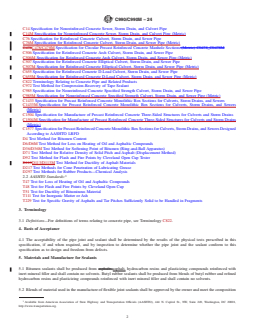
C14 Specification for Nonreinforced Concrete Sewer, Storm
structures, which are subject to internal or external pressure,
Drain, and Culvert Pipe
infiltration or exfiltration limits are not prohibited from being
C14M Specification for Nonreinforced Concrete Sewer,
specified. Joints in vertical structures covered by this specifi-
Storm Drain, and Culvert Pipe (Metric)
cation are intended mainly to prevent the flow of solids or
C76 Specification for Reinforced Concrete Culvert, Storm
fluids through the joint.
Drain, and Sewer Pipe
1.3 This specification is to be used with pipe and structures
C76M Specification for Reinforced Concrete Culvert, Storm
conforming in all respects to Specifications C14, C14M, C76,
Drain, and Sewer Pipe (Metric)
C76M, C478/C478M, C506, C506M, C507, C507M, C655,
C478/C478M Specification for Circular Precast Reinforced
C655M, C985, C985M, C1433, C1433M, C1504, C1504M,
Concrete Manhole Sections
and C1577, provided that if there is a conflict in permissible
C506 Specification for Reinforced Concrete Arch Culvert,
variations in dimensions, the requirements of this specification
Storm Drain, and Sewer Pipe
shall govern.
C506M Specification for Reinforced Concrete Arch Culvert,
Storm Drain, and Sewer Pipe (Metric)
1.4 The values stated in either inch pound or SI units are to
be regarded separately as standard. The SI units are shown in C507 Specification for Reinforced Concrete Elliptical
Culvert, Storm Drain, and Sewer Pipe
brackets. The value stated in each system shall be used
independently of the other. Combining values from the two C507M Specification for Reinforced Concrete Elliptical
Culvert, Storm Drain, and Sewer Pipe (Metric)
systems may result in nonconformance with the standard.
NOTE 1—This specification covers the material and performance of the
C655 Specification for Reinforced Concrete D-Load
joint and sealant only. Infiltration and exfiltration quantities for installed
Culvert, Storm Drain, and Sewer Pipe
sections are dependent on factors other than the joints which must be
C655M Specification for Reinforced Concrete D-Load
covered by other specifications and suitable testing of the installed
Culvert, Storm Drain, and Sewer Pipe (Metric)
pipeline.
C822 Terminology Relating to Concrete Pipe and Related
1.5 This standard does not purport to address all of the
Products
safety concerns, if any, associated with its use. It is the
C972 Test Method for Compression-Recovery of Tape Seal-
responsibility of the user of this standard to establish appro-
ant
priate safety, health, and environmental practices and deter-
C985 Specification for Nonreinforced Concrete Specified
mine the applicability of regulatory limitations prior to use.
Strength Culvert, Storm Drain, and Sewer Pipe
This specification is under the jurisdiction of ASTM Committee C13 on
Concrete Pipe and is the direct responsibility of Subcommittee C13.08 on Joints for
Precast Concrete Structures. For referenced ASTM standards, visit the ASTM website, www.astm.org, or
Current edition approved March 15, 2024. Published April 2024. Originally contact ASTM Customer Service at service@astm.org. For Annual Book of ASTM
approved in 1991. Last previous edition approved in 2019 as C990 – 09(2019). DOI: Standards volume information, refer to the standard’s Document Summary page on
10.1520/C0990_C0990M-24. the ASTM website.
Copyright © ASTM International, 100 Barr Harbor Drive, PO Box C700, West Conshohocken, PA 19428-2959. United States
C990/C990M − 24
C985M Specification for Nonreinforced Concrete Specified inert mineral filler and shall contain no solvents. Butyl rubber
Strength Culvert, Storm Drain, and Sewer Pipe (Metric) sealants shall be produced from blends of butyl rubber and
C1433 Specification for Precast Reinforced Concrete Mono- refined hydrocarbon resins and plasticizing compounds rein-
lithic Box Sections for Culverts, Storm Drains, and forced with inert mineral filler and shall contain no solvents.
Sewers
5.2 Blends of material used in the manufacture of flexible
C1433M Specification for Precast Reinforced Concrete
joint sealants shall be approved by the owner and meet the
Monolithic Box Sections for Culverts, Storm Drains, and
composition and physical requirements prescribed in Section 6.
Sewers (Metric)
The joint sealant shall not depend on oxidizing, evaporating, or
C1504 Specification for Manufacture of Precast Reinforced
chemical action for its adhesive or cohesive strength and shall
Concrete Three-Sided Structures for Culverts and Storm
be supplied preformed and of suitable cross section and size to
Drains
seal the joint annular space when the sections are joined. For a
C1504M Specification for Manufacture of Precast Rein-
given joint size, the sealing material, as furnished, shall be such
forced Concrete Three-Sided Structures for Culverts and
so as to encircle the outside circumference of the spigot or
Storm Drains (Metric)
tongue of the joint or the inside circumference of the bell or
C1577 Specification for Precast Reinforced Concrete Mono-
groove and shall not be stretched when seated in the joint.
lithic Box Sections for Culverts, Storm Drains, and
Sealant material shall be furnished in the required length and
Sewers Designed According to AASHTO LRFD
cross-dimensions, and the dimensions shall be clearly marked.
D4 Test Method for Bitumen Content
Sealant material shall be pre-formed to the following specified
D6/D6M Test Method for Loss on Heating of Oil and
tolerances:
Asphaltic Compounds
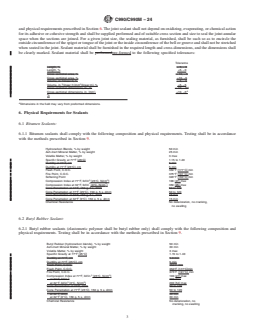
Tolerance
D36/D36M Test Method for Softening Point of Bitumen
Length, % +5, −0
(Ring-and-Ball Apparatus)
Cross sectional area, % +10, −5
3 3
Volume, in. /linear ft [mm /linear m], % +5, −5
D71 Test Method for Relative Density of Solid Pitch and
A
Cross-sectional dimensions, in. [mm], +10, −5
Asphalt (Displacement Method)
%
D92 Test Method for Flash and Fire Points by Cleveland
A
Open Cup Tester Dimensions in the field may vary from preformed dimensions.
D113/D113M Test Method for Ductility of Asphalt Materi-
als 6. Physical Requirements for Sealants
D217 Test Methods for Cone Penetration of Lubricating
6.1 Bitumen Sealants:
Grease
6.1.1 Bitumen sealants shall comply with the following
D297 Test Methods for Rubber Products—Chemical Analy-
composition and physical requirements. Testing shall be in
sis
accordance with the methods prescribed in Section 9.
2.2 AASHTO Standards:
Hydrocarbon Blends, % by weight 50 min
T47 Test for Loss of Heating of Oil and Asphaltic Com-
Ash-Inert Mineral Matter, % by weight 25 min
pounds
Volatile Matter, % by weight 3 max
Specific Gravity at 77°F [25°C] 1.15 to 1.40
T48 Test for Flash and Fire Points by Cleveland Open Cup
Ductility at 77°F [25°C], cm 5 min
T51 Test for Ductility of Bituminous Material
Flash Point, C.O.C. 350°F [177°C] min
T111 Test for Inorganic Matter or Ash Fire Point, C.O.C. 375°F [191°C] min
Softening Point 320°F [160°C] min
T229 Test for Specific Gravity of Asphalts and Tar Pitches
3 3
Compression Index at 77°F, lbf/in [25°C, N/cm ] 100 [27] max
Sufficiently Solid to be Handled in Fragments 3 3
Compression Index at 32°F, lbf/in [0°C, N/cm ] 350 [95] max
Cone Penetration at 77°F [25°C], 150 g, 5 s, dmm 50 to 120
3. Terminology
Cone Penetration at 32°F [0°C], 150 g, 5 s, dmm 15 min
Chemical Resistance No deterioration, no cracking,
3.1 Definitions—For definitions of terms relating to concrete
no swelling
pipe, see Terminology C822.
6.2 Butyl Rubber Sealant:
6.2.1 Butyl rubber sealants (elastomeric polymer shall be
4. Basis of Acceptance
butyl rubber only) shall comply with the following composi-
4.1 The acceptability of the pipe joint and sealant shall be
tion and physical requirements. Testing shall be in accordance
determined by the results of the physical tests prescribed in this
with the methods prescribed in Section 9.
specification, if and when required, and by inspection to
Butyl Rubber (hydrocarbon blends), % by weight 50 min
determine whether the pipe joint and the sealant conform to
Ash-Inert Mi
...
This document is not an ASTM standard and is intended only to provide the user of an ASTM standard an indication of what changes have been made to the previous version. Because
it may not be technically possible to adequately depict all changes accurately, ASTM recommends that users consult prior editions as appropriate. In all cases only the current version
of the standard as published by ASTM is to be considered the official document.
Designation: C990 − 09 (Reapproved 2019) C990/C990M − 24
Standard Specification for
Joints for Concrete Pipe, Manholes, and Precast Box
Sections Using Preformed Flexible Joint Sealants
This standard is issued under the fixed designation C990;C990/C990M; the number immediately following the designation indicates the
year of original adoption or, in the case of revision, the year of last revision. A number in parentheses indicates the year of last
reapproval. A superscript epsilon (´) indicates an editorial change since the last revision or reapproval.
1. Scope
1.1 This specification covers joints for precast concrete pipe and box, and other sections using preformed flexible joint sealants
for use in storm sewers and culverts which are not intended to operate under internal pressure, or are not subject to infiltration or
exfiltration limits. Joint material used in horizontal applications is intended to prevent the flow of solids through the joint.
1.2 For precast concrete manhole sections and other vertical structures, which are subject to internal or external pressure,
infiltration or exfiltration limits are not prohibited from being specified. Joints in vertical structures covered by this specification
are intended mainly to prevent the flow of solids or fluids through the joint.
1.3 This specification is to be used with pipe and structures conforming in all respects to Specifications C14, C14M, C76, C76M,
C478C478/C478M, C506, C506M, C507, C507M, C655, C655M, C985, C985M, C1433, C1433M, C1504, C1504M, and C1577,
provided that if there is a conflict in permissible variations in dimensions, the requirements of this specification shall govern.
1.4 This specification is the inch-pound companion The values stated in either inch pound or SI units are to C990M; therefore,
no SI equivalents are presented in the specification. be regarded separately as standard. The SI units are shown in brackets. The
value stated in each system shall be used independently of the other. Combining values from the two systems may result in
nonconformance with the standard.
NOTE 1—This specification covers the material and performance of the joint and sealant only. Infiltration and exfiltration quantities for installed sections
are dependent on factors other than the joints which must be covered by other specifications and suitable testing of the installed pipeline.
1.5 This standard does not purport to address all of the safety concerns, if any, associated with its use. It is the responsibility
of the user of this standard to establish appropriate safety, health, and environmental practices and determine the applicability of
regulatory limitations prior to use.
1.6 This international standard was developed in accordance with internationally recognized principles on standardization
established in the Decision on Principles for the Development of International Standards, Guides and Recommendations issued
by the World Trade Organization Technical Barriers to Trade (TBT) Committee.
2. Referenced Documents
2.1 ASTM Standards:
This specification is under the jurisdiction of ASTM Committee C13 on Concrete Pipe and is the direct responsibility of Subcommittee C13.08 on Joints for Precast
Concrete Structures.
Current edition approved Sept. 1, 2019March 15, 2024. Published September 2019April 2024. Originally approved in 1991. Last previous edition approved in 20142019
as C990 – 09(2014). DOI: 10.1520/C0990-09R19.(2019). DOI: 10.1520/C0990_C0990M-24.
For referenced ASTM standards, visit the ASTM website, www.astm.org, or contact ASTM Customer Service at service@astm.org. For Annual Book of ASTM Standards
volume information, refer to the standard’s Document Summary page on the ASTM website.
Copyright © ASTM International, 100 Barr Harbor Drive, PO Box C700, West Conshohocken, PA 19428-2959. United States
C990/C990M − 24
C14 Specification for Nonreinforced Concrete Sewer, Storm Drain, and Culvert Pipe
C14M Specification for Nonreinforced Concrete Sewer, Storm Drain, and Culvert Pipe (Metric)
C76 Specification for Reinforced Concrete Culvert, Storm Drain, and Sewer Pipe
C76M Specification for Reinforced Concrete Culvert, Storm Drain, and Sewer Pipe (Metric)
C478C478/C478M Specification for Circular Precast Reinforced Concrete Manhole Sections (Metric) C0478_C0478M
C506 Specification for Reinforced Concrete Arch Culvert, Storm Drain, and Sewer Pipe
C506M Specification for Reinforced Concrete Arch Culvert, Storm Drain, and Sewer Pipe (Metric)
C507 Specification for Reinforced Concrete Elliptical Culvert, Storm Drain, and Sewer Pipe
C507M Specification for Reinforced Concrete Elliptical Culvert, Storm Drain, and Sewer Pipe (Metric)
C655 Specification for Reinforced Concrete D-Load Culvert, Storm Drain, and Sewer Pipe
C655M Specification for Reinforced Concrete D-Load Culvert, Storm Drain, and Sewer Pipe (Metric)
C822 Terminology Relating to Concrete Pipe and Related Products
C972 Test Method for Compression-Recovery of Tape Sealant
C985 Specification for Nonreinforced Concrete Specified Strength Culvert, Storm Drain, and Sewer Pipe
C985M Specification for Nonreinforced Concrete Specified Strength Culvert, Storm Drain, and Sewer Pipe (Metric)
C1433 Specification for Precast Reinforced Concrete Monolithic Box Sections for Culverts, Storm Drains, and Sewers
C1433M Specification for Precast Reinforced Concrete Monolithic Box Sections for Culverts, Storm Drains, and Sewers
(Metric)
C1504 Specification for Manufacture of Precast Reinforced Concrete Three-Sided Structures for Culverts and Storm Drains
C1504M Specification for Manufacture of Precast Reinforced Concrete Three-Sided Structures for Culverts and Storm Drains
(Metric)
C1577 Specification for Precast Reinforced Concrete Monolithic Box Sections for Culverts, Storm Drains, and Sewers Designed
According to AASHTO LRFD
D4 Test Method for Bitumen Content
D6/D6M Test Method for Loss on Heating of Oil and Asphaltic Compounds
D36/D36M Test Method for Softening Point of Bitumen (Ring-and-Ball Apparatus)
D71 Test Method for Relative Density of Solid Pitch and Asphalt (Displacement Method)
D92 Test Method for Flash and Fire Points by Cleveland Open Cup Tester
D113D113/D113M Test Method for Ductility of Asphalt Materials
D217 Test Methods for Cone Penetration of Lubricating Grease
D297 Test Methods for Rubber Products—Chemical Analysis
2.2 AASHTO Standards:
T47 Test for Loss of Heating of Oil and Asphaltic Compounds
T48 Test for Flash and Fire Points by Cleveland Open Cup
T51 Test for Ductility of Bituminous Material
T111 Test for Inorganic Matter or Ash
T229 Test for Specific Gravity of Asphalts and Tar Pitches Sufficiently Solid to be Handled in Fragments
3. Terminology
3.1 Definitions—For definitions of terms relating to concrete pipe, see Terminology C822.
4. Basis of Acceptance
4.1 The acceptability of the pipe joint and sealant shall be determined by the results of the physical tests prescribed in this
specification, if and when required, and by inspection to determine whether the pipe joint and the sealant conform to this
specification as to design and freedom from defects.
5. Materials and Manufacture for Sealants
5.1 Bitumen sealants shall be produced from asphalts,asphalt, hydrocarbon resins and plasticizing compounds reinforced with
inert mineral filler and shall contain no solvents. Butyl rubber sealants shall be produced from blends of butyl rubber and refined
hydrocarbon resins and plasticizing compounds reinforced with inert mineral filler and shall contain no solvents.
5.2 Blends of material used in the manufacture of flexible joint sealants shall be approved by the owner and meet the composition
Available from American Association of State Highway and Transportation Officials (AASHTO), 444 N. Capitol St., NW, Suite 249, Washington, DC 20001,
http://www.transportation.org.
C990/C990M − 24
and physical requirements prescribed in Section 6. The joint sealant shall not depend on oxidizing, evaporating, or chemical action
for its adhesive or cohesive strength and shall be supplied preformed and of suitable cross section and size to seal the joint annular
space when the sections are joined. For a given joint size, the sealing material, as furnished, shall be such so as to encircle the
outside circumference of the spigot or tongue of the joint or the inside circumference of the bell or groove and shall not be stretched
when seated in the joint. Sealant material shall be furnished in the required length and cross-dimensions, and the dimensions shall
be clearly marked. Sealant material shall be preformedpre-formed to the following specified tolerances:
Tolerance
Length, % + 5, − 0
Length, % +5, −0
Cross sectional area, % + 10, − 5
Cross sectional area, % +10, −5
Volume, in. /linear ft, % + 5, − 5
3 3
Volume, in. /linear ft [mm /linear m], % +5, −5
A
Cross-sectional dimensions, in., % + 10, − 5
A
Cross-sectional dimensions, in. [mm], +10, −5
%
A
Dimensions in the field may vary from preformed dimensions.
6. Physical Requirements for Sealants
6.1 Bitumen Sealants:
6.1.1 Bitumen sealants shall comply with the following composition and physical requirements. Testing shall be in accordance
with the methods prescribed in Section 9.
Hydrocarbon Blends, % by weight 50 min
Ash-Inert Mineral Matter, % by weight 25 min
Volatile Matter, % by weight 3 max
Specific Gravity at 77°F [25°C] 1.15 to 1.40
Ductility at 77°F, cm 5 min
Ductility at 77°F [25°C], cm 5 min
Flash Point, C.O.C. 350°F [177°C] min
Fire Point, C.O.C. 375°F [191°C] min
Softening Point 320°F [160°C] min
3 3
Compression Index at 77°F, lbf/in [25°C, N/cm ] 100 [27] max
3 3
Compression Index at 32°F, lbf/in [
...