

ASTM C549-23
(Specification)Standard Specification for Perlite Loose Fill Insulation
General Information
- Abstract
ABSTRACT
This specification covers the standard for the composition and physical properties of expanded perlite loose fill insulation. This specification also covers the testing procedures used in determining the acceptability of the materials which deal primarily with material performance in the temperature range associated with the thermal envelope of buildings. This specification also covers the standard for surface-treated perlite proposed for use in dust suppression. Requirements for the insulation shall include conformance to standard of the following: bulk density, grading, thermal resistance, moisture absorption, combustibility, surface burning characteristics, and dust suppression.
SCOPE
1.1 This specification covers the composition and physical properties of expanded perlite loose fill insulation. The specification includes the testing procedures by which the acceptability of the material is determined. These testing procedures deal primarily with material performance in the temperature range associated with the thermal envelope of buildings; however, the commercially usable temperature range for this insulation is from − 459 to 1400°F (1 to 1033 K). For specialized applications, refer to the manufacturer's instructions.
1.2 The specification covers the composition and properties of perlite that has been surface-treated to produce dust suppression for installations where dust is a factor.
1.3 The values stated in inch-pound units are to be regarded as standard. The values given in parentheses are mathematical conversions to SI units that are provided for information only and are not considered standard.
1.4 The following applies to Test Methods E84 and E136—This standard is used to measure and describe the response of materials, products, or assemblies to heat and flame under controlled conditions, but does not by itself incorporate all factors required for fire hazard or fire risk assessment of the materials, products, or assemblies under actual fire conditions.
1.5 The following applies to Test Methods E84 and E136—Fire testing is inherently hazardous. Adequate safeguards for personnel and property shall be employed in conducting these tests.
1.6 When the installation or use of thermal insulation materials, accessories and systems, may pose safety or health problems, the manufacturer shall provide the user appropriate current information regarding any known problems associated with the recommended use of the company's products, and shall also recommend protective measures to be employed in their safe utilization. The user shall establish appropriate safety and health practices and determine the applicability of regulatory requirements prior to use. For additional precautionary statements, see Section 12.
1.7 This standard does not purport to address all of the safety concerns, if any, associated with its use. It is the responsibility of the user of this standard to establish appropriate safety, health, and environmental practices and determine the applicability of regulatory limitations prior to use.
1.8 This international standard was developed in accordance with internationally recognized principles on standardization established in the Decision on Principles for the Development of International Standards, Guides and Recommendations issued by the World Trade Organization Technical Barriers to Trade (TBT) Committee.
- Status
- Published
- Publication Date
- 31-Oct-2023
- Technical Committee
- C16 - Thermal Insulation
- Drafting Committee
- C16.23 - Blanket and Loose Fill Insulation

Overview
ASTM C549-23 is the internationally recognized standard specification for perlite loose fill insulation, developed by ASTM International. The standard outlines the requirements for the composition, physical properties, and testing procedures of expanded perlite used as loose fill insulation. It also covers perlite that is surface-treated for dust suppression, addressing both safety and performance within the typical temperature ranges of building thermal envelopes. ASTM C549-23 ensures consistency, safety, and quality in perlite insulation products by specifying clear criteria for properties such as bulk density, grading, thermal resistance (R-value), moisture absorption, combustibility, and surface burning characteristics.
Key Topics
Core aspects of ASTM C549-23 include:
- Material Composition: Defines the requirements for expanded perlite as a naturally occurring siliceous mineral, noncombustible and classified as an elementary building material.
- Physical Properties: Sets standards for bulk density, grading, and particulate characteristics to ensure optimal insulation performance.
- Thermal Performance: Specifies criteria for thermal resistance across a range of temperatures, supporting use from cryogenic environments to high-temperature applications (−459 to 1400°F / 1 to 1033 K).
- Fire and Safety Testing: Includes testing for combustibility (ASTM E136), and surface burning characteristics such as flame spread and smoke developed (ASTM E84).
- Moisture Absorption: Establishes limits for water absorption to maintain insulation effectiveness.
- Dust Suppression: Requirements for surface-treated perlite to minimize dust generation, especially during installation.
- Testing and Inspection: Mandates specific ASTM test methods for verifying compliance with the standard.
- Health & Safety: Addresses pre-installation handling, recommended protective measures, and regulatory considerations.
Applications
Perlite loose fill insulation is widely used in:
- Building Envelopes: Filling wall cavities, attics, and floor spaces to improve energy efficiency and provide thermal insulation in residential, commercial, and industrial buildings.
- Cryogenic and High-Temperature Environments: Suitable for temperature extremes, making perlite insulation valuable in thermal protection for process vessels, piping, and storage tanks.
- Fire Protection: Due to its noncombustible nature and strict flammability standards, perlite is ideal for environments where fire safety is critical.
- Noise Reduction: The loose fill form can contribute to sound attenuation when installed in building cavities.
- Dust-Sensitive Installations: Surface-treated perlite is available for use in locations where dust control is necessary for health or operational reasons.
Related Standards
ASTM C549-23 references and works alongside several related standards to ensure comprehensive testing and compatibility:
- ASTM C136: Sieve Analysis of Fine and Coarse Aggregates - used for grading perlite samples.
- ASTM C168: Terminology Relating to Thermal Insulation.
- ASTM C177: Steady-State Heat Flux Measurements and Thermal Transmission Properties by Guarded-Hot-Plate Apparatus.
- ASTM C390: Practice for Sampling and Acceptance of Thermal Insulation Lots.
- ASTM C518: Steady-State Thermal Transmission Properties by Means of the Heat Flow Meter Apparatus.
- ASTM C520: Density of Granular Loose Fill Insulations.
- ASTM E84: Surface Burning Characteristics of Building Materials.
- ASTM E136: Assessing Combustibility of Materials Using a Vertical Tube Furnace at 750°C.
- ASTM E177: Use of Terms Precision and Bias in ASTM Test Methods.
Keywords: perlite insulation, loose fill insulation, thermal insulation, ASTM C549, fire-resistant insulation, dust suppression, building materials, thermal resistance, cryogenic insulation, noncombustible insulation
By adhering to ASTM C549-23, manufacturers, builders, and specifiers can ensure perlite loose fill insulation solutions meet rigorous industry standards for safety, performance, and regulatory compliance.
Relations
- Effective Date
- 01-Nov-2023
- Effective Date
- 15-Apr-2024
- Effective Date
- 01-Mar-2024
- Effective Date
- 01-Mar-2024
- Effective Date
- 01-Feb-2024
- Effective Date
- 01-Dec-2023
- Effective Date
- 01-Sep-2023
- Effective Date
- 01-Oct-2022
- Effective Date
- 01-May-2022
- Effective Date
- 01-Sep-2019
- Effective Date
- 01-Nov-2023
- Referred By
ASTM C1774-13(2019) - Standard Guide for Thermal Performance Testing of Cryogenic Insulation Systems - Effective Date
- 01-Nov-2023
- Effective Date
- 01-Nov-2023
- Effective Date
- 01-Nov-2023
Get Certified
Connect with accredited certification bodies for this standard

DIBt (Deutsches Institut für Bautechnik)
German Institute for Building Technology.
DIN CERTCO
DIN Group product certification.

Aboma Certification B.V.
Specialized in construction, metal, and transport sectors.
Sponsored listings
Frequently Asked Questions
ASTM C549-23 is a technical specification published by ASTM International. Its full title is "Standard Specification for Perlite Loose Fill Insulation". This standard covers: ABSTRACT This specification covers the standard for the composition and physical properties of expanded perlite loose fill insulation. This specification also covers the testing procedures used in determining the acceptability of the materials which deal primarily with material performance in the temperature range associated with the thermal envelope of buildings. This specification also covers the standard for surface-treated perlite proposed for use in dust suppression. Requirements for the insulation shall include conformance to standard of the following: bulk density, grading, thermal resistance, moisture absorption, combustibility, surface burning characteristics, and dust suppression. SCOPE 1.1 This specification covers the composition and physical properties of expanded perlite loose fill insulation. The specification includes the testing procedures by which the acceptability of the material is determined. These testing procedures deal primarily with material performance in the temperature range associated with the thermal envelope of buildings; however, the commercially usable temperature range for this insulation is from − 459 to 1400°F (1 to 1033 K). For specialized applications, refer to the manufacturer's instructions. 1.2 The specification covers the composition and properties of perlite that has been surface-treated to produce dust suppression for installations where dust is a factor. 1.3 The values stated in inch-pound units are to be regarded as standard. The values given in parentheses are mathematical conversions to SI units that are provided for information only and are not considered standard. 1.4 The following applies to Test Methods E84 and E136—This standard is used to measure and describe the response of materials, products, or assemblies to heat and flame under controlled conditions, but does not by itself incorporate all factors required for fire hazard or fire risk assessment of the materials, products, or assemblies under actual fire conditions. 1.5 The following applies to Test Methods E84 and E136—Fire testing is inherently hazardous. Adequate safeguards for personnel and property shall be employed in conducting these tests. 1.6 When the installation or use of thermal insulation materials, accessories and systems, may pose safety or health problems, the manufacturer shall provide the user appropriate current information regarding any known problems associated with the recommended use of the company's products, and shall also recommend protective measures to be employed in their safe utilization. The user shall establish appropriate safety and health practices and determine the applicability of regulatory requirements prior to use. For additional precautionary statements, see Section 12. 1.7 This standard does not purport to address all of the safety concerns, if any, associated with its use. It is the responsibility of the user of this standard to establish appropriate safety, health, and environmental practices and determine the applicability of regulatory limitations prior to use. 1.8 This international standard was developed in accordance with internationally recognized principles on standardization established in the Decision on Principles for the Development of International Standards, Guides and Recommendations issued by the World Trade Organization Technical Barriers to Trade (TBT) Committee.
ABSTRACT This specification covers the standard for the composition and physical properties of expanded perlite loose fill insulation. This specification also covers the testing procedures used in determining the acceptability of the materials which deal primarily with material performance in the temperature range associated with the thermal envelope of buildings. This specification also covers the standard for surface-treated perlite proposed for use in dust suppression. Requirements for the insulation shall include conformance to standard of the following: bulk density, grading, thermal resistance, moisture absorption, combustibility, surface burning characteristics, and dust suppression. SCOPE 1.1 This specification covers the composition and physical properties of expanded perlite loose fill insulation. The specification includes the testing procedures by which the acceptability of the material is determined. These testing procedures deal primarily with material performance in the temperature range associated with the thermal envelope of buildings; however, the commercially usable temperature range for this insulation is from − 459 to 1400°F (1 to 1033 K). For specialized applications, refer to the manufacturer's instructions. 1.2 The specification covers the composition and properties of perlite that has been surface-treated to produce dust suppression for installations where dust is a factor. 1.3 The values stated in inch-pound units are to be regarded as standard. The values given in parentheses are mathematical conversions to SI units that are provided for information only and are not considered standard. 1.4 The following applies to Test Methods E84 and E136—This standard is used to measure and describe the response of materials, products, or assemblies to heat and flame under controlled conditions, but does not by itself incorporate all factors required for fire hazard or fire risk assessment of the materials, products, or assemblies under actual fire conditions. 1.5 The following applies to Test Methods E84 and E136—Fire testing is inherently hazardous. Adequate safeguards for personnel and property shall be employed in conducting these tests. 1.6 When the installation or use of thermal insulation materials, accessories and systems, may pose safety or health problems, the manufacturer shall provide the user appropriate current information regarding any known problems associated with the recommended use of the company's products, and shall also recommend protective measures to be employed in their safe utilization. The user shall establish appropriate safety and health practices and determine the applicability of regulatory requirements prior to use. For additional precautionary statements, see Section 12. 1.7 This standard does not purport to address all of the safety concerns, if any, associated with its use. It is the responsibility of the user of this standard to establish appropriate safety, health, and environmental practices and determine the applicability of regulatory limitations prior to use. 1.8 This international standard was developed in accordance with internationally recognized principles on standardization established in the Decision on Principles for the Development of International Standards, Guides and Recommendations issued by the World Trade Organization Technical Barriers to Trade (TBT) Committee.
ASTM C549-23 is classified under the following ICS (International Classification for Standards) categories: 91.100.60 - Thermal and sound insulating materials. The ICS classification helps identify the subject area and facilitates finding related standards.
ASTM C549-23 has the following relationships with other standards: It is inter standard links to ASTM C549-18, ASTM C168-24, ASTM C390-08(2024), ASTM E136-24a, ASTM E136-24, ASTM E84-23d, ASTM E84-23c, ASTM E136-22, ASTM C168-22, ASTM C390-08(2019), ASTM C1630-19, ASTM C1774-13(2019), ASTM C1373/C1373M-23, ASTM C1558-19. Understanding these relationships helps ensure you are using the most current and applicable version of the standard.
ASTM C549-23 is available in PDF format for immediate download after purchase. The document can be added to your cart and obtained through the secure checkout process. Digital delivery ensures instant access to the complete standard document.
Standards Content (Sample)
This international standard was developed in accordance with internationally recognized principles on standardization established in the Decision on Principles for the
Development of International Standards, Guides and Recommendations issued by the World Trade Organization Technical Barriers to Trade (TBT) Committee.
Designation: C549 − 23
Standard Specification for
Perlite Loose Fill Insulation
This standard is issued under the fixed designation C549; the number immediately following the designation indicates the year of
original adoption or, in the case of revision, the year of last revision. A number in parentheses indicates the year of last reapproval. A
superscript epsilon (´) indicates an editorial change since the last revision or reapproval.
This standard has been approved for use by agencies of the U.S. Department of Defense.
1. Scope safety and health practices and determine the applicability of
regulatory requirements prior to use. For additional precau-
1.1 This specification covers the composition and physical
tionary statements, see Section 12.
properties of expanded perlite loose fill insulation. The speci-
fication includes the testing procedures by which the accept-
1.7 This standard does not purport to address all of the
ability of the material is determined. These testing procedures
safety concerns, if any, associated with its use. It is the
deal primarily with material performance in the temperature
responsibility of the user of this standard to establish appro-
range associated with the thermal envelope of buildings;
priate safety, health, and environmental practices and deter-
however, the commercially usable temperature range for this
mine the applicability of regulatory limitations prior to use.
insulation is from − 459 to 1400°F (1 to 1033 K). For special-
1.8 This international standard was developed in accor-
ized applications, refer to the manufacturer’s instructions.
dance with internationally recognized principles on standard-
1.2 The specification covers the composition and properties
ization established in the Decision on Principles for the
of perlite that has been surface-treated to produce dust sup-
Development of International Standards, Guides and Recom-
pression for installations where dust is a factor.
mendations issued by the World Trade Organization Technical
1.3 The values stated in inch-pound units are to be regarded Barriers to Trade (TBT) Committee.
as standard. The values given in parentheses are mathematical
conversions to SI units that are provided for information only
2. Referenced Documents
and are not considered standard.
2.1 ASTM Standards:
1.4 The following applies to Test Methods E84 and E136—
C136 Test Method for Sieve Analysis of Fine and Coarse
This standard is used to measure and describe the response of
Aggregates
materials, products, or assemblies to heat and flame under
C168 Terminology Relating to Thermal Insulation
controlled conditions, but does not by itself incorporate all
C177 Test Method for Steady-State Heat Flux Measure-
factors required for fire hazard or fire risk assessment of the
ments and Thermal Transmission Properties by Means of
materials, products, or assemblies under actual fire conditions.
the Guarded-Hot-Plate Apparatus
1.5 The following applies to Test Methods E84 and E136—
C390 Practice for Sampling and Acceptance of Thermal
Fire testing is inherently hazardous. Adequate safeguards for
Insulation Lots
personnel and property shall be employed in conducting these
C518 Test Method for Steady-State Thermal Transmission
tests.
Properties by Means of the Heat Flow Meter Apparatus
1.6 When the installation or use of thermal insulation C520 Test Methods for Density of Granular Loose Fill
materials, accessories and systems, may pose safety or health Insulations
problems, the manufacturer shall provide the user appropriate E84 Test Method for Surface Burning Characteristics of
current information regarding any known problems associated
Building Materials
with the recommended use of the company’s products, and
E136 Test Method for Assessing Combustibility of Materials
shall also recommend protective measures to be employed in
Using a Vertical Tube Furnace at 750 °C
their safe utilization. The user shall establish appropriate
E177 Practice for Use of the Terms Precision and Bias in
ASTM Test Methods
This specification is under the jurisdiction of ASTM Committee C16 on
Thermal Insulation and is the direct responsibility of Subcommittee C16.23 on
Blanket and Loose Fill Insulation. For referenced ASTM standards, visit the ASTM website, www.astm.org, or
Current edition approved Nov. 1, 2023. Published December 2023. Originally contact ASTM Customer Service at service@astm.org. For Annual Book of ASTM
approved in 1964. Last previous edition approved in 2018 as C549 – 18. DOI: Standards volume information, refer to the standard’s Document Summary page on
10.1520/C0549-23. the ASTM website.
Copyright © ASTM International, 100 Barr Harbor Drive, PO Box C700, West Conshohocken, PA 19428-2959. United States
C549 − 23
3. Terminology 9.2 Grading—Test Method C136, except that when a me-
chanical sieving device is used, the sieving time shall be 5 min
3.1 Terms used in this specification are defined in Termi-
and the test sample shall be 0.11 6 0.02 lb (50 6 9 g) of
nology C168.
material.
4. Classification 9.3 Small-Scale Fire Test:
9.3.1 Scope—The purpose of this quality control test is to
4.1 Perlite loose-fill insulation shall conform to the physical
confirm that excessive coating or organic material has not been
requirements of 7. Expanded perlite that has been treated to
added during processing.
limit the amount of dust generated during application shall be
9.3.2 Significance—This specification measures and de-
identified on the product label.
scribes the response of materials, products, or assemblies to
heat and flame under controlled condition, but does not by
5. Ordering Information
itself incorporate all factors required for fire risk assessment of
5.1 All purchase orders shall designate the density of
materials, products or assemblies under actual conditions.
insulation desired or required for conformance with the prop-
9.3.3 Procedure—Hold a 0.02 to 0.03 lb (9 to 14g) specimen
erties in 7.1. The purchase order shall identify surface-treated
of the perlite insulation in a suitable fixture (such as 6 by 6 by
products when included.
2-in. (152 by 152 by 51-mm) deep wire mesh basket con-
structed from 100-mesh (150 μm) stainless steel woven wire
6. Materials and Manufacture
cloth) and positioned in direct contact with the flame of a
Bunsen burner for about 20 s. Sparking or ignition indicates
6.1 Perlite is a generic term for a naturally occurring
failure to conform to the requirements of 7.1
siliceous mineral which is mined, crushed, sieved and dried to
9.3.4 Precision and Bias—No statement is made about
produce a crude perlite ore. The crude ore, in the form of
either the precision or the accuracy of the small-scale fire test
particles of varying size, weighing 60 to 75 lb/ft (960 to 1200
for determining resistance of the perlite insulation to heat and
kg/m ), is expanded in high-temperature furnaces to densities
3 3
flame since the result states whether there is conformance to
in the range from 2.0 to 11.0 lb/ft (32 to 176 kg/m ). As a
the criteria for success specified in the procedure.
naturally occurring mineral, it is classified as an elementary
building material. It is noncombustible as determined by Test
9.4 Thermal Resistance—Tests of thermal resistance shall
Method E136.
be determined in accordance with Test Method C177 or C518.
Testing shall be done at the design density and representative
7. Physical Requirements
thickness. The arithmetic average thermal resistance of four
specimens shall exceed 95% the value in Table 1. The thermal
7.1 The physical requirements listed in this section are
resistance (R-value) shall be determined at mean temperature
defined as inspection requirements (see Practice C390). The
of 75 6 1°F (24 6 0.5°C) and a temperature difference of 40°F
insulation shall conform to the following requirements:
(22°C) . Report the direction of heat flow. Thermal resistance
3 3 at other mean temperatures shall be determined if required.
Bulk density, lb/ft (kg/m ) 2–11 (32–176)
Grading (particle size):
9.5 Moisture Absorption—The test specimen shall be 0.11
Percentage retained, maximum (by 5
6 0.05 lb (50 6 23 g) of product. Fill and level the product into
weight), Sieve No. 4 (4.75 mm), %
Small-scale fire test no sparking or
a specimen holder 9 by 9 by 5 6 0.1 in. (228 by 228 by 127
ignition
6 3 mm) deep.
...
This document is not an ASTM standard and is intended only to provide the user of an ASTM standard an indication of what changes have been made to the previous version. Because
it may not be technically possible to adequately depict all changes accurately, ASTM recommends that users consult prior editions as appropriate. In all cases only the current version
of the standard as published by ASTM is to be considered the official document.
Designation: C549 − 18 C549 − 23
Standard Specification for
Perlite Loose Fill Insulation
This standard is issued under the fixed designation C549; the number immediately following the designation indicates the year of
original adoption or, in the case of revision, the year of last revision. A number in parentheses indicates the year of last reapproval. A
superscript epsilon (´) indicates an editorial change since the last revision or reapproval.
This standard has been approved for use by agencies of the U.S. Department of Defense.
1. Scope
1.1 This specification covers the composition and physical properties of expanded perlite loose fill insulation. The specification
also includes the testing procedures by which the acceptability of the material is determined. These testing procedures deal
primarily with material performance in the temperature range associated with the thermal envelope of buildings; however, the
commercially usable temperature range for this insulation is from − 459 to 1400°F (1 to 1033 K). For specialized applications, refer
to the manufacturer’s instructions.
1.2 The specification also covers the composition and properties of perlite that has been surface-treated to produce dust
suppression for installations where dust is a factor.
1.3 The values stated in inch-pound units are to be regarded as standard. The values given in parentheses are mathematical
conversions to SI units that are provided for information only and are not considered standard.
1.4 The following applies to Test Methods E84 and E136—This standard is used to measure and describe the response of materials,
products, or assemblies to heat and flame under controlled conditions, but does not by itself incorporate all factors required for
fire hazard or fire risk assessment of the materials, products, or assemblies under actual fire conditions.
1.5 The following applies to Test Methods E84 and E136—Fire testing is inherently hazardous. Adequate safeguards for personnel
and property shall be employed in conducting these tests.
1.6 When the installation or use of thermal insulation materials, accessories and systems, may pose safety or health problems, the
manufacturer shall provide the user appropriate current information regarding any known problems associated with the
recommended use of the company’s products, and shall also recommend protective measures to be employed in their safe
utilization. The user shall establish appropriate safety and health practices and determine the applicability of regulatory
requirements prior to use. For additional precautionary statements, see Section 12.
1.7 This standard does not purport to address all of the safety concerns, if any, associated with its use. It is the responsibility
of the user of this standard to establish appropriate safety, health, and environmental practices and determine the applicability of
regulatory limitations prior to use.
1.8 This international standard was developed in accordance with internationally recognized principles on standardization
established in the Decision on Principles for the Development of International Standards, Guides and Recommendations issued
by the World Trade Organization Technical Barriers to Trade (TBT) Committee.
This specification is under the jurisdiction of ASTM Committee C16 on Thermal Insulation and is the direct responsibility of Subcommittee C16.23 on Blanket and Loose
Fill Insulation.
Current edition approved Nov. 1, 2018Nov. 1, 2023. Published November 2018December 2023. Originally approved in 1964. Last previous edition approved in 20122018
as C549 – 06 (2012).C549 – 18. DOI: 10.1520/C0549-18.10.1520/C0549-23.
Copyright © ASTM International, 100 Barr Harbor Drive, PO Box C700, West Conshohocken, PA 19428-2959. United States
C549 − 23
2. Referenced Documents
2.1 ASTM Standards:
C136 Test Method for Sieve Analysis of Fine and Coarse Aggregates
C168 Terminology Relating to Thermal Insulation
C177 Test Method for Steady-State Heat Flux Measurements and Thermal Transmission Properties by Means of the
Guarded-Hot-Plate Apparatus
C390 Practice for Sampling and Acceptance of Thermal Insulation Lots
C518 Test Method for Steady-State Thermal Transmission Properties by Means of the Heat Flow Meter Apparatus
C520 Test Methods for Density of Granular Loose Fill Insulations
E84 Test Method for Surface Burning Characteristics of Building Materials
E136 Test Method for Assessing Combustibility of Materials Using a Vertical Tube Furnace at 750 °C
E177 Practice for Use of the Terms Precision and Bias in ASTM Test Methods
3. Terminology
3.1 Terms used in this specification are defined in Terminology C168.
4. Classification
4.1 Perlite loose fill loose-fill insulation shall conform to the physical requirements of 7. Expanded perlite that has been treated
to limit the amount of dust generated during application shall be identified on the product label.
5. Ordering Information
5.1 All purchase orders shall designate the density of insulation desired or require required for conformance with the properties
in 7.1. The purchase order shall designate surface-treated product when desired.identify surface-treated products when included.
6. Materials and Manufacture
6.1 Perlite is a generic term for a naturally occurring siliceous mineral which is mined, crushed, sieved and dried to produce a
3 3
crude perlite ore. The crude ore, in the form of particles of varying size, weighing 60 to 75 lb/ft (960 to 1200 kg/m ), is expanded
3 3
in high-temperature furnaces to densities in the range from 2.0 to 11.0 lb/ft (32 to 176 kg/m ). As a naturally occurring mineral,
it is classified as an elementary building material. It is noncombustible as determined by Test Method E136.
7. Physical Requirements
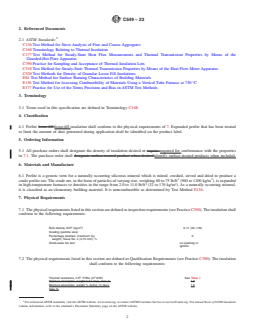
7.1 The physical requirements listed in this section are defined as inspection requirements (see Practice C390). The insulation shall
conform to the following requirements:
3 3
Bulk density, lb/ft (kg/m ) 2–11 (32–176)
Grading (particle size):
Percentage retained, maximum (by 5
weight), Sieve No. 4 (4.75 mm), %
Small-scale fire test no sparking or
ignition
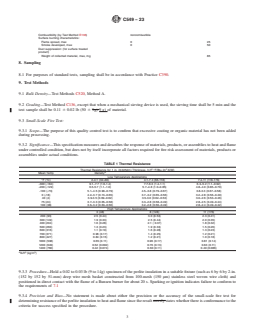
7.2 The physical requirements listed in this section are defined as Qualification Requirements (see Practice C390). The insulation
shall conform to the following requirements:
2 2
Thermal resistance, h·ft ·°F/Btu (m ·K/W) See Table 1
Moisture absorption, weight %⁄14 days, max, % 1.0
Moisture absorption, weight % during 14 days, 1.0
max, %
For referenced ASTM standards, visit the ASTM website, www.astm.org, or contact ASTM Customer Service at service@astm.org. For Annual Book of ASTM Standards
volume information, refer to the standard’s Document Summary page on the ASTM website.
C549 − 23
Combustibility (by Test Method E136) noncombustible
Surface burning characteristics:
Flame spread, max 0 25
Smoke developed, max 0 50
Dust suppression: (for surface treated
product)
Weight of collected material, max, mg 85
8. Sampling
8.1 For purposes of standard tests, sampling shall be in accordance with Practice C390.
9. Test Methods
9.1 Bulk Density—Test Methods C520, Method A.
9.2 Grading—Test Method C136, except that when a mechanical sieving device is used, the sieving time shall be 5 min and the
test sample shall be 0.11 6 0.02 lb (50 6 9g) 9 g) of material.
9.3 Small-Scale Fire Test:
9.3.1 Scope—The purpose of this quality control test is to confirm that excessive coating or organic material has not been added
during processing.
9.3.2 Significance—This specification measures and describes the response of materials, products, or assemblies to heat and flame
under controlled condition, but does not by itself incorporate all factors required for fire risk assessment of materials, products or
assemblies under actual conditions.
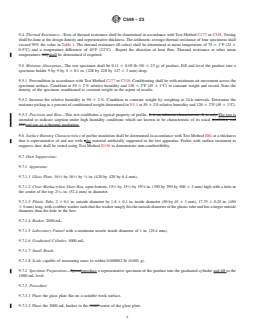
TABLE 1 Thermal Resistance
2 2
Thermal Resistance for 1 in. (0.0254m) Thickness, h·ft ·°F/Btu (m ·K/W)
A
Mean Temp Density
Low Temperature Applications
°F (°C) 2-4.1 (32–66) 4.1-7.4 (66-118) 7.4-11 (118-176)
-300 (-184) 9.1–7.7 (1.6-1.4) 7.7-6.3 (1.4-1.1) 6.3–5.2 (1.1–0.92)
-200 (-129) 6.5-5.7 (1.1–1.0) 5.7–4.8 (1.0–0.85) 4.8–4.0 (0.85–0.70)
-100 (-73) 5.1–4.5 (0.90–0.79) 4.5–3.8 (0.79–0.67) 3.8-3.3 (0.67–0.58)
0 (-18) 4.2–3.7 (0.74–0.65) 3.7–3.2 (0.65–0.56) 3.2–2.8 (0.56–0.49)
40 (4) 3.9-3.5 (0.69–0.62) 3.5-3.0 (0.62–0.53) 3.0–2.6 (0.53–0.46)
75 (24) 3.7–3.3 (0.65–0.58) 3.3–2.8 (0.58–0.49) 2.8–2.5 (0.49–0.44)
100 (38) 3.6–3.2 (0.63–0.56) 3.2–2.8 (0.56–0.49) 2.8–2.4 (0.49–0.42)
High Temperature Applications
...