

ASTM C1558-24
(Guide)Standard Guide for Development of Standard Data Records for Computerization of Thermal Transmission Test Data for Thermal Insulation
General Information
- Abstract
SIGNIFICANCE AND USE
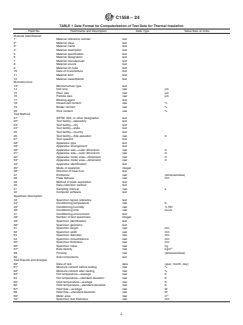
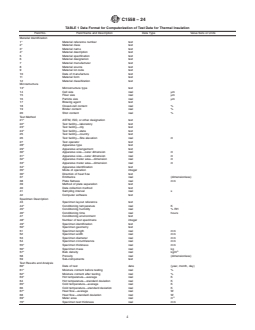
4.1 This guide defines the principal elements of information, which are considered important and worth recording and storing permanently in computerized databases. Sufficient information is provided in this guide to enable the user to construct a database structure suitable for the intended application involving thermal insulation. Guidance on the storage of (optional) digital images associated with test data is provided in Appendix X1.
4.2 Because of increased activity in building computerized materials databases and to maintain uniformity and ease of data comparison and interchange, these formats provide for the inclusion of specific elements of thermal transmission test data in databases.
4.3 The key benefit of using this guide is the establishment of a systematic approach to the management of thermal transmission test data. Other advantages include: (1) an increase in data accuracy because new test data are vetted in real time; (2) increased efficiency in data retrieval and storage; and, (3) improved data consistency. Over time, historical data can show important trends in the test measurements.
4.4 This guide has no implication on data required for materials production or purchase. Reporting of actual test results shall be as described in the actual materials specification or as agreed upon between the vendor and purchaser.
4.5 The suggested set of units for the recommended standard format given in this guide is SI. This guide, however, does not preclude other sets of units, such as inch-pound (IP).
SCOPE
1.1 This guide provides recommended formats for the recording of thermal transmission test data for thermal insulation and similar materials for inclusion in computerized material property databases. From this information, the database designer is able to construct the database dictionary preparatory for development of a database schema.
1.2 This guide is applicable to thermal transmission test data obtained from standard test methods that cover planar and radial specimen geometries.
1.3 This guide is not intended for thermal transmission data obtained for thermal insulation assemblies or systems (that is, heat transmission coefficients for walls, roofs, ceilings, and floors).
1.4 This standard does not purport to address all of the safety concerns, if any, associated with its use. It is the responsibility of the user of this standard to establish appropriate safety, health, and environmental practices and determine the applicability of regulatory limitations prior to use.
1.5 This international standard was developed in accordance with internationally recognized principles on standardization established in the Decision on Principles for the Development of International Standards, Guides and Recommendations issued by the World Trade Organization Technical Barriers to Trade (TBT) Committee.
- Status
- Published
- Publication Date
- 29-Feb-2024
- Technical Committee
- C16 - Thermal Insulation
- Drafting Committee
- C16.30 - Thermal Measurement
Buy Documents
ASTM C1558-24 - Standard Guide for Development of Standard Data Records for Computerization of Thermal Transmission Test Data for Thermal Insulation
REDLINE ASTM C1558-24 - Standard Guide for Development of Standard Data Records for Computerization of Thermal Transmission Test Data for Thermal Insulation
Overview
ASTM C1558-24 - Standard Guide for Development of Standard Data Records for Computerization of Thermal Transmission Test Data for Thermal Insulation is an internationally recognized guide developed by ASTM. It provides a comprehensive framework for recording and storing thermal transmission test data for thermal insulation materials within computerized material property databases. The guide addresses the significance of standardized data records, detailing essential information to ensure data integrity, consistency, and interoperability.
This standard is especially valuable as the construction and manufacturing industries increasingly utilize digital materials databases for managing and exchanging data related to the thermal properties of insulation materials. ASTM C1558-24 supports the systematic management of these technical data, leading to improvements in data accuracy, efficiency, and traceability.
Key Topics
- Principal Elements of Information: Defines essential fields that must be recorded, such as material identification, microstructure, test method, specimen description, and test results.
- Recommended Data Format: Offers a structured template for consolidating relevant test data, including data type and applicable SI or inch-pound units.
- Database Construction Guidance: Enables database designers to develop schemas and dictionaries aligned with standardized data structures for thermal insulation.
- Digital Images: Provides guidance on the optional storage and handling of digital images (e.g., of specimens or test setups), supporting richer documentation.
- International Applicability: Compliant with WTO recognized standardization principles, promoting data comparison and exchange globally.
Applications
Organizations that conduct thermal transmission testing and maintain, use, or share thermal insulation property databases can leverage ASTM C1558-24 to:
- Standardize Data Collection: Establish uniform data formats across projects, laboratories, and companies, facilitating reliable data aggregation and comparison.
- Improve Data Interoperability: Ensure compatibility of thermal insulation test data between different digital systems and stakeholders in supply chains, research, and regulatory compliance.
- Enhance Data Quality: By specifying essential fields for each record (e.g., material class, test method, specimen geometry, thermal conductance), the standard enables higher data accuracy and reduces gaps or ambiguity.
- Enable Historical Trend Analysis: A well-structured database supports more effective analysis of long-term trends in thermal testing, which is valuable for product development and process improvement.
- Integrate Digital Documentation: The optional inclusion of digital images in the database provides visual verification and enhances traceability of specimen identification, preparation, and testing.
- Support Accreditation and Reporting: Compliance with a recognized standard simplifies reporting requirements for accreditation, regulatory submission, and product certification processes.
Related Standards
ASTM C1558-24 references and harmonizes with a range of ASTM and ISO standards, including:
- ASTM C168: Terminology Relating to Thermal Insulation
- ASTM C177: Test Method for Steady-State Heat Flux Measurements
- ASTM C518: Test Method for Thermal Transmission Properties by Heat Flow Meter
- ASTM C335: Test Method for Pipe Insulation
- ISO 8301/8302: Steady-State Thermal Resistance, Heat Flow Meter, Guarded Hot Plate Methods
- ISO 8497, ISO 8990: Steady-State Transmission Properties for Pipes and Calibrated Hot Box
Utilizing these referenced standards in conjunction with ASTM C1558-24 ensures that recorded thermal insulation test data are both robust and comparable internationally.
Keywords: ASTM C1558-24, thermal insulation, thermal transmission, computerized database, data format, test data, building materials, digital images, standardization, interoperability.
Relations
- Effective Date
- 01-Mar-2024
- Effective Date
- 15-Apr-2024
- Effective Date
- 01-Mar-2024
- Effective Date
- 01-Mar-2024
- Effective Date
- 01-Mar-2024
- Effective Date
- 01-Mar-2024
- Effective Date
- 01-Mar-2024
- Effective Date
- 01-Mar-2023
- Effective Date
- 01-May-2022
- Effective Date
- 01-Sep-2021
- Effective Date
- 01-Oct-2020
- Effective Date
- 01-Sep-2019
Buy Documents
ASTM C1558-24 - Standard Guide for Development of Standard Data Records for Computerization of Thermal Transmission Test Data for Thermal Insulation
REDLINE ASTM C1558-24 - Standard Guide for Development of Standard Data Records for Computerization of Thermal Transmission Test Data for Thermal Insulation
Get Certified
Connect with accredited certification bodies for this standard

BSI Group
BSI (British Standards Institution) is the business standards company that helps organizations make excellence a habit.

NYCE
Mexican standards and certification body.
Sponsored listings
Frequently Asked Questions
ASTM C1558-24 is a guide published by ASTM International. Its full title is "Standard Guide for Development of Standard Data Records for Computerization of Thermal Transmission Test Data for Thermal Insulation". This standard covers: SIGNIFICANCE AND USE 4.1 This guide defines the principal elements of information, which are considered important and worth recording and storing permanently in computerized databases. Sufficient information is provided in this guide to enable the user to construct a database structure suitable for the intended application involving thermal insulation. Guidance on the storage of (optional) digital images associated with test data is provided in Appendix X1. 4.2 Because of increased activity in building computerized materials databases and to maintain uniformity and ease of data comparison and interchange, these formats provide for the inclusion of specific elements of thermal transmission test data in databases. 4.3 The key benefit of using this guide is the establishment of a systematic approach to the management of thermal transmission test data. Other advantages include: (1) an increase in data accuracy because new test data are vetted in real time; (2) increased efficiency in data retrieval and storage; and, (3) improved data consistency. Over time, historical data can show important trends in the test measurements. 4.4 This guide has no implication on data required for materials production or purchase. Reporting of actual test results shall be as described in the actual materials specification or as agreed upon between the vendor and purchaser. 4.5 The suggested set of units for the recommended standard format given in this guide is SI. This guide, however, does not preclude other sets of units, such as inch-pound (IP). SCOPE 1.1 This guide provides recommended formats for the recording of thermal transmission test data for thermal insulation and similar materials for inclusion in computerized material property databases. From this information, the database designer is able to construct the database dictionary preparatory for development of a database schema. 1.2 This guide is applicable to thermal transmission test data obtained from standard test methods that cover planar and radial specimen geometries. 1.3 This guide is not intended for thermal transmission data obtained for thermal insulation assemblies or systems (that is, heat transmission coefficients for walls, roofs, ceilings, and floors). 1.4 This standard does not purport to address all of the safety concerns, if any, associated with its use. It is the responsibility of the user of this standard to establish appropriate safety, health, and environmental practices and determine the applicability of regulatory limitations prior to use. 1.5 This international standard was developed in accordance with internationally recognized principles on standardization established in the Decision on Principles for the Development of International Standards, Guides and Recommendations issued by the World Trade Organization Technical Barriers to Trade (TBT) Committee.
SIGNIFICANCE AND USE 4.1 This guide defines the principal elements of information, which are considered important and worth recording and storing permanently in computerized databases. Sufficient information is provided in this guide to enable the user to construct a database structure suitable for the intended application involving thermal insulation. Guidance on the storage of (optional) digital images associated with test data is provided in Appendix X1. 4.2 Because of increased activity in building computerized materials databases and to maintain uniformity and ease of data comparison and interchange, these formats provide for the inclusion of specific elements of thermal transmission test data in databases. 4.3 The key benefit of using this guide is the establishment of a systematic approach to the management of thermal transmission test data. Other advantages include: (1) an increase in data accuracy because new test data are vetted in real time; (2) increased efficiency in data retrieval and storage; and, (3) improved data consistency. Over time, historical data can show important trends in the test measurements. 4.4 This guide has no implication on data required for materials production or purchase. Reporting of actual test results shall be as described in the actual materials specification or as agreed upon between the vendor and purchaser. 4.5 The suggested set of units for the recommended standard format given in this guide is SI. This guide, however, does not preclude other sets of units, such as inch-pound (IP). SCOPE 1.1 This guide provides recommended formats for the recording of thermal transmission test data for thermal insulation and similar materials for inclusion in computerized material property databases. From this information, the database designer is able to construct the database dictionary preparatory for development of a database schema. 1.2 This guide is applicable to thermal transmission test data obtained from standard test methods that cover planar and radial specimen geometries. 1.3 This guide is not intended for thermal transmission data obtained for thermal insulation assemblies or systems (that is, heat transmission coefficients for walls, roofs, ceilings, and floors). 1.4 This standard does not purport to address all of the safety concerns, if any, associated with its use. It is the responsibility of the user of this standard to establish appropriate safety, health, and environmental practices and determine the applicability of regulatory limitations prior to use. 1.5 This international standard was developed in accordance with internationally recognized principles on standardization established in the Decision on Principles for the Development of International Standards, Guides and Recommendations issued by the World Trade Organization Technical Barriers to Trade (TBT) Committee.
ASTM C1558-24 is classified under the following ICS (International Classification for Standards) categories: 35.240.50 - IT applications in industry. The ICS classification helps identify the subject area and facilitates finding related standards.
ASTM C1558-24 has the following relationships with other standards: It is inter standard links to ASTM C1558-19, ASTM C168-24, ASTM C1482-24e1, ASTM C1482-24, ASTM C1044-24, ASTM C1363-24, ASTM C739-24, ASTM C1482-23, ASTM C168-22, ASTM C739-21a, ASTM C1044-16(2020), ASTM C1363-19. Understanding these relationships helps ensure you are using the most current and applicable version of the standard.
ASTM C1558-24 is available in PDF format for immediate download after purchase. The document can be added to your cart and obtained through the secure checkout process. Digital delivery ensures instant access to the complete standard document.
Standards Content (Sample)
This international standard was developed in accordance with internationally recognized principles on standardization established in the Decision on Principles for the
Development of International Standards, Guides and Recommendations issued by the World Trade Organization Technical Barriers to Trade (TBT) Committee.
Designation: C1558 − 24
Standard Guide for
Development of Standard Data Records for Computerization
of Thermal Transmission Test Data for Thermal Insulation
This standard is issued under the fixed designation C1558; the number immediately following the designation indicates the year of
original adoption or, in the case of revision, the year of last revision. A number in parentheses indicates the year of last reapproval. A
superscript epsilon (´) indicates an editorial change since the last revision or reapproval.
1. Scope C177 Test Method for Steady-State Heat Flux Measure-
ments and Thermal Transmission Properties by Means of
1.1 This guide provides recommended formats for the
the Guarded-Hot-Plate Apparatus
recording of thermal transmission test data for thermal insula-
C195 Specification for Mineral Fiber Thermal Insulating
tion and similar materials for inclusion in computerized mate-
Cement
rial property databases. From this information, the database
C196 Specification for Expanded or Exfoliated Vermiculite
designer is able to construct the database dictionary prepara-
Thermal Insulating Cement
tory for development of a database schema.
C208 Specification for Cellulosic Fiber Insulating Board
1.2 This guide is applicable to thermal transmission test data
C335 Test Method for Steady-State Heat Transfer Properties
obtained from standard test methods that cover planar and
of Pipe Insulation
radial specimen geometries.
C449/C449M Specification for Mineral Fiber Hydraulic-
Setting Thermal Insulating and Finishing Cement
1.3 This guide is not intended for thermal transmission data
obtained for thermal insulation assemblies or systems (that is, C516 Specification for Vermiculite Loose Fill Thermal In-
sulation
heat transmission coefficients for walls, roofs, ceilings, and
floors). C518 Test Method for Steady-State Thermal Transmission
Properties by Means of the Heat Flow Meter Apparatus
1.4 This standard does not purport to address all of the
C533 Specification for Calcium Silicate Block and Pipe
safety concerns, if any, associated with its use. It is the
Thermal Insulation
responsibility of the user of this standard to establish appro-
C534 Specification for Preformed Flexible Elastomeric Cel-
priate safety, health, and environmental practices and deter-
lular Thermal Insulation in Sheet and Tubular Form
mine the applicability of regulatory limitations prior to use.
C547 Specification for Mineral Fiber Pipe Insulation
1.5 This international standard was developed in accor-
C549 Specification for Perlite Loose Fill Insulation
dance with internationally recognized principles on standard-
C552 Specification for Cellular Glass Thermal Insulation
ization established in the Decision on Principles for the
C553 Specification for Mineral Fiber Blanket Thermal Insu-
Development of International Standards, Guides and Recom-
lation for Commercial and Industrial Applications
mendations issued by the World Trade Organization Technical
C578 Specification for Rigid, Cellular Polystyrene Thermal
Barriers to Trade (TBT) Committee.
Insulation
2. Referenced Documents C592 Specification for Mineral Fiber Blanket Insulation and
Blanket-Type Pipe Insulation (Metal-Mesh Covered) (In-
2.1 ASTM Standards:
dustrial Type)
C168 Terminology Relating to Thermal Insulation
C610 Specification for Molded Expanded Perlite Block and
Pipe Thermal Insulation
This guide is under the jurisdiction of ASTM Committee C16 on Thermal C612 Specification for Mineral Fiber Block and Board
Insulation and is the direct responsibility of Subcommittee C16.30 on Thermal
Thermal Insulation
Measurement.
C656 Specification for Structural Insulating Board, Calcium
Current edition approved March 1, 2024. Published March 2024. Originally
Silicate
approved in 2003. Last previous edition approved in 2019 as C1558 – 19. DOI:
10.1520/C1558-24.
C665 Specification for Mineral-Fiber Blanket Thermal Insu-
For referenced ASTM standards, visit the ASTM website, www.astm.org, or
lation for Light Frame Construction and Manufactured
contact ASTM Customer Service at service@astm.org. For Annual Book of ASTM
Housing
Standards volume information, refer to the standard’s Document Summary page on
the ASTM website. C726 Specification for Mineral Wool Roof Insulation Board
Copyright © ASTM International, 100 Barr Harbor Drive, PO Box C700, West Conshohocken, PA 19428-2959. United States
C1558 − 24
C728 Specification for Perlite Thermal Insulation Board C1902 Specification for Cellular Glass Insulation Used in
C739 Specification for Cellulosic Fiber Loose-Fill Thermal Building and Roof Applications
Insulation
2.2 ISO Standards:
C745 Test Method for Heat Flux Through Evacuated Insu-
ISO 8301 Thermal Insulation, Determination of Steady-
lations Using a Guarded Flat Plate Boiloff Calorimeter
State Thermal Resistance and Related Properties—Heat
(Withdrawn 2008)
Flow Meter Apparatus
C764 Specification for Mineral Fiber Loose-Fill Thermal
ISO 8302 Thermal Insulation—Determination of Steady-
Insulation
State Thermal Resistance and Related Properties—
C991 Specification for Flexible Fibrous Glass Insulation for
Guarded Hot Plate Apparatus
Metal Buildings
ISO 8497 Thermal Insulation—Determination of Steady-
C1014 Specification for Spray-Applied Mineral Fiber Ther-
State Thermal Transmission Properties of Thermal Insu-
mal and Sound Absorbing Insulation
lation for Circular Pipes
C1029 Specification for Spray-Applied Rigid Cellular Poly-
ISO 8990 Thermal Insulation—Determination of Steady-
urethane Thermal Insulation
State Thermal Transmission Properties—Calibrated and
C1044 Practice for Using a Guarded-Hot-Plate Apparatus or
Guarded Hot Box
Thin-Heater Apparatus in the Single-Sided Mode
3. Terminology
C1045 Practice for Calculating Thermal Transmission Prop-
erties Under Steady-State Conditions
3.1 Definitions—For definitions of some terms applicable to
C1071 Specification for Fibrous Glass Duct Lining Insula-
this guide, see Terminology C168
tion (Thermal and Sound Absorbing Material)
3.2 Definitions of Terms Specific to This Standard:
C1086 Specification for Glass Fiber Mechanically Bonded
3.2.1 class, n—a major material class, for example, ceramic,
Felt Thermal Insulation
insulation, polymer, etc.
C1114 Test Method for Steady-State Thermal Transmission
3.2.2 data element, n—an individual piece of information
Properties by Means of the Thin-Heater Apparatus
used to describe a material or to record test results; for
C1126 Specification for Faced or Unfaced Rigid Cellular
example, a variable name or a test parameter.
Phenolic Thermal Insulation
3.2.2.1 Discussion—The term is synonymous with data
C1149 Specification for Self-Supported Spray Applied Cel-
item.
lulosic Thermal Insulation
C1289 Specification for Faced Rigid Cellular Polyisocyanu-
3.2.3 essential field, n—a field in a record that shall be
rate Thermal Insulation Board
completed in order to make the record meaningful in accor-
C1290 Specification for Flexible Fibrous Glass Blanket
dance with the pertinent guidelines or standard.
Insulation Used to Externally Insulate HVAC Ducts
3.2.3.1 Discussion—Fields are considered essential if re-
C1363 Test Method for Thermal Performance of Building
quired to make a comparison of property data from different
Materials and Envelope Assemblies by Means of a Hot
sources meaningful. A comparison of data from different
Box Apparatus
sources where essential information is omitted reduces the
C1410 Specification for Cellular Melamine Thermal and
value of the comparison.
Sound-Absorbing Insulation
3.2.4 field, n—an elementary unit of a record that contains a
C1427 Specification for Extruded Preformed Flexible Cel-
data item, a data aggregate, a pointer, or a link.
lular Polyolefin Thermal Insulation in Sheet and Tubular
3.2.5 field name, n—a name or code associated with a field
Form
and used for identification.
C1482 Specification for Polyimide Flexible Cellular Ther-
3.2.6 form, n—the material form, for example, blanket,
mal and Sound Absorbing Insulation
board, or roll.
C1484 Specification for Vacuum Insulation Panels
C1534 Specification for Flexible Polymeric Foam Sheet
3.2.7 value set, n—an open listing of representative accept-
Insulation Used as a Thermal and Sound Absorbing Liner
able text which is included in a particular field of a record.
for Duct Systems
C1594 Specification for Polyimide Rigid Cellular Thermal 4. Significance and Use
Insulation
4.1 This guide defines the principal elements of
C1631 Specification for Cellular Polypropylene Thermal
information, which are considered important and worth record-
Insulation (Withdrawn 2011)
ing and storing permanently in computerized databases. Suffi-
C1676 Specification for Microporous Thermal Insulation
cient information is provided in this guide to enable the user to
C1685 Specification for Pneumatically Applied High-
construct a database structure suitable for the intended appli-
Temperature Fiber Thermal Insulation for Industrial Ap-
cation involving thermal insulation. Guidance on the storage of
plications
(optional) digital images associated with test data is provided
C1728 Specification for Flexible Aerogel Insulation
in Appendix X1.
3 4
The last approved version of this historical standard is referenced on Available from American National Standards Institute (ANSI), 25 W. 43rd St.,
www.astm.org. 4th Floor, New York, NY 10036, http://www.ansi.org.
C1558 − 24
4.2 Because of increased activity in building computerized 5.4 Fields that indicate the accuracy of each measurement
materials databases and to maintain uniformity and ease of data are beyond the scope of this guide. However, the entries in all
fields shall be given to the appropriate number of significant
comparison and interchange, these formats provide for the
inclusion of specific elements of thermal transmission test data figures.
in databases.
6. Material Identification
4.3 The key benefit of using this guide is the establishment
6.1 The fields in this section identify the material tested.
of a systematic approach to the management of thermal
transmission test data. Other advantages include: (1) an in- NOTE 2—The numbers given in parentheses after the field name refer to
the field number in Table 1 and accompanying tables. Essential fields are
crease in data accuracy because new test data are vetted in real
identified by an asterisk (*).
time; (2) increased efficiency in data retrieval and storage; and,
6.1.1 Material Reference Number (1*) —Unique database
(3) improved data consistency. Over time, historical data can
identifier containing material and process information for the
show important trends in the test measurements.
specimens. A typical value set contains information from the
4.4 This guide has no implication on data required for
material lot code (see Field 9).
materials production or purchase. Reporting of actual test
6.1.2 Material Class (2*)—A major material class, for
results shall be as described in the actual materials specification
example ceramic, insulation, metal, polymer, rubber, etc.
or as agreed upon between the vendor and purchaser.
6.1.3 Material Name (3*)—A (generic) name for the par-
ticular material. A value set of typical responses is given in
4.5 The suggested set of units for the recommended stan-
Table 2.
dard format given in this guide is SI. This guide, however, does
6.1.4 Material Description (4*)—Descriptive name of ma-
not preclude other sets of units, such as inch-pound (IP).
terial tested, for example, E-type fibrous glass with phenolic
binder.
5. Recording of Test Data
6.1.5 Material Specification (5)—Specification and year of
5.1 Table 1 is a recommended standard format for the
issue for material name in field (3). A value set of typical
computerization of thermal transmission data for thermal
responses is given in Table 2.
insulation materials. The headings for each field are:
6.1.6 Material Designation (6)—Trade name, trademark,
brand name, etc., of material.
5.1.1 Field Number—A reference number assigned to an
6.1.7 Material Manufacturer (7)—Manufacturer of material.
individual data field that has no permanent value and does not
6.1.8 Material Source (8)—Source of material, if different
become part of the database.
from manufacturer.
5.1.2 Field Name and Description—The complete name of
6.1.9 Material Lot Code (9)—Manufacturer identification
the field, descriptive of the data element of information of
(date, plant, etc.).
interest.
6.1.10 Date of Manufacture (10)—Date of manufacture.
5.1.3 Data Type—Type of data to be included in the field,
6.1.11 Material Form (11)—Functional form of material. A
such as the type of number, character text, logical values
value set of typical responses is given in Table 2.
(yes/no), and date.
6.1.12 Material Classification (12) —ASTM Classification
5.1.4 Value Sets or Units—A listing of the types of infor-
for material, see particular material specification (include year
mation which are included in the field or, in the case of
of issue).
properties or the numeric fields, the SI units in which the
numbers are expressed.
7. Microstructure
7.1 The fields in this section pertain to the microstructure of
5.2 The presentation of the recommended standard format
the material and provide information complementary to the test
does not require that every element of information be included
results and analysis given in 10. The information requested is
in every database. There is, however, a minimum number of
basic to the characterization of the insulation and is not
fields considered essential to any database and these fields are
intended, in this condensed form, for prediction of thermal
marked with an asterisk (*).
performance.
NOTE 1—Many databases are prepared for specific applications and,
7.1.1 Microstructure Type (13*)—Composition (cellular,
therefore, some database builders will omit certain elements considered to
fibrous, particle, etc.).
be of no value for that specific application. Conversely, in some individual
7.1.2 Cell Size (14)—Diameter of cells, if applicable.
cases, additional data elements are needed and the database builder is
7.1.3 Fiber Size (15)—Diameter of fibers, if applicable.
encouraged to include these elements along with the elements in the
recommended standard format. It is important to note that not all of the 7.1.4 Particle Size (16)—Diameter of particles, if appli-
elements considered essential will be available for every test. Further, not
cable.
all of the fields included in the recommended standard format are
7.1.5 Blowing Agent (17)—Name of blowing agent, if ap-
appropriate for all tests.
plicable.
5.3 The recommended standard format is divided into five
7.1.6 Closed-cell Content (18)—Percentage of closed cells,
sections as illustrated in Fig. 1: material identification; micro- if applicable.
structure; test method; specimen description; and test results
7.1.7 Binder Content (19)—Binder content, if applicable.
and analysis. 7.1.8 Shot Content (20)—Shot content, if applicable.
C1558 − 24
TABLE 1 Data Format for Computerization of Test Data for Thermal Insulation
Field No. Field Name and Description Data Type Value Sets or Units
Material Identification
1* Material reference number text
2* Material class text
3* Material name text
4* Material description text
5 Material specification text
6 Material designation text
7 Material manufacturer text
8 Material source text
9 Material lot code text
10 Date of manufacture text
11 Material form text
12 Material classification text
Microstructure
13* Microstructure type text
14 Cell size real μm
15 Fiber size real μm
16 Particle size real μm
17 Blowing agent text
18 Closed-cell content real %
19 Binder content real %
20 Shot content real %
Test Method
21* ASTM, ISO, or other designation text
22* Test facility—laboratory text
23* Test facility—city text
24* Test facility—state text
25 Test facility—country text
26 Test facility—Site elevation real m
27 Test operator text
28* Apparatus type text
29* Apparatus arrangement text
30* Apparatus size—outer dimension real m
31* Apparatus size—outer dimension real m
32* Apparatus meter area—dimension real m
33* Apparatus meter area—dimension real m
34* Apparatus identification text
35* Mode of operation integer
36* Direction of heat flow text
37 Emittance real (dimensionless)
38 Plate flatness real mm
39 Method of plate separation text
40 Data collection method text
41 Sampling interval real s
42 Computer software text
Specimen Description
43 Specimen layout reference text
44* Conditioning temperature real K
45* Conditioning humidity real % RH
46* Conditioning time real hours
47 Conditioning environment text
48* Number of test specimens integer
49* Specimen identification text
50* Specimen geometry text
51 Specimen length real mm
52 Specimen width real mm
53 Specimen diameter real mm
54 Specimen circumference real mm
55* Specimen thickness real mm
56* Specimen mass real kg
57* Bulk density real kg/m
58 Porosity real (dimensionless)
59 Sub-components text
Test Results and Analysis
60* Date of test date (year, month, day)
61* Moisture content before testing real %
62* Moisture content after testing real %
63* Hot temperature—average real K
64 Hot temperature—standard deviation real K
65* Cold temperature—average real K
66 Cold temperature—standard deviation real K
67* Heat flow—average real W
68 Heat flow—standard deviation real W
69* Meter area real m
70* Specimen test thickness real mm
C1558 − 24
TABLE 1 Continued
Field No. Field Name and Description Data Type Value Sets or Units
71 Clamping pressure real kPa
72 Mean temperature real K
73 Temperature difference real K
74* Ambient temperature—average real K
75 Ambient temperature—standard deviation real K
76 Ambient humidity—average real %
77 Ambient humidity—standard deviation real %
78 Ambient barometric pressure—average real kPa
79 Ambient barometric pressure—standard real kPa
deviation
80* Thermal conductance—average real W/(m ·K)
81 Thermal conductance—standard deviation real W/(m ·K)
82* Thermal resistance—average real m ·K/W
83 Thermal resistance—standard deviation real m ·K/W
84 Thermal conductivity—average real W/(m·K)
85 Thermal conductivity—standard deviation real W/(m·K)
86 Thermal resistivity—average real m·K/W
87 Thermal resistivity—standard deviation real m·K/W
88* Is the test valid? logical
89* Standard uncertainty of test result real %
90* Footnotes text
* Essential field
8. Test Method 8.1.13 Method of Plate Separation (39)—Techniq
...
This document is not an ASTM standard and is intended only to provide the user of an ASTM standard an indication of what changes have been made to the previous version. Because
it may not be technically possible to adequately depict all changes accurately, ASTM recommends that users consult prior editions as appropriate. In all cases only the current version
of the standard as published by ASTM is to be considered the official document.
Designation: C1558 − 19 C1558 − 24
Standard Guide for
Development of Standard Data Records for Computerization
of Thermal Transmission Test Data for Thermal Insulation
This standard is issued under the fixed designation C1558; the number immediately following the designation indicates the year of
original adoption or, in the case of revision, the year of last revision. A number in parentheses indicates the year of last reapproval. A
superscript epsilon (´) indicates an editorial change since the last revision or reapproval.
1. Scope
1.1 This guide provides recommended formats for the recording of thermal transmission test data for thermal insulation and
similar materials for inclusion in computerized material property databases. From this information, the database designer is able
to construct the database dictionary preparatory for development of a database schema.
1.2 This guide is applicable to thermal transmission test data obtained from standard test methods that cover planar and radial
specimen geometries.
1.3 This guide is not intended for thermal transmission data obtained for thermal insulation assemblies or systems (that is, heat
transmission coefficients for walls, roofs, ceilings, and floors).
1.4 This standard does not purport to address all of the safety concerns, if any, associated with its use. It is the responsibility
of the user of this standard to establish appropriate safety, health, and environmental practices and determine the applicability of
regulatory limitations prior to use.
1.5 This international standard was developed in accordance with internationally recognized principles on standardization
established in the Decision on Principles for the Development of International Standards, Guides and Recommendations issued
by the World Trade Organization Technical Barriers to Trade (TBT) Committee.
2. Referenced Documents
2.1 ASTM Standards:
C168 Terminology Relating to Thermal Insulation
C177 Test Method for Steady-State Heat Flux Measurements and Thermal Transmission Properties by Means of the
Guarded-Hot-Plate Apparatus
C195 Specification for Mineral Fiber Thermal Insulating Cement
C196 Specification for Expanded or Exfoliated Vermiculite Thermal Insulating Cement
C208 Specification for Cellulosic Fiber Insulating Board
C335 Test Method for Steady-State Heat Transfer Properties of Pipe Insulation
C449/C449M Specification for Mineral Fiber Hydraulic-Setting Thermal Insulating and Finishing Cement
C516 Specification for Vermiculite Loose Fill Thermal Insulation
C518 Test Method for Steady-State Thermal Transmission Properties by Means of the Heat Flow Meter Apparatus
C533 Specification for Calcium Silicate Block and Pipe Thermal Insulation
This guide is under the jurisdiction of ASTM Committee C16 on Thermal Insulation and is the direct responsibility of Subcommittee C16.30 on Thermal Measurement.
Current edition approved March 1, 2019March 1, 2024. Published March 2019March 2024. Originally approved in 2003. Last previous edition approved in 20162019 as
C1558 – 16.C1558 – 19. DOI: 10.1520/C1558-19.10.1520/C1558-24.
For referenced ASTM standards, visit the ASTM website, www.astm.org, or contact ASTM Customer Service at service@astm.org. For Annual Book of ASTM Standards
volume information, refer to the standard’s Document Summary page on the ASTM website.
Copyright © ASTM International, 100 Barr Harbor Drive, PO Box C700, West Conshohocken, PA 19428-2959. United States
C1558 − 24
C534 Specification for Preformed Flexible Elastomeric Cellular Thermal Insulation in Sheet and Tubular Form
C547 Specification for Mineral Fiber Pipe Insulation
C549 Specification for Perlite Loose Fill Insulation
C552 Specification for Cellular Glass Thermal Insulation
C553 Specification for Mineral Fiber Blanket Thermal Insulation for Commercial and Industrial Applications
C578 Specification for Rigid, Cellular Polystyrene Thermal Insulation
C592 Specification for Mineral Fiber Blanket Insulation and Blanket-Type Pipe Insulation (Metal-Mesh Covered) (Industrial
Type)
C610 Specification for Molded Expanded Perlite Block and Pipe Thermal Insulation
C612 Specification for Mineral Fiber Block and Board Thermal Insulation
C656 Specification for Structural Insulating Board, Calcium Silicate
C665 Specification for Mineral-Fiber Blanket Thermal Insulation for Light Frame Construction and Manufactured Housing
C726 Specification for Mineral Wool Roof Insulation Board
C728 Specification for Perlite Thermal Insulation Board
C739 Specification for Cellulosic Fiber Loose-Fill Thermal Insulation
C745 Test Method for Heat Flux Through Evacuated Insulations Using a Guarded Flat Plate Boiloff Calorimeter (Withdrawn
2008)
C764 Specification for Mineral Fiber Loose-Fill Thermal Insulation
C991 Specification for Flexible Fibrous Glass Insulation for Metal Buildings
C1014 Specification for Spray-Applied Mineral Fiber Thermal and Sound Absorbing Insulation
C1029 Specification for Spray-Applied Rigid Cellular Polyurethane Thermal Insulation
C1044 Practice for Using a Guarded-Hot-Plate Apparatus or Thin-Heater Apparatus in the Single-Sided Mode
C1045 Practice for Calculating Thermal Transmission Properties Under Steady-State Conditions
C1071 Specification for Fibrous Glass Duct Lining Insulation (Thermal and Sound Absorbing Material)
C1086 Specification for Glass Fiber Mechanically Bonded Felt Thermal Insulation
C1114 Test Method for Steady-State Thermal Transmission Properties by Means of the Thin-Heater Apparatus
C1126 Specification for Faced or Unfaced Rigid Cellular Phenolic Thermal Insulation
C1149 Specification for Self-Supported Spray Applied Cellulosic Thermal Insulation
C1289 Specification for Faced Rigid Cellular Polyisocyanurate Thermal Insulation Board
C1290 Specification for Flexible Fibrous Glass Blanket Insulation Used to Externally Insulate HVAC Ducts
C1363 Test Method for Thermal Performance of Building Materials and Envelope Assemblies by Means of a Hot Box Apparatus
C1410 Specification for Cellular Melamine Thermal and Sound-Absorbing Insulation
C1427 Specification for Extruded Preformed Flexible Cellular Polyolefin Thermal Insulation in Sheet and Tubular Form
C1482 Specification for Polyimide Flexible Cellular Thermal and Sound Absorbing Insulation
C1484 Specification for Vacuum Insulation Panels
C1534 Specification for Flexible Polymeric Foam Sheet Insulation Used as a Thermal and Sound Absorbing Liner for Duct
Systems
C1594 Specification for Polyimide Rigid Cellular Thermal Insulation
C1631 Specification for Cellular Polypropylene Thermal Insulation (Withdrawn 2011)
C1676 Specification for Microporous Thermal Insulation
C1685 Specification for Pneumatically Applied High-Temperature Fiber Thermal Insulation for Industrial Applications
C1728 Specification for Flexible Aerogel Insulation
C1902 Specification for Cellular Glass Insulation Used in Building and Roof Applications
2.2 ISO Standards:
ISO 8301 Thermal Insulation, Determination of Steady-State Thermal Resistance and Related Properties—Heat Flow Meter
Apparatus
ISO 8302 Thermal Insulation—Determination of Steady-State Thermal Resistance and Related Properties—Guarded Hot Plate
Apparatus
ISO 8497 Thermal Insulation—Determination of Steady-State Thermal Transmission Properties of Thermal Insulation for
Circular Pipes
ISO 8990 Thermal Insulation—Determination of Steady-State Thermal Transmission Properties—Calibrated and Guarded Hot
Box
3. Terminology
3.1 Definitions—For definitions of some terms applicable to this guide, see Terminology C168
The last approved version of this historical standard is referenced on www.astm.org.
Available from American National Standards Institute (ANSI), 25 W. 43rd St., 4th Floor, New York, NY 10036, http://www.ansi.org.
C1558 − 24
3.2 Definitions of Terms Specific to This Standard:
3.2.1 class, n—a major material class, for example, ceramic, insulation, polymer, etc.
3.2.2 data element, n—an individual piece of information used to describe a material or to record test results; for example, a
variable name or a test parameter.
3.2.2.1 Discussion—
The term is synonymous with data item.
3.2.3 essential field, n—a field in a record that shall be completed in order to make the record meaningful in accordance with the
pertinent guidelines or standard.
3.2.3.1 Discussion—
Fields are considered essential if required to make a comparison of property data from different sources meaningful. A comparison
of data from different sources where essential information is omitted reduces the value of the comparison.
3.2.4 field, n—an elementary unit of a record that contains a data item, a data aggregate, a pointer, or a link.
3.2.5 field name, n—a name or code associated with a field and used for identification.
3.2.6 form, n—the material form, for example, blanket, board, or roll.
3.2.7 value set, n—an open listing of representative acceptable text which is included in a particular field of a record.
4. Significance and Use
4.1 This guide defines the principal elements of information, which are considered important and worth recording and storing
permanently in computerized databases. Sufficient information is provided in this guide to enable the user to construct a database
structure suitable for the intended application involving thermal insulation. Guidance on the storage of (optional) digital images
associated with test data is provided in Appendix X1.
4.2 Because of increased activity in building computerized materials databases and to maintain uniformity and ease of data
comparison and interchange, these formats provide for the inclusion of specific elements of thermal transmission test data in
databases.
4.3 The key benefit of using this guide is the establishment of a systematic approach to the management of thermal transmission
test data. Other advantages include: (1) an increase in data accuracy because new test data are vetted in real time; (2) increased
efficiency in data retrieval and storage; and, (3) improved data consistency. Over time, historical data can show important trends
in the test measurements.
4.4 This guide has no implication on data required for materials production or purchase. Reporting of actual test results shall be
as described in the actual materials specification or as agreed upon between the vendor and purchaser.
4.5 The suggested set of units for the recommended standard format given in this guide is SI. This guide, however, does not
preclude other sets of units, such as inch-pound (IP).
5. Recording of Test Data
5.1 Table 1 is a recommended standard format for the computerization of thermal transmission data for thermal insulation
materials. The headings for each field are:
5.1.1 Field Number—A reference number assigned to an individual data field that has no permanent value and does not become
part of the database.
5.1.2 Field Name and Description—The complete name of the field, descriptive of the data element of information of interest.
C1558 − 24
TABLE 1 Data Format for Computerization of Test Data for Thermal Insulation
Field No. Field Name and Description Data Type Value Sets or Units
Material Identification
1* Material reference number text
2* Material class text
3* Material name text
4* Material description text
5 Material specification text
6 Material designation text
7 Material manufacturer text
8 Material source text
9 Material lot code text
10 Date of manufacture text
11 Material form text
12 Material classification text
Microstructure
13* Microstructure type text
14 Cell size real μm
15 Fiber size real μm
16 Particle size real μm
17 Blowing agent text
18 Closed-cell content real %
19 Binder content real %
20 Shot content real %
Test Method
21* ASTM, ISO, or other designation text
22* Test facility—laboratory text
23* Test facility—city text
24* Test facility—state text
25 Test facility—country text
26 Test facility—Site elevation real m
27 Test operator text
28* Apparatus type text
29* Apparatus arrangement text
30* Apparatus size—outer dimension real m
31* Apparatus size—outer dimension real m
32* Apparatus meter area—dimension real m
33* Apparatus meter area—dimension real m
34* Apparatus identification text
35* Mode of operation integer
36* Direction of heat flow text
37 Emittance real (dimensionless)
38 Plate flatness real mm
39 Method of plate separation text
40 Data collection method text
41 Sampling interval real s
42 Computer software text
Specimen Description
43 Specimen layout reference text
44* Conditioning temperature real K
45* Conditioning humidity real % RH
46* Conditioning time real hours
47 Conditioning environment text
48* Number of test specimens integer
49* Specimen identification text
50* Specimen geometry text
51 Specimen length real mm
52 Specimen width real mm
53 Specimen diameter real mm
54 Specimen circumference real mm
55* Specimen thickness real mm
56* Specimen mass real kg
57* Bulk density real kg/m
58 Porosity real (dimensionless)
59 Sub-components text
Test Results and Analysis
60* Date of test date (year, month, day)
61* Moisture content before testing real %
62* Moisture content after testing real %
63* Hot temperature—average real K
64 Hot temperature—standard deviation real K
65* Cold temperature—average real K
66 Cold temperature—standard deviation real K
67* Heat flow—average real W
68 Heat flow—standard deviation real W
69* Meter area real m
70* Specimen test thickness real mm
C1558 − 24
TABLE 1 Continued
Field No. Field Name and Description Data Type Value Sets or Units
71 Clamping pressure real kPa
72 Mean temperature real K
73 Temperature difference real K
74* Ambient temperature—average real K
75 Ambient temperature—standard deviation real K
76 Ambient humidity—average real %
77 Ambient humidity—standard deviation real %
78 Ambient barometric pressure—average real kPa
79 Ambient barometric pressure—standard real kPa
deviation
80* Thermal conductance—average real W/(m ·K)
81 Thermal conductance—standard deviation real W/(m ·K)
82* Thermal resistance—average real m ·K/W
83 Thermal resistance—standard deviation real m ·K/W
84 Thermal conductivity—average real W/(m·K)
85 Thermal conductivity—standard deviation real W/(m·K)
86 Thermal resistivity—average real m·K/W
87 Thermal resistivity—standard deviation real m·K/W
88* Is the test valid? logical
89* Standard uncertainty of test result real %
90* Footnotes text
* Essential field
5.1.3 Data Type—Type of data to be included in the field, such as the type of number, character text, logical values (yes/no), and
date.
5.1.4 Value Sets or Units—A listing of the types of information which are included in the field or, in the case of properties or the
numeric fields, the SI units in which the numbers are expressed.
5.2 The presentation of the recommended standard format does not require that every element of information be included in every
database. There is, however, a minimum number of fields considered essential to any database and these fields are marked with
an asterisk (*).
NOTE 1—Many databases are prepared for specific applications and, therefore, some database builders will omit certain elements considered to be of no
value for that specific application. Conversely, in some individual cases, additional data elements are needed and the database builder is encouraged to
include these elements along with the elements in the recommended standard format. It is important to note that not all of the elements considered essential
will be available for every test. Further, not all of the fields included in the recommended standard format are appropriate for all tests.
5.3 The recommended standard format is divided into five sections as illustrated in Fig. 1: material identification; microstructure;
test method; specimen description; and test results and analysis.
5.4 Fields that indicate the accuracy of each measurement are beyond the scope of this guide. However, the entries in all fields
shall be given to the appropriate number of significant figures.
6. Material Identification
6.1 The fields in this section identify the material tested.
NOTE 2—The numbers given in parentheses after the field name refer to the field number in Table 1 and accompanying tables. Essential fields are identified
by an asterisk (*).
6.1.1 Material Reference Number (1*) —Unique database identifier containing material and process information for the
specimens. A typical value set contains information from the material lot code (see Field 9).
6.1.2 Material Class (2*)—A major material class, for example ceramic, insulation, metal, polymer, rubber, etc.
6.1.3 Material Name (3*)—A (generic) name for the particular material. A value set of typical responses is given in Table 2.
6.1.4 Material Description (4*)—Descriptive name of material tested, for example, E-type fibrous glass with phenolic binder.
C1558 − 24
FIG. 1 Sequence of Steps for Entering Data
6.1.5 Material Specification (5)—Specification and year of issue for material name in field (3). A value set of typical responses
is given in Table 2.
6.1.6 Material Designation (6)—Trade name, trademark, brand name, etc., of material.
6.1.7 Material Manufacturer (7)—Manufacturer of material.
6.1.8 Material Source (8)—Source of material, if different from manufacturer.
C1558 − 24
TABLE 2 Typical Information for Material Name, Specification, and Form
A
Material Name Material Specification Material Form
Calcium Silicate C533, C656 Block/Pipe, Board
Cellular Glass C552, C1902 Block/Board/Pipe/Special
Cellular Elastomeric C534 Pipe/Sheet
Cellular Melamine C1410 Slab/Pipe/Special
Cellular Phenolic C1126 Board/Pipe
Cellular Polyimide C1482, C1594 Slab
Cellular Polyisocyanurate C1289 Board
Cellular Polymeric C1534 Sheet
Cellular Polyolefin C1427 Pipe/Sheet
Cellular Polypropylene C1631 Block/Board
Cellular Polystyrene C578 Board
Cellular Polyurethane, Spray C1029 Spray
Cellulosic Fiber C739 Loose
Cellulosic Fiberboard C208 Board
Cellulosic, Spray C1149 Spray
Fibrous Glass C991, C1071, C1290 Blanket, Blanket/Board, Blanket
Flexible Aerogel C1728 Blanket
Glass Fiber Felt C1086 Mat
Microporous C1676 Board/Quilted Panel /Pipe
Mineral Fiber C553, C592, C665, C612, C764, C726, C547, C1685 Blanket, Block, Board, Loose, Pipe
Mineral Fiber Insulating Cement C195 Paste (dry after application), Flat/Special
Mineral Fiber Hydraulic Cement C449/C449M Paste (dry after application), Flat/Special
Mineral Fiber, Spray C1014 Spray
Perlite C
...