

ASTM E911-98(2021)
(Specification)Standard Specification for Glass Stopcocks with Polytetrafluoroethylene (PTFE) Plugs
General Information
- Abstract
ABSTRACT
This specification covers dimensional interchangeability requirements of glass stopcocks with polytetrafluoroethylene (PTFE) plugs for use in ordinary laboratory and industrial applications. However, it does not cover the design characteristics of the stopcock-plug assembly nor the physical or chemical properties of the materials used. Glass stopcocks with glass plugs or stopcocks for use in high-vacuum applications are not covered as well. The plug shall be manufactured from PTFE material of Types I and IV, extrusion and molding grade resins. Stopcocks, on the other hand, shall be manufactured from glass into one of various types: single straight-bore stopcock, single oblique-bore stopcock, double oblique-bore (three-way) stopcock, T-bore stopcock, or angled-bore stopcock. Tests for dimension conformity, taper, leak rate, and performance shall be performed and shall conform to the requirements specified.
SCOPE
1.1 This specification covers standard dimensional requirements for obtaining, within practical limits, interchangeability in glass stopcocks (Note 1) with polytetrafluoroethylene (PTFE) plugs for ordinary laboratory and industrial applications. It covers dimensional interchangeability only and does not involve design characteristics of the item except where specified, nor does it involve physical or chemical characteristics of the material used. It does not cover glass stopcocks with glass plugs (Note 2) or stopcocks intended for use in high-vacuum work.
Note 1: A stopcock is defined as consisting of a plug and barrel in assembled configuration.
Note 2: Glass stopcocks with glass plugs are covered by Specification E675.
Note 3: The dimensions pertaining to stopcocks were taken from the now obsolete Commercial Standard CS 21-58 of the U.S. Department of Commerce and Product Standard PS 28-70 published by the National Bureau of Standards.
Note 4: Although glass is the most common material for stopcocks, other materials may be used as specified. Stopcocks constructed from glass shall be in accordance with Specifications E438 and E671.
1.2 This international standard was developed in accordance with internationally recognized principles on standardization established in the Decision on Principles for the Development of International Standards, Guides and Recommendations issued by the World Trade Organization Technical Barriers to Trade (TBT) Committee.
- Status
- Published
- Publication Date
- 31-Dec-2020
- Technical Committee
- E41 - Laboratory Apparatus
- Drafting Committee
- E41.01 - Laboratory Ware and Supplies

Overview
ASTM E911-98(2021) is the internationally recognized standard specification for glass stopcocks with polytetrafluoroethylene (PTFE) plugs used in laboratory and industrial applications. Developed by ASTM International, this standard specifies the dimensional interchangeability requirements to ensure compatibility and performance of glass stopcocks fitted with PTFE plugs. It focuses strictly on dimensional interchangeability and does not address design features or the chemical or physical properties of materials. Glass stopcocks with glass plugs and those intended for high-vacuum applications are not included within the scope.
Key Topics
- Dimensional Interchangeability: The standard prescribes measurements and tolerances to guarantee that glass stopcocks and PTFE plugs from different manufacturers can be used interchangeably. This facilitates repairs, replacements, and system flexibility in laboratory setups.
- Stopcock Types Covered:
- Single straight-bore stopcocks
- Single oblique-bore stopcocks
- Double oblique-bore (three-way) stopcocks
- T-bore stopcocks
- Angled-bore stopcocks
- Material Requirements: PTFE plugs must be manufactured from Types I or IV (extrusion or molding grades) as per relevant standards. Glass used must comply with other ASTM laboratory glassware specifications.
- Testing Requirements: Procedures for conformity evaluation include checks for:
- Dimensional accuracy (plug and barrel)
- Taper and fit of the plug
- Leak rate under specified conditions
- General performance criteria
- Marking: All compliant stopcocks must be clearly marked on the glass barrel with the appropriate size designation and manufacturer or distributor trademark, indicating conformance to the standard.
Applications
ASTM E911-98(2021) is essential for laboratories and industries where chemical handling, mixing, or flow control is performed under non-high-vacuum conditions. Practical applications include:
- Laboratory Glassware: Used in burettes, reaction vessels, chromatography columns, and various custom apparatus requiring precise liquid or gas control.
- Chemical and Pharmaceutical Manufacturing: Ensures easy maintenance and replacement of components in pilot plants and process setups.
- Quality Assurance: Aids procurement teams in specifying and sourcing interchangeable laboratory equipment components, fostering operational efficiency and reliability.
- International Trade: Ensures that laboratory glass stopcocks with PTFE plugs from different global suppliers meet uniform standards, simplifying inventory and logistics.
Related Standards
When implementing or referencing ASTM E911-98(2021), consider these related standards to ensure comprehensive compliance and equipment compatibility:
- ASTM E438: Specification for glasses used in laboratory apparatus.
- ASTM E671: Specification relating to maximum permissible thermal residual stress in annealed glass laboratory apparatus.
- ASTM E675: Specification for interchangeable taper-ground glass stopcocks and stoppers (for glass plugs).
- ASTM E920 / E921 / E1133: Specifications relating to packaging and performance testing of laboratory glassware.
- ASTM E1157: Specification for sampling and testing of reusable laboratory glassware.
- ASTM D1457: Specification for PTFE molding and extrusion materials.
Conclusion
Implementing ASTM E911-98(2021) ensures interchangeability, reliability, and safety in laboratory and industrial setups using glass stopcocks with PTFE plugs. Adherence to this ASTM standard helps organizations streamline equipment sourcing, maintenance, and compliance in global laboratory environments. For full details and official documentation, always consult the latest edition directly from ASTM International.
Relations
- Effective Date
- 01-Feb-2024
- Effective Date
- 01-Jul-2019
- Refers
ASTM E675-02(2019) - Standard Specification for Interchangeable Taper-Ground Stopcocks And Stoppers - Effective Date
- 01-Jan-2019
- Effective Date
- 01-Jan-2018
- Effective Date
- 01-Nov-2013
- Refers
ASTM E675-02(2012) - Standard Specification for Interchangeable Taper-Ground Stopcocks And Stoppers - Effective Date
- 01-Nov-2012
- Effective Date
- 01-Dec-2011
- Effective Date
- 01-Dec-2011
- Effective Date
- 01-Dec-2011
- Effective Date
- 01-Sep-2010
- Effective Date
- 15-May-2010
- Effective Date
- 01-Apr-2010
- Effective Date
- 01-Nov-2008
- Refers
ASTM E675-02(2007) - Standard Specification for Interchangeable Taper-Ground Stopcocks And Stoppers - Effective Date
- 01-Nov-2007
- Effective Date
- 01-Nov-2006
Get Certified
Connect with accredited certification bodies for this standard

ECOCERT
Organic and sustainability certification.

Eurofins Food Testing Global
Global leader in food, environment, and pharmaceutical product testing.

Intertek Bangladesh
Intertek certification and testing services in Bangladesh.
Sponsored listings
Frequently Asked Questions
ASTM E911-98(2021) is a technical specification published by ASTM International. Its full title is "Standard Specification for Glass Stopcocks with Polytetrafluoroethylene (PTFE) Plugs". This standard covers: ABSTRACT This specification covers dimensional interchangeability requirements of glass stopcocks with polytetrafluoroethylene (PTFE) plugs for use in ordinary laboratory and industrial applications. However, it does not cover the design characteristics of the stopcock-plug assembly nor the physical or chemical properties of the materials used. Glass stopcocks with glass plugs or stopcocks for use in high-vacuum applications are not covered as well. The plug shall be manufactured from PTFE material of Types I and IV, extrusion and molding grade resins. Stopcocks, on the other hand, shall be manufactured from glass into one of various types: single straight-bore stopcock, single oblique-bore stopcock, double oblique-bore (three-way) stopcock, T-bore stopcock, or angled-bore stopcock. Tests for dimension conformity, taper, leak rate, and performance shall be performed and shall conform to the requirements specified. SCOPE 1.1 This specification covers standard dimensional requirements for obtaining, within practical limits, interchangeability in glass stopcocks (Note 1) with polytetrafluoroethylene (PTFE) plugs for ordinary laboratory and industrial applications. It covers dimensional interchangeability only and does not involve design characteristics of the item except where specified, nor does it involve physical or chemical characteristics of the material used. It does not cover glass stopcocks with glass plugs (Note 2) or stopcocks intended for use in high-vacuum work. Note 1: A stopcock is defined as consisting of a plug and barrel in assembled configuration. Note 2: Glass stopcocks with glass plugs are covered by Specification E675. Note 3: The dimensions pertaining to stopcocks were taken from the now obsolete Commercial Standard CS 21-58 of the U.S. Department of Commerce and Product Standard PS 28-70 published by the National Bureau of Standards. Note 4: Although glass is the most common material for stopcocks, other materials may be used as specified. Stopcocks constructed from glass shall be in accordance with Specifications E438 and E671. 1.2 This international standard was developed in accordance with internationally recognized principles on standardization established in the Decision on Principles for the Development of International Standards, Guides and Recommendations issued by the World Trade Organization Technical Barriers to Trade (TBT) Committee.
ABSTRACT This specification covers dimensional interchangeability requirements of glass stopcocks with polytetrafluoroethylene (PTFE) plugs for use in ordinary laboratory and industrial applications. However, it does not cover the design characteristics of the stopcock-plug assembly nor the physical or chemical properties of the materials used. Glass stopcocks with glass plugs or stopcocks for use in high-vacuum applications are not covered as well. The plug shall be manufactured from PTFE material of Types I and IV, extrusion and molding grade resins. Stopcocks, on the other hand, shall be manufactured from glass into one of various types: single straight-bore stopcock, single oblique-bore stopcock, double oblique-bore (three-way) stopcock, T-bore stopcock, or angled-bore stopcock. Tests for dimension conformity, taper, leak rate, and performance shall be performed and shall conform to the requirements specified. SCOPE 1.1 This specification covers standard dimensional requirements for obtaining, within practical limits, interchangeability in glass stopcocks (Note 1) with polytetrafluoroethylene (PTFE) plugs for ordinary laboratory and industrial applications. It covers dimensional interchangeability only and does not involve design characteristics of the item except where specified, nor does it involve physical or chemical characteristics of the material used. It does not cover glass stopcocks with glass plugs (Note 2) or stopcocks intended for use in high-vacuum work. Note 1: A stopcock is defined as consisting of a plug and barrel in assembled configuration. Note 2: Glass stopcocks with glass plugs are covered by Specification E675. Note 3: The dimensions pertaining to stopcocks were taken from the now obsolete Commercial Standard CS 21-58 of the U.S. Department of Commerce and Product Standard PS 28-70 published by the National Bureau of Standards. Note 4: Although glass is the most common material for stopcocks, other materials may be used as specified. Stopcocks constructed from glass shall be in accordance with Specifications E438 and E671. 1.2 This international standard was developed in accordance with internationally recognized principles on standardization established in the Decision on Principles for the Development of International Standards, Guides and Recommendations issued by the World Trade Organization Technical Barriers to Trade (TBT) Committee.
ASTM E911-98(2021) is classified under the following ICS (International Classification for Standards) categories: 71.040.20 - Laboratory ware and related apparatus. The ICS classification helps identify the subject area and facilitates finding related standards.
ASTM E911-98(2021) has the following relationships with other standards: It is inter standard links to ASTM E438-92(2024), ASTM E920-97(2019), ASTM E675-02(2019), ASTM E438-92(2018), ASTM E920-97(2013), ASTM E675-02(2012), ASTM E1157-87(2018)e1, ASTM E438-92(2011), ASTM E1157-87(2011), ASTM E1133-86(2010), ASTM E921-97(2010), ASTM E671-98(2010), ASTM E920-97(2008), ASTM E675-02(2007), ASTM E1157-87(2006). Understanding these relationships helps ensure you are using the most current and applicable version of the standard.
ASTM E911-98(2021) is available in PDF format for immediate download after purchase. The document can be added to your cart and obtained through the secure checkout process. Digital delivery ensures instant access to the complete standard document.
Standards Content (Sample)
This international standard was developed in accordance with internationally recognized principles on standardization established in the Decision on Principles for the
Development of International Standards, Guides and Recommendations issued by the World Trade Organization Technical Barriers to Trade (TBT) Committee.
Designation:E911 −98 (Reapproved 2021)
Standard Specification for
Glass Stopcocks with Polytetrafluoroethylene (PTFE) Plugs
This standard is issued under the fixed designation E911; the number immediately following the designation indicates the year of
original adoption or, in the case of revision, the year of last revision. A number in parentheses indicates the year of last reapproval. A
superscript epsilon (´) indicates an editorial change since the last revision or reapproval.
1. Scope Molding and Extrusion Materials (Withdrawn 1996)
E438 Specification for Glasses in Laboratory Apparatus
1.1 This specification covers standard dimensional require-
E671 Specification for Maximum Permissible Thermal Re-
ments for obtaining, within practical limits, interchangeability
sidual Stress in Annealed Glass Laboratory Apparatus
in glass stopcocks (Note 1) with polytetrafluoroethylene
E675 Specification for Interchangeable Taper-Ground Stop-
(PTFE) plugs for ordinary laboratory and industrial applica-
cocks And Stoppers
tions. It covers dimensional interchangeability only and does
E920 Specification for Commercially Packaged Laboratory
not involve design characteristics of the item except where
Apparatus
specified, nor does it involve physical or chemical character-
E921 Specification for Export Packaged Laboratory Appa-
istics of the material used. It does not cover glass stopcocks
ratus
with glass plugs (Note 2) or stopcocks intended for use in
E1133 Practice for Performance Testing of Packaged Labo-
high-vacuum work.
ratory Apparatus for United States Government Procure-
NOTE 1—A stopcock is defined as consisting of a plug and barrel in
ments
assembled configuration.
E1157 Specification for Sampling and Testing of Reusable
NOTE 2—Glass stopcocks with glass plugs are covered by Specification
Laboratory Glassware
E675.
2.2 Other Standard:
NOTE 3—The dimensions pertaining to stopcocks were taken from the
now obsolete Commercial Standard CS 21-58 of the U.S. Department of PS 28-70 Glass Stopcocks With Polytetrafluoroethylene
Commerce and Product Standard PS 28-70 published by the National
(PTFE) Plugs
Bureau of Standards.
NOTE 4—Although glass is the most common material for stopcocks,
3. Material
other materials may be used as specified. Stopcocks constructed from
glass shall be in accordance with Specifications E438 and E671. 3.1 The PTFE material used to manufacture the plugs shall
be in accordance with the requirements of Specification D1457
1.2 This international standard was developed in accor-
Types I and IV, extrusion and molding grade resins.
dance with internationally recognized principles on standard-
ization established in the Decision on Principles for the
4. Requirements for Single Straight-Bore Stopcocks
Development of International Standards, Guides and Recom-
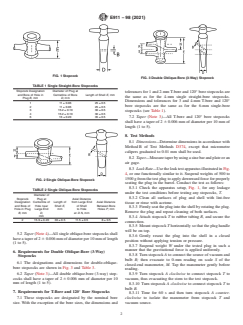
4.1 The designations and dimensions for single straight-
mendations issued by the World Trade Organization Technical
bore stopcocks are shown in Fig. 1 and Table 1.
Barriers to Trade (TBT) Committee.
4.2 Taper (Note 3)—All straight-bore stopcocks shall have a
2. Referenced Documents
taper of 2 6 0.006 mm of diameter per 10 mm of length (1 to
5).
2.1 ASTM Standards:
D374 Test Methods for Thickness of Solid Electrical Insu-
NOTE 5—The lines of contact of the mating surfaces should form a
lation (Metric) D0374_D0374M conical section having a taper of 2 6 0.006 mm per 1 cm of axial length
(before compression of the plug surface) for an axial distance of at least
D1457 Specification for Polytetrafluoroethylene (PTFE)
10 mm on each side of the bore.
5. Requirements for Single Oblique-Bore Stopcocks
This specification is under the jurisdiction of ASTM Committee E41 on
5.1 The designations and dimensions for single oblique-
Laboratory Apparatus and is the direct responsibility of Subcommittee E41.01 on
bore stopcocks are shown in Fig. 2 and Table 2.
Laboratory Ware and Supplies.
Current edition approved Jan. 1, 2021. Published February 2021. Originally
approvedin1982.Lastpreviouseditionapprovedin2015asE911 – 98(2015).DOI:
10.1520/E0911-98R21. The last approved version of this historical standard is referenced on
For referenced ASTM standards, visit the ASTM website, www.astm.org, or www.astm.org.
contact ASTM Customer Service at service@astm.org. For Annual Book of ASTM Commercial Standards and Product Standards are available from National
Standards volume information, refer to the standard’s Document Summary page on Institute of Standards and Technology (NIST), 100 Bureau Dr., Stop 1070,
the ASTM website. Gaithersburg, MD 20899-1070, http://www.nist.gov.
Copyright © ASTM International, 100 Barr Harbor Drive, PO Box C700, West Conshohocken, PA 19428-2959. United States
E911−98 (2021)
FIG. 1Stopcock
FIG. 3Double Oblique-Bore (3-Way) Stopcock
TABLE 1 Single Straight-Bore Stopcocks
Stopcock Designation Diameter of Plug at
tolerances for 1 and 2-mm T-bore and 120° bore stopcocks are
and Bore of Hole in Centerline of Bore Length of Shell E,mm
the same as for the 4-mm single straight-bore stopcocks.
Plug B,mm D,mm
Dimensions and tolerances for 3 and 4-mm T-bore and 120°
1 11±0.06 25±0.5
bore stopcocks are the same as for the 6-mm single-bore
2 11±0.06 25±0.5
3 15.2±0.10 30±0.5
stopcocks (see Table 1).
4 15.2±0.10 30±0.5
6 16±0.20 35±0.5 7.2 Taper (Note 3)—All T-bore and 120° bore stopcocks
shall have a taper of 2 6 0.006 mm of diameter per 10 mm of
length (1 to 5).
8. Test Methods
8.1 Dimensions—Determine dimensions in accordance with
Method B of Test Methods D374, except that micrometre
calipers graduated to 0.01 mm shall be used.
8.2 Taper—Measuretaperbyusingasinebarandplateoran
air gage.
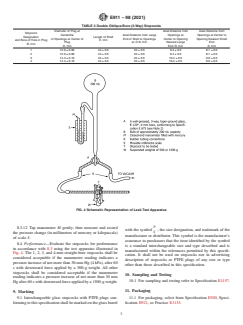
8.3 LeakRate—UsetheleaktestapparatusillustratedinFig.
4, or one
...