

ASTM A726-18
(Specification)Standard Specification for Cold-Rolled Magnetic Lamination Quality Steel, Semiprocessed Types
General Information
- Abstract
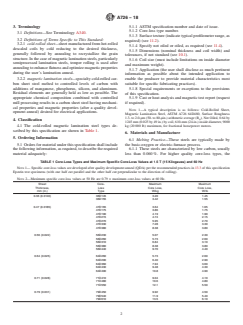
ABSTRACT
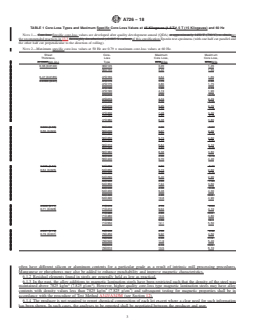
This specification covers the standard requirements for semi-processed cold-rolled magnetic lamination quality steels. These steels shall be made by the basic-oxygen or electric-furnace method and shall be processed by hot rolling, pickling, cold rolling, annealing, and temper rolling. Magnetic lamination steels shall have low-carbon contents and may have manganese, phosphorus, silicon, and aluminum additions to enhance punchability and to improve magnetic characteristics by increasing the electrical resistivity. There are no fixed chemical requirements for these steels only the requirement to meet the specified magnetic properties. These steels must be heat treated by the user to develop the specified magnetic properties. This specification covered steels with thicknesses of 0.0185 in. ( 0.47 mm), 0.022 in. (0.56 mm), 0.025 in. (0.64 mm), 0.028 in. (0.71 mm) and 0.031 in. (0.79 mm). For a given thickness there are three or more core loss types distinguished by maximum allowable core loss after a specified quality development anneal. Magnetic testing shall be done after the specified quality development anneal and shall use the Epstein test method. Magnetic testing shall be done at a test frequency of 60 Hz and a maximum flux density of 15 kG (1.5 T). Test methods to determine the magnetic and mechanical properties are listed. Other typical magnetic and physical properties are listed for reference.
SCOPE
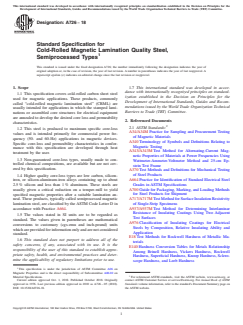
1.1 This specification covers cold-rolled carbon sheet steel used for magnetic applications. These products, commonly called “cold-rolled magnetic lamination steel” (CRML) are usually intended for applications in which the stamped laminations or assembled core structures for electrical equipment are annealed to develop the desired core loss and permeability characteristics.
1.2 This steel is produced to maximum specific core-loss values and is intended primarily for commercial power frequency (50- and 60-Hz) applications in magnetic devices. Specific core-loss and permeability characteristics in conformance with this specification are developed through heat treatment by the user.
1.3 Non-guaranteed core-loss types, usually made to controlled chemical compositions, are available but are not covered by this specification.
1.4 Higher quality core-loss types are low carbon, silicon-iron, or silicon-aluminum-iron alloys containing up to about 2.5 % silicon and less than 1 % aluminum. These steels are usually given a critical reduction on a temper-mill to yield specified magnetic properties after a suitable lamination anneal. These products, typically called semiprocessed magnetic lamination steel, are classified by the ASTM Code Letter D in accordance with Practice A664.
1.5 The values stated in SI units are to be regarded as standard. The values given in parentheses are mathematical conversions to customary (cgs-emu and inch-pound) units which are provided for information only and are not considered standard.
1.6 This standard does not purport to address all of the safety concerns, if any, associated with its use. It is the responsibility of the user of this standard to establish appropriate safety, health, and environmental practices and determine the applicability of regulatory limitations prior to use.
1.7 This international standard was developed in accordance with internationally recognized principles on standardization established in the Decision on Principles for the Development of International Standards, Guides and Recommendations issued by the World Trade Organization Technical Barriers to Trade (TBT) Committee.
- Status
- Published
- Publication Date
- 30-Sep-2018
- Technical Committee
- A06 - Magnetic Properties
- Drafting Committee
- A06.02 - Material Specifications
Buy Documents
ASTM A726-18 - Standard Specification for Cold-Rolled Magnetic Lamination Quality Steel, Semiprocessed Types
REDLINE ASTM A726-18 - Standard Specification for Cold-Rolled Magnetic Lamination Quality Steel, Semiprocessed Types
Overview
ASTM A726-18 establishes the standard specification for cold-rolled magnetic lamination quality steel, semiprocessed types. These materials-commonly referenced as Cold-Rolled Magnetic Lamination Steel (CRML)-are produced through controlled metallurgical and mechanical procedures to meet critical requirements for magnetic applications. They are primarily intended for use in electrical devices where the steel’s magnetic properties can be further enhanced by subsequent heat treatment.
The specification details the manufacturing processes, chemical and mechanical characteristics, permissible dimensions, core-loss classifications, and testing methods necessary to ensure steel products suitable for electrical core assemblies. It focuses on steels manufactured by the basic-oxygen or electric-furnace method, processed via hot rolling, pickling, cold rolling, annealing, and temper rolling, and characterized by low-carbon content with possible manganese, phosphorus, silicon, and aluminum additions.
Key Topics
Material Characteristics and Processes
- Steels must be cold-rolled and semiprocessed, designed for further user heat treatment to achieve desired magnetic properties.
- Typical production steps include: hot rolling, pickling, cold rolling, annealing, and temper rolling.
Chemical Composition
- Low-carbon content is mandatory. Specific compositions (with silicon, aluminum, manganese, phosphorus) ensure improved magnetic performance and punchability.
- Residual elements are minimized to preserve magnetic quality.
Magnetic and Mechanical Requirements
- Magnetic core-loss and permeability requirements are central. Steel must meet specified core-loss limits after user-applied annealing.
- Thickness ranges covered: 0.0185 in. (0.47 mm) to 0.031 in. (0.79 mm), each with multiple core-loss types.
- Hardness ranges are defined by Rockwell values, with testing as per ASTM methods.
Testing and Quality Control
- Magnetic properties are evaluated with the Epstein test after specified annealing.
- Permeability and core-loss figures must comply with standard limits at 60 Hz and 15 kG (1.5 T).
- Test methods for physical, magnetic, and mechanical properties are outlined.
Dimensions, Tolerances, and Surface Preparation
- Stringent thickness, width, and camber tolerances are specified.
- Surface finish should enhance decarburization and minimize lamination sticking during annealing.
- Product can be supplied with or without insulating coatings per user specification.
Applications
Steel conforming to ASTM A726-18 is used in electrical equipment where optimal magnetic properties are crucial:
- Transformers and inductors
- Electric motors (including hermetic motors and fractional horsepower motors)
- Generators and magnetic core assemblies
- Any device that requires stamped steel laminations or core structures annealed to achieve low core losses and high magnetic permeability
The specification’s focus on semiprocessed quality means the final annealing and development of magnetic properties occur during the user’s manufacturing process, providing flexibility to optimize performance for specific end uses such as power frequency (50 Hz and 60 Hz) operation.
Related Standards
- ASTM A34/A34M: Practice for Sampling and Procurement Testing of Magnetic Materials
- ASTM A340: Terminology of Symbols and Definitions Relating to Magnetic Testing
- ASTM A343/A343M: Test Methods for Alternating-Current Magnetic Properties Using Epstein Test Frame
- ASTM A664: Practice for Identification of Standard Electrical Steel Grades
- ASTM A700: Guide for Packaging, Marking, and Loading Methods for Steel Products
- ASTM A717/A717M: Test Method for Surface Insulation Resistivity
- ASTM A937/A937M: Test Method for Interlaminar Resistance of Insulating Coatings
- ASTM A976: Classification of Insulating Coatings for Electrical Steels
These related standards provide further direction for sampling, testing, identification, shipment, and coating classification of magnetic lamination steels, supporting full compliance within the electrical steel supply chain.
Keywords: cold-rolled magnetic lamination steel, ASTM A726-18, semiprocessed electrical steel, magnetic core-loss, electrical steel standards, transformer steel, motor lamination steel, permeability, Epstein test, steel core applications.
Relations
- Effective Date
- 01-Mar-2024
- Effective Date
- 01-Dec-2023
- Effective Date
- 01-Nov-2019
- Effective Date
- 15-Oct-2019
- Effective Date
- 01-Jul-2019
- Effective Date
- 15-Jun-2019
- Effective Date
- 01-Apr-2019
- Effective Date
- 01-Apr-2019
- Effective Date
- 15-Feb-2019
- Effective Date
- 01-Oct-2018
- Effective Date
- 01-Jul-2018
- Effective Date
- 01-Jun-2018
- Refers
ASTM A370-17a - Standard Test Methods and Definitions for Mechanical Testing of Steel Products - Effective Date
- 15-Nov-2017
- Effective Date
- 15-Oct-2017
- Effective Date
- 01-Jul-2017
Buy Documents
ASTM A726-18 - Standard Specification for Cold-Rolled Magnetic Lamination Quality Steel, Semiprocessed Types
REDLINE ASTM A726-18 - Standard Specification for Cold-Rolled Magnetic Lamination Quality Steel, Semiprocessed Types
Get Certified
Connect with accredited certification bodies for this standard

Element Materials Technology
Materials testing and product certification.

Inštitut za kovinske materiale in tehnologije
Institute of Metals and Technology. Materials testing, metallurgical analysis, NDT.
Sponsored listings
Frequently Asked Questions
ASTM A726-18 is a technical specification published by ASTM International. Its full title is "Standard Specification for Cold-Rolled Magnetic Lamination Quality Steel, Semiprocessed Types". This standard covers: ABSTRACT This specification covers the standard requirements for semi-processed cold-rolled magnetic lamination quality steels. These steels shall be made by the basic-oxygen or electric-furnace method and shall be processed by hot rolling, pickling, cold rolling, annealing, and temper rolling. Magnetic lamination steels shall have low-carbon contents and may have manganese, phosphorus, silicon, and aluminum additions to enhance punchability and to improve magnetic characteristics by increasing the electrical resistivity. There are no fixed chemical requirements for these steels only the requirement to meet the specified magnetic properties. These steels must be heat treated by the user to develop the specified magnetic properties. This specification covered steels with thicknesses of 0.0185 in. ( 0.47 mm), 0.022 in. (0.56 mm), 0.025 in. (0.64 mm), 0.028 in. (0.71 mm) and 0.031 in. (0.79 mm). For a given thickness there are three or more core loss types distinguished by maximum allowable core loss after a specified quality development anneal. Magnetic testing shall be done after the specified quality development anneal and shall use the Epstein test method. Magnetic testing shall be done at a test frequency of 60 Hz and a maximum flux density of 15 kG (1.5 T). Test methods to determine the magnetic and mechanical properties are listed. Other typical magnetic and physical properties are listed for reference. SCOPE 1.1 This specification covers cold-rolled carbon sheet steel used for magnetic applications. These products, commonly called “cold-rolled magnetic lamination steel” (CRML) are usually intended for applications in which the stamped laminations or assembled core structures for electrical equipment are annealed to develop the desired core loss and permeability characteristics. 1.2 This steel is produced to maximum specific core-loss values and is intended primarily for commercial power frequency (50- and 60-Hz) applications in magnetic devices. Specific core-loss and permeability characteristics in conformance with this specification are developed through heat treatment by the user. 1.3 Non-guaranteed core-loss types, usually made to controlled chemical compositions, are available but are not covered by this specification. 1.4 Higher quality core-loss types are low carbon, silicon-iron, or silicon-aluminum-iron alloys containing up to about 2.5 % silicon and less than 1 % aluminum. These steels are usually given a critical reduction on a temper-mill to yield specified magnetic properties after a suitable lamination anneal. These products, typically called semiprocessed magnetic lamination steel, are classified by the ASTM Code Letter D in accordance with Practice A664. 1.5 The values stated in SI units are to be regarded as standard. The values given in parentheses are mathematical conversions to customary (cgs-emu and inch-pound) units which are provided for information only and are not considered standard. 1.6 This standard does not purport to address all of the safety concerns, if any, associated with its use. It is the responsibility of the user of this standard to establish appropriate safety, health, and environmental practices and determine the applicability of regulatory limitations prior to use. 1.7 This international standard was developed in accordance with internationally recognized principles on standardization established in the Decision on Principles for the Development of International Standards, Guides and Recommendations issued by the World Trade Organization Technical Barriers to Trade (TBT) Committee.
ABSTRACT This specification covers the standard requirements for semi-processed cold-rolled magnetic lamination quality steels. These steels shall be made by the basic-oxygen or electric-furnace method and shall be processed by hot rolling, pickling, cold rolling, annealing, and temper rolling. Magnetic lamination steels shall have low-carbon contents and may have manganese, phosphorus, silicon, and aluminum additions to enhance punchability and to improve magnetic characteristics by increasing the electrical resistivity. There are no fixed chemical requirements for these steels only the requirement to meet the specified magnetic properties. These steels must be heat treated by the user to develop the specified magnetic properties. This specification covered steels with thicknesses of 0.0185 in. ( 0.47 mm), 0.022 in. (0.56 mm), 0.025 in. (0.64 mm), 0.028 in. (0.71 mm) and 0.031 in. (0.79 mm). For a given thickness there are three or more core loss types distinguished by maximum allowable core loss after a specified quality development anneal. Magnetic testing shall be done after the specified quality development anneal and shall use the Epstein test method. Magnetic testing shall be done at a test frequency of 60 Hz and a maximum flux density of 15 kG (1.5 T). Test methods to determine the magnetic and mechanical properties are listed. Other typical magnetic and physical properties are listed for reference. SCOPE 1.1 This specification covers cold-rolled carbon sheet steel used for magnetic applications. These products, commonly called “cold-rolled magnetic lamination steel” (CRML) are usually intended for applications in which the stamped laminations or assembled core structures for electrical equipment are annealed to develop the desired core loss and permeability characteristics. 1.2 This steel is produced to maximum specific core-loss values and is intended primarily for commercial power frequency (50- and 60-Hz) applications in magnetic devices. Specific core-loss and permeability characteristics in conformance with this specification are developed through heat treatment by the user. 1.3 Non-guaranteed core-loss types, usually made to controlled chemical compositions, are available but are not covered by this specification. 1.4 Higher quality core-loss types are low carbon, silicon-iron, or silicon-aluminum-iron alloys containing up to about 2.5 % silicon and less than 1 % aluminum. These steels are usually given a critical reduction on a temper-mill to yield specified magnetic properties after a suitable lamination anneal. These products, typically called semiprocessed magnetic lamination steel, are classified by the ASTM Code Letter D in accordance with Practice A664. 1.5 The values stated in SI units are to be regarded as standard. The values given in parentheses are mathematical conversions to customary (cgs-emu and inch-pound) units which are provided for information only and are not considered standard. 1.6 This standard does not purport to address all of the safety concerns, if any, associated with its use. It is the responsibility of the user of this standard to establish appropriate safety, health, and environmental practices and determine the applicability of regulatory limitations prior to use. 1.7 This international standard was developed in accordance with internationally recognized principles on standardization established in the Decision on Principles for the Development of International Standards, Guides and Recommendations issued by the World Trade Organization Technical Barriers to Trade (TBT) Committee.
ASTM A726-18 is classified under the following ICS (International Classification for Standards) categories: 77.140.40 - Steels with special magnetic properties. The ICS classification helps identify the subject area and facilitates finding related standards.
ASTM A726-18 has the following relationships with other standards: It is inter standard links to ASTM A370-24, ASTM A340-23a, ASTM A700-14(2019), ASTM A340-19b, ASTM A370-19, ASTM A340-19a, ASTM A343/A343M-14(2019), ASTM A937/A937M-12(2019), ASTM A340-19, ASTM A976-18, ASTM E18-18, ASTM A340-18, ASTM A370-17a, ASTM A340-17a, ASTM A340-17. Understanding these relationships helps ensure you are using the most current and applicable version of the standard.
ASTM A726-18 is available in PDF format for immediate download after purchase. The document can be added to your cart and obtained through the secure checkout process. Digital delivery ensures instant access to the complete standard document.
Standards Content (Sample)
This international standard was developed in accordance with internationally recognized principles on standardization established in the Decision on Principles for the
Development of International Standards, Guides and Recommendations issued by the World Trade Organization Technical Barriers to Trade (TBT) Committee.
Designation:A726 −18
Standard Specification for
Cold-Rolled Magnetic Lamination Quality Steel,
Semiprocessed Types
This standard is issued under the fixed designation A726; the number immediately following the designation indicates the year of
original adoption or, in the case of revision, the year of last revision.Anumber in parentheses indicates the year of last reapproval.A
superscript epsilon (´) indicates an editorial change since the last revision or reapproval.
1. Scope 1.7 This international standard was developed in accor-
dance with internationally recognized principles on standard-
1.1 This specification covers cold-rolled carbon sheet steel
ization established in the Decision on Principles for the
used for magnetic applications. These products, commonly
Development of International Standards, Guides and Recom-
called “cold-rolled magnetic lamination steel” (CRML) are
mendations issued by the World Trade Organization Technical
usually intended for applications in which the stamped lami-
Barriers to Trade (TBT) Committee.
nations or assembled core structures for electrical equipment
are annealed to develop the desired core loss and permeability
2. Referenced Documents
characteristics.
2.1 ASTM Standards:
1.2 This steel is produced to maximum specific core-loss
A34/A34MPractice for Sampling and Procurement Testing
values and is intended primarily for commercial power fre-
of Magnetic Materials
quency (50- and 60-Hz) applications in magnetic devices.
A340Terminology of Symbols and Definitions Relating to
Specific core-loss and permeability characteristics in confor-
Magnetic Testing
mance with this specification are developed through heat
A343/A343MTest Method for Alternating-Current Mag-
treatment by the user.
netic Properties of Materials at Power Frequencies Using
1.3 Non-guaranteed core-loss types, usually made to con-
Wattmeter-Ammeter-Voltmeter Method and 25-cm Ep-
trolled chemical compositions, are available but are not cov-
stein Test Frame
ered by this specification.
A370Test Methods and Definitions for Mechanical Testing
of Steel Products
1.4 Higher quality core-loss types are low carbon, silicon-
A664Practice for Identification of Standard Electrical Steel
iron, or silicon-aluminum-iron alloys containing up to about
Grades in ASTM Specifications
2.5% silicon and less than 1% aluminum. These steels are
usually given a critical reduction on a temper-mill to yield A700Guide for Packaging, Marking, and Loading Methods
for Steel Products for Shipment
specified magnetic properties after a suitable lamination an-
neal. These products, typically called semiprocessed magnetic A717/A717MTestMethodforSurfaceInsulationResistivity
of Single-Strip Specimens
lamination steel, are classified by theASTM Code Letter D in
accordance with Practice A664. A937/A937MTest Method for Determining Interlaminar
Resistance of Insulating Coatings Using Two Adjacent
1.5 The values stated in SI units are to be regarded as
Test Surfaces
standard. The values given in parentheses are mathematical
A976Classification of Insulating Coatings for Electrical
conversions to customary (cgs-emu and inch-pound) units
Steels by Composition, Relative Insulating Ability and
whichareprovidedforinformationonlyandarenotconsidered
Application
standard.
E18Test Methods for Rockwell Hardness of Metallic Ma-
1.6 This standard does not purport to address all of the
terials
safety concerns, if any, associated with its use. It is the
E140Hardness Conversion Tables for Metals Relationship
responsibility of the user of this standard to establish appro-
Among Brinell Hardness, Vickers Hardness, Rockwell
priate safety, health, and environmental practices and deter-
Hardness, Superficial Hardness, Knoop Hardness, Sclero-
mine the applicability of regulatory limitations prior to use.
scope Hardness, and Leeb Hardness
This specification is under the jurisdiction of ASTM Committee A06 on
Magnetic Properties and is the direct responsibility of Subcommittee A06.02 on
Material Specifications. For referenced ASTM standards, visit the ASTM website, www.astm.org, or
Current edition approved Oct. 1, 2018. Published October 2018. Originally contact ASTM Customer Service at service@astm.org. For Annual Book of ASTM
approved in 1976. Last previous edition approved in 2010 as A726–05 (2010). Standards volume information, refer to the standard’s Document Summary page on
DOI: 10.1520/A0726-18. the ASTM website.
Copyright © ASTM International, 100 Barr Harbor Drive, PO Box C700, West Conshohocken, PA 19428-2959. United States
A726−18
3. Terminology 5.1.1 ASTM specification number and date of issue.
5.1.2 Core-loss type number.
3.1 Definitions—See Terminology A340.
5.1.3 Surfacetexture(indicatetypicalprofilometerrange,as
3.2 Definitions of Terms Specific to This Standard:
required) (see 11.2).
3.2.1 cold-rolled sheet—sheetmanufacturedfromhot-rolled
5.1.4 Specify not oiled or oiled, as required (see 11.4).
descaled coils by cold reducing to the desired thickness,
5.1.5 Dimensions (nominal thickness and coil width) and
generally followed by annealing to recrystallize the grain
tolerances, if not standard (see 10.1).
structure.Inthecaseofmagneticlaminationsteels,particularly
5.1.6 Coil size (must include limitations on inside diameter
semiprocessed lamination steels, temper rolling is used after
and maximum weight).
annealingtoenhanceflatnessandoptimizemagneticproperties
5.1.7 Application (the user shall disclose as much pertinent
during the user’s lamination anneal.
information as possible about the intended application to
3.2.2 magnetic lamination steels—specialty cold-rolled car-
enable the producer to provide material characteristics most
bon sheet steel melted to controlled levels of carbon with suitable for specific fabricating practices).
additions of manganese, phosphorus, silicon, and aluminum.
5.1.8 Special requirements or exceptions to the provisions
Residual elements are generally held as low as possible. The
of this specification.
appropriate chemical composition combined with controlled 5.1.9 Cast or heat analysis and magnetic test report (request
mill processing results in a carbon sheet steel having mechani-
if required).
cal properties and magnetic properties (after a quality devel-
NOTE 1—A typical description is as follows: Cold-Rolled Sheet,
opment anneal) desired for electrical applications.
Magnetic Lamination Steel, ASTM A726 64D480, Surface Roughness
1.3-to2.0-µm(50-to80-µin.)arithmeticaverage(R ),NotOiled,0.64by
A
4. Classification
1245mm(0.025by49in.)bycoil,610-mm(24-in.)insidediameter,9000
kg (20000 lb) maximum, for fractional horsepower motors.
4.1 The cold-rolled magnetic lamination steel types de-
scribed by this specification are shown in Table 1.
6. Materials and Manufacture
5. Ordering Information
6.1 Melting Practice—These steels are typically made by
5.1 Ordersformaterialunderthisspecificationshallinclude the basic-oxygen or electric-furnace process.
thefollowinginformation,asrequired,todescribetherequired 6.1.1 These steels are characterized by low carbon, usually
material adequately: less than 0.060%. For higher quality core-loss types, the
TABLE 1 Core-Loss Types and Maximum Specific Core-Loss Values at 1.5 T (15 Kilogauss) and 60 Hz
NOTE1—Specificcore-lossvaluesaredevelopedafterqualitydevelopmentanneal(QDA)pertherecommendedpracticesin13.3ofthisspecification
Epstein test specimens (with one half cut parallel and the other half cut perpendicular to the direction of rolling).
NOTE 2—Maximum specific core-loss values at 50 Hz are 0.79 × maximum core-loss values at 60 Hz.
Sheet Core- Maximum Maximum
Thickness, Loss Core Loss, Core Loss,
mm (in.) Type W/kg W/lb
0.36 (0.0140) 36D145 3.20 1.45
36D155 3.42 1.55
0.47 (0.0185) 47D165 3.64 1.65
47D175 3.86 1.75
47D190 4.19 1.90
47D215 4.74 2.15
47D270 5.95 2.70
47D330 7.28 3.30
47D380 8.38 3.80
0.56 (0.022) 56D230 5.07 2.30
56D260 5.73 2.60
56D310 6.84 3.10
56D380 8.38 3.80
56D440 9.70 4.40
0.64 (0.025) 64D260 5.73 2.60
64D290 6.40 2.90
64D360 7.94 3.60
64D430 9.48 4.30
64D490 10.8 4.90
0.71 (0.028) 71D410 9.04 4.10
71D480 10.6 4.80
71D550 12.1 5.50
0.79 (0.031) 79D450 9.92 4.50
79D540 11.9 5.40
79D610 13.5 6.10
A726−18
carbon content is typically less than 0.04% and may be busted natural gas atmosphere with suitable dew point is often
reduced to less than 0.02% by means of vacuum degassing, used. Also, some users of lamination steels use a hydrogen-
argon stirring, or other steel refining practices when such
nitrogen gas mixture with a suitable dew point. For steel
low-carbon contents are required to facilitate decarburizing
containing manganese, silicon, and aluminum, annealing con-
during annealing. Some magnetic lamination steels are pro-
ditions shall be such that subsurface oxidation of these ele-
duced to carbon contents less than 0.005%. In these steels,
ments is minimized.
decarburization during annealing may not be required. The
7.2 Specific Core Loss—Each core loss type is identified by
principle alloying element is commonly silicon, but aluminum
maximum specific core-loss limits as shown in Table 1.
up to about 0.8% is sometimes used instead of, or in addition
tosilicon,dependingonmillprocessingpracticeforthedesired
7.3 Permeability—The permeability at all magnetic flux
magnetic grade. Individual producers will often have different
density levels shall be as high as possible consistent with the
silicon or aluminum contents for a particular grade as a result
required maximum specific core-loss limits that govern the
of intrinsic mill processing procedures. Manganese or phos-
grade. The typical values of relative peak permeability for
phorusmayalsobeaddedtoenhancepunchabilityandimprove
higher quality core-loss types are given in Appendix X1.
magnetic characteristics.
6.1.2 Residualelementsfoundinsteelsaregenerallyheldas
8. Surface Insulation Characteristics
low as practical.
8.1 Unless otherwise specified, cold-rolled magnetic lami-
6.1.3 In the past, the alloy additions to magnetic lamination
steelshavebeenrestrictedsuchthatthedensityofthesteelwas nation steels are supplied with no mill-applied coating. A
3 3
maintained above 7825 kg/m (7.825 g/cm ). However, higher user-formed oxide (coating Type C-1 in Classification A976)
quality core-loss type magnetic lamination steels may have canbecreatedattheendoftheheattreatingcycleandprovides
alloy contents with density values less than 7825 kg/m (7.825 adequate insulation for most applications.
g/cm ) and subsequent testing for magnetic properties shall be
8.2 Applied Coatings:
in accordance with the procedure of Test Method A343/
8.2.1 Severaltypesofthin,tightlyadherentappliedcoatings
A343M (see Section 12).
can be applied to magnetic lamination steels. If a coating will
6.1.4 The producer is not required to report chemical
be applied, the surface finish (see 10.2) may be altered to
composition of each lot except where a clear need for such
ensure proper insulating characteristics and coating adherence.
information has been shown. In such cases, the analyses to be
Most suitable for magnetic lamination steels are coatings
reported shall be negotiated between the producer and user.
designed to withstand the heat treatment performed after
6.2 Typical Rolling and Annealing—The processing se-
stamping (coating Type C-5 in Classification A976).
quence for magnetic lamination steel comprises hot rolling,
8.2.2 The use of coatings as specified in Classification
pickling, cold rolling, annealing, and temper rolling. An
A976, or other coatings, as well as the test method (Test
additional annealing operation may precede or follow the
Methods A717/A717M or A937/A937M), minimum value of
pickling operation.
insulating ability and other conditions for evaluating the
6.2.1 Magneticlaminationsteels(alltypes)arecoldreduced
effectiveness of the coating, shall be determined by agreement
to thickness and are usually temper rolled after box or
between the user and producer. Usage of such coatings should
continuous annealing to enhance magnetic property develop-
be approached with great caution since the coatings may have
ment during the user’s lamination anneal. In addition, the
an inhibiting effect on decarburization and thereby limit the
temper pass is used to improve sheet flatness and punchability
attainment of the lowest specific core losses in the user’s heat
and to obtain the required surface texture. Special emphasis
may be placed on high extensions (2 to 10%) during the treatment.
temper roll after annealing.
6.2.2 When changes in the manufacture of the material are
9. Mechanical Properties
believed to exert possible significant effects upon the user’s
9.1 Hardness in the finished product depends on chemical
fabricating practices and upon the magnetic performance to be
compositionandmillprocessing.Forthemillprocessannealed
obtained in the specified end use, the producer shall notify the
and temper rolled condition, hardness values typically range
userbeforeshipmentismadesothatuserhasanopportunityto
from Rockwell 45 to 85 HRB.
evaluate the effects.
9.2 Specific ranges of hardness are subject to negotiation
7. Magnetic Property Requirements
and should be specified on the order.
7.1 The magnetic properties of these steels are optimized
9.3 Rockwell hardness measurements are normally deter-
whenthestampedlaminationsorassembledcorestructuresare
mined by a superficial test (R30T and R15T) and converted to
annealed to reduce the carbon content to 0.005% or less. To
a B scale value in accordance with Test Methods E18 and
avoid sticking of laminations and assure adequate
Tables E140.
decarburization, the annealing temperature should be in the
range from 730 to 845°C (1350 to 1500°F). Time at tempera- 9.4 When mechanical tests are required, test specimens
shall be prepared and mechanical tests conducted in accor-
ture will vary with lamination dimensions, charge size, surface
finish, and annealing furnace characteristics. A partially com- dance with Test Methods and Definitions A370.
A726−18
10. Dimensions and Permissible Variations promote decarburization and minimize sticking during the
lamination anneal. Depending upon the application
10.1 Tolerancesforthickness,width,andcamberapplicable
requirements, surface roughness is usually within the range
to magnetic lamination steels are shown in Table 2, Table 3,
from 1.0- to 4.0-µm (40- to 160-µin.) arithmetic average (R )
A
and Table 4.
at 0.76-mm (0.030-in.) cutoff and 3.2-mm/s (0.125-in./s) trac-
10.2 Thickness Variations—The average thickness of the
ing speed and a minimum 25-mm (1-in.) stroke.
material supplied shall be as close as possible to the order
11.3 Cut edges made at the continuous pickler before cold
thickness. Measurements made with a contacting micrometer
reduction (non-side trimmed last) will be furnished unless
...
This document is not an ASTM standard and is intended only to provide the user of an ASTM standard an indication of what changes have been made to the previous version. Because
it may not be technically possible to adequately depict all changes accurately, ASTM recommends that users consult prior editions as appropriate. In all cases only the current version
of the standard as published by ASTM is to be considered the official document.
Designation: A726 − 05 (Reapproved 2010) A726 − 18
Standard Specification for
Cold-Rolled Magnetic Lamination Quality Steel,
Semiprocessed Types
This standard is issued under the fixed designation A726; the number immediately following the designation indicates the year of
original adoption or, in the case of revision, the year of last revision. A number in parentheses indicates the year of last reapproval. A
superscript epsilon (´) indicates an editorial change since the last revision or reapproval.
1. Scope
1.1 This specification covers cold-rolled carbon sheet steel used for magnetic applications. These products, commonly called
“cold-rolled magnetic lamination steel” (CRML) are usually intended for applications in which the stamped laminations or
assembled core structures for electrical equipment are annealed to develop the desired core loss and permeability characteristics.
1.2 By using appropriate lamination annealing practices, the user can optimize magnetic properties for the various types.This
steel is produced to maximum specific core-loss values and is intended primarily for commercial power frequency (50- and 60-Hz)
applications in magnetic devices. Specific core-loss and permeability characteristics in conformance with this specification are
developed through heat treatment by the user.
1.3 Non-guaranteed core-loss types, usually made to controlled chemical compositions, are available but are not covered by this
specification.
1.4 Higher quality core-loss types are made to controlled chemical compositions and low carbon, silicon-iron, or silicon-
aluminum-iron alloys containing up to about 2.5 % silicon and less than 1 % aluminum. These steels are usually given a critical
reduction on a temper-mill to yield specified magnetic properties after a suitable lamination anneal. These products, typically called
semiprocessed magnetic lamination steel, are classified by the ASTM Code Letter D in accordance with Practice A664.
1.5 The values stated in customary (cgs-emu and inch-pound) SI units are to be regarded as standard. The values given in
parentheses are mathematical conversions to SI customary (cgs-emu and inch-pound) units which are provided for information
only and are not considered standard.
1.6 This standard does not purport to address all of the safety concerns, if any, associated with its use. It is the responsibility
of the user of this standard to establish appropriate safety, health, and environmental practices and determine the applicability of
regulatory limitations prior to use.
1.7 This international standard was developed in accordance with internationally recognized principles on standardization
established in the Decision on Principles for the Development of International Standards, Guides and Recommendations issued
by the World Trade Organization Technical Barriers to Trade (TBT) Committee.
2. Referenced Documents
2.1 ASTM Standards:
A34/A34M Practice for Sampling and Procurement Testing of Magnetic Materials
A340 Terminology of Symbols and Definitions Relating to Magnetic Testing
A343/A343M Test Method for Alternating-Current Magnetic Properties of Materials at Power Frequencies Using Wattmeter-
Ammeter-Voltmeter Method and 25-cm Epstein Test Frame
A370 Test Methods and Definitions for Mechanical Testing of Steel Products
A664 Practice for Identification of Standard Electrical Steel Grades in ASTM Specifications
A700 Guide for Packaging, Marking, and Loading Methods for Steel Products for Shipment
A717/A717M Test Method for Surface Insulation Resistivity of Single-Strip Specimens
A937/A937M Test Method for Determining Interlaminar Resistance of Insulating Coatings Using Two Adjacent Test Surfaces
This specification is under the jurisdiction of ASTM Committee A06 on Magnetic Properties and is the direct responsibility of Subcommittee A06.02 on Material
Specifications.
Current edition approved Nov. 1, 2010Oct. 1, 2018. Published December 2010October 2018. Originally approved in 1976. Last previous edition approved in 20052010
as A726 – 05.A726 – 05 (2010). DOI: 10.1520/A0726-05R10.10.1520/A0726-18.
For referenced ASTM standards, visit the ASTM website, www.astm.org, or contact ASTM Customer Service at service@astm.org. For Annual Book of ASTM Standards
volume information, refer to the standard’s Document Summary page on the ASTM website.
Copyright © ASTM International, 100 Barr Harbor Drive, PO Box C700, West Conshohocken, PA 19428-2959. United States
A726 − 18
A976 Classification of Insulating Coatings for Electrical Steels by Composition, Relative Insulating Ability and Application
E18 Test Methods for Rockwell Hardness of Metallic Materials
E140 Hardness Conversion Tables for Metals Relationship Among Brinell Hardness, Vickers Hardness, Rockwell Hardness,
Superficial Hardness, Knoop Hardness, Scleroscope Hardness, and Leeb Hardness
3. Terminology
3.1 Definitions of Terms Specific to This Standard:
3.1.1 cold-rolled sheet—sheet manufactured from hot-rolled descaled coils by cold reducing to the desired thickness, generally
followed by annealing to recrystallize the grain structure. In the case of magnetic lamination steels, particularly semiprocessed
lamination steels, temper rolling is used after annealing to enhance flatness and optimize magnetic properties during the user’s
lamination anneal.
3.1.2 magnetic lamination steels—specialty cold-rolled carbon sheet steel melted to controlled levels of carbon with additions
of manganese, phosphorus, silicon, and aluminum. Residual elements are generally held as low as possible. The appropriate
chemical composition combined with controlled mill processing results in a carbon sheet steel having mechanical properties and
magnetic properties (after a quality development anneal) desired for electrical applications.
3.1 Definitions—Other terms and symbols used in this specification are defined in See Terminology A340.
3.2 Definitions of Terms Specific to This Standard:
3.2.1 cold-rolled sheet—sheet manufactured from hot-rolled descaled coils by cold reducing to the desired thickness, generally
followed by annealing to recrystallize the grain structure. In the case of magnetic lamination steels, particularly semiprocessed
lamination steels, temper rolling is used after annealing to enhance flatness and optimize magnetic properties during the user’s
lamination anneal.
3.2.2 magnetic lamination steels—specialty cold-rolled carbon sheet steel melted to controlled levels of carbon with additions
of manganese, phosphorus, silicon, and aluminum. Residual elements are generally held as low as possible. The appropriate
chemical composition combined with controlled mill processing results in a carbon sheet steel having mechanical properties and
magnetic properties (after a quality development anneal) desired for electrical applications.
4. Classification
4.1 The cold-rolled magnetic lamination steel types described by this specification are shown in Table 1.
5. Ordering Information
5.1 Orders for material under this specification shall include the following information, as required, to describe the required
material adequately:
5.1.1 ASTM specification number and date of issue.
5.1.2 Core-loss type number.
5.1.3 Finish Surface texture (indicate typical profilometer range, as required) (see 10.211.2).
5.1.4 Specify not oiled or oiled, as required (see 10.411.4).
5.1.5 Dimensions (nominal thickness and coil width) and tolerances, if not standard (see 9.110.1).
5.1.6 Coil size (must include limitations on inside diameter and maximum weight).
5.1.7 Application (scroll slit for hermetic motors, and so forth).(the user shall disclose as much pertinent information as possible
about the intended application to enable the producer to provide material characteristics most suitable for specific fabricating
practices).
5.1.8 Special requirements (indicate hardness range, magnetic limitations, and so forth).or exceptions to the provisions of this
specification.
5.1.9 Cast or heat analysis and magnetic test report (request if required).
NOTE 1—A typical description is as follows: Cold-Rolled Sheet, Magnetic Lamination Steel, ASTM A726 64D480, Surface Roughness 50-1.3- to
80-μin. (1.3-2.0-μm (50- to 2.0-μm)80-μin.) arithmetic average (R ), Not Oiled, 0.025 by 49 in. (0.64 by 1245 mm) by coil, 24-in. (610-mm) inside
A
diameter, 20 000 lb (9000 kg)0.64 by 1245 mm (0.025 by 49 in.) by coil, 610-mm (24-in.) inside diameter, 9000 kg (20 000 lb) maximum, for fractional
horsepower motors.
6. Materials and Manufacture
6.1 Melting Practice—These steels are typically made by the basic-oxygen or electric-furnace process.
6.1.1 These steels are characterized by low carbon, usually less than 0.060 %. For higher quality core-loss types, the carbon
content is typically less than 0.04 % and may be reduced to less than 0.02 % by means of vacuum degassing, argon stirring, or
other steel refining practices when such low-carbon contents are required to facilitate decarburizing during annealing. Some
magnetic lamination steels are produced to carbon contents less than 0.005 %. In these steels, decarburization during annealing
may not be required. The principle alloying element is commonly silicon, but aluminum up to about 0.8 % is sometimes used
instead of, or in addition to silicon, depending on mill processing practice for the desired magnetic grade. Individual producers will
A726 − 18
TABLE 1 Core-Loss Types and Maximum Specific Core-Loss Values at 15 Kilogauss (1.5 T)1.5 T (15 Kilogauss) and 60 Hz
NOTE 1— Core-loss Specific core-loss values are developed after quality development anneal (QDA) at approximately 1450°F (790°C) to obtainper
the recommended practices in 13.3 thoroughly decarburized (<0.005 % carbon) of this specification Epstein test specimens (with one half cut parallel and
the other half cut perpendicular to the direction of rolling).
NOTE 2—Maximum specific core-loss values at 50 Hz are 0.79 × maximum core-loss values at 60 Hz.
Sheet Core- Maximum Maximum
Thickness, Loss Core Loss, Core Loss,
in. (mm)mm (in.) Type W/lbW/kg W/kgW/lb
0.36 (0.0140) 36D145 3.20 1.45
36D155 3.42 1.55
0.47 (0.0185) 47D165 3.64 1.65
0.0185 (0.47) 47D175 1.75 3.86
47D175 3.86 1.75
47D190 1.90 4.19
47D190 4.19 1.90
47D215 2.15 4.74
47D215 4.74 2.15
47D270 2.70 5.95
47D270 5.95 2.70
47D330 3.30 7.28
47D330 7.28 3.30
47D380 3.80 8.38
47D380 8.38 3.80
0.022 (0.56) 56D230 2.30 5.07
0.56 (0.022) 56D230 5.07 2.30
56D260 2.60 5.73
56D260 5.73 2.60
56D310 3.10 6.84
56D310 6.84 3.10
56D380 3.80 8.38
56D380 8.38 3.80
56D440 4.40 9.70
56D440 9.70 4.40
0.025 (0.64) 64D260 2.60 5.73
0.64 (0.025) 64D260 5.73 2.60
64D290 2.90 6.40
64D290 6.40 2.90
64D360 3.60 7.94
64D360 7.94 3.60
64D430 4.30 9.48
64D430 9.48 4.30
64D490 4.90 10.8
64D490 10.8 4.90
0.028 (0.71) 71D410 4.10 9.04
0.71 (0.028) 71D410 9.04 4.10
71D480 4.80 10.6
71D480 10.6 4.80
71D550 5.50 12.1
71D550 12.1 5.50
0.031 (0.79) 79D450 4.50 9.92
0.79 (0.031) 79D450 9.92 4.50
79D540 5.40 11.9
79D540 11.9 5.40
79D610 6.10 13.5
79D610 13.5 6.10
often have different silicon or aluminum contents for a particular grade as a result of intrinsic mill processing procedures.
Manganese or phosphorus may also be added to enhance punchability and improve magnetic characteristics.
6.1.2 Residual elements found in steels are generally held as low as practical.
6.1.3 In the past, the alloy additions to magnetic lamination steels have been restricted such that the density of the steel was
3 3
maintained above 7825 kg/m (7.825 g/cm ). However, higher quality core-loss type magnetic lamination steels may have alloy
3 3
contents with density values less than 7825 kg/m (7.825 g/cm ) and subsequent testing for magnetic properties shall be in
accordance with the procedure of Test Method A343/A343M (see Section 12).
6.1.4 The producer is not required to report chemical composition of each lot except where a clear need for such information
has been shown. In such cases, the analyses to be reported shall be negotiated between the producer and user.
A726 − 18
6.2 Typical Rolling and Annealing—The processing sequence for magnetic lamination steel comprises hot rolling, pickling, cold
rolling, annealing, and temper rolling. An additional annealing operation may precede or follow the pickling operation.
6.2.1 Magnetic lamination steels (all types) are cold reduced to thickness. The non-guaranteed core-loss type product can also
be sold in the as-annealed condition or after a temper mill pass to flatten and to impart the required surface texture (surface
roughness). Magnetic lamination steels thickness and are usually temper rolled after box or continuous annealing to enhance
magnetic property development during the user’s lamination anneal. In addition, the temper pass is used to improve sheet flatness
and punchability and to obtain the required surface texture. Special emphasis may be placed on high extensions (2 to 10 %) during
the temper roll after annealing.
6.2.2 When changes in the manufacture of the material are believed to exert possible significant effects upon the user’s
fabricating practices and upon the magnetic performance to be obtained in the specified end use, the producer shall notify the user
before shipment is made so that user has an opportunity to evaluate the effects.
6. Chemical Composition
6.1 Magnetic lamination steels have low-carbon contents. For the non-guaranteed core-loss type, the carbon content is less than
0.06 %. For higher quality core-loss types, the carbon content is typically less than 0.04 % and may be reduced to less than 0.02 %
by means of vacuum degassing, argon stirring, or other steel refining practices when such low-carbon contents are required to
facilitate decarburizing during annealing. Some magnetic lamination steels are produced to carbon contents less than 0.005 %. In
these steels, decarburization during annealing may not be required.
6.2 Magnetic lamination steels may have manganese, phosphorus, silicon, and aluminum added to enhance punchability and to
improve magnetic characteristics by increasing electrical resistivity. Other elements in small controlled amounts may be used in
the manufacture of these steels. In the past, the alloy additions to magnetic lamination steels have been restricted such that the
3 3
density of the steel was maintained above 7.825 g/cm (7825 kg/m ). However, higher quality core-loss type magnetic lamination
3 3
steels may have alloy contents with density values less than 7.825 g/cm (7825 kg/m ) and subsequent testing for magnetic
properties shall be in accordance with the procedure of Test Method A343/A343M (see Section 12).
6.3 Residual elements found in steels are generally held as low as practical.
7. Magnetic Properties Property Requirements
7.1 The magnetic properties of these steels are optimized when the stamped laminations or assembled core structures are
annealed to reduce the carbon content to 0.005 % or less. To avoid sticking of laminations and assure adequate decarburization,
the annealing temperature should be in the range from 1350730 to 1500°F (730845°C (1350 to 845°C).1500°F). Time at
temperature will vary with lamination dimensions, charge size, surface finish, and annealing furnace characteristics. A partially
combusted natural gas atmosphere with suitable dew point is often used. Also, some users of lamination steels use a
hydrogen-nitrogen gas mixture with a suitable dew point. For steel containing manganese, silicon, and aluminum, annealing
conditions shall be such that subsurface oxidation of these elements is minimized.
7.2 Specific Core Loss—Each core loss type is identified by maximum specific core-loss limits as shown in Table 1.
7.3 Permeability—Core losses of higher quality core-loss types are guaranteed and shall conform to the limits given inThe
permeability at all magnetic flux density levels shall be as high as possible consistent with the required maximum specific Table
1. Relative peak permeability is a dimensionless quantity which is the same in all unit systems. core-loss limits that govern the
grade. The typical values of relative peak permeability for higher quality core-loss types are given in Appendix X1.
8. Surface Insulation Characteristics
8.1 Unless otherwise specified, cold-rolled magnetic lamination steels are supplied with no mill-applied coating. A user-formed
oxide (coating Type C-1 in Classification A976) can be created at the end of the heat treating cycle and provides adequate
insulation for most applications.
8.2 Applied Coatings:
8.2.1 Several types of thin, tightly adherent applied coatings can be applied to magnetic lamination steels. If a coating will be
applied, the surface finish (see 10.2) may be altered to ensure proper insulating characteristics and coating adherence. Most suitable
for magnetic lamination steels are coatings designed to withstand the heat treatment performed after stamping (coating Type C-5
in Classification A976).
8.2.2 The use of coatings as specified in Classification A976, or other coatings, as well as the test method (Test Methods
A717/A717M or A937/A937M), minimum value of insulating ability and other conditions for evaluating the effectiveness of the
coating, shall be determined by agreement between the user and producer. Usage of such coatings should be approached with great
caution since the coatings may have an inhibiting effect on decarburization and thereby limit the attainment of the lowest specific
core losses in the user’s heat treatment.
A726 − 18
9. Mechanical Properties
9.1 Hardness in the finished product depends on chemical composition and mill processing. For the mill process annealed and
temper rolled condition, hardness values typically range from Rockwell 45 to 85 HRB.
9.2 Specific ranges of hardness are subject to negotiation and should be specified on the order.
9.3 Rockwell hardness measurements are normally determined by a superficial test (R30T and R15T) and converted to a B scale
value in accordance with Test Methods E18 and Tables E140.
9.4 When mechanical tests are required, test specimens shall be prepared and mechanical tests conducted in accordance with
Test Methods and Definitions A370.
10. Dimensions and Permissible Variations
10.1 Tolerances for thickness, width, and camber applicable to magnetic lamination steels are shown in Table 2, Table 3, and
Table 4.
10.2 Thickness Variations—The average thickness of the material supplied shall be as close as possible to the order thickness.
Measureme
...