

ASTM F2160-22a
(Specification)Standard Specification for Solid Wall High Density Polyethylene (HDPE) Conduit Based on Controlled Outside Diameter (OD)
General Information
- Abstract
ABSTRACT
This specification covers material, dimensional, workmanship and performance requirements for polyethylene conduit, duct and innerduct manufactured for use in a nonpressure application with communication, CATV, or power wire and cables. HDPE conduit meeting the requirements of this standard shall be made as OD controlled solid wall, with or without internal or external ribs. The sizing shall be Iron Pipe Size (IPS). The internal or external surface may contain a coextruded layer provided the finished conduit meets the specified product requirements. The product shall be subject to elongation, impact, and ovality tests.
SCOPE
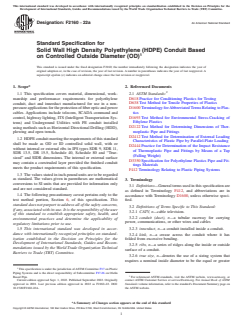
1.1 This specification covers material, dimensional, workmanship and performance requirements for polyethylene conduit, duct and innerduct manufactured for use in a non- pressure applications for the protection of fiber optic and power cables. Applications include telecom, SCADA command and control, highway lighting, ITS (Intelligent Transportation Systems) and Underground Utilities with PE conduit installed using methods such as Horizontal Directional Drilling (HDD), plowing and open trench.
1.2 HDPE conduit meeting the requirements of this standard shall be made as OD or ID controlled solid wall, with or without internal or external ribs in IPS types SDR 9, SDR 11, SDR 13.5, DR 15.5, Schedule 40, Schedule 80 and “True-sized” and SIDR dimensions. The internal or external surface may contain a coextruded layer provided the finished conduit meets the product requirements of this specification.
1.3 The values stated in inch-pound units are to be regarded as standard. The values given in parentheses are mathematical conversions to SI units that are provided for information only and are not considered standard.
1.4 The following precautionary caveat pertains only to the test method portion, Section 6, of this specification. This standard does not purport to address all of the safety concerns, if any, associated with its use. It is the responsibility of the user of this standard to establish appropriate safety, health, and environmental practices and determine the applicability of regulatory limitations prior to use.
1.5 This international standard was developed in accordance with internationally recognized principles on standardization established in the Decision on Principles for the Development of International Standards, Guides and Recommendations issued by the World Trade Organization Technical Barriers to Trade (TBT) Committee.
- Status
- Published
- Publication Date
- 31-Aug-2022
- Technical Committee
- F17 - Plastic Piping Systems
- Drafting Committee
- F17.26 - Olefin Based Pipe
Buy Documents
ASTM F2160-22a - Standard Specification for Solid Wall High Density Polyethylene (HDPE) Conduit Based on Controlled Outside Diameter (OD)
REDLINE ASTM F2160-22a - Standard Specification for Solid Wall High Density Polyethylene (HDPE) Conduit Based on Controlled Outside Diameter (OD)
Overview
ASTM F2160-22a specifies requirements for solid wall High Density Polyethylene (HDPE) conduit, duct, and innerduct used in non-pressure applications for the protection of communication wire, CATV, fiber optic, and power cables. Developed by ASTM International, this standard details material, dimensional, workmanship, and performance criteria, ensuring that HDPE conduit products are suitable for diverse utility and communication infrastructure needs. The document applies to conduits produced as controlled outside diameter (OD) or inside diameter (ID) solid wall types, with options for internal or external ribs, various sizing systems, and the inclusion of coextruded layers.
Key Topics
- Material Requirements: HDPE conduit must meet stringent polyethylene compound classifications, ensuring durability and low environmental risk. Rework material from the manufacturer’s own production may be reused only if it meets specified limits for heavy metal content and overall product performance.
- Dimensional Specifications: Covers Iron Pipe Size (IPS) systems in SDR 9, SDR 11, SDR 13.5, DR 15.5, Schedule 40, Schedule 80, “True-sized,” and SIDR dimensions. Tolerances are outlined for outside diameter, wall thickness, and ovality, ensuring consistent product quality and fit.
- Performance Testing: Includes requirements and methods for elongation at break, impact resistance at low temperatures, pipe stiffness, compression, recovery, and ovality. Test methods are referenced from established ASTM practices.
- Workmanship & Surface Quality: Mandates homogenous construction and defect-free internal and external surfaces without visible cracks, voids, blisters, or foreign inclusions.
- Marking and Identification: Specifies legible, contrasting identification markings at intervals not exceeding 5 ft (1.5 m), including the ASTM designation, conduit size, type, manufacturer, and production code. Sequential length footage or total length marking is required for coils and reels.
Applications
HDPE conduit manufactured in accordance with ASTM F2160-22a is widely used for:
- Telecommunications Infrastructure: Protective pathways for fiber optic cables in telecom and data networks, including SCADA (Supervisory Control and Data Acquisition) systems.
- Underground Utilities: Conduit installations for power and communication lines in distribution grids and intelligent transportation systems (ITS).
- Installation Methods: Suitable for horizontal directional drilling (HDD), plowing, and open trench techniques, providing flexibility in various site conditions.
- Highway and Street Lighting: Safeguarding control, lighting, and communication cables in highway and metropolitan installations.
- Above Ground/Aerial Applications: Enhanced UV stability and color requirements support long-term aerial installations, where marked conduit must be stabilized with carbon black for durability.
- Outdoor Storage: HDPE conduit is designed for robust outdoor storage, retaining color and physical integrity for at least one year, aiding in inventory and logistics management for large utility projects.
Related Standards
Several referenced standards and practices inform the material properties, testing, and terminology in ASTM F2160-22a, including:
- ASTM D3350: Specification for Polyethylene Plastics Pipe and Fittings Materials
- ASTM D618: Practice for Conditioning Plastics for Testing
- ASTM D638: Test Method for Tensile Properties of Plastics
- ASTM D1693: Test Method for Environmental Stress-Cracking of Ethylene Plastics
- ASTM D2122: Test Method for Determining Dimensions of Thermoplastic Pipe and Fittings
- ASTM D2444: Practice for Impact Resistance of Thermoplastic Pipes and Fittings
- ASTM F412: Terminology Relating to Plastic Piping Systems
ASTM F2160-22a supports safety, consistency, and regulatory compliance for HDPE conduit in utility, telecom, and power distribution markets, making it a key reference for manufacturers, installers, and specifiers seeking high-performance conduit solutions.
Relations
- Effective Date
- 01-Apr-2020
- Effective Date
- 01-Jan-2019
- Refers
ASTM D1600-18 - Standard Terminology for Abbreviated Terms Relating to Plastics (Withdrawn 2024) - Effective Date
- 01-Jan-2018
- Effective Date
- 15-Nov-2017
- Effective Date
- 01-Aug-2017
- Effective Date
- 01-Feb-2017
- Effective Date
- 15-Nov-2016
- Effective Date
- 01-Aug-2016
- Effective Date
- 01-Jun-2015
- Refers
ASTM D2122-15 - Standard Test Method for Determining Dimensions of Thermoplastic Pipe and Fittings - Effective Date
- 15-Mar-2015
- Effective Date
- 01-Feb-2014
- Effective Date
- 15-Apr-2013
- Effective Date
- 01-Apr-2013
- Effective Date
- 15-Feb-2013
- Refers
ASTM D3350-12e1 - Standard Specification for Polyethylene Plastics Pipe and Fittings Materials - Effective Date
- 01-Apr-2012
Buy Documents
ASTM F2160-22a - Standard Specification for Solid Wall High Density Polyethylene (HDPE) Conduit Based on Controlled Outside Diameter (OD)
REDLINE ASTM F2160-22a - Standard Specification for Solid Wall High Density Polyethylene (HDPE) Conduit Based on Controlled Outside Diameter (OD)
Get Certified
Connect with accredited certification bodies for this standard

IMQ S.p.A. (Certification)
Italian electrical product certification.

SLG Prüf- und Zertifizierungs GmbH
German testing and certification body.

UL Solutions
Global safety science company with testing, inspection and certification.
Sponsored listings
Frequently Asked Questions
ASTM F2160-22a is a technical specification published by ASTM International. Its full title is "Standard Specification for Solid Wall High Density Polyethylene (HDPE) Conduit Based on Controlled Outside Diameter (OD)". This standard covers: ABSTRACT This specification covers material, dimensional, workmanship and performance requirements for polyethylene conduit, duct and innerduct manufactured for use in a nonpressure application with communication, CATV, or power wire and cables. HDPE conduit meeting the requirements of this standard shall be made as OD controlled solid wall, with or without internal or external ribs. The sizing shall be Iron Pipe Size (IPS). The internal or external surface may contain a coextruded layer provided the finished conduit meets the specified product requirements. The product shall be subject to elongation, impact, and ovality tests. SCOPE 1.1 This specification covers material, dimensional, workmanship and performance requirements for polyethylene conduit, duct and innerduct manufactured for use in a non- pressure applications for the protection of fiber optic and power cables. Applications include telecom, SCADA command and control, highway lighting, ITS (Intelligent Transportation Systems) and Underground Utilities with PE conduit installed using methods such as Horizontal Directional Drilling (HDD), plowing and open trench. 1.2 HDPE conduit meeting the requirements of this standard shall be made as OD or ID controlled solid wall, with or without internal or external ribs in IPS types SDR 9, SDR 11, SDR 13.5, DR 15.5, Schedule 40, Schedule 80 and “True-sized” and SIDR dimensions. The internal or external surface may contain a coextruded layer provided the finished conduit meets the product requirements of this specification. 1.3 The values stated in inch-pound units are to be regarded as standard. The values given in parentheses are mathematical conversions to SI units that are provided for information only and are not considered standard. 1.4 The following precautionary caveat pertains only to the test method portion, Section 6, of this specification. This standard does not purport to address all of the safety concerns, if any, associated with its use. It is the responsibility of the user of this standard to establish appropriate safety, health, and environmental practices and determine the applicability of regulatory limitations prior to use. 1.5 This international standard was developed in accordance with internationally recognized principles on standardization established in the Decision on Principles for the Development of International Standards, Guides and Recommendations issued by the World Trade Organization Technical Barriers to Trade (TBT) Committee.
ABSTRACT This specification covers material, dimensional, workmanship and performance requirements for polyethylene conduit, duct and innerduct manufactured for use in a nonpressure application with communication, CATV, or power wire and cables. HDPE conduit meeting the requirements of this standard shall be made as OD controlled solid wall, with or without internal or external ribs. The sizing shall be Iron Pipe Size (IPS). The internal or external surface may contain a coextruded layer provided the finished conduit meets the specified product requirements. The product shall be subject to elongation, impact, and ovality tests. SCOPE 1.1 This specification covers material, dimensional, workmanship and performance requirements for polyethylene conduit, duct and innerduct manufactured for use in a non- pressure applications for the protection of fiber optic and power cables. Applications include telecom, SCADA command and control, highway lighting, ITS (Intelligent Transportation Systems) and Underground Utilities with PE conduit installed using methods such as Horizontal Directional Drilling (HDD), plowing and open trench. 1.2 HDPE conduit meeting the requirements of this standard shall be made as OD or ID controlled solid wall, with or without internal or external ribs in IPS types SDR 9, SDR 11, SDR 13.5, DR 15.5, Schedule 40, Schedule 80 and “True-sized” and SIDR dimensions. The internal or external surface may contain a coextruded layer provided the finished conduit meets the product requirements of this specification. 1.3 The values stated in inch-pound units are to be regarded as standard. The values given in parentheses are mathematical conversions to SI units that are provided for information only and are not considered standard. 1.4 The following precautionary caveat pertains only to the test method portion, Section 6, of this specification. This standard does not purport to address all of the safety concerns, if any, associated with its use. It is the responsibility of the user of this standard to establish appropriate safety, health, and environmental practices and determine the applicability of regulatory limitations prior to use. 1.5 This international standard was developed in accordance with internationally recognized principles on standardization established in the Decision on Principles for the Development of International Standards, Guides and Recommendations issued by the World Trade Organization Technical Barriers to Trade (TBT) Committee.
ASTM F2160-22a is classified under the following ICS (International Classification for Standards) categories: 29.120.10 - Conduits for electrical purposes. The ICS classification helps identify the subject area and facilitates finding related standards.
ASTM F2160-22a has the following relationships with other standards: It is inter standard links to ASTM F412-20, ASTM F412-19, ASTM D1600-18, ASTM D2444-17, ASTM F412-17a, ASTM F412-17, ASTM F412-16a, ASTM F412-16, ASTM F412-15, ASTM D2122-15, ASTM D1600-14, ASTM D1600-13, ASTM D1693-13, ASTM F412-13, ASTM D3350-12e1. Understanding these relationships helps ensure you are using the most current and applicable version of the standard.
ASTM F2160-22a is available in PDF format for immediate download after purchase. The document can be added to your cart and obtained through the secure checkout process. Digital delivery ensures instant access to the complete standard document.
Standards Content (Sample)
This international standard was developed in accordance with internationally recognized principles on standardization established in the Decision on Principles for the
Development of International Standards, Guides and Recommendations issued by the World Trade Organization Technical Barriers to Trade (TBT) Committee.
Designation:F2160 −22a An American National Standard
Standard Specification for
Solid Wall High Density Polyethylene (HDPE) Conduit Based
on Controlled Outside Diameter (OD)
This standard is issued under the fixed designation F2160; the number immediately following the designation indicates the year of
original adoption or, in the case of revision, the year of last revision. A number in parentheses indicates the year of last reapproval. A
superscript epsilon (´) indicates an editorial change since the last revision or reapproval.
1. Scope* 2. Referenced Documents
2.1 ASTM Standards:
1.1 This specification covers material, dimensional, work-
D618 Practice for Conditioning Plastics for Testing
manship and performance requirements for polyethylene
D638 Test Method for Tensile Properties of Plastics
conduit, duct and innerduct manufactured for use in a non-
D1600 Terminology forAbbreviatedTerms Relating to Plas-
pressureapplicationsfortheprotectionoffiberopticandpower
tics
cables. Applications include telecom, SCADA command and
D1693 Test Method for Environmental Stress-Cracking of
control, highway lighting, ITS (Intelligent Transportation Sys-
Ethylene Plastics
tems) and Underground Utilities with PE conduit installed
D2122 Test Method for Determining Dimensions of Ther-
using methods such as Horizontal Directional Drilling (HDD),
moplastic Pipe and Fittings
plowing and open trench.
D2412 Test Method for Determination of External Loading
1.2 HDPEconduitmeetingtherequirementsofthisstandard
Characteristics of Plastic Pipe by Parallel-Plate Loading
shall be made as OD or ID controlled solid wall, with or
D2444 Practice for Determination of the Impact Resistance
without internal or external ribs in IPS types SDR 9, SDR 11,
of Thermoplastic Pipe and Fittings by Means of a Tup
SDR 13.5, DR 15.5, Schedule 40, Schedule 80 and “True-
(Falling Weight)
sized” and SIDR dimensions. The internal or external surface
D3350 Specification for Polyethylene Plastics Pipe and Fit-
may contain a coextruded layer provided the finished conduit
tings Materials
meets the product requirements of this specification.
F412 Terminology Relating to Plastic Piping Systems
1.3 The values stated in inch-pound units are to be regarded
as standard. The values given in parentheses are mathematical
3. Terminology
conversions to SI units that are provided for information only
3.1 Definitions—General terms used in this specification are
and are not considered standard.
as defined in Terminology F412, and abbreviations are in
1.4 The following precautionary caveat pertains only to the
accordance with Terminology D1600, unless otherwise speci-
test method portion, Section 6, of this specification. This
fied.
standard does not purport to address all of the safety concerns,
3.2 Definitions of Terms Specific to This Standard:
if any, associated with its use. It is the responsibility of the user
3.2.1 CATV, n—cable television.
of this standard to establish appropriate safety, health, and
3.2.2 conduit (duct), n—a tubular raceway for carrying
environmental practices and determine the applicability of
power, communications, or other wires and cables
regulatory limitations prior to use.
3.2.3 innerduct, n—a conduit installed inside a conduit.
1.5 This international standard was developed in accor-
dance with internationally recognized principles on standard-
3.2.4 kink, n—a crease across the conduit where it has
ization established in the Decision on Principles for the
folded from excessive bending.
Development of International Standards, Guides and Recom-
3.2.5 ribs, n—a series of ridges along the inside or outside
mendations issued by the World Trade Organization Technical
surface of a conduit.
Barriers to Trade (TBT) Committee.
3.2.6 true size, n—denotes the use of a sizing system that
requires a nominal inside diameter to be the equal or greater
This specification is under the jurisdiction ofASTM Committee F17 on Plastic
Piping Systems and is the direct responsibility of Subcommittee F17.26 on Olefin
Based Pipe. For referenced ASTM standards, visit the ASTM website, www.astm.org, or
Current edition approved Sept. 1, 2022. Published September 2022. Originally contact ASTM Customer Service at service@astm.org. For Annual Book of ASTM
approved in 2001. Last previous edition approved in 2022 as F2160–22. DOI: Standards volume information, refer to the standard’s Document Summary page on
10.1520/F2160-22A. the ASTM website.
*A Summary of Changes section appears at the end of this standard
Copyright © ASTM International, 100 Barr Harbor Drive, PO Box C700, West Conshohocken, PA 19428-2959. United States
F2160−22a
NOTE 3—Acceptable cell for Color and UV resistance properties in
than the stated nominal size of the conduit (that is, a 1 ⁄4 in.
Table 1 may be achieved by utilizing a precompounded material or by
conduit has a minimum ID of 1.25 in.).
blending a base natural material with a color concentrate.
3.2.7 SCADA, n—(Supervisorycontrolanddataacquisition)
4.5.1 Colored Conduit—PE material for colored (black
use of fiber optic to, for example, control gates for pipelines.
included) conduit in non-UV exposed applications shall be
suitably protected against UV degradation so that conduit may
4. Materials
be stored outside and uncovered for a period of not less than
4.1 PE compound shall meet Specification D3350 require-
one year. Permanent color identification shall be permitted to
ments and be classified in accordance with Specification
be as solid color, as stripes, as a co-extruded skin, or a
D3350 with a minimum cell classification of PE334480C or
combination of these. If stripes are specified, a minimum of 3
PE334480E. Higher classification values for the first four cells
stripes equally spaced around the circumference shall be
and the sixth cell shall be acceptable. The classification value
required, to aid in the identification of the conduit. Colored
for the fifth cell shall be 8 in accordance with 4.2.
conduit shall maintain its color for a period of 1 year when
4.1.1 Rework Material—Clean polyethylene compound
stored outside, or as otherwise agreed to by the specifier and
from the manufacturers own production may be re-extruded
producer.
into conduit, either alone or blended with virgin compound.
4.5.1.1 Solid yellow or black with yellow stripes shall not
Conduit containing the rework material shall meet all the
be used for identification of conduit due to risk of misidenti-
material and product requirements of this specification. Where
fication with gas pipe.
rework material is known to contain cadmium, lead, mercury
or hexavalent chromium, or a combination thereof, the loading 5. Requirements
of rework shall be limited such that the final conduit product
5.1 Workmanship—Each layer of the conduit shall be ho-
shall not contain more than 0.01 % by weight cadmium and no
mogeneous throughout and essentially uniform in color,
more than 0.1 % by weight each of lead, mercury, and
opacity, density and other properties. The inside and outside
hexavalent chromium.
surfaces shall be free of visible cracks, holes, blisters, voids,
foreign inclusions, or other deleterious defects.
NOTE 1—Conformance with the metal requirements of 4.1.1 can be
demonstrated by either a determination of heavy metals in the final
5.2 Dimensions and Tolerances:
product or a calculation of the maximum heavy metals expected to be
5.2.1 Outside Diameters—The outside diameters and toler-
present based on their presence in the rework material.
ances shall be as shown in Table 1 for IPS SDR and Schedule
4.1.2 Color Compounds—Color concentrate compounds
40and80sizes,Table2for“true”sizing,andTable3forSIDR
used to color the conduit shall have no cadmium, lead,
sized conduit, when measured in accordance with Test Method
mercury, and hexavalent chromium added as an intentional
D2122.
ingredient and shall contain no more than 0.01 % by weight
5.2.2 Wall Thickness—The wall thicknesses and tolerances
cadmium and no more than 0.1 % by weight each of lead,
shall be as shown in Table 4 for IPS sizes, Schedule 40 and 80
mercury, and hexavalent chromium.
and Table 2 for “True-sized” PE conduit, and Table 3 for SIDR
NOTE 2—Conformance with the requirements of 4.1.2 can be demon-
sized Conduit when measured in accordance with Test Method
strated based on letters of compliance from color compound
D2122.
manufacturers, for example a RoHS compliance letter.
5.2.3 Special Sizes—When mutually agreeable between the
4.2 Slow Crack Growth—The minimum specified ESCR
manufacturer and the purchaser, other sizes and wall thick-
cell class 8 requirement is F10 > 96 h per Test Method D1693,
nesses shall be acceptable. The tolerance on outside diameter
condition B, 10 % Igepal.Alternatively, slow crack growth cell
shall be 6 0.5 percent of the nominal outside diameter. The
classification per Specification D3350 of 4 or higher is accept-
lowest permissible wall thickness for any conduit outside
able in meeting this requirement
diameter shall be 0.062 in. (1.57 mm). For wall thicknesses not
4.3 Coextruded Layer—Any material used as a coextruded
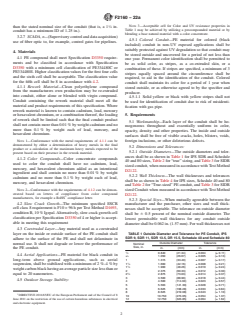
layer on the inside or outside surface of the PE conduit shall TABLE 1 Outside Diameter and Tolerance for PE Conduit, IPS
SDR 9, SDR 11, SDR 13.5, DR 15.5, Schedule 40 and Schedule 80
adhere to the surface of the PE and shall not delaminate in
Outside Diameter Tolerance
normal use. It shall not degrade or lower the performance of
Nominal
Size, in.
the PE conduit. in. (mm) in. (mm)
⁄2 0.840 (21.34) ± 0.004 (± 0.11)
4.4 Aerial Applications—PE material for black conduit in
⁄4 1.050 (26.67) ± 0.005 (± 0.13)
long-term above ground applications, such as aerial
1 1.315 (33.40) ± 0.007 (± 0.17)
1 ⁄4 1.660 (42.16) ± 0.008 (± 0.21)
suspension, shall be stabilized with a minimum of 2 %–4 % by
1 ⁄2 1.900 (48.26) ± 0.010 (± 0.24)
weightcarbonblackhavinganaverageparticlesizelessthanor
2 2.375 (60.33) ± 0.012 (± 0.30)
equal to 20 nanometers. 2 ⁄2 2.875 (73.03) ± 0.014 (± 0.37)
3 3.500 (88.90) ± 0.018 (± 0.44)
4.5 Outdoor Storage Stability:
4 4.500 (114.30) ± 0.023 (± 0.57)
5 5.563 (141.30) ± 0.028 (± 0.71)
6 6.625 (168.28) ± 0.033 (± 0.84)
8 8.625 (219.08) ± 0.043 (± 1.10)
DIRECTIVE 2011/65/EU of the European Parliament and of the Council of 8
10 10.750 (273.05) ± 0.054 (± 1.37)
June 2011 on the restriction of the use of certain hazardous substances in electrical 12 12.750 (323.85) ± 0.064 (± 1.62)
and electronic equipment.
F2160−22a
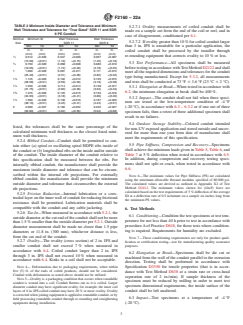
TABLE 2 Minimum Inside Diameter and Tolerance and Minimum
5.2.7.1 Ovality measurements of coiled conduit shall be
Wall Thickness and Tolerance for “True Sized” SDR 11 and SDR
made on a sample cut from the end of the coil or reel, and in
9 PE Conduit
case of disagreement, conditioned per 6.1.
Nominal Minimum ID Wall Thickness Wall Thickness
5.2.7.2 If ovality greater than 10 % for coiled conduit larger
Size SDR 11 SDR 9
Min Tol Min Tol Min Tol than 3 in. IPS is unsuitable for a particular application, the
in. in. in. in. in. in.
coiled conduit shall be processed by the installer through
(mm) (mm) (mm) (mm) (mm) (mm)
re-rounding equipment that corrects ovality to 10 % or less.
⁄2 0.512 +0.020 0.047 +0.006 0.057 +0.007
(13.00) +(0.51) (1.19) +(0.15) (1.45) +(0.18)
5.3 Test Performance—All specimens shall be measured
⁄4 0.750 +0.020 0.068 +0.008 0.083 +0.010
(19.05) +(0.51) (1.72) +(0.20) (3.18) +(0.25) beforetestinginaccordancewithTestMethodD2122andshall
1 1.000 +0.020 0.091 +0.011 0.111 +0.013
meet all the required dimensions and tolerances for the conduit
(25.40) +(0.51) (2.31) +(0.28) (2.82) +(0.33)
type being manufactured. Except for 5.3.2, all measurements
1 ⁄8 1.125 +0.020 0.102 +0.012 0.125 +0.015
(28.58) +(0.51) (2.59) +(0.30) (3.18) +(0.38) and tests shall be conducted at 73 °F 6 3.6 °F (23 °C 6 2 °C).
1 ⁄4 1.250 +0.020 0.114 +0.014 0.139 +0.017
5.3.1 Elongation at Break—When tested in accordance with
(31.75) +(0.51) (2.90) +(0.36) (3.53) +(0.43)
6.2, the minimum elongation at break shall be 400 %.
1 ⁄8 1.375 +0.020 0.125 +0.015 0.153 +0.018
(34.93) +(0.51) (3.18) +(0.41) (3.89) +(0.46)
5.3.2 Impact—The conduit shall not fail when three speci-
1 ⁄2 1.500 +0.020 0.136 +0.016 0.167 +0.020
men are tested at the low-temperature condition of -4 °F
(38.10) +(0.51) (3.45) +(0.41) (4.24) +(0.51)
2 2.000 +0.027 0.182 +0.022 0.222 +0.027
(-20 °C), in accordance with 6.3 – 6.3.2 or if one out of three
(50.80) +(0.51) (4.62) +(0.55) (5.64) +(0.68)
specimen fails, then a retest of three additional specimen shall
result in no failures.
5.4 Outdoor Storage Stability—Colored conduit intended
listed, the tolerances shall be the same percentage of the
for non-UV exposed application and stored outside and uncov-
calculated minimum wall thickness as the closest listed mini-
ered for more than one year from date of manufacture shall
mum wall thickness.
meet the requirements of this specification.
5.2.4 Ribbed Conduit—Conduit shall be permitted to con-
5.5 Pipe Stiffness, Compression and Recovery—Specimens
tain either (a) spiral or oscillating spiral HDPE ribs inside of
shall achieve the minimum loads given in Table 5, Table 6, and
the conduit or (b) longitudinal ribs on the inside and/or outside
Table 7 at 5 % deflection when tested in accordance with 6.5.
of the conduit. The inside diameter of the conduit relative to
In addition, during compression and recovery testing speci-
this specification shall be measured between the ribs. For
mens shall not split or crack, when tested in accordance with
internally ribbed conduit, the manufacturer shall provide the
6.6.
maximum inside diameter and tolerance that can be circum-
scribed within the internal rib projections. For externally
NOTE 6—The minimum values for Pipe Stiffness (PS) are calculated
ribbed conduit, the manufacturer shall provide the minimum
using the minimum allowable flexural modulus specified of 80 000 psi.
outside diameter and tolerance that circumscribes the external The calculated values are derived as outlined in Appendix X2 of Test
Method D2412. The minimum values shown for (LbsF) force are
rib projections.
calculated based on the test requirements of 5 % deflection of the average
5.2.5 Friction Reduction—Internal lubrication or a coex-
ID at a deflection rate of 0.5 in/minute on a sample six inches long from
truded layer on the inner wall of conduit for reducing frictional
the minimum PS values.
resistance shall be permitted. Lubrication materials shall be
compatible with the conduit and any cable jacketing.
6. Test Methods
5.2.6 Toe-In—When measured in accordance with 5.2.1, the
6.1 Conditioning—Condition the test specimens at test tem-
outside diameter at the cut end of the conduit shall not be more
perature for not less than 40 h prior to test in accordance with
than 1.5 % smaller than the outside diameter per 5.2.1. Outside
procedureAof Practice D618, for those tests where condition-
diameter measurement shall be made no closer than 1.5 pipe
ing is required. Requirements for humidity are excluded.
diameters or 11.8 in. (300 mm), whichever distance is less,
from the cut end of the conduit.
NOTE 7—These conditioning requirements are only for product quali-
5.2.7 Ovality—The ovality (cross section) of 2 in. IPS and
fication or certification testing—not for manufacturing quality assurance
smaller conduit shall not exceed 7 % when measured in purposes.
accordance with 6.4. Coiled conduit larger than 2 in. IPS
6.2 Elongation at Break—Specimens shall be die cut or
through 3 in. IPS shall not exceed 10 % when measured in
machined from the wall of the conduit parallel to the extrusion
accordance with 6.4. Kinks in a coil shall not be acceptable.
direction. Testing shall be performed in accordance with
Specification D3350 for tensile properties (that is in accor-
NOTE 4— Deformations due to packaging requirements, when within
five (5) ft. of the ends of coiled products, should not be considered.
dance with Test Method D638 at a strain rate or cross-head
Conduit with deformation as noted above should not be utilized.
separation rate of 2 in./min). If sample thickness of the
NOTE 5—Ovality is a packaging condition that occurs when roundable
specimen must be reduced by milling in order to meet test
conduit is wound into a coil. Conduit flattens out as it is coiled. Larger
specimen dimensional requirements, the inside surface of the
diameter conduit may have significant ovality, for example, the inner coil
layers of 6 in. IPS coiled conduit may have 20 % or more ovality. Ovality conduit shall be left unaltered.
iscorrectedwhenjoiningequipmentisappliedtoroundableconduit,orby
6.3 Impact—Test specimens at a temperature of -4 °F
field processing roundable conduit through re-rounding and straightening
equipment
...
This document is not an ASTM standard and is intended only to provide the user of an ASTM standard an indication of what changes have been made to the previous version. Because
it may not be technically possible to adequately depict all changes accurately, ASTM recommends that users consult prior editions as appropriate. In all cases only the current version
of the standard as published by ASTM is to be considered the official document.
Designation: F2160 − 22 F2160 − 22a An American National Standard
Standard Specification for
Solid Wall High Density Polyethylene (HDPE) Conduit Based
on Controlled Outside Diameter (OD)
This standard is issued under the fixed designation F2160; the number immediately following the designation indicates the year of
original adoption or, in the case of revision, the year of last revision. A number in parentheses indicates the year of last reapproval. A
superscript epsilon (´) indicates an editorial change since the last revision or reapproval.
1. Scope*
1.1 This specification covers material, dimensional, workmanship and performance requirements for polyethylene conduit, duct
and innerduct manufactured for use in a non- pressure applications for the protection of fiber optic and power cables. Applications
include telecom, SCADA command and control, highway lighting, ITS (Intelligent Transportation Systems) and Underground
Utilities with PE conduit installed using methods such as Horizontal Directional Drilling (HDD), plowing and open trench.
1.2 HDPE conduit meeting the requirements of this standard shall be made as OD or ID controlled solid wall, with or without
internal or external ribs in IPS types SDR 9, SDR 11, SDR 13.5, DR 15.5, Schedule 40, Schedule 80 and “True-sized” and SIDR
dimensions. The internal or external surface may contain a coextruded layer provided the finished conduit meets the product
requirements of this specification.
1.3 The values stated in inch-pound units are to be regarded as standard. The values given in parentheses are mathematical
conversions to SI units that are provided for information only and are not considered standard.
1.4 The following precautionary caveat pertains only to the test method portion, Section 6, of this specification. This standard
does not purport to address all of the safety concerns, if any, associated with its use. It is the responsibility of the user of this
standard to establish appropriate safety, health, and environmental practices and determine the applicability of regulatory
limitations prior to use.
1.5 This international standard was developed in accordance with internationally recognized principles on standardization
established in the Decision on Principles for the Development of International Standards, Guides and Recommendations issued
by the World Trade Organization Technical Barriers to Trade (TBT) Committee.
2. Referenced Documents
2.1 ASTM Standards:
D618 Practice for Conditioning Plastics for Testing
D638 Test Method for Tensile Properties of Plastics
D1600 Terminology for Abbreviated Terms Relating to Plastics
D1693 Test Method for Environmental Stress-Cracking of Ethylene Plastics
D2122 Test Method for Determining Dimensions of Thermoplastic Pipe and Fittings
D2412 Test Method for Determination of External Loading Characteristics of Plastic Pipe by Parallel-Plate Loading
This specification is under the jurisdiction of ASTM Committee F17 on Plastic Piping Systems and is the direct responsibility of Subcommittee F17.26 on Olefin Based
Pipe.
Current edition approved April 1, 2022Sept. 1, 2022. Published May 2022September 2022. Originally approved in 2001. Last previous edition approved in 20162022 as
F2160–16.–22. DOI: 10.1520/F2160-16.10.1520/F2160-22A.
For referenced ASTM standards, visit the ASTM website, www.astm.org, or contact ASTM Customer Service at service@astm.org. For Annual Book of ASTM Standards
volume information, refer to the standard’s Document Summary page on the ASTM website.
*A Summary of Changes section appears at the end of this standard
Copyright © ASTM International, 100 Barr Harbor Drive, PO Box C700, West Conshohocken, PA 19428-2959. United States
F2160 − 22a
D2444 Practice for Determination of the Impact Resistance of Thermoplastic Pipe and Fittings by Means of a Tup (Falling
Weight)
D3350 Specification for Polyethylene Plastics Pipe and Fittings Materials
F412 Terminology Relating to Plastic Piping Systems
3. Terminology
3.1 Definitions—General terms used in this Specificationspecification are as defined in Terminology F412, and abbreviations are
in accordance with Terminology D1600, unless otherwise specified.
3.2 Definitions of Terms Specific to This Standard:
3.2.1 CATV, n—cable television.
3.2.2 conduit (duct), n—a tubular raceway for carrying power, communications, or other wires and cables
3.2.3 innerduct, n—a conduit installed inside a conduit.
3.2.4 kink, n—a crease across the conduit where it has folded from excessive bending.
3.2.5 ribs, n—a series of ridges along the inside or outside surface of a conduit.
3.2.6 true size, n—denotes the use of a sizing system that requires a nominal inside diameter to be the equal or greater than the
stated nominal size of the conduit (that is, a 1 ⁄4 in. conduit has a minimum ID of 1.25 in.).
3.2.7 SCADA, n—(Supervisory control and data acquisition) use of fiber optic to, for example, control gates for pipelines.
4. Materials
4.1 PE compound shall meet Specification D3350 requirements and be classified in accordance with Specification D3350 with a
minimum cell classification of PE334480C or PE334480E. Higher classification values for the first four cells and the sixth cell shall
be acceptable. The classification value for the fifth cell shall be 8 in accordance with 4.2.
4.1.1 Rework Material—Clean polyethylene compound from the manufacturers own production may be re-extruded into conduit,
either alone or blended with virgin compound. Conduit containing the rework material shall meet all the material and product
requirements of this specification. Where rework material is known to contain cadmium, lead, mercury or hexavalent chromium,
or a combination thereof, the loading of rework shall be limited such that the final conduit product shall not contain more than
0.01 % by weight cadmium and no more than 0.1 % by weight each of lead, mercury, and hexavalent chromium.
NOTE 1—Conformance with the metal requirements of 4.1.1 can be demonstrated by either a determination of heavy metals in the final product or a
calculation of the maximum heavy metals expected to be present based on their presence in the rework material.
4.1.2 Color Compounds—Color concentrate compounds used to color the conduit shall have no cadmium, lead, mercury, and
hexavalent chromium added as an intentional ingredient and shall contain no more than 0.01 % by weight cadmium and no more
than 0.1 % by weight each of lead, mercury, and hexavalent chromium.
NOTE 2—Conformance with the requirements of 4.1.2 can be demonstrated based on letters of compliance from color compound manufacturers, for
example a RoHS compliance letter.
4.2 Slow Crack Growth—The minimum specified ESCR cell class 8 requirement is F10 > 96 h per Test Method D1693, condition
B, 10 % Igepal. Alternatively, slow crack growth cell classification per Specification D3350 of 4 or higher is acceptable in meeting
this requirement
DIRECTIVE 2011/65/EU of the European Parliament and of the Council of 8 June 2011 on the restriction of the use of certain hazardous substances in electrical and
electronic equipment.
F2160 − 22a
4.3 Coextruded Layer—Any material used as a coextruded layer on the inside or outside surface of the PE conduit shall adhere
to the surface of the PE and shall not delaminate in normal use. It shall not degrade or lower the performance of the PE conduit.
4.4 Aerial Applications—PE material for black conduit in long-term above ground applications, such as aerial suspension, shall
be stabilized with a minimum of 2 %–4 % by weight carbon black having an average particle size less than or equal to 20
nanometers.
4.5 Outdoor Storage Stability:
NOTE 3—Acceptable cell for Color and UV resistance properties in Table 1 may be achieved by utilizing a precompounded material or by blending a base
natural material with a color concentrate.
4.5.1 Colored Conduit—PE material for colored (black included) conduit in non-UV exposed applications shall be suitably
protected against UV degradation so that conduit may be stored outside and uncovered for a period of not less than one year.
Permanent color identification shall be permitted to be as solid color, as stripes, as a co-extruded skin, or a combination of these.
If stripes are specified, a minimum of 3 stripes equally spaced around the circumference shall be required, to aid in the
identification of the conduit. Colored conduit shall maintain its color for a period of 1 year when stored outside, or as otherwise
agreed to by the specifier and producer.
4.5.1.1 Solid yellow or black with yellow stripes shall not be used for identification of conduit due to risk of misidentification with
gas pipe.
5. Requirements
5.1 Workmanship—Each layer of the conduit shall be homogeneous throughout and essentially uniform in color, opacity, density
and other properties. The inside and outside surfaces shall be free of visible cracks, holes, blisters, voids, foreign inclusions, or
other deleterious defects.
5.2 Dimensions and Tolerances:
5.2.1 Outside Diameters—The outside diameters and tolerances shall be as shown in Table 1 for IPS SDR and Schedule 40 and
80 sizes, Table 2 for “true” sizing, and Table 3 for SIDR sized conduit, when measured in accordance with Test Method D2122.
5.2.2 Wall Thickness—The wall thicknesses and tolerances shall be as shown in Table 4 for IPS sizes, Schedule 40 and 80 and
Table 2 for “True-sized” PE conduit, and Table 3 for SIDR sized Conduit when measured in accordance with Test Method D2122.
5.2.3 Special Sizes—When mutually agreeable between the manufacturer and the purchaser, other sizes and wall thicknesses shall
be acceptable. The tolerance on outside diameter shall be 6 0.5 percent of the nominal outside diameter. The lowest permissible
TABLE 1 Outside Diameter and Tolerance for PE Conduit, IPS
SDR 9, SDR 11, SDR 13.5, DR 15.5, Schedule 40 and Schedule 80
Outside Diameter Tolerance
Nominal
Size, in.
in. (mm) in. (mm)
⁄2 0.840 (21.34) ± 0.004 (± 0.11)
⁄4 1.050 (26.67) ± 0.005 (± 0.13)
1 1.315 (33.40) ± 0.007 (± 0.17)
1 ⁄4 1.660 (42.16) ± 0.008 (± 0.21)
1 ⁄2 1.900 (48.26) ± 0.010 (± 0.24)
2 2.375 (60.33) ± 0.012 (± 0.30)
2 ⁄2 2.875 (73.03) ± 0.014 (± 0.37)
3 3.500 (88.90) ± 0.018 (± 0.44)
4 4.500 (114.30) ± 0.023 (± 0.57)
5 5.563 (141.30) ± 0.028 (± 0.71)
6 6.625 (168.28) ± 0.033 (± 0.84)
8 8.625 (219.08) ± 0.043 (± 1.10)
10 10.750 (273.05) ± 0.054 (± 1.37)
12 12.750 (323.85) ± 0.064 (± 1.62)
F2160 − 22a
TABLE 2 Minimum Inside Diameter and Tolerance and Minimum
Wall Thickness and Tolerance for “True Sized” SDR 11 and SDR
9 PE Conduit
Nominal Minimum ID Wall Thickness Wall Thickness
Size SDR 11 SDR 9
Min Tol Min Tol Min Tol
in. in. in. in. in. in.
(mm) (mm) (mm) (mm) (mm) (mm)
⁄2 0.512 +0.020 0.047 +0.006 0.057 +0.007
(13.00) +(0.51) (1.19) +(0.15) (1.45) +(0.18)
⁄4 0.750 +0.020 0.068 +0.008 0.083 +0.010
(19.05) +(0.51) (1.72) +(0.20) (3.18) +(0.25)
1 1.000 +0.020 0.091 +0.011 0.111 +0.013
(25.40) +(0.51) (2.31) +(0.28) (2.82) +(0.33)
1 ⁄8 1.125 +0.020 0.102 +0.012 0.125 +0.015
(28.58) +(0.51) (2.59) +(0.30) (3.18) +(0.38)
1 ⁄4 1.250 +0.020 0.114 +0.014 0.139 +0.017
(31.75) +(0.51) (2.90) +(0.36) (3.53) +(0.43)
1 ⁄8 1.375 +0.020 0.125 +0.015 0.153 +0.018
(34.93) +(0.51) (3.18) +(0.41) (3.89) +(0.46)
1 ⁄2 1.500 +0.020 0.136 +0.016 0.167 +0.020
(38.10) +(0.51) (3.45) +(0.41) (4.24) +(0.51)
2 2.000 +0.027 0.182 +0.022 0.222 +0.027
(50.80) +(0.51) (4.62) +(0.55) (5.64) +(0.68)
wall thickness for any conduit outside diameter shall be 0.062 in. (1.57 mm). For wall thicknesses not listed, the tolerances shall
be the same percentage of the calculated minimum wall thickness as the closest listed minimum wall thickness.
5.2.4 Ribbed Conduit—Conduit shall be permitted to contain either (a) spiral or oscillating spiral HDPE ribs inside of the conduit
or (b) longitudinal ribs on the inside and/or outside of the conduit. The inside diameter of the conduit relative to this specification
shall be measured between the ribs. For internally ribbed conduit, the manufacturer shall provide the maximum inside diameter
and tolerance that can be circumscribed within the internal rib projections. For externally ribbed conduit, the manufacturer shall
provide the minimum outside diameter and tolerance that circumscribes the external rib projections.
5.2.5 Friction Reduction—Internal lubrication or a coextruded layer on the inner wall of conduit for reducing frictional resistance
shall be permitted. Lubrication materials shall be compatible with the conduit and any cable jacketing.
5.2.6 Toe-In—When measured in accordance with 5.2.1, the outside diameter at the cut end of the conduit shall not be more than
1.5 % smaller than the outside diameter per 5.2.1. Outside diameter measurement shall be made no closer than 1.5 pipe diameters
or 11.8 in. (300 mm), whichever distance is less, from the cut end of the conduit.
5.2.7 Ovality—The ovality (cross section) of 2 in. IPS and smaller conduit shall not exceed 7 % when measured in accordance
with 6.4. Coiled conduit larger than 2 in. IPS through 3 in. IPS shall not exceed 10 % when measured in accordance with 6.4. Kinks
in a coil shall not be acceptable.
NOTE 4— Deformations due to packaging requirements, when within five (5) ft. of the ends of coiled products, should not be considered. Conduit with
deformation as noted above should not be utilized.
NOTE 5—Ovality is a packaging condition that occurs when roundable conduit is wound into a coil. Conduit flattens out as it is coiled. Larger diameter
conduit may have significant ovality, for example, the inner coil layers of 6 in. IPS coiled conduit may have 20 % or more ovality. Ovality is corrected
when joining equipment is applied to roundable conduit, or by field processing roundable conduit through re-rounding and straightening equipment during
installation.
5.2.7.1 Ovality measurements of coiled conduit shall be made on a sample cut from the end of the coil or reel, and in case of
disagreement, conditioned per 6.1.
5.2.7.2 If ovality greater than 10 % for coiled conduit larger than 3 in. IPS is unsuitable for a particular application, the coiled
conduit shall be processed by the installer through re-rounding equipment that corrects ovality to 10 % or less.
5.3 Test Performance—All specimens shall be measured before testing in accordance with Test Method D2122 and shall meet all
the required dimensions and tolerances for the conduit type being manufactured. Except for 5.3.2, all measurements and tests shall
be conducted at 73°F73 °F 6 3.6°F (23°3.6 °F (23 °C 6 2°C).2 °C).
F2160 − 22a
TABLE 3 Inside Diameter and Tolerance and Minimum Wall Thickness and Tolerance for SIDR PE Conduit
Nominal Size Inside Diameter Wall Thickness Wall Thickness Wall Thickness
SIDR 15 SIDR 11.5 SIDR 9
Min Tol Min Tol Min Tol Min Tol
in. in. in. in. in. in. in. in.
(mm) (mm) (mm) (mm) (mm) (mm) (mm) (mm)
1 1.049 +0.010 0.070 +0.020 0.091 +0.020 0.117 +0.020
-0.020
(26.64) (+0.25) (1.78) +(0.51) (2.31) +(0.51) (2.97) +(0.51)
(-0.51)
1 ⁄4 1.380 +0.010 0.092 +0.020 0.120 +0.020 0.153 +0.020
-0.020
(35.05) (+0.25) (2.34) +(0.51) (3.05) +(0.51) (3.89) +(0.51)
(-0.51)
1 ⁄2 1.610 +0.015 0.107 +0.020 0.140 +0.020 0.179 +0.020
-0.020
(40.89) (+0.38) (2.72) +(0.51) (3.56) +(0.51) (4.55) +(0.51)
(-0.51)
2 2.067 +0.015 0.138 +0.020 0.180 +0.022 0.230 +0.028
-0.020
(52.50) (+0.38) (3.51) +(0.51) (4.57) +(0.56) (5.84) +(0.71)
(-0.51)
2 ⁄2 2.469 +0.015 0.165 +0.020 0.215 +0.026 . .
-0.020
(62.71) (+0.38) (4.19) +(0.51) (5.46) +(0.66) . .
(-0.51)
3 3.068 +0.015 . . 0.267 +0.032 . .
-0.030
(77.93) (+0.38) . . (6.78) +(0.81) . .
(-0.76)
4 4.026 +0.020 . . 0.350 +0.042 . .
-0.020
(102.26) (+0.51) . . (8.89) +(1.07) . .
(-0.051)
5 5.046 +0.025 . . 0.429 +0.053 . .
(128.17) -0.025 . . (10.90) +(1.35) . .
(+0.64)
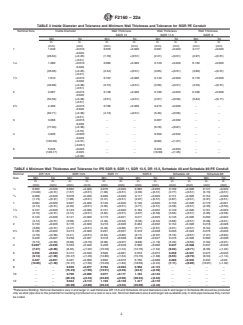
TABLE 4 Minimum Wall Thickness and Tolerance for IPS SDR 9, SDR 11, SDR 13.5, DR 15.5, Schedule 40 and Schedule 80 PE Conduit
Nominal DR 15.5 SDR 13.5 SDR 11 SDR 9 Schedule 40 Schedule 80
Size Min. Tol. Min. Tol. Min. Tol. Min. Tol. Min. Tol. Min. Tol.
in. in. in. in. in. in. in. in. in. in. in. in.
(mm) (mm) (mm) (mm) (mm) (mm) (mm) (mm) (mm) (mm) (mm) (mm)
⁄2 0.062 +0.020 0.062 +0.020 0.076 +0.020 0.093 +0.020 0.109 +0.020 0.147 +0.020
(13.00) +(0.51) (1.57) +(0.51) (1.93) +(0.51) (2.36) +(0.51) (2.77) +(0.51) (3.73) +(0.51)
⁄4 0.068 +0.020 0.078 +0.020 0.095 +0.020 0.117 +0.020 0.113 +0.020 0.154 +0.020
(1.73) +(0.51) (1.98) +(0.51) (2.41) +(0.51) (2.97) +(0.51) (2.87) +(0.51) (3.91) +(0.51)
1 0.084 +0.020 0.097 +0.020 0.120 +0.020 0.146 +0.020 0.133 +0.020 0.179 +0.021
(2.13) +(0.51) (2.46) +(0.51) (3.05) +(0.51) (3.71) +(0.51) (3.38) +(0.51) (4.55) +(0.53)
1 ⁄4 0.107 +0.020 0.123 +0.020 0.151 +0.020 0.184 +0.022 0.140 +
...