

ASTM A247-24
(Test Method)Standard Test Method for Visual Evaluation of Graphite in Iron Castings
General Information
- Abstract
SIGNIFICANCE AND USE
4.1 The comparison of observed graphite particles with the structures shown in the charts give only purely descriptive information on the type, distribution, and size of the graphite in the sample being evaluated. It does not indicate, except in a very broad way, the origin of the graphite or the suitability of the iron-carbon alloy for a particular service.
SCOPE
1.1 This test method covers the classification of graphite in cast irons in terms of type, distribution, and size by visual comparison to reference photomicrographs. This test method is intended to be applicable for all iron-carbon alloys containing graphite particles, and may be applied to gray irons, malleable irons, compacted graphite irons, and the ductile (nodular) irons.
1.2 The reference photomicrographs included in this test method are in no way to be construed as specifications. In an appropriate specification for a specific material where graphite microstructure is an important consideration, this test method may be used as a reference to concisely define the graphite microstructure required.
1.3 These reference photomicrographs are offered primarily to permit accurate reporting of microstructures of cast irons and to facilitate the comparison of reports by different laboratories or investigators.
1.4 The values stated in SI units are to be regarded as standard. No other units of measurement are included in this standard.
1.5 This standard does not purport to address all of the safety concerns, if any, associated with its use. It is the responsibility of the user of this standard to establish appropriate safety, health, and environmental practices and determine the applicability of regulatory limitations prior to use.
1.6 This international standard was developed in accordance with internationally recognized principles on standardization established in the Decision on Principles for the Development of International Standards, Guides and Recommendations issued by the World Trade Organization Technical Barriers to Trade (TBT) Committee.
- Status
- Published
- Publication Date
- 31-Mar-2024
- Technical Committee
- A04 - Iron Castings
- Drafting Committee
- A04.21 - Testing
Overview
ASTM A247-24: Standard Test Method for Visual Evaluation of Graphite in Iron Castings is an internationally recognized standard developed by ASTM International. This standard provides a reliable methodology for classifying the graphite present in cast iron components by visual comparison to reference photomicrographs. ASTM A247-24 is broadly applicable to all iron-carbon alloys containing graphite-such as gray iron, ductile (nodular) iron, malleable iron, and compacted graphite iron-and enables consistent, descriptive reporting of graphite type, distribution, and size. Crucially, this test method serves as a reference tool in specifications requiring concise definitions of graphite microstructure, facilitating clear communication across manufacturers, purchasers, and laboratories.
Key Topics
ASTM A247-24 covers several core aspects of evaluating graphite microstructure in cast irons:
Classification by Visual Comparison: Graphite particles are classified by comparing observed microstructures with standardized photomicrographs, focusing on:
- Graphite form (types I to VII)
- Distribution (patterns A to E)
- Size classes (eight gradations based on particle dimensions)
Sample Preparation: Preferred samples are taken directly from castings or from representative test coupons, and prepared using standard metallographic techniques that preserve graphite integrity.
Reporting Structure: The standard recommends clear reporting headings:
- Sample identification
- Graphite form type(s)
- Graphite distribution
- Graphite size class
- Nodularity (% nodular particles)
- Nodule count (nodules per mm²)
Descriptive Emphasis: The method provides descriptive microstructural information, helping users report graphite characteristics without inferring material performance or origin.
International Alignment: Developed in accordance with the World Trade Organization’s principles for international standardization.
Applications
The ASTM A247-24 test method is vital for:
Foundries and Quality Control: Ensuring that iron castings meet the desired microstructural criteria stipulated in contractual or product specifications.
Material Specifications: Serving as a reference to define required graphite microstructures in iron castings for various engineering and automotive applications.
Comparative Analysis: Enabling laboratories and investigators to compare results, standardize reporting, and understand the graphite characteristics that may influence mechanical properties and performance.
Research and Development: Facilitating metallurgical investigations into cast iron, with accurate, standardized descriptions of graphite content across alloy types.
Regulatory Compliance: Assisting organizations in meeting industry, national, and international requirements for iron castings.
Related Standards
Several other standards and guides are crucial in conjunction with ASTM A247-24:
- ASTM E3: Guide for Preparation of Metallographic Specimens-essential for proper sample preparation.
- Other ASTM Cast Iron Standards: Such as those for mechanical testing and chemical analysis, which may specify the use of A247 for microstructural assessment.
- International Metals Standards: Documents adopting or referencing ASTM A247 contribute to global conformity in cast iron characterization.
ASTM A247-24 is the benchmark for the visual evaluation of graphite in iron casting microstructures, widely used for quality control, specification definition, and metallurgical consistency within the iron casting industry. By standardizing the visual assessment process, it supports improved reliability and comparability for producers and end users of iron castings worldwide.
Relations
- Replaces
ASTM A247-19 - Standard Test Method for Evaluating the Microstructure of Graphite in Iron Castings - Effective Date
- 01-Apr-2024
- Effective Date
- 01-Apr-2024
- Effective Date
- 01-Apr-2024
- Effective Date
- 01-Apr-2024
- Effective Date
- 01-Apr-2024
- Effective Date
- 01-Apr-2024
- Effective Date
- 01-Apr-2024
- Referred By
ASTM A1095-15(2023) - Standard Specification for High-Silicon Molybdenum Ferritic Iron Castings - Effective Date
- 01-Apr-2024
- Effective Date
- 01-Apr-2024
- Effective Date
- 01-Apr-2024
- Effective Date
- 01-Apr-2024
- Referred By
ASTM A823-99(2023) - Standard Specification for Statically Cast Permanent Mold Gray Iron Castings - Effective Date
- 01-Apr-2024
- Effective Date
- 01-Apr-2024
- Effective Date
- 01-Apr-2024
Get Certified
Connect with accredited certification bodies for this standard

Element Materials Technology
Materials testing and product certification.

Inštitut za kovinske materiale in tehnologije
Institute of Metals and Technology. Materials testing, metallurgical analysis, NDT.
Sponsored listings
Frequently Asked Questions
ASTM A247-24 is a standard published by ASTM International. Its full title is "Standard Test Method for Visual Evaluation of Graphite in Iron Castings". This standard covers: SIGNIFICANCE AND USE 4.1 The comparison of observed graphite particles with the structures shown in the charts give only purely descriptive information on the type, distribution, and size of the graphite in the sample being evaluated. It does not indicate, except in a very broad way, the origin of the graphite or the suitability of the iron-carbon alloy for a particular service. SCOPE 1.1 This test method covers the classification of graphite in cast irons in terms of type, distribution, and size by visual comparison to reference photomicrographs. This test method is intended to be applicable for all iron-carbon alloys containing graphite particles, and may be applied to gray irons, malleable irons, compacted graphite irons, and the ductile (nodular) irons. 1.2 The reference photomicrographs included in this test method are in no way to be construed as specifications. In an appropriate specification for a specific material where graphite microstructure is an important consideration, this test method may be used as a reference to concisely define the graphite microstructure required. 1.3 These reference photomicrographs are offered primarily to permit accurate reporting of microstructures of cast irons and to facilitate the comparison of reports by different laboratories or investigators. 1.4 The values stated in SI units are to be regarded as standard. No other units of measurement are included in this standard. 1.5 This standard does not purport to address all of the safety concerns, if any, associated with its use. It is the responsibility of the user of this standard to establish appropriate safety, health, and environmental practices and determine the applicability of regulatory limitations prior to use. 1.6 This international standard was developed in accordance with internationally recognized principles on standardization established in the Decision on Principles for the Development of International Standards, Guides and Recommendations issued by the World Trade Organization Technical Barriers to Trade (TBT) Committee.
SIGNIFICANCE AND USE 4.1 The comparison of observed graphite particles with the structures shown in the charts give only purely descriptive information on the type, distribution, and size of the graphite in the sample being evaluated. It does not indicate, except in a very broad way, the origin of the graphite or the suitability of the iron-carbon alloy for a particular service. SCOPE 1.1 This test method covers the classification of graphite in cast irons in terms of type, distribution, and size by visual comparison to reference photomicrographs. This test method is intended to be applicable for all iron-carbon alloys containing graphite particles, and may be applied to gray irons, malleable irons, compacted graphite irons, and the ductile (nodular) irons. 1.2 The reference photomicrographs included in this test method are in no way to be construed as specifications. In an appropriate specification for a specific material where graphite microstructure is an important consideration, this test method may be used as a reference to concisely define the graphite microstructure required. 1.3 These reference photomicrographs are offered primarily to permit accurate reporting of microstructures of cast irons and to facilitate the comparison of reports by different laboratories or investigators. 1.4 The values stated in SI units are to be regarded as standard. No other units of measurement are included in this standard. 1.5 This standard does not purport to address all of the safety concerns, if any, associated with its use. It is the responsibility of the user of this standard to establish appropriate safety, health, and environmental practices and determine the applicability of regulatory limitations prior to use. 1.6 This international standard was developed in accordance with internationally recognized principles on standardization established in the Decision on Principles for the Development of International Standards, Guides and Recommendations issued by the World Trade Organization Technical Barriers to Trade (TBT) Committee.
ASTM A247-24 is classified under the following ICS (International Classification for Standards) categories: 77.140.80 - Iron and steel castings. The ICS classification helps identify the subject area and facilitates finding related standards.
ASTM A247-24 has the following relationships with other standards: It is inter standard links to ASTM A247-19, ASTM A220/A220M-99(2022)e1, ASTM A842-11A(2022)e1, ASTM A439/A439M-18(2022), ASTM A197/A197M-00(2023)e1, ASTM A897/A897M-22, ASTM A874/A874M-98(2022), ASTM A1095-15(2023), ASTM E2567-16a(2023), ASTM A159-83(2020), ASTM A834-95(2020), ASTM A823-99(2023), ASTM A47/A47M-99(2022)e1, ASTM A395/A395M-99(2022). Understanding these relationships helps ensure you are using the most current and applicable version of the standard.
ASTM A247-24 is available in PDF format for immediate download after purchase. The document can be added to your cart and obtained through the secure checkout process. Digital delivery ensures instant access to the complete standard document.
Standards Content (Sample)
This international standard was developed in accordance with internationally recognized principles on standardization established in the Decision on Principles for the
Development of International Standards, Guides and Recommendations issued by the World Trade Organization Technical Barriers to Trade (TBT) Committee.
Designation: A247 − 24
Standard Test Method for
Visual Evaluation of Graphite in Iron Castings
This standard is issued under the fixed designation A247; the number immediately following the designation indicates the year of
original adoption or, in the case of revision, the year of last revision. A number in parentheses indicates the year of last reapproval. A
superscript epsilon (´) indicates an editorial change since the last revision or reapproval.
This standard has been approved for use by agencies of the U.S. Department of Defense.
1. Scope 2. Referenced Documents
2.1 ASTM Standards:
1.1 This test method covers the classification of graphite in
E3 Guide for Preparation of Metallographic Specimens
cast irons in terms of type, distribution, and size by visual
comparison to reference photomicrographs. This test method is
3. Summary of Test Method
intended to be applicable for all iron-carbon alloys containing
3.1 The reference micrographs included in this standard
graphite particles, and may be applied to gray irons, malleable
form the basis for classification. Characteristic features of
irons, compacted graphite irons, and the ductile (nodular)
graphite particle shape and distribution are designated by
irons.
numerals and letters. Type, distribution, and size of observed
1.2 The reference photomicrographs included in this test
graphite are compared with the idealized microstructures in the
method are in no way to be construed as specifications. In an
standard charts and rated accordingly as closely as possible to
appropriate specification for a specific material where graphite
the equal or similar microstructures in the charts.
microstructure is an important consideration, this test method
may be used as a reference to concisely define the graphite
4. Significance and Use
microstructure required.
4.1 The comparison of observed graphite particles with the
1.3 These reference photomicrographs are offered primarily structures shown in the charts give only purely descriptive
to permit accurate reporting of microstructures of cast irons
information on the type, distribution, and size of the graphite in
and to facilitate the comparison of reports by different labora- the sample being evaluated. It does not indicate, except in a
tories or investigators.
very broad way, the origin of the graphite or the suitability of
the iron-carbon alloy for a particular service.
1.4 The values stated in SI units are to be regarded as
standard. No other units of measurement are included in this
5. Test Specimens or Samples
standard.
5.1 The preferred sample is a section cut from an actual
1.5 This standard does not purport to address all of the
casting that is being evaluated at a location agreed upon
safety concerns, if any, associated with its use. It is the
between the manufacturer and purchaser. When this is
responsibility of the user of this standard to establish appro-
impractical, a test lug or projection often can be appended to
priate safety, health, and environmental practices and deter-
the casting and sawed or broken off to be used as the test
mine the applicability of regulatory limitations prior to use.
sample. If neither of these methods is convenient, microstruc-
1.6 This international standard was developed in accor-
tural test coupons, such as those recommended by the Cast Iron
dance with internationally recognized principles on standard-
Research Committee (5R) of the American Foundry Society
ization established in the Decision on Principles for the
shall be cast from metal representative of the castings poured.
Development of International Standards, Guides and Recom-
6. Polishing
mendations issued by the World Trade Organization Technical
Barriers to Trade (TBT) Committee.
6.1 Grinding and polishing may follow the usual accepted
metallographic procedures as covered in Guide E3, except that
1 2
This test method is under the jurisdiction of ASTM Committee A04 on Iron For referenced ASTM standards, visit the ASTM website, www.astm.org, or
Castings and is the direct responsibility of Subcommittee A04.21 on Testing. contact ASTM Customer Service at service@astm.org. For Annual Book of ASTM
Current edition approved April 1, 2024. Published April 2024. Originally Standards volume information, refer to the standard’s Document Summary page on
approved in 1941. Last previous edition approved in 2019 as A247 – 19. DOI: the ASTM website.
10.1520/A0247-24. Transactions, American Foundrymen’s Society, 1960, p. 655.
Copyright © ASTM International, 100 Barr Harbor Drive, PO Box C700, West Conshohocken, PA 19428-2959. United States
A247 − 24
care must be taken that the graphite is retained at the polished 8. Classification of Graphite Distribution Using Chart
surface and not torn or dragged out. Use of diamond powder
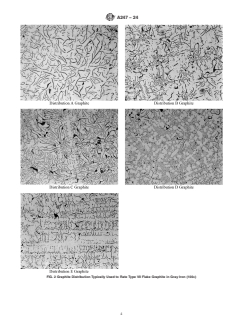
8.1 The graphite distribution chart (Fig. 2) is useful princi-
polishing compound in one of the final stages of polishing is
pally in rating flake graphite, Type VII, distributions in gray
very effective in retaining the graphite at the polished surface.
cast iron. Graphite in malleable iron may occur in a nonrandom
distribution pattern which the distributions B to E may be used
7. Classification of Graphite Form Using Chart
to describe.
7.1 The graphite form type chart (Fig. 1) is used as a
reference standard by scanning the polished specimen under
9. Classification of Graphite Size by Chart
the microscope and noting the graphite forms in the micro-
9.1 This method categorizes the graphite particles by size
structure that more nearly correspond to type designations on
into eight classes. Figs. 3-5 show size classes for flake graphite
the chart. The percentages of each graphite type are estimated
and nodular graphite to facilitate comparisons. The maximum
by observation, or better, by counting the particles of each type.
dimension of the graphite particles for the various size classes
Types present in a sample are to be reported in percentages to
are listed in Table 1.
total 100. Any convenient magnification that clearly reveals the
graphite form may be used. 9.2 For direct comparison with the size classes in Figs. 3-5,
the specimen to be evaluated shall be captured at the magni-
7.2 Type I graphite is nodular in shape and is the normal and
fication of exactly 100×. Usually visual comparison with the
usually desirable graphite form in ductile iron.
chart is adequate to define the size class. Where a mixture of
7.3 Type II graphite consists of slightly irregular nodules
one or more sizes occurs in the same sample, the sizes may be
and has little or no adverse effect on properties of ductile iron.
reported as percentages of the total graphite area represented
by the sizes involved. It is a common practice in malleable
7.4 Type III is the graphite form most often seen in
irons to use nodule count per unit area instead of a comparison
malleable iron castings after annealing. Some malleable irons
chart as given here. Nodule count, with known free carbon
may also contain Type I or I
...
This document is not an ASTM standard and is intended only to provide the user of an ASTM standard an indication of what changes have been made to the previous version. Because
it may not be technically possible to adequately depict all changes accurately, ASTM recommends that users consult prior editions as appropriate. In all cases only the current version
of the standard as published by ASTM is to be considered the official document.
Designation: A247 − 19 A247 − 24
Standard Test Method for
Evaluating the Microstructure Visual Evaluation of Graphite
in Iron Castings
This standard is issued under the fixed designation A247; the number immediately following the designation indicates the year of
original adoption or, in the case of revision, the year of last revision. A number in parentheses indicates the year of last reapproval. A
superscript epsilon (´) indicates an editorial change since the last revision or reapproval.
This standard has been approved for use by agencies of the U.S. Department of Defense.
1. Scope
1.1 This test method covers the classification of graphite in cast irons in terms of type, distribution, and size by visual comparison
to reference photomicrographs. This test method is intended to be applicable for all iron-carbon alloys containing graphite particles,
and may be applied to gray irons, malleable irons, compacted graphite irons, and the ductile (nodular) irons.
1.2 The reference photomicrographs included in this test method are in no way to be construed as specifications. In an appropriate
specification for a specific material where graphite microstructure is an important consideration, this test method may be used as
a reference to concisely define the graphite microstructure required.
1.3 These reference photomicrographs are offered primarily to permit accurate reporting of microstructures of cast irons and to
facilitate the comparison of reports by different laboratories or investigators.
1.4 The values stated in SI units are to be regarded as standard. No other units of measurement are included in this standard.
1.5 This standard does not purport to address all of the safety concerns, if any, associated with its use. It is the responsibility
of the user of this standard to establish appropriate safety, health, and environmental practices and determine the applicability of
regulatory limitations prior to use.
1.6 This international standard was developed in accordance with internationally recognized principles on standardization
established in the Decision on Principles for the Development of International Standards, Guides and Recommendations issued
by the World Trade Organization Technical Barriers to Trade (TBT) Committee.
2. Referenced Documents
2.1 ASTM Standards:
E3 Guide for Preparation of Metallographic Specimens
3. Summary of Test Method
3.1 The reference micrographs included in this standard form the basis for classification. Characteristic features of graphite
This test method is under the jurisdiction of ASTM Committee A04 on Iron Castings and is the direct responsibility of Subcommittee A04.21 on Testing.
Current edition approved March 1, 2019April 1, 2024. Published March 2019April 2024. Originally approved in 1941. Last previous edition approved in 20172019 as
A247 – 17.A247 – 19. DOI: 10.1520/A0247-19.10.1520/A0247-24.
For referenced ASTM standards, visit the ASTM website, www.astm.org, or contact ASTM Customer Service at service@astm.org. For Annual Book of ASTM Standards
volume information, refer to the standard’s Document Summary page on the ASTM website.
Copyright © ASTM International, 100 Barr Harbor Drive, PO Box C700, West Conshohocken, PA 19428-2959. United States
A247 − 24
particle shape and distribution are designated by numerals and letters. Type, distribution, and size of observed graphite are
compared with the idealized microstructures in the standard charts and rated accordingly as closely as possible to the equal or
similar microstructures in the charts.
4. Significance and Use
4.1 The comparison of observed graphite particles with the structures shown in the charts give only purely descriptive information
on the type, distribution, and size of the graphite in the sample being evaluated. It does not indicate, except in a very broad way,
the origin of the graphite or the suitability of the iron-carbon alloy for a particular service.
5. Test Specimens or Samples
5.1 The preferred sample is a section cut from an actual casting that is being evaluated at a location agreed upon between the
manufacturer and purchaser. When this is impractical, a test lug or projection often can be appended to the casting and sawed or
broken off to be used as the test sample. If neither of these methods is convenient, microstructural test coupons, such as those
recommended by the Cast Iron Research Committee (5R) of the American Foundry Society shall be cast from metal representative
of the castings poured.
6. Polishing
6.1 Grinding and polishing may follow the usual accepted metallographic procedures as covered in Guide E3, except that care
must be taken that the graphite is retained at the polished surface and not torn or dragged out. Use of diamond powder polishing
compound in one of the final stages of polishing is very effective in retaining the graphite at the polished surface.
7. Classification of Graphite Form Using Chart
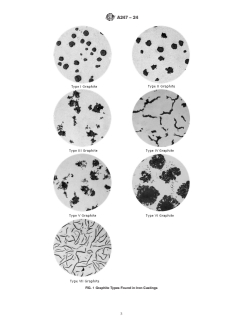
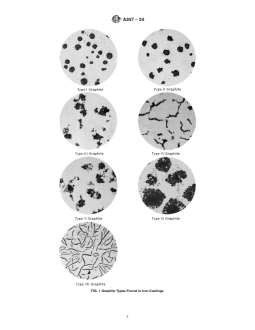
7.1 The graphite form type chart (Fig. 1) is used as a reference standard by scanning the polished specimen under the microscope
and noting the graphite forms in the microstructure that more nearly correspond to type designations on the chart. The percentages
of each graphite type are estimated by observation, or better, by counting the particles of each type. Types present in a sample are
to be reported in percentages to total 100. Any convenient magnification that clearly reveals the graphite form may be used.
7.2 Type I graphite is nodular in shape and is the normal and usually desirable graphite form in ductile iron.
7.3 Type II graphite consists of slightly irregular nodules and has little or no adverse effect on properties of ductile iron.
7.4 Type III is the graphite form most often seen in malleable iron castings after annealing. Some malleable irons may also contain
Type I or II graphite particles.
7.5 Type IV is the predominant graphite form in compacted (vermicular) graphite iron. However, the microstructure is typically
evaluated by the percentage of Types I and II that are commonly observed.
TABLE 1 Graphite Size
A
Size Class Actual Dimension (μm)
1 $640
2 320 to <640
3 160 to <320
4 80 to <160
5 40 to <80
6 20 to <40
7 10 to <20
8 <10
A
The gradation of sizes shown in each size class from the maximum dimension
were computer calculated at the National Bureau of Standards using data obtained
from actual micrographs (Wyman, L. L., and Moore, G. A., “Quantitative Metallo-
graphic Evaluations of Graphite Microstructures,” Modern Castings, Vol 43, No. 1,
Jan. 1963, p. 7).
Transactions, American Foundrymen’s Society, 1960, p. 655.
A247 − 24
FIG. 1 Graphite Types Found in Iron Castings
A247 − 24
7.6 Type V is the spiky graphite form occasionally seen in ductile iron in conjunction with Types I and II.
7.7 Type VI is the exploded nodule graphite form occasionally seen in ductile iron in conjunction with Types I and II.
...