


ASTM D6217-21
(Test Method)Standard Test Method for Particulate Contamination in Middle Distillate Fuels by Laboratory Filtration
Standard Test Method for Particulate Contamination in Middle Distillate Fuels by Laboratory Filtration<rangeref></rangeref >
SIGNIFICANCE AND USE
5.1 This is the first ASTM standard test method for assessing the mass quantity of particulates in middle distillate fuels. Test Method D5452 and its predecessor Test Method D2276 were developed for aviation fuels and used 1 gal or 5 L of fuel sample. Using 1 gal of a middle distillate fuel, which can contain greater particulate levels, often required excessive time to complete the filtration. This test method used about a quarter of the volume used in the aviation fuel methods.
5.2 The mass of particulates present in a fuel is a significant factor, along with the size and nature of the individual particles, in the rapidity with which fuel system filters and other small orifices in fuel systems can become plugged. This test method provides a means of assessing the mass of particulates present in a fuel sample.
5.3 The test method can be used in specifications and purchase documents as a means of controlling particulate contamination levels in the fuels purchased. Maximum particulate levels are specified in several military fuel specifications.
SCOPE
1.1 This test method covers the determination of the mass of particulate contamination in a middle distillate fuel by filtration. This test method is suitable for all No. 1 and No. 2 grades in Specifications D396, D975, D2880 and D3699 and for grades DMA and DMB in Specification D2069.
1.2 This test method is not suitable for fuels whose flash point as determined by Test Methods D56, D93 or D3828 is less than 38 °C.
Note 1: Middle distillate fuels with flash points less than 38 °C have been ignited by discharges of static electricity when the fuels have been filtered through inadequately bonded or grounded membrane filter systems. See Test Methods D2276 and D5452 for means of determining particulate contamination in Specification D1655 aviation turbine fuels and other similar aviation fuels. See Guide D4865 for a more detailed discussion of static electricity formation and discharge.
1.3 This test method has not been validated for testing biodiesel, such as meeting Specification D6751 or blends of middle distillates and biodiesel, such as meeting Specification D7467, or both. Test Method D7321 has been determined to be suitable for testing B100 and all blends of middle distillates and biodiesel.
Note 2: No. 1 and No. 2 grades in Specifications D396 or D975 currently allow up to 5 % biodiesel meeting Specification D6751. Samples containing biodiesel can result in partial dissolution or compromise of the membrane filters and give erroneous results.
1.4 The precision of this test method is applicable to particulate contaminant levels between 0 g/m3 to 25 g/m3 provided that 1 L samples are used and the 1 L is filtered completely. Higher levels of particulate contaminant can be measured, but are subject to uncertain precision.
1.5 The values stated in SI units are to be regarded as standard. No other units of measurement are included in this standard.
1.6 This standard does not purport to address all of the safety concerns, if any, associated with its use. It is the responsibility of the user of this standard to establish appropriate safety, health, and environmental practices and determine the applicability of regulatory limitations prior to use.
1.7 This international standard was developed in accordance with internationally recognized principles on standardization established in the Decision on Principles for the Development of International Standards, Guides and Recommendations issued by the World Trade Organization Technical Barriers to Trade (TBT) Committee.
General Information
- Status
- Published
- Publication Date
- 30-Sep-2021
- Technical Committee
- D02 - Petroleum Products, Liquid Fuels, and Lubricants
- Drafting Committee
- D02.14 - Stability, Cleanliness and Compatibility of Liquid Fuels
Relations
- Effective Date
- 15-Mar-2024
- Refers
ASTM D4175-23a - Standard Terminology Relating to Petroleum Products, Liquid Fuels, and Lubricants - Effective Date
- 15-Dec-2023
- Effective Date
- 15-Dec-2023
- Effective Date
- 01-Nov-2023
- Effective Date
- 01-Oct-2023
- Effective Date
- 01-Oct-2023
- Refers
ASTM D4175-23e1 - Standard Terminology Relating to Petroleum Products, Liquid Fuels, and Lubricants - Effective Date
- 01-Jul-2023
- Effective Date
- 01-Aug-2020
- Effective Date
- 01-Jun-2020
- Effective Date
- 01-Jan-2020
- Effective Date
- 15-Dec-2019
- Effective Date
- 01-May-2019
- Effective Date
- 01-May-2019
- Effective Date
- 01-Feb-2019
- Effective Date
- 15-Dec-2018
Overview
ASTM D6217-21 is the standard test method developed by ASTM International for determining particulate contamination in middle distillate fuels via laboratory filtration. This method fills an important gap for diesel and similar fuels, as previous filtration tests were designed for aviation fuels and involved impractical sample volumes for dirtier middle distillates. By filtering a 1-liter sample through membrane filters and measuring the mass of particulates, the standard allows for more practical and accurate assessment of fuel cleanliness, which is vital for reliable engine and equipment operation.
This test method is suitable for No. 1 and No. 2 fuel grades (such as those in ASTM specifications D396, D975, D2880, and D3699), as well as specified marine fuel grades (DMA, DMB per Specification D2069). It addresses the significant role that particulate contamination plays in clogged fuel filters and system failures, supporting quality assurance and contractual compliance for buyers and suppliers in the petroleum industry.
Key Topics
Scope and Limitations
- Applicable to all No. 1 and No. 2 middle distillate fuel grades.
- Not suitable for fuels with a flash point below 38 °C.
- Not validated for biodiesel or blends exceeding current limits in D396 or D975.
- Most accurate for particulate contaminant levels between 0–25 g/m³.
Test Procedure
- Involves vacuum filtration of approximately 1 L of representative fuel sample through stacked 0.8 μm nylon membrane filters.
- Particulates are determined gravimetrically by weighing filters before and after filtration.
- Total particulate contamination is reported in g/m³ or mg/L of fuel.
Precision and Reliability
- Designed for repeatable and reproducible results across different laboratories, especially when using 1-liter samples.
- Provides clear repeatability and reproducibility values, supporting regulatory and contractual uses.
Safety and Precautions
- Caution for handling fuels with low flash points due to risk of ignition from static electricity.
- Use only with properly bonded/grounded apparatus; follow relevant health, safety, and environmental guidelines.
Applications
- Fuel Quality Control: Regular testing ensures that diesel, kerosine, and related fuels meet industry and military particulate contamination limits.
- Maintenance Prevention: Early detection of excessive particulate levels prevents filter clogging and operational disruptions in engines and equipment.
- Specification Compliance: Enables suppliers and buyers to set and verify maximum allowable particulate contamination levels in procurement documents.
- Laboratory and Field Use: Suitable for commercial fuel laboratories and on-site quality assurance during fuel storage, transfer, and distribution.
This test method is particularly valuable for refineries, fuel distributors, storage facilities, and end-users who require consistent and clean fuel for high-performance applications.
Related Standards
- ASTM D5452: Test Method for particulate contamination in aviation fuels by laboratory filtration.
- ASTM D2276: Test Method for particulate contamination in aviation fuel by line sampling.
- ASTM D396, D975, D2880, D3699: Specifications for fuel oils, diesel fuel, gas turbine fuel oils, and kerosine.
- ASTM D2069: Specification for marine fuels.
- ASTM D4057: Practice for manual sampling of petroleum products.
- ASTM D4865: Guide for static electricity generation and dissipation in fuel systems.
- ASTM D6751, D7467, D7321: Standards related to biodiesel and blends.
For aviation fuels or biodiesel mixes beyond standard limits, refer to the specific test methods above to ensure accurate and safe determination of particulate contamination.
Keywords: ASTM D6217-21, particulate contamination, middle distillate fuels, diesel fuel testing, laboratory filtration, fuel cleanliness, membrane filtration, quality control, petroleum standards, fuel filter plugging prevention.
Buy Documents
ASTM D6217-21 - Standard Test Method for Particulate Contamination in Middle Distillate Fuels by Laboratory Filtration<rangeref></rangeref >
REDLINE ASTM D6217-21 - Standard Test Method for Particulate Contamination in Middle Distillate Fuels by Laboratory Filtration<rangeref></rangeref >
Get Certified
Connect with accredited certification bodies for this standard

ABS Quality Evaluations Inc.
American Bureau of Shipping quality certification.

Element Materials Technology
Materials testing and product certification.

ABS Group Brazil
ABS Group certification services in Brazil.
Sponsored listings
Frequently Asked Questions
ASTM D6217-21 is a standard published by ASTM International. Its full title is "Standard Test Method for Particulate Contamination in Middle Distillate Fuels by Laboratory Filtration<rangeref></rangeref >". This standard covers: SIGNIFICANCE AND USE 5.1 This is the first ASTM standard test method for assessing the mass quantity of particulates in middle distillate fuels. Test Method D5452 and its predecessor Test Method D2276 were developed for aviation fuels and used 1 gal or 5 L of fuel sample. Using 1 gal of a middle distillate fuel, which can contain greater particulate levels, often required excessive time to complete the filtration. This test method used about a quarter of the volume used in the aviation fuel methods. 5.2 The mass of particulates present in a fuel is a significant factor, along with the size and nature of the individual particles, in the rapidity with which fuel system filters and other small orifices in fuel systems can become plugged. This test method provides a means of assessing the mass of particulates present in a fuel sample. 5.3 The test method can be used in specifications and purchase documents as a means of controlling particulate contamination levels in the fuels purchased. Maximum particulate levels are specified in several military fuel specifications. SCOPE 1.1 This test method covers the determination of the mass of particulate contamination in a middle distillate fuel by filtration. This test method is suitable for all No. 1 and No. 2 grades in Specifications D396, D975, D2880 and D3699 and for grades DMA and DMB in Specification D2069. 1.2 This test method is not suitable for fuels whose flash point as determined by Test Methods D56, D93 or D3828 is less than 38 °C. Note 1: Middle distillate fuels with flash points less than 38 °C have been ignited by discharges of static electricity when the fuels have been filtered through inadequately bonded or grounded membrane filter systems. See Test Methods D2276 and D5452 for means of determining particulate contamination in Specification D1655 aviation turbine fuels and other similar aviation fuels. See Guide D4865 for a more detailed discussion of static electricity formation and discharge. 1.3 This test method has not been validated for testing biodiesel, such as meeting Specification D6751 or blends of middle distillates and biodiesel, such as meeting Specification D7467, or both. Test Method D7321 has been determined to be suitable for testing B100 and all blends of middle distillates and biodiesel. Note 2: No. 1 and No. 2 grades in Specifications D396 or D975 currently allow up to 5 % biodiesel meeting Specification D6751. Samples containing biodiesel can result in partial dissolution or compromise of the membrane filters and give erroneous results. 1.4 The precision of this test method is applicable to particulate contaminant levels between 0 g/m3 to 25 g/m3 provided that 1 L samples are used and the 1 L is filtered completely. Higher levels of particulate contaminant can be measured, but are subject to uncertain precision. 1.5 The values stated in SI units are to be regarded as standard. No other units of measurement are included in this standard. 1.6 This standard does not purport to address all of the safety concerns, if any, associated with its use. It is the responsibility of the user of this standard to establish appropriate safety, health, and environmental practices and determine the applicability of regulatory limitations prior to use. 1.7 This international standard was developed in accordance with internationally recognized principles on standardization established in the Decision on Principles for the Development of International Standards, Guides and Recommendations issued by the World Trade Organization Technical Barriers to Trade (TBT) Committee.
SIGNIFICANCE AND USE 5.1 This is the first ASTM standard test method for assessing the mass quantity of particulates in middle distillate fuels. Test Method D5452 and its predecessor Test Method D2276 were developed for aviation fuels and used 1 gal or 5 L of fuel sample. Using 1 gal of a middle distillate fuel, which can contain greater particulate levels, often required excessive time to complete the filtration. This test method used about a quarter of the volume used in the aviation fuel methods. 5.2 The mass of particulates present in a fuel is a significant factor, along with the size and nature of the individual particles, in the rapidity with which fuel system filters and other small orifices in fuel systems can become plugged. This test method provides a means of assessing the mass of particulates present in a fuel sample. 5.3 The test method can be used in specifications and purchase documents as a means of controlling particulate contamination levels in the fuels purchased. Maximum particulate levels are specified in several military fuel specifications. SCOPE 1.1 This test method covers the determination of the mass of particulate contamination in a middle distillate fuel by filtration. This test method is suitable for all No. 1 and No. 2 grades in Specifications D396, D975, D2880 and D3699 and for grades DMA and DMB in Specification D2069. 1.2 This test method is not suitable for fuels whose flash point as determined by Test Methods D56, D93 or D3828 is less than 38 °C. Note 1: Middle distillate fuels with flash points less than 38 °C have been ignited by discharges of static electricity when the fuels have been filtered through inadequately bonded or grounded membrane filter systems. See Test Methods D2276 and D5452 for means of determining particulate contamination in Specification D1655 aviation turbine fuels and other similar aviation fuels. See Guide D4865 for a more detailed discussion of static electricity formation and discharge. 1.3 This test method has not been validated for testing biodiesel, such as meeting Specification D6751 or blends of middle distillates and biodiesel, such as meeting Specification D7467, or both. Test Method D7321 has been determined to be suitable for testing B100 and all blends of middle distillates and biodiesel. Note 2: No. 1 and No. 2 grades in Specifications D396 or D975 currently allow up to 5 % biodiesel meeting Specification D6751. Samples containing biodiesel can result in partial dissolution or compromise of the membrane filters and give erroneous results. 1.4 The precision of this test method is applicable to particulate contaminant levels between 0 g/m3 to 25 g/m3 provided that 1 L samples are used and the 1 L is filtered completely. Higher levels of particulate contaminant can be measured, but are subject to uncertain precision. 1.5 The values stated in SI units are to be regarded as standard. No other units of measurement are included in this standard. 1.6 This standard does not purport to address all of the safety concerns, if any, associated with its use. It is the responsibility of the user of this standard to establish appropriate safety, health, and environmental practices and determine the applicability of regulatory limitations prior to use. 1.7 This international standard was developed in accordance with internationally recognized principles on standardization established in the Decision on Principles for the Development of International Standards, Guides and Recommendations issued by the World Trade Organization Technical Barriers to Trade (TBT) Committee.
ASTM D6217-21 is classified under the following ICS (International Classification for Standards) categories: 75.160.20 - Liquid fuels. The ICS classification helps identify the subject area and facilitates finding related standards.
ASTM D6217-21 has the following relationships with other standards: It is inter standard links to ASTM D1655-24, ASTM D4175-23a, ASTM D975-23a, ASTM D4865-23, ASTM D1655-23a, ASTM D7467-23, ASTM D4175-23e1, ASTM D93-20, ASTM D7467-20a, ASTM D7467-20, ASTM D396-19a, ASTM D7467-19, ASTM D396-19, ASTM D975-19, ASTM D7467-18b. Understanding these relationships helps ensure you are using the most current and applicable version of the standard.
ASTM D6217-21 is available in PDF format for immediate download after purchase. The document can be added to your cart and obtained through the secure checkout process. Digital delivery ensures instant access to the complete standard document.
Standards Content (Sample)
This international standard was developed in accordance with internationally recognized principles on standardization established in the Decision on Principles for the
Development of International Standards, Guides and Recommendations issued by the World Trade Organization Technical Barriers to Trade (TBT) Committee.
Designation: D6217 − 21
Designation: 415/98
Standard Test Method for
Particulate Contamination in Middle Distillate Fuels by
1,2
Laboratory Filtration
This standard is issued under the fixed designation D6217; the number immediately following the designation indicates the year of
original adoption or, in the case of revision, the year of last revision. A number in parentheses indicates the year of last reapproval. A
superscript epsilon (´) indicates an editorial change since the last revision or reapproval.
1. Scope* completely. Higher levels of particulate contaminant can be
measured, but are subject to uncertain precision.
1.1 Thistestmethodcoversthedeterminationofthemassof
particulate contamination in a middle distillate fuel by filtra- 1.5 The values stated in SI units are to be regarded as
tion.This test method is suitable for all No. 1 and No. 2 grades standard. No other units of measurement are included in this
in Specifications D396, D975, D2880 and D3699 and for standard.
grades DMA and DMB in Specification D2069.
1.6 This standard does not purport to address all of the
safety concerns, if any, associated with its use. It is the
1.2 This test method is not suitable for fuels whose flash
responsibility of the user of this standard to establish appro-
point as determined by Test Methods D56, D93 or D3828 is
priate safety, health, and environmental practices and deter-
less than 38 °C.
mine the applicability of regulatory limitations prior to use.
NOTE 1—Middle distillate fuels with flash points less than 38 °C have
1.7 This international standard was developed in accor-
been ignited by discharges of static electricity when the fuels have been
dance with internationally recognized principles on standard-
filtered through inadequately bonded or grounded membrane filter sys-
tems. See Test Methods D2276 and D5452 for means of determining ization established in the Decision on Principles for the
particulate contamination in Specification D1655 aviation turbine fuels
Development of International Standards, Guides and Recom-
and other similar aviation fuels. See Guide D4865 for a more detailed
mendations issued by the World Trade Organization Technical
discussion of static electricity formation and discharge.
Barriers to Trade (TBT) Committee.
1.3 This test method has not been validated for testing
biodiesel, such as meeting Specification D6751 or blends of
2. Referenced Documents
middle distillates and biodiesel, such as meeting Specification
2.1 ASTM Standards:
D7467, or both.Test Method D7321 has been determined to be
D56 Test Method for Flash Point by Tag Closed Cup Tester
suitable for testing B100 and all blends of middle distillates
D93 Test Methods for Flash Point by Pensky-Martens
and biodiesel.
Closed Cup Tester
NOTE 2—No. 1 and No. 2 grades in Specifications D396 or D975
D396 Specification for Fuel Oils
currentlyallowupto5 %biodieselmeetingSpecificationD6751.Samples
D975 Specification for Diesel Fuel
containing biodiesel can result in partial dissolution or compromise of the
D1193 Specification for Reagent Water
membrane filters and give erroneous results.
D1655 Specification for Aviation Turbine Fuels
1.4 The precision of this test method is applicable to
D2069 Specification for Marine Fuels (Withdrawn 2003)
3 3
particulate contaminant levels between 0 g⁄m to 25 g⁄m
D2276 Test Method for Particulate Contaminant inAviation
provided that 1 L samples are used and the 1 L is filtered
Fuel by Line Sampling
D2880 Specification for Gas Turbine Fuel Oils
D3699 Specification for Kerosine
This test method is under the jurisdiction of ASTM International Committee
D3828 Test Methods for Flash Point by Small Scale Closed
D02 on Petroleum Products, Liquid Fuels, and Lubricants and is the direct
Cup Tester
responsibility of ASTM Subcommittee D02.14 on Stability, Cleanliness and
Compatibility of Liquid Fuels. The technically equivalent standard as referenced is
under the jurisdiction of the Energy Institute Subcommittee SC-B-5.
Current edition approved Oct. 1, 2021. Published October 2021. Originally
approved in 1998. Last previous edition approved in 2018 as D6217 – 18. DOI: For referenced ASTM standards, visit the ASTM website, www.astm.org, or
10.1520/D6217-21. contact ASTM Customer Service at service@astm.org. For Annual Book of ASTM
This test method has been developed through the cooperative effort between Standards volume information, refer to the standard’s Document Summary page on
ASTM and the Energy Institute, London.ASTM and IPstandards were approved by the ASTM website.
ASTMandEItechnicalcommitteesasbeingtechnicallyequivalentbutthatdoesnot The last approved version of this historical standard is referenced on
imply both standards are identical. www.astm.org.
*A Summary of Changes section appears at the end of this standard
Copyright © ASTM International, 100 Barr Harbor Drive, PO Box C700, West Conshohocken, PA 19428-2959. United States
D6217 − 21
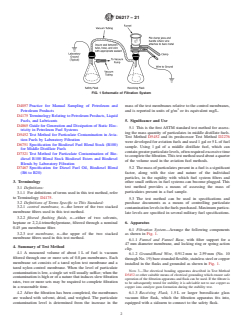
FIG. 1 Schematic of Filtration System
D4057 Practice for Manual Sampling of Petroleum and mass of the test membranes relative to the control membranes,
Petroleum Products and is reported in units of g/m or its equivalent mg/L.
D4175 Terminology Relating to Petroleum Products, Liquid
Fuels, and Lubricants
5. Significance and Use
D4865 Guide for Generation and Dissipation of Static Elec-
5.1 This is the first ASTM standard test method for assess-
tricity in Petroleum Fuel Systems
ing the mass quantity of particulates in middle distillate fuels.
D5452 Test Method for Particulate Contamination in Avia-
Test Method D5452 and its predecessor Test Method D2276
tion Fuels by Laboratory Filtration
were developed for aviation fuels and used 1 gal or 5 Lof fuel
D6751 Specification for Biodiesel Fuel Blend Stock (B100)
sample. Using 1 gal of a middle distillate fuel, which can
for Middle Distillate Fuels
contain greater particulate levels, often required excessive time
D7321 Test Method for Particulate Contamination of Bio-
tocompletethefiltration.Thistestmethodusedaboutaquarter
diesel B100 Blend Stock Biodiesel Esters and Biodiesel
of the volume used in the aviation fuel methods.
Blends by Laboratory Filtration
5.2 The mass of particulates present in a fuel is a significant
D7467 Specification for Diesel Fuel Oil, Biodiesel Blend
factor, along with the size and nature of the individual
(B6 to B20)
particles, in the rapidity with which fuel system filters and
3. Terminology
other small orifices in fuel systems can become plugged. This
test method provides a means of assessing the mass of
3.1 Definitions:
particulates present in a fuel sample.
3.1.1 For definitions of terms used in this test method, refer
to Terminology D4175.
5.3 The test method can be used in specifications and
3.2 Definitions of Terms Specific to This Standard:
purchase documents as a means of controlling particulate
3.2.1 control membrane, n—the lower of the two stacked
contaminationlevelsinthefuelspurchased.Maximumparticu-
membrane filters used in this test method.
late levels are specified in several military fuel specifications.
3.2.2 filtered flushing fluids, n—either of two solvents,
heptane or 2,2,4-trimethylpentane, filtered through a nominal 6. Apparatus
0.45 µm membrane filter.
6.1 Filtration System—Arrange the following components
3.2.3 test membrane, n—the upper of the two stacked
as shown in Fig. 1.
membrane filters used in this test method.
6.1.1 Funnel and Funnel Base, with filter support for a
47 mm diameter membrane, and locking ring or spring action
4. Summary of Test Method
clip.
4.1 A measured volume of about 1 L of fuel is vacuum
6.1.2 Ground/Bond Wire, 0.912 mm to 2.59 mm (No. 10
filtered through one or more sets of 0.8 µm membranes. Each
throughNo.19)barestrandedflexible,stainlesssteelorcopper
membrane set consists of a tared nylon test membrane and a
installed in the flasks and grounded as shown in Fig. 1.
tared nylon control membrane. When the level of particulate
NOTE 3—The electrical bonding apparatus described in Test Method
contamination is low, a single set will usually suffice; when the
D5452 or other suitable means of electrical grounding which ensure safe
contamination is high or of a nature that induces slow filtration
operation of the filtration apparatus and flask can be used. If the filtrate is
rates, two or more sets may be required to complete filtration
to be subsequently tested for stability it is advisable not to use copper as
in a reasonable time. copper ions catalyze gum formation during the stability test.
4.2 After the filtration has been completed, the membranes 6.1.3 Receiving Flask, 1.5 L or larger borosilicate glass
are washed with solvent, dried, and weighed. The particulate vacuum filter flask, which the filtration apparatus fits into,
contamination level is determined from the increase in the equipped with a sidearm to connect to the safety flask.
D6217 − 21
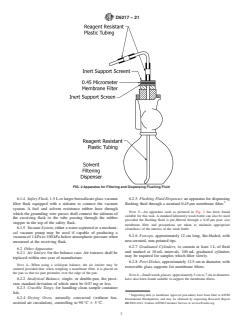
FIG. 2 Apparatus for Filtering and Dispensing Flushing Fluid
6.1.4 Safety Flask, 1.5 Lor larger borosilicate glass vacuum 6.2.5 Flushing Fluid Dispenser, an apparatus for dispensing
filter flask equipped with a sidearm to connect the vacuum flushing fluid through a nominal 0.45 µm membrane filter.
system. A fuel and solvent resistance rubber hose through
NOTE 5—An apparatus such as pictured in Fig. 2 has been found
which the grounding wire passes shall connect the sidearm of
suitable for this task. A standard laboratory wash bottle can also be used
the receiving flask to the tube passing through the rubber
provided the flushing fluid is pre-filtered through a 0.45 µm pore size
stopper in the top of the safety flask.
membrane filter and precautions are taken to maintain appropriate
6.1.5 Vacuum System, either a water aspirated or a mechani-
cleanliness of the interior of the wash bottle
cal vacuum pump may be used if capable of producing a
6.2.6 Forceps, approximately 12 cm long, flat-bladed, with
vacuum of 1 kPa to 100 kPa below atmospheric pressure when
non-serrated, non-pointed tips.
measured at the receiving flask.
6.2.7 Graduated Cylinders, to contain at least 1 L of fluid
6.2 Other Apparatus:
and marked at 10 mL intervals. 100 mL graduated cylinders
6.2.1 Air Ionizer, for the balance case. Air ionizers shall be
may be required for samples which filter slowly.
replaced within one year of manufacture.
6.2.8 Petri Dishes, approximately 12.5 cm in diameter, with
NOTE 4—When using a solid-pan balance, the air ionizer may be
removable glass supports for membrane filters.
omitted provided that, when weighing a membrane filter, it is placed on
the pan so that no part protrudes over the edge of the pan.
NOTE 6—Small watch glasses, approximately 5 cm to 7 cm in diameter,
6.2.2 Analytical Balance, single- or double-pan, the preci- have also been found suitable to support the membrane filters.
sion standard deviation of which must be 0.07 mg or less.
6.2.3 Crucible Tongs, for handling clean sample container
lids.
Supporting data (a membrane approval procedure) have been filed at ASTM
6.2.4 Drying Oven, naturally convected (without fan-
International Headquarters and may be obtained by requesting Research Report
assisted air circulation), controlling to 90 °C 6 5 °C. RR:D02-1012. Contact ASTM Customer Service at service@astm.org.
D6217 − 21
7. Reagents and Materials 9. Sampling
7.1 Purity of Reagents—Reagent grade chemicals shall be
9.1 The sample container shall be 1 L (60.15 L) in volume
used in all tests. Unless otherwise indicated, it is intended that
and have a screw on cap. Glass containers are preferred to
all reagents shall conform to the specifications of the Commit-
facilitate a visual inspection of the contents and the container
tee onAnalytical Reagents of theAmerican Chemical Society,
before and after filling. Glass containers also allow for visual
where such specifications are available. Other grades may be
inspection of the container, after the sample is emptied, to
used, provided it is first ascertained that the reagent is of
confirm complete rinsing of the container. Epoxy lined sample
sufficient purity to permit its use without lessening the accu-
cans, polytetrafluoroethylene (PTFE) bottles, and high density
racy of the determination.
linear polyethylene bottles have also been found suitable as
sample containers but are less desirable since visual inspection
7.2 Purity of Water—Unless otherwise indicated, references
of the interior of the container is more difficult. (Warning—It
to water mean reagent water as defined by Type III of
is important to note that the entire contents of the sample
Specification D1193.
container are filtered during the conduct of this test method.
7.3 Flushing Fluids:
This includes not only all of the fuel but also all rinsings of the
7.3.1 Heptane, (Warning—Flammable.)
interior of the container with flushing fluid. Because of this,
7.3.2 2,2,4-trimethylpentane (isoctane), (Warning—
take care to protect the sample from any external contamina-
Flammable.)
tion.)
7.4 Propan-2-ol (2-propanol; isopropyl alcohol),
9.2 All containers and their caps, sampling lines, and other
(Warning—Flammable.)
equipment used in obtaining the sample for analysis shall be
thoroughly cleaned as described in Section 8. When it is not
7.5 Liquid or Powder Detergent, water-soluble, for cleaning
glassware. practical to clean the sample containers in this manner, the
containers shall be rinsed three times with the fuel to be
7.6 Nylon Test Membrane Filters, plain, 47 mm diameter,
sampled. When it is not practical to clean the sampling lines,
nominal pore size 0.8 µm.
rinse them thoroughly with the fuel to be sampled.
7.7 Nylon Control Membrane Filters (see Note 7), 47 mm
9.3 Precautions to avoid sample contamination shall include
diameter, nominal pore size 0.8 µm.
selection of an appropriate sampling point. Samples should
NOTE 7—Membrane filters with a grid imprinted on their surface, may
preferentiallybeobtaineddynamicallyfromasamplingloopin
be used as control membrane filters for identification.
a distribution line, or from the flushing line of a field sampling
7.8 Protective Cover, polyethylene film or clean aluminum kit. Ensure that the line to be sampled is flushed with fuel
foil. before taking the sample.
9.3.1 Where it is desirable or only possible to obtain
8. Preparation of Apparatus and Sample Containers
samples from static storage, fo
...
This document is not an ASTM standard and is intended only to provide the user of an ASTM standard an indication of what changes have been made to the previous version. Because
it may not be technically possible to adequately depict all changes accurately, ASTM recommends that users consult prior editions as appropriate. In all cases only the current version
of the standard as published by ASTM is to be considered the official document.
Designation: D6217 − 18 D6217 − 21
Designation: 415/98
Standard Test Method for
Particulate Contamination in Middle Distillate Fuels by
1,2
Laboratory Filtration
This standard is issued under the fixed designation D6217; the number immediately following the designation indicates the year of
original adoption or, in the case of revision, the year of last revision. A number in parentheses indicates the year of last reapproval. A
superscript epsilon (´) indicates an editorial change since the last revision or reapproval.
1. Scope*
1.1 This test method covers the determination of the mass of particulate contamination in a middle distillate fuel by filtration. This
test method is suitable for all No. 1 and No. 2 grades in Specifications D396, D975, D2880 and D3699 and for grades DMA and
DMB in Specification D2069.
1.2 This test method is not suitable for fuels whose flash point as determined by Test Methods D56, D93 or D3828 is less than
38 °C.
NOTE 1—Middle distillate fuels with flash points less than 38 °C have been ignited by discharges of static electricity when the fuels have been filtered
through inadequately bonded or grounded membrane filter systems. See Test Methods D2276 and D5452 for means of determining particulate
contamination in Specification D1655 aviation turbine fuels and other similar aviation fuels. See Guide D4865 for a more detailed discussion of static
electricity formation and discharge.
1.3 This test method has not been validated for testing biodiesel, such as meeting Specification D6751 or blends of middle
distillates and biodiesel, such as meeting Specification D7467, or both. Test Method D7321 has been determined to be suitable for
testing B100 and all blends of middle distillates and biodiesel.
NOTE 2—No. 1 and No. 2 grades in Specifications D396 or D975 currently allow up to 5 % biodiesel meeting Specification D6751. Samples containing
biodiesel can result in partial dissolution or compromise of the membrane filters and give erroneous results.
3 3
1.4 The precision of this test method is applicable to particulate contaminant levels between 0 g ⁄m to 25 g ⁄m provided that 1 L
samples are used and the 1 L is filtered completely. Higher levels of particulate contaminant can be measured, but are subject to
uncertain precision.
1.5 The values stated in SI units are to be regarded as standard. No other units of measurement are included in this standard.
1.6 This standard does not purport to address all of the safety concerns, if any, associated with its use. It is the responsibility
of the user of this standard to establish appropriate safety, health, and environmental practices and determine the applicability of
regulatory limitations prior to use.
This test method is under the jurisdiction of ASTM International Committee D02 on Petroleum Products, Liquid Fuels, and Lubricants and is the direct responsibility
of ASTM Subcommittee D02.14 on Stability, Cleanliness and Compatibility of Liquid Fuels. The technically equivalent standard as referenced is under the jurisdiction of
the Energy Institute Subcommittee SC-B-5.
Current edition approved July 1, 2018Oct. 1, 2021. Published July 2018October 2021. Originally approved in 1998. Last previous edition approved in 20162018 as
D6217 – 11 (2016).D6217 – 18. DOI: 10.1520/D6217-18. 10.1520/D6217-21.
This test method has been developed through the cooperative effort between ASTM and the Energy Institute, London. ASTM and IP standards were approved by ASTM
and EI technical committees as being technically equivalent but that does not imply both standards are identical.
*A Summary of Changes section appears at the end of this standard
Copyright © ASTM International, 100 Barr Harbor Drive, PO Box C700, West Conshohocken, PA 19428-2959. United States
D6217 − 21
1.7 This international standard was developed in accordance with internationally recognized principles on standardization
established in the Decision on Principles for the Development of International Standards, Guides and Recommendations issued
by the World Trade Organization Technical Barriers to Trade (TBT) Committee.
2. Referenced Documents
2.1 ASTM Standards:
D56 Test Method for Flash Point by Tag Closed Cup Tester
D93 Test Methods for Flash Point by Pensky-Martens Closed Cup Tester
D396 Specification for Fuel Oils
D975 Specification for Diesel Fuel
D1193 Specification for Reagent Water
D1655 Specification for Aviation Turbine Fuels
D2069 Specification for Marine Fuels (Withdrawn 2003)
D2276 Test Method for Particulate Contaminant in Aviation Fuel by Line Sampling
D2880 Specification for Gas Turbine Fuel Oils
D3699 Specification for Kerosine
D3828 Test Methods for Flash Point by Small Scale Closed Cup Tester
D4057 Practice for Manual Sampling of Petroleum and Petroleum Products
D4175 Terminology Relating to Petroleum Products, Liquid Fuels, and Lubricants
D4865 Guide for Generation and Dissipation of Static Electricity in Petroleum Fuel Systems
D5452 Test Method for Particulate Contamination in Aviation Fuels by Laboratory Filtration
D6751 Specification for Biodiesel Fuel Blend Stock (B100) for Middle Distillate Fuels
D7321 Test Method for Particulate Contamination of Biodiesel B100 Blend Stock Biodiesel Esters and Biodiesel Blends by
Laboratory Filtration
D7467 Specification for Diesel Fuel Oil, Biodiesel Blend (B6 to B20)
3. Terminology
3.1 Definitions:
3.1.1 bond, v—to connect two parts of a system electrically by means of a conductive wire to eliminate voltage differences.
3.1.1 For definitions of terms used in this test method, refer to Terminology D4175.
3.1.2 ground, vt—to connect electrically with ground (earth).
3.1.3 membrane filter, n—a porous article of closely controlled pore size through which a liquid is passed to separate matter in
suspension.
3.2 Definitions of Terms Specific to This Standard:
3.2.1 control membrane, n—the lower of the two stacked membrane filters used in this test method.
3.2.2 filtered flushing fluids, n—either of two solvents, heptane or 2,2,4-trimethylpentane, filtered through a nominal 0.45 μm
membrane filter.
3.2.3 test membrane, n—the upper of the two stacked membrane filters used in this test method.
4. Summary of Test Method
4.1 A measured volume of about 1 L of fuel is vacuum filtered through one or more sets of 0.8 μm membranes. Each membrane
set consists of a tared nylon test membrane and a tared nylon control membrane. When the level of particulate contamination is
low, a single set will usually suffice; when the contamination is high or of a nature that induces slow filtration rates, two or more
sets may be required to complete filtration in a reasonable time.
For referenced ASTM standards, visit the ASTM website, www.astm.org, or contact ASTM Customer Service at service@astm.org. For Annual Book of ASTM Standards
volume information, refer to the standard’s Document Summary page on the ASTM website.
The last approved version of this historical standard is referenced on www.astm.org.
D6217 − 21
FIG. 1 Schematic of Filtration System
4.2 After the filtration has been completed, the membranes are washed with solvent, dried, and weighed. The particulate
contamination level is determined from the increase in the mass of the test membranes relative to the control membranes, and is
reported in units of g/m or its equivalent mg/L.
5. Significance and Use
5.1 This is the first ASTM standard test method for assessing the mass quantity of particulates in middle distillate fuels. Test
Method D5452 and its predecessor Test Method D2276 were developed for aviation fuels and used 1 gal or 5 L of fuel sample.
Using 1 gal of a middle distillate fuel, which can contain greater particulate levels, often required excessive time to complete the
filtration. This test method used about a quarter of the volume used in the aviation fuel methods.
5.2 The mass of particulates present in a fuel is a significant factor, along with the size and nature of the individual particles, in
the rapidity with which fuel system filters and other small orifices in fuel systems can become plugged. This test method provides
a means of assessing the mass of particulates present in a fuel sample.
5.3 The test method can be used in specifications and purchase documents as a means of controlling particulate contamination
levels in the fuels purchased. Maximum particulate levels are specified in several military fuel specifications.
6. Apparatus
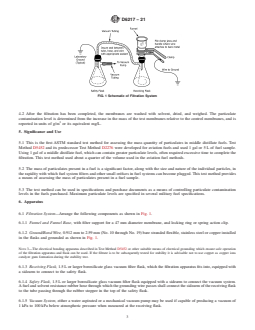
6.1 Filtration System—Arrange the following components as shown in Fig. 1.
6.1.1 Funnel and Funnel Base, with filter support for a 47 mm diameter membrane, and locking ring or spring action clip.
6.1.2 Ground/Bond Wire, 0.912 mm to 2.59 mm (No. 10 through No. 19) bare stranded flexible, stainless steel or copper installed
in the flasks and grounded as shown in Fig. 1.
NOTE 3—The electrical bonding apparatus described in Test Method D5452 or other suitable means of electrical grounding which ensure safe operation
of the filtration apparatus and flask can be used. If the filtrate is to be subsequently tested for stability it is advisable not to use copper as copper ions
catalyze gum formation during the stability test.
6.1.3 Receiving Flask, 1.5 L or larger borosilicate glass vacuum filter flask, which the filtration apparatus fits into, equipped with
a sidearm to connect to the safety flask.
6.1.4 Safety Flask, 1.5 L or larger borosilicate glass vacuum filter flask equipped with a sidearm to connect the vacuum system.
A fuel and solvent resistance rubber hose through which the grounding wire passes shall connect the sidearm of the receiving flask
to the tube passing through the rubber stopper in the top of the safety flask.
6.1.5 Vacuum System, either a water aspirated or a mechanical vacuum pump may be used if capable of producing a vacuum of
1 kPa to 100 kPa below atmospheric pressure when measured at the receiving flask.
D6217 − 21
FIG. 2 Apparatus for Filtering and Dispensing Flushing Fluid
6.2 Other Apparatus:
6.2.1 Air Ionizer, for the balance case. Air ionizers shall be replaced within one year of manufacture.
NOTE 4—When using a solid-pan balance, the air ionizer may be omitted provided that, when weighing a membrane filter, it is placed on the pan so that
no part protrudes over the edge of the pan.
6.2.2 Analytical Balance, single- or double-pan, the precision standard deviation of which must be 0.07 mg or less.
6.2.3 Crucible Tongs, for handling clean sample container lids.
6.2.4 Drying Oven, naturally convected (without fan-assisted air circulation), controlling to 90 °C 6 5 °C.
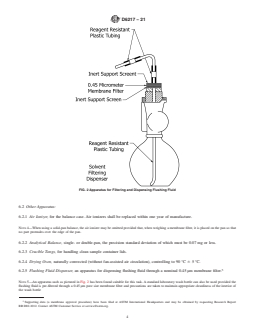
6.2.5 Flushing Fluid Dispenser, an apparatus for dispensing flushing fluid through a nominal 0.45 μm membrane filter.
NOTE 5—An apparatus such as pictured in Fig. 2 has been found suitable for this task. A standard laboratory wash bottle can also be used provided the
flushing fluid is pre-filtered through a 0.45 μm pore size membrane filter and precautions are taken to maintain appropriate cleanliness of the interior of
the wash bottle
Supporting data (a membrane approval procedure) have been filed at ASTM International Headquarters and may be obtained by requesting Research Report
RR:D02-1012. Contact ASTM Customer Service at service@astm.org.
D6217 − 21
6.2.6 Forceps, approximately 12 cm long, flat-bladed, with non-serrated, non-pointed tips.
6.2.7 Graduated Cylinders, to contain at least 1 L of fluid and marked at 10 mL intervals. 100 mL graduated cylinders may be
required for samples which filter slowly.
6.2.8 Petri Dishes, approximately 12.5 cm in diameter, with removable glass supports for membrane filters.
NOTE 6—Small watch glasses, approximately 5 cm to 7 cm in diameter, have also been found suitable to support the membrane filters.
7. Reagents and Materials
7.1 Purity of Reagents—Reagent grade chemicals shall be used in all tests. Unless otherwise indicated, it is intended that all
reagents shall conform to the specifications of the Committee on Analytical Reagents of the American Chemical Society, where
such specifications are available. Other grades may be used, provided it is first ascertained that the reagent is of sufficient purity
to permit its use without lessening the accuracy of the determination.
7.2 Purity of Water—Unless otherwise indicated, references to water mean reagent water as defined by Type III of Specification
D1193.
7.3 Flushing Fluids:
7.3.1 Heptane, (Warning—Flammable.)
7.3.2 2,2,4-trimethylpentane (isoctane), (Warning—Flammable.)
7.4 Propan-2-ol (2-propanol; isopropyl alcohol), (Warning—Flammable.)
7.5 Liquid or Powder Detergent, water-soluble, for cleaning glassware.
7.6 Nylon Test Membrane Filters, plain, 47 mm diameter, nominal pore size 0.8 μm.
7.7 Nylon Control Membrane Filters (see Note 7), 47 mm diameter, nominal pore size 0.8 μm.
NOTE 7—Membrane filters with a grid imprinted on their surface, may be used as control membrane filters for identification.
7.8 Protective Cover, polyethylene film or clean aluminum foil.
8. Preparation of Apparatus and Sample Containers
8.1 Clean all components of the filtration apparatus, sample containers, their caps and petriPetri dishes as described in 8.1.1 –
8.1.7.
8.1.1 Remove any labels, tags, and so forth.
8.1.2 Wash with warm tap water containing detergent.
8.1.3 Rinse thoroughly with warm tap water.
8.1.4 Rinse thoroughly with reagent water. Container caps should be handled only externally with clean laboratory crucible tongs
during this and subsequent washings.
Reagent Chemicals, American Chemical Society Specifications,ACS Reagent Chemicals, Specifications and Procedures for Reagents and Standard-Grade Reference
Materials, American Chemical Society, Washington, DC. For Suggestionssuggestions on the testing of reagents not listed by the American Chemical Society, see
AnnualAnalar Standards for Laboratory Chemicals, BDH Ltd., Poole, Dorset, U.K., and the United States Pharmacopeia and National Formulary, U.S. Pharmacopeial
Convention, Inc. (USPC), Rockville, MD.
D6217 − 21
8.1.5 Rinse thoroughly with propan-2-ol that has been filtered through a 0.45 μm membrane filter.
8.1.6 Rinse thoroughly with filtered flushing fluid and dry.
8.1.7 Keep a clean protective cover (the cover may be rinsed with filtered flushing fluid), over the top of the sample container until
the cap is installed. Similarly protect the funnel opening of the assembled filtration apparatus with a clean protective cover until
ready for use.
9. Sampling
9.1 The sample container shall be 1 L (60.15 L) in volume and have a screw on cap. Glass containers are preferred to facilitate
a visual inspection of the contents and the container before and after filling. Glass containers al
...
Questions, Comments and Discussion
Ask us and Technical Secretary will try to provide an answer. You can facilitate discussion about the standard in here.
Loading comments...