

ASTM D8386-21
(Test Method)Standard Test Method for Determining Enhanced Filter Blocking Tendency (EFBT)
General Information
- Abstract
SIGNIFICANCE AND USE
5.1 This test method is intended for use in evaluating the cleanliness of middle distillate fuels for quality control purposes.
5.2 The filter media specified in this procedure is suitable for the materials in the scope.
5.3 A change in filtration performance after storage or pretreatment can be indicative of changes of fuel condition.
5.4 The filterability of fuels varies depending on filter porosity and structure. Therefore, results from this test method might not correlate with full-scale filtration; however, results from this test might help identify fuels that can reduce filter life.
5.5 Causes of poor filterability in industrial/refinery filters include fuel degradation products, contaminants (including water) picked up during storage or transfer, effects due to temperature or composition for diesel, incompatibility of commingled fuels, or interaction of the fuel with the filter media. Any of these could correlate with orifice or filter system plugging, or both.
5.6 The results of the EFBT test can range from 1 for a fuel with very good filterability, to over 30 for a fuel with poor filterability. The selection of a single EFBT number to define a pass or fail criteria is not possible, as this will be dependent on the fuel type and application specifics. The correlation between filter life and EFBT number is, therefore, dependent on many variables stemming from the design and use of the engine. Some factors like pressures and particle size removal required come from the fuel system design while others are a result of the duty cycle and environment where the engine is deployed. As an example, a large displacement HPCR (High-Pressure Common Rail) engine in continuous operation may have cleanliness needs much greater than that of a medium or light-duty engine in occasional use. In each case, the expected EFBT value may be different. An EFBT value of D2068 method (Appendix X1).
SCOPE
1.1 This test method covers a procedure for the determination of the Enhanced Filter Blocking Tendency (EFBT) and the filterability of middle distillate fuel oils. This test is applicable to fuels within the viscosity range of 1.3 mm2/s to 6.0 mm2/s at 40 °C.
Note 1: ASTM specification fuels falling within the scope of this test method are: Specification D396 Grades No 1 and 2; Specification D975 Grades No. 1-D S15 and S500, and No. 2-D S15 and S500; Specification D2880 Grades No. 1-GT and No. 2-GT.
1.2 This test method has interim repeatability only. For more information, see Section 12.
1.3 This test method is not applicable to fuels that contain free (undissolved) water (see 7.3).
1.4 The values stated in SI units are to be regarded as standard. No other units of measurement are included in this standard.
1.5 This standard does not purport to address all of the safety concerns, if any, associated with its use. It is the responsibility of the user of this standard to establish appropriate safety, health, and environmental practices and determine the applicability of regulatory limitations prior to use.
1.6 This international standard was developed in accordance with internationally recognized principles on standardization established in the Decision on Principles for the Development of International Standards, Guides and Recommendations issued by the World Trade Organization Technical Barriers to Trade (TBT) Committee.
- Status
- Published
- Publication Date
- 31-Mar-2021
- Technical Committee
- D02 - Petroleum Products, Liquid Fuels, and Lubricants
- Drafting Committee
- D02.14 - Stability, Cleanliness and Compatibility of Liquid Fuels
Overview
ASTM D8386-21: Standard Test Method for Determining Enhanced Filter Blocking Tendency (EFBT) provides a laboratory procedure for measuring the filterability and contamination risk of middle distillate fuel oils. Developed by ASTM International, this standard is designed to support quality control and fuel cleanliness management, helping users identify and manage fuels that may cause filter blockages or reduce filter life in various engine and equipment applications.
The EFBT test evaluates contaminants in distillate fuels by monitoring how these substances interact with a specific sensitive filter medium under controlled flow and pressure conditions. The results indicate a fuel's tendency to cause filter plugging, represented by the Enhanced Filter Blocking Tendency (EFBT) number-a key indicator for routine fuel quality assessment and specification compliance.
Key Topics
Scope and Applicability
- Covers middle distillate fuel oils with viscosities from 1.3 mm²/s to 6.0 mm²/s at 40 °C.
- Applies to fuels under specifications such as ASTM D396 (Fuel Oils), ASTM D975 (Diesel Fuels), and ASTM D2880 (Gas Turbine Fuel Oils).
- Excludes samples with visible free water.
Significance of EFBT
- Assesses how particulates, degradation byproducts, water, and incompatible additives affect filter life and system reliability.
- A change in filtration performance following storage or treatment often signals changes in fuel quality.
- Results assist in identifying fuels that could increase maintenance costs by reducing filter service intervals.
Test Principle
- A measured sample is passed through a specified filter at a constant flow rate.
- Pressure across the filter and fuel volume are recorded until reaching set maximums.
- The EFBT value is calculated based on pressure or volume outcomes, indicating filterability-a lower EFBT reflects cleaner fuel.
Result Interpretation
- EFBT values generally range from 1 (excellent filterability) to above 30 (poor filterability).
- No universal pass/fail threshold-the appropriate EFBT depends on engine type, fuel system design, duty cycle, and operating environment.
Applications
Quality Control in Fuel Handling
- Enables fuel suppliers, refiners, and distributors to monitor cleanliness before delivery or blending.
- Assists in meeting performance specifications and detecting potential sources of contamination during fuel storage or transfer.
Engine and Equipment Protection
- Useful for fleet operators, engine manufacturers, and maintenance professionals to reduce filter plugging incidents.
- Supports predictive maintenance programs by identifying problematic fuels before use in high-pressure common rail (HPCR) and other sensitive engines.
Research and Development
- Provides a consistent baseline for comparing new fuel formulations, additives, or treatments aimed at improving filterability.
Related Standards
- ASTM D396 - Specification for Fuel Oils
- ASTM D975 - Specification for Diesel Fuel Oils
- ASTM D2880 - Specification for Gas Turbine Fuel Oils
- ASTM D2068 - Test Method for Filter Blocking Tendency (precursor to EFBT)
- ASTM D4057/D4177 - Practices for Sampling Petroleum Products
- ASTM D4175 - Terminology for Petroleum Products
- ASTM D4176/D4860 - Test Methods for Free Water and Particulate Contamination in Distillate Fuels
Adhering to ASTM D8386-21 helps stakeholders maintain high fuel quality, maximize filter performance, and ensure the reliable operation of diesel, marine, stationary, and aviation engines by effectively detecting filter-blocking risks in middle distillate fuels.
Relations
- Effective Date
- 01-Mar-2024
- Refers
ASTM D4175-23a - Standard Terminology Relating to Petroleum Products, Liquid Fuels, and Lubricants - Effective Date
- 15-Dec-2023
- Effective Date
- 15-Dec-2023
- Effective Date
- 01-Dec-2023
- Refers
ASTM D4175-23e1 - Standard Terminology Relating to Petroleum Products, Liquid Fuels, and Lubricants - Effective Date
- 01-Jul-2023
- Effective Date
- 15-Dec-2019
- Effective Date
- 01-Dec-2019
- Effective Date
- 01-May-2019
- Effective Date
- 01-Feb-2019
- Effective Date
- 01-Dec-2018
- Effective Date
- 01-Oct-2018
- Effective Date
- 01-Oct-2018
- Effective Date
- 01-May-2018
- Effective Date
- 01-May-2018
- Effective Date
- 15-Dec-2017
Get Certified
Connect with accredited certification bodies for this standard

Element Materials Technology
Materials testing and product certification.

ABS Group Brazil
ABS Group certification services in Brazil.

ABS Quality Evaluations Inc.
American Bureau of Shipping quality certification.
Sponsored listings
Frequently Asked Questions
ASTM D8386-21 is a standard published by ASTM International. Its full title is "Standard Test Method for Determining Enhanced Filter Blocking Tendency (EFBT)". This standard covers: SIGNIFICANCE AND USE 5.1 This test method is intended for use in evaluating the cleanliness of middle distillate fuels for quality control purposes. 5.2 The filter media specified in this procedure is suitable for the materials in the scope. 5.3 A change in filtration performance after storage or pretreatment can be indicative of changes of fuel condition. 5.4 The filterability of fuels varies depending on filter porosity and structure. Therefore, results from this test method might not correlate with full-scale filtration; however, results from this test might help identify fuels that can reduce filter life. 5.5 Causes of poor filterability in industrial/refinery filters include fuel degradation products, contaminants (including water) picked up during storage or transfer, effects due to temperature or composition for diesel, incompatibility of commingled fuels, or interaction of the fuel with the filter media. Any of these could correlate with orifice or filter system plugging, or both. 5.6 The results of the EFBT test can range from 1 for a fuel with very good filterability, to over 30 for a fuel with poor filterability. The selection of a single EFBT number to define a pass or fail criteria is not possible, as this will be dependent on the fuel type and application specifics. The correlation between filter life and EFBT number is, therefore, dependent on many variables stemming from the design and use of the engine. Some factors like pressures and particle size removal required come from the fuel system design while others are a result of the duty cycle and environment where the engine is deployed. As an example, a large displacement HPCR (High-Pressure Common Rail) engine in continuous operation may have cleanliness needs much greater than that of a medium or light-duty engine in occasional use. In each case, the expected EFBT value may be different. An EFBT value of D2068 method (Appendix X1). SCOPE 1.1 This test method covers a procedure for the determination of the Enhanced Filter Blocking Tendency (EFBT) and the filterability of middle distillate fuel oils. This test is applicable to fuels within the viscosity range of 1.3 mm2/s to 6.0 mm2/s at 40 °C. Note 1: ASTM specification fuels falling within the scope of this test method are: Specification D396 Grades No 1 and 2; Specification D975 Grades No. 1-D S15 and S500, and No. 2-D S15 and S500; Specification D2880 Grades No. 1-GT and No. 2-GT. 1.2 This test method has interim repeatability only. For more information, see Section 12. 1.3 This test method is not applicable to fuels that contain free (undissolved) water (see 7.3). 1.4 The values stated in SI units are to be regarded as standard. No other units of measurement are included in this standard. 1.5 This standard does not purport to address all of the safety concerns, if any, associated with its use. It is the responsibility of the user of this standard to establish appropriate safety, health, and environmental practices and determine the applicability of regulatory limitations prior to use. 1.6 This international standard was developed in accordance with internationally recognized principles on standardization established in the Decision on Principles for the Development of International Standards, Guides and Recommendations issued by the World Trade Organization Technical Barriers to Trade (TBT) Committee.
SIGNIFICANCE AND USE 5.1 This test method is intended for use in evaluating the cleanliness of middle distillate fuels for quality control purposes. 5.2 The filter media specified in this procedure is suitable for the materials in the scope. 5.3 A change in filtration performance after storage or pretreatment can be indicative of changes of fuel condition. 5.4 The filterability of fuels varies depending on filter porosity and structure. Therefore, results from this test method might not correlate with full-scale filtration; however, results from this test might help identify fuels that can reduce filter life. 5.5 Causes of poor filterability in industrial/refinery filters include fuel degradation products, contaminants (including water) picked up during storage or transfer, effects due to temperature or composition for diesel, incompatibility of commingled fuels, or interaction of the fuel with the filter media. Any of these could correlate with orifice or filter system plugging, or both. 5.6 The results of the EFBT test can range from 1 for a fuel with very good filterability, to over 30 for a fuel with poor filterability. The selection of a single EFBT number to define a pass or fail criteria is not possible, as this will be dependent on the fuel type and application specifics. The correlation between filter life and EFBT number is, therefore, dependent on many variables stemming from the design and use of the engine. Some factors like pressures and particle size removal required come from the fuel system design while others are a result of the duty cycle and environment where the engine is deployed. As an example, a large displacement HPCR (High-Pressure Common Rail) engine in continuous operation may have cleanliness needs much greater than that of a medium or light-duty engine in occasional use. In each case, the expected EFBT value may be different. An EFBT value of D2068 method (Appendix X1). SCOPE 1.1 This test method covers a procedure for the determination of the Enhanced Filter Blocking Tendency (EFBT) and the filterability of middle distillate fuel oils. This test is applicable to fuels within the viscosity range of 1.3 mm2/s to 6.0 mm2/s at 40 °C. Note 1: ASTM specification fuels falling within the scope of this test method are: Specification D396 Grades No 1 and 2; Specification D975 Grades No. 1-D S15 and S500, and No. 2-D S15 and S500; Specification D2880 Grades No. 1-GT and No. 2-GT. 1.2 This test method has interim repeatability only. For more information, see Section 12. 1.3 This test method is not applicable to fuels that contain free (undissolved) water (see 7.3). 1.4 The values stated in SI units are to be regarded as standard. No other units of measurement are included in this standard. 1.5 This standard does not purport to address all of the safety concerns, if any, associated with its use. It is the responsibility of the user of this standard to establish appropriate safety, health, and environmental practices and determine the applicability of regulatory limitations prior to use. 1.6 This international standard was developed in accordance with internationally recognized principles on standardization established in the Decision on Principles for the Development of International Standards, Guides and Recommendations issued by the World Trade Organization Technical Barriers to Trade (TBT) Committee.
ASTM D8386-21 is classified under the following ICS (International Classification for Standards) categories: 75.160.20 - Liquid fuels. The ICS classification helps identify the subject area and facilitates finding related standards.
ASTM D8386-21 has the following relationships with other standards: It is inter standard links to ASTM D6300-24, ASTM D4175-23a, ASTM D975-23a, ASTM D6300-23a, ASTM D4175-23e1, ASTM D396-19a, ASTM D6300-19a, ASTM D396-19, ASTM D975-19, ASTM D975-18a, ASTM D396-18a, ASTM D2880-18a, ASTM D396-18, ASTM D2880-18, ASTM D975-17a. Understanding these relationships helps ensure you are using the most current and applicable version of the standard.
ASTM D8386-21 is available in PDF format for immediate download after purchase. The document can be added to your cart and obtained through the secure checkout process. Digital delivery ensures instant access to the complete standard document.
Standards Content (Sample)
This international standard was developed in accordance with internationally recognized principles on standardization established in the Decision on Principles for the
Development of International Standards, Guides and Recommendations issued by the World Trade Organization Technical Barriers to Trade (TBT) Committee.
Designation: D8386 − 21
Standard Test Method for
Determining Enhanced Filter Blocking Tendency (EFBT)
This standard is issued under the fixed designation D8386; the number immediately following the designation indicates the year of
original adoption or, in the case of revision, the year of last revision. A number in parentheses indicates the year of last reapproval. A
superscript epsilon (´) indicates an editorial change since the last revision or reapproval.
INTRODUCTION
This test method is based on Test Method D2068 and uses a filter media which is more sensitive
to blocking by contaminants in fuels than the filter specified in Test Method D2068 ProcedureAand
B.Theresultofthistestmethodisdependentonthemandatedfiltermaterial,aswellastheprocedural
steps of this method. If a specification requires a specific Dxxxx procedure, do not substitute a
different procedure or filter without agreement from the specifier.
1. Scope 2. Referenced Documents
1.1 This test method covers a procedure for the determina-
2.1 ASTM Standards:
tionoftheEnhancedFilterBlockingTendency(EFBT)andthe
D396 Specification for Fuel Oils
filterability of middle distillate fuel oils. This test is applicable
D975 Specification for Diesel Fuel
2 2
tofuelswithintheviscosityrangeof1.3 mm /sto6.0 mm /sat
D2068 Test Method for Determining Filter Blocking Ten-
40 °C.
dency
D2880 Specification for Gas Turbine Fuel Oils
NOTE 1—ASTM specification fuels falling within the scope of this test
method are: Specification D396 Grades No 1 and 2; Specification D975
D4057 Practice for Manual Sampling of Petroleum and
Grades No. 1-D S15 and S500, and No. 2-D S15 and S500; Specification
Petroleum Products
D2880 Grades No. 1-GT and No. 2-GT.
D4175 Terminology Relating to Petroleum Products, Liquid
1.2 This test method has interim repeatability only. For
Fuels, and Lubricants
more information, see Section 12.
D4176 Test Method for FreeWater and Particulate Contami-
nation in Distillate Fuels (Visual Inspection Procedures)
1.3 This test method is not applicable to fuels that contain
D4177 Practice for Automatic Sampling of Petroleum and
free (undissolved) water (see 7.3).
Petroleum Products
1.4 The values stated in SI units are to be regarded as
D4860 Test Method for FreeWater and Particulate Contami-
standard. No other units of measurement are included in this
nation in Middle Distillate Fuels (Clear and Bright Nu-
standard.
merical Rating)
1.5 This standard does not purport to address all of the
D6300 Practice for Determination of Precision and Bias
safety concerns, if any, associated with its use. It is the
Data for Use in Test Methods for Petroleum Products,
responsibility of the user of this standard to establish appro-
Liquid Fuels, and Lubricants
priate safety, health, and environmental practices and deter-
2.2 ASTM Manuals:
mine the applicability of regulatory limitations prior to use.
1.6 This international standard was developed in accor- ASTM MNL 1
dance with internationally recognized principles on standard-
2.3 ASTM Adjuncts:
ization established in the Decision on Principles for the
D2PP, Determination of Precision and Bias Data for Use in
Development of International Standards, Guides and Recom-
Test Methods for Petroleum Products
mendations issued by the World Trade Organization Technical
Barriers to Trade (TBT) Committee.
For referenced ASTM standards, visit the ASTM website, www.astm.org, or
contact ASTM Customer Service at service@astm.org. For Annual Book of ASTM
This test method is under the jurisdiction of ASTM Committee D02 on Standards volume information, refer to the standard’s Document Summary page on
Petroleum Products, Liquid Fuels, and Lubricants and is the direct responsibility of the ASTM website.
Subcommittee D02.14 on Stability, Cleanliness and Compatibility of Liquid Fuels. MNL 1, Manual on Significance of Tests for Petroleum Products, 9th Edition,
Current edition approved April 1, 2021. Published May 2021. DOI: 10.1520/ ASTM International, West Conshohocken, 2018.
D8386-21. This adjunct has been withdrawn and is no longer available.
Copyright © ASTM International, 100 Barr Harbor Drive, PO Box C700, West Conshohocken, PA 19428-2959. United States
D8386 − 21
3. Terminology pass or fail criteria is not possible, as this will be dependent on
thefueltypeandapplicationspecifics.Thecorrelationbetween
3.1 For definitions of terms used in this standard, see
filter life and EFBT number is, therefore, dependent on many
Terminology D4175.
variables stemming from the design and use of the engine.
3.2 Definitions of Terms Specific to This Standard:
Some factors like pressures and particle size removal required
3.2.1 enhanced filter blocking tendency (EFBT), n—of fuels
come from the fuel system design while others are a result of
described in 1.1, a calculated dimensionless value that defines
the duty cycle and environment where the engine is deployed.
the tendency of contaminants in the fuel to plug or block the
As an example, a large displacement HPCR (High-Pressure
filter media specified in this test procedure.
Common Rail) engine in continuous operation may have
3.2.1.1 Discussion—The value is calculated using the pres-
cleanliness needs much greater than that of a medium or
sure across the filter or the volume of fuel filtered at the end of
light-duty engine in occasional use. In each case, the expected
the test. Depending on the outcome of the test, one of two
EFBT value may be different. An EFBT value of <1.4 for the
equations is applied. See Section 10, Calculation. See 5.6 for
fuel before it reaches the fuel system in the first example of
the interpretation of results.
HPCR engines may be suitable, while an EFBT <2.0 may be
3.2.2 filterability, n—of fuels described in 1.1, is the rela-
suitable in the medium/light-duty engines. In a small study, the
tionship between the volume of sample filtered and the EFBT test was shown to be more sensitive to constituents in
measured pressure increase across the filter.
the fuel than the Test Method D2068 method (Appendix X1).
3.2.2.1 Discussion—The filterability of the fuel can be
assessed by recording the pressure when a specific volume of
6. Apparatus
fuelhasflowedthroughthefilterorrecordingthevolumewhen
6.1 General—TheapparatusisdescribedinA1.1andshown
a specific pressure across the filter has been achieved. This
in Fig. A1.1.
assessment may be assisted by plotting a volume versus
pressure graph. See Appendix X1.
6.2 Filter Media and Assemblies:
NOTE 2—Effective filtration areas were determined by measuring the
4. Summary of Test Method
diameter of the sediment collected in the center of the filter media.
4.1 A test portion of the fuel to be analyzed is passed at a
6.2.1 Filter Housing, stainless steel, nominal 13 mm diam-
constant rate of flow (20 mL⁄min) through a specified filter
eter with a Luer fitting at the top where it connects with the
medium. The pressure difference across the filter, and the
filtration apparatus as shown in Fig. 1.
volume of fuel passing the filter, are monitored until the
6.2.2 Filter Media , the media is 2.1 µm 6 0.15 µm nomi-
pressure reaches 105 kPa, or the volume of fuel passing the
nal pore diameter, nominal 13.0 mm diameter and with an
filter medium reaches 300 mL. The pressure (see 3.2.2) and
2 2
effective filtration area of 55.4 mm to 63.6 mm . The filter
flow are then used to calculate the enhanced filter blocking
media has been treated with a resin to bring the permeability to
tendency, where a low number indicates clean fuel (see 5.6).
2 2
13.2 l⁄m /s 6 1.5 l⁄m /s.
5. Significance and Use
6.3 Measuring Cylinder, 25 mL, glass or other suitable
5.1 This test method is intended for use in evaluating the
transparent material, with graduations every 0.5 mL, for veri-
cleanliness of middle distillate fuels for quality control pur-
fying the flow rate.
poses.
6.4 Measuring Cylinder, 500 mL, glass or other suitable
5.2 The filter media specified in this procedure is suitable
transparent material, with graduations every 5 mL, for verify-
for the materials in the scope.
ing the flow rate, and for measuring the volume of fuel in the
5.3 A change in filtration performance after storage or fuel receiver if required.
pretreatment can be indicative of changes of fuel condition.
6.5 Stopwatch, capable of measuring to the nearest 0.2 s,
5.4 The filterability of fuels varies depending on filter
required for verifying the flow rate and preparing the sample.
porosity and structure. Therefore, results from this test method
6.6 Thermometer, electronic or liquid-in-glass type ther-
might not correlate with full-scale filtration; however, results
mometers with a range of at least 15 °C to 25 °C and accuracy
from this test might help identify fuels that can reduce filter
of 60.5 °C or better are suitable.
life.
6.7 Forceps, spade-ended.
5.5 Causes of poor filterability in industrial/refinery filters
include fuel degradation products, contaminants (including
6.8 Open-Ended Spanner Wrenches, plastic or metal.
water) picked up during storage or transfer, effects due to
temperature or composition for diesel, incompatibility of
commingled fuels, or interaction of the fuel with the filter
The sole source of supply of the Cummins Nanonet® Quantitative Media and
media.Anyofthesecouldcorrelatewithorificeorfiltersystem
entire apparatus known to the committee at this time is Stanhope-Seta, London
plugging, or both.
Street, Chertsey, KT16 8AP, United Kingdom (part numbers 91620 and 91600
respectively). If you are aware of alternative suppliers, please provide this
5.6 The results of the EFBTtest can range from 1 for a fuel
information to ASTM International Headquarters. Your comments will receive
with very good filterability, to over 30 for a fuel with poor
careful consideration at a meeting of the responsible technical committee, which
filterability. The selection of a single EFBT number to define a you may attend.
D8386 − 21
8.1.1 Pressure and Temperature—Follow the manufactur-
er’s instructions for verifying that the pressure and temperature
readings are in accordance with the tolerances given in A1.1.3
and 6.6, respectively. Verify the pressure reading, at ambient
atmospheric pressure (0 kPa) and at approximately 100 kPa, at
least every six months or if the apparatus has not been used for
the previous three months. Verify the temperature reading is
correct, at ambient temperature, at least every twelve months.
If the readings do not meet the specified tolerances in A1.1.3
and 6.6, calibrate the sensors (8.2.1).
8.1.2 Flow Rate—Follow the manufacturer’s instructions
for verifying that the flow rate is 20 mL⁄min 6 1 mL⁄min
through a filter assembly. The flow rate is verified by measur-
ing the volume pumped during a 15 min period, at least once a
month, using a suitable measuring cylinder (6.4). If the
measured volume is between 285 mLand 315 mLthe flow rate
is correct. More frequent checks on the flow rate may be made
by measuring the volume during a 1 min period using a 25 mL
measuring cylinder (6.3). If the measured volume is not
between 19 mL and 21 mL, calibrate the pump (8.2.2).
8.2 Calibration:
8.2.1 Pressure and Temperature—Follow the manufactur-
er’s instructions to calibrate the pressure at atmospheric pres-
sure (0 kPa) and approximately 100 kPa, and temperature-
measuring device at ambient temperature.
8.2.2 Flow Rate—Follow the manufacturer’s instructions to
set and lock the mechanical flow adjustment control on the
pump to give a flow rate of 20 mL⁄min 6 1 mL⁄min.
8.2.2.1 Afilter assembly shall be fitted when the flow rate is
calibrated.
8.3 Apparatus Assembly—Assemble the apparatus as shown
in Fig. A1.1, without the filter unit connected.
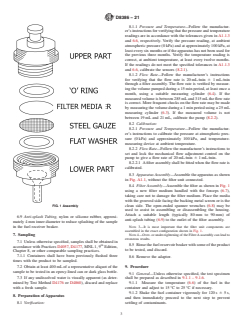
8.4 Filter Assembly—Assemble the filter as shown in Fig. 1
using a new filter medium handled with the forceps (6.7),
taking care not to damage the filter medium. Place the media
with the grooved side facing the backing metal screen or is the
clean side. The open-ended spanner wrenches (6.8) may be
FIG. 1 Assembly
used to assist in assembling or disassembling the housing.
Attach a suitable length (typically 80 mm to 90 mm) of
6.9 Anti-splash Tubing, nylon or silicone rubber, approxi-
anti-splash tubing (6.9) to the outlet of the filter assembly.
mately 4 mm inner diameter to reduce splashing of the sample
in the fuel receiver beaker. NOTE 3—It is most important that the filter unit components are
assembled in the exact configuration shown in Fig. 1.
NOTE 4—Over- or under-tightening of the FilterAassembly can lead to
7. Sampling
erroneous results.
7.1 Unless otherwise specified, samples shall be obtained in
th
8.5 Rinse the fuel reservoir beaker with some of the product
accordance with Practices D4057, D4177, MNL1, 9 Edition,
to be tested, and discard.
Chapter 8, or other comparable sampling practices.
7.1.1 Containers shall have been previously flushed three
8.6 Remove the adaptor.
times with the product to be sampled.
9. Procedure
7.2 Obtain at least 400 mLof a representative aliquot of the
sample to be tested in an epoxy-lined can or dark glass bottle.
9.1 General—Unless
...