

ASTM D5431-08(2019)
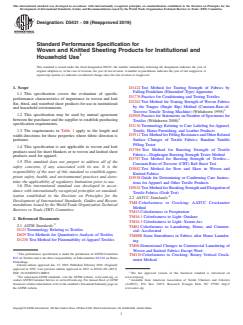
(Specification)Standard Performance Specification for Woven and Knitted Sheeting Products for Institutional and Household Use
General Information
- Abstract
SIGNIFICANCE AND USE
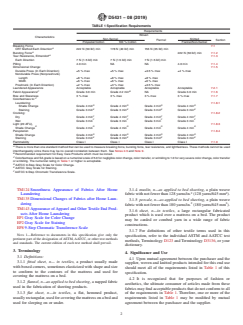
4.1 Upon mutual agreement between the purchaser and the supplier, woven and knitted products intended for this end use should meet all of the requirements listed in Table 1 of this specification.
4.2 It is recognized that for purposes of fashion or aesthetics, the ultimate consumer of articles made from these fabrics may find acceptable products that do not conform to all of the requirements in Table 1. Therefore, one or more of the requirements listed in Table 1 may be modified by mutual agreement between the purchaser and the supplier.
4.2.1 In such cases, any references to the specification shall specify that: “This product meets ASTM Specification ____ except for the following characteristic(s).”
4.3 Where no prepurchase agreement has been reached between the purchaser and the supplier, and in case of controversy, the requirements listed in Table 1 are intended to be used as a guide only. As noted in 4.2, ultimate consumer demands dictate varying performance parameters for any particular product.
4.4 The uses and significance of particular properties and test methods are discussed in the appropriate sections of the specified test methods. For additional information see Test Methods D629, Practice D1776, and Guide D3938.
SCOPE
1.1 This specification covers the evaluation of specific performance characteristics of importance in woven and knit flat, fitted, and waterbed sheet products for use in institutional and household environments.
1.2 This specification may be used by mutual agreement between the purchaser and the supplier to establish purchasing specification requirements.
1.3 The requirements in Table 1 apply to the length and width directions for those properties where fabric direction is pertinent.
1.4 This specification is not applicable to woven and knit products used for sheet blankets or to woven and knitted sheet products used for apparel.
1.5 This standard does not purport to address all of the safety concerns, if any, associated with its use. It is the responsibility of the user of this standard to establish appropriate safety, health, and environmental practices and determine the applicability of regulatory limitations prior to use.
1.6 This international standard was developed in accordance with internationally recognized principles on standardization established in the Decision on Principles for the Development of International Standards, Guides and Recommendations issued by the World Trade Organization Technical Barriers to Trade (TBT) Committee.
- Status
- Published
- Publication Date
- 14-Jan-2019
- Technical Committee
- D13 - Textiles
- Drafting Committee
- D13.63 - Home Furnishings

Overview
ASTM D5431-08(2019), Standard Performance Specification for Woven and Knitted Sheeting Products for Institutional and Household Use, is a comprehensive international standard developed by ASTM International. The purpose of this standard is to outline key performance characteristics for woven and knitted sheeting products, including flat, fitted, and waterbed sheets, intended for use in both institutional settings (such as hotels and hospitals) and household environments.
This specification serves as a guideline for manufacturers, suppliers, and purchasers to ensure that fabric-based sheeting products meet agreed-upon quality, durability, and performance criteria. The standard can be referenced in purchasing agreements and provides consistency in the evaluation of key textile properties, enhancing the reliability and usability of these products in demanding environments.
Key Topics
Product Scope
The standard covers various types of sheeting products made from woven and knit fabrics but excludes sheet blankets and apparel items.Performance Requirements
Detailed requirements address physical and functional attributes, including:- Breaking force and bursting strength
- Tear resistance
- Pilling resistance (as applicable)
- Dimensional change after laundering
- Appearance after laundering and smoothness retention
- Colorfastness to laundering, light, crocking, and perspiration
- Bow and skewness of the fabric
- Flammability classification
Testing and Evaluation
Cited test methods come from ASTM and AATCC standards, covering both laboratory and field-relevant criteria:- Breaking force: ASTM D5034 (Grab Test)
- Tear resistance: ASTM D1424 (Elmendorf)
- Pilling resistance: ASTM D3512
- Dimensional change: AATCC TM135 and TM96
- Colorfastness: AATCC TM61, TM8, TM16.1, TM16.3, TM15
- Flammability: ASTM D1230
Mutual Agreements and Modifications
The standard allows for modification of requirements by mutual agreement between purchaser and supplier, acknowledging variations needed for fashion or aesthetic preferences.Guidance in Absence of Agreement
Where no formal agreement exists, requirements serve as a guide for resolving disputes or meeting general consumer demands.Safety and Regulatory Compliance
The standard explicitly advises users to consider appropriate safety, health, and environmental practices and to comply with applicable regulations.
Applications
ASTM D5431-08(2019) is widely applicable in settings where textile sheeting performance is critical:
Institutional Use
- Hotels and resorts
- Hospitals and healthcare facilities
- Universities and dormitories
- Correctional facilities
Household Use
- Residential bedding products
- Specialty sheeting for home waterbeds or fitted beds
Procurement and Quality Assurance
- Manufacturers, suppliers, and buyers use the standard to create clear purchase specifications and quality control protocols.
- Third-party laboratories and certification bodies may use this guideline during product testing and accreditation.
By adhering to ASTM D5431, organizations can ensure consistent, reliable, and safe textile products, fostering consumer trust and reducing the risk of disputes related to product quality.
Related Standards
The following ASTM and AATCC standards are commonly referenced in conjunction with ASTM D5431-08(2019):
- ASTM D629: Test Methods for Quantitative Analysis of Textiles
- ASTM D1776: Practice for Conditioning and Testing Textiles
- ASTM D3512: Test Method for Pilling Resistance
- ASTM D5034: Test Method for Breaking Strength and Elongation (Grab Test)
- ASTM D1424: Test Method for Tearing Strength (Elmendorf)
- ASTM D3882: Test Method for Bow and Skew in Woven and Knitted Fabrics
- ASTM D1230: Test Method for Flammability of Apparel Textiles
- AATCC TM61: Colorfastness to Laundering
- AATCC TM8 & TM116: Colorfastness to Crocking
- AATCC TM16.1 & TM16.3: Colorfastness to Light
- AATCC TM15: Colorfastness to Perspiration
- AATCC TM135 & TM96: Dimensional Changes in Laundering
These related standards help establish a robust framework for the performance evaluation of woven and knit sheeting products, supporting the comprehensive approach provided by ASTM D5431-08(2019).
Keywords: ASTM D5431, sheeting products, woven sheets, knitted sheets, institutional bedding, household bedding, textile standards, performance specification, fabric testing, colorfastness, durability, laundering, flammability, product quality.
Relations
- Effective Date
- 15-Jan-2019
- Effective Date
- 01-Dec-2023
- Effective Date
- 01-Jul-2020
- Effective Date
- 01-Jul-2020
- Effective Date
- 01-Jan-2018
- Effective Date
- 01-Mar-2017
- Effective Date
- 01-Jul-2016
- Effective Date
- 01-Jul-2016
- Effective Date
- 01-Apr-2016
- Effective Date
- 01-Jan-2016
- Effective Date
- 15-Sep-2015
- Effective Date
- 01-Sep-2015
- Effective Date
- 01-Jul-2015
- Effective Date
- 01-Apr-2015
- Effective Date
- 01-Feb-2015
Frequently Asked Questions
ASTM D5431-08(2019) is a technical specification published by ASTM International. Its full title is "Standard Performance Specification for Woven and Knitted Sheeting Products for Institutional and Household Use". This standard covers: SIGNIFICANCE AND USE 4.1 Upon mutual agreement between the purchaser and the supplier, woven and knitted products intended for this end use should meet all of the requirements listed in Table 1 of this specification. 4.2 It is recognized that for purposes of fashion or aesthetics, the ultimate consumer of articles made from these fabrics may find acceptable products that do not conform to all of the requirements in Table 1. Therefore, one or more of the requirements listed in Table 1 may be modified by mutual agreement between the purchaser and the supplier. 4.2.1 In such cases, any references to the specification shall specify that: “This product meets ASTM Specification ____ except for the following characteristic(s).” 4.3 Where no prepurchase agreement has been reached between the purchaser and the supplier, and in case of controversy, the requirements listed in Table 1 are intended to be used as a guide only. As noted in 4.2, ultimate consumer demands dictate varying performance parameters for any particular product. 4.4 The uses and significance of particular properties and test methods are discussed in the appropriate sections of the specified test methods. For additional information see Test Methods D629, Practice D1776, and Guide D3938. SCOPE 1.1 This specification covers the evaluation of specific performance characteristics of importance in woven and knit flat, fitted, and waterbed sheet products for use in institutional and household environments. 1.2 This specification may be used by mutual agreement between the purchaser and the supplier to establish purchasing specification requirements. 1.3 The requirements in Table 1 apply to the length and width directions for those properties where fabric direction is pertinent. 1.4 This specification is not applicable to woven and knit products used for sheet blankets or to woven and knitted sheet products used for apparel. 1.5 This standard does not purport to address all of the safety concerns, if any, associated with its use. It is the responsibility of the user of this standard to establish appropriate safety, health, and environmental practices and determine the applicability of regulatory limitations prior to use. 1.6 This international standard was developed in accordance with internationally recognized principles on standardization established in the Decision on Principles for the Development of International Standards, Guides and Recommendations issued by the World Trade Organization Technical Barriers to Trade (TBT) Committee.
SIGNIFICANCE AND USE 4.1 Upon mutual agreement between the purchaser and the supplier, woven and knitted products intended for this end use should meet all of the requirements listed in Table 1 of this specification. 4.2 It is recognized that for purposes of fashion or aesthetics, the ultimate consumer of articles made from these fabrics may find acceptable products that do not conform to all of the requirements in Table 1. Therefore, one or more of the requirements listed in Table 1 may be modified by mutual agreement between the purchaser and the supplier. 4.2.1 In such cases, any references to the specification shall specify that: “This product meets ASTM Specification ____ except for the following characteristic(s).” 4.3 Where no prepurchase agreement has been reached between the purchaser and the supplier, and in case of controversy, the requirements listed in Table 1 are intended to be used as a guide only. As noted in 4.2, ultimate consumer demands dictate varying performance parameters for any particular product. 4.4 The uses and significance of particular properties and test methods are discussed in the appropriate sections of the specified test methods. For additional information see Test Methods D629, Practice D1776, and Guide D3938. SCOPE 1.1 This specification covers the evaluation of specific performance characteristics of importance in woven and knit flat, fitted, and waterbed sheet products for use in institutional and household environments. 1.2 This specification may be used by mutual agreement between the purchaser and the supplier to establish purchasing specification requirements. 1.3 The requirements in Table 1 apply to the length and width directions for those properties where fabric direction is pertinent. 1.4 This specification is not applicable to woven and knit products used for sheet blankets or to woven and knitted sheet products used for apparel. 1.5 This standard does not purport to address all of the safety concerns, if any, associated with its use. It is the responsibility of the user of this standard to establish appropriate safety, health, and environmental practices and determine the applicability of regulatory limitations prior to use. 1.6 This international standard was developed in accordance with internationally recognized principles on standardization established in the Decision on Principles for the Development of International Standards, Guides and Recommendations issued by the World Trade Organization Technical Barriers to Trade (TBT) Committee.
ASTM D5431-08(2019) is classified under the following ICS (International Classification for Standards) categories: 97.160 - Home textiles. Linen. The ICS classification helps identify the subject area and facilitates finding related standards.
ASTM D5431-08(2019) has the following relationships with other standards: It is inter standard links to ASTM D5431-08(2013), ASTM D3938-18(2023), ASTM D3882-08(2020), ASTM D3787-16(2020), ASTM D3938-18, ASTM D123-17, ASTM D3882-08(2016)e1, ASTM D3882-08(2016), ASTM D1230-10(2016)e1, ASTM D3787-16, ASTM D123-15b, ASTM D123-15a, ASTM D3787-15, ASTM D123-15, ASTM D629-15. Understanding these relationships helps ensure you are using the most current and applicable version of the standard.
ASTM D5431-08(2019) is available in PDF format for immediate download after purchase. The document can be added to your cart and obtained through the secure checkout process. Digital delivery ensures instant access to the complete standard document.
Standards Content (Sample)
This international standard was developed in accordance with internationally recognized principles on standardization established in the Decision on Principles for the
Development of International Standards, Guides and Recommendations issued by the World Trade Organization Technical Barriers to Trade (TBT) Committee.
Designation:D5431 −08 (Reapproved 2019)
Standard Performance Specification for
Woven and Knitted Sheeting Products for Institutional and
Household Use
This standard is issued under the fixed designation D5431; the number immediately following the designation indicates the year of
original adoption or, in the case of revision, the year of last revision. A number in parentheses indicates the year of last reapproval. A
superscript epsilon (´) indicates an editorial change since the last revision or reapproval.
1. Scope D1424 Test Method for Tearing Strength of Fabrics by
Falling-Pendulum (Elmendorf-Type) Apparatus
1.1 This specification covers the evaluation of specific
D1776 Practice for Conditioning and Testing Textiles
performance characteristics of importance in woven and knit
D2262 Test Method for Tearing Strength of Woven Fabrics
flat, fitted, and waterbed sheet products for use in institutional
by the Tongue (Single Rip) Method (Constant-Rate-of-
and household environments.
Traverse Tensile Testing Machine) (Withdrawn 1995)
1.2 This specification may be used by mutual agreement
D2905 Practice for Statements on Number of Specimens for
between the purchaser and the supplier to establish purchasing
Textiles (Withdrawn 2008)
specification requirements.
D3136 Terminology Relating to Care Labeling for Apparel,
Textile, Home Furnishing, and Leather Products
1.3 The requirements in Table 1 apply to the length and
width directions for those properties where fabric direction is D3512 TestMethodforPillingResistanceandOtherRelated
Surface Changes of Textile Fabrics: Random Tumble
pertinent.
Pilling Tester
1.4 This specification is not applicable to woven and knit
D3786 Test Method for Bursting Strength of Textile
products used for sheet blankets or to woven and knitted sheet
Fabrics—Diaphragm Bursting Strength Tester Method
products used for apparel.
D3787 Test Method for Bursting Strength of Textiles—
1.5 This standard does not purport to address all of the
Constant-Rate-of-Traverse (CRT) Ball Burst Test
safety concerns, if any, associated with its use. It is the
D3882 Test Method for Bow and Skew in Woven and
responsibility of the user of this standard to establish appro-
Knitted Fabrics
priate safety, health, and environmental practices and deter-
D3938 Guide for Determining or Confirming Care Instruc-
mine the applicability of regulatory limitations prior to use.
tions for Apparel and Other Textile Products
1.6 This international standard was developed in accor-
D5034 TestMethodforBreakingStrengthandElongationof
dance with internationally recognized principles on standard-
Textile Fabrics (Grab Test)
ization established in the Decision on Principles for the
2.2 AATCC Standards:
Development of International Standards, Guides and Recom-
TM8 Colorfastness to Crocking: AATCC Crockmeter
mendations issued by the World Trade Organization Technical
Method
Barriers to Trade (TBT) Committee.
TM15 Colorfastness to Perspiration
TM16.1 Colorfastness to Light: Outdoor
2. Referenced Documents
TM16.3 Colorfastness to Light: Xenon-Arc
2.1 ASTM Standards:
TM61 Colorfastness to Laundering, Home, and Commer-
D123 Terminology Relating to Textiles
cial: Accelerated
D629 Test Methods for Quantitative Analysis of Textiles
TM88B Seam Smoothness in Fabrics after Home Launder-
D1230 Test Method for Flammability of Apparel Textiles
ing
TM96 Dimensional Changes in Commercial Laundering of
Woven and Knitted Fabrics Except Wool
This performance specification is under the jurisdiction of ASTM Committee
TM116 Colorfastness to Crocking: Rotary Vertical Crock-
D13 on Textiles and is the direct responsibility of Subcommittee D13.63 on Home
meter Method
Furnishings.
Current edition approved Jan. 15, 2019. Published February 2019. Originally
approved in 1993. Last previous edition approved in 2013 as D5431–08 (2013).
DOI: 10.1520/D5431-08R19. The last approved version of this historical standard is referenced on
For referenced ASTM standards, visit the ASTM website, www.astm.org, or www.astm.org.
contact ASTM Customer Service at service@astm.org. For Annual Book of ASTM Available from American Association of Textile Chemists and Colorists
Standards volume information, refer to the standard’s Document Summary page on (AATCC), P.O. Box 12215, Research Triangle Park, NC 27709, http://
the ASTM website. www.aatcc.org.
Copyright © ASTM International, 100 Barr Harbor Drive, PO Box C700, West Conshohocken, PA 19428-2959. United States
D5431−08 (2019)
TABLE 1 Specification Requirements
Requirements
Woven
Characteristics
Non-flannel Knitted
Flannel Section
Polyester/Cotton 100 % Cotton Flannel/Non-flannel
Breaking Force 7.1
A
CRT Method Each Direction 222 N (50 lbf) min 178 N (40 lbf) min 156 N (35 lbf) min
A
Bursting Force 222 N (50 lbf) min 7.1.2
A
Tear Resistance, Elmendorf 7.1.3
Each Direction 7 N (1.5 lbf) min 7 N (1.5 lbf) min 7 N (1.5 lbf) min
Pilling 4.0 min NA NA 4.0 min 7.1.4
Dimensional Change: 7.1.5
Durable Press (In Each Direction) ±5 % max ±5 % max ±3.5 % max ±4 % max
Nondurable Press (Nonpreshrunk)
Length ±8 % max ±8 % max ±8 % max
Width ±6 % max ±6 % max ±6 % max
Preshrunk (In Each Direction) ±2 % max ±3 % max ±3.5 % max
Laundered Appearance Acceptable Acceptable Acceptable Acceptable 7.2.1
C B
Fabric Appearance Grade 3.0 min Grade 2.2 min NA Grade 3.0 min 7.1.6
Bow and Skewness 3 % max 3 % max 3 % max 3 % max 7.1.7
C
Colorfastness to:
Laundering: 7.1.8.1
D D D D
Shade Change Grade 4 min Grade 4 min Grade 4 min Grade 4 min
E E E E
Staining Grade 3 min Grade 3 min Grade 3 min Grade 3 min
Crocking: 7.1.8.2
F F F F
Dry Grade 4 min Grade 4 min Grade 4 min Grade 4 min
F F F F
Wet Grade3min Grade 3 min Grade 3 min Grade 3 min
Light (20 AFU), 7.1.8.3
D D D D D
Shade Change Grade 4 min Grade 4 min Grade 4 min Grade 4 min
Perspiration 7.1.8.4
D D D D
Shade Change Grade 4 min Grade 4 min Grade 4 min Grade 4 min
E E E E
Staining Grade 3 min Grade 3 min Grade 3 min Grade 3 min
Flammability Class I Class I Class I Class I 7.1.9
A
There is more than one standard method that can be used to measure breaking force, bursting force, tear resistance, and lightfastness. These methods cannot be used
interchangeably since there may be no overall correlation between them. See Notes 2-5 and Note 9.
B
Recommended requirement for Easy Care Products which must be ironed.
C
ColorfastnessandSAgradeisbasedonanumericalscaleof5.0fornegligiblecolorchange,colortransfer,orwrinklingto1.0forveryseverecolorchange,colortransfer
or wrinkling. The numerical rating in Table 1 or higher is acceptable.
D
AATCC 9-Step Gray Scale for Color Change.
E
AATCC Gray Scale for Staining.
F
AATCC 9-Step Chromatic Transference Scale.
TM124 Smoothness Appearance of Fabrics After Home 3.1.4 muslin, n—as applied to bed sheeting, a plain weave
2 2
Laundering fabric with not fewer than 128 yarns/in. (128 yarns/645 mm ).
TM135 Dimensional Changes of Fabrics after Home Laun-
3.1.5 percale, n—as applied to bed sheeting, a plain weave
2 2
dering
fabric with not fewer than 180 yarns/in. (180 yarns/645 mm ).
TM143 Appearance ofApparel and Other Textile End Prod-
3.1.6 sheet, n—in textiles, a large rectangular fabricated
ucts After Home Laundering
product which is used over a mattress on a bed. The product
EP1 Gray Scale for Color Change
may be carded or combed yarn in a wide range of fabric
EP2 Gray Scale for Staining
constructions.
EP8 9-Step Chromatic Transference Scale
3.1.7 For definitions of other textile terms used in this
NOTE 1—Reference to documents in this specification give only the
specification, refer to the individual ASTM and AATCC test
pertinent part of the designation ofASTM,AATCC, or other test methods
methods, Terminology D123 and Terminology D3136, or your
and standards. The current edition of each test method shall prevail.
dictionary.
3. Terminology
4. Significance and Use
3.1 Definitions:
4.1 Upon mutual agreement between the purchaser and the
3.1.1 fitted sheet, n— in textiles, a product usually made
supplier, woven and knitted products intended for this end use
with boxed corners, sometimes elasticized with shape and size
should meet all of the requirements listed in Table 1 of this
to conform to the contours of the mattress and used for
specification.
covering the mattress on a bed.
4.2 It is recognized that for purposes of fashion or
3.1.2 flannel, n—as applied to bed sheeting, a napped fabric
aesthetics, the ultimate consumer of articles made from these
used in the fabrication of sheeting products.
fabrics may find acceptable products that do not conform to all
3.1.3 flat sheet, n—in textiles, a flat, hemmed product, of the requirements in Table 1. Therefore, one or more of the
usuallyrectangular,usedforcoveringthemattressonabedand requirements listed in Table 1 may be modified by mutual
used for sleeping on or under. agreement between the purchaser and the supplier.
D5431−08 (2019)
machine may be used. The crosshead speed should be as agreed upon
4.2.1 In such cases, any references to the specification shall
between the purchaser and the supplier. There may be no overall
specify that: “This product meets ASTM Specification ____
correlation between the results obtained with the CRT machine and with
except for the following characteristic(s).”
theCREmachine.Conse
...