

ASTM A994-23a
(Guide)Standard Guide for Editorial Procedures and Form of Product Specifications for Steel, Stainless Steel, and Related Alloys
General Information
- Abstract
SIGNIFICANCE AND USE
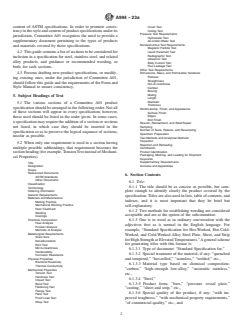
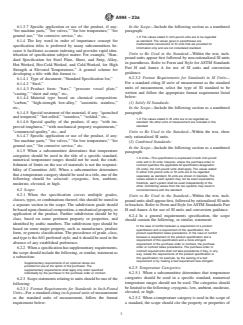
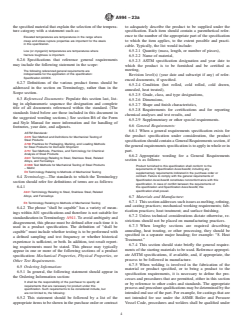
4.1 The Form and Style Manual provides mandatory requirements and recommended practices for the preparation and content of ASTM specifications. In order to promote consistency in the style and content of product specifications under its jurisdiction, Committee A01 recognizes the need to provide a supplementary document pertaining to the types of products and materials covered by those specifications.
4.2 This guide contains a list of sections to be considered for inclusion in a specification for steel, stainless steel, and related alloy products, and guidance or recommended wording, or both, for such sections.
4.3 Persons drafting new product specifications, or modifying existing ones, under the jurisdiction of Committee A01, should follow this guide and the requirements of the Form and Style Manual to ensure consistency.
SCOPE
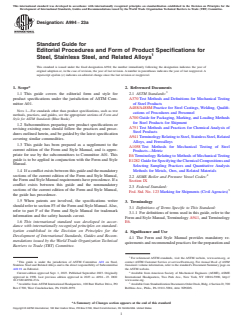
1.1 This guide covers the editorial form and style for product specifications under the jurisdiction of ASTM Committee A01.
Note 1: For standards other than product specifications, such as test methods, practices, and guides, see the appropriate sections of Form and Style for ASTM Standards (Blue Book).2
1.2 Subcommittees preparing new product specifications or revising existing ones should follow the practices and procedures outlined herein, and be guided by the latest specification covering similar commodities.
1.3 This guide has been prepared as a supplement to the current edition of the Form and Style Manual, and is appropriate for use by the subcommittees to Committee A01. This guide is to be applied in conjunction with the Form and Style Manual.
1.4 If a conflict exists between this guide and the mandatory sections of the current edition of the Form and Style Manual, the Form and Style Manual requirements have precedence. If a conflict exists between this guide and the nonmandatory sections of the current edition of the Form and Style Manual, the guide has precedence.
1.5 When patents are involved, the specifications writer should refer to section F3 of the Form and Style Manual. Also, refer to part F of the Form and Style Manual for trademark information and the safety hazards caveat.
1.6 This international standard was developed in accordance with internationally recognized principles on standardization established in the Decision on Principles for the Development of International Standards, Guides and Recommendations issued by the World Trade Organization Technical Barriers to Trade (TBT) Committee.
- Status
- Published
- Publication Date
- 31-Aug-2023
- Technical Committee
- A01 - Steel, Stainless Steel and Related Alloys
- Drafting Committee
- A01.91 - Editorial
Buy Documents
ASTM A994-23a - Standard Guide for Editorial Procedures and Form of Product Specifications for Steel, Stainless Steel, and Related Alloys
REDLINE ASTM A994-23a - Standard Guide for Editorial Procedures and Form of Product Specifications for Steel, Stainless Steel, and Related Alloys
Overview
ASTM A994-23a is the Standard Guide developed by ASTM Committee A01 for editorial procedures and the structuring of product specifications pertaining to steel, stainless steel, and related alloys. This guide supports writers and subcommittees in creating, updating, or revising product specifications by promoting a consistent, clear, and comprehensive approach. It works alongside the mandatory Form and Style Manual, providing supplementary guidance for the style, sequence, and required content of product requirements, ensuring coherence and uniformity across all documentation under the Committee A01 jurisdiction.
Key Topics
- Editorial Consistency: Emphasizes alignment with the Form and Style Manual for ASTM Standards, ensuring document uniformity and adherence to recognized practices.
- Standardized Structure: Outlines required and recommended sections for all product specifications, such as Scope, Terminology, Referenced Documents, Chemical Composition, Mechanical Properties, Sampling, and Packaging.
- Drafting Guidance: Provides preferred wording, content suggestions, and order of sections. Addresses common distinctions for units (SI and inch-pound), temperature categories, and property specifications.
- Chemical and Mechanical Specification: Advises on representing chemical composition, preferred order for elements, specification increments for mechanical test requirements, and referencing relevant ASTM test methods.
- Legal and Safety Considerations: Identifies when to refer to patents, trademarks, and safety hazard caveats as outlined in the Form and Style Manual.
- Conflict Resolution: Clarifies precedence if conflicts arise between this guide and the Form and Style Manual, ensuring proper standards are maintained.
Applications
ASTM A994-23a is a critical resource for:
- Specification Authors: Engineers, metallurgists, and technical writers responsible for drafting or revising product specifications for steel, stainless steel, and related alloys can use this guide to ensure documents are complete, clearly worded, and consistent.
- ASTM Subcommittees: Provides subcommittees with step-by-step editorial procedures and helps maintain harmonization within and across product standards managed by ASTM Committee A01.
- Manufacturers & Suppliers: Helps ensure product documentation meets internationally recognized formatting and content standards, easing product acceptance in global markets.
- Quality Assurance: Ensures that all required testing, sampling, and certification procedures are clearly specified, improving compliance with quality and safety requirements.
- Procurement & Contracts: Assists purchasing professionals in specifying critical ordering information, including product grade, dimensions, certification needs, and special requirements, to fully describe contract expectations.
Related Standards
ASTM A994-23a references and aligns with several significant standards, including:
- ASTM Form and Style Manual: The authoritative document for formatting and editorial content of ASTM International standards.
- A941 Terminology Relating to Steel, Stainless Steel, Related Alloys, and Ferroalloys: Ensures uniform terminology for clarity.
- A370 Test Methods and Definitions for Mechanical Testing of Steel Products: Related to mechanical property requirements.
- A700 Guide for Packaging, Marking, and Loading Methods for Steel Products for Shipment.
- A751 Test Methods and Practices for Chemical Analysis of Steel Products.
- A1058 Test Methods for Mechanical Testing of Steel Products-Metric.
- E6 Terminology Relating to Methods of Mechanical Testing.
- E1282 Guide for Specifying Chemical Compositions and Analysis Methods for Metals.
- ASME Boiler and Pressure Vessel Codes Section IX: Referenced for welding procedure qualifications when applicable.
This guide is developed in accordance with internationally recognized principles as set forth by the World Trade Organization (WTO) Technical Barriers to Trade (TBT) Committee, making it suitable for global specification development and ensuring technical harmonization across international standards.
By following ASTM A994-23a, organizations ensure that their steel and alloy product specifications are professionally structured, legally sound, and internationally relevant.
Relations
- Effective Date
- 01-Mar-2024
- Effective Date
- 01-Mar-2024
- Effective Date
- 01-Mar-2024
- Effective Date
- 01-Nov-2019
- Effective Date
- 01-Jul-2019
- Effective Date
- 01-Jul-2018
- Effective Date
- 01-Jul-2018
- Refers
ASTM A370-17a - Standard Test Methods and Definitions for Mechanical Testing of Steel Products - Effective Date
- 15-Nov-2017
- Effective Date
- 01-Sep-2017
- Effective Date
- 01-May-2017
- Effective Date
- 01-Jan-2017
- Effective Date
- 01-Mar-2016
- Effective Date
- 01-Nov-2015
- Effective Date
- 01-Nov-2015
- Effective Date
- 01-Nov-2014
Buy Documents
ASTM A994-23a - Standard Guide for Editorial Procedures and Form of Product Specifications for Steel, Stainless Steel, and Related Alloys
REDLINE ASTM A994-23a - Standard Guide for Editorial Procedures and Form of Product Specifications for Steel, Stainless Steel, and Related Alloys
Get Certified
Connect with accredited certification bodies for this standard

Element Materials Technology
Materials testing and product certification.

Inštitut za kovinske materiale in tehnologije
Institute of Metals and Technology. Materials testing, metallurgical analysis, NDT.
Sponsored listings
Frequently Asked Questions
ASTM A994-23a is a guide published by ASTM International. Its full title is "Standard Guide for Editorial Procedures and Form of Product Specifications for Steel, Stainless Steel, and Related Alloys". This standard covers: SIGNIFICANCE AND USE 4.1 The Form and Style Manual provides mandatory requirements and recommended practices for the preparation and content of ASTM specifications. In order to promote consistency in the style and content of product specifications under its jurisdiction, Committee A01 recognizes the need to provide a supplementary document pertaining to the types of products and materials covered by those specifications. 4.2 This guide contains a list of sections to be considered for inclusion in a specification for steel, stainless steel, and related alloy products, and guidance or recommended wording, or both, for such sections. 4.3 Persons drafting new product specifications, or modifying existing ones, under the jurisdiction of Committee A01, should follow this guide and the requirements of the Form and Style Manual to ensure consistency. SCOPE 1.1 This guide covers the editorial form and style for product specifications under the jurisdiction of ASTM Committee A01. Note 1: For standards other than product specifications, such as test methods, practices, and guides, see the appropriate sections of Form and Style for ASTM Standards (Blue Book).2 1.2 Subcommittees preparing new product specifications or revising existing ones should follow the practices and procedures outlined herein, and be guided by the latest specification covering similar commodities. 1.3 This guide has been prepared as a supplement to the current edition of the Form and Style Manual, and is appropriate for use by the subcommittees to Committee A01. This guide is to be applied in conjunction with the Form and Style Manual. 1.4 If a conflict exists between this guide and the mandatory sections of the current edition of the Form and Style Manual, the Form and Style Manual requirements have precedence. If a conflict exists between this guide and the nonmandatory sections of the current edition of the Form and Style Manual, the guide has precedence. 1.5 When patents are involved, the specifications writer should refer to section F3 of the Form and Style Manual. Also, refer to part F of the Form and Style Manual for trademark information and the safety hazards caveat. 1.6 This international standard was developed in accordance with internationally recognized principles on standardization established in the Decision on Principles for the Development of International Standards, Guides and Recommendations issued by the World Trade Organization Technical Barriers to Trade (TBT) Committee.
SIGNIFICANCE AND USE 4.1 The Form and Style Manual provides mandatory requirements and recommended practices for the preparation and content of ASTM specifications. In order to promote consistency in the style and content of product specifications under its jurisdiction, Committee A01 recognizes the need to provide a supplementary document pertaining to the types of products and materials covered by those specifications. 4.2 This guide contains a list of sections to be considered for inclusion in a specification for steel, stainless steel, and related alloy products, and guidance or recommended wording, or both, for such sections. 4.3 Persons drafting new product specifications, or modifying existing ones, under the jurisdiction of Committee A01, should follow this guide and the requirements of the Form and Style Manual to ensure consistency. SCOPE 1.1 This guide covers the editorial form and style for product specifications under the jurisdiction of ASTM Committee A01. Note 1: For standards other than product specifications, such as test methods, practices, and guides, see the appropriate sections of Form and Style for ASTM Standards (Blue Book).2 1.2 Subcommittees preparing new product specifications or revising existing ones should follow the practices and procedures outlined herein, and be guided by the latest specification covering similar commodities. 1.3 This guide has been prepared as a supplement to the current edition of the Form and Style Manual, and is appropriate for use by the subcommittees to Committee A01. This guide is to be applied in conjunction with the Form and Style Manual. 1.4 If a conflict exists between this guide and the mandatory sections of the current edition of the Form and Style Manual, the Form and Style Manual requirements have precedence. If a conflict exists between this guide and the nonmandatory sections of the current edition of the Form and Style Manual, the guide has precedence. 1.5 When patents are involved, the specifications writer should refer to section F3 of the Form and Style Manual. Also, refer to part F of the Form and Style Manual for trademark information and the safety hazards caveat. 1.6 This international standard was developed in accordance with internationally recognized principles on standardization established in the Decision on Principles for the Development of International Standards, Guides and Recommendations issued by the World Trade Organization Technical Barriers to Trade (TBT) Committee.
ASTM A994-23a is classified under the following ICS (International Classification for Standards) categories: 01.110 - Technical product documentation; 77.140.01 - Iron and steel products in general. The ICS classification helps identify the subject area and facilitates finding related standards.
ASTM A994-23a has the following relationships with other standards: It is inter standard links to ASTM A488/A488M-24, ASTM A941-24, ASTM A370-24, ASTM A700-14(2019), ASTM A370-19, ASTM A488/A488M-18, ASTM A488/A488M-18e1, ASTM A370-17a, ASTM A941-17, ASTM A488/A488M-17, ASTM A370-17, ASTM A488/A488M-16, ASTM A370-15, ASTM A941-15, ASTM A700-14. Understanding these relationships helps ensure you are using the most current and applicable version of the standard.
ASTM A994-23a is available in PDF format for immediate download after purchase. The document can be added to your cart and obtained through the secure checkout process. Digital delivery ensures instant access to the complete standard document.
Standards Content (Sample)
This international standard was developed in accordance with internationally recognized principles on standardization established in the Decision on Principles for the
Development of International Standards, Guides and Recommendations issued by the World Trade Organization Technical Barriers to Trade (TBT) Committee.
Designation: A994 − 23a
Standard Guide for
Editorial Procedures and Form of Product Specifications for
Steel, Stainless Steel, and Related Alloys
This standard is issued under the fixed designation A994; the number immediately following the designation indicates the year of
original adoption or, in the case of revision, the year of last revision. A number in parentheses indicates the year of last reapproval. A
superscript epsilon (´) indicates an editorial change since the last revision or reapproval.
1. Scope* 2. Referenced Documents
2.1 ASTM Standards:
1.1 This guide covers the editorial form and style for
product specifications under the jurisdiction of ASTM Com- A370 Test Methods and Definitions for Mechanical Testing
of Steel Products
mittee A01.
A488/A488M Practice for Steel Castings, Welding, Qualifi-
NOTE 1—For standards other than product specifications, such as test
cations of Procedures and Personnel
methods, practices, and guides, see the appropriate sections of Form and
A700 Guide for Packaging, Marking, and Loading Methods
Style for ASTM Standards (Blue Book).
for Steel Products for Shipment
1.2 Subcommittees preparing new product specifications or
A751 Test Methods and Practices for Chemical Analysis of
revising existing ones should follow the practices and proce-
Steel Products
dures outlined herein, and be guided by the latest specification
A941 Terminology Relating to Steel, Stainless Steel, Related
covering similar commodities.
Alloys, and Ferroalloys
1.3 This guide has been prepared as a supplement to the
A1058 Test Methods for Mechanical Testing of Steel
current edition of the Form and Style Manual, and is appro-
Products—Metric
priate for use by the subcommittees to Committee A01. This
E6 Terminology Relating to Methods of Mechanical Testing
guide is to be applied in conjunction with the Form and Style
E1282 Guide for Specifying the Chemical Compositions and
Manual.
Selecting Sampling Practices and Quantitative Analysis
Methods for Metals, Ores, and Related Materials
1.4 If a conflict exists between this guide and the mandatory
sections of the current edition of the Form and Style Manual,
2.2 ASME Boiler and Pressure Vessel Codes:
the Form and Style Manual requirements have precedence. If a
Section IX
conflict exists between this guide and the nonmandatory
2.3 Federal Standard:
sections of the current edition of the Form and Style Manual,
Fed. Std. No. 123 Marking for Shipments (Civil Agencies)
the guide has precedence.
1.5 When patents are involved, the specifications writer
3. Terminology
should refer to section F3 of the Form and Style Manual. Also,
3.1 Definitions of Terms Specific to This Standard:
refer to part F of the Form and Style Manual for trademark
3.1.1 For definitions of terms used in this guide, refer to the
information and the safety hazards caveat.
Form and Style Manual, Terminology A941, and Terminology
1.6 This international standard was developed in accor-
E6.
dance with internationally recognized principles on standard-
ization established in the Decision on Principles for the
4. Significance and Use
Development of International Standards, Guides and Recom-
4.1 The Form and Style Manual provides mandatory re-
mendations issued by the World Trade Organization Technical
quirements and recommended practices for the preparation and
Barriers to Trade (TBT) Committee.
For referenced ASTM standards, visit the ASTM website, www.astm.org, or
This guide is under the jurisdiction of ASTM Committee A01 on Steel, contact ASTM Customer Service at service@astm.org. For Annual Book of ASTM
Stainless Steel and Related Alloys and is the direct responsibility of Subcommittee Standards volume information, refer to the standard’s Document Summary page on
A01.91 on Editorial. the ASTM website.
Current edition approved Sept. 1, 2023. Published September 2023. Originally Available from American Society of Mechanical Engineers (ASME), ASME
approved in 1998. Last previous edition approved in 2023 as A994 – 23. DOI: International Headquarters, Two Park Ave., New York, NY 10016-5990, http://
10.1520/A0994-23A. www.asme.org.
2 5
Available from ASTM International Headquarters, 100 Barr Harbor Drive, PO Available from Standardization Documents Order Desk, Bldg. 4 Section D, 700
Box C700, West Conshohocken, PA 19428-2959. Robbins Ave., Phila., PA 19111-5094, Attn: NPODS.
*A Summary of Changes section appears at the end of this standard
Copyright © ASTM International, 100 Barr Harbor Drive, PO Box C700, West Conshohocken, PA 19428-2959. United States
A994 − 23a
content of ASTM specifications. In order to promote consis-
Crush Test
Coiling Test
tency in the style and content of product specifications under its
Pressure Test Requirements
jurisdiction, Committee A01 recognizes the need to provide a
Hydrostatic Test
supplementary document pertaining to the types of products
Air-Under-Water Test
Nondestructive Test Requirements
and materials covered by those specifications.
Magnetic Particle Test
Liquid Penetrant Test
4.2 This guide contains a list of sections to be considered for
Radiographic Test
inclusion in a specification for steel, stainless steel, and related
Ultrasonic Test
alloy products, and guidance or recommended wording, or
Eddy Current Test
both, for such sections. Flux Leakage Test
Other Test Requirements
4.3 Persons drafting new product specifications, or modify-
Dimensions, Mass, and Permissible Variations
Flatness
ing existing ones, under the jurisdiction of Committee A01,
Straightness
should follow this guide and the requirements of the Form and
Out-of-roundness
Style Manual to ensure consistency.
Camber
Bowing
Mating
5. Subject Headings of Text
Length
Diameter
5.1 The various sections of a Committee A01 product
Thickness
specification should be arranged in the following order. Not all
Workmanship, Finish, and Appearance
of these sections will appear in every specification; however,
Surface Finish
Edges
those used should be listed in the order given. In some cases,
End Finish
a specification may require the addition of a section or sections
Rework, Retreatment, and Weld Repair
not listed, in which case they should be inserted in the Sampling
Number of Tests, Retests, and Resampling
specification so as to preserve the logical sequence of sections,
Specimen Preparation
insofar as possible.
Test Methods and Analytical Methods
Inspection
5.2 When only one requirement is used in a section having
Rejection and Rehearing
multiple possible subheadings, that requirement becomes the
Certification
Product Identification
section heading (for example, Tension Test instead of Mechani-
Packaging, Marking, and Loading for Shipment
cal Properties).
Keywords
Title Supplementary Requirements
Annexes and Appendixes
Designation
Scope
Referenced Documents
6. Section Contents
ASTM Standards
Other Documents
6.1 Title:
Classification
6.1.1 The title should be as concise as possible, but com-
Terminology
Ordering Information plete enough to identify clearly the product covered by the
General Requirements
specification. Titles are also used in lists, table of contents, and
Materials and Manufacture
indexes, and it is most important that they be brief but
Melting Practice
Mechanical Working Practice
self-explanatory.
Heat Treatment
6.1.2 Two methods for establishing wording are considered
Welding
acceptable and are at the option of the subcommittee.
Coatings
Chemical Composition
6.1.3 One is to word as in ordinary conversation with the
Heat Analysis
adjectives first as is normal in the English language. For
Product Analysis
example, “Standard Specification for Hot-Worked, Hot-Cold-
Methods of Analysis
Metallurgical Requirements
Worked, and Cold-Worked Alloy Steel Plate, Sheet, and Strip
Grain Size
for High Strength at Elevated Temperatures.” A general scheme
Decarburization
for generating titles with this format is:
Etch Test
Micro-cleanliness
6.1.3.1 Type of document: “Standard Specification for,”
Hardenability
6.1.3.2 Special treatment of the material, if any: “quenched
Corrosion Resistance
Physical Properties
and tempered,” “hot-rolled,” “seamless,” “welded,” etc.,
Electrical Resistivity
6.1.3.3 Material type based on chemical composition:
Thermal Conductivity
“carbon,” “high-strength low-alloy,” “austenitic stainless,”
Mechanical Properties
Tension Test
etc.,
Hardness Test
6.1.3.4 “Steel,”
Impact Test
Bend Test 6.1.3.5 Product form: “bars,” “pressure vessel plate,”
Flattening Test
“casting,” “sheet and strip,” etc.,
Flange Test
6.1.3.6 Special quality of the product, if any: “with im-
Flare Test
Proof Load Test proved toughness,” “with mechanical property requirements,”
Wrap Test
“of commercial quality,” etc., and
A994 − 23a
6.1.3.7 Specific application or use of the product, if any: In the Scope—Include the following section as a numbered
“for machine parts,” “for valves,” “for low temperature,” “for paragraph:
general use,” “for corrosive service,” etc.
1.X The values stated in inch-pound units are to be regarded
as standard. The values given in parentheses are
6.1.4 The key word in order of importance concept for
mathematical conversions to SI units that are provided for
specification titles is preferred by many subcommittees be-
information only and are not considered standard.
cause it facilitates accurate indexing and provides rapid iden-
Units to Be Used in the Standard—Within the text, inch-
tification of specification subject matter. For example, “Stan-
pound units appear first followed by non-rationalized SI units
dard Specification for Steel Plate, Sheet, and Strip, Alloy,
in parentheses. Refer to Form and Style for ASTM Standards
Hot-Worked, Hot-Cold-Worked, and Cold-Worked, for High
Part H and Annex A for use of SI units and conversion
Strength at Elevated Temperatures.” A general scheme for
guidance.
developing a title with this format is:
6.2.3.2 Format Requirements for Standards in SI Units—
6.1.4.1 Type of document: “Standard Specification for,”
For a standard citing SI units of measurement as the standard
6.1.4.2 “Steel,”
units of measurement, select the type of SI standard to be
6.1.4.3 Product form: “bars,” “pressure vessel plate,”
written and follow the appropriate format requirement listed
“casting,” “sheet and strip,” etc.,
below:
6.1.4.4 Material type based on chemical composition:
“carbon,” “high-strength low-alloy,” “austenitic stainless,” (1) Solely SI Standards:
etc.,
In the Scope—Include the following section as a numbered
6.1.4.5 Special treatment of the material, if any: “quenched
paragraph:
and tempered,” “hot-rolled,” “seamless,” “welded,” etc.,
1.X The values stated in SI units are to be regarded as
6.1.4.6 Special quality of the product, if any: “with im- standard. No other units of measurement are included in this
standard.
proved toughness,” “with mechanical property requirements,”
“commercial quality,” etc., and Units to Be Used in the Standard—Within the text, show
6.1.4.7 Specific application or use of the product, if any:
only rationalized SI units.
“for machine parts,” “for valves,” “for low temperature,” “for
(2) Combined Standards:
general use,” “for corrosive service,” etc.
In the Scope—Include the following section as a numbered
6.1.5 When a subcommittee determines that temperature
paragraph:
categories should be used in the title of a specific standard,
1.X Units—This specification is expressed in both inch-pound
numerical temperature ranges should not be used; the estab-
units and in SI units; however, unless the purchase order or
lishment of limits on the use of materials is not the responsi- contract specifies the applicable M specification designation
(SI units), the inch-pound units shall apply. The values stated
bility of Committee A01. When a subcommittee determines
in either inch-pound units or SI units are to be regarded
that a temperature category should be used in a title, one of the
separately as standard. SI units are shown in brackets. The
values stated in each system may not be exact equivalents;
following should be selected: cryogenic, low, ambient,
therefore, each system shall be used independently of the
moderate, elevated, or high.
other. Combining values from the two systems may result in
nonconformance with the standard.
6.2 Scope:
6.2.1 When the specification covers multiple grades,
Units to Be Used in the Standard—Within the text, inch-
classes, types, or combinations thereof, this should be stated in
pound units shall appear first, followed by rationalized SI units
a separate section in the scope. The subdivision grade should
in brackets. Refer to Form and Style for ASTM Standards Part
be based upon chemical composition, a mechanical property, or
H and Annex A for use of SI units and conversion guidance.
application of the product. Further subdivision should be by
6.2.4 In a general requirements specification, the scope
class, based on some pertinent property or properties, and
should contain the following, or similar, statement:
identified by arabic numbers. The subdivision type should be
In the case of conflict between a requirement of a product
based on some major property, such as manufacture, product
specification and a requirement of this specification, the
form, or generic classification. The precedence of grade, class, product specification takes precedence. In the case of conflict
between a requirement of the product specification and a
and type is the A01 preferred style, and it should be used in the
requirement of this specification and a more stringent
absence of any established preference.
requirement of the purchase order or contract, the purchase
order or contract takes precedence. The purchase order or
6.2.2 When a specification has supplementary requirements,
contract requirements shall not take precedence if they, in any
the scope should include the following, or similar, statement as
way, violate the requirements of the product specification or
a subsection:
this specification; for example, by the waiving of a test
requirement or by making a test requirement less stringent.
Supplementary requirements of an optional nature are
provided for use at the option of the purchaser. The
6.2.5 Temperature Categories:
supplementary requirements shall apply only when specified
6.2.5.1 When a subcommittee determines that temperature
individually by the purchaser in the purchase order or contract.
categories should be used in a specific standard, numerical
6.2.3 Scope statements relating to units should be one of the
temperature ranges should not be used. The categories should
following:
be limited to the following: cryogenic, low, ambient, moderate,
6.2.3.1 Format Requirements for Standards in Inch-Pound
elevated, or high.
Units—For a standard citing inch-pound units of measurement
as the standard units of measurement, follow the format 6.2.5.2 When a temperature category is used in the scope of
requirement below: a standard, the scope should cite the property or properties of
A994 − 23a
the specified material that explain the selection of the tempera- to adequately describe the product to be supplied under the
ture category with a statement such as: specification. Each item should contain a parenthetical refer-
ence to the number of the appropriate part of the specification
Elevated temperatures are temperatures in the range where
creep and stress rupture properties are important for the steels
to which the item applies, to the extent possible and practi-
in this specification.
cable. Typically, the list would include:
6.5.2.1 Quantity (mass, length, or number of pieces),
Low (or cryogenic) temperatures are temperatures where
fracture toughness is important.
6.5.2.2 Name of material,
6.2.6 Specifications that reference general requirements
6.5.2.3 ASTM specification designation and year date to
may include the following statement in the scope:
which the product is to be furnished and be certified as
meeting,
The following referenced general requirements are
indispensable for the application of this specification:
Revision level(s) (year date and subscript if any) of refer-
Specification AXXXX.
enced documents, if specified.
6.2.7 Definitions of the various product forms should be
6.5.2.4 Condition (hot rolled, cold rolled, cold drawn,
addressed in the section on Terminology, rather than in the
annealed, heat treated),
Scope section.
6.5.2.5 Grade, class, and type designations,
6.3 Referenced Documents: Populate this section last, list-
6.5.2.6 Dimensions,
ing in alphanumeric sequence the designation and complete
6.5.2.7 Shape and finish characteristics,
title of all documents referenced within the standard. (The
6.5.2.8 Requirements for certifications and for reporting
standards listed below are those included in this document in
chemical analyses and test results, and
the suggested wording sections.) See section B6 of the Form
6.5.2.9 Supplementary or other special requirements.
and Style Manual for more information and for handling of
6.6 General Requirements:
footnotes, year date, and adjuncts.
6.6.1 When a general requirements specification exists for
ASTM Standards:
A370 Test Method and Definitions for Mechanical Testing of the product specification under consideration, the product
Steel Products
specification should contain a General Requirements section, if
A700 Practices for Packaging, Marking, and Loading Methods
the general requirements specification is to apply in whole or in
for Steel Products for Domestic Shipment
A751 Test Methods, Practices, and Terminology for Chemical part.
Analysis of Steel Products
6.6.2 Appropriate wording for a General Requirements
A941 Terminology Relating to Steel, Stainless Steel, Related
section is as follows:
Alloys, and Ferroalloys
A1058 Test Methods for Mechanical Testing of Steel Products
Product furnished to this specification shall conform to the
– Metric
requirements of Specification Axxx/AxxxM, including any
E6 Terminology Relating to Methods of Mechanical Testing
supplementary requirements indicated in the purchase order or
contract. Failure to comply with the general requirements of
6.4 Terminology—The standards to which the Terminology
Specification Axxx/AxxxM constitutes nonconformance with this
section should refer for definitions of terms are as follows:
specification. In case of conflict between the requirements of
6.4.1
this specification and Specification Axxx/AxxxM, this
specification shall prevail.
A941 Terminology Relating to Steel, Stainless Steel, Related
Alloys, and Ferroalloys
6.7 Materials and Manufacture:
6.7.1 This section addresses such issues as melting, refining,
E6 Terminology Relating to Methods of Mechanical Testing
and casting practices; mechanical working requirements; fab-
6.4.2 The phrase “shall be capable” has a variety of mean-
rication practices; heat treatment; and surface finishing.
ings within A01 specifications and therefore is not suitable for
6.7.2 Unless technical considerations dictate otherwise, re-
standardization in Terminology A941. To avoid ambiguity and
strictions should not be placed on manufacturing practices.
disagreement, this phrase must be defined after each time it is
6.7.3 When lengthy sections are required describing
used in a product specification. The definition of “shall be
annealing, heat treating, or other processing, they should be
capable” must include whether testing is to be performed with
specified in a separate major heading; for example: “8. Heat
a defined sampling and test frequency or whether historical
Treatment.”
experience is sufficient, or both. In addition, test result report-
6.7.4 This section should state briefly the general require-
ing requirements must be stated. This phrase may typically
ments of the starting materials to be used. Reference appropri-
appear in one or more of the following sections of a product
ate ASTM specifications, if available, and, if appropriate, the
specification: Mechanical Properties, Physical Properties, or
process to be followed in manufacture.
Other Test Requirements.
6.7.5 When welding is involved in the fabrication of the
6.5 Ordering Information:
material or product specified, or to bring a product to the
6.5.1 In general, the following statement should appear in
specification requirements, it is necessary to define the pro-
the Ordering Information section:
cesses and procedures that are permitted, either in this section
It shall be the responsibility of the purchaser to specify all
or by reference to other codes and standards. The appropriate
requirements that are necessary for product under this
process and procedure qualifications may be determined by the
specification. Such requirements to be considered include, but
are not limited to, the following:
intended end use of the part. For example, for castings that are
6.5.2 This statement should be followed by a list of the not intended for use under the ASME Boiler and Pressure
appropriate items to be shown in the purchase order or contract Vessel Code, procedures and welders shall be qualified under
A994 − 23a
Practice A488/A488M. For castings that are intended for use
Chemical
Concentration Composition Limits
under the ASME Boiler and Pressure Vessel Code, procedures
and welders shall be qualified under Section IX of that code.
Up to 0.010 % 0.XXXX
0.010 to 0.10 % 0.XXX
6.8 Chemical Composition:
0.10 to 3.00 % X.XX
Over 3.00 % X.X
6.8.1 When limits on chemical composition are required,
the section should be stated substantially as, “The steel shall
NOTE 2—This recommendation should be used to reduce the number of
conform to the requirements prescribed in Table X.”
significant figures, such as from 18.00 to 18.0 %; however a significant
figure should not be added unless there is a technical reason for so doing.
6.8.2 This section should include detailed requirements of
the chemical composition to which the steel should conform.
6.8.5.3 For those cases in which the composition range
These requirements should be listed in tabular form and
spans 0.010, 0.10, or 3.00 %, the number of figures to the right
include:
of the decimal point is to be determined by that indicated by the
6.8.2.1 Name of each element spelled out, upper limit of the range.
6.8.5.4 Technical considerations may dictate the employ-
6.8.2.2 Maximum, minimum, or range for each element,
ment of less than the maximum number of figures to the right
6.8.2.3 The units applicable (percent or ppm),
of the decimal point as previously recommended.
6.8.2.4 The UNS number (if available) or common name for
6.8.5.5 Listings for elements which show only one value
each grade of steel, or both, and
(not a range) are to be interpreted as maximum values unless
6.8.2.5 References to explanatory notes, when applicable.
otherwise noted.
6.8.3 The preferred order for listing elements for carbon and
6.8.6 A product analysis may be required or be optional in
alloy steels is as follows:
a product specification. When permissible variations for prod-
Carbon
uct analysis are included, the following language is recom-
Manganese
mended:
Phosphorus
Sulfur
The chemical composition determined by product analysis
Silicon
shall conform to the composition limits of Table X, within the
Nickel
permissible variations listed in Table Y.
Chromium
Molybdenum
6.8.7 The section on methods and practices for chemical
Copper
analysis should be worded as follows:
Titanium
Methods and practices relating to chemical analysis shall be in
Vanadium
accordance with Test Methods, Practices, and Terminology
Aluminum
A751.
Boron
Columbium / Niobium
6.8.8 Requirements are often enumerated in tables. Ellipses
Columbium / Niobium + Tantalum
Tantalum (…) may be used in tables to indicate “there is no require-
Cobalt
ment.” It is suggested that tables using ellipses should be
Selenium
accompanied by a note which states that “…” means “there is
Lead
Nitrogen no requirement.” Ellipses may be used in tables describing
Others alphabetically
chemical analysis or any other property.
6.8.4 The preferred order for listing elements for stainless
6.9 Mechanical Properties:
steels is as stated in 6.8.3, except list chromium before nickel,
6.9.1 This section should include separate sections, where
nitrogen before copper, and columbium / niobium before
applicable, for tests such as tension, hardness, and impact. The
titanium.
heading “Mechanical Properties” shall be used only when two
6.8.4.1 Names Columbium (Cb) and Niobium (Nb) for
or more properties are specified. When only one property is
Periodic Table Element 41 are considered interchangeable
specified, the section shall be given the heading for the specific
within A01 Product specifications. Product Subcommittees
test, such as “Tension Test” or “Hardness Test.”
may choose which name to use, but it is suggested that all
6.9.2 Each section should include information on general
specifications under jurisdiction of any individual subcommit-
requirements, including, but not limited to, number of samples,
tee identify Element 41 uniformly.
sample location (for example, width, length, thickness), speci-
6.8.4.2 It is furthermore suggested that chemical analysis
men orientation, specimen size and shape (when relevant), and
tables referring to Element 41 be accompanied by a footnote
retest provisions.
clarifying that Columbium and Niobium are interchangeable
6.9.3 Test Methods:
names for the same element and that both names are acceptable
6.9.3.1 Where appropriate, the test methods described in
for use in A01 specifications.
Test Methods and Definitions A370 or Test Methods A1058
6.8.5 Significant Figures:
should be used and referenced.
6.8.5.1 It is recommended that Guide E1282 be consulted as
6.9.3.2 When test methods other than those contained in
a guide for specifying the chemical compositions for steels.
Test Methods and Definitions A370 or Test Methods A1058 are
6.8.5.2 It is recommended that for specifying chemical required, such methods shall be referenced or described. It is
composition limits the number of figures for each element to preferable that test methods that have been standardized by a
the right of the decimal point does not exceed the following: consensus process be used.
A994 − 23a
6.9.4 When converting specified yield strength and tensile 6.12.2 Each nondestructive test should be covered in a
strength requirement values to SI units, convert to the nearest separate section that includes the acceptance criteria.
5 MPa. When converting from SI units, convert to the nearest
6.12.3 The requirements for test procedures should be
1 ksi.
contained within the section addressing the nondestructive test.
6.9.5 Specified Values—The recommended practice for
The test procedure should either be defined completely within
specifying mechanical test requirements is to specify to the
the section or by reference to another test procedure specifi-
nearest value in accordance with Table 1.
cation. All information required by the referenced specification
6.9.6 The definitions of terms relating to mechanical testing
should be provided.
found in Terminology E6 should be used to the extent possible.
6.12.4 Many specifications require the individual perform-
ing nondestructive examinations to be certified. Wording simi-
6.10 Metallurgical Requirements:
lar to the following should be used in such cases:
6.10.1 This section should include separate sections, where
applicable, on grain size, decarburization, etch testing, micro- Individuals conducting the examinations shall be certified in
accordance with (state referenced standard) or an equivalent
cleanliness, hardenability, corrosion resistance, or other metal-
documented standard acceptable to both purchaser and
lurgical structure requirements.
manufacturer.
6.10.2 Each section should include information on the
6.13 Other Test Requirements:
requirements, including the test methods or reference to a
6.13.1 This section should include, where applicable, test
General Requirements specification that contains this informa-
requirements that are not addressed elsewhere in this guide.
tion. In addition, each section should contain the number of
6.13.2 Each test requirement should be covered in a separate
tests and the test locations.
section that includes the acceptance criteria.
6.11 Physical Properties:
6.13.3 The requirements for test procedures should be
6.11.1 This section should include, where applicable, re-
contained within the section addressing the test requirement.
quirements for physical properties, such as electrical resistivity,
The test procedure should either be defined completely within
thermal conductivity, and other specified physical properties.
the section or by reference to another test procedure standard.
6.11.2 Each physical property should be covered in a
separate section that includes the acceptance criteria.
6.14 Dimensions, Mass, and Permissible Variations:
6.11.3 The requirements for test procedures should be
6.14.1 For clarity, details as to standard shape, mass, and
contained within the section addressing the physical property.
size usually are presented in tabular form with a brief reference
The test procedure should either be defined completely within
in the text. Separate sections with individual tables are pre-
the section or by reference to another test procedure specifi-
ferred. Such a reference may be similar to the following:
cation. All information required by the referenced specification
The product form referred to (sheet, strip, bar, etc.) shall
should be provided.
conform to the permissible variations in dimension and mass
prescribed in Table X.
6.12 Nondestructive Examination Requirements:
6.14.2 In tables of permissible variations, the following
6.12.1 This section should include, where applicable, re-
preferred usage should be adhered to as far as possible:
quirements for nondestructive examinations, such as magnetic
particle tests, liquid penetrant tests, radiographic tests, ultra- 6.14.2.1 In general headings for columns for thickness, etc.,
sonic tests, eddy current tests, and flux leakage tests. the word “specified” is to be used in preference to “nominal”or
TABLE 1 Recommended Specification Increments for Specifying Mechanical Test Requirements
A
Test Quantity Inch-pound Units SI Units
Test Data Range Specify to Test Data Range Specify to
Yield Point, Yield Strength, and Tensile Under 100 ksi 1 ksi Under 1000 MPa 5 MPa
Strength
100 ksi and over 5 ksi 1000 MPa and over 10 MPa
Elongation All values 1 % All values 1 %
Reduction of Area All values 1 % All values 1 %
Impact Energy Under 30 ft-lbf 1 ft-lbf Under 40 J 1 J
30 to 100 ft-lbf 2 ft-lbf 40 to 140 J 5 J
100 ft-lbf and over 5 ft-lbf 140 J and over 10 J
Lateral Expansion All 1 mil All 25 μm
Percent Shear Area All 5 % All 5 %
B B
Brinell Hardness All All
Rockwell Hardness All scales 1 Rockwell no. All scales 1 Rockwell no.
A
Refer to Form and Style for ASTM Standards Part H and Annex A for unit conversion guidance.
B
Select values corresponding to 0.002 in. [0.05 mm] indentation diameter increments.
A994 − 23a
“ordered.” Where size designations are indeed nominal, for
The type of edge required shall be specified in the purchase
order or contract, as follows:
example, for some structural shapes, and for pipe, “nominal” is
preferred.
No. 1 Edge—An edge of a specified contour (round or
6.14.2.2 The tables should clearly indicate where the vari- square) that is produced when a very accurate width is
required or when an edge finish suitable for electroplating is
ous size ranges are divided, for example, ranges from 0 to 10
required, or both.
in., 10 to 20 in., 20 to 30 in. should be more properly stated as:
No. 5 Edge—An approximately square edge produced from
10 in. [250 mm] and under
slit edge material on which the burr is eliminated by rolling or
Over 10 to 20 in. [250 to 510 mm], incl
filing.
Over 20 to 30 in. [510 to 760 mm], incl
6.15 Workmanship, Finish, and Appearance:
Cut Edge—An approximately square edge resulting from
the cutting of flat-rolled steel into one or more desired widths
6.15.1 Workmanship—Examples of workmanship require-
by means of rotary knives (slit edge) or blade shears (sheared
ments that might be used are presented below. Examples
edge).
6.15.1.1 and 6.15.1.2 could apply to any product form. Ex-
6.16 Rework and Retreatment:
amples 6.15.1.3 – 6.15.1.6 could also apply, as appropriate for
6.16.1 This section should be used, when appropriate, to
the product form and quality ordered.
provide for rework, such as by grinding or repair welding, or
6.15.1.1 For all product forms where surface finish is not
retreatment of product represented by tests or inspections that
specified elsewhere in the specification, “The general appear-
fail to meet the requirements of the specification. Any limita-
ance with respect to soundness and surface finish shall be
tions on the extent of such rework or the number of retreat-
consistent with good commercial practice, as determined by
ments should be addressed in this section.
visual inspection.”
6.16.2 When welding is permitted to bring a deficient
6.15.1.2 For all product forms where surface finish is
product to the specification requirements, it is necessary to
specified elsewhere in the specification, the statement of
define the processes and procedures that may be used, either in
6.15.1.1 should be preceded by the phrase, “In addition to the
this section or by reference to other codes and standards. The
surface finish requirements of . . .”
appropriate process and procedure qualifications may be deter-
6.15.1.3 For bars, “Bars shall be commercially straight and
mined by the intended end use of the part. For example, for
free from twist.”
castings that are not intended for use under the ASME Boiler
6.15.1.4 For castings, “All castings shall be made in a
and Pressure Vessel Code, procedures and welders shall be
workmanlike manner and shall conform to the dimensions on
qualified under Practice A488/A488M. For castings that are
drawings furnished by the purchaser before manufacture is
intended for use under the ASME Boiler and Pressure Vessel
started. If the pattern is supplied by the purchaser or is
Code, procedures and welders shall be qualified under Section
produced using a die supplied by the purchaser, the dimensions
IX of that code.
of the casting shall be as predicated by the pattern or die.”
6.17 Sampling:
6.15.1.5 For tubular products, “Tubular products shall have
smooth ends free from burrs. They shall be free from defects, 6.17.1 If a sampling section is included, the size, that is,
mass, number of pieces, etc., of the lot to be qualified should
as determined by visual inspection.”
6.15.1.6 For wire, “The wire shall be uniform in diameter be described for each required test.
6.17.2 When the qualification of the lot is dependent upon
and shall be free from splits, scale, and similar imperfections.”
6.15.2 Finish and Appearance—This section should be used test results from an individual sample or samples, the number
of tests necessary to qualify the lot should be defined.
to specify the surface finish requirements, edge requirements,
or end finish requirements. 6.17.3 The location of the sample or samples and orienta-
tion of the test specimen or specimens should be stated, as well
6.15.2.1 Appropriate wording for a section on finish would
be, “The types of finish shall be as follows.” (This statement is as procedures for acquisition of the sample or samples.
then followed by a list of the finishes and their individual 6.17.4 When statistical sampling methods are used to
descriptions. For clarity and uniformity, the nomenclature for qualify a lot on the basis of an examination of some individual
the finishes and their respective descriptions should be accord- units of the lot, references to appropriate sampling plans and
ing to recognized industry standards.) procedures for implementation of such plans should be in-
cluded in an annex to the standard. The sampling plans should
6.15.2.2 When required, a section should be used to specify
the type of edge required. Typical wordings for such sections include the lot size, the number of units to be sampled, and the
number that must be acceptable for the lot to be qualified.
are:
A994 − 23a
6.17.5 Specifications may include provisions for the making specimens and the acceptance criteria, should be included. The
and testing of new test specimens to provide for occasions following are examples describing resampling procedures:
when a specimen is damaged by defective machining, or
If the result for an original tension test specimen is within 2 ksi
(14 MPa) of the required tensile strength, resampling is
reveals casting imperfections or other imperfections during
permitted. The new sample shall be taken at random from the
preparation of the specimens that might cause failure upon
lot in question. If the result for this retest specimen meet the
testing for reasons not attributable to typical material properties
specified requirements, the lot shall be accepted.
or conditions. For example:
If the result for an original tension test specimen is more than
If in the course of preparation, a test specimen is made or
2 ksi (14 MPa) from the required tensile strength, resampling
found to be defective due to such things as machining errors
is permitted, provided that product produced between the
or the presence of non-typical imperfections in the metal, the
location of the original sample and the new sample is
specimen may be replaced with another that shall be selected
discarded from the lot being qualified. Such discarded product
on the same basis as the one discarded.
shall not be qualified to meet the specification by the new
sample. A total of two resampling efforts shall be permitted. If
6.18 Number of Tests, Retests, and Resampling Procedures:
the lot is resampled, two tests shall be required. The first shall
be adjacent to the beginning of the lot to be qualified. If the
6.18.1 This section should address the number of tests for
results of both resampling test specimens meet the specified
each test required by the specification. It should also cover the
requirements, the lot shall be accepted.
allowances for retesting and resampling, if permitted by the
6.19 Specimen Preparation—Specifications requiring the
specification. For example, retesting might be permitted due to
determination of the mechanical properties of the product
the mechanical failure of a specimen, for example, it broke
should include the appropriate paragraphs to adequately de-
outside the gage length during a tension test. Resampling is the
scribe the preparation of the required test specimens. Below are
securing of new samples because the tests failed to meet the
some examples:
limits of the standard but were within prescribed limits that
The tension test specimens shall conform to the appropriate
allow resampling. Procedures for dealing with product between
sections of Test Methods and Definitions A370.
the original sample and additional samples should be de-
scribed.
Hardness tests may be made on the grip ends of the tension
test specimens before they are subjected to the tension test.
6.18.2 The number of test units and the number of test
specimens necessary to qualify the product should be included,
Test coupons, from which tension test specimens are
as well as the orientation of such test units or specimens.
prepared, shall be attached to the castings where practicable.
If, in the opinion of the manufacturer, the design of the casting
Following are examples of paragraphs that have been used to
is such that test coupons should not be attached thereon,
define the number, location, and orientation of test specimens:
these coupons shall be cast attached to separately cast
blocks. The test coupons from which test specimens are to be
6.18.2.1 For structural steel plates:
prepared shall remain attached to the castings or blocks they
Tension Tests—Orientation—For plates wider than 24 in. [600
represent until submitted for inspection, and shall be heat
mm], test specimens shall be taken such that the longitudinal
treated with the castings. Test coupons shall be provided in
axis of the specimen is transverse to the final direction of the
sufficient numbers to furnish the test specimens required in
rolling of the plate. Test specimens for all other products shall
Section X.
be taken such that the longitudinal axis of the specimen is
parallel to the final direction of rolling.
The width of strip for which bend tests can be made is subject to practical
limitations on the length of the bend test specimen. For narrow strip, the
Plates Provided from Coils—Two tension test specimens shall
following widths can be tested:
be taken from each coil tested. One tension-test specimen
shall be taken immediately prior to the first plate produced to
the qualifying specification and the second tension test Strip Thickness, in. [mm] Minimum Strip Width and
specimen shall be taken from the approximate center lap. . . Transverse Minimum Specimen Length for
Bend Tests,
A
6.18.2.2 For high-strength low-alloy sheet and strip:
in. [mm]
0.100 [2.5] and under ⁄2 [13]
Location and Orientation—Tension test specimens shall be
taken at a point immediately adjacent to the material to be Over 0.100 [2.5] to 0.140 [3.5], 1 [25]
excl.
qualified. Tension test specimens shall be taken with the
longitudinal axis of the test specimens parallel to the rolling 0.140 [3.5], and over 1 ⁄2 [38]
direction (longitudinal test).
A
Bend test specimens for sheet and strip may be of any suitable length over the
6.18.3 If the specification allows retesting, the rules for such
above minimum length.
retesting and the procedures to be followed should be stated,
6.20 Inspection—The following standard wording for this
including the number of additional test specimens required and
section has been adopted by Committee A01:
the limits of acceptance. The following paragraph is an
example of a paragraph describing retesting procedures: The manufacturer shall afford the purchaser’s inspector all
reasonable facilities necessary to be satisfied that the product
If the percentage of elongation of any test specimen is less
is being produced and furnished in accordance with this
than specified, and any part of the fracture is more than ¾ in.
specification. Mill inspection by the purchaser shall not
[20 mm] from the center of the 2-in. [50-mm] gage length of a
interfere unnecessarily with the manufacturer’s operations.
specimen, or is outside the middle half of the 8-in. [200-mm]
gage length of a specimen, a retest is allowed.
6.21 Rejection and Rehearing:
6.18.4 If the specification allows resampling, the rules for 6.21.1 Rejection—When a rejection section is to be
such resampling, including disposition of product between the included, the provisions for rejecting the product should be
original test and the resample, should be included. The proce- stated. Examples of rejection paragraphs, which may be used,
dures to be followed, including the number of additional test as appropriate, are:
A994 − 23a
letter and year of issue, if necessary; type; grade; class; lot;
Product that is found to be defective subsequent to its
acceptance at the manufacturer’s works may be rejected, and
manufacturer’s name, brand or trademark; and any additional
the manufacturer shall be notified.
codes required by the specification or invoked by the pur-
Product that is found to be defective following original chaser.
inspection and acceptance at the manufacturer’s works may
6.24 Packaging, Marking, and Loading for Shipment:
be rejected, and the manufacturer shall be notified.
6.24.1 Where appropriate Practice A700 should be
6.21.2 Rehearing—Provisions should be stated for main-
referenced, as follows:
taining samples of product rejected by the purchaser, pending
Where applicable, the packing, marking, and loading methods
disposition. An example is as follows:
described in Practice A700 shall be used.
Samples representing product rejected by the purchaser shall
6.24.2 Marking for shipment for civil agencies should be
be preserved until disposition of the claim has been agreed to
between the supplier and the purchaser.
required to be in accordance with Fed. Std. 123.
6.22 Certification:
6.25 Keywords—This section lists appropriate terms for
6.22.1 When a specification is to include a certification
indexing.
section, the ordering information section should include 6.5.2.3
6.26
...
This document is not an ASTM standard and is intended only to provide the user of an ASTM standard an indication of what changes have been made to the previous version. Because
it may not be technically possible to adequately depict all changes accurately, ASTM recommends that users consult prior editions as appropriate. In all cases only the current version
of the standard as published by ASTM is to be considered the official document.
Designation: A994 − 23 A994 − 23a
Standard Guide for
Editorial Procedures and Form of Product Specifications for
Steel, Stainless Steel, and Related Alloys
This standard is issued under the fixed designation A994; the number immediately following the designation indicates the year of
original adoption or, in the case of revision, the year of last revision. A number in parentheses indicates the year of last reapproval. A
superscript epsilon (´) indicates an editorial change since the last revision or reapproval.
1. Scope*
1.1 This guide covers the editorial form and style for product specifications under the jurisdiction of ASTM Committee A01.
NOTE 1—For standards other than product specifications, such as test methods, practices, and guides, see the appropriate sections of Form and Style for
ASTM Standards (Blue Book).
1.2 Subcommittees preparing new product specifications or revising existing ones should follow the practices and procedures
outlined herein, and be guided by the latest specification covering similar commodities.
1.3 This guide has been prepared as a supplement to the current edition of the Form and Style Manual, and is appropriate for use
by the subcommittees to Committee A01. This guide is to be applied in conjunction with the Form and Style Manual.
1.4 If a conflict exists between this guide and the mandatory sections of the current edition of the Form and Style Manual, the
Form and Style Manual requirements have precedence. If a conflict exists between this guide and the nonmandatory sections of
the current edition of the Form and Style Manual, the guide has precedence.
1.5 When patents are involved, the specifications writer should refer to section F3 of the Form and Style Manual. Also, refer to
part F of the Form and Style Manual for trademark information and the safety hazards caveat.
1.6 This international standard was developed in accordance with internationally recognized principles on standardization
established in the Decision on Principles for the Development of International Standards, Guides and Recommendations issued
by the World Trade Organization Technical Barriers to Trade (TBT) Committee.
2. Referenced Documents
2.1 ASTM Standards:
A370 Test Methods and Definitions for Mechanical Testing of Steel Products
A488/A488M Practice for Steel Castings, Welding, Qualifications of Procedures and Personnel
A700 Guide for Packaging, Marking, and Loading Methods for Steel Products for Shipment
A751 Test Methods and Practices for Chemical Analysis of Steel Products
This guide is under the jurisdiction of ASTM Committee A01 on Steel, Stainless Steel and Related Alloys and is the direct responsibility of Subcommittee A01.91 on
Editorial.
Current edition approved May 1, 2023Sept. 1, 2023. Published June 2023September 2023. Originally approved in 1998. Last previous edition approved in 20182023 as
A994 – 18.A994 – 23. DOI: 10.1520/A0994-23.10.1520/A0994-23A.
Available from ASTM International Headquarters, 100 Barr Harbor Drive, PO Box C700, West Conshohocken, PA 19428-2959.
For referenced ASTM standards, visit the ASTM website, www.astm.org, or contact ASTM Customer Service at service@astm.org. For Annual Book of ASTM Standards
volume information, refer to the standard’s Document Summary page on the ASTM website.
*A Summary of Changes section appears at the end of this standard
Copyright © ASTM International, 100 Barr Harbor Drive, PO Box C700, West Conshohocken, PA 19428-2959. United States
A994 − 23a
A941 Terminology Relating to Steel, Stainless Steel, Related Alloys, and Ferroalloys
A1058 Test Methods for Mechanical Testing of Steel Products—Metric
E6 Terminology Relating to Methods of Mechanical Testing
E1282 Guide for Specifying the Chemical Compositions and Selecting Sampling Practices and Quantitative Analysis Methods
for Metals, Ores, and Related Materials
2.2 ASME Boiler and Pressure Vessel Codes:
Section IX
2.3 Federal Standard:
Fed. Std. No. 123 Marking for Shipments (Civil Agencies)
3. Terminology
3.1 Definitions of Terms Specific to This Standard:
3.1.1 For definitions of terms used in this guide, refer to the Form and Style Manual, Terminology A941, and Terminology E6.
4. Significance and Use
4.1 The Form and Style Manual provides mandatory requirements and recommended practices for the preparation and content of
ASTM specifications. In order to promote consistency in the style and content of product specifications under its jurisdiction,
Committee A01 recognizes the need to provide a supplementary document pertaining to the types of products and materials
covered by those specifications.
4.2 This guide contains a list of sections to be considered for inclusion in a specification for steel, stainless steel, and related alloy
products, and guidance or recommended wording, or both, for such sections.
4.3 Persons drafting new product specifications, or modifying existing ones, under the jurisdiction of Committee A01, should
follow this guide and the requirements of the Form and Style Manual to ensure consistency.
5. Subject Headings of Text
5.1 The various sections of a Committee A01 product specification should be arranged in the following order. Not all of these
sections will appear in every specification; however, those used should be listed in the order given. In some cases, a specification
may require the addition of a section or sections not listed, in which case they should be inserted in the specification so as to
preserve the logical sequence of sections, insofar as possible.
5.2 When only one requirement is used in a section having multiple possible subheadings, that requirement becomes the section
heading (for example, Tension Test instead of Mechanical Properties).
Title
Designation
Scope
Referenced Documents
ASTM Standards
Other Documents
Classification
Terminology
Ordering Information
General Requirements
Materials and Manufacture
Melting Practice
Mechanical Working Practice
Heat Treatment
Welding
Coatings
Chemical Composition
Heat Analysis
Available from American Society of Mechanical Engineers (ASME), ASME International Headquarters, Two Park Ave., New York, NY 10016-5990, http://
www.asme.org.
Available from Standardization Documents Order Desk, Bldg. 4 Section D, 700 Robbins Ave., Phila., PA 19111-5094, Attn: NPODS.
A994 − 23a
Product Analysis
Methods of Analysis
Metallurgical Requirements
Grain Size
Decarburization
Etch Test
Micro-cleanliness
Hardenability
Corrosion Resistance
Physical Properties
Electrical Resistivity
Thermal Conductivity
Mechanical Properties
Tension Test
Hardness Test
Impact Test
Bend Test
Flattening Test
Flange Test
Flare Test
Proof Load Test
Wrap Test
Crush Test
Coiling Test
Pressure Test Requirements
Hydrostatic Test
Air-Under-Water Test
Nondestructive Test Requirements
Magnetic Particle Test
Liquid Penetrant Test
Radiographic Test
Ultrasonic Test
Eddy Current Test
Flux Leakage Test
Other Test Requirements
Dimensions, Mass, and Permissible Variations
Flatness
Straightness
Out-of-roundness
Camber
Bowing
Mating
Length
Diameter
Thickness
Workmanship, Finish, and Appearance
Surface Finish
Edges
End Finish
Rework, Retreatment, and Weld Repair
Sampling
Number of Tests, Retests, and Resampling
Specimen Preparation
Test Methods and Analytical Methods
Inspection
Rejection and Rehearing
Certification
Product Identification
Packaging, Marking, and Loading for Shipment
Keywords
Supplementary Requirements
Annexes and Appendixes
6. Section Contents
6.1 Title:
6.1.1 The title should be as concise as possible, but complete enough to identify clearly the product covered by the specification.
Titles are also used in lists, table of contents, and indexes, and it is most important that they be brief but self-explanatory.
6.1.2 Two methods for establishing wording are considered acceptable and are at the option of the subcommittee.
A994 − 23a
6.1.3 One is to word as in ordinary conversation with the adjectives first as is normal in the English language. For example,
“Standard Specification for Hot-Worked, Hot-Cold-Worked, and Cold-Worked Alloy Steel Plate, Sheet, and Strip for High Strength
at Elevated Temperatures.” A general scheme for generating titles with this format is:
6.1.3.1 Type of document: “Standard Specification for,”
6.1.3.2 Special treatment of the material, if any: “quenched and tempered,” “hot-rolled,” “seamless,” “welded,” etc.,
6.1.3.3 Material type based on chemical composition: “carbon,” “high-strength low-alloy,” “austenitic stainless,” etc.,
6.1.3.4 “Steel,”
6.1.3.5 Product form: “bars,” “pressure vessel plate,” “casting,” “sheet and strip,” etc.,
6.1.3.6 Special quality of the product, if any: “with improved toughness,” “with mechanical property requirements,” “of
commercial quality,” etc., and
6.1.3.7 Specific application or use of the product, if any: “for machine parts,” “for valves,” “for low temperature,” “for general
use,” “for corrosive service,” etc.
6.1.4 The key word in order of importance concept for specification titles is preferred by many subcommittees because it facilitates
accurate indexing and provides rapid identification of specification subject matter. For example, “Standard Specification for Steel
Plate, Sheet, and Strip, Alloy, Hot-Worked, Hot-Cold-Worked, and Cold-Worked, for High Strength at Elevated Temperatures.” A
general scheme for developing a title with this format is:
6.1.4.1 Type of document: “Standard Specification for,”
6.1.4.2 “Steel,”
6.1.4.3 Product form: “bars,” “pressure vessel plate,” “casting,” “sheet and strip,” etc.,
6.1.4.4 Material type based on chemical composition: “carbon,” “high-strength low-alloy,” “austenitic stainless,” etc.,
6.1.4.5 Special treatment of the material, if any: “quenched and tempered,” “hot-rolled,” “seamless,” “welded,” etc.,
6.1.4.6 Special quality of the product, if any: “with improved toughness,” “with mechanical property requirements,” “commercial
quality,” etc., and
6.1.4.7 Specific application or use of the product, if any: “for machine parts,” “for valves,” “for low temperature,” “for general
use,” “for corrosive service,” etc.
6.1.5 When a subcommittee determines that temperature categories should be used in the title of a specific standard, numerical
temperature ranges should not be used; the establishment of limits on the use of materials is not the responsibility of Committee
A01. When a subcommittee determines that a temperature category should be used in a title, one of the following should be
selected: cryogenic, low, ambient, moderate, elevated, or high.
6.2 Scope:
6.2.1 When the specification covers multiple grades, classes, types, or combinations thereof, this should be stated in a separate
section in the scope. The subdivision grade should be based upon chemical composition, a mechanical property, or application of
the product. Further subdivision should be by class, based on some pertinent property or properties, and identified by arabic
numbers. The subdivision type should be based on some major property, such as manufacture, product form, or generic
classification. The precedence of grade, class, and type is the A01 preferred style, and it should be used in the absence of any
established preference.
6.2.2 When a specification has supplementary requirements, the scope should include the following, or similar, statement as a
subsection:
A994 − 23a
Supplementary requirements of an optional nature are
provided for use at the option of the purchaser. The
supplementary requirements shall apply only when specified
individually by the purchaser in the purchase order or contract.
6.2.3 Scope statements relating to units should be one of the following:
6.2.3.1 Format Requirements for Standards in Inch-Pound Units: Units—For a standard citing inch-pound units of measurement
as the standard units of measurement, follow the format requirement below:
In the Scope—Include the following in the scope section as a numbered paragraph:
I.X Units—The values stated in inch-pound units are to be
regarded as standard. The values given in parentheses are
mathematical conversions to SI units that are provided for
information only and are not considered standard.
1.X The values stated in inch-pound units are to be regarded
as standard. The values given in parentheses are
mathematical conversions to SI units that are provided for
information only and are not considered standard.
Units to Be Used in the Standard—Within the text, inch-pound units shall appear first followed by non-rationalized SI units in
parentheses. Refer to Form and Style for ASTM Standards Part H and Annex A for use of SI units and conversion guidance.
6.2.3.2 Format Requirements for Standards in SI Units: Units—For a standard citing SI units of measurement as the standard units
of measurement, select the type of SI standard to be written and follow the appropriate format requirement listed below:
(1) Solely SI Standards:
In the Scope—Include the following in the scope as a numbered paragraph:
I.X Units—The values stated in SI units are to be regarded as
standard. No other units of measurement are included in this
standard.
Units to Be Used in Standard2Within the text, show only rationalized SI units.
(2) Combined Standards:
In the Scope—Include the following in the scope as a numbered paragraph:
I.X Units—This specification is expressed in both inch-pound
units and in SI units; however, unless the purchase order or
contract specifies the applicable M specification designation
(SI units), the inch-pound units shall apply. The values stated
in either inch-pound units or SI units are to be regarded
separately as standard. Within the text, the SI units are shown
in brackets. The values stated in each system may not be
exact equivalents; therefore, each system shall be used
independently of the other. Combining values from the two
systems may result in nonconformance with the standard.
(1) Solely SI Standards:
In the Scope—Include the following section as a numbered paragraph:
1.X The values stated in SI units are to be regarded as
standard. No other units of measurement are included in this
standard.
Units to Be Used in the Standard—Within the text, show only rationalized SI units.
(2) Combined Standards:
In the Scope—Include the following section as a numbered paragraph:
A994 − 23a
1.X Units—This specification is expressed in both inch-pound
units and in SI units; however, unless the purchase order or
contract specifies the applicable M specification designation
(SI units), the inch-pound units shall apply. The values stated
in either inch-pound units or SI units are to be regarded
separately as standard. SI units are shown in brackets. The
values stated in each system may not be exact equivalents;
therefore, each system shall be used independently of the
other. Combining values from the two systems may result in
nonconformance with the standard.
Units to Be Used in the Standard—Within the text, inch-pound units shall appear first, followed by rationalized SI units in
brackets. Refer to Form and Style for ASTM Standards Part H and Annex A for use of SI units and conversion guidance.
6.2.4 In a general requirements specification, the scope should contain the following, or similar, statement:
In the case of conflict between a requirement of a product
specification and a requirement of this specification, the
product specification takes precedence. In the case of conflict
between a requirement of the product specification and a
requirement of this specification and a more stringent
requirement of the purchase order or contract, the purchase
order or contract takes precedence. The purchase order or
contract requirements shall not take precedence if they, in any
way, violate the requirements of the product specification or
this specification; for example, by the waiving of a test
requirement or by making a test requirement less stringent.
6.2.5 Temperature Categories:
6.2.5.1 When a subcommittee determines that temperature categories should be used in a specific standard, numerical temperature
ranges should not be used. The categories should be limited to the following: cryogenic, low, ambient, moderate, elevated, or high.
6.2.5.2 When a temperature category is used in the scope of a standard, the scope should cite the property or properties of the
specified material that explain the selection of the temperature category with a statement such as:
Elevated temperatures are temperatures in the range where
creep and stress rupture properties are important for the steels
in this specification.
Low (or cryogenic) temperatures are temperatures where
fracture toughness is important.
6.2.6 Specifications that reference general requirements may include the following statement in the scope:
The following referenced general requirements are
indispensable for the application of this specification:
Specification AXXXX.
6.2.7 Definitions of the various product forms should be addressed in the section on Terminology, rather than in the Scope section.
6.3 Referenced Documents: Populate this section last, listing in alphanumeric sequence the designation and complete title of all
documents referenced within the standard. (The standards listed below are those included in this document in the suggested
wording sections.) See section B6 of the Form and Style Manual for more information and for handling of footnotes, year date,
and adjuncts.
A994 − 23a
ASTM Standards:
A370 Test Method and Definitions for Mechanical Testing of
Steel Products
A700 Practices for Packaging, Marking, and Loading Methods
for Steel Products for Domestic Shipment
A751 Test Methods, Practices, and Terminology for Chemical
Analysis of Steel Products
A941 Terminology Relating to Steel, Stainless Steel, Related
Alloys, and Ferroalloys
A1058 Test Methods for Mechanical Testing of Steel Products
– Metric
E6 Terminology Relating to Methods of Mechanical Testing
6.4 Terminology—The standards to which the Terminology section should refer for definitions of terms are as follows:
6.4.1
A941 Terminology Relating to Steel, Stainless Steel, Related
Alloys, and Ferroalloys
E6 Terminology Relating to Methods of Mechanical Testing
6.4.2 The phrase “shall be capable” has a variety of meanings within A01 specifications and therefore is not suitable for
standardization in Terminology A941. To avoid ambiguity and disagreement, this phrase must be defined after each time it is used
in a product specification. The definition of “shall be capable” must include whether testing is to be performed with a defined
sampling and test frequency or whether historical experience is sufficient, or both. In addition, test result reporting requirements
must be stated. This phrase may typically appear in one or more of the following sections of a product specification: Mechanical
Properties,Physical Properties, or Other Test Requirements.
6.5 Ordering Information:
6.5.1 In general, the following statement should appear in the Ordering Information section:
It shall be the responsibility of the purchaser to specify all
requirements that are necessary for product under this
specification. Such requirements to be considered include, but
are not limited to, the following:
6.5.2 This statement should be followed by a list of the appropriate items to be shown in the purchase order or contract to
adequately describe the product to be supplied under the specification. Each item should contain a parenthetical reference to the
number of the appropriate part of the specification to which the item applies, to the extent possible and practicable. Typically, the
list would include:
6.5.2.1 Quantity (mass, length, or number of pieces),
6.5.2.2 Name of material,
6.5.2.3 ASTM specification designation and year date to which the product is to be furnished and be certified as meeting,
Revision level(s) (year date and subscript if any) of referenced documents, if specified.
6.5.2.4 Condition (hot rolled, cold rolled, cold drawn, annealed, heat treated),
6.5.2.5 Grade, class, and type designations,
6.5.2.6 Dimensions,
6.5.2.7 Shape and finish characteristics,
6.5.2.8 Requirements for certifications and for reporting chemical analyses and test results, and
A994 − 23a
6.5.2.9 Supplementary or other special requirements.
6.6 General Requirements:
6.6.1 When a general requirements specification exists for the product specification under consideration, the product specification
should contain a General Requirements section, if the general requirements specification is to apply in whole or in part.
6.6.2 Appropriate wording for a General Requirements section is as follows:
Product furnished to this specification shall conform to the
requirements of Specification Axxx/AxxxM, including any
supplementary requirements indicated in the purchase order or
contract. Failure to comply with the general requirements of
Specification Axxx/AxxxM constitutes nonconformance with this
specification. In case of conflict between the requirements of
this specification and Specification Axxx/AxxxM, this
specification shall prevail.
6.7 Materials and Manufacture:
6.7.1 This section addresses such issues as melting, refining, and casting practices; mechanical working requirements; fabrication
practices; heat treatment; and surface finishing.
6.7.2 Unless technical considerations dictate otherwise, restrictions should not be placed on manufacturing practices.
6.7.3 When lengthy sections are required describing annealing, heat treating, or other processing, they should be specified in a
separate major heading; for example: “8. Heat Treatment.”
6.7.4 This section should state briefly the general requirements of the starting materials to be used. Reference appropriate ASTM
specifications, if available, and, if appropriate, the process to be followed in manufacture.
6.7.5 When welding is involved in the fabrication of the material or product specified, or to bring a product to the specification
requirements, it is necessary to define the processes and procedures that are permitted, either in this section or by reference to other
codes and standards. The appropriate process and procedure qualifications may be determined by the intended end use of the part.
For example, for castings that are not intended for use under the ASME Boiler and Pressure Vessel Code, procedures and welders
shall be qualified under Practice A488/A488M. For castings that are intended for use under the ASME Boiler and Pressure Vessel
Code, procedures and welders shall be qualified under Section IX of that code.
6.8 Chemical Composition:
6.8.1 When limits on chemical composition are required, the section should be stated substantially as, “The steel shall conform
to the requirements prescribed in Table X.”
6.8.2 This section should include detailed requirements of the chemical composition to which the steel should conform. These
requirements should be listed in tabular form and include:
6.8.2.1 Name of each element spelled out,
6.8.2.2 Maximum, minimum, or range for each element,
6.8.2.3 The units applicable (percent or ppm),
6.8.2.4 The UNS number (if available) or common name for each grade of steel, or both, and
6.8.2.5 References to explanatory notes, when applicable.
6.8.3 The preferred order for listing elements for carbon and alloy steels is as follows:
A994 − 23a
Carbon
Manganese
Phosphorus
Sulfur
Silicon
Nickel
Chromium
Molybdenum
Copper
Titanium
Vanadium
Aluminum
Boron
Columbium / Niobium
Columbium / Niobium + Tantalum
Tantalum
Cobalt
Selenium
Lead
Nitrogen
Others alphabetically
6.8.4 The preferred order for listing elements for stainless steels is as stated in 6.8.3, except list chromium before nickel, nitrogen
before copper, and columbium / niobium before titanium.
6.8.4.1 Names Columbium (Cb) and Niobium (Nb) for Periodic Table Element 41 are considered interchangeable within A01
Product specifications. Product Subcommittees may choose which name to use, but it is suggested that all specifications under
jurisdiction of any individual subcommittee identify Element 41 uniformly.
6.8.4.2 It is furthermore suggested that chemical analysis tables referring to Element 41 be accompanied by a footnote clarifying
that Columbium and Niobium are interchangeable names for the same element and that both names are acceptable for use in A01
specifications.
6.8.5 Significant Figures:
6.8.5.1 It is recommended that Guide E1282 be consulted as a guide for specifying the chemical compositions for steels.
6.8.5.2 It is recommended that for specifying chemical composition limits the number of figures for each element to the right of
the decimal point does not exceed the following:
Chemical
Concentration Composition Limits
Up to 0.010 % 0.XXXX
0.010 to 0.10 % 0.XXX
0.10 to 3.00 % X.XX
Over 3.00 % X.X
NOTE 2—This recommendation should be used to reduce the number of significant figures, such as from 18.00 to 18.0 %; however a significant figure
should not be added unless there is a technical reason for so doing.
6.8.5.3 For those cases in which the composition range spans 0.010, 0.10, or 3.00 %, the number of figures to the right of the
decimal point is to be determined by that indicated by the upper limit of the range.
6.8.5.4 Technical considerations may dictate the employment of less than the maximum number of figures to the right of the
decimal point as previously recommended.
6.8.5.5 Listings for elements which show only one value (not a range) are to be interpreted as maximum values unless otherwise
noted.
6.8.6 A product analysis may be required or be optional in a product specification. When permissible variations for product
analysis are included, the following language is recommended:
A994 − 23a
The chemical composition determined by product analysis
shall conform to the composition limits of Table X, within the
permissible variations listed in Table Y.
6.8.7 The section on methods and practices for chemical analysis should be worded as follows:
Methods and practices relating to chemical analysis shall be in
accordance with Test Methods, Practices, and Terminology
A751.
6.8.8 Requirements are often enumerated in tables. Ellipses (…) may be used in tables to indicate “there is no requirement.” It
is suggested that tables using ellipses should be accompanied by a note which states that “…” means “there is no requirement.”
Ellipses may be used in tables describing chemical analysis or any other property.
6.9 Mechanical Properties:
6.9.1 This section should include separate sections, where applicable, for tests such as tension, hardness, and impact. The heading
“Mechanical Properties” shall be used only when two or more properties are specified. When only one property is specified, the
section shall be given the heading for the specific test, such as “Tension Test” or “Hardness Test.”
6.9.2 Each section should include information on general requirements, including, but not limited to, number of samples, sample
location (for example, width, length, thickness), specimen orientation, specimen size and shape (when relevant), and retest
provisions.
6.9.3 Test Methods:
6.9.3.1 Where appropriate, the test methods described in Test Methods and Definitions A370 or Test Methods A1058 should be
used and referenced.
6.9.3.2 When test methods other than those contained in Test Methods and Definitions A370 or Test Methods A1058 are required,
such methods shall be referenced or described. It is preferable that test methods that have been standardized by a consensus process
be used.
6.9.4 When converting specified yield strength and tensile strength requirement values to SI units, convert to the nearest 5 MPa.
When converting from SI units, convert to the nearest 1 ksi.
6.9.5 Specified Values—The recommended practice for specifying mechanical test requirements is to specify to the nearest value
in accordance with Table 1.
6.9.6 The definitions of terms relating to mechanical testing found in Terminology E6 should be used to the extent possible.
6.10 Metallurgical Requirements:
6.10.1 This section should include separate sections, where applicable, on grain size, decarburization, etch testing, micro-
cleanliness, hardenability, corrosion resistance, or other metallurgical structure requirements.
6.10.2 Each section should include information on the requirements, including the test methods or reference to a General
Requirements specification that contains this information. In addition, each section should contain the number of tests and the test
locations.
6.11 Physical Properties:
6.11.1 This section should include, where applicable, requirements for physical properties, such as electrical resistivity, thermal
conductivity, and other specified physical properties.
6.11.2 Each physical property should be covered in a separate section that includes the acceptance criteria.
A994 − 23a
TABLE 1 Recommended Specification Increments for Specifying Mechanical Test Requirements
A
Test Quantity Inch-pound Units SI Units
Test Data Range Specify to Test Data Range Specify to
Yield Point, Yield Strength, and Tensile Under 100 ksi 1 ksi Under 1000 MPa 5 MPa
Strength
100 ksi and over 5 ksi 1000 MPa and over 10 MPa
Elongation All values 1 % All values 1 %
Reduction of Area All values 1 % All values 1 %
Impact Energy Under 30 ft-lbf 1 ft-lbf Under 40 J 1 J
30 to 100 ft-lbf 2 ft-lbf 40 to 140 J 5 J
100 ft-lbf and over 5 ft-lbf 140 J and over 10 J
Lateral Expansion All 1 mil All 25 μm
Percent Shear Area All 5 % All 5 %
A A
Brinell Hardness All All
B B
Brinell Hardness All All
Rockwell Hardness All scales 1 Rockwell no. All scales 1 Rockwell no.
A
Refer to Form and Style for ASTM Standards Part H and Annex A for unit conversion guidance.
B
Select values corresponding to 0.002 in. [0.05 mm] indentation diameter increments.
6.11.3 The requirements for test procedures should be contained within the section addressing the physical property. The test
procedure should either be defined completely within the section or by reference to another test procedure specification. All
information required by the referenced specification should be provided.
6.12 Nondestructive Examination Requirements:
6.12.1 This section should include, where applicable, requirements for nondestructive examinations, such as magnetic particle
tests, liquid penetrant tests, radiographic tests, ultrasonic tests, eddy current tests, and flux leakage tests.
6.12.2 Each nondestructive test should be covered in a separate section that includes the acceptance criteria.
6.12.3 The requirements for test procedures should be contained within the section addressing the nondestructive test. The test
procedure should either be defined completely within the section or by reference to another test procedure specification. All
information required by the referenced specification should be provided.
6.12.4 Many specifications require the individual performing nondestructive examinations to be certified. Wording similar to the
following should be used in such cases:
Individuals conducting the examinations shall be certified in
accordance with (state referenced standard) or an equivalent
documented standard acceptable to both purchaser and
manufacturer.
6.13 Other Test Requirements:
6.13.1 This section should include, where applicable, test requirements that are not addressed elsewhere in this guide.
6.13.2 Each test requirement should be covered in a separate section that includes the acceptance criteria.
6.13.3 The requirements for test procedures should be contained within the section addressing the test requirement. The test
procedure should either be defined completely within the section or by reference to another test procedure standard.
6.14 Dimensions, Mass, and Permissible Variations:
6.14.1 For clarity, details as to standard shape, mass, and size usually are presented in tabular form with a brief reference in the
text. Separate sections with individual tables are preferred. Such a reference may be similar to the following:
A994 − 23a
The product form referred to (sheet, strip, bar, etc.) shall
conform to the permissible variations in dimension and mass
prescribed in Table X.
6.14.2 In tables of permissible variations, the following preferred usage should be adhered to as far as possible:
6.14.2.1 In general headings for columns for thickness, etc., the word “specified” is to be used in preference to “nominal”or
“ordered.” Where size designations are indeed nominal, for example, for some structural shapes, and for pipe, “nominal” is
preferred.
6.14.2.2 The tables should clearly indicate where the various size ranges are divided, for example, ranges from 0 to 10 in., 10 to
20 in., 20 to 30 in. should be more properly stated as:
10 in. [250 mm] and under
Over 10 to 20 in. [250 to 510 mm], incl
Over 20 to 30 in. [510 to 760 mm], incl
6.15 Workmanship, Finish, and Appearance:
6.15.1 Workmanship—Examples of workmanship requirements that might be used are presented below. Examples 6.15.1.1 and
6.15.1.2 could apply to any product form. Examples 6.15.1.3 – 6.15.1.6 could also apply, as appropriate for the product form and
quality ordered.
6.15.1.1 For all product forms where surface finish is not specified elsewhere in the specification, “The general appearance with
respect to soundness and surface finish shall be consistent with good commercial practice, as determined by visual inspection.”
6.15.1.2 For all product forms where surface finish is specified elsewhere in the specification, the statement of 6.15.1.1 should be
preceded by the phrase, “In addition to the surface finish requirements of . . .”
6.15.1.3 For bars, “Bars shall be commercially straight and free from twist.”
6.15.1.4 For castings, “All castings shall be made in a workmanlike manner and shall conform to the dimensions on drawings
furnished by the purchaser before manufacture is started. If the pattern is supplied by the purchaser or is produced using a die
supplied by the purchaser, the dimensions of the casting shall be as predicated by the pattern or die.”
6.15.1.5 For tubular products, “Tubular products shall have smooth ends free from burrs. They shall be free from defects, as
determined by visual inspection.”
6.15.1.6 For wire, “The wire shall be uniform in diameter and shall be free from splits, scale, and similar imperfections.”
6.15.2 Finish and Appearance—This section should be used to specify the surface finish requirements, edge requirements, or end
finish requirements.
6.15.2.1 Appropriate wording for a section on finish would be, “The types of finish shall be as follows.” (This statement is then
followed by a list of the finishes and their individual descriptions. For clarity and uniformity, the nomenclature for the finishes and
their respective descriptions should be according to recognized industry standards.)
6.15.2.2 When required, a section should be used to specify the type of edge required. Typical wordings for such sections are:
A994 − 23a
The type of edge required shall be specified in the purchase
order or contract, as follows:
No. 1 Edge—An edge of a specified contour (round or
square) that is produced when a very accurate width is
required or when an edge finish suitable for electroplating is
required, or both.
No. 5 Edge—An approximately square edge produced from
slit edge material on which the burr is eliminated by rolling or
filing.
Cut Edge—An approximately square edge resulting from
the cutting of flat-rolled steel into one or more desired widths
by means of rotary knives (slit edge) or blade shears (sheared
edge).
6.16 Rework and Retreatment:
6.16.1 This section should be used, when appropriate, to provide for rework, such as by grinding or repair welding, or retreatment
of product represented by tests or inspections that fail to meet the requirements of the specification. Any limitations on the extent
of such rework or the number of retreatments should be addressed in this section.
6.16.2 When welding is permitted to bring a deficient product to the specification requirements, it is necessary to define the
processes and procedures that may be used, either in this section or by reference to other codes and standards. The appropriate
process and procedure qualifications may be determined by the intended end use of the part. For example, for castings that are not
intended for use under the ASME Boiler and Pressure Vessel Code, procedures and welders shall be qualified under Practice
A488/A488M. For castings that are intended for use under the ASME Boiler and Pressure Vessel Code, procedures and welders
shall be qualified under Section IX of that code.
6.17 Sampling:
6.17.1 If a sampling section is included, the size, that is, mass, number of pieces, etc., of the lot to be qualified should be described
for each required test.
6.17.2 When the qualification of the lot is dependent upon test results from an individual sample or samples, the number of tests
necessary to qualify the lot should be defined.
6.17.3 The location of the sample or samples and orientation of the test specimen or specimens should be stated, as well as
procedures for acquisition of the sample or samples.
6.17.4 When statistical sampling methods are used to qualify a lot on the basis of an examination of some individual units of the
lot, references to appropriate sampling plans and procedures for implementation of such plans should be included in an annex to
the standard. The sampling plans should include the lot size, the number of units to be sampled, and the number that must be
acceptable for the lot to be qualified.
6.17.5 Specifications may include provisions for the making and testing of new test specimens to provide for occasions when a
specimen is damaged by defective machining, or reveals casting imperfections or other imperfections during preparation of the
specimens that might cause failure upon testing for reasons not attributable to typical material properties or conditions. For
example:
If in the course of preparation, a test specimen is made or
found to be defective due to such things as machining errors
or the presence of non-typical imperfections in the metal, the
specimen may be replaced with another that shall be selected
on the same basis as the one discarded.
6.18 Number of Tests, Retests, and Resampling Procedures:
6.18.1 This section should address the number of tests for each test required by the specification. It should also cover the
allowances for retesting and resampling, if permitted by the specification. For example, retesting might be permitted due to the
A994 − 23a
mechanical failure of a specimen, for example, it broke outside the gage length during a tension test. Resampling is the securing
of new samples because the tests failed to meet the limits of the standard but were within prescribed limits that allow resampling.
Procedures for dealing with product between the original sample and additional samples should be described.
6.18.2 The number of test units and the number of test specimens necessary to qualify the product should be included, as well as
the orientation of such test units or specimens. Following are examples of paragraphs that have been used to define the number,
location, and orientation of test specimens:
6.18.2.1 For structural steel plates:
Tension Tests—Orientation—For plates wider than 24 in. [600
mm], test specimens shall be taken such that the longitudinal
axis of the specimen is transverse to the final direction of the
rolling of the plate. Test specimens for all other products shall
be taken such that the longitudinal axis of the specimen is
parallel to the final direction of rolling.
Plates Provided from Coils—Two tension test specimens shall
be taken from each coil tested. One tension-test specimen
shall be taken immediately prior to the first plate produced to
the qualifying specification and the second tension test
specimen shall be taken from the approximate center lap. . .
6.18.2.2 For high-strength low-alloy sheet and strip:
Location and Orientation—Tension test specimens shall be
taken at a point immediately adjacent to the material to be
qualified. Tension test specimens shall be taken with the
longitudinal axis of the test specimens parallel to the rolling
direction (longitudinal test).
6.18.3 If the specification allows retesting, the rules for such retesting and the procedures to be followed should be stated,
including the number of additional test specimens required and the limits of acceptance. The following paragraph is an example
of a paragraph describing retesting procedures:
If the percentage of elongation of any test specimen is less
than specified, and any part of the fracture is more than ¾ in.
[20 mm] from the center of the 2-in. [50-mm] gage length of a
specimen, or is outside the middle half of the 8-in. [200-mm]
gage length of a specimen, a retest is allowed.
6.18.4 If the specification allows resampling, the rules for such resampling, including disposition of product between the original
test and the resample, should be included. The procedures to be followed, including the number of additional test specimens and
the acceptance criteria, should be included. The following are examples describing resampling procedures:
If the result for an original tension test specimen is within 2 ksi
(14 MPa) of the required tensile strength, resampling is
permitted. The new sample shall be taken at random from the
lot in question. If the result for this retest specimen meet the
specified requirements, the lot shall be accepted.
If the result for an original tension test specimen is more than
2 ksi (14 MPa) from the required tensile strength, resampling
is permitted, provided that product produced between the
location of the original sample and the new sample is
discarded from the lot being qualified. Such discarded product
shall not be qualified to meet the specification by the new
sample. A total of two resampling efforts shall be permitted. If
the lot is resampled, two tests shall be required. The first shall
be adjacent to the beginning of the lot to be qualified. If the
results of both resampling test specimens meet the specified
requirements, the lot shall be accepted.
A994 − 23a
6.19 Specimen Preparation—Specifications requiring the determination of the mechanical properties of the product should include
the appropriate paragraphs to adequately describe the preparation of the required test specimens. Below are some examples:
The tension test specimens shall conform to the appropriate
sections of Test Methods and Definitions A370.
Hardness tests may be made on the grip ends of the tension
test specimens before they are subjected to the tension test.
Test coupons, from which tension test specimens are
prepared, shall be attached to the castings where practicable.
If, in the opinion of the manufacturer, the design of the casting
is such that test coupons should not be attached thereon,
these coupons shall be cast attached to separately cast
blocks. The test coupons from which test specimens are to be
prepared shall remain attached to the castings or blocks they
represent until submitted for inspection, and shall be heat
treated with the castings. Test coupons shall be provided in
sufficient numbers to furnish the test specimens required in
Section X.
The width of strip for which bend tests can be made is subject to practical limitations on the length of the bend test
specimen. For narrow strip, the following widths can be tested:
Strip Thickness, in. [mm] Minimum Strip Width and
Transverse Minimum Specimen Length for
Bend Tests,
A
in. [mm]
0.100 [2.5] and under ⁄2 [13]
Over 0.100 [2.5] to 0.140 [3.5], 1 [25]
excl.
0.140 [3.5], and over 1 ⁄2 [38]
A
Bend test specimens for sheet and strip may be of any suitable length over the above minimum length.
6.20 Inspection—The following standard wording for this section has been adopted by Committee A01:
The manufacturer shall afford the purchaser’s inspector all
reasonable facilities necessary to be satisfied th
...