

ASTM F1494-23
(Terminology)Standard Terminology Relating to Protective Clothing
General Information
- Abstract
SCOPE
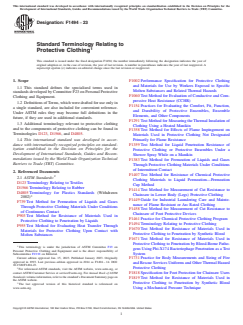
1.1 This standard defines the specialized terms used in standards developed by Committee F23 on Personal Protective Clothing and Equipment.
1.2 Definitions of Terms, which were drafted for use only in a single standard, are also included for convenient reference. Under ASTM rules they may become full definitions in the future, if they are used in additional standards.
1.3 Additional terminology relevant to protective clothing and to the components of protective clothing can be found in Terminologies D123, D1566, and D4805.
1.4 This international standard was developed in accordance with internationally recognized principles on standardization established in the Decision on Principles for the Development of International Standards, Guides and Recommendations issued by the World Trade Organization Technical Barriers to Trade (TBT) Committee.
- Status
- Published
- Publication Date
- 14-Jan-2023
- Technical Committee
- F23 - Personal Protective Clothing and Equipment
- Drafting Committee
- F23.91 - Editorial
Overview
ASTM F1494-23: Standard Terminology Relating to Protective Clothing is a comprehensive terminology standard developed by ASTM Committee F23 on Personal Protective Clothing and Equipment. This standard provides authoritative definitions for specialized terms used across standards related to protective clothing and personal protective equipment (PPE). It serves as a foundational reference for manufacturers, testing laboratories, regulatory agencies, and end-users who require a clear, consistent understanding of terminology in the field of protective clothing.
Why Terminology Standards Matter
Establishing common language and definitions supports safety, compliance, and innovation throughout the global protective clothing industry. The terminology in ASTM F1494-23 ensures clear communication in technical documents, procurement, design, testing, certification, and regulatory settings.
Key Topics
ASTM F1494-23 covers a wide array of terms associated with protective clothing and PPE, including but not limited to:
- Garment Construction and Sizing: Definitions related to garment types, body measurements, fit, sizing, and specific clothing elements such as armholes, cuffs, and inseams.
- Materials and Performance: Terms defining types of materials (e.g., flame-resistant fabrics, elastomers, plastics), and their performance characteristics including thermal insulation, cut resistance, penetration resistance, and flame resistance.
- Testing and Evaluation Methods: Terminology explaining test procedures and associated metrics, such as breakthrough time, cumulative permeation, and cut-through time.
- Exposure and Hazards: Terms for describing hazard assessment, types of exposure (chemical, thermal, biological), and specific protective ensemble types (primary/secondary protection, station/work uniforms).
- Programmatic and Administrative Terms: Definitions concerning certification, program administration, hazard assessment, and standardization principles.
This standard includes both widely used terms and specialized definitions developed for specific ASTM F23 standards. Some terms are provisional and may become fully approved definitions as they gain broader application.
Applications
ASTM F1494-23 is essential for:
- Manufacturers and Designers: Clarifying requirements for garment design, labeling, and communication of product attributes.
- Testing Laboratories: Establishing uniform test methodologies and result reporting by using consistent definitions.
- Safety Professionals and Industrial Hygienists: Interpreting regulatory guidance, certifications, and procurement documents.
- Regulators and Certification Bodies: Ensuring products, test results, and compliance documentation align with industry-accepted terminology.
- Training and Education: Developing training materials, product documentation, and educational curricula based on common terms.
Industries where this terminology standard is used include healthcare, firefighting, industrial manufacturing, hazardous material handling, and laboratories-anywhere that personal protective clothing is critical for safety.
Related Standards
ASTM F1494-23 references and complements other ASTM standards and terminology including:
- ASTM D123 - Terminology Relating to Textiles
- ASTM D1566 - Terminology Relating to Rubber
- ASTM D4805 - Terminology for Plastics Standards (Withdrawn)
- Numerous Committee F23 standards on performance specifications, test methods, and practices for protective clothing, such as F1002, F1358, F1671, F2101, F2302, and others.
For a complete list of referenced and related documents, consult the ASTM website or the standard’s annex.
Keywords: protective clothing terminology, ASTM F1494-23, PPE definitions, personal protective equipment standards, safety clothing glossary, garment testing terms, hazard assessment, industrial safety standards, certification.
Relations
- Effective Date
- 01-Feb-2024
- Effective Date
- 01-Nov-2023
- Effective Date
- 01-Apr-2020
- Effective Date
- 01-Jan-2020
- Effective Date
- 01-Jun-2019
- Effective Date
- 01-May-2019
- Effective Date
- 01-Aug-2018
- Effective Date
- 15-Jul-2018
- Effective Date
- 01-Jul-2018
- Effective Date
- 01-Jul-2018
- Effective Date
- 01-Nov-2017
- Effective Date
- 01-Nov-2017
- Effective Date
- 01-Jun-2017
- Effective Date
- 01-Mar-2017
- Effective Date
- 01-Feb-2017
Get Certified
Connect with accredited certification bodies for this standard

CIS Institut d.o.o.
Personal Protective Equipment (PPE) certification body. Notified Body NB-2890 for EU Regulation 2016/425 PPE.

Kiwa BDA Testing
Building and construction product certification.
Kmetijski inštitut Slovenije
Agricultural Institute of Slovenia. Soil testing, plant health, agricultural product analysis.
Sponsored listings
Frequently Asked Questions
ASTM F1494-23 is a standard published by ASTM International. Its full title is "Standard Terminology Relating to Protective Clothing". This standard covers: SCOPE 1.1 This standard defines the specialized terms used in standards developed by Committee F23 on Personal Protective Clothing and Equipment. 1.2 Definitions of Terms, which were drafted for use only in a single standard, are also included for convenient reference. Under ASTM rules they may become full definitions in the future, if they are used in additional standards. 1.3 Additional terminology relevant to protective clothing and to the components of protective clothing can be found in Terminologies D123, D1566, and D4805. 1.4 This international standard was developed in accordance with internationally recognized principles on standardization established in the Decision on Principles for the Development of International Standards, Guides and Recommendations issued by the World Trade Organization Technical Barriers to Trade (TBT) Committee.
SCOPE 1.1 This standard defines the specialized terms used in standards developed by Committee F23 on Personal Protective Clothing and Equipment. 1.2 Definitions of Terms, which were drafted for use only in a single standard, are also included for convenient reference. Under ASTM rules they may become full definitions in the future, if they are used in additional standards. 1.3 Additional terminology relevant to protective clothing and to the components of protective clothing can be found in Terminologies D123, D1566, and D4805. 1.4 This international standard was developed in accordance with internationally recognized principles on standardization established in the Decision on Principles for the Development of International Standards, Guides and Recommendations issued by the World Trade Organization Technical Barriers to Trade (TBT) Committee.
ASTM F1494-23 is classified under the following ICS (International Classification for Standards) categories: 01.040.13 - Environment. Health protection. Safety (Vocabularies); 13.340.01 - Protective equipment in general. The ICS classification helps identify the subject area and facilitates finding related standards.
ASTM F1494-23 has the following relationships with other standards: It is inter standard links to ASTM F1154-24, ASTM F1414-19(2023), ASTM F1449-20, ASTM F1897-20, ASTM F1414-19, ASTM F1819-19, ASTM F1060-18, ASTM F1154-18, ASTM F2669-12(2018), ASTM F903-18, ASTM F2061-17, ASTM F1461-17, ASTM F1407-12(2017), ASTM D123-17, ASTM F903-17. Understanding these relationships helps ensure you are using the most current and applicable version of the standard.
ASTM F1494-23 is available in PDF format for immediate download after purchase. The document can be added to your cart and obtained through the secure checkout process. Digital delivery ensures instant access to the complete standard document.
Standards Content (Sample)
This international standard was developed in accordance with internationally recognized principles on standardization established in the Decision on Principles for the
Development of International Standards, Guides and Recommendations issued by the World Trade Organization Technical Barriers to Trade (TBT) Committee.
Designation: F1494 − 23
Standard Terminology Relating to
Protective Clothing
This standard is issued under the fixed designation F1494; the number immediately following the designation indicates the year of
original adoption or, in the case of revision, the year of last revision. A number in parentheses indicates the year of last reapproval. A
superscript epsilon (´) indicates an editorial change since the last revision or reapproval.
1. Scope F1002 Performance Specification for Protective Clothing
and Materials for Use by Workers Exposed to Specific
1.1 This standard defines the specialized terms used in
Molten Substances and Related Thermal Hazards
standards developed by Committee F23 on Personal Protective
F1060 Test Method for Evaluation of Conductive and Com-
Clothing and Equipment.
pressive Heat Resistance (CCHR)
1.2 Definitions ofTerms, which were drafted for use only in
F1154 Practices for Evaluating the Comfort, Fit, Function,
a single standard, are also included for convenient reference.
and Durability of Protective Ensembles, Ensemble
Under ASTM rules they may become full definitions in the
Elements, and Other Components
future, if they are used in additional standards.
F1291 Test Method for Measuring the Thermal Insulation of
1.3 Additional terminology relevant to protective clothing
Clothing Using a Heated Manikin
and to the components of protective clothing can be found in
F1358 Test Method for Effects of Flame Impingement on
Terminologies D123, D1566, and D4805.
Materials Used in Protective Clothing Not Designated
1.4 This international standard was developed in accor-
Primarily for Flame Resistance
dance with internationally recognized principles on standard-
F1359 Test Method for Liquid Penetration Resistance of
ization established in the Decision on Principles for the
Protective Clothing or Protective Ensembles Under a
Development of International Standards, Guides and Recom-
Shower Spray While on a Manikin
mendations issued by the World Trade Organization Technical
F1383 Test Method for Permeation of Liquids and Gases
Barriers to Trade (TBT) Committee.
Through Protective Clothing Materials Under Conditions
of Intermittent Contact
2. Referenced Documents
F1407 Test Method for Resistance of Chemical Protective
2.1 ASTM Standards:
Clothing Materials to Liquid Permeation—Permeation
D123 Terminology Relating to Textiles
Cup Method
D1566 Terminology Relating to Rubber
F1414 Test Method for Measurement of Cut Resistance to
D4805 Terminology for Plastics Standards (Withdrawn
Chainsaw in Lower Body (Legs) Protective Clothing
2002)
F1449 Guide for Industrial Laundering Care and Mainte-
F739 Test Method for Permeation of Liquids and Gases
nance of Flame Resistant or Arc Rated Clothing
Through Protective Clothing Materials Under Conditions
F1458 Test Method for Measurement of Cut Resistance to
of Continuous Contact
Chainsaw of Foot Protective Devices
F903 Test Method for Resistance of Materials Used in
F1461 Practice for Chemical Protective Clothing Program
Protective Clothing to Penetration by Liquids
F1494 Terminology Relating to Protective Clothing
F955 Test Method for Evaluating Heat Transfer Through
F1670 Test Method for Resistance of Materials Used in
Materials for Protective Clothing Upon Contact with
Protective Clothing to Penetration by Synthetic Blood
Molten Substances
F1671 Test Method for Resistance of Materials Used in
Protective Clothing to Penetration by Blood-Borne Patho-
This terminology is under the jurisdiction of ASTM Committee F23 on
gens Using Phi-X174 Bacteriophage Penetration as a Test
Personal Protective Clothing and Equipment and is the direct responsibility of
System
Subcommittee F23.91 on Editorial.
Current edition approved Jan. 15, 2023. Published January 2023. Originally
F1731 Practice for Body Measurements and Sizing of Fire
approved in 1993. Last previous edition approved in 2014 as F1494 – 14. DOI:
and Rescue Services Uniforms and OtherThermal Hazard
10.1520/F1494-23.
2 Protective Clothing
For referenced ASTM standards, visit the ASTM website, www.astm.org, or
contact ASTM Customer Service at service@astm.org. For Annual Book of ASTM
F1818 Specification for Foot Protection for Chainsaw Users
Standards volume information, refer to the standard’s Document Summary page on
F1819 Test Method for Resistance of Materials Used in
the ASTM website.
3 Protective Clothing to Penetration by Synthetic Blood
The last approved version of this historical standard is referenced on
www.astm.org. Using a Mechanical Pressure Technique
Copyright © ASTM International, 100 Barr Harbor Drive, PO Box C700, West Conshohocken, PA 19428-2959. United States
F1494 − 23
F1862 TestMethodforResistanceofMedicalFaceMasksto air-purifying respirator, n—respirator in which ambient air is
Penetration by Synthetic Blood (Horizontal Projection of passed through an air-purifying element by either inhalation
Fixed Volume at a Known Velocity) or by means of a blower.
F1897 Specification for Leg Protection for Chain Saw Users
analytical detection limit, n—a number, expressed in units of
F2061 Practice for Chemical Protective Clothing: Wearing,
concentration (or amount), that describes the lowest concen-
Care, and Maintenance Instructions
tration level (or amount) that an analyst can determine to be
F2101 Test Method for Evaluating the Bacterial Filtration
different from an analytical blank (background level).
Efficiency (BFE) of Medical Face Mask Materials, Using
(F23.70) F1461
a Biological Aerosol of Staphylococcus aureus
F2300 Test Method for Measuring the Performance of Per-
analytical technique, n—a procedure whereby the concentra-
sonal Cooling Systems Using Physiological Testing
tion of the test chemical in a collection medium is quantita-
F2302 Performance Specification for Labeling Protective
tively determined. (F23.30) F739
Clothing Which Provides Resistance to Incidental Expo-
sures to Heat or Open Flame anisotropic, adj—having different values for a specific prop-
F2407 Specification for Surgical Gowns Intended for Use in erty in different directions. (F23.20) F1358
Healthcare Facilities
armhole, n—in garment construction, the area of a garment
F2668 PracticeforDeterminingthePhysiologicalResponses
through which the arm passes or into which a sleeve is fitted.
of the Wearer to Protective Clothing Ensembles
(See armscye.) (F23.60) F1731
F2669 Performance Specification for Protective Clothing
Worn by Operators Applying Pesticides
armscye, n—in garment construction, the opening in a gar-
F2733 Specification for Flame-Resistant Rainwear for Pro-
ment for the attachment of a fitted sleeve. (See armhole.)
tection Against Flame Hazards
(F23.60) F1731
F2815 Practice for Chemical PermeationThrough Protective
Clothing Materials: Testing Data Analysis by Use of a aseptic, adj—sterile, free from viable microbiological
Computer Program (Withdrawn 2019) contamination. (F23.40) F1671
F2894 Test Method for Evaluation of Materials, Protective
assay, n—analysis of a mixture to determine the presence or
Clothing, and Equipment for Heat Resistance Using a Hot
concentration of a particular component. (F23.40) F1671
Air Circulating Oven
assay fluid, n—a sterile liquid used to wash the test specimen
3. Terminology
surface to determine microbiological penetration. (F23.40)
3.1 Definitions:
F1671
acclimation, n—physiological adaptations occurring within an
organism, which reduce the strain or enhance endurance of
atmosphere-supplying respirator, ASR, n—class of respira-
strain, caused by artificially or experimentally induced
tors that supply a respirable atmosphere independent of the
stressful changes in particular environmental conditions.
workplace atmosphere.
(F23.60) F2300, F2668
DISCUSSION—This class includes airline respirators and self-
contained breathing apparatus (SCBA).
acclimatization, n—physiological adaptations occurring
within an organism, which reduce the strain or enhance
authority having jurisdiction, n—the organization, office, or
endurance of strain, caused by stressful changes in the
individual responsible for approving any equipment,
natural environment. (F23.60) F2300, F2668
installation, or procedure. (F23.20) F1818
after-flame time, n—the length of time for which a material
back waist length, n—in body measurements, the vertical
continues to flame after the ignition source has been
distance along the spine from the cervical to the waist.
removed. (F23.20) F1358
(F23.60) F1731
afterglow, n—a glow in a material after the removal of an
bacterial filtration efficiency (BFE), n—the effectiveness of
external ignition source or after the cessation (natural or
medical face mask material in preventing the passage of
induced) of flaming of the material (see also glow). (F23.20)
aerosolized bacteria; expressed in the percentage of a known
F1358
quantity that does not pass the medical face mask material at
agar, n—a semisolid culture medium used to support the
a given aerosol flow rate.
growth of bacteria and other microorganisms. (F23.40)
bacteriophage, n—a type of virus which infects bacteria.
F1671
(F23.40) F1671
airborne exposure pathways, n—inhalation routes of expo-
bartack, n—in garment construction,areinforcementatpoints
sure to the medical face mask wearer.
of strain. (F23.60) F1731
airline respirator (supplied-air respirator, SAR),
n—atmosphere-supplying respirator in which the respirable biological aerosol, n—a suspension of particles containing
air is supplied from a hose or breathing tube rather than biological agents which have been dispersed in a gas.
being carried by the wearer. (F23.40) F2101
F1494 − 23
biological monitoring, n—the chemical analysis of chemicals methods the manufacturer uses to determine compliance
or metabolites, or both, from a worker’s blood, urine, with the requirements of this specification. (F23.20) F1818
fingernails, sweat, breath, and so forth. (F23.70) F1461
certification organization, n—an independent, third party
blood-borne pathogen, n—aninfectiousbacteriumorvirus,or
organization that determines product compliance with the
other disease-inducing microbe carried in blood or other requirements of the specification with a labeling and listing
potentially infectious body fluids. (F23.40) F1671, F1819,
follow-up program. (F23.20) F1818
F1862, F2101, F2407
cervical, n—in body measurements, the most prominent bone
body dimension, n—in garment construction,abodymeasure-
at the base of the neck. (F23.60) F1731
ment which can be used to build a sizing system or to select
chain saw, n—a portable power-operated tool used for cutting
an appropriately sized garment. (F23.60) F1731
wood which has cutters linked in a chain. (F23.20) F1414,
body fluid, n—any liquid produced, secreted, or excreted by
F1458
the human body.
chain speed, n—the velocity of synchronized movement of
body fluid simulant, n—a liquid which is used to act as a
linked cutters around a bar and sprocket. (F23.20) F1414,
model for human body liquids. (F23.40) F1670, F1671
F1458
body measurement, n—in anthropometry, a standardized
chainspeed 50 (CS50), n—for chain saw protection, the mean
distance between two specified points on the human
velocity at which cut-through occurs. (F23.20) F1458,
anatomy. (F23.60) F1731
F1818, F1897
break-open—intestingthermalprotectivematerial,aresponse
chainstop, n—for chainsaw cut resistance, the resulting action
evidenced by the formation of a hole in the material, which
when a material clogs (jams) the drive sprocket or slows the
allows the molten substance to pass through the material.
speed sufficiently to prevent advancement of the chain saw.
(F23.80) F955
(F23.20) F1414, F1458, F1818
breakthrough detection time, n—the elapsed time measured
challenge suspension, n—a liquid containing an agent that is
from the start of the test to the sampling time that immedi-
used to test the penetration resistance of materials. (F23.40)
ately precedes the sampling time at which the test chemical
F1671
is first detected. (F23.30) F739, F1383
char length, n—in measuring flame resistance of textiles, the
buddy system, n—a means of organizing employee work
distance from the fabric edge which was directly exposed to
groups whereby each participant is matched with another so
the flame to the furthest point of visible fabric damage after
that prompt assistance can be rendered in the case of any
a specified tearing force has been applied. (F23.80) F2302,
emergency. (F23.70) F1461
F2733
burn distance, n—the measurement from the bottom edge of
charring—the formation of a carbonaceous residue as the
the specimen to the farthest point that shows evidence of
result of pyrolysis or incomplete combustion. (F23.80)
damage due to combustion. (F23.20) F1358
F1060
burning behavior, n—all the changes that take place when
chemical protective clothing (CPC), n—any material or
materials or products are exposed to a specified ignition
combination of materials used in an item of clothing for the
source. (F23.20) F1358
purpose of isolating parts of the body from direct contact
bust girth, n—in body measurement, the circumference of the
with a potentially hazardous chemical. (F23.70) F1461
body over the fullest part of the breasts and parallel to the
chemical-protective suit ensemble—the combination of pro-
floor. (See chest girth.) (F23.60) F1731
tective clothing with respiratory protective equipment,
care and maintenance, n—effective cleaning to remove soil
hoods, helmets, gloves, boots, communications systems,
and maximize use life of garments while maintaining (not
coolingdevices,andotheraccessoriesintendedtoprotectthe
removing) protective properties. (F23.80) F1449
wearer from a chemical hazard when worn together.
(F23.50) F1154, F1359
centerline, n—in foot protective devices, a line which extends
from the toe of the footwear horizontally along the sole to
chest, n—in garment construction, a measurement taken from
the heel vertically to the top of the footwear, and diagonally
below each armhole seam straight across the garment while
to the point of intersection at the toe. (F23.20) F1458
it is laid flat. (F23.60) F1731
certification, n—a system whereby an organization determines
chest girth, n—in body measurements, the circumference of
that a manufacturer has demonstrated the ability to make a
the body over the shoulder blades, under the arms and across
product that complies with the requirements of the
the upper chest. (See bust girth.) (F23.60) F1731
specification, authorizes the manufacturer to use a label on
products that comply with the requirements of the clo, n—a unit of thermal resistance (insulation) equal to 0.155
specification,andconductsafollow-upprogramtoverifythe K-m /W. (F23.60) F1291
F1494 − 23
DISCUSSION—The value of the clo was selected as roughly the
decontamination, n—reduction, removal, or neutralization of
insulation value of typical indoor clothing, which should keep a resting
a contaminant or contaminants from protective clothing to
man (producing heat at the rate of 58 W/m ) comfortable in an
the extent necessary to safely permit the protective clothing
environment at 21 °C, air movement 0.1 m/s.
to be doffed (taken off), or reused, or discarded. (F23.30)
F1461, F2061, F2669
closed-loop, adj—refers to a testing mode in which there is no
change in the volume of the collection medium except for
degradation, n—a deleterious change in one or more proper-
sampling. (F23.30) F739, F1383
ties of a material. (F23.30, F23.91, F23.80) F739, F903,
F1494, F2061, F2894
clothing ensemble, n—a group of garments worn together on
the body at the same time. (F23.60) F1291
demand respirator, n—atmosphere-supplying respirator that
admits respirable air to the respiratory inlet covering only
collection medium, n—a liquid, gas, or solid that absorbs,
when a negative pressure is created inside the respiratory
adsorbs, dissolves, suspends, or otherwise captures the test
inlet covering by inhalation.
chemical and does not affect the measured permeation.
(F23.30) F739, F1383
dripping—in testing thermal protective material, a response
evidenced by flowing of the fiber polymer. (F23.80) F955
combustion, n—a chemical process of oxidation that occurs at
a rate fast enough to produce heat and usually light either as
ease, n—in garment construction, the difference between
glow or flames. (F23.20) F1358
garment measurement and body measurement. (F23.60)
F1731
contact time, n—in an intermittent contact test, the duration
during each cycle that the challenge side chamber of the
elastomer, n—a term often used for rubber and polymers that
permeation cell is filled with the test chemical. (F23.30)
have properties similar to rubber. (F23.70) F1461
F1383
elbow, n—in anatomy, the joint that articulates between the
continuous-flow respirator, n—atmosphere-supplying respi- upper arm and the lower arm. (F23.60) F1731
rator that provides a continuous flow of respirable air to the
embrittlement—theformationofabrittleresidueasaresultof
respiratory inlet covering.
pyrolysis or incomplete combustion. (F23.80) F955, F1060,
core temperature, n—the mean temperature of the thermal F1358
core.
end user, n—for the purpose of this guide, this term is used to
identify specifically the party requiring protective clothing
crotch, n—in anatomy, the body area adjacent to the vertex of
(for example, the employer of the person wearing the
the included angle between the legs. (F23.60) F1731
garment). (F23.80) F1449
cuff, n—in garment construction, a finished edge at the end of
escape-only respirator, n—respirator intended only for use
eitheragarmentsleeveortrouserlegcreatedbyturningback
during emergency egress from a hazardous atmosphere.
or rolling up and stitching the fabric. (F23.60) F1731
Fick’s laws of diffusion, n—mathematical descriptions of the
cumulative permeation, n—the total mass of chemical that
movement of one type of molecule through another.
permeates a specific area of protective clothing material
(F23.70) F1461
during a specified time from when the material is first
contacted by the test chemical. (F23.30) F739, F1383,
filtering face piece, n—negative-pressure respirator in which
F1407
the filter is an integral part of the face piece or comprises the
entire face piece.
cut resistance, n—in chainsaw testing, the ability of a
material, while in contact with the linked cutters, to resist
finish, n—a chemical or mechanical modification, or both, of
cut-through of the cutters of a moving saw chain, indepen-
the fabric for a specific performance result. (F23.80) F1449
dent of either jamming or chain stop. (F23.20) F1414,
finishing technique, n—as applies to laundry and dry cleaning
F1458, F1818
procedures, the mechanical means by which the garment is
cut resistance (blade), n—in blade cut testing, the property
put in its final state (for example, pressing, drying, wrinkle
that hinders cut-through when a material or a combination of
removal, and so forth). (F23.80) F1449
materials is exposed to a sharp-edged device.
fit, n—the quality, state, or manner in which the length and
cut-through time, n—for chainsaw cut resistance, the time closenessofclothing,whenworn,relatestothehumanbody.
required for a running chainsaw to effect complete break-
(F23.60) F1731
through of a protective garment or protective device.
flame, n—as related to ignition of textiles, a controlled hot
(F23.20) F1414, F1458, F1818
luminous zone of gas or matter in gaseous suspension, or
cycle time, n—in an intermittent contact test, the interval of both, of constant size and shape that is undergoing combus-
time from the start of one contact period to the start of the tion as evidenced by a low-intensity heat source of less than
next contact period. (F23.30) F1383 5 kW, such as a burner flame on a gas stove. (F23.20) F1358
F1494 − 23
flame impingement, n—direct contact between a flame and a hip, n—in anatomy, the laterally projecting region formed by
material. (F23.20) F1358 the lateral parts of the pelvis and the upper part of the femur
together with the flesh covering them. (F23.60) F1731
flame resistance, n—the property of a material whereby
hip girth, n—in body measurements, the maximum circumfer-
flaming combustion is prevented, terminated, or inhibited
ence of the body at the level of maximum prominence of the
following application of a flaming or nonflaming source of
buttocks. (F23.60) F1731
ignition, with or without subsequent removal of the ignition
source.
ignition, n—the initiation of combustion. (F23.80)
flammability, n—those characteristics of a material that per-
industrial hygienist, n—a person who, by experience and
tain to its ignition and support of combustion. (F23.20)
academic training, is qualified to recognize, evaluate, and
F1358
control chemical, physical, and biological agents in the
workplace, or a person certified by the American Board of
follow-up program, n—the sampling, inspection, tests, or
Industrial Hygiene. (F23.70) F1461
other measures conducted by the certification organization
on a periodic basis to determine the continued compliance of inseam, n—in garment construction, with the trousers folded
by mating the inside leg seams, measure from center of
products that are being made by the manufacturer to the
requirements of the standard specification. (F23.20) crotch to bottom edge of trouser’s leg or cuff. (F23.60)
F1731
foot, n—the terminal part of the vertebrate leg, including the
inseam length, n—in body measurements, from center of
ankle, upon which an individual stands (see foot protective
crotch to 25.4 mm (1 in.) below top of the shoe. (F23.60)
device). (F23.20) F1458
F1731
foot protective device, n—for chain saw cut resistance,an
jamming, n—
...
This document is not an ASTM standard and is intended only to provide the user of an ASTM standard an indication of what changes have been made to the previous version. Because
it may not be technically possible to adequately depict all changes accurately, ASTM recommends that users consult prior editions as appropriate. In all cases only the current version
of the standard as published by ASTM is to be considered the official document.
Designation: F1494 − 14 F1494 − 23
Standard Terminology Relating to
Protective Clothing
This standard is issued under the fixed designation F1494; the number immediately following the designation indicates the year of
original adoption or, in the case of revision, the year of last revision. A number in parentheses indicates the year of last reapproval. A
superscript epsilon (´) indicates an editorial change since the last revision or reapproval.
1. Scope
1.1 This standard defines the specialized terms used in standards developed by Committee F23 on Protective Clothing.Personal
Protective Clothing and Equipment.
1.2 Definitions of Terms, which were drafted for use only in a single standard, are also included for convenient reference. Under
ASTM rules they may become full definitions in the future, if they are used in additional standards.
1.3 Additional terminology relevant to protective clothing and to the components of protective clothing can be found in
TerminologyTerminologies D123, D1566, and D4805.
1.4 This international standard was developed in accordance with internationally recognized principles on standardization
established in the Decision on Principles for the Development of International Standards, Guides and Recommendations issued
by the World Trade Organization Technical Barriers to Trade (TBT) Committee.
2. Referenced Documents
2.1 ASTM Standards:
D123 Terminology Relating to Textiles
D1566 Terminology Relating to Rubber
D4805 Terminology for Plastics Standards (Withdrawn 2002)
F739 Test Method for Permeation of Liquids and Gases Through Protective Clothing Materials Under Conditions of Continuous
Contact
F903 Test Method for Resistance of Materials Used in Protective Clothing to Penetration by Liquids
F955 Test Method for Evaluating Heat Transfer Through Materials for Protective Clothing Upon Contact with Molten
Substances
F1002 Performance Specification for Protective Clothing and Materials for Use by Workers Exposed to Specific Molten
Substances and Related Thermal Hazards
F1060 Test Method for Evaluation of Conductive and Compressive Heat Resistance (CCHR)
F1154 Practices for Evaluating the Comfort, Fit, Function, and Durability of Protective Ensembles, Ensemble Elements, and
Other Components
F1291 Test Method for Measuring the Thermal Insulation of Clothing Using a Heated Manikin
This terminology is under the jurisdiction of ASTM Committee F23 on Personal Protective Clothing and Equipment and is the direct responsibility of Subcommittee
F23.91 on Editorial.
Current edition approved Oct. 1, 2014Jan. 15, 2023. Published November 2014January 2023. Originally approved in 1993. Last previous edition approved in 20132014
as F1494 – 13.F1494 – 14. DOI: 10.1520/F1494-14.10.1520/F1494-23.
For referenced ASTM standards, visit the ASTM website, www.astm.org, or contact ASTM Customer Service at service@astm.org. For Annual Book of ASTM Standards
volume information, refer to the standard’s Document Summary page on the ASTM website.
The last approved version of this historical standard is referenced on www.astm.org.
Copyright © ASTM International, 100 Barr Harbor Drive, PO Box C700, West Conshohocken, PA 19428-2959. United States
F1494 − 23
F1358 Test Method for Effects of Flame Impingement on Materials Used in Protective Clothing Not Designated Primarily for
Flame Resistance
F1359 Test Method for Liquid Penetration Resistance of Protective Clothing or Protective Ensembles Under a Shower Spray
While on a Manikin
F1383 Test Method for Permeation of Liquids and Gases Through Protective Clothing Materials Under Conditions of
Intermittent Contact
F1407 Test Method for Resistance of Chemical Protective Clothing Materials to Liquid Permeation—Permeation Cup Method
F1414 Test Method for Measurement of Cut Resistance to Chainsaw in Lower Body (Legs) Protective Clothing
F1449 Guide for Industrial Laundering Care and Maintenance of Flame Resistant or Arc Rated Clothing
F1458 Test Method for Measurement of Cut Resistance to Chainsaw of Foot Protective Devices
F1461 Practice for Chemical Protective Clothing Program
F1494 Terminology Relating to Protective Clothing
F1670 Test Method for Resistance of Materials Used in Protective Clothing to Penetration by Synthetic Blood
F1671 Test Method for Resistance of Materials Used in Protective Clothing to Penetration by Blood-Borne Pathogens Using
Phi-X174 Bacteriophage Penetration as a Test System
F1731 Practice for Body Measurements and Sizing of Fire and Rescue Services Uniforms and Other Thermal Hazard Protective
Clothing
F1818 Specification for Foot Protection for Chainsaw Users
F1819 Test Method for Resistance of Materials Used in Protective Clothing to Penetration by Synthetic Blood Using a
Mechanical Pressure Technique
F1862 Test Method for Resistance of Medical Face Masks to Penetration by Synthetic Blood (Horizontal Projection of Fixed
Volume at a Known Velocity)
F1897 Specification for Leg Protection for Chain Saw Users
F2061 Practice for Chemical Protective Clothing: Wearing, Care, and Maintenance Instructions
F2101 Test Method for Evaluating the Bacterial Filtration Efficiency (BFE) of Medical Face Mask Materials, Using a Biological
Aerosol of Staphylococcus aureus
F2300 Test Method for Measuring the Performance of Personal Cooling Systems Using Physiological Testing
F2302 Performance Specification for Labeling Protective Clothing Which Provides Resistance to Incidental Exposures to Heat
or Open Flame
F2407 Specification for Surgical Gowns Intended for Use in Healthcare Facilities
F2668 Practice for Determining the Physiological Responses of the Wearer to Protective Clothing Ensembles
F2669 Performance Specification for Protective Clothing Worn by Operators Applying Pesticides
F2733 Specification for Flame-Resistant Rainwear for Protection Against Flame Hazards
F2815 Practice for Chemical Permeation Through Protective Clothing Materials: Testing Data Analysis by Use of a Computer
Program (Withdrawn 2019)
F2894 Test Method for Evaluation of Materials, Protective Clothing, and Equipment for Heat Resistance Using a Hot Air
Circulating Oven
3. Terminology
3.1 Definitions:
acclimation, n—physiological adaptations occurring within an organism, which reduce the strain or enhance endurance of strain,
caused by artificially or experimentally induced stressful changes in particular environmental conditions. (F23.60) F2300,
F2668
acclimatization, n—physiological adaptations occurring within an organism, which reduce the strain or enhance endurance of
strain, caused by stressful changes in the natural environment. (F23.60) F2300, F2668
after-flame time, n—the length of time for which a material continues to flame after the ignition source has been removed.
(F23.20) F1358
afterglow, n—a glow in a material after the removal of an external ignition source or after the cessation (natural or induced)
of flaming of the material (see also glow). (F23.20) F1358
agar, n—a semisolid culture medium used to support the growth of bacteria and other micro-organisms.microorganisms.
(F23.40) F1671
F1494 − 23
airborne exposure pathways, n—inhalation routes of exposure to the medical face mask wearer.
airline respirator (supplied-air respirator, SAR), n—atmosphere-supplying respirator in which the respirable air is supplied
from a hose or breathing tube rather than being carried by the wearer.
air-purifying respirator, n—respirator in which ambient air is passed through an air-purifying element by either inhalation or
by means of a blower.
analytical detection limit, n—a number, expressed in units of concentration (or amount), that describes the lowest concentration
level (or amount) that an analyst can determine to be different from an analytical blank (background level). (F23.70) F1461
airborne exposure pathways, n—inhalation routes of exposure to the medical face mask wearer.
analytical technique, n—a procedure whereby the concentration of the test chemical in a collection medium is quantitatively
determined. (F23.30) F739
anisotropic, adj—having different values for a specific property in different directions. (F23.20) F1358
armhole, n—in garment construction, the area of a garment through which the arm passes or into which a sleeve is fitted. (See
armscye.) (F23.60) F1731
armscye, n—in garment construction, the opening in a garment for the attachment of a fitted sleeve. (See armhole.) (F23.60)
F1731
aseptic, adj—sterile, free from viable microbiological contamination. (F23.40) F1671
assay, n—analysis of a mixture to determine the presence or concentration of a particular component. (F23.40) F1671
assay fluid, n—a sterile liquid used to wash the test specimen surface to determine microbiological penetration. (F23.40) F1671
atmosphere-supplying respirator, ASR, n—class of respirators that supply a respirable atmosphere independent of the
workplace atmosphere.
DISCUSSION—
This class includes airline respirators and self-contained breathing apparatus (SCBA).
authority having jurisdiction, n—the organization, office, or individual responsible for approving any equipment, installation,
or procedure. (F23.20) F1818
back waist length, n—in body measurements, the vertical distance along the spine from the cervical to the waist. (F23.60)
F1731
bacterial filtration efficiency (BFE), n—the effectiveness of medical face mask material in preventing the passage of
aerosolized bacteria; expressed in the percentage of a known quantity that does not pass the medical face mask material at a
given aerosol flow rate.
bacteriophage, n—a type of virus which infects bacteria. (F23.40) F1671
bartack, n—in garment construction, a reinforcement at points of strain. (F23.60) F1731
F1494 − 23
biological aerosol, n—a suspension of particles containing biological agents which have been dispersed in a gas. (F23.40)
F2101
biological monitoring, n—the chemical analysis of chemicals or metabolites, or both, from a worker’s blood, urine, fingernails,
sweat, breath, and so forth. (F23.70) F1461
blood-borne pathogen, n—an infectious bacterium or virus, or other disease-inducing microbe carried in blood or other
potentially infectious body fluids. (F23.40) F1671, F1819, F1862, F2101, F2407
body dimension, n—in garment construction, a body measurement which can be used to build a sizing system or to select an
appropriately sized garment. (F23.60) F1731
body fluid, n—any liquid produced, secreted, or excreted by the human body.
body fluid simulant, n—a liquid which is used to act as a model for human body liquids. (F23.40) F1670, F1671
body measurement, n—in anthropometry, a standardized distance between two specified points on the human anatomy.
(F23.60) F1731
break-open—in testing thermal protective material, a response evidenced by the formation of a hole in the material, which
allows the molten substance to pass through the material. (F23.80) F955
breakthrough detection time, n—the elapsed time measured from the start of the test to the sampling time that immediately
precedes the sampling time at which the test chemical is first detected. (F23.30) F739, F1383
buddy system, n—a means of organizing employee work groups whereby each participant is matched with another so that
prompt assistance can be rendered in the case of any emergency. (F23.70) F1461
burn distance, n—the measurement from the bottom edge of the specimen to the farthest point that shows evidence of damage
due to combustion. (F23.20) F1358
burning behavior, n—all the changes that take place when materials or products are exposed to a specified ignition source.
(F23.20) F1358
bust girth, n—in body measurement, the circumference of the body over the fullest part of the breasts and parallel to the floor.
(See chest girth.) (F23.60) F1731
care and maintenance, n—effective cleaning to remove soil and maximize use life of garments while maintaining (not
removing) protective properties. (F23.80) F1449
centerline, n—in foot protective devices, a line which extends from the toe of the footwear horizontally along the sole to the
heel vertically to the top of the footwear, and diagonally to the point of intersection at the toe. (F23.20) F1458
certification, n—a system whereby an organization determines that a manufacturer has demonstrated the ability to make a
product that complies with the requirements of the specification, authorizes the manufacturer to use a label on products that
comply with the requirements of the specification, and conducts a follow-up program to verify the methods the manufacturer
uses to determine compliance with the requirements of this specification. (F23.20) F1818
F1494 − 23
certification organization, n—an independent, third party organization that determines product compliance with the
requirements of the specification with a labeling and listing follow-up program. (F23.20) F1818
cervical, n—in body measurements, the most prominent bone at the base of the neck. (F23.60) F1731
chain saw, n—a portable power operated power-operated tool used for cutting wood which has cutters linked in a chain.
(F23.20) F1414, F1458
chain speed, n—the velocity of synchronized movement of linked cutters around a bar and sprocket. (F23.20) F1414, F1458
chainspeed 50 (CS50), n—for chain saw protection, the mean velocity at which cut through cut-through occurs. (F23.20)
F1458, F1818, F1897
chainstop, n—for chainsaw cut resistance, the resulting action when a material clogs (jams) the drive sprocket or slows the
speed sufficiently to prevent advancement of the chain saw. (F23.20) F1414, F1458, F1818
challenge suspension, n—a liquid containing an agent that is used to test the penetration resistance of materials. (F23.40) F1671
char length, n—in measuring flame resistance of textiles, the distance from the fabric edge which was directly exposed to the
flame to the furthest point of visible fabric damage after a specified tearing force has been applied. (F23.80) F2302, F2733
charring—the formation of a carbonaceous residue as the result of pyrolysis or incomplete combustion. (F23.80) F1060
chemical protective clothing (CPC), n—any material or combination of materials used in an item of clothing for the purpose
of isolating parts of the body from direct contact with a potentially hazardous chemical. (F23.70) F1461
chemical-protective suit ensemble—the combination of protective clothing with respiratory protective equipment, hoods,
helmets, gloves, boots, communications systems, cooling devices, and other accessories intended to protect the wearer from a
chemical hazard when worn together. (F23.50) F1154, F1359
chest, n—in garment construction, a measurement taken from below each armhole seam straight across the garment while it is
laid flat. (F23.60) F1731
chest girth, n—in body measurements, the circumference of the body over the shoulder blades, under the arms and across the
upper chest. (See bust girth.) (F23.60) F1731
clo, n—a unit of thermal resistance (insulation) equal to 0.155 K-m /W. (F23.60) F1291
DISCUSSION—
The value of the clo was selected as roughly the insulation value of typical indoor clothing, which should keep a resting man (producing heat at the
rate of 58 W/m ) comfortable in an environment at 21°C,21 °C, air movement 0.1 m/s.
closed-loop, adj—refers to a testing mode in which there is no change in the volume of the collection medium except for
sampling. (F23.30) F739, F1383
clothing ensemble, n—a group of garments worn together on the body at the same time. (F23.60) F1291
collection medium, n—a liquid, gas, or solid that absorbs, adsorbs, dissolves, suspends, or otherwise captures the test chemical
and does not affect the measured permeation. (F23.30) F739, F1383
F1494 − 23
combustion, n—a chemical process of oxidation that occurs at a rate fast enough to produce heat and usually light either as glow
or flames. (F23.20) F1358
contact time, n—in an intermittent contact test, the duration during each cycle that the challenge side chamber of the permeation
cell is filled with the test chemical. (F23.30) F1383
continuous-flow respirator, n—atmosphere-supplying respirator that provides a continuous flow of respirable air to the
respiratory inlet covering.
core temperature, n—the mean temperature of the thermal core.
crotch, n—in anatomy, the body area adjacent to the vertex of the included angle between the legs. (F23.60) F1731
cuff, n—in garment construction, a finished edge at the end of either a garment sleeve or trouser leg created by turning back
or rolling up and stitching the fabric. (F23.60) F1731
cumulative permeation, n—the total mass of chemical that permeates a specific area of protective clothing material during a
specified time from when the material is first contacted by the test chemical. (F23.30) F739, F1383, F1407
cut resistance, n—in chainsaw testing, the ability of a material, while in contact with the linked cutters, to resist cut through
cut-through of the cutters of a moving saw chain, independent of either jamming or chain stop. (F23.20) F1414, F1458, F1818.
cut resistance (blade), n—in blade cut testing, the property that hinders cut through cut-through when a material or a
combination of materials is exposed to a sharp-edged device.
cut-through time, n—for chainsaw cut resistance, the time required for a running chainsaw to effect complete breakthrough of
a protective garment or protective device. (F23.20) F1414, F1458, F1818
cycle time, n—in an intermittent contact test, the interval of time from the start of one contact period to the start of the next
contact period. (F23.30) F1383
decontamination, n—reduction, removal, or neutralization of a contaminant or contaminants from protective clothing to the
extent necessary to safely permit the protective clothing to be doffed (taken off), or reused, or discarded. (F23.30) F1461, F2061,
F2669
degradation, n—a deleterious change in one or more properties of a material. (F23.30, F23.91, F23.80) F739, F903, F1494,
F2061, F2894
demand respirator, n—atmosphere-supplying respirator that admits respirable air to the respiratory inlet covering only when
a negative pressure is created inside the respiratory inlet covering by inhalation.
dripping—in testing thermal protective material, a response evidenced by flowing of the fiber polymer. (F23.80) F955
ease, n—in garment construction, the difference between garment measurement and body measurement. (F23.60) F1731
elastomer, n—a term often used for rubber and polymers that have properties similar to rubber. (F23.70) F1461
elbow, n—in anatomy, the joint that articulates between the upper arm and the lower arm. (F23.60) F1731
F1494 − 23
embrittlement—the formation of a brittle residue as a result of pyrolysis or incomplete combustion. (F23.80) F955, F1060,
F1358
end user, n—for the purpose of this guide, this term is used to identify specifically the party requiring protective clothing (for
example, the employer of the person wearing the garment). (F23.80) F1449
escape-only respirator, n—respirator intended only for use during emergency egress from a hazardous atmosphere.
Fick’s laws of diffusion, n—mathematical descriptions of the movement of one type of molecule through another.
(F23.70) F1461
filtering face piece, n—negative-pressure respirator in which the filter is an integral part of the face piece or comprises the entire
face piece.
finish, n—a chemical or mechanical modification, or both, of the fabric for a specific performance result. (F23.80) F1449
finishing technique, n—as applies to laundry and dry cleaning procedures, the mechanical means by which the garment is put
in its final state (for example, pressing, drying, wrinkle removal, and so forth). (F23.80) F1449
fit, n—the quality, state, or manner in which the length and closeness of clothing, when worn, relates to the human body.
(F23.60) F1731
flame, n—as related to ignition of textiles, a controlled hot luminous zone of gas or matter in gaseous suspension, or both, of
constant size and shape that is undergoing combustion as evidenced by a low-intensity heat source of less than 5 kW, such as
a burner flame on a gas stove. (F23.20) F1358
flame impingement, n—direct contact between a flame and a material. (F23.20) F1358
flame resistance, n—the property of a material whereby flaming combustion is prevented, terminated, or inhibited following
application of a flaming or nonflaming source of ignition, with or without subsequent removal of the ignition source.
flammability, n—those characteristics of a material that pertain to its ignition and support of combustion. (F23.20) F1358
follow-up program, n—the sampling, inspection, tests, or other measures conducted by the certification organization on a
periodic basis to determine the continued compliance of products that are being made by the manufacturer to the requirements
of the standard specification. (F23.20)
foot, n—the terminal part of the vertebrate leg, including the ankle, upon which an individual stands (see foot protective device).
(F23.20) F1458
foot protective device, n—for chain saw cut resistance, an article of personal equipment which covers the foot and ankle for
the purpose of providing limited protection from injury due to contact with a moving saw chain. (F23.20) F1458
footwear, n—a boot or shoe of any construction. (F23.20) F1458
gaiter, n—for chain saw cut resistance, a foot protective device permanently attached to the outside of the footwear. (F23.20)
F1458
F1494 − 23
garment, n—a single item of clothing (for example, shirt). (F23.60) F1291
girth, n—in body measurements, a circumferential measurement around some part of the body, such as neck, chest, waist, and
so forth. (F23.60) F1731
glow, n—visible, flameless combustion of the solid phase of a material. (F23.20) F1358
hazard assessment, n—the determination of the lack of safety or degree of risk based on all integral parts of an exposure
situation, including the characteristics of the chemical(s) to which one is exposed and the conditions that determine degree of
exposure. (F23.70) F1461
hazardous chemical—any solid, liquid, gas, or
...