


ASTM A1011/A1011M-23
(Specification)Standard Specification for Steel, Sheet and Strip, Hot-Rolled, Carbon, Structural, High-Strength Low-Alloy, High-Strength Low-Alloy with Improved Formability, and Ultra-High Strength
Standard Specification for Steel, Sheet and Strip, Hot-Rolled, Carbon, Structural, High-Strength Low-Alloy, High-Strength Low-Alloy with Improved Formability, and Ultra-High Strength
ABSTRACT
This specification covers hot-rolled, carbon, structural, high-strength low-alloy, high-strength low-alloy with improved formability, and ultra-high strength steel sheet and strip, in coils and cut lengths. The steels covered here are: Commercial Steels of types A, B, C, and D; Drawing Steels of types A and B; Structural Steels of grades 30 [205], 33 [230], 36 [250] (with Types 1 and 2), 40 [275], 45 [310], 50 [340], 55 [380], 60 [410], 70 [480], and 80 [550]; High-strength Low-alloy Steel of classes 1 and 2 in grades 45 [310], 50 [340], 55 [380], 60 [410], 65 [450], and 70 [480]; High-strength Low-alloy steels with improved formability in grades 50 [340], 60 [410], 70 [480], and 80 [550]; and Ultra-high Strength Steels of types 1 and 2 in grades 90 [620] and 100 [690]. Heat and product analyses shall be performed wherein specimens shall conform to required chemical composition of carbon, manganese, phosphorus, sulfur, aluminum, silicon, copper, nickel, chromium, molybdenum, vanadium, niobium, titanium, nitrogen, and boron. Except for Commercial and Drawing steels, all other steels shall undergo two tension tests, and shall conform to the following mechanical requirements: yield strength, tensile strength, and elongation. All steels shall undergo bending tests.
SCOPE
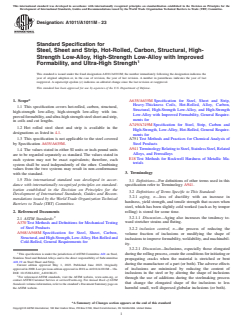
1.1 This specification covers hot-rolled, carbon, structural, high-strength low-alloy, high-strength low-alloy with improved formability, and ultra-high strength steel sheet and strip, in coils and cut lengths.
1.2 Hot rolled steel sheet and strip is available in the designations as listed in 4.1.
1.3 This specification is not applicable to the steel covered by Specification A635/A635M.
1.4 The values stated in either SI units or inch-pound units are to be regarded separately as standard. The values stated in each system may not be exact equivalents; therefore, each system shall be used independently of the other. Combining values from the two systems may result in non-conformance with the standard.
1.5 This international standard was developed in accordance with internationally recognized principles on standardization established in the Decision on Principles for the Development of International Standards, Guides and Recommendations issued by the World Trade Organization Technical Barriers to Trade (TBT) Committee.
General Information
- Status
- Published
- Publication Date
- 30-Apr-2023
- Technical Committee
- A01 - Steel, Stainless Steel and Related Alloys
- Drafting Committee
- A01.19 - Steel Sheet and Strip
Relations
- Effective Date
- 01-Mar-2024
- Effective Date
- 01-Mar-2024
- Effective Date
- 01-Nov-2019
- Effective Date
- 01-Jul-2019
- Effective Date
- 01-Jul-2018
- Refers
ASTM A370-17a - Standard Test Methods and Definitions for Mechanical Testing of Steel Products - Effective Date
- 15-Nov-2017
- Effective Date
- 01-Nov-2017
- Effective Date
- 01-Sep-2017
- Effective Date
- 01-Sep-2017
- Effective Date
- 01-Jul-2017
- Effective Date
- 01-Jan-2017
- Effective Date
- 01-Nov-2015
- Effective Date
- 01-Nov-2015
- Effective Date
- 01-Nov-2015
- Effective Date
- 15-May-2014
Overview
ASTM A1011/A1011M-23 is the standard specification developed by ASTM International for hot-rolled steel sheet and strip. This specification covers a broad range of steel grades, including carbon, structural, high-strength low-alloy (HSLA), HSLA with improved formability, and ultra-high strength steels. The standard applies to steel supplied in coils and cut lengths for a variety of commercial, structural, and specialized forming applications.
This specification outlines the chemical and mechanical property requirements, ensuring that products meet specific performance and quality standards. It serves as a critical reference point for steel suppliers, manufacturers, and end-users in diverse industries.
Key Topics
Steel Types and Grades
ASTM A1011/A1011M-23 defines several steel categories and designations:
- Commercial Steel (CS): Types A, B, C, D
- Drawing Steel (DS): Types A, B
- Special Forming Steel (SFS)
- Structural Steel (SS): Grades 30–70 [205–480]
- High-Strength Low-Alloy Steel (HSLAS): Classes 1 and 2, Grades 45–70 [310–480]
- High-Strength Low-Alloy Steel with Improved Formability (HSLAS-F): Grades 50–80 [340–550]
- Ultra-High Strength Steel (UHSS): Types 1 and 2, Grades 90 and 100 [620, 690]
Chemical Composition
The specification provides limits for elements such as carbon, manganese, phosphorus, sulfur, and other microalloying constituents. This ensures consistency in performance characteristics such as weldability, machinability, and formability.
Mechanical Properties
Mechanical requirements-such as yield strength, tensile strength, and elongation-are specified for structural, high-strength, and ultra-high strength grades. Test methods for verifying mechanical properties include tension and bend tests.
Weldability and Formability
All grades are generally suitable for welding under standard conditions, with recommendations for specifying more restrictive composition limits if needed for particular welding processes. Enhanced formability is achieved through careful control of microalloying elements and inclusion control.
Dimensional and Finish Options
Products can be ordered in various thicknesses, widths, and lengths, with options for edge finishes (mill or cut edge), surface finish (as-rolled, pickled, or blast cleaned), and oiling.
Applications
ASTM A1011/A1011M-23 hot-rolled steel sheet and strip is widely used in:
- Automotive: Structural components, stampings, brackets, reinforcements
- Construction: Building frames, bridges, structural supports
- Heavy Equipment: Frames, chassis components, parts exposed to stress or load
- General Manufacturing: Shelving, tubing, appliances, racking and storage systems
- Machining and Fabrication: Parts requiring bending, welding, or complex forming processes
The specification supports applications requiring a wide range of strength, ductility, and formability properties, from basic commercial forming to demanding structural and high-strength uses.
Related Standards
Several ASTM and ISO standards complement ASTM A1011/A1011M-23 or provide broader context:
- ASTM A568/A568M: General requirements for hot-rolled and cold-rolled steel sheet
- ASTM A635/A635M: Specification for heavy-thickness coils and strip
- ASTM A749/A749M: Requirements for carbon and high-strength low-alloy hot-rolled steel strip
- ASTM A370: Test methods for mechanical testing of steel products
- ISO 3573: Hot-rolled carbon steel sheet of commercial and drawing qualities
- ISO 4995: Hot-rolled steel sheet of structural quality
- ISO 4996: Hot-rolled steel with higher yield strength and improved formability
Practical Value
Adherence to ASTM A1011/A1011M-23 assures consistent product quality and performance across multiple steel applications, streamlining procurement, manufacturing, and compliance requirements. Reference to this standard is essential when specifying hot-rolled steel sheet and strip for engineering, fabrication, or construction work where mechanical properties and chemical consistency are critical.
Buy Documents
ASTM A1011/A1011M-23 - Standard Specification for Steel, Sheet and Strip, Hot-Rolled, Carbon, Structural, High-Strength Low-Alloy, High-Strength Low-Alloy with Improved Formability, and Ultra-High Strength
REDLINE ASTM A1011/A1011M-23 - Standard Specification for Steel, Sheet and Strip, Hot-Rolled, Carbon, Structural, High-Strength Low-Alloy, High-Strength Low-Alloy with Improved Formability, and Ultra-High Strength
Get Certified
Connect with accredited certification bodies for this standard

Element Materials Technology
Materials testing and product certification.

Inštitut za kovinske materiale in tehnologije
Institute of Metals and Technology. Materials testing, metallurgical analysis, NDT.
Sponsored listings
Frequently Asked Questions
ASTM A1011/A1011M-23 is a technical specification published by ASTM International. Its full title is "Standard Specification for Steel, Sheet and Strip, Hot-Rolled, Carbon, Structural, High-Strength Low-Alloy, High-Strength Low-Alloy with Improved Formability, and Ultra-High Strength". This standard covers: ABSTRACT This specification covers hot-rolled, carbon, structural, high-strength low-alloy, high-strength low-alloy with improved formability, and ultra-high strength steel sheet and strip, in coils and cut lengths. The steels covered here are: Commercial Steels of types A, B, C, and D; Drawing Steels of types A and B; Structural Steels of grades 30 [205], 33 [230], 36 [250] (with Types 1 and 2), 40 [275], 45 [310], 50 [340], 55 [380], 60 [410], 70 [480], and 80 [550]; High-strength Low-alloy Steel of classes 1 and 2 in grades 45 [310], 50 [340], 55 [380], 60 [410], 65 [450], and 70 [480]; High-strength Low-alloy steels with improved formability in grades 50 [340], 60 [410], 70 [480], and 80 [550]; and Ultra-high Strength Steels of types 1 and 2 in grades 90 [620] and 100 [690]. Heat and product analyses shall be performed wherein specimens shall conform to required chemical composition of carbon, manganese, phosphorus, sulfur, aluminum, silicon, copper, nickel, chromium, molybdenum, vanadium, niobium, titanium, nitrogen, and boron. Except for Commercial and Drawing steels, all other steels shall undergo two tension tests, and shall conform to the following mechanical requirements: yield strength, tensile strength, and elongation. All steels shall undergo bending tests. SCOPE 1.1 This specification covers hot-rolled, carbon, structural, high-strength low-alloy, high-strength low-alloy with improved formability, and ultra-high strength steel sheet and strip, in coils and cut lengths. 1.2 Hot rolled steel sheet and strip is available in the designations as listed in 4.1. 1.3 This specification is not applicable to the steel covered by Specification A635/A635M. 1.4 The values stated in either SI units or inch-pound units are to be regarded separately as standard. The values stated in each system may not be exact equivalents; therefore, each system shall be used independently of the other. Combining values from the two systems may result in non-conformance with the standard. 1.5 This international standard was developed in accordance with internationally recognized principles on standardization established in the Decision on Principles for the Development of International Standards, Guides and Recommendations issued by the World Trade Organization Technical Barriers to Trade (TBT) Committee.
ABSTRACT This specification covers hot-rolled, carbon, structural, high-strength low-alloy, high-strength low-alloy with improved formability, and ultra-high strength steel sheet and strip, in coils and cut lengths. The steels covered here are: Commercial Steels of types A, B, C, and D; Drawing Steels of types A and B; Structural Steels of grades 30 [205], 33 [230], 36 [250] (with Types 1 and 2), 40 [275], 45 [310], 50 [340], 55 [380], 60 [410], 70 [480], and 80 [550]; High-strength Low-alloy Steel of classes 1 and 2 in grades 45 [310], 50 [340], 55 [380], 60 [410], 65 [450], and 70 [480]; High-strength Low-alloy steels with improved formability in grades 50 [340], 60 [410], 70 [480], and 80 [550]; and Ultra-high Strength Steels of types 1 and 2 in grades 90 [620] and 100 [690]. Heat and product analyses shall be performed wherein specimens shall conform to required chemical composition of carbon, manganese, phosphorus, sulfur, aluminum, silicon, copper, nickel, chromium, molybdenum, vanadium, niobium, titanium, nitrogen, and boron. Except for Commercial and Drawing steels, all other steels shall undergo two tension tests, and shall conform to the following mechanical requirements: yield strength, tensile strength, and elongation. All steels shall undergo bending tests. SCOPE 1.1 This specification covers hot-rolled, carbon, structural, high-strength low-alloy, high-strength low-alloy with improved formability, and ultra-high strength steel sheet and strip, in coils and cut lengths. 1.2 Hot rolled steel sheet and strip is available in the designations as listed in 4.1. 1.3 This specification is not applicable to the steel covered by Specification A635/A635M. 1.4 The values stated in either SI units or inch-pound units are to be regarded separately as standard. The values stated in each system may not be exact equivalents; therefore, each system shall be used independently of the other. Combining values from the two systems may result in non-conformance with the standard. 1.5 This international standard was developed in accordance with internationally recognized principles on standardization established in the Decision on Principles for the Development of International Standards, Guides and Recommendations issued by the World Trade Organization Technical Barriers to Trade (TBT) Committee.
ASTM A1011/A1011M-23 is classified under the following ICS (International Classification for Standards) categories: 77.140.20 - Stainless steels. The ICS classification helps identify the subject area and facilitates finding related standards.
ASTM A1011/A1011M-23 has the following relationships with other standards: It is inter standard links to ASTM A941-24, ASTM A370-24, ASTM A568/A568M-19a, ASTM A370-19, ASTM E18-18, ASTM A370-17a, ASTM A568/A568M-17a, ASTM A941-17, ASTM A568/A568M-17, ASTM E18-17, ASTM A370-17, ASTM A941-15, ASTM A370-15, ASTM A568/A568M-15, ASTM A370-14. Understanding these relationships helps ensure you are using the most current and applicable version of the standard.
ASTM A1011/A1011M-23 is available in PDF format for immediate download after purchase. The document can be added to your cart and obtained through the secure checkout process. Digital delivery ensures instant access to the complete standard document.
Standards Content (Sample)
This international standard was developed in accordance with internationally recognized principles on standardization established in the Decision on Principles for the
Development of International Standards, Guides and Recommendations issued by the World Trade Organization Technical Barriers to Trade (TBT) Committee.
Designation: A1011/A1011M − 23
Standard Specification for
Steel, Sheet and Strip, Hot-Rolled, Carbon, Structural, High-
Strength Low-Alloy, High-Strength Low-Alloy with Improved
Formability, and Ultra-High Strength
This standard is issued under the fixed designation A1011/A1011M; the number immediately following the designation indicates the
year of original adoption or, in the case of revision, the year of last revision. A number in parentheses indicates the year of last
reapproval. A superscript epsilon (´) indicates an editorial change since the last revision or reapproval.
This standard has been approved for use by agencies of the U.S. Department of Defense.
1. Scope* A635/A635M Specification for Steel, Sheet and Strip,
Heavy-Thickness Coils, Hot-Rolled, Alloy, Carbon,
1.1 This specification covers hot-rolled, carbon, structural,
Structural, High-Strength Low-Alloy, and High-Strength
high-strength low-alloy, high-strength low-alloy with im-
Low-Alloy with Improved Formability, General Require-
proved formability, and ultra-high strength steel sheet and strip,
ments for
in coils and cut lengths.
A749/A749M Specification for Steel, Strip, Carbon and
1.2 Hot rolled steel sheet and strip is available in the
High-Strength, Low-Alloy, Hot-Rolled, General Require-
designations as listed in 4.1.
ments for
1.3 This specification is not applicable to the steel covered
A751 Test Methods and Practices for Chemical Analysis of
by Specification A635/A635M.
Steel Products
A941 Terminology Relating to Steel, Stainless Steel, Related
1.4 The values stated in either SI units or inch-pound units
Alloys, and Ferroalloys
are to be regarded separately as standard. The values stated in
E18 Test Methods for Rockwell Hardness of Metallic Ma-
each system may not be exact equivalents; therefore, each
terials
system shall be used independently of the other. Combining
values from the two systems may result in non-conformance
3. Terminology
with the standard.
1.5 This international standard was developed in accor-
3.1 Definitions—For definitions of other terms used in this
dance with internationally recognized principles on standard-
specification refer to Terminology A941.
ization established in the Decision on Principles for the
3.2 Definitions of Terms Specific to This Standard:
Development of International Standards, Guides and Recom-
3.2.1 aging, n—loss of ductility with an increase in
mendations issued by the World Trade Organization Technical
hardness, yield strength, and tensile strength that occurs when
Barriers to Trade (TBT) Committee.
steel, which has been slightly cold worked (such as by temper
2. Referenced Documents rolling) is stored for some time.
3.2.1.1 Discussion—Aging also increases the tendency to-
2.1 ASTM Standards:
ward stretcher strains and fluting.
A370 Test Methods and Definitions for Mechanical Testing
of Steel Products
3.2.2 inclusion control, n—the process of reducing the
A568/A568M Specification for Steel, Sheet, Carbon,
volume fraction of inclusions or modifying the shape of
Structural, and High-Strength, Low-Alloy, Hot-Rolled and
inclusions to improve formability, weldability, and machinabil-
Cold-Rolled, General Requirements for
ity.
3.2.2.1 Discussion—Inclusions, especially those elongated
This specification is under the jurisdiction of ASTM Committee A01 on Steel, during the rolling process, create the conditions for initiating or
Stainless Steel and Related Alloys and is the direct responsibility of Subcommittee
propagating cracks when the material is stretched or bent
A01.19 on Steel Sheet and Strip.
during the manufacture of a part (or both). The adverse effects
Current edition approved May 1, 2023. Published June 2023. Originally
of inclusions are minimized by reducing the content of
approved in 2000. Last previous edition approved in 2018 as A1011/A1011M – 18a.
DOI: 10.1520/A1011_A1011M-23.
inclusions in the steel or by altering the shape of inclusions
For referenced ASTM standards, visit the ASTM website, www.astm.org, or
through the use of additions during the steelmaking process
contact ASTM Customer Service at service@astm.org. For Annual Book of ASTM
that change the elongated shape of the inclusions to less
Standards volume information, refer to the standard’s Document Summary page on
the ASTM website. harmful small, well dispersed globular inclusions (or both).
*A Summary of Changes section appears at the end of this standard
Copyright © ASTM International, 100 Barr Harbor Drive, PO Box C700, West Conshohocken, PA 19428-2959. United States
A1011/A1011M − 23
3.2.3 stabilization, n—addition of one or more nitride or Specification A568/A568M Tables X2.1 or X2.2 (examples:
carbide forming elements, or both, such as titanium and SFS – 1010, SFS – 1020, SFS – C 0.12–0.18 % & Mn
columbium, to control the level of the interstitial elements 0.50–0.80 %).
carbon and nitrogen in the steel. 4.1.7 Structural Steel (SS grades 30[205], 33[230], 36[250]
3.2.3.1 Discussion—Stabilization improves formability and Types 1 and 2, 40[275], 45[310] Types 1 and 2, 50[340],
increases resistance to aging. 55[380], 60[410], and 70[480].
4.1.8 High-Strength Low-Alloy Steel (HSLAS, classes 1
3.2.4 vacuum degassing, n—process of refining liquid steel
and 2, in grades 45[310], 50[340], 55[380], 60[410], 65[450],
in which the liquid is exposed to a vacuum as part of a special
and 70[480].
technique for removing impurities or for decarburizing the
4.1.9 High-Strength Low-Alloy Steel with Improved Form-
steel.
ability (HSLAS-F grades 50[340], 60[410], 70[480], and
3.2.5 Special Forming Steel (SFS), n—Steel ordered to 1010
80[550]).
chemistry or greater levels of carbon, manganese or both,
4.1.9.1 HSLAS-F steel has improved formability when
which exhibits enhanced formability or mechanical properties.
compared to HSLAS. The steel is fully deoxidized, made to a
3.2.5.1 Discussion—Steel grades such as CS – 1010 or CS –
fine grain practice, and includes microalloying elements such
1020 for example, adheres to chemistry requirements only,
as columbium, vanadium, and zirconium. The steel shall be
whereas SFS – 1010 or SFS – 1020, also provide enhanced
treated to achieve inclusion control.
formability. Due to greater carbon content, SFS – 1020 is not
4.1.10 Ultra-High Strength (UHSS Types 1 and 2, in Grades
as formable as SFS – 1010.
90 [620] and 100 [690]).
4.1.10.1 UHSS steel has increased strength compared with
4. Classification
HSLAS-F. The steel is killed and made to a fine ferritic grain
4.1 Hot-rolled steel sheet and steel strip is available in the
practice, and includes microalloying elements such as colum-
following designations:
bium (niobium), titanium, vanadium, molybdenum, and so
4.1.1 Commercial Steel (CS Types A, B, C, and D, as
forth. The steel shall be treated to achieve inclusion control.
specified in Table 1),
The material is intended for miscellaneous applications where
4.1.2 Commercial Steel (CS Types A and B combined with
higher strength, savings in weight, and weldability are impor-
chemistry grade in accordance with Specification A568/
tant. Atmospheric corrosion resistance of these steels is equiva-
A568M Table X2.3),
lent to plain carbon steels. With copper specified, the atmo-
4.1.3 Drawing Steel (DS Types A and B, as specified in
spheric corrosion resistance is somewhat enhanced.
Table 1),
4.1.11 When required for HSLAS, HSLAS-F, and UHSS
4.1.4 Drawing Steel (DS Types A and B combined with
steels, limitations on the use of one or more of the microalloy
chemistry grade in accordance with Specification A568/
elements shall be specified on the order.
A568M Table X2.3,
5. Ordering Information
4.1.5 Commercial Steel Chemistry grade in accordance with
Specification A568/A568M Table X2.1, with no type specified 5.1 It is the purchaser’s responsibility to specify in the
(CS – 1005, CS – 1008, CS – 1020, and so forth), purchase order all ordering information necessary to describe
4.1.6 Special Forming Steel (SFS), chemistry as specified in the required material. Examples of such information include,
Table 1 with carbon & manganese limits in accordance with
but are not limited to, the following:
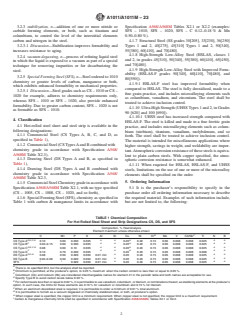
TABLE 1 Chemical Composition
For Hot Rolled Steel Sheet and Strip Designations CS, DS, and SFS
Composition, % Heat Analysis
Element maximum unless otherwise shown
B C
C Mn P S Al Si Cu Ni Cr Mo V Cb/Nb Ti N B
D,E,F,G A A H A A
CS Type A 0.10 0.60 0.030 0.035 0.20 0.20 0.15 0.06 0.008 0.008 0.025
F A A H A A
CS Type B 0.02–0.15 0.60 0.030 0.035 0.20 0.20 0.15 0.06 0.008 0.008 0.025
D,E,F,G A A H A A
CS Type C 0.08 0.60 0.10 0.035 0.20 0.20 0.15 0.06 0.008 0.008 0.025
F A A H A A
CS Type D 0.10 0.70 0.030 0.035 0.20 0.20 0.15 0.06 0.008 0.008 0.008
D,E,G A A A
DS Type A 0.08 0.50 0.020 0.030 0.01 min 0.20 0.20 0.15 0.06 0.008 0.008 0.025
A A A
DS Type B 0.02–0.08 0.50 0.020 0.030 0.01 min 0.20 0.20 0.15 0.06 0.008 0.008 0.025
I I A A A
SFS 0.020 0.030 0.01 min 0.20 0.20 0.15 0.06 0.008 0.008 0.025
A
There is no specified limit, but the analysis shall be reported.
B
Chromium is permitted, at the producer’s option, to 0.25 % maximum when the carbon content is less than or equal to 0.05 %.
C
Columbium (Cb) and niobium (Nb) are considered interchangeable names for element 41 in the periodic table and both names are acceptable for use.
D
Specify Type B to avoid carbon levels below 0.02 %.
E
For carbon levels less than or equal to 0.02 %, it is permissible to use vanadium, columbium, or titanium, or combinations thereof, as stabilizing elements at the producer’s
option. In such case, the limits for these elements are 0.10 % for vanadium or columbium and 0.15 % for titanium.
F
When an aluminum deoxidized steel is required, it is permissible to order a minimum of 0.01 % total aluminum.
G
It is permissible to furnish as a vacuum degassed or chemically stabilized steel, or both, at producer’s option.
H
When copper steel is specified, the copper limit is a minimum requirement. When copper steel is not specified, the copper limit is a maximum requirement.
I
Carbon & manganese chemistry limits shall be specified in accordance with Specification A568/A568M, Tables X2.1 or X2.2.
A1011/A1011M − 23
5.1.1 ASTM specification number and year of issue, 5.1.12.2 Tighter requirements can be specified based on
agreement between seller and purchaser.
5.1.2 Name of material and designation (hot-rolled steel
sheet) (include grade, type and class, as appropriate, for CS,
NOTE 2—A typical ordering description is as follows: ASTM A1011-
DS, SFS, SS, HSLAS, HSLAS-F, and UHSS) (see 4.1),
XX, hot rolled steel sheet, CS Type A, pickled and oiled, cut edge, 0.075
by 36 by 96 in., 100 000 lb, for part no. 6310, for shelf bracket.
5.1.2.1 When a chemistry grade is specified in accordance
Or, ASTM A1011M-XX, hot rolled steel sheet, CS Type B, pickled and
with Specification A568/A568M Table X2.3, the grade shall be
oiled, cut edge, 3.7 by 117 mm by coil, ID 600 mm, OD 1500 mm, max
furnished as; CS Type B – 1008, DS Type A – 1005, and so
weight 10 000 kg, 50 000 kg, for upper control arm.
forth,
5.1.2.2 When a chemistry grade is specified in accordance 6. General Requirements for Delivery
with Specification A568/A568M Table X2.1, with no reference
6.1 Material furnished under this specification shall con-
to CS Type A, CS Type B, DS Type A, DS Type B, or SFS, the
form to the applicable requirements of the current edition of
grade shall be furnished as CS – 1005, CS – 1008, CS – 1020
Specification A568/A568M for sheets and Specification A749/
and so forth, and meet chemistry specified in accordance with
A749M for strip, unless otherwise provided for herein.
Specification A568/A568M Table X2.1,
5.1.2.3 When a type is not specified for CS or DS and there 7. Chemical Composition
is no reference to a chemistry grade such as 1005, 1006, and so
7.1 The heat analysis of the steel shall conform to the
forth, Type B will be furnished (see 4.1),
chemical composition requirements of the appropriate desig-
5.1.2.4 When SFS is specified, a chemistry grade designa-
nation shown in Table 1 for CS, DS and SFS, and Table 2 for
tion shall also be specified in accordance with Specification
SS, HSLAS, HSLAS-F, and UHSS.
A568/A568M Table X2.1 (that is, 1010, 1020, and so forth), or
7.1.1 A report of heat analysis will be supplied, if requested,
carbon & manganese in accordance with Table X2.2 (that is, C
for CS and DS. For materials with required mechanical
0.12–0.18 %, Mn 0.50–0.80 %, and so forth). The characteris-
properties, SS, HSLAS, HSLAS-F, and UHSS, a report of heat
tics identifying the enhanced formability or mechanical prop-
analysis is required.
erties shall be specified by the user or purchaser, on the
7.2 Each of the elements listed in Table 1, Table 2, and
purchase order. If requested, the producer or seller shall
Specification A568/A568M Table X2.3 shall be included in the
provide verification of special practices or mechanical proper-
report of the heat analysis. When the amount of copper, nickel,
ties supporting enhanced formability.
chromium, or molybdenum is less than 0.02 %, report the
5.1.2.5 When a class is not specified for HSLAS, Class 1
analysis as <0.02 % or the actual determined value. When the
will be furnished (see 4.1),
amount of vanadium, columbium, or titanium is less than
5.1.2.6 When a type is not specified for SS Grades, Type 1
0.008 %, report the analysis as <0.008 % or the actual deter-
will be furnished (see 4.1),
mined value. When the amount of boron is less than 0.0005 %,
5.1.2.7 When a type is not specified for UHSS, Type 1 shall
report the analysis as <0.0005 % or the actual determined
be furnished (see 4.1).
value.
5.1.3 Finish (see 9.1)
7.3 Sheet steel grades defined by this specification are
5.1.4 Type of edge (see 9.3),
suitable for welding if appropriate welding conditions are
5.1.5 Oiled or not oiled, as required (see 9.2),
selected. For certain welding processes, if more restrictive
5.1.6 Dimensions (thickness, width, and whether cut lengths
composition limits are desirable, they shall be specified at the
or coils),
time of inquiry and confirmed at the time of ordering.
NOTE 1—Not all producers are capable of meeting all the limitations of
8. Mechanical Properties
the thickness tolerance tables in Specifications A568/A568M and A749/
A749M. The purchaser should contact the producer prior to placing an
8.1 CS and DS:
order.
8.1.1 Typical, nonmandatory mechanical properties for CS
5.1.7 Coil size (inside diameter, outside diameter, and maxi-
and DS for all grades specified in Table 1 and Specification
mum weight),
A568/A568M Table X2.3 are found in Table 3.
5.1.8 Copper bearing steel (if required),
8.1.2 The material represented by all grades specified in
5.1.9 Quantity, Table 1 and Specification A568/A568M Table X2.3 shall be
capable of being bent at room temperature in any direction
5.1.10 Application (part identification and description),
through 180° flat on itself without cracking on the outside of
5.1.11 A report of heat analysis will be supplied, if
the bent portion (see the section on bend test in Test Methods
requested, for CS, DS and SFS. For materials with required
and Definitions A370). The bend test is not a requirement of
mechanical properties, SS, HSLAS, HSLAS-F, and UHSS, a
delivery. However, if testing is performed by the purchaser,
report is required of heat analysis and mechanical properties as
material not conforming to the requirement shall be subject to
determined by the tension test, and
rejection.
5.1.12 Special requirements (if any).
5.1.12.1 When the purchaser requires thickness tolerances 8.2 SS, HSLAS, HSLAS-F, and UHSS:
for ⁄8 in. [10 mm] minimum edge distance (see Supplementary 8.2.1 The available grades and corresponding mechanical
Requirement in Specification A568/A568M), this requirement properties for SS, HSLAS, HSLAS-F, and UHSS are shown in
shall be specified in the purchase order or contract. Table 4.
A1011/A1011M − 23
TABLE 2 Chem
...
This document is not an ASTM standard and is intended only to provide the user of an ASTM standard an indication of what changes have been made to the previous version. Because
it may not be technically possible to adequately depict all changes accurately, ASTM recommends that users consult prior editions as appropriate. In all cases only the current version
of the standard as published by ASTM is to be considered the official document.
Designation: A1011/A1011M − 18a A1011/A1011M − 23
Standard Specification for
Steel, Sheet and Strip, Hot-Rolled, Carbon, Structural, High-
Strength Low-Alloy, High-Strength Low-Alloy with Improved
Formability, and Ultra-High Strength
This standard is issued under the fixed designation A1011/A1011M; the number immediately following the designation indicates the
year of original adoption or, in the case of revision, the year of last revision. A number in parentheses indicates the year of last
reapproval. A superscript epsilon (´) indicates an editorial change since the last revision or reapproval.
This standard has been approved for use by agencies of the U.S. Department of Defense.
1. Scope*
1.1 This specification covers hot-rolled, carbon, structural, high-strength low-alloy, high-strength low-alloy with improved
formability, and ultra-high strength steel sheet and strip, in coils and cut lengths.
1.2 Hot rolled steel sheet and strip is available in the designations as listed in 4.1.
1.3 This specification is not applicable to the steel covered by Specification A635/A635M.
1.4 The values stated in either SI units or inch-pound units are to be regarded separately as standard. The values stated in each
system may not be exact equivalents; therefore, each system shall be used independently of the other. Combining values from the
two systems may result in non-conformance with the standard.
1.5 This international standard was developed in accordance with internationally recognized principles on standardization
established in the Decision on Principles for the Development of International Standards, Guides and Recommendations issued
by the World Trade Organization Technical Barriers to Trade (TBT) Committee.
2. Referenced Documents
2.1 ASTM Standards:
A370 Test Methods and Definitions for Mechanical Testing of Steel Products
A568/A568M Specification for Steel, Sheet, Carbon, Structural, and High-Strength, Low-Alloy, Hot-Rolled and Cold-Rolled,
General Requirements for
A635/A635M Specification for Steel, Sheet and Strip, Heavy-Thickness Coils, Hot-Rolled, Alloy, Carbon, Structural,
High-Strength Low-Alloy, and High-Strength Low-Alloy with Improved Formability, General Requirements for
A749/A749M Specification for Steel, Strip, Carbon and High-Strength, Low-Alloy, Hot-Rolled, General Requirements for
A751 Test Methods and Practices for Chemical Analysis of Steel Products
A941 Terminology Relating to Steel, Stainless Steel, Related Alloys, and Ferroalloys
E18 Test Methods for Rockwell Hardness of Metallic Materials
This specification is under the jurisdiction of ASTM Committee A01 on Steel, Stainless Steel and Related Alloys and is the direct responsibility of Subcommittee A01.19
on Steel Sheet and Strip.
Current edition approved Sept. 1, 2018May 1, 2023. Published September 2018June 2023. Originally approved in 2000. Last previous edition approved in 2018 as
A1011/A1011M – 18.A1011/A1011M – 18a. DOI: 10.1520/A1011_A1011M-18A. 10.1520/A1011_A1011M-23.
For referenced ASTM standards, visit the ASTM website, www.astm.org, or contact ASTM Customer Service at service@astm.org. For Annual Book of ASTM Standards
volume information, refer to the standard’s Document Summary page on the ASTM website.
*A Summary of Changes section appears at the end of this standard
Copyright © ASTM International, 100 Barr Harbor Drive, PO Box C700, West Conshohocken, PA 19428-2959. United States
A1011/A1011M − 23
3. Terminology
3.1 Definitions—For definitions of other terms used in this specification refer to Terminology A941.
3.2 Definitions of Terms Specific to This Standard:
3.2.1 aging, n—loss of ductility with an increase in hardness, yield strength, and tensile strength that occurs when steel, which
has been slightly cold worked (such as by temper rolling) is stored for some time.
3.2.1.1 Discussion—
Aging also increases the tendency toward stretcher strains and fluting.
3.2.2 inclusion control, n—the process of reducing the volume fraction of inclusions or modifying the shape of inclusions to
improve formability, weldability, and machinability.
3.2.2.1 Discussion—
Inclusions, especially those elongated during the rolling process, create the conditions for initiating or propagating cracks when
the material is stretched or bent during the manufacture of a part (or both). The adverse effects of inclusions are minimized by
reducing the content of inclusions in the steel or by altering the shape of inclusions through the use of additions during the
steelmaking process that change the elongated shape of the inclusions to less harmful small, well dispersed globular inclusions (or
both).
3.2.3 stabilization, n—addition of one or more nitride or carbide forming elements, or both, such as titanium and columbium, to
control the level of the interstitial elements carbon and nitrogen in the steel.
3.2.3.1 Discussion—
Stabilization improves formability and increases resistance to aging.
3.2.4 vacuum degassing, n—process of refining liquid steel in which the liquid is exposed to a vacuum as part of a special
technique for removing impurities or for decarburizing the steel.
3.2.5 Special Forming Steel (SFS), n—Steel ordered to 1010 chemistry or greater levels of carbon, manganese or both, which
exhibits enhanced formability or mechanical properties.
3.2.5.1 Discussion—
Steel grades such as CS – 1010 or CS – 1020 for example, adheres to chemistry requirements only, whereas SFS – 1010 or SFS
– 1020, also provide enhanced formability. Due to greater carbon content, SFS – 1020 is not as formable as SFS – 1010.
4. Classification
4.1 Hot-rolled steel sheet and steel strip is available in the following designations:
4.1.1 Commercial Steel (CS Types A, B, C, and D, as specified in Table 1),
4.1.2 Commercial Steel (CS Types A and B combined with chemistry grade in accordance with Specification A568/A568M Table
X2.3),
4.1.3 Drawing Steel (DS Types A and B, as specified in Table 1),
4.1.4 Drawing Steel (DS Types A and B combined with chemistry grade in accordance with Specification A568/A568M Table
X2.3,
4.1.5 Commercial Steel Chemistry grade in accordance with Specification A568/A568M Table X2.1, with no type specified (CS
– 1005, CS – 1008, CS – 1020, and so forth),
4.1.6 Special Forming Steel (SFS), chemistry as specified in Table 1 with carbon & manganese limits in accordance with
Specification A568/A568M Tables X2.1 or X2.2 (examples: SFS – 1010, SFS – 1020, SFS – C 0.12–0.18 % & Mn 0.50–0.80 %).
4.1.7 Structural Steel (SS grades 30[205], 33[230], 36[250] Types 1 and 2, 40[275], 45[310] Types 1 and 2, 50[340], 55[380],
60[410], and 70[480].
A1011/A1011M − 23
TABLE 1 Chemical Composition
For Hot Rolled Steel Sheet and Strip Designations CS, DS, and SFS
Composition, % Heat Analysis
Element maximum unless otherwise shown
B JC C
C Mn P S Al Si Cu Ni Cr Mo V Cb/Nb Ti N B
D,E,F,G A A H A A
CS Type A 0.10 0.60 0.030 0.035 0.20 0.20 0.15 0.06 0.008 0.008 0.025
F A A H A A
CS Type B 0.02–0.15 0.60 0.030 0.035 0.20 0.20 0.15 0.06 0.008 0.008 0.025
D,E,F,G A A H A A
CS Type C 0.08 0.60 0.10 0.035 0.20 0.20 0.15 0.06 0.008 0.008 0.025
F A A H A A
CS Type D 0.10 0.70 0.030 0.035 0.20 0.20 0.15 0.06 0.008 0.008 0.008
D,E,G A A A
DS Type A 0.08 0.50 0.020 0.030 0.01 min 0.20 0.20 0.15 0.06 0.008 0.008 0.025
A A A
DS Type B 0.02–0.08 0.50 0.020 0.030 0.01 min 0.20 0.20 0.15 0.06 0.008 0.008 0.025
I I A A A
SFS 0.020 0.030 0.01 min 0.20 0.20 0.15 0.06 0.008 0.008 0.025
A
There is no specified limit, but the analysis shall be reported.
B
Chromium is permitted, at the producer’s option, to 0.25 % maximum when the carbon content is less than or equal to 0.05 %.
C
For steels containing 0.02 % carbon or more, titanium is permitted at the producer’s option, to the lesser of 3.4N + 1.5S or 0.025 %. Columbium (Cb) and niobium (Nb)
are considered interchangeable names for element 41 in the periodic table and both names are acceptable for use.
D
Specify Type B to avoid carbon levels below 0.02 %.
E
For carbon levels less than or equal to 0.02 %, it is permissible to use vanadium, columbium, or titanium, or combinations thereof, as stabilizing elements at the producer’s
option. In such case, the limits for these elements are 0.10 % for vanadium or columbium and 0.15 % for titanium.
F
When an aluminum deoxidized steel is required, it is permissible to order a minimum of 0.01 % total aluminum.
G
It is permissible to furnish as a vacuum degassed or chemically stabilized steel, or both, at producer’s option.
H
When copper steel is specified, the copper limit is a minimum requirement. When copper steel is not specified, the copper limit is a maximum requirement.
I
Carbon & manganese chemistry limits shall be specified in accordance with Specification A568/A568M, Tables X2.1 or X2.2.
J
Columbium (Cb) and niobium (Nb) are considered interchangeable names for element 41 in the periodic table and both names are acceptable for use.
4.1.8 High-Strength Low-Alloy Steel (HSLAS, classes 1 and 2, in grades 45[310], 50[340], 55[380], 60[410], 65[450], and
70[480].
4.1.9 High-Strength Low-Alloy Steel with Improved Formability (HSLAS-F grades 50[340], 60[410], 70[480], and 80[550]).
4.1.9.1 HSLAS-F steel has improved formability when compared to HSLAS. The steel is fully deoxidized, made to a fine grain
practice, and includes microalloying elements such as columbium, vanadium, and zirconium. The steel shall be treated to achieve
inclusion control.
4.1.10 Ultra-High Strength (UHSS Types 1 and 2, in Grades 90 [620] and 100 [690]).
4.1.10.1 UHSS steel has increased strength compared with HSLAS-F. The steel is killed and made to a fine ferritic grain practice,
and includes microalloying elements such as columbium (niobium), titanium, vanadium, molybdenum, and so forth. The steel shall
be treated to achieve inclusion control. The material is intended for miscellaneous applications where higher strength, savings in
weight, and weldability are important. Atmospheric corrosion resistance of these steels is equivalent to plain carbon steels. With
copper specified, the atmospheric corrosion resistance is somewhat enhanced.
4.1.11 When required for HSLAS, HSLAS-F, and UHSS steels, limitations on the use of one or more of the microalloy elements
shall be specified on the order.
5. Ordering Information
5.1 It is the purchaser’s responsibility to specify in the purchase order all ordering information necessary to describe the required
material. Examples of such information include, but are not limited to, the following:
5.1.1 ASTM specification number and year of issue,
5.1.2 Name of material and designation (hot-rolled steel sheet) (include grade, type and class, as appropriate, for CS, DS, SFS,
SS, HSLAS, HSLAS-F, and UHSS) (see 4.1),
5.1.2.1 When a chemistry grade is specified in accordance with Specification A568/A568M Table X2.3, the grade shall be
furnished as; CS Type B – 1008, DS Type A – 1005, and so forth,
5.1.2.2 When a chemistry grade is specified in accordance with Specification A568/A568M Table X2.1, with no reference to CS
Type A, CS Type B, DS Type A, DS Type B, or SFS, the grade shall be furnished as CS – 1005, CS – 1008, CS – 1020 and so
forth, and meet chemistry specified in accordance with Specification A568/A568M Table X2.1,
A1011/A1011M − 23
5.1.2.3 When a type is not specified for CS or DS and there is no reference to a chemistry grade such as 1005, 1006, and so forth,
Type B will be furnished (see 4.1),
5.1.2.4 When SFS is specified, a chemistry grade designation shall also be specified in accordance with Specification
A568/A568M Table X2.1 (that is, 1010, 1020, and so forth), or carbon & manganese in accordance with Table X2.2 (that is, C
0.12–0.18 %, Mn 0.50–0.80 %, and so forth). The characteristics identifying the enhanced formability or mechanical properties
shall be specified by the user or purchaser, on the purchase order. If requested, the producer or seller shall provide verification of
special practices or mechanical properties supporting enhanced formability.
5.1.2.5 When a class is not specified for HSLAS, Class 1 will be furnished (see 4.1),
5.1.2.6 When a type is not specified for SS Grades, Type 1 will be furnished (see 4.1),
5.1.2.7 When a type is not specified for UHSS, Type 1 shall be furnished (see 4.1).
5.1.3 Finish (see 9.1)
5.1.4 Type of edge (see 9.3),
5.1.5 Oiled or not oiled, as required (see 9.2),
5.1.6 Dimensions (thickness, width, and whether cut lengths or coils),
NOTE 1—Not all producers are capable of meeting all the limitations of the thickness tolerance tables in Specifications A568/A568M and A749/A749M.
The purchaser should contact the producer prior to placing an order.
5.1.7 Coil size (inside diameter, outside diameter, and maximum weight),
5.1.8 Copper bearing steel (if required),
5.1.9 Quantity,
5.1.10 Application (part identification and description),
5.1.11 A report of heat analysis will be supplied, if requested, for CS, DS and SFS. For materials with required mechanical
properties, SS, HSLAS, HSLAS-F, and UHSS, a report is required of heat analysis and mechanical properties as determined by
the tension test, and
5.1.12 Special requirements (if any).
5.1.12.1 When the purchaser requires thickness tolerances for ⁄8 in. [10 mm] minimum edge distance (see Supplementary
Requirement in Specification A568/A568M), this requirement shall be specified in the purchase order or contract.
5.1.12.2 Tighter requirements can be specified based on agreement between seller and purchaser.
NOTE 2—A typical ordering description is as follows: ASTM A1011-XX, hot rolled steel sheet, CS Type A, pickled and oiled, cut edge, 0.075 by 36 by
96 in., 100 000 lb, for part no. 6310, for shelf bracket.
Or, ASTM A1011M-XX, hot rolled steel sheet, CS Type B, pickled and oiled, cut edge, 3.7 by 117 mm by coil, ID 600 mm, OD 1500 mm, max weight
10 000 kg, 50 000 kg, for upper control arm.
6. General Requirements for Delivery
6.1 Material furnished under this specification shall conform to the applicable requirements of the current edition of Specification
A568/A568M for sheets and Specification A749/A749M for strip, unless otherwise provided for herein.
A1011/A1011M − 23
7. Chemical Composition
7.1 The heat analysis of the steel shall conform to the chemical composition requirements of the appropriate designation shown
in Table 1 for CS, DS and SFS, and Table 2 for SS, HSLAS, HSLAS-F, and UHSS.
7.1.1 A report of heat analysis will be supplied, if requested, for CS and DS. For materials with required mechanical properties,
SS, HSLAS, HSLAS-F, and UHSS, a report of heat analysis is required.
7.2 Each of the elements listed in Table 1, Table 2, and Specification A568/A568M Table X2.3 shall be included in the report of
the heat analysis. When the amount of copper, nickel, chromium, or molybdenum is less than 0.02 %, report the analysis as
<0.02 % or the actual determined value. When the amount of vanadium, columbium, or titanium is less than 0.008 %, report the
analysis as <0.008 % or the actual determined value. When the amount of boron is less than 0.0005 %, report the analysis as
<0.0005 % or the actual determined value.
7.3 Sheet steel grades defined by this specification are suitable for welding if appropriate welding conditions are selected. For
certain welding processes, if more restrictive composition limits are desirable, they shall be specified at the time of inquiry and
confirmed at the time of ordering.
8. Mechanical Properties
8.1 CS and DS:
8.1.1 Typical, nonmandatory mechanical properties for CS and DS for all grades specified in Table 1 and Specification
A568/A568M Table X2.3 are found in Table 3.
8.1.2 The material represented by all grades specified in Table 1 and Specification A568/A568M Table X2.3 shall be capable of
being bent at room temperature in any direction through 180° flat on itself without cracking on the outside of the bent portion (see
the section on bend test in Test Methods and Definitions A370). The bend test is not a requirement of delivery. However, if testing
is performed by the purchaser, material not conforming to the requirement shall be subject to rejection.
8.2 SS, HSLAS, HSLAS-F, and UHSS:
8.2.1 The available grades and corresponding mechanical properties for SS, HSLAS, HSLAS-F, and UHSS are shown in Table
4.
8.2.1.1 For SS, HSLAS, HSLAS-F, and UHSS, a report is required of mechanical properties as determined by the tension test.
8.2.2 Tension Tests:
8.2.2.1 Requirements—Material as represented by the test specimen shall conform to the mechanical property requirements
specified in Table 4. These requirements do not apply to the uncropped ends of unprocessed coils.
8.2.2.2 Number of Tests—Two tension tests shall be made from each heat or from each 50 tons [45 000 kg]. When the amount of
finished material from a heat is less than 50 tons [45 000 kg], one tension test shall be made. When material rolled from one heat
differs 0.050 in. [1.27 mm] or more in thickness, one tension test shall be made from the thickest and thinnest material regardless
of the weight represented.
8.2.
...
Questions, Comments and Discussion
Ask us and Technical Secretary will try to provide an answer. You can facilitate discussion about the standard in here.
Loading comments...