

ASTM A961/A961M-23
(Specification)Standard Specification for Common Requirements for Steel Flanges, Forged Fittings, Valves, and Parts for Piping Applications
General Information
- Abstract
ABSTRACT
This specification covers a group of common requirements that shall apply to steel flanges, forged fittings, valves, and parts for piping applications. If the primary melting is required it shall incorporate separate degassing or refining and may be followed by secondary melting, such as electroslag remelting or vacuum remelting. If secondary melting is employed, the heat shall be defined as all of the ingot remelted from a single primary heat. Material requiring heat treatment shall be treated as specified in the individual product specification using the following procedures such as full annealing, solution annealing, isothermal annealing, normalizing, tempering and post-weld heat treatment, stress relieving. Heat analysis shall be used to determine the percentages of carbon, manganese, phosphorus, sulfur, silicon, chromium, nickel, molybdenum, titanium, tantalum, copper, cobalt, nitrogen, aluminum, vanadium, cerium to meet the required chemical composition. The product analysis shall be used to determine if the chemical composition shall conform to the limits of the product specified. Mechanical tests shall be performed to determine the mechanical properties such as hardness, tensile properties, and impact properties.
SCOPE
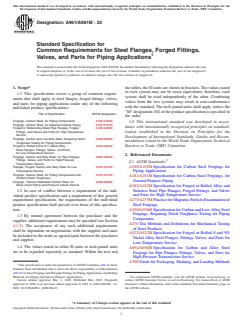
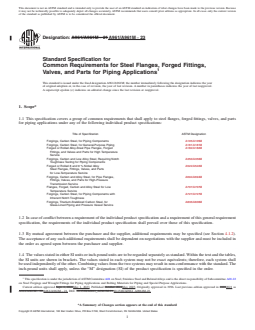
1.1 This specification covers a group of common requirements that shall apply to steel flanges, forged fittings, valves, and parts for piping applications under any of the following individual product specifications:
Title of Specification
ASTM Designation
Forgings, Carbon Steel, for Piping Components
A105/A105M
Forgings, Carbon Steel, for General-Purpose Piping
A181/A181M
Forged or Rolled Alloy-Steel Pipe Flanges, Forged
A182/A182M
Fittings, and Valves and Parts for High Temperature
Service
Forgings, Carbon and Low Alloy Steel, Requiring Notch
A350/A350M
Toughness Testing for Piping Components
Forged or Rolled 8 and 9 % Nickel Alloy
A522/A522M
Steel Flanges, Fittings, Valves, and Parts
for Low-Temperature Service
Forgings, Carbon and Alloy Steel, for Pipe Flanges,
A694/A694M
Fittings, Valves, and Parts for High-Pressure
Transmission Service
Flanges, Forged, Carbon and Alloy Steel for Low
A707/A707M
Temperature Service
Forgings, Carbon Steel, for Piping Components with
A727/A727M
Inherent Notch Toughness
Forgings, Titanium-Stabilized Carbon Steel, for
A836/A836M
Glass-Lined Piping and Pressure Vessel Service
1.2 In case of conflict between a requirement of the individual product specification and a requirement of this general requirement specification, the requirements of the individual product specification shall prevail over those of this specification.
1.3 By mutual agreement between the purchaser and the supplier, additional requirements may be specified (see Section 4.1.2). The acceptance of any such additional requirements shall be dependent on negotiations with the supplier and must be included in the order as agreed upon between the purchaser and supplier.
1.4 The values stated in either SI units or inch-pound units are to be regarded separately as standard. Within the text and the tables, the SI units are shown in brackets. The values stated in each system may not be exact equivalents; therefore, each system shall be used independently of the other. Combining values from the two systems may result in non-conformance with the standard. The inch-pound units shall apply, unless the “M” designation (SI) of the product specification is specified in the order.
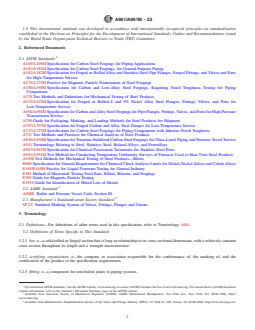
1.5 This international standard was developed in accordance with internationally recognized principles on standardization established in the Decision on Principles for the Development of International Standards, Guides and Recommendations issued by the World Trade Organization Technical Barriers to Trade (TBT) Committee.
- Status
- Published
- Publication Date
- 30-Apr-2023
- Technical Committee
- A01 - Steel, Stainless Steel and Related Alloys
Buy Documents
ASTM A961/A961M-23 - Standard Specification for Common Requirements for Steel Flanges, Forged Fittings, Valves, and Parts for Piping Applications
REDLINE ASTM A961/A961M-23 - Standard Specification for Common Requirements for Steel Flanges, Forged Fittings, Valves, and Parts for Piping Applications
Overview
ASTM A961/A961M-23 is the standard specification that defines the common requirements for steel flanges, forged fittings, valves, and parts intended for piping applications. Developed by ASTM International, this standard establishes key quality and manufacturing criteria applicable across a range of steel piping components. Its provisions are referenced by multiple individual ASTM product specifications, ensuring consistency, safety, and performance in industrial piping systems.
This specification outlines metallurgical, mechanical, and manufacturing controls, addressing processes such as steel melting, heat treatment, chemical composition, testing, and certification. It is widely recognized in sectors where reliable pressure-containing parts-like flanges and valves-are critical, including the oil and gas, petrochemical, power generation, and water treatment industries.
Key Topics
- Scope and Applicability
Covers steel flanges, forged fittings, valves, and parts produced under ASTM specifications such as A105/A105M, A181/A181M, A182/A182M, A350/A350M, A694/A694M, A707/A707M, A522/A522M, A727/A727M, and A836/A836M. - Metallurgical Processes
Outlines requirements for steel melting-including degassing, refining, secondary melting like electroslag remelting (ESR) or vacuum remelting (VR)-to ensure material integrity. - Manufacturing Controls
Details on acceptable starting materials, forging practices, and the use of bar or seamless piping for machining parts, with orientation guidelines for optimal mechanical properties. - Heat Treatment
Specifies when and how heat treatment processes-like annealing, normalizing, tempering, solution annealing, and stress relieving-must be applied to achieve the desired mechanical properties. - Chemical and Mechanical Testing
Sets requirements for heat and product chemical analysis, hardness testing, tensile and impact property evaluation, and hydrostatic testing when referenced by the product standard. - Quality, Marking, and Certification
Ensures all components are appropriately marked, certified, and tested, with traceability back to the original manufacturer and heat.
Applications
ASTM A961/A961M-23 is essential wherever steel piping components are specified for critical applications:
- Oil & Gas - Provides confidence in flanges and forged parts used in high-pressure pipelines, refineries, and petrochemical plants.
- Power Generation - Used in both fossil fuel and nuclear facilities for reliable, pressure-resistant piping connections.
- Chemical Processing - Assures material reliability and safety in corrosive or low/high-temperature piping environments.
- Water Treatment and Distribution - Steel fittings and flanges manufactured to this standard support safe, leak-free connections.
- General Industrial Use - Widely adopted in any industry where high-strength, certified piping components are needed.
This standard ensures interoperability between components, simplifies procurement-thanks to standardized requirements-and enhances safety and performance in piping systems globally.
Related Standards
ASTM A961/A961M-23 is commonly referenced alongside various product-specific standards. Key related ASTM standards include:
- A105/A105M: Carbon Steel Forgings for Piping Applications
- A181/A181M: Carbon Steel Forgings for General-Purpose Piping
- A182/A182M: Forged or Rolled Alloy-Steel Pipe Flanges, Fittings, and Valves for High-Temperature Service
- A350/A350M: Carbon and Low Alloy Steel Forgings for Piping Components Requiring Notch Toughness Testing
- A522/A522M: Forged or Rolled 8 and 9% Nickel Alloy Steel Components for Low-Temperature Service
- A694/A694M: Carbon and Alloy Steel Forgings for High-Pressure Transmission
- A707/A707M: Forged Carbon and Alloy Steel Flanges for Low-Temperature Service
- A727/A727M: Carbon Steel Forgings with Inherent Notch Toughness
- A836/A836M: Titanium-Stabilized Carbon Steel Forgings for Glass-Lined Piping and Pressure Vessels
Other Referenced Standards and Guidelines:
- ASME Boiler and Pressure Vessel Code, Section IX
- MSS SP 25: Standard Marking System for Valves, Fittings, and Flanges
By adhering to ASTM A961/A961M-23 and related standards, industries ensure piping system components are produced, tested, and certified to rigorous, internationally recognized benchmarks-improving reliability, maintaining compliance, and ensuring long service life of critical infrastructure.
Relations
- Effective Date
- 15-Apr-2024
- Effective Date
- 01-Mar-2024
- Effective Date
- 01-Mar-2024
- Effective Date
- 01-Mar-2024
- Effective Date
- 01-Mar-2024
- Effective Date
- 01-Nov-2023
- Effective Date
- 01-Dec-2019
- Effective Date
- 01-Nov-2019
- Effective Date
- 01-Nov-2019
- Effective Date
- 01-Nov-2019
- Effective Date
- 01-Oct-2019
- Effective Date
- 01-Jul-2019
- Refers
ASTM A370-17a - Standard Test Methods and Definitions for Mechanical Testing of Steel Products - Effective Date
- 15-Nov-2017
- Effective Date
- 01-Sep-2017
- Effective Date
- 01-Sep-2017
Buy Documents
ASTM A961/A961M-23 - Standard Specification for Common Requirements for Steel Flanges, Forged Fittings, Valves, and Parts for Piping Applications
REDLINE ASTM A961/A961M-23 - Standard Specification for Common Requirements for Steel Flanges, Forged Fittings, Valves, and Parts for Piping Applications
Get Certified
Connect with accredited certification bodies for this standard

Element Materials Technology
Materials testing and product certification.

Inštitut za kovinske materiale in tehnologije
Institute of Metals and Technology. Materials testing, metallurgical analysis, NDT.
Institut za varilstvo d.o.o. (Welding Institute)
Slovenia's leading welding institute since 1952. ISO 3834, EN 1090, pressure equipment certification, NDT personnel, welder qualification. Only IIW Au
Sponsored listings
Frequently Asked Questions
ASTM A961/A961M-23 is a technical specification published by ASTM International. Its full title is "Standard Specification for Common Requirements for Steel Flanges, Forged Fittings, Valves, and Parts for Piping Applications". This standard covers: ABSTRACT This specification covers a group of common requirements that shall apply to steel flanges, forged fittings, valves, and parts for piping applications. If the primary melting is required it shall incorporate separate degassing or refining and may be followed by secondary melting, such as electroslag remelting or vacuum remelting. If secondary melting is employed, the heat shall be defined as all of the ingot remelted from a single primary heat. Material requiring heat treatment shall be treated as specified in the individual product specification using the following procedures such as full annealing, solution annealing, isothermal annealing, normalizing, tempering and post-weld heat treatment, stress relieving. Heat analysis shall be used to determine the percentages of carbon, manganese, phosphorus, sulfur, silicon, chromium, nickel, molybdenum, titanium, tantalum, copper, cobalt, nitrogen, aluminum, vanadium, cerium to meet the required chemical composition. The product analysis shall be used to determine if the chemical composition shall conform to the limits of the product specified. Mechanical tests shall be performed to determine the mechanical properties such as hardness, tensile properties, and impact properties. SCOPE 1.1 This specification covers a group of common requirements that shall apply to steel flanges, forged fittings, valves, and parts for piping applications under any of the following individual product specifications: Title of Specification ASTM Designation Forgings, Carbon Steel, for Piping Components A105/A105M Forgings, Carbon Steel, for General-Purpose Piping A181/A181M Forged or Rolled Alloy-Steel Pipe Flanges, Forged A182/A182M Fittings, and Valves and Parts for High Temperature Service Forgings, Carbon and Low Alloy Steel, Requiring Notch A350/A350M Toughness Testing for Piping Components Forged or Rolled 8 and 9 % Nickel Alloy A522/A522M Steel Flanges, Fittings, Valves, and Parts for Low-Temperature Service Forgings, Carbon and Alloy Steel, for Pipe Flanges, A694/A694M Fittings, Valves, and Parts for High-Pressure Transmission Service Flanges, Forged, Carbon and Alloy Steel for Low A707/A707M Temperature Service Forgings, Carbon Steel, for Piping Components with A727/A727M Inherent Notch Toughness Forgings, Titanium-Stabilized Carbon Steel, for A836/A836M Glass-Lined Piping and Pressure Vessel Service 1.2 In case of conflict between a requirement of the individual product specification and a requirement of this general requirement specification, the requirements of the individual product specification shall prevail over those of this specification. 1.3 By mutual agreement between the purchaser and the supplier, additional requirements may be specified (see Section 4.1.2). The acceptance of any such additional requirements shall be dependent on negotiations with the supplier and must be included in the order as agreed upon between the purchaser and supplier. 1.4 The values stated in either SI units or inch-pound units are to be regarded separately as standard. Within the text and the tables, the SI units are shown in brackets. The values stated in each system may not be exact equivalents; therefore, each system shall be used independently of the other. Combining values from the two systems may result in non-conformance with the standard. The inch-pound units shall apply, unless the “M” designation (SI) of the product specification is specified in the order. 1.5 This international standard was developed in accordance with internationally recognized principles on standardization established in the Decision on Principles for the Development of International Standards, Guides and Recommendations issued by the World Trade Organization Technical Barriers to Trade (TBT) Committee.
ABSTRACT This specification covers a group of common requirements that shall apply to steel flanges, forged fittings, valves, and parts for piping applications. If the primary melting is required it shall incorporate separate degassing or refining and may be followed by secondary melting, such as electroslag remelting or vacuum remelting. If secondary melting is employed, the heat shall be defined as all of the ingot remelted from a single primary heat. Material requiring heat treatment shall be treated as specified in the individual product specification using the following procedures such as full annealing, solution annealing, isothermal annealing, normalizing, tempering and post-weld heat treatment, stress relieving. Heat analysis shall be used to determine the percentages of carbon, manganese, phosphorus, sulfur, silicon, chromium, nickel, molybdenum, titanium, tantalum, copper, cobalt, nitrogen, aluminum, vanadium, cerium to meet the required chemical composition. The product analysis shall be used to determine if the chemical composition shall conform to the limits of the product specified. Mechanical tests shall be performed to determine the mechanical properties such as hardness, tensile properties, and impact properties. SCOPE 1.1 This specification covers a group of common requirements that shall apply to steel flanges, forged fittings, valves, and parts for piping applications under any of the following individual product specifications: Title of Specification ASTM Designation Forgings, Carbon Steel, for Piping Components A105/A105M Forgings, Carbon Steel, for General-Purpose Piping A181/A181M Forged or Rolled Alloy-Steel Pipe Flanges, Forged A182/A182M Fittings, and Valves and Parts for High Temperature Service Forgings, Carbon and Low Alloy Steel, Requiring Notch A350/A350M Toughness Testing for Piping Components Forged or Rolled 8 and 9 % Nickel Alloy A522/A522M Steel Flanges, Fittings, Valves, and Parts for Low-Temperature Service Forgings, Carbon and Alloy Steel, for Pipe Flanges, A694/A694M Fittings, Valves, and Parts for High-Pressure Transmission Service Flanges, Forged, Carbon and Alloy Steel for Low A707/A707M Temperature Service Forgings, Carbon Steel, for Piping Components with A727/A727M Inherent Notch Toughness Forgings, Titanium-Stabilized Carbon Steel, for A836/A836M Glass-Lined Piping and Pressure Vessel Service 1.2 In case of conflict between a requirement of the individual product specification and a requirement of this general requirement specification, the requirements of the individual product specification shall prevail over those of this specification. 1.3 By mutual agreement between the purchaser and the supplier, additional requirements may be specified (see Section 4.1.2). The acceptance of any such additional requirements shall be dependent on negotiations with the supplier and must be included in the order as agreed upon between the purchaser and supplier. 1.4 The values stated in either SI units or inch-pound units are to be regarded separately as standard. Within the text and the tables, the SI units are shown in brackets. The values stated in each system may not be exact equivalents; therefore, each system shall be used independently of the other. Combining values from the two systems may result in non-conformance with the standard. The inch-pound units shall apply, unless the “M” designation (SI) of the product specification is specified in the order. 1.5 This international standard was developed in accordance with internationally recognized principles on standardization established in the Decision on Principles for the Development of International Standards, Guides and Recommendations issued by the World Trade Organization Technical Barriers to Trade (TBT) Committee.
ASTM A961/A961M-23 is classified under the following ICS (International Classification for Standards) categories: 23.040.01 - Pipeline components and pipelines in general; 77.140.20 - Stainless steels. The ICS classification helps identify the subject area and facilitates finding related standards.
ASTM A961/A961M-23 has the following relationships with other standards: It is inter standard links to ASTM A105/A105M-24, ASTM A182/A182M-24, ASTM A370-24, ASTM A350/A350M-24, ASTM A941-24, ASTM A275/A275M-23, ASTM A727/A727M-14(2019), ASTM A707/A707M-19, ASTM A182/A182M-19a, ASTM A700-14(2019), ASTM E1916-11(2019), ASTM A370-19, ASTM A370-17a, ASTM A350/A350M-17, ASTM A941-17. Understanding these relationships helps ensure you are using the most current and applicable version of the standard.
ASTM A961/A961M-23 is available in PDF format for immediate download after purchase. The document can be added to your cart and obtained through the secure checkout process. Digital delivery ensures instant access to the complete standard document.
Standards Content (Sample)
This international standard was developed in accordance with internationally recognized principles on standardization established in the Decision on Principles for the
Development of International Standards, Guides and Recommendations issued by the World Trade Organization Technical Barriers to Trade (TBT) Committee.
Designation: A961/A961M − 23
Standard Specification for
Common Requirements for Steel Flanges, Forged Fittings,
Valves, and Parts for Piping Applications
This standard is issued under the fixed designation A961/A961M; the number immediately following the designation indicates the year
of original adoption or, in the case of revision, the year of last revision. A number in parentheses indicates the year of last reapproval.
A superscript epsilon (´) indicates an editorial change since the last revision or reapproval.
1. Scope* the tables, the SI units are shown in brackets. The values stated
in each system may not be exact equivalents; therefore, each
1.1 This specification covers a group of common require-
system shall be used independently of the other. Combining
ments that shall apply to steel flanges, forged fittings, valves,
values from the two systems may result in non-conformance
and parts for piping applications under any of the following
with the standard. The inch-pound units shall apply, unless the
individual product specifications:
“M” designation (SI) of the product specification is specified in
Title of Specification ASTM Designation
the order.
Forgings, Carbon Steel, for Piping Components A105/A105M
1.5 This international standard was developed in accor-
Forgings, Carbon Steel, for General-Purpose Piping A181/A181M
dance with internationally recognized principles on standard-
Forged or Rolled Alloy-Steel Pipe Flanges, Forged A182/A182M
Fittings, and Valves and Parts for High Temperature ization established in the Decision on Principles for the
Service
Development of International Standards, Guides and Recom-
Forgings, Carbon and Low Alloy Steel, Requiring Notch A350/A350M
mendations issued by the World Trade Organization Technical
Toughness Testing for Piping Components
Forged or Rolled 8 and 9 % Nickel Alloy A522/A522M
Barriers to Trade (TBT) Committee.
Steel Flanges, Fittings, Valves, and Parts
for Low-Temperature Service
2. Referenced Documents
Forgings, Carbon and Alloy Steel, for Pipe Flanges, A694/A694M
Fittings, Valves, and Parts for High-Pressure
2.1 ASTM Standards:
Transmission Service
A105/A105M Specification for Carbon Steel Forgings for
Flanges, Forged, Carbon and Alloy Steel for Low A707/A707M
Temperature Service
Piping Applications
Forgings, Carbon Steel, for Piping Components with A727/A727M
A181/A181M Specification for Carbon Steel Forgings, for
Inherent Notch Toughness
General-Purpose Piping
Forgings, Titanium-Stabilized Carbon Steel, for A836/A836M
Glass-Lined Piping and Pressure Vessel Service
A182/A182M Specification for Forged or Rolled Alloy and
Stainless Steel Pipe Flanges, Forged Fittings, and Valves
1.2 In case of conflict between a requirement of the indi-
and Parts for High-Temperature Service
vidual product specification and a requirement of this general
A275/A275M Practice for Magnetic Particle Examination of
requirement specification, the requirements of the individual
Steel Forgings
product specification shall prevail over those of this specifica-
A350/A350M Specification for Carbon and Low-Alloy Steel
tion.
Forgings, Requiring Notch Toughness Testing for Piping
1.3 By mutual agreement between the purchaser and the
Components
supplier, additional requirements may be specified (see Section
A370 Test Methods and Definitions for Mechanical Testing
4.1.2). The acceptance of any such additional requirements
of Steel Products
shall be dependent on negotiations with the supplier and must
A522/A522M Specification for Forged or Rolled 8 and 9%
be included in the order as agreed upon between the purchaser
Nickel Alloy Steel Flanges, Fittings, Valves, and Parts for
and supplier.
Low-Temperature Service
1.4 The values stated in either SI units or inch-pound units
A694/A694M Specification for Carbon and Alloy Steel
are to be regarded separately as standard. Within the text and
Forgings for Pipe Flanges, Fittings, Valves, and Parts for
High-Pressure Transmission Service
A700 Guide for Packaging, Marking, and Loading Methods
This specification is under the jurisdiction of ASTM Committee A01 on Steel,
Stainless Steel and Related Alloys and is the direct responsibility of Subcommittee
A01.22 on Steel Forgings and Wrought Fittings for Piping Applications and Bolting
Materials for Piping and Special Purpose Applications. For referenced ASTM standards, visit the ASTM website, www.astm.org, or
Current edition approved May 1, 2023. Published May 2023. Originally contact ASTM Customer Service at service@astm.org. For Annual Book of ASTM
approved in 1996. Last previous edition approved in 2021 as A961/A961M – 21. Standards volume information, refer to the standard’s Document Summary page on
DOI: 10.1520/A0961_A0961M-23. the ASTM website.
*A Summary of Changes section appears at the end of this standard
Copyright © ASTM International, 100 Barr Harbor Drive, PO Box C700, West Conshohocken, PA 19428-2959. United States
A961/A961M − 23
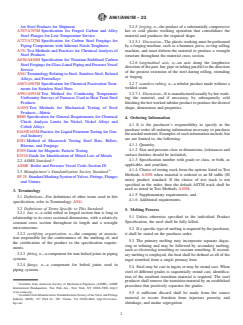
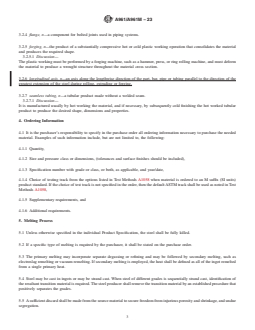
for Steel Products for Shipment 3.2.5 forging, n—the product of a substantially compressive
A707/A707M Specification for Forged Carbon and Alloy hot or cold plastic working operation that consolidates the
Steel Flanges for Low-Temperature Service material and produces the required shape.
A727/A727M Specification for Carbon Steel Forgings for
3.2.5.1 Discussion—The plastic working must be performed
Piping Components with Inherent Notch Toughness
by a forging machine, such as a hammer, press, or ring rolling
A751 Test Methods and Practices for Chemical Analysis of
machine, and must deform the material to produce a wrought
Steel Products
structure throughout the material cross section.
A836/A836M Specification for Titanium-Stabilized Carbon
3.2.6 longitudinal axis, n—an axis along the lengthwise
Steel Forgings for Glass-Lined Piping and Pressure Vessel
direction of the part, bar, pipe or tubing parallel to the direction
Service
of the greatest extension of the steel during rolling, extruding
A941 Terminology Relating to Steel, Stainless Steel, Related
or forging.
Alloys, and Ferroalloys
3.2.7 seamless tubing, n—a tubular product made without a
A967/A967M Specification for Chemical Passivation Treat-
welded seam.
ments for Stainless Steel Parts
A991/A991M Test Method for Conducting Temperature 3.2.7.1 Discussion—It is manufactured usually by hot work-
Uniformity Surveys of Furnaces Used to Heat Treat Steel
ing the material, and if necessary, by subsequently cold
Products finishing the hot worked tubular product to produce the desired
A1058 Test Methods for Mechanical Testing of Steel
shape, dimensions and properties.
Products—Metric
B880 Specification for General Requirements for Chemical
4. Ordering Information
Check Analysis Limits for Nickel, Nickel Alloys and
4.1 It is the purchaser’s responsibility to specify in the
Cobalt Alloys
purchase order all ordering information necessary to purchase
E165/E165M Practice for Liquid Penetrant Testing for Gen-
the needed material. Examples of such information include, but
eral Industry
are not limited to, the following:
E381 Method of Macroetch Testing Steel Bars, Billets,
4.1.1 Quantity,
Blooms, and Forgings
4.1.2 Size and pressure class or dimensions, (tolerances and
E709 Guide for Magnetic Particle Testing
surface finishes should be included),
E1916 Guide for Identification of Mixed Lots of Metals
4.1.3 Specification number with grade or class, or both, as
2.2 ASME Standard:
applicable, and year/date,
ASME Boiler and Pressure Vessel Code–Section IX
4 4.1.4 Choice of testing track from the options listed in Test
2.3 Manufacturer’s Standardization Society Standard:
Methods A1058 when material is ordered to an M suffix (SI
SP 25 Standard Marking System of Valves, Fittings, Flanges
units) product standard. If the choice of test track is not
and Unions
specified in the order, then the default ASTM track shall be
used as noted in Test Methods A1058,
3. Terminology
4.1.5 Supplementary requirements, and
3.1 Definitions—For definitions of other terms used in this
4.1.6 Additional requirements.
specification, refer to Terminology A941.
3.2 Definitions of Terms Specific to This Standard:
5. Melting Process
3.2.1 bar, n—a solid rolled or forged section that is long in
5.1 Unless otherwise specified in the individual Product
relationship to its cross sectional dimensions, with a relatively
Specification, the steel shall be fully killed.
constant cross section throughout its length and a wrought
microstructure.
5.2 If a specific type of melting is required by the purchaser,
3.2.2 certifying organization, n—the company or associa- it shall be stated on the purchase order.
tion responsible for the conformance of, the marking of, and
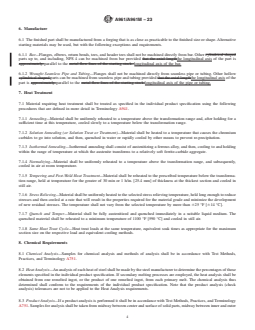
5.3 The primary melting may incorporate separate degas-
the certification of the product to the specification require-
sing or refining and may be followed by secondary melting,
ments.
such as electroslag remelting or vacuum remelting. If second-
3.2.3 fitting, n—a component for non-bolted joints in piping
ary melting is employed, the heat shall be defined as all of the
systems.
ingot remelted from a single primary heat.
3.2.4 flange, n—a component for bolted joints used in
5.4 Steel may be cast in ingots or may be strand cast. When
piping systems.
steel of different grades is sequentially strand cast, identifica-
tion of the resultant transition material is required. The steel
producer shall remove the transition material by an established
Available from American Society of Mechanical Engineers (ASME), ASME
procedure that positively separates the grades.
International Headquarters, Two Park Ave., New York, NY 10016-5990, http://
www.asme.org.
5.5 A sufficient discard shall be made from the source
Available from Manufacturers Standardization Society of the Valve and Fittings
material to secure freedom from injurious porosity and
Industry (MSS), 127 Park St., NE, Vienna, VA 22180-4602, http://www.mss-
hq.com. shrinkage, and undue segregation.
A961/A961M − 23
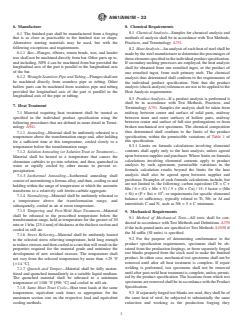
6. Manufacture 8. Chemical Requirements
8.1 Chemical Analysis—Samples for chemical analysis and
6.1 The finished part shall be manufactured from a forging
methods of analysis shall be in accordance with Test Methods,
that is as close as practicable to the finished size or shape.
Practices, and Terminology A751.
Alternative starting materials may be used, but with the
following exceptions and requirements.
8.2 Heat Analysis—An analysis of each heat of steel shall be
6.1.1 Bar—Flanges, elbows, return bends, tees, and header
made by the steel manufacturer to determine the percentages of
tees shall not be machined directly from bar. Other parts up to,
those elements specified in the individual product specification.
and including, NPS 4 can be machined from bar provided the
If secondary melting processes are employed, the heat analysis
longitudinal axis of the part is parallel to the longitudinal axis
shall be obtained from one remelted ingot, or the product of
of the bar.
one remelted ingot, from each primary melt. The chemical
6.1.2 Wrought Seamless Pipe and Tubing—Flanges shall not
analysis thus determined shall conform to the requirements of
be machined directly from seamless pipe or tubing. Other
the individual product specification. Note that the product
hollow parts can be machined from seamless pipe and tubing
analysis (check analysis) tolerances are not to be applied to the
provided the longitudinal axis of the part is parallel to the
Heat Analysis requirements.
longitudinal axis of the pipe or tubing.
8.3 Product Analysis—If a product analysis is performed it
shall be in accordance with Test Methods, Practices, and
7. Heat Treatment
Terminology A751. Samples for analysis shall be taken from
midway between center and surface of solid parts, midway
7.1 Material requiring heat treatment shall be treated as
specified in the individual product specification using the between inner and outer surfaces of hollow parts, midway
between center and surface of full-size prolongations or from
following procedures that are defined in more detail in Termi-
nology A941. broken mechanical test specimens. The chemical composition
thus determined shall conform to the limits of the product
7.1.1 Annealing—Material shall be uniformly reheated to a
specification, within the permissible variations of Table 1 of
temperature above the transformation range and, after holding
this specification.
for a sufficient time at this temperature, cooled slowly to a
8.3.1 Limits on formula calculations involving elemental
temperature below the transformation range.
contents shall apply only to the heat analysis, unless agreed
7.1.2 Solution Annealing (or Solution Treat or Treatment)—
upon between supplier and purchaser. Where limits on formula
Material shall be heated to a temperature that causes the
calculations involving elemental contents apply to product
chromium carbides to go into solution, and then, quenched in
analysis by such agreement, permissible variations in the
water or rapidly cooled by other means to prevent re-
formula calculation results beyond the limits for the heat
precipitation.
analysis shall also be agreed upon between supplier and
7.1.3 Isothermal Annealing—Isothermal annealing shall
purchaser. Examples of such formula calculations include, but
consist of austenitizing a ferrous alloy, and then, cooling to and
are not limited to, the following: carbon equivalent CE = C +
holding within the range of temperature at which the austenite
Mn / 6 + (Cr + Mo + V) / 5 + (Ni + Cu) / 15; J factor = (Mn
transforms to a relatively soft ferrite-carbide aggregate.
+ Si) × (P + Sn) × 10 ; or requirements for specific elemental
7.1.4 Normalizing—Material shall be uniformly reheated to
balance or sufficiency, typically related to Ti, Nb, or Al and
a temperature above the transformation range, and
interstitials C and N, such as Nb = 5 × C minimum.
subsequently, cooled in air at room temperature.
7.1.5 Tempering and Post-Weld Heat Treatment—Material
9. Mechanical Requirements
shall be reheated to the prescribed temperature below the
9.1 Method of Mechanical Tests—All tests shall be con-
transformation range, held at temperature for the greater of 30
ducted in accordance with Test Methods and Definitions A370
min or 1 h/in. [25.4 mm] of thickness at the thickest section and
if the inch-pound units are specified or Test Methods A1058 if
cooled in still air.
the M suffix (SI units) is specified.
7.1.6 Stress Relieving—Material shall be uniformly heated
9.2 For the purpose of determining conformance to the
to the selected stress relieving temperature, held long enough
product specification requirements, specimens shall be ob-
to reduce stresses and then cooled at a rate that will result in the
tained from the production forgings, or from separately forged
properties required for the material grade and minimize the
test blanks prepared from the stock used to make the finished
development of new residual stresses. The temperature shall
product. In either case, mechanical test specimens shall not be
not vary from the selected temperature by more than 625 °F
removed until after all heat treatment is complete. If repair
[614 °C].
welding is performed, test specimens shall not be removed
7.1.7 Quench and Temper—Material shall be fully austen-
until after post-weld heat treatment is complete, unless permit-
itized and quenched immediately in a suitable liquid medium.
ted by the product specification. The locations from which test
The quenched material shall be reheated to a minimum
specimens are removed shall be in accordance with the Product
temperature of 1100 °F [590 °C] and cooled in still air.
Specification.
7.1.8 Same Heat Treat Cycle—Heat treat loads at the same
temperature, equivalent soak times as appropriate for the 9.3 If separately forged test blanks are used, they shall be of
maximum section size on the respective load and equivalent the same heat of steel, be subjected to substantially the same
cooling methods. reduction and working as the production forging they
A961/A961M − 23
A
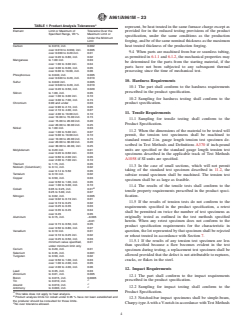
TABLE 1 Product Analysis Tolerances
represent, be heat treated in the same furnace charge except as
Element Limit or Maximum of Tolerance Over the
provided for in the reduced testing provisions of the product
Specified Range, Wt % Maximum Limit or
specification, under the same conditions as the production
Under the Minimum
forging, and be of the same nominal thickness as the maximum
Limit
heat treated thickness of the production forging.
Carbon to 0.010, incl. 0.002
over 0.010 to 0.030, incl. 0.005
9.4 When parts are machined from bar or seamless tubing,
over 0.030 to 0.20 incl. 0.01
over 0.20 to 0.80, incl. 0.02 as permitted in 6.1.1 and 6.1.2, the mechanical properties may
Manganese to 1.00 incl. 0.03
be determined for the parts from the starting material, if the
over 1.00 to 3.00 incl. 0.04
parts have not been subjected to any subsequent thermal
over 3.00 to 6.00, incl. 0.05
over 6.00 to 10.00, incl. 0.06
processing since the time of mechanical test.
Phosphorous to 0.040, incl. 0.005
over 0.040 to 0.20, incl. 0.010
10. Hardness Requirements
Sulfur to 0.040 incl. 0.005
over 0.040 to 0.20, incl. 0.010
10.1 The part shall conform to the hardness requirements
over 0.20 to 0.50, incl. 0.020
prescribed in the product specification.
Silicon to 1.00, incl. 0.05
over 1.00 to 3.00 incl. 0.10
10.2 Sampling for hardness testing shall conform to the
over 3.00 to 7.00, incl. 0.15
Chromium 0.90 and under 0.03
product specification.
over 0.90 to 2.10, incl. 0.05
over 2.10 to 4.00, incl. 0.07
11. Tensile Requirements
over 4.00 to 10.00 incl. 0.10
over 10.00 to 15.00 incl. 0.15
11.1 Sampling for tensile testing shall conform to the
over 15.00 to 20.00 incl. 0.20
Product Specification.
over 20.00 to 30.00 incl. 0.25
Nickel to 1.00 incl. 0.03
11.2 When the dimensions of the material to be tested will
over 1.00 to 5.00 incl. 0.07
over 5.00 to 10.00 incl. 0.10 permit, the tension test specimens shall be machined to
over 10.00 to 20.00 incl. 0.15
standard round 2-in. gauge length tension test specimen de-
over 20.00 to 30.00 incl. 0.20
scribed in Test Methods and Definitions A370 if inch-pound
over 30.00 to 40.00, incl. 0.25
Molybdenum to 0.20 incl. 0.01 units are specified or the standard gauge length tension test
over 0.20 to 0.60 incl. 0.03
specimens described in the applicable track of Test Methods
over 0.60 to 2.00 incl. 0.05
A1058 if SI units are specified.
over 2.00 to 7.00 incl. 0.10
Titanium to 1.15, incl. 0.05
11.3 In the case of small sections, which will not permit
Niobium (Columbium) to 0.14, incl. 0.02
taking of the standard test specimen described in 11.2, the
over 0.14 to 5.50 0.05
Tantalum to 0.10 incl. 0.02
subsize round specimen shall be machined. The tension test
Copper to 0.50, incl. 0.03
specimen shall be as large as feasible.
over 0.50 to 1.00, incl. 0.05
over 1.00 to 5.00, incl. 0.10
11.4 The results of the tensile tests shall conform to the
B
Cobalt 0.05 to 0.25, incl. 0.01
tensile property requirements prescribed in the product speci-
0.25 to 5.00, incl. 0.07
Nitrogen to 0.02, incl. 0.005 fication.
over 0.02 to 0.19 incl. 0.01
11.5 If the results of tension tests do not conform to the
over 0.19 to 0.25 0.02
over 0.25 to 0.35 0.03
requirements specified in the product specification, a retest
over 0.35 to 0.45 0.04
shall be permitted on twice the number of test specimens as
over 0.45 0.05
originally tested as outlined in the test methods specified
Aluminum to 0.15, incl. –0.005
+0.01
herein. When any retest specimen does not conform to the
over 0.15 to 0.50, incl. 0.05
product specification requirements for the characteristic in
over 0.50 to 0.80, incl. 0.07
question, the lot represented by that specimen shall be rejected
Vanadium to 0.10 incl. 0.01
over 0.10 to 0.25 incl. 0.02
or reheat treated in accordance with Section 7.
over 0.25 to 0.50, incl. 0.03
11.5.1 If the results of any tension test specimen are less
minimum value specified, 0.01
than specified because a flaw becomes evident in the test
under minimum limit only
Cerium to 0.20, incl. 0.01
specimen during testing, a replacement test specimen shall be
Selenium to 0.35, incl. 0.001
allowed provided that the defect is not attributable to ruptures,
Tungsten to 0.50, incl. 0.02
cracks, or flakes in the steel.
over 0.50 to 1.00, incl. 0.03
over 1.00 to 2.00, incl. 0.05
over 2.00 to 4.00, incl. 0.06
12. Impact Requirements
Lead to 0.35, incl. 0.03
Zirconium to 0.01, incl. 0.005
12.1 The part shall conform to the impact requirements
Boron to 0.015, incl. 0.0005
C
prescribed in the product specification.
Tin to 0.010, incl.
C
Arsenic to 0.010, incl.
12.2 Sampling for impact testing shall conform to the
C
Antimony to 0.003, incl.
Product Specification.
A
This table does not apply to heat analysis.
B
Product analysis limits for cobalt under 0.05 % have not been established and
12.3 Notched-bar impact specimens shall be simple-b
...
This document is not an ASTM standard and is intended only to provide the user of an ASTM standard an indication of what changes have been made to the previous version. Because
it may not be technically possible to adequately depict all changes accurately, ASTM recommends that users consult prior editions as appropriate. In all cases only the current version
of the standard as published by ASTM is to be considered the official document.
Designation: A961/A961M − 21 A961/A961M − 23
Standard Specification for
Common Requirements for Steel Flanges, Forged Fittings,
Valves, and Parts for Piping Applications
This standard is issued under the fixed designation A961/A961M; the number immediately following the designation indicates the year
of original adoption or, in the case of revision, the year of last revision. A number in parentheses indicates the year of last reapproval.
A superscript epsilon (´) indicates an editorial change since the last revision or reapproval.
1. Scope*
1.1 This specification covers a group of common requirements that shall apply to steel flanges, forged fittings, valves, and parts
for piping applications under any of the following individual product specifications:
Title of Specification ASTM Designation
Forgings, Carbon Steel, for Piping Components A105/A105M
Forgings, Carbon Steel, for General-Purpose Piping A181/A181M
Forged or Rolled Alloy-Steel Pipe Flanges, Forged A182/A182M
Fittings, and Valves and Parts for High Temperature
Service
Forgings, Carbon and Low Alloy Steel, Requiring Notch A350/A350M
Toughness Testing for Piping Components
Forged or Rolled 8 and 9 % Nickel Alloy A522/A522M
Steel Flanges, Fittings, Valves, and Parts
for Low-Temperature Service
Forgings, Carbon and Alloy Steel, for Pipe Flanges, A694/A694M
Fittings, Valves, and Parts for High-Pressure
Transmission Service
Flanges, Forged, Carbon and Alloy Steel for Low A707/A707M
Temperature Service
Forgings, Carbon Steel, for Piping Components with A727/A727M
Inherent Notch Toughness
Forgings, Titanium-Stabilized Carbon Steel, for A836/A836M
Glass-Lined Piping and Pressure Vessel Service
1.2 In case of conflict between a requirement of the individual product specification and a requirement of this general requirement
specification, the requirements of the individual product specification shall prevail over those of this specification.
1.3 By mutual agreement between the purchaser and the supplier, additional requirements may be specified (see Section 4.1.2).
The acceptance of any such additional requirements shall be dependent on negotiations with the supplier and must be included in
the order as agreed upon between the purchaser and supplier.
1.4 The values stated in either SI units or inch-pound units are to be regarded separately as standard. Within the text and the tables,
the SI units are shown in brackets. The values stated in each system may not be exact equivalents; therefore, each system shall
be used independently of the other. Combining values from the two systems may result in non-conformance with the standard. The
inch-pound units shall apply, unless the “M” designation (SI) of the product specification is specified in the order.
This specification is under the jurisdiction of ASTM Committee A01 on Steel, Stainless Steel and Related Alloys and is the direct responsibility of Subcommittee A01.22
on Steel Forgings and Wrought Fittings for Piping Applications and Bolting Materials for Piping and Special Purpose Applications.
Current edition approved Sept. 1, 2021May 1, 2023. Published October 2021May 2023. Originally approved in 1996. Last previous edition approved in 20202021 as
A961/A961M – 20.A961/A961M – 21. DOI: 10.1520/A0961_A0961M-21.10.1520/A0961_A0961M-23.
*A Summary of Changes section appears at the end of this standard
Copyright © ASTM International, 100 Barr Harbor Drive, PO Box C700, West Conshohocken, PA 19428-2959. United States
A961/A961M − 23
1.5 This international standard was developed in accordance with internationally recognized principles on standardization
established in the Decision on Principles for the Development of International Standards, Guides and Recommendations issued
by the World Trade Organization Technical Barriers to Trade (TBT) Committee.
2. Referenced Documents
2.1 ASTM Standards:
A105/A105M Specification for Carbon Steel Forgings for Piping Applications
A181/A181M Specification for Carbon Steel Forgings, for General-Purpose Piping
A182/A182M Specification for Forged or Rolled Alloy and Stainless Steel Pipe Flanges, Forged Fittings, and Valves and Parts
for High-Temperature Service
A275/A275M Practice for Magnetic Particle Examination of Steel Forgings
A350/A350M Specification for Carbon and Low-Alloy Steel Forgings, Requiring Notch Toughness Testing for Piping
Components
A370 Test Methods and Definitions for Mechanical Testing of Steel Products
A522/A522M Specification for Forged or Rolled 8 and 9% Nickel Alloy Steel Flanges, Fittings, Valves, and Parts for
Low-Temperature Service
A694/A694M Specification for Carbon and Alloy Steel Forgings for Pipe Flanges, Fittings, Valves, and Parts for High-Pressure
Transmission Service
A700 Guide for Packaging, Marking, and Loading Methods for Steel Products for Shipment
A707/A707M Specification for Forged Carbon and Alloy Steel Flanges for Low-Temperature Service
A727/A727M Specification for Carbon Steel Forgings for Piping Components with Inherent Notch Toughness
A751 Test Methods and Practices for Chemical Analysis of Steel Products
A836/A836M Specification for Titanium-Stabilized Carbon Steel Forgings for Glass-Lined Piping and Pressure Vessel Service
A941 Terminology Relating to Steel, Stainless Steel, Related Alloys, and Ferroalloys
A967/A967M Specification for Chemical Passivation Treatments for Stainless Steel Parts
A991/A991M Test Method for Conducting Temperature Uniformity Surveys of Furnaces Used to Heat Treat Steel Products
A1058 Test Methods for Mechanical Testing of Steel Products—Metric
B880 Specification for General Requirements for Chemical Check Analysis Limits for Nickel, Nickel Alloys and Cobalt Alloys
E165/E165M Practice for Liquid Penetrant Testing for General Industry
E381 Method of Macroetch Testing Steel Bars, Billets, Blooms, and Forgings
E709 Guide for Magnetic Particle Testing
E1916 Guide for Identification of Mixed Lots of Metals
2.2 ASME Standard:
ASME Boiler and Pressure Vessel Code–Section IX
2.3 Manufacturer’s Standardization Society Standard:
SP 25 Standard Marking System of Valves, Fittings, Flanges and Unions
3. Terminology
3.1 Definitions—For definitions of other terms used in this specification, refer to Terminology A941.
3.2 Definitions of Terms Specific to This Standard:
3.2.1 bar, n—a solid rolled or forged section that is long in relationship to its cross sectional dimensions, with a relatively constant
cross section throughout its length and a wrought microstructure.
3.2.2 certifying organization, n—the company or association responsible for the conformance of, the marking of, and the
certification of the product to the specification requirements.
3.2.3 fitting, n—a component for non-bolted joints in piping systems.
For referenced ASTM standards, visit the ASTM website, www.astm.org, or contact ASTM Customer Service at service@astm.org. For Annual Book of ASTM Standards
volume information, refer to the standard’s Document Summary page on the ASTM website.
Available from American Society of Mechanical Engineers (ASME), ASME International Headquarters, Two Park Ave., New York, NY 10016-5990, http://
www.asme.org.
Available from Manufacturers Standardization Society of the Valve and Fittings Industry (MSS), 127 Park St., NE, Vienna, VA 22180-4602, http://www.mss-hq.com.
A961/A961M − 23
3.2.4 flange, n—a component for bolted joints used in piping systems.
3.2.5 forging, n—the product of a substantially compressive hot or cold plastic working operation that consolidates the material
and produces the required shape.
3.2.5.1 Discussion—
The plastic working must be performed by a forging machine, such as a hammer, press, or ring rolling machine, and must deform
the material to produce a wrought structure throughout the material cross section.
3.2.6 longitudinal axis, n—an axis along the lengthwise direction of the part, bar, pipe or tubing parallel to the direction of the
greatest extension of the steel during rolling, extruding or forging.
3.2.7 seamless tubing, n—a tubular product made without a welded seam.
3.2.7.1 Discussion—
It is manufactured usually by hot working the material, and if necessary, by subsequently cold finishing the hot worked tubular
product to produce the desired shape, dimensions and properties.
4. Ordering Information
4.1 It is the purchaser’s responsibility to specify in the purchase order all ordering information necessary to purchase the needed
material. Examples of such information include, but are not limited to, the following:
4.1.1 Quantity,
4.1.2 Size and pressure class or dimensions, (tolerances and surface finishes should be included),
4.1.3 Specification number with grade or class, or both, as applicable, and year/date,
4.1.4 Choice of testing track from the options listed in Test Methods A1058 when material is ordered to an M suffix (SI units)
product standard. If the choice of test track is not specified in the order, then the default ASTM track shall be used as noted in Test
Methods A1058,
4.1.5 Supplementary requirements, and
4.1.6 Additional requirements.
5. Melting Process
5.1 Unless otherwise specified in the individual Product Specification, the steel shall be fully killed.
5.2 If a specific type of melting is required by the purchaser, it shall be stated on the purchase order.
5.3 The primary melting may incorporate separate degassing or refining and may be followed by secondary melting, such as
electroslag remelting or vacuum remelting. If secondary melting is employed, the heat shall be defined as all of the ingot remelted
from a single primary heat.
5.4 Steel may be cast in ingots or may be strand cast. When steel of different grades is sequentially strand cast, identification of
the resultant transition material is required. The steel producer shall remove the transition material by an established procedure that
positively separates the grades.
5.5 A sufficient discard shall be made from the source material to secure freedom from injurious porosity and shrinkage, and undue
segregation.
A961/A961M − 23
6. Manufacture
6.1 The finished part shall be manufactured from a forging that is as close as practicable to the finished size or shape. Alternative
starting materials may be used, but with the following exceptions and requirements.
6.1.1 Bar—Flanges, elbows, return bends, tees, and header tees shall not be machined directly from bar. Other cylindrical shaped
parts up to, and including, NPS 4 can be machined from bar provided that the axial lengththe longitudinal axis of the part is
approximately parallel to the metal flow lines of the starting stock. longitudinal axis of the bar.
6.1.2 Wrought Seamless Pipe and Tubing—Flanges shall not be machined directly from seamless pipe or tubing. Other hollow
cylindrical shaped parts can be machined from seamless pipe and tubing provided that the axial lengththe longitudinal axis of the
part is approximately parallel to the metal flow lines of the starting stock.longitudinal axis of the pipe or tubing.
7. Heat Treatment
7.1 Material requiring heat treatment shall be treated as specified in the individual product specification using the following
procedures that are defined in more detail in Terminology A941.
7.1.1 Annealing—Material shall be uniformly reheated to a temperature above the transformation range and, after holding for a
sufficient time at this temperature, cooled slowly to a temperature below the transformation range.
7.1.2 Solution Annealing (or Solution Treat or Treatment)—Material shall be heated to a temperature that causes the chromium
carbides to go into solution, and then, quenched in water or rapidly cooled by other means to prevent re-precipitation.
7.1.3 Isothermal Annealing—Isothermal annealing shall consist of austenitizing a ferrous alloy, and then, cooling to and holding
within the range of temperature at which the austenite transforms to a relatively soft ferrite-carbide aggregate.
7.1.4 Normalizing—Material shall be uniformly reheated to a temperature above the transformation range, and subsequently,
cooled in air at room temperature.
7.1.5 Tempering and Post-Weld Heat Treatment—Material shall be reheated to the prescribed temperature below the transforma-
tion range, held at temperature for the greater of 30 min or 1 h/in. [25.4 mm] of thickness at the thickest section and cooled in
still air.
7.1.6 Stress Relieving—Material shall be uniformly heated to the selected stress relieving temperature, held long enough to reduce
stresses and then cooled at a rate that will result in the properties required for the material grade and minimize the development
of new residual stresses. The temperature shall not vary from the selected temperature by more than 625 °F [614 °C].
7.1.7 Quench and Temper—Material shall be fully austenitized and quenched immediately in a suitable liquid medium. The
quenched material shall be reheated to a minimum temperature of 1100 °F [590 °C] and cooled in still air.
7.1.8 Same Heat Treat Cycle—Heat treat loads at the same temperature, equivalent soak times as appropriate for the maximum
section size on the respective load and equivalent cooling methods.
8. Chemical Requirements
8.1 Chemical Analysis—Samples for chemical analysis and methods of analysis shall be in accordance with Test Methods,
Practices, and Terminology A751.
8.2 Heat Analysis—An analysis of each heat of steel shall be made by the steel manufacturer to determine the percentages of those
elements specified in the individual product specification. If secondary melting processes are employed, the heat analysis shall be
obtained from one remelted ingot, or the product of one remelted ingot, from each primary melt. The chemical analysis thus
determined shall conform to the requirements of the individual product specification. Note that the product analysis (check
analysis) tolerances are not to be applied to the Heat Analysis requirements.
8.3 Product Analysis—If a product analysis is performed it shall be in accordance with Test Methods, Practices, and Terminology
A751. Samples for analysis shall be taken from midway between center and surface of solid parts, midway between inner and outer
A961/A961M − 23
surfaces of hollow parts, midway between center and surface of full-size prolongations or from broken mechanical test specimens.
The chemical composition thus determined shall conform to the limits of the product specification, within the permissible
variations of Table 1 of this specification.
8.3.1 Limits on formula calculations involving elemental contents shall apply only to the heat analysis, unless agreed upon
between supplier and purchaser. Where limits on formula calculations involving elemental contents apply to product analysis by
such agreement, permissible variations in the formula calculation results beyond the limits for the heat analysis shall also be agreed
upon between supplier and purchaser. Examples of such formula calculations include, but are not limited to, the following: carbon
equivalent CE = C + Mn / 6 + (Cr + Mo + V) / 5 + (Ni + Cu) / 15; J factor = (Mn + Si) × (P + Sn) × 10 ; or requirements for
specific elemental balance or sufficiency, typically related to Ti, Nb, or Al and interstitials C and N, such as Nb = 5 × C minimum.
9. Mechanical Requirements
9.1 Method of Mechanical Tests—All tests shall be conducted in accordance with Test Methods and Definitions A370 if the
inch-pound units are specified or Test Methods A1058 if the M suffix (SI units) is specified.
9.2 For the purpose of determining conformance to the product specification requirements, specimens shall be obtained from the
production forgings, or from separately forged test blanks prepared from the stock used to make the finished product. In either case,
mechanical test specimens shall not be removed until after all heat treatment is complete. If repair welding is performed, test
specimens shall not be removed until after post-weld heat treatment is complete, unless permitted by the product specification. The
locations from which test specimens are removed shall be in accordance with the Product Specification.
9.3 If separately forged test blanks are used, they shall be of the same heat of steel, be subjected to substantially the same reduction
and working as the production forging they represent, be heat treated in the same furnace charge except as provided for in the
reduced testing provisions of the product specification, under the same conditions as the production forging, and be of the same
nominal thickness as the maximum heat treated thickness of the production forging.
9.4 When parts are machined from bar or seamless tubing, as permitted in 6.1.1 and 6.1.2, the mechanical properties may be
determined for the parts from the starting material, if the parts have not been subjected to any subsequent thermal processing since
the time of mechanical test.
10. Hardness Requirements
10.1 The part shall conform to the hardness requirements prescribed in the product specification.
10.2 Sampling for hardness testing shall conform to the product specification.
11. Tensile Requirements
11.1 Sampling for tensile testing shall conform to the Product Specification.
11.2 When the dimensions of the material to be tested will permit, the tension test specimens shall be machined to standard round
2-in. gauge length tension test specimen described in Test Methods and Definitions A370 if inch-pound units are specified or the
standard gauge length tension test specimens described in the applicable track of Test Methods A1058 if SI units are specified.
11.3 In the case of small sections, which will not permit taking of the standard test specimen described in 11.2, the subsize round
specimen shall be machined. The tension test specimen shall be as large as feasible.
11.4 The results of the tensile tests shall conform to the tensile property requirements prescribed in the product specification.
11.5 If the results of tension tests do not conform to the requirements specified in the product specification, a retest shall be
permitted on twice the number of test specimens as originally tested as outlined in the test methods specified herein. When any
retest specimen does not conform to the product specification requirements for the characteristic in question, the lot represented
by that specimen shall be rejected or reheat treated in accordance with Section 7.
A961/A961M − 23
A
TABLE 1 Product Analysis Tolerances
Element Limit or Maximum of Tolerance Over the
Specified Range, Wt % Maximum Limit or
Under the Minimum
Limit
Carbon to 0.010, incl. 0.002
over 0.010 to 0.030, incl. 0.005
over 0.030 to 0.20 incl. 0.01
over 0.20 to 0.80, incl. 0.02
Manganese to 1.00 incl. 0.03
over 1.00 to 3.00 incl. 0.04
over 3.00 to 6.00, incl. 0.05
over 6.00 to 10.00, incl. 0.06
Phosphorous to 0.040, incl. 0.005
over 0.040 to 0.20, incl. 0.010
Sulfur to 0.040 incl. 0.005
over 0.040 to 0.20, incl. 0.010
over 0.20 to 0.50, incl. 0.020
Silicon to 1.00, incl. 0.05
over 1.00 to 3.00 incl. 0.10
over 3.00 to 7.00, incl. 0.15
Chromium 0.90 and under 0.03
over 0.90 to 2.10, incl. 0.05
over 2.10 to 4.00, incl. 0.07
over 4.00 to 10.00 incl. 0.10
over 10.00 to 15.00 incl. 0.15
over 15.00 to 20.00 incl. 0.20
over 20.00 to 30.00 incl. 0.25
Nickel to 1.00 incl. 0.03
over 1.00 to 5.00 incl. 0.07
over 5.00 to 10.00 incl. 0.10
over 10.00 to 20.00 incl. 0.15
over 20.00 to 30.00 incl. 0.20
over 30.00 to 40.00, incl. 0.25
Molybdenum to 0.20 incl. 0.01
over 0.20 to 0.60 incl. 0.03
over 0.60 to 2.00 incl. 0.05
over 2.00 to 7.00 incl. 0.10
Titanium to 1.15, incl. 0.05
Niobium (Columbium) to 0.14, incl. 0.02
over 0.14 to 5.50 0.05
Tantalum to 0.10 incl. 0.02
Copper to 0.50, incl. 0.03
over 0.50 to 1.00, incl. 0.05
over 1.00 to 5.00, incl. 0.10
B
Cobalt 0.05 to 0.25, incl. 0.01
0.25 to 5.00, incl. 0.07
Nitrogen to 0.02, incl. 0.005
over 0.02 to 0.19 incl. 0.01
over 0.19 to 0.25 0.02
over 0.25 to 0.35 0.03
over 0.35 to 0.45 0.04
over 0.45 0.05
Aluminum to 0.15, incl. –0.005
+0.01
over 0.15 to 0.50, incl. 0.05
over 0.50 to 0.80, incl. 0.07
Vanadium to 0.10 incl. 0.01
over 0.10 to 0.25 incl. 0.02
over 0.25 to 0.50, incl. 0.03
minimum value specified, 0.01
under minimum limit only
Cerium to 0.20, incl. 0.01
Selenium to 0.35, incl. 0.001
Tungsten to 0.50, incl. 0.02
over 0.50 to 1.00, incl. 0.03
over 1.00 to 2.00, incl. 0.05
over 2.00 to 4.00, incl. 0.06
Lead to 0.35, incl. 0.03
Zirconium to 0.01, incl. 0.005
Boron to 0.015, incl. 0.0005
C
Tin to 0.010, incl.
C
Arsenic to 0.010, incl.
C
Antimony to 0.003, incl.
A
This table does not apply to heat analysis.
B
Product analysis limits for cobalt under 0.05 % have not been established and
the producer should be consulted for those limits.
A961/A961M − 23
C
No over tolerance allowed.
11.5.1 If the results of any tension test specimen are less than specified because a flaw becomes evident in the test specimen during
testing, a replacement test specimen shall be allowed provided that the defect is not attributable to ruptures, cracks, or flakes in
the steel.
12. Impact Requirements
12.1 The part shall conform to the impact requirements prescribed in
...